
Iyondji Community Bonobo Reserve: Difference between revisions
No edit summary |
No edit summary |
||
| (3 intermediate revisions by the same user not shown) | |||
| Line 13: | Line 13: | ||
* Bonobos at the site are mainly threatened by poaching. | * Bonobos at the site are mainly threatened by poaching. | ||
* Conservation interventions have focused on anti-poaching activities, including patrols, removal of snares, and inspecting markets. | * Conservation interventions have focused on anti-poaching activities, including patrols, removal of snares, and inspecting markets. | ||
| Line 83: | Line 79: | ||
= Threats = | = Threats = | ||
Temporary hunting and gathering camps, and small hamlets with cassava fields were present within the ICBR. Approximately 10 people lived in a hamlet. According to the villagers, people lived in the forest permanently, and some of their children had never been to the villages along the established roads where there were schools and dispensaries. This situation was, in part, the result of the DRC civil war in the 1990s (Nackoney et al. 2014). Although villagers hunted primarily for their own consumption prior to the civil war, during the warfare the trucking and shipping transportation network collapsed, and the villagers were left with no means of selling cash crops such as coffee beans. As a result, the sale of bush meat became the primary way of earning cash. | Temporary hunting and gathering camps, and small hamlets with cassava fields were present within the ICBR. Approximately 10 people lived in a hamlet. According to the villagers, people lived in the forest permanently, and some of their children had never been to the villages along the established roads where there were schools and dispensaries. This situation was, in part, the result of the DRC civil war in the 1990s ([[#R00791|Nackoney et al. 2014]]). Although villagers hunted primarily for their own consumption prior to the civil war, during the warfare the trucking and shipping transportation network collapsed, and the villagers were left with no means of selling cash crops such as coffee beans. As a result, the sale of bush meat became the primary way of earning cash. | ||
'''Table 3. Threats to apes reported for Iyondji Community Bonobo Reserve''' | '''Table 3. Threats to apes reported for Iyondji Community Bonobo Reserve''' | ||
| Line 96: | Line 92: | ||
|5.1 Hunting & collecting terrestrial animals | |5.1 Hunting & collecting terrestrial animals | ||
|Present (unknown severity) | |Present (unknown severity) | ||
|Human presence in the southern part of the reserve (Nackoney et al. 2014). | |Human presence in the southern part of the reserve ([[#R00791|Nackoney et al. 2014]]). | ||
|Ongoing (2014) | |Ongoing (2014) | ||
|} | |} | ||
| Line 157: | Line 153: | ||
!Source | !Source | ||
!Year(s) | !Year(s) | ||
|- | |||
|1 Site management | |||
|1.2 Need for improved coordination | |||
|Sakamaki & Kasalevo pers. comm. 2020 | |||
| | |||
|- | |- | ||
|2 Resources and capacity | |2 Resources and capacity | ||
| Line 165: | Line 166: | ||
|2 Resources and capacity | |2 Resources and capacity | ||
|2.3 General lack of funding | |2.3 General lack of funding | ||
|Sakamaki & Kasalevo pers. comm. 2020 | |Sakamaki & Kasalevo pers. comm. 2020 | ||
| | | | ||
| Line 227: | Line 223: | ||
= Research activities = | = Research activities = | ||
Bonobo habituation has been conducted between 2010-2016 (Sakamaki et al. 2012). A census of diurnal monkeys and duikers was conducted in 2014 (Sakamaki et al. 2016). | Bonobo habituation has been conducted between 2010-2016 ([[#R00792|Sakamaki et al. 2012]]). A census of diurnal monkeys and duikers was conducted in 2014 ([[#R00793|Sakamaki et al. 2016]]). | ||
| Line 251: | Line 247: | ||
| | | | ||
| | | | ||
|Sakamaki et al. 2016 | |[[#R00793|Sakamaki et al. 2016]] | ||
| | | | ||
| | | | ||
| Line 263: | Line 259: | ||
<div><ul><li style="display: inline-block; vertical-align: top;"> [[File:PrecipAnomaly_Iyondji_Bonobo_CR.png| 450px | thumb| none | Precipitation anomaly | <div><ul><li style="display: inline-block; vertical-align: top;"> [[File:PrecipAnomaly_Iyondji_Bonobo_CR.png| 450px | thumb| none | Precipitation anomaly in Iyondji Community Bonobo Reserve]] </li><li style="display: inline-block; vertical-align: top;"> [[File:TempAnomaly_Iyondji_Bonobo_CR.png | 450px | thumb| none | Temperature anomaly in Iyondji Community Bonobo Reserve]] </li></ul></div> | ||
= External links = | = External links = | ||
| Line 271: | Line 267: | ||
= References = | = References = | ||
Dupain, J., Fowler, A., Kasalevo, P., Sakamaki, T., | <span id="R00790"></span>Dupain, J., Fowler, A., Kasalevo, P., Sakamaki, T., Lingomo, B., Way, T., …, & Facheux, C. (2013). The Process of Creation of a New Protected Area in the Democratic Republic of Congo: The Case of the Iyondji Community Bonobo Reserve. ''Pan Africa News'', 20(1), 10-13. [https://doi.org/10.5134/177623 doi:10.5134/177623] | ||
Nackoney, J., Molinario, G., Potapov, P., Turubanova, S., Hansen, M.C. & Furuichi, T. (2014). Impacts of civil conflict on primary forest habitat in northern Democratic Republic of the Congo, 1990–2010. | <span id="R00791"></span>Nackoney, J., Molinario, G., Potapov, P., Turubanova, S., Hansen, M. C., & Furuichi, T. (2014). Impacts of civil conflict on primary forest habitat in northern Democratic Republic of the Congo, 1990–2010. ''Biological Conservation'', 170, 321-328. [https://doi.org/10.1016/j.biocon.2013.12.033 doi:10.1016/j.biocon.2013.12.033] | ||
Sakamaki, T., Kasalevo, | <span id="R00792"></span>Sakamaki, T., Kasalevo, P., Bokamba, M. B., & Bongoli, L. (2012). Iyondji Community Bonobo Reserve: A Recently Established Reserve in the Democratic Republic of Congo. ''Pan Africa News'', 19(2), 16-19. [https://doi.org/10.5134/168180 doi:10.5134/168180] | ||
Sakamaki, T., Maloueki, U., Bakaa, B., Bongoli, L., Kasalevo, P., Terada, S. & Furuichi, T. (2016). Mammals consumed by bonobos (Pan paniscus): new data from the Iyondji forest, Tshuapa, Democratic Republic of the Congo. Primates, 57, | <span id="R00793"></span>Sakamaki, T., Maloueki, U., Bakaa, B., Bongoli, L., Kasalevo, P., Terada, S., & Furuichi, T. (2016). Mammals consumed by bonobos (Pan paniscus): new data from the Iyondji forest, Tshuapa, Democratic Republic of the Congo. ''Primates'', 57(3), 295-301. [https://doi.org/10.1007/s10329-016-0529-z doi:10.1007/s10329-016-0529-z] | ||
'''Page created by: '''Tetsuya Sakamaki & Phila Kasalevo''' Date:''' 2020-11-15 | '''Page created by: '''Tetsuya Sakamaki & Phila Kasalevo''' Date:''' 2020-11-15 | ||
Latest revision as of 16:28, 12 October 2026
Central Africa > Democratic Republic of the Congo > Iyondji Community Bonobo Reserve
Français | Português | Español | Bahasa Indonesia | Melayu
Summary
- Bonobos (Pan paniscus) are present in Iyondji Community Bonobo Reserve.
- The population size is unknown.
- The bonobo population trend is unknown.
- The site has a total size of 1,100 km².
- Bonobos at the site are mainly threatened by poaching.
- Conservation interventions have focused on anti-poaching activities, including patrols, removal of snares, and inspecting markets.
Site characteristics
Iyondji Community Bonobo Reserve (ICBR), established in 2012, is located in one of the four bonobo strongholds, i.e. the northern block, Maringa-Lopori-Wamba Landscape (Bonobo Conservation Action Plan, 2012-2022, IUCN) and encompasses approximately 1,100 km² of tropical moist forest that harbors bonobos (Pan paniscus). With the Luo Scientific Reserve and Kokolopori Bonobo Reserve, ICBR contributes to a contiguous 5,627 m² bonobo conservation stronghold.
Table 1. Basic site information for Iyondji Community Bonobo Reserve
| Species | Pan paniscus |
| Area | 1,100 km² |
| Coordinates | Lat: 0.07 , Lon: 22.87 |
| Type of site | Protected area (Forest Reserve) |
| Habitat types | Subtropical/tropical moist lowland forest, Subtropical/tropical swamp forest |
| Type of governance |
Types of sites Governance types Habitat types
-
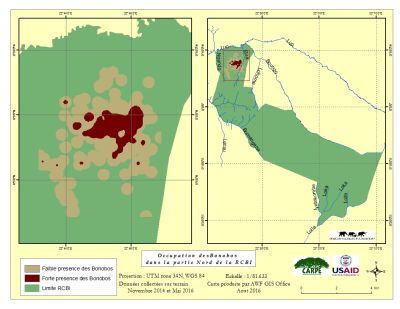
Iyondji Community Bonobo Reserve and detected points of bonobos in the northern part © Tetsuya Sakamaki and Phila Kasa Levo -
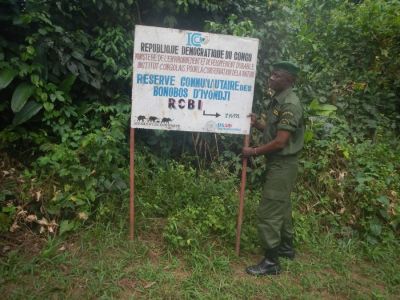
Board of Iyondji Community Bonobo Reserve and a ranger © Tetsuya Sakamaki and Phila Kasa Levo


Ape status
We set up a study site of bonobos in 2010 and habituated two bonobo communities by 2016 in the northern part of ICBR. We confirmed at least four groups at the study site. Although there are bonobos in the middle part, they are unknown. The survival of individuals may be at stake in the southern parts (Sakamaki & Kasalevo pers. comm. 2020)
Table 2. Ape population estimates reported for Iyondji Community Bonobo Reserve
| Species | Year | Occurrence | Encounter or vistation rate (nests/km; ind/day) | Density estimate [ind./ km²] (95% CI) | Abundance estimate (95% CI) | Survey area | Sampling method | Analytical framework | Source | Comments | A.P.E.S. database ID |
|---|---|---|---|---|---|---|---|---|---|---|---|
| Pan paniscus | 2010-2016 | Present | Iyondji Community Bonobo Reserve | Unknown | Habituation efforts confirmed the presence of bonobos; total abundance is unknown. |
Sampling methods Analytical frameworks
Threats
Temporary hunting and gathering camps, and small hamlets with cassava fields were present within the ICBR. Approximately 10 people lived in a hamlet. According to the villagers, people lived in the forest permanently, and some of their children had never been to the villages along the established roads where there were schools and dispensaries. This situation was, in part, the result of the DRC civil war in the 1990s (Nackoney et al. 2014). Although villagers hunted primarily for their own consumption prior to the civil war, during the warfare the trucking and shipping transportation network collapsed, and the villagers were left with no means of selling cash crops such as coffee beans. As a result, the sale of bush meat became the primary way of earning cash.
Table 3. Threats to apes reported for Iyondji Community Bonobo Reserve
| Category | Specific threats | Threat level | Description | Year of threat |
|---|---|---|---|---|
| 5 Biological resource use | 5.1 Hunting & collecting terrestrial animals | Present (unknown severity) | Human presence in the southern part of the reserve (Nackoney et al. 2014). | Ongoing (2014) |
Conservation activities
Table 4. Conservation activities reported for Iyondji Community Bonobo Reserve
| Category | Specific activity | Description | Implementing organization(s) | Year of activity |
|---|---|---|---|---|
| 2 Counter-wildlife crime | 2.11 Implement monitoring surveillance strategies (e.g., SMART) or use monitoring data to improve effectiveness of patrols | Ongoing (2019) | ||
| 2 Counter-wildlife crime | 2.3 Conduct regular anti-poaching patrols | Ongoing (2019) | ||
| 2 Counter-wildlife crime | 2.5 Inspect bushmeat markets for ape species | Ongoing (2019) | ||
| 2 Counter-wildlife crime | 2.6 Regularly de-activate/remove ground snares | Ongoing (2019) | ||
| 2 Counter-wildlife crime | 2.8 Provide training to anti-poaching ranger patrols | Ongoing (2019) |
Challenges
Table 5. Challenges reported for Iyondji Community Bonobo Reserve
| Challenges | Specific challenges | Source | Year(s) |
|---|---|---|---|
| 1 Site management | 1.2 Need for improved coordination | Sakamaki & Kasalevo pers. comm. 2020 | |
| 2 Resources and capacity | 2.1 Lack of capacity/training | Sakamaki & Kasalevo pers. comm. 2020 | |
| 2 Resources and capacity | 2.3 General lack of funding | Sakamaki & Kasalevo pers. comm. 2020 | |
| 2 Resources and capacity | 2.5 Lack of equipment/transportation | Sakamaki & Kasalevo pers. comm. 2020 |
Enablers
Table 6. Enablers reported for Iyondji Community Bonobo Reserve
| Enablers | Specific enablers | Source | Year(s) |
|---|---|---|---|
| 1 Site management | |||
| 2 Resources and capacity | |||
| 3 Engaged community | |||
| 4 Institutional support | |||
| 5 Ecological context | |||
| 6 Safety and stability |
Research activities
Bonobo habituation has been conducted between 2010-2016 (Sakamaki et al. 2012). A census of diurnal monkeys and duikers was conducted in 2014 (Sakamaki et al. 2016).
Documented behaviours
Table 7. Behaviours documented for Iyondji Community Bonobo Reserve
| Category | Behavior | Observation type | Prevalence | Observation dates | Source | Habituation | Species | Comment |
|---|---|---|---|---|---|---|---|---|
| Hunting and meat eating | Sakamaki et al. 2016 |
Exposure to climate change impacts
-
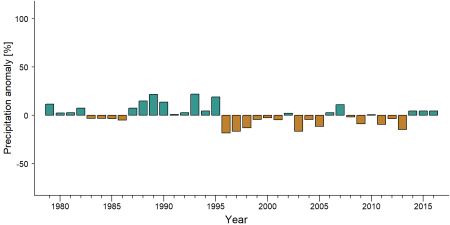
Precipitation anomaly in Iyondji Community Bonobo Reserve -
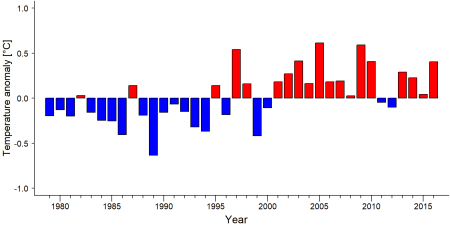
Temperature anomaly in Iyondji Community Bonobo Reserve


External links
References
Dupain, J., Fowler, A., Kasalevo, P., Sakamaki, T., Lingomo, B., Way, T., …, & Facheux, C. (2013). The Process of Creation of a New Protected Area in the Democratic Republic of Congo: The Case of the Iyondji Community Bonobo Reserve. Pan Africa News, 20(1), 10-13. doi:10.5134/177623
Nackoney, J., Molinario, G., Potapov, P., Turubanova, S., Hansen, M. C., & Furuichi, T. (2014). Impacts of civil conflict on primary forest habitat in northern Democratic Republic of the Congo, 1990–2010. Biological Conservation, 170, 321-328. doi:10.1016/j.biocon.2013.12.033
Sakamaki, T., Kasalevo, P., Bokamba, M. B., & Bongoli, L. (2012). Iyondji Community Bonobo Reserve: A Recently Established Reserve in the Democratic Republic of Congo. Pan Africa News, 19(2), 16-19. doi:10.5134/168180
Sakamaki, T., Maloueki, U., Bakaa, B., Bongoli, L., Kasalevo, P., Terada, S., & Furuichi, T. (2016). Mammals consumed by bonobos (Pan paniscus): new data from the Iyondji forest, Tshuapa, Democratic Republic of the Congo. Primates, 57(3), 295-301. doi:10.1007/s10329-016-0529-z
Page created by: Tetsuya Sakamaki & Phila Kasalevo Date: 2020-11-15