
Leuser Ecosystem: Difference between revisions
No edit summary |
No edit summary |
||
| (2 intermediate revisions by the same user not shown) | |||
| Line 110: | Line 110: | ||
|5.1.4 Capture for the live animal trade | |5.1.4 Capture for the live animal trade | ||
|Present (unknown severity) | |Present (unknown severity) | ||
|Capturing young orangutans for illegal pet trade ([ | |Capturing young orangutans for illegal pet trade ([[#R02003|SOCP]]). | ||
|Ongoing (2020) | |Ongoing (2020) | ||
|- | |- | ||
| Line 136: | Line 136: | ||
|6 Species management | |6 Species management | ||
|6.7 Translocate (capture & release) wild apes from human impacted sites to natural habitat elsewhere | |6.7 Translocate (capture & release) wild apes from human impacted sites to natural habitat elsewhere | ||
|The Human-Orangutan Conflict Response Unit rescue, relocate, and confiscate orangutans in human-orangutan conflict situations ([ | |The Human-Orangutan Conflict Response Unit rescue, relocate, and confiscate orangutans in human-orangutan conflict situations ([[#R02042|OIC]]). | ||
| | | | ||
|2010-Ongoing (2020) | |2010-Ongoing (2020) | ||
| Line 218: | Line 218: | ||
= Research activities = | = Research activities = | ||
The '''Leuser Ecosystem''' in northern Sumatra hosts several long-term research stations strategically positioned across various forest types. These sites provide vital insights into orangutan behavior, habitat use, and ecological dynamics (Leuser Conservation Forum 2020, Sherman et al. 2022). The reseach sites are as follows; | The '''Leuser Ecosystem''' in northern Sumatra hosts several long-term research stations strategically positioned across various forest types. These sites provide vital insights into orangutan behavior, habitat use, and ecological dynamics ([[#R01043|Leuser Conservation Forum 2020]], [[#R02242|Sherman et al. 2022]]). The reseach sites are as follows; | ||
* Sikundur Research Station – Located in the eastern lowland dipterocarp forest of Gunung Leuser National Park, Sikundur studies orangutan feeding ecology, travel patterns, and forest regeneration in a recovering former logging area (Sumatran Orangutan Conservation Programme-SOCP 2025). | * Sikundur Research Station – Located in the eastern lowland dipterocarp forest of Gunung Leuser National Park, Sikundur studies orangutan feeding ecology, travel patterns, and forest regeneration in a recovering former logging area ([[#R01045|Sumatran Orangutan Conservation Programme-SOCP 2025]]). | ||
* Ketambe Research Station – Established in 1971 within Gunung Leuser National Park, Ketambe is the world's first orangutan research station, supporting long-term studies on orangutan behavior, forest phenology, and biodiversity monitoring (Leuser Conservation Forum 2020). | * Ketambe Research Station – Established in 1971 within Gunung Leuser National Park, Ketambe is the world's first orangutan research station, supporting long-term studies on orangutan behavior, forest phenology, and biodiversity monitoring ([[#R01043|Leuser Conservation Forum 2020]]). | ||
* Soraya Research Station – Situated outside the national park in secondary forest, Soraya contributes key data on orangutan nesting behavior, forest structure, and post-logging habitat recovery (Leuser Conservation Forum 2020). | * Soraya Research Station – Situated outside the national park in secondary forest, Soraya contributes key data on orangutan nesting behavior, forest structure, and post-logging habitat recovery ([[#R01043|Leuser Conservation Forum 2020]]). | ||
* Suaq Balimbing (SUAQ) Research Station – Located in a peat-swamp forest within Gunung Leuser National Park, SUAQ is globally recognized for its research on tool use, social learning, and cultural behavior in high-density orangutan populations (Sumatran Orangutan Conservation Programme-SOCP 2025). | * Suaq Balimbing (SUAQ) Research Station – Located in a peat-swamp forest within Gunung Leuser National Park, SUAQ is globally recognized for its research on tool use, social learning, and cultural behavior in high-density orangutan populations ([[#R01045|Sumatran Orangutan Conservation Programme-SOCP 2025]]). | ||
| Line 272: | Line 272: | ||
= References = | = References = | ||
<span id="R01043"></span>Leuser Conservation Forum. (2020). Research and monitoring station. Leuser Conservancy. Retrieved June 17, 2025, from https://leuserconservancy.or.id/what-we-do/research-station/ | |||
Leuser Conservation Forum. (2020). Research and | |||
<span id="R01044"></span>Singleton, I., Wich, S. A., Nowak, M., Usher, G., & Utami-Atmoko, S. S. (2017). Pongo abelii. ''IUCN Red List of Threatened Species'', 2017. [https://doi.org/10.2305/iucn.uk.2017-3.rlts.t121097935a115575085.en doi:10.2305/iucn.uk.2017-3.rlts.t121097935a115575085.en] | |||
<span id="R01045"></span>Sumatran Orangutan Conservation Programme. (2025). Biodiversity monitoring, research, and surveys. SOCP. Retrieved June 17, 2025, from https://sumatranorangutan.org/what-we-do/biodiversity-monitoring-research-and-surveys/ | |||
<span id="R02242"></span>Sherman, J., Voigt, M., Ancrenaz, M., Wich, S. A., Qomariah, I. N., Lyman, E., …, & Meijaard, E. (2022). Orangutan killing and trade in Indonesia: Wildlife crime, enforcement, and deterrence patterns. ''Biological Conservation'', 276, 109744. [https://doi.org/10.1016/j.biocon.2022.109744 doi:10.1016/j.biocon.2022.109744] | |||
<span id="R02003"></span>SOCP. https://www.sumatranorangutan.org/sumatran-orangutans/threats/ [https://web.archive.org/web/20230605073511/https://www.sumatranorangutan.org/sumatran-orangutans/threats/ link] | |||
<span id="R02042"></span>OIC. https://orangutancentre.org/rescueing-orangutan/ | |||
'''Page created by: '''Serge Wich & APES Atlas Team''' Date:''' 2020-12-30 | '''Page created by: '''Serge Wich & APES Atlas Team''' Date:''' 2020-12-30 | ||
Latest revision as of 15:10, 14 October 2026
Asia > Indonesia > Leuser Ecosystem
Français | Português | Español | Bahasa Indonesia | Melayu
Summary
- Sumatran orangutans (Pongo abelii) are present in the Leuser Ecosystem.
- It has been estimated that 13,846 (CI: 11,561-16,805) individuals occur in the site.
- The orangutan population trend is decreasing.
- The site has a total size of 2.6 million ha.
- Key threats to orangutans are deforestation, construction of roads and planned construction of hydroelectric power plants, poaching, and capturing of young orangutans for the illegal pet trade.
- Several NGOs are involved in the implementation of conservation interventions; for example, the Human-Orangutan Conflict Response Unit rescues and relocate orangutans trapped by humans.

Site characteristics
The site is located in the provinces of Aceh and North Sumatra, at the northernmost tip of Sumatra, Indonesia. The area is extremely rich in biodiversity; more than 200 mammal species, 580 bird species, and an estimated 10,000 plant species, including 17 endemic genera, can be found at the Leuser Ecosystem. Within Leuser, the coastal peat swamp forests of Tripa, Kluet, and Trumon-Singkil harbour the highest densities of orangutans. In addition to Sumatran orangutans, the Leuser Ecosystem is also home to the last remaining viable populations of Sumatran tigers, Sumatran rhinoceros, and Sumatran elephants (Sumatran Orangutan Conservation Programme). The Leuser Ecosystem is designated as a National Strategic Area for its environmental function. This designation does not exclude non-forest uses, but stresses the importance of sustainable management (Singleton et al. 2018). The Gunung Leuser National Park is found within the Leuser Ecosystem, which is also designated a Man and Biosphere Reserve, and is part of the Tropical Rainforest Heritage of Sumatra World Heritage Cluster Site by UNESCO (Singleton et al. 2018). The park supports only 25.3% of Sumatra’s Orangutans. Also within the Leuser Ecosystem, is the 1,025 km² Singkil Swamps Wildlife Reserve (Singleton et al. 2018).
Table 1. Basic site information for Leuser Ecosystem
| Species | Pongo abelii |
| Area | 26,000 km² |
| Coordinates | Lat: 3.630896 , Lon: 97.378969 |
| Type of site | Non-protected area (Mixed use conservation activity area) |
| Habitat types | Subtropical/tropical dry forest, Agricultural land, Subtropical/tropical heavily degraded former forest |
| Type of governance |
Types of sites Governance types Habitat types
-
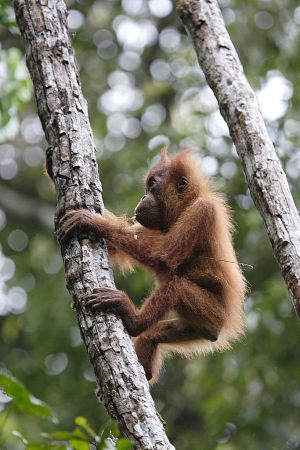
Sumatran orangutan © Perry van Duijnhoven -
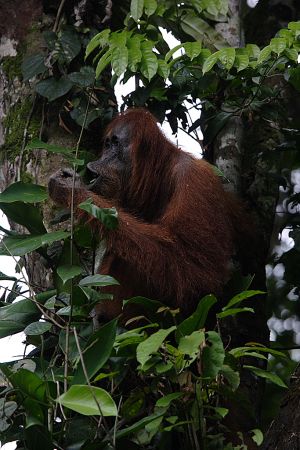
Female orangutan © Perry van Duijnhoven -
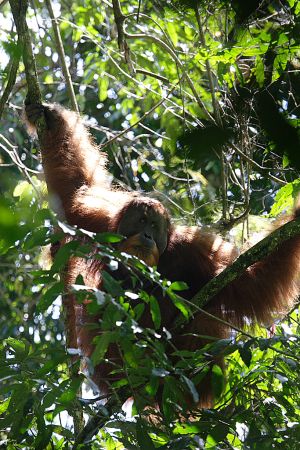
Flanged male Sumatran orangutan © Perry van Duijnhoven


Ape status
The peat-swamp forests of the Leuser Ecosystem hold the highest Sumatran orangutan densities (Wich et al. 2016). The species is predicted to decline across a variety of land-use scenarios; as many as 4,500 individuals could vanish by 2030 (Wich et al. 2016).
Table 2. Ape population estimates reported for Leuser Ecosystem
| Species | Year | Occurrence | Encounter or vistation rate (nests/km; ind/day) | Density estimate [ind./ km²] (95% CI) | Abundance estimate (95% CI) | Survey area | Sampling method | Analytical framework | Source | Comments | A.P.E.S. database ID |
|---|---|---|---|---|---|---|---|---|---|---|---|
| Pongo abelii | 1999-2013 | 0.73 | 13,846 (11,561-16,805) | Leuser Ecosystem | Line transects | Wich et al. 2016 |
Sampling methods Analytical frameworks
Threats
Key threats to orangutans at the Leuser Ecosystem include habitat destruction, habitat fragmentation, hunting, and the illegal pet trade (SOCP). New roads are continuously being cut through the habitat. In addition to habitat encroachment, palm oil concessions, and new hydro electric schemes and geothermal energy plants are proposed in critical areas (SOCP). As a by-product of land-conversion and increased proximity to humans, orangutans are sometimes killed due to human-wildlife conflict situations, for example, when orangutans raid farmlands (Singleton et al. 2018).
Table 3. Threats to apes reported for Leuser Ecosystem
| Category | Specific threats | Threat level | Description | Year of threat |
|---|---|---|---|---|
| 3 Energy production & mining | 3.3 Renewable energy | Low (up to 30% of population affected) | Proposed construction of several new hydroelectric power plants leading to habitat loss (Wich pers. comm. 2020; SOCP). | Ongoing (2020) |
| 4 Transportation & service corridors | 4.1 Roads & railroads | Medium (30-70% of population affected) | The construction of roads is causing forest loss and forest fragmentation (Wich et al. 2016). | Ongoing (2016) |
| 5 Biological resource use | 5.1 Hunting & collecting terrestrial animals | Low (up to 30% of population affected) | Poaching/persecution. Orangutans are captured or killed when they leave the forest and enter agricultural land or areas that have been recently deforested (Wich et al 2016; Singleton et al. 2018). | Ongoing (2018) |
| 5 Biological resource use | 5.1.4 Capture for the live animal trade | Present (unknown severity) | Capturing young orangutans for illegal pet trade (SOCP). | Ongoing (2020) |
| 5 Biological resource use | 5.3 Logging & wood harvesting | Medium (30-70% of population affected) | Deforestation as a result of land-cover changes (Wich et al. 2016). | Ongoing (2016) |
-
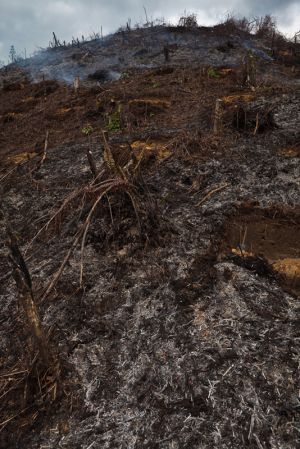
Deforestation for small scale agiriculture © Perry van Duijnhoven -
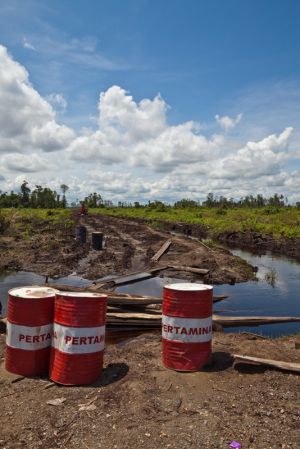
Draining canals in peat swamp © Perry van Duijnhoven -

Small-scale logging © Perry van Duijnhoven


Conservation activities
A number of NGOs are active in the implementation of conservation activities, including the Sumatran Orangutan Conservation Programme (SOCP), the Orangutan Information Center (OIC), the Leuser International Foundation (LIF), and HAkA.
Table 4. Conservation activities reported for Leuser Ecosystem
| Category | Specific activity | Description | Implementing organization(s) | Year of activity |
|---|---|---|---|---|
| 6 Species management | 6.7 Translocate (capture & release) wild apes from human impacted sites to natural habitat elsewhere | The Human-Orangutan Conflict Response Unit rescue, relocate, and confiscate orangutans in human-orangutan conflict situations (OIC). | 2010-Ongoing (2020) |
Challenges
Table 5. Challenges reported for Leuser Ecosystem
| Challenges | Specific challenges | Source | Year(s) |
|---|---|---|---|
| 1 Site management | 1.2 Need for improved coordination | Wich pers. comm. 2020 | |
| 4 Institutional support | 4.1 Lack of law enforcement | Singleton et al. 2018 | |
| 4 Institutional support | 4.2 Lack of government support | Singleton et al. 2018 |
Enablers
Table 6. Enablers reported for Leuser Ecosystem
| Enablers | Specific enablers | Source | Year(s) |
|---|---|---|---|
| 1 Site management | |||
| 2 Resources and capacity | |||
| 3 Engaged community | |||
| 4 Institutional support | |||
| 5 Ecological context | |||
| 6 Safety and stability |
Research activities
The Leuser Ecosystem in northern Sumatra hosts several long-term research stations strategically positioned across various forest types. These sites provide vital insights into orangutan behavior, habitat use, and ecological dynamics (Leuser Conservation Forum 2020, Sherman et al. 2022). The reseach sites are as follows;
- Sikundur Research Station – Located in the eastern lowland dipterocarp forest of Gunung Leuser National Park, Sikundur studies orangutan feeding ecology, travel patterns, and forest regeneration in a recovering former logging area (Sumatran Orangutan Conservation Programme-SOCP 2025).
- Ketambe Research Station – Established in 1971 within Gunung Leuser National Park, Ketambe is the world's first orangutan research station, supporting long-term studies on orangutan behavior, forest phenology, and biodiversity monitoring (Leuser Conservation Forum 2020).
- Soraya Research Station – Situated outside the national park in secondary forest, Soraya contributes key data on orangutan nesting behavior, forest structure, and post-logging habitat recovery (Leuser Conservation Forum 2020).
- Suaq Balimbing (SUAQ) Research Station – Located in a peat-swamp forest within Gunung Leuser National Park, SUAQ is globally recognized for its research on tool use, social learning, and cultural behavior in high-density orangutan populations (Sumatran Orangutan Conservation Programme-SOCP 2025).
Documented behaviours
Table 7. Behaviours documented for Leuser Ecosystem
| Category | Behavior | Observation type | Prevalence | Observation dates | Source | Habituation | Species | Comment |
|---|---|---|---|---|---|---|---|---|
| Not reported |
Exposure to climate change impacts
External links
Leuser International Foundation
References
Leuser Conservation Forum. (2020). Research and monitoring station. Leuser Conservancy. Retrieved June 17, 2025, from https://leuserconservancy.or.id/what-we-do/research-station/
Singleton, I., Wich, S. A., Nowak, M., Usher, G., & Utami-Atmoko, S. S. (2017). Pongo abelii. IUCN Red List of Threatened Species, 2017. doi:10.2305/iucn.uk.2017-3.rlts.t121097935a115575085.en
Sumatran Orangutan Conservation Programme. (2025). Biodiversity monitoring, research, and surveys. SOCP. Retrieved June 17, 2025, from https://sumatranorangutan.org/what-we-do/biodiversity-monitoring-research-and-surveys/
Sherman, J., Voigt, M., Ancrenaz, M., Wich, S. A., Qomariah, I. N., Lyman, E., …, & Meijaard, E. (2022). Orangutan killing and trade in Indonesia: Wildlife crime, enforcement, and deterrence patterns. Biological Conservation, 276, 109744. doi:10.1016/j.biocon.2022.109744
SOCP. https://www.sumatranorangutan.org/sumatran-orangutans/threats/ link
OIC. https://orangutancentre.org/rescueing-orangutan/
Page created by: Serge Wich & APES Atlas Team Date: 2020-12-30