
Ankasa Conservation Area: Difference between revisions
No edit summary |
No edit summary Tag: Manual revert |
||
| (2 intermediate revisions by the same user not shown) | |||
| Line 168: | Line 168: | ||
|1 Site management | |1 Site management | ||
|1.2 Need for improved coordination | |1.2 Need for improved coordination | ||
|Wildlife Division and PADP II, 2010 | |[[#R00017|Wildlife Division and PADP II, 2010]] | ||
| | | | ||
|- | |- | ||
|2 Resources and capacity | |2 Resources and capacity | ||
|2.2 Lack of staff | |2.2 Lack of staff | ||
|Wildlife Division and PADP II, 2010 | |[[#R00017|Wildlife Division and PADP II, 2010]] | ||
| | | | ||
|- | |- | ||
| Line 183: | Line 183: | ||
|3 Engaged community | |3 Engaged community | ||
|3.1 General lack of community engagement or support | |3.1 General lack of community engagement or support | ||
|Wildlife Division and PADP II, 2010 | |[[#R00017|Wildlife Division and PADP II, 2010]] | ||
| | | | ||
|} | |} | ||
| Line 269: | Line 269: | ||
= Exposure to climate change impacts = | = Exposure to climate change impacts = | ||
As part of a study on the exposure of African great ape sites to climate change impacts, Kiribou et al. (2024) extracted climate data and data on projected extreme climate impact events for the site. Climatological characteristics were derived from observation-based climate data provided by the Inter-Sectoral Impact Model Intercomparison Project (ISIMIP, www.isimip.org). Parameters were calculated as the average across each 30-year period. For 1981-2010, the EWEMBI dataset from ISIMIP2a was used. For the two future periods (2021-2050 and 2071-2099) ISIMIP2b climate data based on four CMIP5 global climate models were used. For future projections, two Representative Concentration Pathways (RCP) were used. RCP 2.6 is a scenario with strong mitigation measures in which global temperatures would likely rise below 2°C. RCP 6.0 is a scenario with medium emissions in which global temperatures would likely rise up to 3°C by 2100. For the number of days with heavy precipitation events, the 98th percentile of all precipitation days (>1mm/d) was calculated for the 1979-2013 reference period as a threshold for a heavy precipitation event. Then, for each year, the number of days above that threshold was derived. The figures on temperature and precipitation anomaly show the deviation from the mean temperature and mean precipitation for the 1979-2013 reference period. | As part of a study on the exposure of African great ape sites to climate change impacts, [[#R00016|Kiribou et al. (2024)]] extracted climate data and data on projected extreme climate impact events for the site. Climatological characteristics were derived from observation-based climate data provided by the Inter-Sectoral Impact Model Intercomparison Project (ISIMIP, www.isimip.org). Parameters were calculated as the average across each 30-year period. For 1981-2010, the EWEMBI dataset from ISIMIP2a was used. For the two future periods (2021-2050 and 2071-2099) ISIMIP2b climate data based on four CMIP5 global climate models were used. For future projections, two Representative Concentration Pathways (RCP) were used. RCP 2.6 is a scenario with strong mitigation measures in which global temperatures would likely rise below 2°C. RCP 6.0 is a scenario with medium emissions in which global temperatures would likely rise up to 3°C by 2100. For the number of days with heavy precipitation events, the 98th percentile of all precipitation days (>1mm/d) was calculated for the 1979-2013 reference period as a threshold for a heavy precipitation event. Then, for each year, the number of days above that threshold was derived. The figures on temperature and precipitation anomaly show the deviation from the mean temperature and mean precipitation for the 1979-2013 reference period. | ||
The estimated exposure to future extreme climate impact events (crop failure, drought, river flood, wildfire, tropical cyclone, and heatwave) is based on a published dataset by Lange et al. 2020 derived from ISIMIP2b data. The same global climate models and RCPs as described above were used. Within each 30-year period, the number of years with an extreme event and the average proportion of the site affected were calculated (Kiribou et al. 2024). | The estimated exposure to future extreme climate impact events (crop failure, drought, river flood, wildfire, tropical cyclone, and heatwave) is based on a published dataset by Lange et al. 2020 derived from ISIMIP2b data. The same global climate models and RCPs as described above were used. Within each 30-year period, the number of years with an extreme event and the average proportion of the site affected were calculated ([[#R00016|Kiribou et al. 2024]]). | ||
'''Table 8. Estimated past and projected climatological characteristics in Ankasa Conservation Area''' | '''Table 8. Estimated past and projected climatological characteristics in Ankasa Conservation Area''' | ||
| Line 394: | Line 394: | ||
= References = | = References = | ||
Kiribou, R., Tehoda, P., Chukwu, O., Bempah, G., Kühl, H. S., Ferreira, J., | <span id="R00016"></span>Kiribou, R., Tehoda, P., Chukwu, O., Bempah, G., Kühl, H. S., Ferreira, J., …, & Heinicke, S. (2024). Exposure of African ape sites to climate change impacts. ''PLOS Climate'', 3(2), e0000345. [https://doi.org/10.1371/journal.pclm.0000345 doi:10.1371/journal.pclm.0000345] | ||
Wildlife Division & PADP II | <span id="R00017"></span>Wildlife Division, & Protected Areas Development Programme II (PADP II) (2010). Ankasa Conservation Area management plan, Ankasa Conservation Area quarterly reports (unpublished). | ||
'''Page created by: '''Richard Ofori-Amanfo''' Date:''' 2023-08-14 | '''Page created by: '''Richard Ofori-Amanfo''' Date:''' 2023-08-14 | ||
Latest revision as of 17:52, 15 October 2026
West Africa > Ghana > Ankasa Conservation Area
Français | Português | Español | Bahasa Indonesia | Melayu
Summary
- Western chimpanzees (Pan troglodytes verus) may be present in Ankasa Conservation Area.
- Chimpanzees have not been documented in the area since 2016.
- The chimpanzee population trend is unknown; possibly absent.
- The site has a total size of 509 km².
- Key threats to chimpanzees are agricultural encroachment and hunting.
- Conservation activities have focused on education, patrolling, and preventing further degradation from farming activities.
Site characteristics
Ankasa Conservation Area (National Park and Resource Reserve) is located in the South Western part of Ghana, borderingIvory Coast. The Park is one of the few remnants of undisturbed Tropical Rainforest in Ghana. It was created in 1976. The site is very rich in biodiversity including forest elephants, bongos, leopards, olive colobus, black and white colobus, mangabey and other monkeys, yellow backed duikers and other duikers, pangolins, over 200 species of birds recorded, over 600 species of butterflies etc. The area is one of the known World Bird Areas and a Key Biodiversity Area (Ofori-Amanfo, R. pers. comm. 2023).
Table 1. Basic site information for Ankasa Conservation Area
| Species | Pan troglodytes verus |
| Area | 509 km² |
| Coordinates | Lat: 5.252710 , Lon: -2.583665 |
| Type of site | Conservation area |
| Habitat types | Subtropical/tropical moist lowland forest |
| Type of governance |
Types of sites Governance types Habitat types
Ape status
Chimpanzees have not been documented in the area since 2016.
Table 2. Ape population estimates reported for Ankasa Conservation Area
| Species | Year | Occurrence | Encounter or vistation rate (nests/km; ind/day) | Density estimate [ind./ km²] (95% CI) | Abundance estimate (95% CI) | Survey area | Sampling method | Analytical framework | Source | Comments | A.P.E.S. database ID |
|---|---|---|---|---|---|---|---|---|---|---|---|
| Pan troglodytes verus | 2016 | 0.0 | Ankasa Conservation Area | Unknown | Ofori-Amanfo pers. obs. 2016 |
Sampling methods Analytical frameworks
Threats
There are poaching camps, which the park’s staff has encountered, as well as temporary farm houses in encroached areas, but efforts are being made to clear all these in the park (Ofori-Amanfo pers. obs. 2023).
Table 3. Threats to apes reported for Ankasa Conservation Area
| Category | Specific threats | Threat level | Description | Year of threat |
|---|---|---|---|---|
| 2 Agriculture & aquaculture | 2.1 Annual & perennial non-timber crops | Medium (30-70% of population affected) | The community members are predominantly farmers, embarking on cocoa and rubber plantations affecting the surroundings of the park and the entire landscape (Ofori-Amanfo pers. obs. 2023). | Ongoing (2023) |
| 5 Biological resource use | 5.1 Hunting & collecting terrestrial animals | Low (up to 30% of population affected) | Communities surrounding the Park (Ofori-Amanfo pers. obs. 2023). | 2016-2020 |
Conservation activities
The Wildlife Division of Forestry Commission is the main organization that protects the Ankasa Conservation Area. Forest Research Institute and some Universities in the country carry out research in the Park and give some recommendations regarding management of some of the species and information on some species in the Park for conservation and management purposes.
Table 4. Conservation activities reported for Ankasa Conservation Area
| Category | Specific activity | Description | Implementing organization(s) | Year of activity |
|---|---|---|---|---|
| 1 Development impact mitigation | 1.3 Prohibit (livestock) farmers from entering protected areas | Farmers and all unauthorised people are not allowed to enter into the reserve by intensive patrols within the area (Ofori-Amanfo pers. obs. 2023). | Ongoing (2023) | |
| 1 Development impact mitigation | 1.4 Farm more intensively and effectively in selected areas and spare more natural land | Old cocoa and rubber farms are being cleared (since 2016) to plant new hybrid to yield more products to increase farmers income rather than clearing more land for cultivation (Ofori-Amanfo pers. obs. 2023). | 2016-Ongoing (2023) | |
| 2 Counter-wildlife crime | 2.3 Conduct regular anti-poaching patrols | Field staff undertake day patrols, over night patrols and long/sleeping patrols in the Park to control poaching and for field data collection (Ofori-Amanfo pers. obs. 2023). | Ongoing (2023) | |
| 2 Counter-wildlife crime | 2.8 Provide training to anti-poaching ranger patrols | Staff are trained in, how take field data on animals and how to manage the animal species causing human animals conflict and others (Ofori-Amanfo pers. obs. 2023). | Ongoing (2023) | |
| 4 Education & awareness | 4.1 Educate local communities about apes and sustainable use | Local communities are educated on the need to conserve the resources in the Park since the 1990s (Ofori-Amanfo pers. obs. 2023). | 1990-Ongoing (2023) | |
| 5 Protection & restoration | 5.2 Legally protect ape habitat | 1976-Ongoing (2023) |
Challenges
Inadequate equipment and financial resources make protection of the Park difficult. The communities’ expectation is very high; that serves as disincentive to them no matter the efforts put in to support them (Ofori-Amanfo pers. obs. 2023).
Table 5. Challenges reported for Ankasa Conservation Area
| Challenges | Specific challenges | Source | Year(s) |
|---|---|---|---|
| 1 Site management | 1.2 Need for improved coordination | Wildlife Division and PADP II, 2010 | |
| 2 Resources and capacity | 2.2 Lack of staff | Wildlife Division and PADP II, 2010 | |
| 2 Resources and capacity | 2.3 General lack of funding | Ofori-Amanfo pers. obs. 2023 | |
| 3 Engaged community | 3.1 General lack of community engagement or support | Wildlife Division and PADP II, 2010 |
Enablers
Table 6. Enablers reported for Ankasa Conservation Area
| Enablers | Specific enablers | Source | Year(s) |
|---|---|---|---|
| 1 Site management | |||
| 2 Resources and capacity | |||
| 3 Engaged community | |||
| 4 Institutional support | |||
| 5 Ecological context | |||
| 6 Safety and stability |
Research activities
Documented behaviours
Table 7. Behaviours documented for Ankasa Conservation Area
| Category | Behavior | Observation type | Prevalence | Observation dates | Source | Habituation | Species | Comment |
|---|---|---|---|---|---|---|---|---|
| Not reported |
Exposure to climate change impacts
As part of a study on the exposure of African great ape sites to climate change impacts, Kiribou et al. (2024) extracted climate data and data on projected extreme climate impact events for the site. Climatological characteristics were derived from observation-based climate data provided by the Inter-Sectoral Impact Model Intercomparison Project (ISIMIP, www.isimip.org). Parameters were calculated as the average across each 30-year period. For 1981-2010, the EWEMBI dataset from ISIMIP2a was used. For the two future periods (2021-2050 and 2071-2099) ISIMIP2b climate data based on four CMIP5 global climate models were used. For future projections, two Representative Concentration Pathways (RCP) were used. RCP 2.6 is a scenario with strong mitigation measures in which global temperatures would likely rise below 2°C. RCP 6.0 is a scenario with medium emissions in which global temperatures would likely rise up to 3°C by 2100. For the number of days with heavy precipitation events, the 98th percentile of all precipitation days (>1mm/d) was calculated for the 1979-2013 reference period as a threshold for a heavy precipitation event. Then, for each year, the number of days above that threshold was derived. The figures on temperature and precipitation anomaly show the deviation from the mean temperature and mean precipitation for the 1979-2013 reference period.
The estimated exposure to future extreme climate impact events (crop failure, drought, river flood, wildfire, tropical cyclone, and heatwave) is based on a published dataset by Lange et al. 2020 derived from ISIMIP2b data. The same global climate models and RCPs as described above were used. Within each 30-year period, the number of years with an extreme event and the average proportion of the site affected were calculated (Kiribou et al. 2024).
Table 8. Estimated past and projected climatological characteristics in Ankasa Conservation Area
| Value | 1981-2010 | 2021-2050, RCP 2.6 | 2021-2050, RCP 6.0 | 2071-2099, RCP 2.6 | 2071-2099, RCP 6.0 |
|---|---|---|---|---|---|
| Mean temperature [°C] | 27.2 | 28.2 | 28.1 | 28.4 | 29.3 |
| Annual precipitation [mm] | 1649 | 1583 | 1674 | 1625 | 1711 |
| Max no. consecutive dry days (per year) | 24.4 | 24.6 | 26.3 | 23.5 | 29.4 |
| No. days with heavy precipitation (per year) | 7.1 | 8.8 | 8.6 | 8 | 10.4 |
Table 9. Projected exposure of apes to extreme climate impact events in Ankasa Conservation Area
| Type | No. of years with event (2021-2050, RCP 2.6) | % of site exposed (2021-2050, RCP 2.6) | No. of years with event (2021-2050, RCP 6.0) | % of site exposed (2021-2050, RCP 6.0) | No. of years with event (2070-2099, RCP 2.6) | % of site exposed (2070-2099, RCP 2.6) | No. of years with event (2070-2099, RCP 6.0) | % of site exposed (2070-2099, RCP 6.0) |
|---|---|---|---|---|---|---|---|---|
| Crop failure | 3.5 | 2.06 | 3.5 | 1.5 | 1 | 0.87 | 2 | 2.4 |
| Drought | 1.75 | 100 | 1.25 | 100 | 0.25 | 25 | 1.75 | 50 |
| Heatwave | 18 | 100 | 15.5 | 100 | 21.5 | 100 | 17.5 | 100 |
| River flood | 0 | 0 | 0 | 0 | 0 | 0 | 1 | 4.59 |
| Tropical cyclone | 0 | 0 | 0 | 0 | 0 | 0 | 0.5 | 2.29 |
| Wildfire | 30 | 0.39 | 30 | 0.36 | 29 | 0.39 | 29 | 0.37 |
-
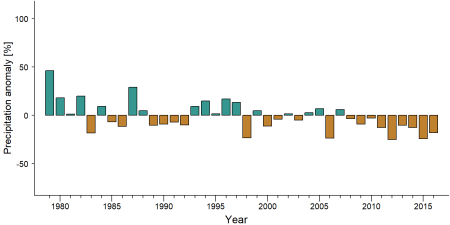
Precipitation anomaly in Ankasa Conservation Area -
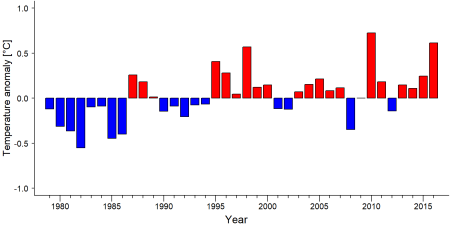
Temperature anomaly in Ankasa Conservation Area


External links
References
Kiribou, R., Tehoda, P., Chukwu, O., Bempah, G., Kühl, H. S., Ferreira, J., …, & Heinicke, S. (2024). Exposure of African ape sites to climate change impacts. PLOS Climate, 3(2), e0000345. doi:10.1371/journal.pclm.0000345
Wildlife Division, & Protected Areas Development Programme II (PADP II) (2010). Ankasa Conservation Area management plan, Ankasa Conservation Area quarterly reports (unpublished).
Page created by: Richard Ofori-Amanfo Date: 2023-08-14