
Atewa Range Forest Reserve: Difference between revisions
No edit summary |
No edit summary Tag: Manual revert |
||
| (7 intermediate revisions by the same user not shown) | |||
| Line 12: | Line 12: | ||
* Chimpanzees were mainly threatened by hunting. | * Chimpanzees were mainly threatened by hunting. | ||
* Conservation activities have focused on patrolling and controlling poaching. | * Conservation activities have focused on patrolling and controlling poaching. | ||
| Line 21: | Line 17: | ||
= Site characteristics = | = Site characteristics = | ||
Atewa Range Forest Reserve is located in southeastern Ghana. The reserve is on a mountain range, which peaks at 842 m a.s.l., (Kusimi 2015). Atewa is unique because of its Upland Evergreen forest, which is an important reservoir of biodiversity. It was established as a national forest reserve in 1926. The site was also designated as a Special Biological Protection Area in 1994, a Hill Sanctuary in 1995, a Globally Significant Biodiversity Areas (GSBAs) in 1999, and an Important Bird Area (IBA) by BirdLife International in 2001 (RAP 2007). In 2021, a new frog species was discovered in the site; it was given the common name Atewa Slippery frog, ''Conraua sagyimase'' ([https://ghana.arocha.org/projects/protecting-atewa-forest/ A Rocha Ghana]). | Atewa Range Forest Reserve is located in southeastern Ghana. The reserve is on a mountain range, which peaks at 842 m a.s.l., ([[#R00028|Kusimi 2015]]). Atewa is unique because of its Upland Evergreen forest, which is an important reservoir of biodiversity. It was established as a national forest reserve in 1926. The site was also designated as a Special Biological Protection Area in 1994, a Hill Sanctuary in 1995, a Globally Significant Biodiversity Areas (GSBAs) in 1999, and an Important Bird Area (IBA) by BirdLife International in 2001 ([[#R00031|RAP 2007]]). In 2021, a new frog species was discovered in the site; it was given the common name Atewa Slippery frog, ''Conraua sagyimase'' ([https://ghana.arocha.org/projects/protecting-atewa-forest/ A Rocha Ghana]). | ||
'''Table 1. Basic site information for Atewa Range Forest Reserve''' | '''Table 1. Basic site information for Atewa Range Forest Reserve''' | ||
| Line 48: | Line 44: | ||
= Ape status = | = Ape status = | ||
No chimpanzees have been found in the reserve. An old chief hunter reported that he has not seen a chimpanzee in the forest since he started hunting over 40 years ago (Ofori-Amanfo pers. comm. 2023). During a 2006 Rapid Assessment Program (RAP) survey of the site, most nearby communities said that chimpanzees were not present; this was in line with the RAP’s transect and recce survey results, which found no evidence of chimpanzees (McCullough et al. 2007). | No chimpanzees have been found in the reserve. An old chief hunter reported that he has not seen a chimpanzee in the forest since he started hunting over 40 years ago (Ofori-Amanfo pers. comm. 2023). During a 2006 Rapid Assessment Program (RAP) survey of the site, most nearby communities said that chimpanzees were not present; this was in line with the RAP’s transect and recce survey results, which found no evidence of chimpanzees ([[#R00029|McCullough et al. 2007]]). | ||
'''Table 2. Ape population estimates reported for Atewa Range Forest Reserve''' | '''Table 2. Ape population estimates reported for Atewa Range Forest Reserve''' | ||
| Line 74: | Line 70: | ||
|Line transects & recces | |Line transects & recces | ||
| | | | ||
|McCullough et al. 2007 | |[[#R00029|McCullough et al. 2007]] | ||
| | | | ||
| | | | ||
| Line 96: | Line 92: | ||
= Threats = | = Threats = | ||
Chimpanzees were mainly threatened by the high levels of uncontrolled hunting (Ofori-Amanfo pers. comm. 2023). A study by Kusimi 2015 also found that land cover (especially forest cover) in the reserve declined, while land use increased between 1986 and 2013. Parts of the forest degraded into bushes/shrubs and the peripheral landscape was more affected due to intense human activities such as farming and illegal logging. Other activities such as expansion of settlements and illegal gold mining have also contributed to the negative impacts on the forest cover (Kusimi 2015). Atewa Forest is one of three possible sites where the government of Ghana is seeking to mine bauxite to develop an integrated bauxite-aluminium industry; up to this point it has not been exploited but the risk still exists (Purwins 2022). | Chimpanzees were mainly threatened by the high levels of uncontrolled hunting (Ofori-Amanfo pers. comm. 2023). A study by [[#R00028|Kusimi 2015]] also found that land cover (especially forest cover) in the reserve declined, while land use increased between 1986 and 2013. Parts of the forest degraded into bushes/shrubs and the peripheral landscape was more affected due to intense human activities such as farming and illegal logging. Other activities such as expansion of settlements and illegal gold mining have also contributed to the negative impacts on the forest cover ([[#R00028|Kusimi 2015]]). Atewa Forest is one of three possible sites where the government of Ghana is seeking to mine bauxite to develop an integrated bauxite-aluminium industry; up to this point it has not been exploited but the risk still exists ([[#R00030|Purwins 2022]]). | ||
'''Table 3. Threats to apes reported for Atewa Range Forest Reserve''' | '''Table 3. Threats to apes reported for Atewa Range Forest Reserve''' | ||
| Line 105: | Line 101: | ||
!Description | !Description | ||
!Year of threat | !Year of threat | ||
|- | |||
|2 Agriculture & aquaculture | |||
|2.1 Annual & perennial non-timber crops | |||
|Low (up to 30% of population affected) | |||
|Farmers encroach into the Forest Reserve for illegal subsistence farming ([[#R00028|Kusimi 2015]], Ofori-Amanfo pers. obs. 2023). | |||
|2014-Ongoing (2023) | |||
|- | |||
|3 Energy production & mining | |||
|3.2 Mining & quarrying | |||
|High (more than 70% of population affected) | |||
|Illegal mining can be found in the Forest Reserve, specifically gold mining ([[#R00028|Kusimi 2015]], Ofori-Amanfo pers. obs. 2023). | |||
|2014-Ongoing (2023) | |||
|- | |||
|3 Energy production & mining | |||
|3.2 Mining & quarrying | |||
|Low (up to 30% of population affected) | |||
|In June 2019, in the absence of an environmental impact assessment, the Ghanaian authorities started clearing access roads to Atewa Forest to allow test-drilling for bauxite ([[#R01992|IUCN Congress 2020]]). Bauxite deposits have been assessed several other times at the site by prospective companies, but bauxite mining has been so far met with strong opposition ([[#R00026|Lindsell et al. 2019]]). Although the threat is low because mining has not proceeded, the potential impacts are high. | |||
|2019-Ongoing (2023) | |||
|- | |- | ||
|5 Biological resource use | |5 Biological resource use | ||
| Line 121: | Line 135: | ||
|5.3 Logging & wood harvesting | |5.3 Logging & wood harvesting | ||
|High (more than 70% of population affected) | |High (more than 70% of population affected) | ||
|Legal logging was permitted between 1966 and 1998 (Lindsell et al. 2019). | |Legal logging was permitted between 1966 and 1998 ([[#R00026|Lindsell et al. 2019]]). | ||
|1966-1998 | |1966-1998 | ||
|- | |- | ||
| Line 127: | Line 141: | ||
|5.3 Logging & wood harvesting | |5.3 Logging & wood harvesting | ||
|Medium (30-70% of population affected) | |Medium (30-70% of population affected) | ||
|Illegal logging still goes on in the Reserve, even after the 2003 management plan made no provisions for timber harvesting (Ofori-Amanfo pers. obs. 2023, Lindsell et al. 2019). | |Illegal logging still goes on in the Reserve, even after the 2003 management plan made no provisions for timber harvesting (Ofori-Amanfo pers. obs. 2023, [[#R00026|Lindsell et al. 2019]]). | ||
|2003-Ongoing (2023) | |2003-Ongoing (2023) | ||
|- | |- | ||
|7 Natural system modifications | |7 Natural system modifications | ||
| Line 147: | Line 149: | ||
|The Forest Reserve has a long boundary, where periodic fires occur due to farming practices around the reserve (Ofori-Amanfo pers. obs. 2023). | |The Forest Reserve has a long boundary, where periodic fires occur due to farming practices around the reserve (Ofori-Amanfo pers. obs. 2023). | ||
|2016-Ongoing (2023) | |2016-Ongoing (2023) | ||
|} | |} | ||
| Line 159: | Line 155: | ||
= Conservation activities = | = Conservation activities = | ||
Some organisations are advocating that the Atewa Forest Reserve should be upgraded to National Park status, including the NGO Ghana A Rocha and the IUCN (Lindsell et al. 2019). | Some organisations are advocating that the Atewa Forest Reserve should be upgraded to National Park status, including the NGO Ghana A Rocha and the IUCN ([[#R00026|Lindsell et al. 2019]]). | ||
'''Table 4. Conservation activities reported for Atewa Range Forest Reserve''' | '''Table 4. Conservation activities reported for Atewa Range Forest Reserve''' | ||
| Line 209: | Line 205: | ||
|The site has been a Forest Reserve since 1926. | |The site has been a Forest Reserve since 1926. | ||
| | | | ||
|1926-Ongoing ( | |1926-Ongoing (2026) | ||
|- | |- | ||
|7 Economic & other incentives | |7 Economic & other incentives | ||
| Line 222: | Line 218: | ||
= Challenges = | = Challenges = | ||
The main challenges to conservation include lack of vigorous law Enforcement activities in the Forest Reserve, lack of logistics and low staff (Kusimi 2015). | The main challenges to conservation include lack of vigorous law Enforcement activities in the Forest Reserve, lack of logistics and low staff ([[#R00028|Kusimi 2015]]). | ||
'''Table 5. Challenges reported for Atewa Range Forest Reserve''' | '''Table 5. Challenges reported for Atewa Range Forest Reserve''' | ||
| Line 230: | Line 226: | ||
!Source | !Source | ||
!Year(s) | !Year(s) | ||
|- | |- | ||
|1 Site management | |1 Site management | ||
|1.2 Need for improved coordination | |1.2 Need for improved coordination | ||
|Kusimi 2015 | |[[#R00028|Kusimi 2015]] | ||
| | | | ||
|- | |- | ||
|2 Resources and capacity | |2 Resources and capacity | ||
|2.2 Lack of staff | |2.2 Lack of staff | ||
|Kusimi 2015 | |[[#R00028|Kusimi 2015]] | ||
| | |||
|- | |||
|4 Institutional support | |||
|4.1 Lack of law enforcement | |||
|Ofori-Amanfo pers. obs. 2023, [[#R00028|Kusimi 2015]] | |||
| | | | ||
|} | |} | ||
| Line 329: | Line 325: | ||
= Exposure to climate change impacts = | = Exposure to climate change impacts = | ||
As part of a study on the exposure of African great ape sites to climate change impacts, Kiribou et al. (2024) extracted climate data and data on projected extreme climate impact events for the site. Climatological characteristics were derived from observation-based climate data provided by the Inter-Sectoral Impact Model Intercomparison Project (ISIMIP, www.isimip.org). Parameters were calculated as the average across each 30-year period. For 1981-2010, the EWEMBI dataset from ISIMIP2a was used. For the two future periods (2021-2050 and 2071-2099) ISIMIP2b climate data based on four CMIP5 global climate models were used. For future projections, two Representative Concentration Pathways (RCP) were used. RCP 2.6 is a scenario with strong mitigation measures in which global temperatures would likely rise below 2°C. RCP 6.0 is a scenario with medium emissions in which global temperatures would likely rise up to 3°C by 2100. For the number of days with heavy precipitation events, the 98th percentile of all precipitation days (>1mm/d) was calculated for the 1979-2013 reference period as a threshold for a heavy precipitation event. Then, for each year, the number of days above that threshold was derived. The figures on temperature and precipitation anomaly show the deviation from the mean temperature and mean precipitation for the 1979-2013 reference period. | As part of a study on the exposure of African great ape sites to climate change impacts, [[#R00027|Kiribou et al. (2024)]] extracted climate data and data on projected extreme climate impact events for the site. Climatological characteristics were derived from observation-based climate data provided by the Inter-Sectoral Impact Model Intercomparison Project (ISIMIP, www.isimip.org). Parameters were calculated as the average across each 30-year period. For 1981-2010, the EWEMBI dataset from ISIMIP2a was used. For the two future periods (2021-2050 and 2071-2099) ISIMIP2b climate data based on four CMIP5 global climate models were used. For future projections, two Representative Concentration Pathways (RCP) were used. RCP 2.6 is a scenario with strong mitigation measures in which global temperatures would likely rise below 2°C. RCP 6.0 is a scenario with medium emissions in which global temperatures would likely rise up to 3°C by 2100. For the number of days with heavy precipitation events, the 98th percentile of all precipitation days (>1mm/d) was calculated for the 1979-2013 reference period as a threshold for a heavy precipitation event. Then, for each year, the number of days above that threshold was derived. The figures on temperature and precipitation anomaly show the deviation from the mean temperature and mean precipitation for the 1979-2013 reference period. | ||
The estimated exposure to future extreme climate impact events (crop failure, drought, river flood, wildfire, tropical cyclone, and heatwave) is based on a published dataset by Lange et al. 2020 derived from ISIMIP2b data. The same global climate models and RCPs as described above were used. Within each 30-year period, the number of years with an extreme event and the average proportion of the site affected were calculated (Kiribou et al. 2024). | The estimated exposure to future extreme climate impact events (crop failure, drought, river flood, wildfire, tropical cyclone, and heatwave) is based on a published dataset by Lange et al. 2020 derived from ISIMIP2b data. The same global climate models and RCPs as described above were used. Within each 30-year period, the number of years with an extreme event and the average proportion of the site affected were calculated ([[#R00027|Kiribou et al. 2024]]). | ||
'''Table 8. Estimated past and projected climatological characteristics in Atewa Range Forest Reserve''' | '''Table 8. Estimated past and projected climatological characteristics in Atewa Range Forest Reserve''' | ||
| Line 454: | Line 450: | ||
= References = | = References = | ||
<span id="R00026"></span>Lindsell, J., Agyei, R., Bosu, D., Decher, J., Hawthorne, W., Marshall, C., Ofori-Boateng, C., & Rödel, M.-O. (2019). The biodiversity of Atewa Forest. Technical report to A Rocha, January 2019. https://ghana.arocha.org/wp-content/uploads/sites/15/2019/11/Biodiversity-of-Atewa-A-Rocha.pdf | |||
<span id="R00027"></span>Kiribou, R., Tehoda, P., Chukwu, O., Bempah, G., Kühl, H. S., Ferreira, J., …, & Heinicke, S. (2024). Exposure of African ape sites to climate change impacts. ''PLOS Climate'', 3(2), e0000345. [https://doi.org/10.1371/journal.pclm.0000345 doi:10.1371/journal.pclm.0000345] | |||
Kusimi, J. M. (2015). Characterizing land disturbance in Atewa | <span id="R00028"></span>Kusimi, J. M. (2015). Characterizing land disturbance in Atewa Range Forest Reserve and Buffer Zone. ''Land Use Policy'', 49, 471-482. [https://doi.org/10.1016/j.landusepol.2015.08.020 doi:10.1016/j.landusepol.2015.08.020] | ||
<span id="R00029"></span>McCullough, J., Alonso, L. E., Naskrecki, P., Wright, H. E., & Osei-Owusu, Y. (2007). A Rapid Biological Assessment of the Atewa Range Forest Reserve, Eastern Ghana. Conservation International. RAP Bulletin of Biological Assessment 47. | |||
<span id="R00030"></span>Purwins, S. (2022). Bauxite mining at Atewa Forest Reserve, Ghana: A political ecology of a conservation-exploitation conflict. GeoJournal, 87(2), 1085–1097. [https://doi.org/10.1007/s10708-020-10303-3 doi:10.1007/s10708-020-10303-3] | |||
<span id="R00031"></span>Rapid Assessment Program. (2007). Biodiversity in the Atewa Range Forest Reserve, Ghana. Conservation International. https://www.conservation.org/docs/default-source/publication-pdfs/ci_atewa_ghana_booklet | |||
<span id="R01992"></span>IUCN Congress 2020. https://www.iucncongress2020.org/motion/103 | |||
'''Page created by: '''Richard Ofori-Amanfo & APES Atlas Team''' Date:''' 2023-11-10 | '''Page created by: '''Richard Ofori-Amanfo & APES Atlas Team''' Date:''' 2023-11-10 | ||
Latest revision as of 17:52, 15 October 2026
West Africa > Ghana > Atewa Range Forest Reserve
Français | Português | Español | Bahasa Indonesia | Melayu
Summary
- Western chimpanzees (Pan troglodytes verus) are no longer present in Atewa Range Forest Reserve.
- Chimpanzees have been extirpated from the site.
- The site has a total size of 258 km².
- Chimpanzees were mainly threatened by hunting.
- Conservation activities have focused on patrolling and controlling poaching.
Site characteristics
Atewa Range Forest Reserve is located in southeastern Ghana. The reserve is on a mountain range, which peaks at 842 m a.s.l., (Kusimi 2015). Atewa is unique because of its Upland Evergreen forest, which is an important reservoir of biodiversity. It was established as a national forest reserve in 1926. The site was also designated as a Special Biological Protection Area in 1994, a Hill Sanctuary in 1995, a Globally Significant Biodiversity Areas (GSBAs) in 1999, and an Important Bird Area (IBA) by BirdLife International in 2001 (RAP 2007). In 2021, a new frog species was discovered in the site; it was given the common name Atewa Slippery frog, Conraua sagyimase (A Rocha Ghana).
Table 1. Basic site information for Atewa Range Forest Reserve
| Species | Pan troglodytes verus |
| Area | 258 km² |
| Coordinates | Lat: 6.170532 , Lon: -0.600267 |
| Type of site | Protected area (Forest Reserve) |
| Habitat types | Subtropical/tropical moist montane forest |
| Type of governance |
Types of sites Governance types Habitat types
Ape status
No chimpanzees have been found in the reserve. An old chief hunter reported that he has not seen a chimpanzee in the forest since he started hunting over 40 years ago (Ofori-Amanfo pers. comm. 2023). During a 2006 Rapid Assessment Program (RAP) survey of the site, most nearby communities said that chimpanzees were not present; this was in line with the RAP’s transect and recce survey results, which found no evidence of chimpanzees (McCullough et al. 2007).
Table 2. Ape population estimates reported for Atewa Range Forest Reserve
| Species | Year | Occurrence | Encounter or vistation rate (nests/km; ind/day) | Density estimate [ind./ km²] (95% CI) | Abundance estimate (95% CI) | Survey area | Sampling method | Analytical framework | Source | Comments | A.P.E.S. database ID |
|---|---|---|---|---|---|---|---|---|---|---|---|
| Pan troglodytes verus | 2006 | 0.0 | Atewa Range Forest Reserve | Line transects & recces | McCullough et al. 2007 | ||||||
| Pan troglodytes verus | 1980-2023 | 0.0 | Atewa Range Forest Reserve | Unknown | Ofori-Amanfo pers. comm. 2023 |
Sampling methods Analytical frameworks
Threats
Chimpanzees were mainly threatened by the high levels of uncontrolled hunting (Ofori-Amanfo pers. comm. 2023). A study by Kusimi 2015 also found that land cover (especially forest cover) in the reserve declined, while land use increased between 1986 and 2013. Parts of the forest degraded into bushes/shrubs and the peripheral landscape was more affected due to intense human activities such as farming and illegal logging. Other activities such as expansion of settlements and illegal gold mining have also contributed to the negative impacts on the forest cover (Kusimi 2015). Atewa Forest is one of three possible sites where the government of Ghana is seeking to mine bauxite to develop an integrated bauxite-aluminium industry; up to this point it has not been exploited but the risk still exists (Purwins 2022).
Table 3. Threats to apes reported for Atewa Range Forest Reserve
| Category | Specific threats | Threat level | Description | Year of threat |
|---|---|---|---|---|
| 2 Agriculture & aquaculture | 2.1 Annual & perennial non-timber crops | Low (up to 30% of population affected) | Farmers encroach into the Forest Reserve for illegal subsistence farming (Kusimi 2015, Ofori-Amanfo pers. obs. 2023). | 2014-Ongoing (2023) |
| 3 Energy production & mining | 3.2 Mining & quarrying | High (more than 70% of population affected) | Illegal mining can be found in the Forest Reserve, specifically gold mining (Kusimi 2015, Ofori-Amanfo pers. obs. 2023). | 2014-Ongoing (2023) |
| 3 Energy production & mining | 3.2 Mining & quarrying | Low (up to 30% of population affected) | In June 2019, in the absence of an environmental impact assessment, the Ghanaian authorities started clearing access roads to Atewa Forest to allow test-drilling for bauxite (IUCN Congress 2020). Bauxite deposits have been assessed several other times at the site by prospective companies, but bauxite mining has been so far met with strong opposition (Lindsell et al. 2019). Although the threat is low because mining has not proceeded, the potential impacts are high. | 2019-Ongoing (2023) |
| 5 Biological resource use | 5.1 Hunting & collecting terrestrial animals | High (more than 70% of population affected) | Poaching of wild animals in the Forest is common (Ofori-Amanfo pers. obs. 2023). | 1926-Ongoing (2023) |
| 5 Biological resource use | 5.2 Gathering terrestrial plants | High (more than 70% of population affected) | The communities around the Forest Reserve enter and collect non timber forest products for domestic and commercial purposes (Ofori-Amanfo pers. obs. 2023). | 1926-Ongoing (2023) |
| 5 Biological resource use | 5.3 Logging & wood harvesting | High (more than 70% of population affected) | Legal logging was permitted between 1966 and 1998 (Lindsell et al. 2019). | 1966-1998 |
| 5 Biological resource use | 5.3 Logging & wood harvesting | Medium (30-70% of population affected) | Illegal logging still goes on in the Reserve, even after the 2003 management plan made no provisions for timber harvesting (Ofori-Amanfo pers. obs. 2023, Lindsell et al. 2019). | 2003-Ongoing (2023) |
| 7 Natural system modifications | 7.1 Fire & fire suppression | Medium (30-70% of population affected) | The Forest Reserve has a long boundary, where periodic fires occur due to farming practices around the reserve (Ofori-Amanfo pers. obs. 2023). | 2016-Ongoing (2023) |
Conservation activities
Some organisations are advocating that the Atewa Forest Reserve should be upgraded to National Park status, including the NGO Ghana A Rocha and the IUCN (Lindsell et al. 2019).
Table 4. Conservation activities reported for Atewa Range Forest Reserve
| Category | Specific activity | Description | Implementing organization(s) | Year of activity |
|---|---|---|---|---|
| 2 Counter-wildlife crime | 2.3 Conduct regular anti-poaching patrols | The Forestry Commission used to carry out patrols in the Forest and has increased the number of Rapid Response Teams (RRT) to undertake regular patrols in important Forest Reserves (Ofori-Amanfo pers. obs. 2023). | 1926-Ongoing (2023) | |
| 2 Counter-wildlife crime | 2.5 Inspect bushmeat markets for ape species | The Forestry Commission carries out checks on illegal trade in bush meat (Ofori-Amanfo pers. obs. 2023). | Ongoing (2023) | |
| 2 Counter-wildlife crime | 2.6 Regularly de-activate/remove ground snares | All snares seen in the Reserve by patrol teams and researchers are removed (Ofori-Amanfo pers. obs. 2023). | Ongoing (2023) | |
| 2 Counter-wildlife crime | 2.7 Provide better equipment (e.g., guns) to anti-poaching ranger patrols | New and better weapons have been acquired for the RRT (Ofori-Amanfo pers. obs. 2023). | 2023 | |
| 4 Education & awareness | 4.1 Educate local communities about apes and sustainable use | NGOs such as A Rocha Ghana, Conservation International etc. undertake conservation education around the Forest Reserve (Ofori-Amanfo pers. obs. 2023). | Ongoing (2023) | |
| 4 Education & awareness | 4.2 Involve local community in ape research and conservation management | Local communities are involved in research activities in the Forest Reserve (Ofori-Amanfo pers. obs. 2023). | Ongoing (2023) | |
| 5 Protection & restoration | 5.2 Legally protect ape habitat | The site has been a Forest Reserve since 1926. | 1926-Ongoing (2026) | |
| 7 Economic & other incentives | 7.2 Provide non-monetary benefits to local communities for sustainably managing their forest and its wildlife (e.g., better education, infrastructure development) | Communities are provided livelihood support programmes (implemented by A Rocha Ghana) to increase their support for conservation (Ofori-Amanfo pers. obs. 2023). | Ongoing (2023) |
Challenges
The main challenges to conservation include lack of vigorous law Enforcement activities in the Forest Reserve, lack of logistics and low staff (Kusimi 2015).
Table 5. Challenges reported for Atewa Range Forest Reserve
| Challenges | Specific challenges | Source | Year(s) |
|---|---|---|---|
| 1 Site management | 1.2 Need for improved coordination | Kusimi 2015 | |
| 2 Resources and capacity | 2.2 Lack of staff | Kusimi 2015 | |
| 4 Institutional support | 4.1 Lack of law enforcement | Ofori-Amanfo pers. obs. 2023, Kusimi 2015 |
Enablers
Table 6. Enablers reported for Atewa Range Forest Reserve
| Enablers | Specific enablers | Source | Year(s) |
|---|---|---|---|
| 1 Site management | |||
| 2 Resources and capacity | |||
| 3 Engaged community | |||
| 4 Institutional support | |||
| 5 Ecological context | |||
| 6 Safety and stability |
Research activities
Studies have been carried out in the Forest Reserve on its biodiversity since 2003, for management plans, biodiversity assessments and threat assessments.
Documented behaviours
Table 7. Behaviours documented for Atewa Range Forest Reserve
| Category | Behavior | Observation type | Prevalence | Observation dates | Source | Habituation | Species | Comment |
|---|---|---|---|---|---|---|---|---|
| Not reported |
Exposure to climate change impacts
As part of a study on the exposure of African great ape sites to climate change impacts, Kiribou et al. (2024) extracted climate data and data on projected extreme climate impact events for the site. Climatological characteristics were derived from observation-based climate data provided by the Inter-Sectoral Impact Model Intercomparison Project (ISIMIP, www.isimip.org). Parameters were calculated as the average across each 30-year period. For 1981-2010, the EWEMBI dataset from ISIMIP2a was used. For the two future periods (2021-2050 and 2071-2099) ISIMIP2b climate data based on four CMIP5 global climate models were used. For future projections, two Representative Concentration Pathways (RCP) were used. RCP 2.6 is a scenario with strong mitigation measures in which global temperatures would likely rise below 2°C. RCP 6.0 is a scenario with medium emissions in which global temperatures would likely rise up to 3°C by 2100. For the number of days with heavy precipitation events, the 98th percentile of all precipitation days (>1mm/d) was calculated for the 1979-2013 reference period as a threshold for a heavy precipitation event. Then, for each year, the number of days above that threshold was derived. The figures on temperature and precipitation anomaly show the deviation from the mean temperature and mean precipitation for the 1979-2013 reference period.
The estimated exposure to future extreme climate impact events (crop failure, drought, river flood, wildfire, tropical cyclone, and heatwave) is based on a published dataset by Lange et al. 2020 derived from ISIMIP2b data. The same global climate models and RCPs as described above were used. Within each 30-year period, the number of years with an extreme event and the average proportion of the site affected were calculated (Kiribou et al. 2024).
Table 8. Estimated past and projected climatological characteristics in Atewa Range Forest Reserve
| Value | 1981-2010 | 2021-2050, RCP 2.6 | 2021-2050, RCP 6.0 | 2071-2099, RCP 2.6 | 2071-2099, RCP 6.0 |
|---|---|---|---|---|---|
| Mean temperature [°C] | 26.6 | 27.8 | 27.5 | 27.9 | 29.1 |
| Annual precipitation [mm] | 1401 | 1360 | 1420 | 1391 | 1427 |
| Max no. consecutive dry days (per year) | 23.7 | 28.4 | 30.8 | 29.8 | 30.7 |
| No. days with heavy precipitation (per year) | 6.3 | 8.1 | 7.4 | 7.4 | 9.7 |
Table 9. Projected exposure of apes to extreme climate impact events in Atewa Range Forest Reserve
| Type | No. of years with event (2021-2050, RCP 2.6) | % of site exposed (2021-2050, RCP 2.6) | No. of years with event (2021-2050, RCP 6.0) | % of site exposed (2021-2050, RCP 6.0) | No. of years with event (2070-2099, RCP 2.6) | % of site exposed (2070-2099, RCP 2.6) | No. of years with event (2070-2099, RCP 6.0) | % of site exposed (2070-2099, RCP 6.0) |
|---|---|---|---|---|---|---|---|---|
| Crop failure | 2.5 | 8.4 | 2 | 4.45 | 3 | 8.4 | 4 | 8.4 |
| Drought | 1.5 | 50 | 1 | 75 | 0.25 | 25 | 0.5 | 50 |
| Heatwave | 6.5 | 100 | 5.5 | 100 | 2 | 50 | 6 | 100 |
| River flood | 0.25 | 0 | 0.5 | 0 | 1 | 0 | 1.5 | 0.64 |
| Tropical cyclone | 0 | 0 | 0 | 0 | 0 | 0 | 0 | 0 |
| Wildfire | 30 | 0.37 | 30 | 0.36 | 29 | 0.37 | 29 | 0.4 |
-
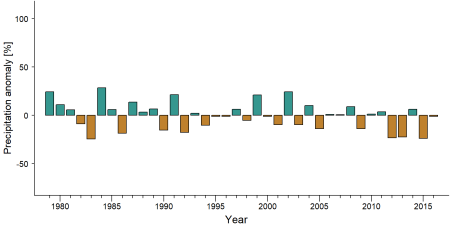
Precipitation anomaly in Atewa Range Forest Reserve -
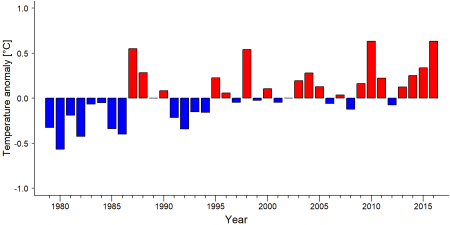
Temperature anomaly in Atewa Range Forest Reserve


External links
References
Lindsell, J., Agyei, R., Bosu, D., Decher, J., Hawthorne, W., Marshall, C., Ofori-Boateng, C., & Rödel, M.-O. (2019). The biodiversity of Atewa Forest. Technical report to A Rocha, January 2019. https://ghana.arocha.org/wp-content/uploads/sites/15/2019/11/Biodiversity-of-Atewa-A-Rocha.pdf
Kiribou, R., Tehoda, P., Chukwu, O., Bempah, G., Kühl, H. S., Ferreira, J., …, & Heinicke, S. (2024). Exposure of African ape sites to climate change impacts. PLOS Climate, 3(2), e0000345. doi:10.1371/journal.pclm.0000345
Kusimi, J. M. (2015). Characterizing land disturbance in Atewa Range Forest Reserve and Buffer Zone. Land Use Policy, 49, 471-482. doi:10.1016/j.landusepol.2015.08.020
McCullough, J., Alonso, L. E., Naskrecki, P., Wright, H. E., & Osei-Owusu, Y. (2007). A Rapid Biological Assessment of the Atewa Range Forest Reserve, Eastern Ghana. Conservation International. RAP Bulletin of Biological Assessment 47.
Purwins, S. (2022). Bauxite mining at Atewa Forest Reserve, Ghana: A political ecology of a conservation-exploitation conflict. GeoJournal, 87(2), 1085–1097. doi:10.1007/s10708-020-10303-3
Rapid Assessment Program. (2007). Biodiversity in the Atewa Range Forest Reserve, Ghana. Conservation International. https://www.conservation.org/docs/default-source/publication-pdfs/ci_atewa_ghana_booklet
IUCN Congress 2020. https://www.iucncongress2020.org/motion/103
Page created by: Richard Ofori-Amanfo & APES Atlas Team Date: 2023-11-10