
Banco National Park: Difference between revisions
No edit summary |
No edit summary Tag: Manual revert |
||
| (8 intermediate revisions by the same user not shown) | |||
| Line 14: | Line 14: | ||
* Conservation activities have focused on conservation and environmental awareness campaigns and education. | * Conservation activities have focused on conservation and environmental awareness campaigns and education. | ||
* The site is surrounded by the capital city of Abidjan. | * The site is surrounded by the capital city of Abidjan. | ||
= Site characteristics = | = Site characteristics = | ||
The Banco National Park was created in October 1953. It is located in the heart of the Ivorian economic capital, Abidjan, and is bounded by the municipalities of Adjamé, Attécoubé, Abobo, and Yopougon. The surface of the park has shrunk over the years and now covers an area of 3,438 hectares. Being the unique remaining relic of the dense primary forest that once covered the area of Abidjan, Banco National Park is often described as the hydraulic reservoir and green lung of the economic capital of Côte d'Ivoire. This protected area is a center for environmental education (OIPR n.d.). The park holds about 600 ha of primary forests; an arboretum of over 800 species of higher plants native to the tropics of Africa, Asia and Latin America; many fish ponds located in the heart of the park, a semi-natural swimming pool, an ecomuseum, and the presence of a family of chimpanzees (OIPR n.d.). Based on a wildlife survey (Bitty et al. 2013), the site is also home to other primates, including Campbell's mona monkey, and lesser white-nosed monkey, ungulates (harnessed bushbuck, Maxwell's duiker, Royal antelope), and predators, such as the cape genet, common kusimanse, and African civet (OIPR n.d.). | The Banco National Park was created in October 1953. It is located in the heart of the Ivorian economic capital, Abidjan, and is bounded by the municipalities of Adjamé, Attécoubé, Abobo, and Yopougon. The surface of the park has shrunk over the years and now covers an area of 3,438 hectares. Being the unique remaining relic of the dense primary forest that once covered the area of Abidjan, Banco National Park is often described as the hydraulic reservoir and green lung of the economic capital of Côte d'Ivoire. This protected area is a center for environmental education (OIPR n.d.). The park holds about 600 ha of primary forests; an arboretum of over 800 species of higher plants native to the tropics of Africa, Asia and Latin America; many fish ponds located in the heart of the park, a semi-natural swimming pool, an ecomuseum, and the presence of a family of chimpanzees (OIPR n.d.). Based on a wildlife survey ([[#R00079|Bitty et al. 2013]]), the site is also home to other primates, including Campbell's mona monkey, and lesser white-nosed monkey, ungulates (harnessed bushbuck, Maxwell's duiker, Royal antelope), and predators, such as the cape genet, common kusimanse, and African civet (OIPR n.d.). | ||
'''Table 1. Basic site information for Banco National Park''' | '''Table 1. Basic site information for Banco National Park''' | ||
| Line 66: | Line 62: | ||
|- | |- | ||
|''Pan troglodytes verus'' | |''Pan troglodytes verus'' | ||
| | |2021 | ||
| | | | ||
| | | | ||
| | | | ||
| | |40-50 | ||
|Banco National Park | |Banco National Park | ||
|Informed guess | |Informed guess | ||
| | | | ||
| | |Bakayoko, Hillihase, personal comm. 2021 | ||
| | | | ||
| | | | ||
|- | |- | ||
|''Pan troglodytes verus'' | |''Pan troglodytes verus'' | ||
| | |2019 | ||
|Present | |||
| | | | ||
| | | | ||
| | | | ||
|Banco National Park | |Banco National Park | ||
| | |Line transects | ||
| | | | ||
|Azani Dede pers. comm. 2023 | |||
|0.077 feeding trace/km and 0.0038 vocalization/km | |||
| | | | ||
|- | |- | ||
|''Pan troglodytes verus'' | |''Pan troglodytes verus'' | ||
| | |2013 | ||
| | |||
| | | | ||
| | | | ||
|0 | |20.0 | ||
|Banco National Park | |Banco National Park | ||
| | |Informed guess | ||
| | | | ||
| | |Normand, E. personal comm., 2016 | ||
| | | | ||
| | | | ||
|- | |- | ||
|''Pan troglodytes verus'' | |''Pan troglodytes verus'' | ||
| | |2006 | ||
| | | | ||
| | | | ||
|0.22 | |||
|7 (4-14) | |||
|Banco National Park | |Banco National Park | ||
|Line transects | |Line transects | ||
| | | | ||
| | |[[#R02071|WCF 2009]] | ||
| | |||
| | | | ||
|CIV0011 | |||
|} | |} | ||
| Line 131: | Line 127: | ||
!Description | !Description | ||
!Year of threat | !Year of threat | ||
|- | |||
|2 Agriculture & aquaculture | |||
|2.1 Annual & perennial non-timber crops | |||
|Present (unknown severity) | |||
|Azani Dede pers. obs. 2022 | |||
|Ongoing (2022) | |||
|- | |||
|5 Biological resource use | |||
|5.1 Hunting & collecting terrestrial animals | |||
|Low (up to 30% of population affected) | |||
|Azani Dede pers. obs. 2022 | |||
|Ongoing (2022) | |||
|- | |- | ||
|5 Biological resource use | |5 Biological resource use | ||
|5.2 Gathering terrestrial plants | |5.2 Gathering terrestrial plants | ||
|Present (unknown severity) | |Present (unknown severity) | ||
|OIPR 2021 | |[[#R00082|OIPR 2021]] | ||
|Ongoing (2021) | |Ongoing (2021) | ||
|- | |- | ||
| Line 141: | Line 149: | ||
|5.3 Logging & wood harvesting | |5.3 Logging & wood harvesting | ||
|Present (unknown severity) | |Present (unknown severity) | ||
|OIPR 2021 | |[[#R00082|OIPR 2021]] | ||
|Ongoing (2021) | |Ongoing (2021) | ||
|- | |- | ||
| Line 147: | Line 155: | ||
|6.1 Recreational activities | |6.1 Recreational activities | ||
|Low (up to 30% of population affected) | |Low (up to 30% of population affected) | ||
|OIPR 2021 | |[[#R00082|OIPR 2021]] | ||
|Ongoing (2021) | |Ongoing (2021) | ||
|- | |- | ||
| Line 153: | Line 161: | ||
|9.1 Domestic & urban waste water | |9.1 Domestic & urban waste water | ||
|High (more than 70% of population affected) | |High (more than 70% of population affected) | ||
|OIPR 2021 | |[[#R00082|OIPR 2021]] | ||
|Ongoing (2021) | |Ongoing (2021) | ||
|- | |- | ||
| Line 159: | Line 167: | ||
|9.2 Industrial & military effluents | |9.2 Industrial & military effluents | ||
|Present (unknown severity) | |Present (unknown severity) | ||
|OIPR 2021 | |[[#R00082|OIPR 2021]] | ||
|Ongoing (2021) | |Ongoing (2021) | ||
|- | |- | ||
| Line 165: | Line 173: | ||
|9.4 Garbage & solid waste | |9.4 Garbage & solid waste | ||
|Medium (30-70% of population affected) | |Medium (30-70% of population affected) | ||
|OIPR 2021 | |[[#R00082|OIPR 2021]] | ||
|Ongoing (2021) | |Ongoing (2021) | ||
|- | |- | ||
| Line 171: | Line 179: | ||
|9.6 Energy emissions | |9.6 Energy emissions | ||
|High (more than 70% of population affected) | |High (more than 70% of population affected) | ||
|OIPR 2021 | |[[#R00082|OIPR 2021]] | ||
|Ongoing (2021) | |Ongoing (2021) | ||
|} | |} | ||
| Line 200: | Line 196: | ||
!Implementing organization(s) | !Implementing organization(s) | ||
!Year of activity | !Year of activity | ||
|- | |- | ||
|1 Development impact mitigation | |1 Development impact mitigation | ||
| Line 215: | Line 205: | ||
|2 Counter-wildlife crime | |2 Counter-wildlife crime | ||
|2.3 Conduct regular anti-poaching patrols | |2.3 Conduct regular anti-poaching patrols | ||
|OIPR 2021 | |[[#R00082|OIPR 2021]] | ||
| | | | ||
|Ongoing (2021) | |Ongoing (2021) | ||
| Line 221: | Line 211: | ||
|2 Counter-wildlife crime | |2 Counter-wildlife crime | ||
|2.6 Regularly de-activate/remove ground snares | |2.6 Regularly de-activate/remove ground snares | ||
|OIPR 2021 | |[[#R00082|OIPR 2021]] | ||
| | | | ||
|Ongoing (2021) | |Ongoing (2021) | ||
| Line 233: | Line 223: | ||
|4 Education & awareness | |4 Education & awareness | ||
|4.1 Educate local communities about apes and sustainable use | |4.1 Educate local communities about apes and sustainable use | ||
|OIPR 2021 | |[[#R00082|OIPR 2021]] | ||
| | | | ||
|Ongoing (2021) | |Ongoing (2021) | ||
| Line 239: | Line 229: | ||
|4 Education & awareness | |4 Education & awareness | ||
|4.2 Involve local community in ape research and conservation management | |4.2 Involve local community in ape research and conservation management | ||
|OIPR 2021 | |[[#R00082|OIPR 2021]] | ||
| | | | ||
|Ongoing (2021) | |Ongoing (2021) | ||
| Line 245: | Line 235: | ||
|4 Education & awareness | |4 Education & awareness | ||
|4.5 Implement multimedia campaigns using theatre, film, print media, discussions | |4.5 Implement multimedia campaigns using theatre, film, print media, discussions | ||
|OIPR 2021 | |[[#R00082|OIPR 2021]] | ||
| | | | ||
|Ongoing (2021) | |Ongoing (2021) | ||
|- | |||
|5 Protection & restoration | |||
|5.2 Legally protect ape habitat | |||
|[[#R00082|OIPR 2021]] | |||
| | |||
|1953-Ongoing (2026) | |||
|} | |} | ||
| Line 265: | Line 261: | ||
|1 Site management | |1 Site management | ||
|1.2 Need for improved coordination | |1.2 Need for improved coordination | ||
|OIPR | |[[#R00082|OIPR 2021]]. | ||
| | | | ||
|- | |- | ||
|4 Institutional support | |4 Institutional support | ||
|4.2 Lack of government support | |4.2 Lack of government support | ||
|OIPR | |[[#R00082|OIPR 2021]]. | ||
| | | | ||
|- | |- | ||
| | | | ||
|Other (Strong urban pressure) | |Other (Strong urban pressure) | ||
|OIPR | |[[#R00082|OIPR 2021]]. | ||
| | | | ||
|} | |} | ||
| Line 361: | Line 357: | ||
= Exposure to climate change impacts = | = Exposure to climate change impacts = | ||
As part of a study on the exposure of African great ape sites to climate change impacts, Kiribou et al. (2024) extracted climate data and data on projected extreme climate impact events for the site. Climatological characteristics were derived from observation-based climate data provided by the Inter-Sectoral Impact Model Intercomparison Project (ISIMIP, www.isimip.org). Parameters were calculated as the average across each 30-year period. For 1981-2010, the EWEMBI dataset from ISIMIP2a was used. For the two future periods (2021-2050 and 2071-2099) ISIMIP2b climate data based on four CMIP5 global climate models were used. For future projections, two Representative Concentration Pathways (RCP) were used. RCP 2.6 is a scenario with strong mitigation measures in which global temperatures would likely rise below 2°C. RCP 6.0 is a scenario with medium emissions in which global temperatures would likely rise up to 3°C by 2100. For the number of days with heavy precipitation events, the 98th percentile of all precipitation days (>1mm/d) was calculated for the 1979-2013 reference period as a threshold for a heavy precipitation event. Then, for each year, the number of days above that threshold was derived. The figures on temperature and precipitation anomaly show the deviation from the mean temperature and mean precipitation for the 1979-2013 reference period. | As part of a study on the exposure of African great ape sites to climate change impacts, [[#R00080|Kiribou et al. (2024)]] extracted climate data and data on projected extreme climate impact events for the site. Climatological characteristics were derived from observation-based climate data provided by the Inter-Sectoral Impact Model Intercomparison Project (ISIMIP, www.isimip.org). Parameters were calculated as the average across each 30-year period. For 1981-2010, the EWEMBI dataset from ISIMIP2a was used. For the two future periods (2021-2050 and 2071-2099) ISIMIP2b climate data based on four CMIP5 global climate models were used. For future projections, two Representative Concentration Pathways (RCP) were used. RCP 2.6 is a scenario with strong mitigation measures in which global temperatures would likely rise below 2°C. RCP 6.0 is a scenario with medium emissions in which global temperatures would likely rise up to 3°C by 2100. For the number of days with heavy precipitation events, the 98th percentile of all precipitation days (>1mm/d) was calculated for the 1979-2013 reference period as a threshold for a heavy precipitation event. Then, for each year, the number of days above that threshold was derived. The figures on temperature and precipitation anomaly show the deviation from the mean temperature and mean precipitation for the 1979-2013 reference period. | ||
The estimated exposure to future extreme climate impact events (crop failure, drought, river flood, wildfire, tropical cyclone, and heatwave) is based on a published dataset by Lange et al. 2020 derived from ISIMIP2b data. The same global climate models and RCPs as described above were used. Within each 30-year period, the number of years with an extreme event and the average proportion of the site affected were calculated (Kiribou et al. 2024). | The estimated exposure to future extreme climate impact events (crop failure, drought, river flood, wildfire, tropical cyclone, and heatwave) is based on a published dataset by Lange et al. 2020 derived from ISIMIP2b data. The same global climate models and RCPs as described above were used. Within each 30-year period, the number of years with an extreme event and the average proportion of the site affected were calculated ([[#R00080|Kiribou et al. 2024]]). | ||
'''Table 8. Estimated past and projected climatological characteristics in Banco National Park''' | '''Table 8. Estimated past and projected climatological characteristics in Banco National Park''' | ||
| Line 486: | Line 482: | ||
= References = | = References = | ||
Akaffou, S.V.E, Abrou, N.E.J&M.S. | <span id="R00078"></span>Akaffou, S. V. E., Abrou, N. E. J., & Tiébré, M. S. (2020). Current and future distribution of Chromolaena odorata (L.) R. M. King & H. Roxb (Compositae) and Hopea odorata Roxb (Dipterocarpaceae) in the Banco National Park. IOSR Journal of Pharmacy and Biological Sciences (IOSR-JPBS), 15(2), 6–14. | ||
Bitty, | <span id="R00079"></span>Bitty, E. A., Kadjo, B., Gonedele Bi, S., Okon, M., & Kouassi, P. (2013). Inventaire de la faune mammalogique d’une forêt urbaine, le Parc National du Banco, Côte d’Ivoire. ''International Journal of Biological and Chemical Sciences'', 7(4), 1678-1687. [https://doi.org/10.4314/ijbcs.v7i4.23 doi:10.4314/ijbcs.v7i4.23] | ||
<span id="R00080"></span>Kiribou, R., Tehoda, P., Chukwu, O., Bempah, G., Kühl, H. S., Ferreira, J., …, & Heinicke, S. (2024). Exposure of African ape sites to climate change impacts. ''PLOS Climate'', 3(2), e0000345. [https://doi.org/10.1371/journal.pclm.0000345 doi:10.1371/journal.pclm.0000345] | |||
<span id="R00081"></span>Kouadio, K. I., & Singh, R. (n.d.). Urban forest BNP in Abidjan. International Journal for Research in Applied Science & Engineering Technology (IJRASET). https://www.ijraset.com/fileserve.php?FID=32326 [https://doi.org/10.22214/ijraset.2020.32326 doi:10.22214/ijraset.2020.32326] | |||
OIPR (2021). https://www.oipr.ci/index.php/parcs-reserves/parcs-nationaux/parc-national-du-banco | <span id="R00082"></span>OIPR. (2021). Parc National du Banco. https://www.oipr.ci/index.php/parcs-reserves/parcs-nationaux/parc-national-du-banco [https://web.archive.org/web/20250221105500/https://www.oipr.ci/index.php/parcs-reserves/parcs-nationaux/parc-national-du-banco link] | ||
<span id="R02071"></span>WCF. (2009). Rapport sur le recensement des chimpanzés dans le Parc National de la Comoé, Côte d’Ivoire. Wild Chimpanzee Foundation. https://www.wildchimps.org/reports/reports.html | |||
'''Page created by: '''Tene Sop & Colonel Azani Dede''' Date:''' 2021-10-18 | '''Page created by: '''Tene Sop & Colonel Azani Dede''' Date:''' 2021-10-18 | ||
Latest revision as of 17:52, 15 October 2026
West Africa > Côte d'Ivoire > Banco National Park
Français | Português | Español | Bahasa Indonesia | Melayu
Summary
- Western chimpanzees (Pan troglodytes verus) are present in Banco National Park.
- It has been estimated that around 26 individuals occur in the site.
- The chimpanzee population trend is stable.
- The site has a total size of 34 km².
- Key threats to chimpanzees are pollution, hunting, and pressure from urban surroundings.
- Conservation activities have focused on conservation and environmental awareness campaigns and education.
- The site is surrounded by the capital city of Abidjan.
Site characteristics
The Banco National Park was created in October 1953. It is located in the heart of the Ivorian economic capital, Abidjan, and is bounded by the municipalities of Adjamé, Attécoubé, Abobo, and Yopougon. The surface of the park has shrunk over the years and now covers an area of 3,438 hectares. Being the unique remaining relic of the dense primary forest that once covered the area of Abidjan, Banco National Park is often described as the hydraulic reservoir and green lung of the economic capital of Côte d'Ivoire. This protected area is a center for environmental education (OIPR n.d.). The park holds about 600 ha of primary forests; an arboretum of over 800 species of higher plants native to the tropics of Africa, Asia and Latin America; many fish ponds located in the heart of the park, a semi-natural swimming pool, an ecomuseum, and the presence of a family of chimpanzees (OIPR n.d.). Based on a wildlife survey (Bitty et al. 2013), the site is also home to other primates, including Campbell's mona monkey, and lesser white-nosed monkey, ungulates (harnessed bushbuck, Maxwell's duiker, Royal antelope), and predators, such as the cape genet, common kusimanse, and African civet (OIPR n.d.).
Table 1. Basic site information for Banco National Park
| Species | Pan troglodytes verus |
| Area | 34 km² |
| Coordinates | Lat: 5.395175 , Lon: -4.052743 |
| Type of site | Protected area (National Park) |
| Habitat types | Subtropical/tropical dry forest, Subtropical/tropical moist lowland forest, Subtropical/tropical heavily degraded former forest, Agricultural land, Urban areas, Wetlands (lakes, rivers, streams, bogs, marshes), Artificial aquatic (water storage) |
| Type of governance |
Types of sites Governance types Habitat types

Ape status
A marked nest count study conducted in the Banco National Park in 2006 confirmed the presence of a small chimpanzee population. Twentysix fresh nests (including single nests and a group of up to 5 nests) were found along transects, and 5 off transects. The population was estimated to be around 20 individuals. In 2006, assistants succeeded several times to directly observe chimpanzees in groups of over ten individuals (WCF n.d.). Visitors of the park sighted ca. 20 chimpanzees in 2013 (Normand, E., personal communication). The manager of the park supports a group of up to 40 chimpanzees, and 3-4 isolated individuals are occasionally seen in the park (Bakayoko, H, pers. com). Based on these corroborating statements, the population of chimpanzees within the site is likely stable or increasing. In 2020, the Inventaire Forestier Faunique National de Côte d'Ivoire observed 3 chimpanzee nests on the only transect in the park (Azani Dede pers. comm. 2023).
Table 2. Ape population estimates reported for Banco National Park
| Species | Year | Occurrence | Encounter or vistation rate (nests/km; ind/day) | Density estimate [ind./ km²] (95% CI) | Abundance estimate (95% CI) | Survey area | Sampling method | Analytical framework | Source | Comments | A.P.E.S. database ID |
|---|---|---|---|---|---|---|---|---|---|---|---|
| Pan troglodytes verus | 2021 | 40-50 | Banco National Park | Informed guess | Bakayoko, Hillihase, personal comm. 2021 | ||||||
| Pan troglodytes verus | 2019 | Present | Banco National Park | Line transects | Azani Dede pers. comm. 2023 | 0.077 feeding trace/km and 0.0038 vocalization/km | |||||
| Pan troglodytes verus | 2013 | 20.0 | Banco National Park | Informed guess | Normand, E. personal comm., 2016 | ||||||
| Pan troglodytes verus | 2006 | 0.22 | 7 (4-14) | Banco National Park | Line transects | WCF 2009 | CIV0011 |
Sampling methods Analytical frameworks
Threats
Banco National Park is highly threatened by the neighboring populations, which exert a high pressure on the fauna and flora of the park. Snares are regularly found and poachers caught, illustrating that poaching is very much present within the park. Pollution is a real challenge for the park. The park's isolation in the urban area of Abidjan and various types of human activities near the park are the main cause of the pollution observed. In Abobo, to the north and north-east of the park, the various economic activities linked to the sale and repair of automobiles, in particular, the “Abidjan Automobile Casse”, lead to the rejection of a large quantity of abandoned spare parts in the park forest. In addition, engine oils are discharged into polluted water drainage channels which then flow into the park (Kouadio & Singh 2020). The second source of pollution in the Banco forest include the septic waste from the neighboring communities and the Abidjan main detention center (MACA), the largest prison in Côte d'Ivoire, located at the southwestern edge of the park. Waste from septic tanks is also discharged into the park. The park is also bordered by several Small and Medium Industrial Enterprises, and also by small artisanal production units of traditional soaps made by chemical fermentation. These units are located to the north-east in the commune of Adjamé and to the south-west in Yopougon. The liquid waste produced by these units is directly discharged into the park (Kouadio & Singh 2020).
Table 3. Threats to apes reported for Banco National Park
| Category | Specific threats | Threat level | Description | Year of threat |
|---|---|---|---|---|
| 2 Agriculture & aquaculture | 2.1 Annual & perennial non-timber crops | Present (unknown severity) | Azani Dede pers. obs. 2022 | Ongoing (2022) |
| 5 Biological resource use | 5.1 Hunting & collecting terrestrial animals | Low (up to 30% of population affected) | Azani Dede pers. obs. 2022 | Ongoing (2022) |
| 5 Biological resource use | 5.2 Gathering terrestrial plants | Present (unknown severity) | OIPR 2021 | Ongoing (2021) |
| 5 Biological resource use | 5.3 Logging & wood harvesting | Present (unknown severity) | OIPR 2021 | Ongoing (2021) |
| 6 Human intrusions & disturbance | 6.1 Recreational activities | Low (up to 30% of population affected) | OIPR 2021 | Ongoing (2021) |
| 9 Pollution | 9.1 Domestic & urban waste water | High (more than 70% of population affected) | OIPR 2021 | Ongoing (2021) |
| 9 Pollution | 9.2 Industrial & military effluents | Present (unknown severity) | OIPR 2021 | Ongoing (2021) |
| 9 Pollution | 9.4 Garbage & solid waste | Medium (30-70% of population affected) | OIPR 2021 | Ongoing (2021) |
| 9 Pollution | 9.6 Energy emissions | High (more than 70% of population affected) | OIPR 2021 | Ongoing (2021) |

Conservation activities
The Banco National Park has become a hotspot for education and awareness campaigns for environment conservation in Abidjan. Many NGO regularly organize popular events within the park involving kids, neighboring communities, students, etc.
Table 4. Conservation activities reported for Banco National Park
| Category | Specific activity | Description | Implementing organization(s) | Year of activity |
|---|---|---|---|---|
| 1 Development impact mitigation | 1.5 Install mechanical barriers or use natural hedges to deter apes | Construction of fences to the west and north to protect chimpanzees from leaving the park (Azani Dede pers. obs. 2022). | 2022 | |
| 2 Counter-wildlife crime | 2.3 Conduct regular anti-poaching patrols | OIPR 2021 | Ongoing (2021) | |
| 2 Counter-wildlife crime | 2.6 Regularly de-activate/remove ground snares | OIPR 2021 | Ongoing (2021) | |
| 3 Species health | 3.14 Reduce garbage/human food waste to avoid ape injuries and disease transmission | Install garbage cans around the park to prevent primates from rummaging through them and to reduce pollution around the park (Azani Dede pers. comm. 2022). | Ongoing (2021) | |
| 4 Education & awareness | 4.1 Educate local communities about apes and sustainable use | OIPR 2021 | Ongoing (2021) | |
| 4 Education & awareness | 4.2 Involve local community in ape research and conservation management | OIPR 2021 | Ongoing (2021) | |
| 4 Education & awareness | 4.5 Implement multimedia campaigns using theatre, film, print media, discussions | OIPR 2021 | Ongoing (2021) | |
| 5 Protection & restoration | 5.2 Legally protect ape habitat | OIPR 2021 | 1953-Ongoing (2026) |
Challenges
Table 5. Challenges reported for Banco National Park
| Challenges | Specific challenges | Source | Year(s) |
|---|---|---|---|
| 1 Site management | 1.2 Need for improved coordination | OIPR 2021. | |
| 4 Institutional support | 4.2 Lack of government support | OIPR 2021. | |
| Other (Strong urban pressure) | OIPR 2021. |
Enablers
Table 6. Enablers reported for Banco National Park
| Enablers | Specific enablers | Source | Year(s) |
|---|---|---|---|
| 1 Site management | |||
| 2 Resources and capacity | |||
| 3 Engaged community | |||
| 4 Institutional support | |||
| 5 Ecological context | |||
| 6 Safety and stability |
Research activities
Documented behaviours
Table 7. Behaviours documented for Banco National Park
| Category | Behavior | Observation type | Prevalence | Observation dates | Source | Habituation | Species | Comment |
|---|---|---|---|---|---|---|---|---|
| Not reported |
Exposure to climate change impacts
As part of a study on the exposure of African great ape sites to climate change impacts, Kiribou et al. (2024) extracted climate data and data on projected extreme climate impact events for the site. Climatological characteristics were derived from observation-based climate data provided by the Inter-Sectoral Impact Model Intercomparison Project (ISIMIP, www.isimip.org). Parameters were calculated as the average across each 30-year period. For 1981-2010, the EWEMBI dataset from ISIMIP2a was used. For the two future periods (2021-2050 and 2071-2099) ISIMIP2b climate data based on four CMIP5 global climate models were used. For future projections, two Representative Concentration Pathways (RCP) were used. RCP 2.6 is a scenario with strong mitigation measures in which global temperatures would likely rise below 2°C. RCP 6.0 is a scenario with medium emissions in which global temperatures would likely rise up to 3°C by 2100. For the number of days with heavy precipitation events, the 98th percentile of all precipitation days (>1mm/d) was calculated for the 1979-2013 reference period as a threshold for a heavy precipitation event. Then, for each year, the number of days above that threshold was derived. The figures on temperature and precipitation anomaly show the deviation from the mean temperature and mean precipitation for the 1979-2013 reference period.
The estimated exposure to future extreme climate impact events (crop failure, drought, river flood, wildfire, tropical cyclone, and heatwave) is based on a published dataset by Lange et al. 2020 derived from ISIMIP2b data. The same global climate models and RCPs as described above were used. Within each 30-year period, the number of years with an extreme event and the average proportion of the site affected were calculated (Kiribou et al. 2024).
Table 8. Estimated past and projected climatological characteristics in Banco National Park
| Value | 1981-2010 | 2021-2050, RCP 2.6 | 2021-2050, RCP 6.0 | 2071-2099, RCP 2.6 | 2071-2099, RCP 6.0 |
|---|---|---|---|---|---|
| Mean temperature [°C] | 27 | 28 | 27.9 | 28.1 | 29.1 |
| Annual precipitation [mm] | 1821 | 1714 | 1802 | 1745 | 1830 |
| Max no. consecutive dry days (per year) | 28.9 | 24.5 | 26 | 25.3 | 30.2 |
| No. days with heavy precipitation (per year) | 7 | 6.2 | 5.5 | 5.6 | 7.6 |
Table 9. Projected exposure of apes to extreme climate impact events in Banco National Park
| Type | No. of years with event (2021-2050, RCP 2.6) | % of site exposed (2021-2050, RCP 2.6) | No. of years with event (2021-2050, RCP 6.0) | % of site exposed (2021-2050, RCP 6.0) | No. of years with event (2070-2099, RCP 2.6) | % of site exposed (2070-2099, RCP 2.6) | No. of years with event (2070-2099, RCP 6.0) | % of site exposed (2070-2099, RCP 6.0) |
|---|---|---|---|---|---|---|---|---|
| Crop failure | 1.5 | 0.14 | 0.5 | 0.2 | 0.5 | 0 | 1 | 0.72 |
| Drought | 0.25 | 25 | 0 | 0 | 0 | 0 | 0 | 0 |
| Heatwave | 14.5 | 100 | 15.5 | 100 | 20 | 100 | 17 | 100 |
| River flood | 0 | 0 | 0 | 0 | 0 | 0 | 0.25 | 0 |
| Tropical cyclone | 0.5 | 0.44 | 0 | 0 | 0 | 0 | 0 | 0 |
| Wildfire | 30 | 0.43 | 30 | 0.4 | 29 | 0.43 | 29 | 0.4 |
-
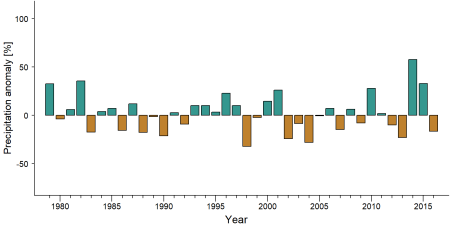
Precipitation anomaly in Banco National Park -
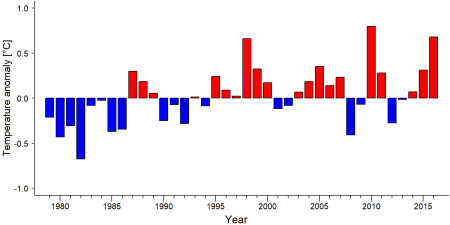
Temperature anomaly in Banco National Park


External links
References
Akaffou, S. V. E., Abrou, N. E. J., & Tiébré, M. S. (2020). Current and future distribution of Chromolaena odorata (L.) R. M. King & H. Roxb (Compositae) and Hopea odorata Roxb (Dipterocarpaceae) in the Banco National Park. IOSR Journal of Pharmacy and Biological Sciences (IOSR-JPBS), 15(2), 6–14.
Bitty, E. A., Kadjo, B., Gonedele Bi, S., Okon, M., & Kouassi, P. (2013). Inventaire de la faune mammalogique d’une forêt urbaine, le Parc National du Banco, Côte d’Ivoire. International Journal of Biological and Chemical Sciences, 7(4), 1678-1687. doi:10.4314/ijbcs.v7i4.23
Kiribou, R., Tehoda, P., Chukwu, O., Bempah, G., Kühl, H. S., Ferreira, J., …, & Heinicke, S. (2024). Exposure of African ape sites to climate change impacts. PLOS Climate, 3(2), e0000345. doi:10.1371/journal.pclm.0000345
Kouadio, K. I., & Singh, R. (n.d.). Urban forest BNP in Abidjan. International Journal for Research in Applied Science & Engineering Technology (IJRASET). https://www.ijraset.com/fileserve.php?FID=32326 doi:10.22214/ijraset.2020.32326
OIPR. (2021). Parc National du Banco. https://www.oipr.ci/index.php/parcs-reserves/parcs-nationaux/parc-national-du-banco link
WCF. (2009). Rapport sur le recensement des chimpanzés dans le Parc National de la Comoé, Côte d’Ivoire. Wild Chimpanzee Foundation. https://www.wildchimps.org/reports/reports.html
Page created by: Tene Sop & Colonel Azani Dede Date: 2021-10-18