
Bulindi Area: Difference between revisions
No edit summary |
No edit summary Tag: Manual revert |
||
| (9 intermediate revisions by the same user not shown) | |||
| Line 13: | Line 13: | ||
* Key threats to chimpanzees are habitat loss, human-chimpanzee conflict, lethal crop protection measures, roads, and diseases. | * Key threats to chimpanzees are habitat loss, human-chimpanzee conflict, lethal crop protection measures, roads, and diseases. | ||
* Conservations activities implemented by the Bulindi Chimpanzee and Community Project focus on supporting local residents through livelihood alternatives to deforestation, extensive tree planting, investing in children’s education, local community outreach, and provision of boreholes and energy stoves. | * Conservations activities implemented by the Bulindi Chimpanzee and Community Project focus on supporting local residents through livelihood alternatives to deforestation, extensive tree planting, investing in children’s education, local community outreach, and provision of boreholes and energy stoves. | ||
[[File:Male_chimpanzees_crossing_the_road_in_Bulindi_(Photo_by_Jacqueline_Rohen)_2.jpg | 350px | thumb| none |Male chimpanzees crossing the road in Bulindi (Photo by Jacqueline Rohen)]] | [[File:Male_chimpanzees_crossing_the_road_in_Bulindi_(Photo_by_Jacqueline_Rohen)_2.jpg | 350px | thumb| none |Male chimpanzees crossing the road in Bulindi (Photo by Jacqueline Rohen)]] | ||
= Site characteristics = | = Site characteristics = | ||
Bulindi (1°29′N, 31°28′E) is situated midway between the Budongo and Bugoma Central Forest Reserves in western Uganda, within the so-called Budongo-Bugoma corridor. Bulindi is unique in that it is a long-term chimpanzee research site located entirely on land belonging to local villagers (McLennan et al. 2020). The site is predominantly agricultural and village land, with remnant patches of unprotected and highly degraded riparian and swamp forest (McLennan & Plumptre 2012). The field site corresponds to the home range of one community of eastern chimpanzees. Black and white colobus monkeys (''Colobus guereza'') also occur at the site; tantalus monkeys (''Chlorocebus tantalus'') and olive baboons (''Papio anubis'') are transitory visitors. | Bulindi (1°29′N, 31°28′E) is situated midway between the Budongo and Bugoma Central Forest Reserves in western Uganda, within the so-called Budongo-Bugoma corridor. Bulindi is unique in that it is a long-term chimpanzee research site located entirely on land belonging to local villagers ([[#R00276|McLennan et al. 2020]]). The site is predominantly agricultural and village land, with remnant patches of unprotected and highly degraded riparian and swamp forest ([[#R00272|McLennan & Plumptre 2012]]). The field site corresponds to the home range of one community of eastern chimpanzees. Black and white colobus monkeys (''Colobus guereza'') also occur at the site; tantalus monkeys (''Chlorocebus tantalus'') and olive baboons (''Papio anubis'') are transitory visitors. | ||
'''Table 1. Basic site information for Bulindi Area''' | '''Table 1. Basic site information for Bulindi Area''' | ||
| Line 48: | Line 44: | ||
= Ape status = | = Ape status = | ||
Community size declined since the first period of research in 2006-2008, when an estimated 30 individuals or more were present (McLennan & Hill 2010): between 2012 (when all individuals were identified) and 2024 community size has numbered 18-22 individuals. The marked decline in community size between 2008 and 2012 is at least partially attributable to trappings (McLennan et al. 2012). The chimpanzee population trend is currently stable due to conservation efforts. | Community size declined since the first period of research in 2006-2008, when an estimated 30 individuals or more were present ([[#R00267|McLennan & Hill 2010]]): between 2012 (when all individuals were identified) and 2024 community size has numbered 18-22 individuals. The marked decline in community size between 2008 and 2012 is at least partially attributable to trappings ([[#R00279|McLennan et al. 2012]]). The chimpanzee population trend is currently stable due to conservation efforts. | ||
'''Table 2. Ape population estimates reported for Bulindi Area''' | '''Table 2. Ape population estimates reported for Bulindi Area''' | ||
| Line 66: | Line 62: | ||
|- | |- | ||
|''Pan troglodytes schweinfurthii'' | |''Pan troglodytes schweinfurthii'' | ||
| | |2024 | ||
| | | | ||
| | | | ||
| Line 74: | Line 70: | ||
|Full count | |Full count | ||
| | | | ||
|BCCP | |[[#R00256|BCCP 2024]] | ||
|Community size has varied between 18-22 individuals (2012- | |Community size has varied between 18-22 individuals (2012-2024). Density estimate is an approximate for the home range. | ||
| | | | ||
|- | |- | ||
|''Pan troglodytes schweinfurthii'' | |''Pan troglodytes schweinfurthii'' | ||
| | |2020 | ||
| | | | ||
| | | | ||
| Line 87: | Line 83: | ||
|Full count | |Full count | ||
| | | | ||
|BCCP | |[[#R02074|BCCP 2020]] | ||
|Community size has varied between 18-22 individuals (2012- | |Community size has varied between 18-22 individuals (2012-2020). Density estimate is an approximate for the home range. | ||
| | | | ||
|} | |} | ||
| Line 96: | Line 92: | ||
= Threats = | = Threats = | ||
More than 80% of the natural forest at Bulindi was converted to farmland in less than 10 years (McLennan et al. 2020; van Dijk et al. 2021). Rapid habitat loss and human encroachment has led to increased conflict between villagers and the resident chimpanzees; loss of wild foods has caused chimpanzees to forage daily for agricultural foods in croplands and around homes (McLennan 2013; McLennan et al. 2020). The chimpanzees are highly threatened by anthropogenic factors including ongoing habitat conversion, lethal crop protection measures (e.g. steel 'mantraps'; McLennan et al. 2012; Cibot et al. 2019a), a busy main road that divides their home range (McLennan & Asiimwe 2016; Tellier et al. 2025), exposure to novel pathogens (McLennan et al. 2017, 2018) and anthropogenic stressors (McLennan et al. 2019a), and habitat loss reducing opportunities for female dispersal (McCarthy et al. 2020). | More than 80% of the natural forest at Bulindi was converted to farmland in less than 10 years ([[#R00276|McLennan et al. 2020]]; van Dijk et al. 2021). Rapid habitat loss and human encroachment has led to increased conflict between villagers and the resident chimpanzees; loss of wild foods has caused chimpanzees to forage daily for agricultural foods in croplands and around homes ([[#R00269|McLennan 2013]]; [[#R00276|McLennan et al. 2020]]). The chimpanzees are highly threatened by anthropogenic factors including ongoing habitat conversion, lethal crop protection measures (e.g. steel 'mantraps'; [[#R00279|McLennan et al. 2012]]; [[#R00257|Cibot et al. 2019a]]), a busy main road that divides their home range ([[#R00266|McLennan & Asiimwe 2016]]; [[#R00282|Tellier et al. 2025]]), exposure to novel pathogens ([[#R00273|McLennan et al. 2017]], 2018) and anthropogenic stressors ([[#R00274|McLennan et al. 2019a]]), and habitat loss reducing opportunities for female dispersal ([[#R00260|McCarthy et al. 2020]]). | ||
'''Table 3. Threats to apes reported for Bulindi Area''' | '''Table 3. Threats to apes reported for Bulindi Area''' | ||
| Line 105: | Line 101: | ||
!Description | !Description | ||
!Year of threat | !Year of threat | ||
|- | |- | ||
|2 Agriculture & aquaculture | |2 Agriculture & aquaculture | ||
|2.1 Annual & perennial non-timber crops | |2.1 Annual & perennial non-timber crops | ||
|High (more than 70% of population affected) | |High (more than 70% of population affected) | ||
|Agricultural expansion for both subsistence crops and cash crops such as sugarcane, tobacco, maize and rice (McLennan & Plumptre 2012; McLennan & Hill 2015). Between 2006 and 2014, 80% of forest in the chimpanzees' home range was cleared entirely for farming (McLennan et al. 2020; van Dijk et al. 2021). | |Agricultural expansion for both subsistence crops and cash crops such as sugarcane, tobacco, maize and rice ([[#R00272|McLennan & Plumptre 2012]]; [[#R00270|McLennan & Hill 2015]]). Between 2006 and 2014, 80% of forest in the chimpanzees' home range was cleared entirely for farming ([[#R00276|McLennan et al. 2020]]; van Dijk et al. 2021). | ||
|2006-Ongoing (2024) | |2006-Ongoing (2024) | ||
|- | |- | ||
|4 Transportation & service corridors | |4 Transportation & service corridors | ||
|4.1 Roads & railroads | |4.1 Roads & railroads | ||
|High (more than 70% of population affected) | |High (more than 70% of population affected) | ||
|A busy main road connecting Hoima and Masindi towns crosses the chimpanzee range. In 2017-28 the road was widened and tarmacked. The chimpanzees cross this road at times on a daily basis, putting them at risk of collision with vehicles (Tellier et al. 2025). 1 adult female chimpanzee, and her infant, were killed crossing the road during 2015-2020 (McLennan & Asiimwe 2016). | |A busy main road connecting Hoima and Masindi towns crosses the chimpanzee range. In 2017-28 the road was widened and tarmacked. The chimpanzees cross this road at times on a daily basis, putting them at risk of collision with vehicles ([[#R00282|Tellier et al. 2025]]). 1 adult female chimpanzee, and her infant, were killed crossing the road during 2015-2020 ([[#R00266|McLennan & Asiimwe 2016]]). | ||
|2015-Ongoing (2024) | |2015-Ongoing (2024) | ||
|- | |- | ||
| | |5 Biological resource use | ||
| | |5.1.5 Persecution/human wildlife conflict | ||
|High (more than 70% of population affected) | |||
|The chimpanzees are at high risk of potentially lethal crop protection measures, particularly large steel leg-hold traps (known as 'mantraps'). Mantraps are placed by agricultural fields by a minority of farmers to deter crop-foraging wildlife including wild pigs, monkeys and the chimpanzees ([[#R00279|McLennan et al. 2012]]; [[#R00257|Cibot et al. 2019a]]). At least 5 chimpanzees caught in steel traps, 2007-2011 ([[#R00279|McLennan et al. 2012]]). | |||
|2007-Ongoing (2024) | |||
|- | |||
|5 Biological resource use | |||
|5.3 Logging & wood harvesting | |||
|High (more than 70% of population affected) | |High (more than 70% of population affected) | ||
| | |Unregulated commercial logging, i.e. local landowners sell trees to timber dealers, and then clear the land for farming ([[#R00272|McLennan & Plumptre 2012]]). Most large trees were logged for timber between c. 2000-2015 (McLennan, unpubl. data). Residents also cut small trees for firewood. | ||
| | |2000-Ongoing (2024) | ||
|- | |- | ||
|6 Human intrusions & disturbance | |6 Human intrusions & disturbance | ||
| Line 153: | Line 131: | ||
|Chimpanzees in Bulindi share their landscape with a high-density human population. The chimpanzees encounter people working in gardens and agricultural fields, or engaged in other work activities (e.g. house building, carpentry, cattle herding), on a daily basis. | |Chimpanzees in Bulindi share their landscape with a high-density human population. The chimpanzees encounter people working in gardens and agricultural fields, or engaged in other work activities (e.g. house building, carpentry, cattle herding), on a daily basis. | ||
|2020-Ongoing (2024) | |2020-Ongoing (2024) | ||
|- | |||
|6 Human intrusions & disturbance | |||
|6.3 Other human disturbances | |||
|High (more than 70% of population affected) | |||
|High exposure to anthropogenic stressors including hostile interactions with local humans, roads, dogs, anthropogenic noise ([[#R00274|McLennan et al. 2019a]]; [[#R00282|Tellier et al. 2025]]). Chimpanzee fecal glucocorticoid metabolite concentrations were substantially higher in chimpanzees in Bulindi compared to conspecifics in minimally-disturbed habitat in nearby Budongo Forest ([[#R00274|McLennan et al. 2019a]]). | |||
|2019-Ongoing (2024) | |||
|- | |- | ||
|7 Natural system modifications | |7 Natural system modifications | ||
| Line 159: | Line 143: | ||
|Fires used for clearing agricultural gardens threaten remaining forest areas during dry seasons. | |Fires used for clearing agricultural gardens threaten remaining forest areas during dry seasons. | ||
|2020-Ongoing (2024) | |2020-Ongoing (2024) | ||
|- | |||
|7 Natural system modifications | |||
|7.3 Other ecosystem modifications | |||
|High (more than 70% of population affected) | |||
|Reduced options for female dispersal caused by clearance of riparian forest corridors ([[#R00260|McCarthy et al. 2020]]). Only 2 females have migrated into the Bulindi community during 2012-2024. | |||
|2012-Ongoing (2024) | |||
|- | |||
|8 Invasive & other problematic species, genes & diseases | |||
|8.4 Pathogens | |||
|High (more than 70% of population affected) | |||
|Chimpanzees in Bulindi have contact with waste of domestic animals and people. A number of potentially pathogenic intestinal parasites that may result from cross-species transmission have been detected in chimpanzees at Bulindi including enterobacteria such as Salmonella spp., enterohemorrhagic Escherichia coli (E. coli) and Shigella spp./enteroinvasive E. coli ([[#R00277|McLennan et al. 2018]]), among various nematode and protozoan parasites ([[#R00280|Ota et al. 2015]]; [[#R00273|McLennan et al. 2017]]). Respiratory diseases circulating in the local human population, including SARS-CoV-2, are also a threat to these chimpanzees ([[#R00283|Tusiime et al. 2024]]). The chimpanzees exhibit an unusually high frequency of self-medication (whole leaf swallowing; [[#R00271|McLennan & Huffman 2012]]; [[#R00273|McLennan et al. 2017]]). | |||
|2012-Ongoing (2024) | |||
|- | |- | ||
|9 Pollution | |9 Pollution | ||
| Line 171: | Line 167: | ||
= Conservation activities = | = Conservation activities = | ||
The Bulindi Chimpanzee and Community Project (BCCP) was initiated in 2015 to help conserve the chimpanzees in Bulindi and their habitat, and provide livelihood support to local households. The project has since expanded to other regions within the [[Budongo-Bugoma corridor]] where chimpanzees survive in unprotected habitat around villages. Main project activities include supporting local residents through livelihood alternatives to deforestation, extensive tree planting, investing in children’s education, local community outreach, and provision of boreholes and energy stoves. These activities help reduce reliance on remaining natural forest and increase tolerance towards chimpanzees. In parallel, BCCP conducts long-term research and monitoring of multiple groups of 'village chimpanzees' (including the Bulindi community) to understand behavioral adaptations to human-driven environmental change, to aid targeted conservation efforts, and mitigate threats to the chimpanzees' welfare and survival (BCCP 2024). | The Bulindi Chimpanzee and Community Project (BCCP) was initiated in 2015 to help conserve the chimpanzees in Bulindi and their habitat, and provide livelihood support to local households. The project has since expanded to other regions within the [[Budongo-Bugoma corridor]] where chimpanzees survive in unprotected habitat around villages. Main project activities include supporting local residents through livelihood alternatives to deforestation, extensive tree planting, investing in children’s education, local community outreach, and provision of boreholes and energy stoves. These activities help reduce reliance on remaining natural forest and increase tolerance towards chimpanzees. In parallel, BCCP conducts long-term research and monitoring of multiple groups of 'village chimpanzees' (including the Bulindi community) to understand behavioral adaptations to human-driven environmental change, to aid targeted conservation efforts, and mitigate threats to the chimpanzees' welfare and survival ([[#R00256|BCCP 2024]]). | ||
'''Table 4. Conservation activities reported for Bulindi Area''' | '''Table 4. Conservation activities reported for Bulindi Area''' | ||
| Line 180: | Line 176: | ||
!Implementing organization(s) | !Implementing organization(s) | ||
!Year of activity | !Year of activity | ||
|- | |- | ||
|1 Development impact mitigation | |1 Development impact mitigation | ||
|1.4 Farm more intensively and effectively in selected areas and spare more natural land | |1.4 Farm more intensively and effectively in selected areas and spare more natural land | ||
|BCCP has a coffee growing alternative livelihood project. The project provides coffee seedlings to farmers and guidance on 'best practice' coffee farming. In contrast to other cash crops (e.g. tobacco and rice), coffee is considered more 'chimpanzee friendly' because farmers establish coffee in existing gardens rather than cutting new gardens in forest or wetlands, and chimpanzees and other primates rarely eat any part of the coffee plant. Coffee matures after 2-3 years and the harvest can contribute significantly to household incomes (BCCP 2024). | |BCCP has a coffee growing alternative livelihood project. The project provides coffee seedlings to farmers and guidance on 'best practice' coffee farming. In contrast to other cash crops (e.g. tobacco and rice), coffee is considered more 'chimpanzee friendly' because farmers establish coffee in existing gardens rather than cutting new gardens in forest or wetlands, and chimpanzees and other primates rarely eat any part of the coffee plant. Coffee matures after 2-3 years and the harvest can contribute significantly to household incomes ([[#R00256|BCCP 2024]]). | ||
|Bulindi Chimpanzee and Community Project | |Bulindi Chimpanzee and Community Project | ||
|2020-Ongoing (2024) | |2020-Ongoing (2024) | ||
| Line 213: | Line 191: | ||
|4 Education & awareness | |4 Education & awareness | ||
|4.1 Educate local communities about apes and sustainable use | |4.1 Educate local communities about apes and sustainable use | ||
|BCCP provides conservation outreach for primary schoolchildren. The program aims to foster interest, empathy, and understanding of chimpanzees, interest in tree planting and awareness of importance of natural forest, and promotes 'safe' behavior for children encountering chimpanzees (BCCP 2020). | |BCCP provides conservation outreach for primary schoolchildren. The program aims to foster interest, empathy, and understanding of chimpanzees, interest in tree planting and awareness of importance of natural forest, and promotes 'safe' behavior for children encountering chimpanzees ([[#R02074|BCCP 2020]]). | ||
|Bulindi Chimpanzee and Community Project | |Bulindi Chimpanzee and Community Project | ||
|2020-Ongoing (2024) | |2020-Ongoing (2024) | ||
|- | |||
|5 Protection & restoration | |||
|5.6 Habitat restoration | |||
|BCCP has an extensive tree planting program in Bulindi since 2015, including raising indigenous tree species for habitat restoration and enrichment, coffee as an alternative livelihood, and fast-growing timber species for sustainable household woodlots. The woodlots provide local households with an alternative source of wood and alternative income from timber sales, reducing reliance on remaining natural forest ([[#R00256|BCCP 2024]]). | |||
|Bulindi Chimpanzee and Community Project | |||
|2015-Ongoing (2024) | |||
|- | |||
|7 Economic & other incentives | |||
|7.1 Provide monetary benefits to local communities for sustainably managing their forest and its wildlife (e.g., REDD, alternative income, employment) | |||
|BCCP supports local households that own areas of natural forest used by the chimpanzees by sponsoring their children's education. Since inception in 2015, this school child sponsorship scheme has been instrumental in conserving remaining patches of riparian forest, following 2 decades of forest clearance in Bulindi ([[#R02074|BCCP 2020]]). | |||
|Bulindi Chimpanzee and Community Project | |||
|2015-Ongoing (2024) | |||
|- | |||
|7 Economic & other incentives | |||
|7.2 Provide non-monetary benefits to local communities for sustainably managing their forest and its wildlife (e.g., better education, infrastructure development) | |||
|BCCP project activities include supporting local residents through livelihood alternatives to deforestation, extensive tree planting, investing in children’s education, and provision of boreholes and energy stoves, helping reduce reliance on remaining natural forest and increase tolerance of chimpanzees. In parallel, BCCP conducts long-term research and monitoring of many of the chimpanzee communities in the Budongo-Bugoma corridor to understand adaptations to human-driven environmental change and mitigate threats to their welfare and survival ([[#R00256|BCCP 2024]]). | |||
|Bulindi Chimpanzee and Community Project | |||
|2015-Ongoing (2024) | |||
|- | |- | ||
|7 Economic & other incentives | |7 Economic & other incentives | ||
| Line 228: | Line 224: | ||
= Challenges = | = Challenges = | ||
Ongoing habitat conversion (clearance of riparian forest for agriculture) (McLennan & Plumptre 2012; McLennan & Hill 2015; McLennan et al. 2020). High levels of human-chimpanzee interactions including habitual feeding on agricultural crops by chimpanzees, frequent harassment of chimpanzees by local residents, occasional chimpanzee aggression towards humans, especially children (McLennan 2008; McLennan & Hill 2012, 2013). Human-human conflicts, i.e. differences between groups or individuals (e.g. local residents, local councillors, and conservation practitioners) about the management and conservation of chimpanzees; politicization of chimpanzees by local politicians (McLennan & Hill 2013). | Ongoing habitat conversion (clearance of riparian forest for agriculture) ([[#R00272|McLennan & Plumptre 2012]]; [[#R00270|McLennan & Hill 2015]]; [[#R00276|McLennan et al. 2020]]). High levels of human-chimpanzee interactions including habitual feeding on agricultural crops by chimpanzees, frequent harassment of chimpanzees by local residents, occasional chimpanzee aggression towards humans, especially children ([[#R00261|McLennan 2008]]; [[#R00268|McLennan & Hill 2012]], 2013). Human-human conflicts, i.e. differences between groups or individuals (e.g. local residents, local councillors, and conservation practitioners) about the management and conservation of chimpanzees; politicization of chimpanzees by local politicians ([[#R00269|McLennan & Hill 2013]]). | ||
'''Table 5. Challenges reported for Bulindi Area''' | '''Table 5. Challenges reported for Bulindi Area''' | ||
| Line 243: | Line 239: | ||
|- | |- | ||
|4 Institutional support | |4 Institutional support | ||
|4. | |4.1 Lack of law enforcement | ||
|McLennan 2008 | |[[#R00261|McLennan 2008]] | ||
| | | | ||
|- | |- | ||
|4 Institutional support | |4 Institutional support | ||
|4. | |4.2 Lack of government support | ||
|McLennan 2008 | |[[#R00261|McLennan 2008]] | ||
| | | | ||
|} | |} | ||
| Line 301: | Line 297: | ||
= Research activities = | = Research activities = | ||
Chimpanzees in Bulindi were first studied in 2006-2008. Research resumed in 2012 and continues to the present; since 2015 the chimpanzees are habituated. Research topics include: (1) chimpanzee dietary, behavioral and socioecological responses to habitat loss, agricultural expansion and increased contact with humans, including crop feeding and human-chimpanzee interactions (e.g. McLennan & Hill 2010; McLennan 2013; McLennan & Hockings 2014; McLennan et al. 2019a, 2020; van Dijk et al. 2021; Satsias et al. 2022); (2) attitudes towards chimpanzees among local residents and constraints to coexistence (e.g. McLennan & Hill 2012, 2013); (3) threats to chimpanzee survival (e.g. McLennan et al. 2012; McLennan & Asiimwe 2016; Cibot et al. 2019a) including road crossing behavior (Tellier et al. 2025); (4) health and disease (e.g. McLennan et al. 2017, 2018); (5) tool use (McLennan 2011a; McLennan et al. 2019b); and (6) paternity and reproductive success (Cibot et al. 2019b; McCarthy et al. 2020). | Chimpanzees in Bulindi were first studied in 2006-2008. Research resumed in 2012 and continues to the present; since 2015 the chimpanzees are habituated. Research topics include: (1) chimpanzee dietary, behavioral and socioecological responses to habitat loss, agricultural expansion and increased contact with humans, including crop feeding and human-chimpanzee interactions (e.g. [[#R00267|McLennan & Hill 2010]]; [[#R00269|McLennan 2013]]; [[#R00275|McLennan & Hockings 2014]]; [[#R00274|McLennan et al. 2019a]], 2020; van Dijk et al. 2021; [[#R00281|Satsias et al. 2022]]); (2) attitudes towards chimpanzees among local residents and constraints to coexistence (e.g. [[#R00268|McLennan & Hill 2012]], 2013); (3) threats to chimpanzee survival (e.g. [[#R00279|McLennan et al. 2012]]; [[#R00266|McLennan & Asiimwe 2016]]; [[#R00257|Cibot et al. 2019a]]) including road crossing behavior ([[#R00282|Tellier et al. 2025]]); (4) health and disease (e.g. [[#R00273|McLennan et al. 2017]], 2018); (5) tool use ([[#R00263|McLennan 2011a]]; [[#R00278|McLennan et al. 2019b]]); and (6) paternity and reproductive success ([[#R00258|Cibot et al. 2019b]]; [[#R00260|McCarthy et al. 2020]]). | ||
[[File: Members_of_the_Bulindi_chimp_community_resting_in_gardens_(Photo_by_Matthew_McLennan)_2.jpg | 350px | thumb| none | Members of the Bulindi chimp community resting in gardens (Photo by Matthew McLennan)]] | [[File: Members_of_the_Bulindi_chimp_community_resting_in_gardens_(Photo_by_Matthew_McLennan)_2.jpg | 350px | thumb| none | Members of the Bulindi chimp community resting in gardens (Photo by Matthew McLennan)]] | ||
| Line 325: | Line 321: | ||
| | | | ||
| | | | ||
|McLennan 2013; McLennan et al. 2020 | |[[#R00269|McLennan 2013]]; [[#R00276|McLennan et al. 2020]] | ||
| | | | ||
| | | | ||
| Line 335: | Line 331: | ||
| | | | ||
| | | | ||
|McLennan & Asiimwe 2016; Tellier et al. 2025 | |[[#R00266|McLennan & Asiimwe 2016]]; [[#R00282|Tellier et al. 2025]] | ||
| | | | ||
| | | | ||
| Line 345: | Line 341: | ||
| | | | ||
| | | | ||
|McLennan et al. 2020 | |[[#R00276|McLennan et al. 2020]] | ||
| | | | ||
| | | | ||
| Line 355: | Line 351: | ||
| | | | ||
| | | | ||
|Cibot et al. 2017 | |[[#R00259|Cibot et al. 2017]] | ||
| | | | ||
| | | | ||
| Line 365: | Line 361: | ||
| | | | ||
| | | | ||
|McLennan & Huffman 2012; McLennan et al. 2017 | |[[#R00271|McLennan & Huffman 2012]]; [[#R00273|McLennan et al. 2017]] | ||
| | | | ||
| | | | ||
| Line 375: | Line 371: | ||
| | | | ||
| | | | ||
|Cibot et al. 2019b | |[[#R00258|Cibot et al. 2019b]] | ||
| | | | ||
| | | | ||
| Line 385: | Line 381: | ||
| | | | ||
| | | | ||
|McLennan 2011a; McLennan et al. 2019b | |[[#R00263|McLennan 2011a]]; [[#R00278|McLennan et al. 2019b]] | ||
| | | | ||
| | | | ||
| Line 395: | Line 391: | ||
| | | | ||
| | | | ||
|McLennan 2011b | |[[#R00264|McLennan 2011b]] | ||
| | | | ||
| | | | ||
| Line 405: | Line 401: | ||
| | | | ||
| | | | ||
|McCarthy et al. 2020 | |[[#R00260|McCarthy et al. 2020]] | ||
| | | | ||
| | | | ||
| Line 415: | Line 411: | ||
| | | | ||
| | | | ||
|McLennan & Hill 2010; McLennan 2010 | |[[#R00267|McLennan & Hill 2010]]; [[#R00262|McLennan 2010]] | ||
| | | | ||
| | | | ||
| Line 425: | Line 421: | ||
| | | | ||
| | | | ||
|McLennan et al. 2019b | |[[#R00278|McLennan et al. 2019b]] | ||
| | | | ||
| | | | ||
| Line 435: | Line 431: | ||
| | | | ||
| | | | ||
|McLennan et al. 2020 | |[[#R00276|McLennan et al. 2020]] | ||
| | | | ||
| | | | ||
| Line 445: | Line 441: | ||
| | | | ||
| | | | ||
|McLennan 2018 | |[[#R00277|McLennan 2018]] | ||
| | | | ||
| | | | ||
| Line 465: | Line 461: | ||
| | | | ||
| | | | ||
|Satsias et al. 2022 | |[[#R00281|Satsias et al. 2022]] | ||
| | | | ||
| | | | ||
| Line 475: | Line 471: | ||
= Exposure to climate change impacts = | = Exposure to climate change impacts = | ||
As part of a study on the exposure of African great ape sites to climate change impacts, Kiribou et al. | As part of a study on the exposure of African great ape sites to climate change impacts, [[#R02164|Kiribou et al. (2024)]] extracted climate data and data on projected extreme climate impact events for the site. Climatological characteristics were derived from observation-based climate data provided by the Inter-Sectoral Impact Model Intercomparison Project (ISIMIP, www.isimip.org). Parameters were calculated as the average across each 30-year period. For 1981-2010, the EWEMBI dataset from ISIMIP2a was used. For the two future periods (2021-2050 and 2071-2099) ISIMIP2b climate data based on four CMIP5 global climate models were used. For future projections, two Representative Concentration Pathways (RCP) were used. RCP 2.6 is a scenario with strong mitigation measures in which global temperatures would likely rise below 2C. RCP 6.0 is a scenario with medium emissions in which global temperatures would likely rise up to 3C by 2100. For the number of days with heavy precipitation events, the 98th percentile of all precipitation days (>1mm/d) was calculated for the 1979-2013 reference period as a threshold for a heavy precipitation event. Then, for each year, the number of days above that threshold was derived. The figures on temperature and precipitation anomaly show the deviation from the mean temperature and mean precipitation for the 1979-2013 reference period. | ||
The estimated exposure to future extreme climate impact events (crop failure, drought, river flood, wildfire, tropical cyclone, and heatwave) is based on a published dataset by Lange et al. 2020 derived from ISIMIP2b data. The same global climate models and RCPs as described above were used. Within each 30-year period, the number of years with an extreme event and the average proportion of the site affected were calculated ( | The estimated exposure to future extreme climate impact events (crop failure, drought, river flood, wildfire, tropical cyclone, and heatwave) is based on a published dataset by Lange et al. 2020 derived from ISIMIP2b data. The same global climate models and RCPs as described above were used. Within each 30-year period, the number of years with an extreme event and the average proportion of the site affected were calculated ([[#R02164|Kiribou et al. 2024]]). | ||
'''Table 8. Estimated past and projected climatological characteristics in Bulindi Area''' | '''Table 8. Estimated past and projected climatological characteristics in Bulindi Area''' | ||
| Line 592: | Line 588: | ||
<div><ul><li style="display: inline-block; vertical-align: top;"> [[File:PrecipAnomaly_Bulindi.png| 450px | thumb| none | Precipitation anomaly | <div><ul><li style="display: inline-block; vertical-align: top;"> [[File:PrecipAnomaly_Bulindi.png| 450px | thumb| none | Precipitation anomaly in Bulindi Area]] </li><li style="display: inline-block; vertical-align: top;"> [[File:TempAnomaly_Bulindi.png | 450px | thumb| none | Temperature anomaly in Bulindi Area]] </li></ul></div> | ||
= External links = | = External links = | ||
| Line 602: | Line 598: | ||
= References = | = References = | ||
BCCP (2024). 2024 | <span id="R00256"></span>BCCP. (2024). 2024 progress report to friends & funders. Bulindi Chimpanzee and Community Project, Hoima, Uganda. | ||
Cibot, M., | |||
Cibot, M., | <span id="R00257"></span>Cibot, M., Le Roux, S., Rohen, J., & McLennan, M. R. (2019a). Death of a trapped chimpanzee: Survival and conservation of great apes in unprotected agricultural areas of Uganda. African Primates, 13, 47–56. [https://www.semanticscholar.org/paper/e4b38d64f1a0639b34f23220d1a5ac3a6f65db6a link] | ||
McCarthy, M.S., Lester, J.D., Cibot, M., Vigilant, L., & McLennan, M.R. (2020). Atypically | <span id="R00258"></span>Cibot, M., McCarthy, M. S., Lester, J. D., Vigilant, L., Sabiiti, T., & McLennan, M. R. (2019b). Infant carrying by a wild chimpanzee father at Bulindi, Uganda. Primates, 60(4), 333–338. https://doi.org/10.1007/s10329-019-00726-z | ||
McLennan, M.R. (2008). Beleaguered | |||
McLennan, M | <span id="R00259"></span>Cibot, M., Sabiiti, T., & McLennan, M. R. (2017). Two Cases of Chimpanzees Interacting with Dead Animals without Food Consumption at Bulindi, Hoima District, Uganda. ''Pan Africa News'', 24(1), 6-8. [https://doi.org/10.5134/226632 doi:10.5134/226632] | ||
McLennan, M. R. ( | <span id="R00260"></span>McCarthy, M. S., Lester, J. D., Cibot, M., Vigilant, L., & McLennan, M. R. (2020). Atypically High Reproductive Skew in a Small Wild Chimpanzee Community in a Human-Dominated Landscape. ''Folia Primatologica'', 91(6), 688-696. [https://doi.org/10.1159/000508609 doi:10.1159/000508609] | ||
<span id="R00261"></span>McLennan, M. R. (2008). Beleaguered Chimpanzees in the Agricultural District of Hoima, Western Uganda. ''Primate Conservation'', 23(1), 45-54. [https://doi.org/10.1896/052.023.0105 doi:10.1896/052.023.0105] | |||
McLennan, M. R. & | <span id="R00262"></span>McLennan, M. (2010). Case study of an unusual human–chimpanzee conflict at Bulindi, Uganda. ''Pan Africa News'', 17(1), 1-4. [https://doi.org/10.5134/143516 doi:10.5134/143516] | ||
McLennan, M.R. & Hill, C.M. ( | |||
McLennan, M.R. | <span id="R00263"></span>McLennan, M. R. (2011a). Preliminary observations of hand-clasp grooming by chimpanzees at Bulindi, Uganda. Pan Africa News, 18(2), 18–20. [https://doi.org/10.5134/152162 doi:10.5134/152162] | ||
<span id="R00264"></span>McLennan, M. R. (2011b). Tool-use to obtain honey by chimpanzees at Bulindi: New record from Uganda. Primates, 52(4), 315–322. https://doi.org/10.1007/s10329-011-0254-6 | |||
McLennan, M.R. & | |||
McLennan, M. R., | <span id="R00265"></span>Mclennan, M. R., & Huffman, M. A. (2012). High Frequency of Leaf Swallowing and its Relationship to Intestinal Parasite Expulsion in “Village” Chimpanzees at Bulindi, Uganda. ''American Journal of Primatology'', 74(7), 642-650. [https://doi.org/10.1002/ajp.22017 doi:10.1002/ajp.22017] | ||
McLennan, M. R., | <span id="R00266"></span>McLennan, M. R., & Asiimwe, C. (2016). Cars kill chimpanzees: case report of a wild chimpanzee killed on a road at Bulindi, Uganda. ''Primates'', 57(3), 377-388. [https://doi.org/10.1007/s10329-016-0528-0 doi:10.1007/s10329-016-0528-0] | ||
McLennan, M. R. | |||
McLennan, M. R., | <span id="R00267"></span>McLennan, M. R., & Hill, C. M. (2010). Chimpanzee responses to researchers in a disturbed forest–farm mosaic at Bulindi, western Uganda. ''American Journal of Primatology'', 72(10), 907-918. [https://doi.org/10.1002/ajp.20839 doi:10.1002/ajp.20839] | ||
McLennan, M. R., | |||
<span id="R00268"></span>McLennan, M. R., & Hill, C. M. (2012). Troublesome neighbours: Changing attitudes towards chimpanzees (Pan troglodytes) in a human-dominated landscape in Uganda. ''Journal for Nature Conservation'', 20(4), 219-227. [https://doi.org/10.1016/j.jnc.2012.03.002 doi:10.1016/j.jnc.2012.03.002] | |||
<span id="R00269"></span>McLennan, M. R., & Hill, C. M. (2013). Ethical issues in the study and conservation of an African great ape in an unprotected, human-dominated landscape in western Uganda. In J. MacClancy & A. Fuentes (Eds.), Ethics in the field: Contemporary challenges (pp. 42–66). Berghahn. | |||
<span id="R00270"></span>McLennan, M. R., & Hill, C. M. (2015). Changing agricultural practices and human-chimpanzee interactions: Tobacco and sugarcane farming in and around Bulindi, Uganda. In Arcus Foundation (Ed.), State of the apes. Volume II: Industrial agriculture and ape conservation (pp. 29–31). Cambridge University Press. | |||
<span id="R00271"></span>Mclennan, M. R., & Huffman, M. A. (2012). High Frequency of Leaf Swallowing and its Relationship to Intestinal Parasite Expulsion in “Village” Chimpanzees at Bulindi, Uganda. ''American Journal of Primatology'', 74(7), 642-650. [https://doi.org/10.1002/ajp.22017 doi:10.1002/ajp.22017] | |||
<span id="R00272"></span>McLennan, M. R., & Plumptre, A. J. (2012). Protected Apes, Unprotected Forest: Composition, Structure and Diversity of Riverine Forest Fragments and Their Conservation Value in Uganda. ''Tropical Conservation Science'', 5(1), 79-103. [https://doi.org/10.1177/194008291200500108 doi:10.1177/194008291200500108] | |||
<span id="R00273"></span>McLennan, M. R., Hasegawa, H., Bardi, M., & Huffman, M. A. (2017). Gastrointestinal parasite infections and self-medication in wild chimpanzees surviving in degraded forest fragments within an agricultural landscape mosaic in Uganda. ''PLOS ONE'', 12(7), e0180431. [https://doi.org/10.1371/journal.pone.0180431 doi:10.1371/journal.pone.0180431] | |||
<span id="R00274"></span>McLennan, M. R., Howell, C. P., Bardi, M., & Heistermann, M. (2019a). Are human-dominated landscapes stressful for wild chimpanzees (Pan troglodytes)?. ''Biological Conservation'', 233, 73-82. [https://doi.org/10.1016/j.biocon.2019.02.028 doi:10.1016/j.biocon.2019.02.028] | |||
<span id="R00275"></span>McLennan, M. R., & Hockings, K. J. (2014). Wild chimpanzees show group differences in selection of agricultural crops. ''Scientific Reports'', 4(1), 5956. [https://doi.org/10.1038/srep05956 doi:10.1038/srep05956] | |||
<span id="R00276"></span>McLennan, M. R., Lorenti, G. A., Sabiiti, T., & Bardi, M. (2020). Forest fragments become farmland: Dietary Response of wild chimpanzees (Pan troglodytes) to fast‐changing anthropogenic landscapes. ''American Journal of Primatology'', 82(4). [https://doi.org/10.1002/ajp.23090 doi:10.1002/ajp.23090] | |||
<span id="R00277"></span>McLennan, M. R., Mori, H., Mahittikorn, A., Prasertbun, R., Hagiwara, K., & Huffman, M. A. (2018). Zoonotic enterobacterial pathogens detected in wild chimpanzees. EcoHealth, 15(1), 143–147. https://doi.org/10.1007/s10393-017-1303-4 | |||
<span id="R00278"></span>McLennan, M. R., Rohen, J., Satsias, Z., Sabiiti, T., Baruzaliire, J. M., & Cibot, M. (2019b). “Customary” use of stick tools by chimpanzees in Bulindi, Uganda: Update and analysis of digging techniques from behavioural observations. Revue de Primatologie, 10. https://doi.org/10.4000/primatologie.6706 | |||
<span id="R00279"></span>McLennan, M. R., Hyeroba, D., Asiimwe, C., Reynolds, V., & Wallis, J. (2012). Chimpanzees in mantraps: lethal crop protection and conservation in Uganda. ''Oryx'', 46(4), 598-603. [https://doi.org/10.1017/s0030605312000592 doi:10.1017/s0030605312000592] | |||
<span id="R00280"></span>Ota, N., Hasegawa, H., McLennan, M. R., Kooriyama, T., Sato, H., Pebsworth, P. A., & Huffman, M. A. (2015). Molecular identification of Oesophagostomum spp. from ‘village’ chimpanzees in Uganda and their phylogenetic relationship with those of other primates. ''Royal Society Open Science'', 2(11), 150471. [https://doi.org/10.1098/rsos.150471 doi:10.1098/rsos.150471] | |||
<span id="R00281"></span>Satsias, Z. M., Silk, M. J., Hockings, K. J., Cibot, M., Rohen, J., & McLennan, M. R. (2022). Sex-specific responses to anthropogenic risk shape wild chimpanzee social networks in a human-impacted landscape. ''Animal Behaviour'', 186, 29-40. [https://doi.org/10.1016/j.anbehav.2022.01.016 doi:10.1016/j.anbehav.2022.01.016] | |||
<span id="R00282"></span>Tellier, M., Druelle, F., Cibot, M., Baruzaliire, J., Sabiiti, T., & McLennan, M. R. (2025). Running the Risk: Road‐Crossing Behavior in Wild Chimpanzees ( Pan troglodytes ) in an Anthropogenic Habitat in Uganda. ''American Journal of Primatology'', 87(2). [https://doi.org/10.1002/ajp.70000 doi:10.1002/ajp.70000] | |||
<span id="R00283"></span>Tusiime, P., Weary, T., Pappas, T., Tuhaise, S., Akankwasa, J. W., Sempebwa, D., …, & Goldberg, T. (2024). Pediatric Respiratory Pathogens Circulate in Children and Adults in Communities Near Susceptible Wild Great Ape Populations in Uganda. ''Transboundary and Emerging Diseases'', 2024(1), 1771163. [https://doi.org/10.1155/2024/1771163 doi:10.1155/2024/1771163] | |||
<span id="R02074"></span>BCCP. (2020). 2019 annual report to friends & funders. Bulindi Chimpanzee and Community Project, Hoima, Uganda. | |||
<span id="R02164"></span>Kiribou, R., Tehoda, P., Chukwu, O., Bempah, G., Kühl, H. S., Ferreira, J., …, & Heinicke, S. (2024). Exposure of African ape sites to climate change impacts. ''PLOS Climate'', 3(2), e0000345. [https://doi.org/10.1371/journal.pclm.0000345 doi:10.1371/journal.pclm.0000345] | |||
Latest revision as of 17:52, 15 October 2026
East Africa > Uganda > Bulindi Area
Français | Português | Español | Bahasa Indonesia | Melayu
Summary
- Eastern chimpanzees (Pan troglodytes schweinfurthii) are present in Bulindi.
- One chimpanzee community is present in Bulindi; community size varied between 20 and 22 individuals in 2020-2024.
- The chimpanzee population trend was decreasing but is currently stable due to conservation efforts.
- The site has a total size of 25 km².
- Key threats to chimpanzees are habitat loss, human-chimpanzee conflict, lethal crop protection measures, roads, and diseases.
- Conservations activities implemented by the Bulindi Chimpanzee and Community Project focus on supporting local residents through livelihood alternatives to deforestation, extensive tree planting, investing in children’s education, local community outreach, and provision of boreholes and energy stoves.

Site characteristics
Bulindi (1°29′N, 31°28′E) is situated midway between the Budongo and Bugoma Central Forest Reserves in western Uganda, within the so-called Budongo-Bugoma corridor. Bulindi is unique in that it is a long-term chimpanzee research site located entirely on land belonging to local villagers (McLennan et al. 2020). The site is predominantly agricultural and village land, with remnant patches of unprotected and highly degraded riparian and swamp forest (McLennan & Plumptre 2012). The field site corresponds to the home range of one community of eastern chimpanzees. Black and white colobus monkeys (Colobus guereza) also occur at the site; tantalus monkeys (Chlorocebus tantalus) and olive baboons (Papio anubis) are transitory visitors.
Table 1. Basic site information for Bulindi Area
| Species | Pan troglodytes schweinfurthii |
| Area | 25 km² |
| Coordinates | Lat: 1.483333 , Lon: 31.466667 |
| Type of site | Non-protected area |
| Habitat types | Subtropical/tropical swamp forest, Agricultural land, Urban areas, Subtropical/tropical heavily degraded former forest |
| Type of governance |
Types of sites Governance types Habitat types

Ape status
Community size declined since the first period of research in 2006-2008, when an estimated 30 individuals or more were present (McLennan & Hill 2010): between 2012 (when all individuals were identified) and 2024 community size has numbered 18-22 individuals. The marked decline in community size between 2008 and 2012 is at least partially attributable to trappings (McLennan et al. 2012). The chimpanzee population trend is currently stable due to conservation efforts.
Table 2. Ape population estimates reported for Bulindi Area
| Species | Year | Occurrence | Encounter or vistation rate (nests/km; ind/day) | Density estimate [ind./ km²] (95% CI) | Abundance estimate (95% CI) | Survey area | Sampling method | Analytical framework | Source | Comments | A.P.E.S. database ID |
|---|---|---|---|---|---|---|---|---|---|---|---|
| Pan troglodytes schweinfurthii | 2024 | 1 | 22.0 | Bulindi | Full count | BCCP 2024 | Community size has varied between 18-22 individuals (2012-2024). Density estimate is an approximate for the home range. | ||||
| Pan troglodytes schweinfurthii | 2020 | 1 | 22.0 | Bulindi | Full count | BCCP 2020 | Community size has varied between 18-22 individuals (2012-2020). Density estimate is an approximate for the home range. |
Sampling methods Analytical frameworks
Threats
More than 80% of the natural forest at Bulindi was converted to farmland in less than 10 years (McLennan et al. 2020; van Dijk et al. 2021). Rapid habitat loss and human encroachment has led to increased conflict between villagers and the resident chimpanzees; loss of wild foods has caused chimpanzees to forage daily for agricultural foods in croplands and around homes (McLennan 2013; McLennan et al. 2020). The chimpanzees are highly threatened by anthropogenic factors including ongoing habitat conversion, lethal crop protection measures (e.g. steel 'mantraps'; McLennan et al. 2012; Cibot et al. 2019a), a busy main road that divides their home range (McLennan & Asiimwe 2016; Tellier et al. 2025), exposure to novel pathogens (McLennan et al. 2017, 2018) and anthropogenic stressors (McLennan et al. 2019a), and habitat loss reducing opportunities for female dispersal (McCarthy et al. 2020).
Table 3. Threats to apes reported for Bulindi Area
| Category | Specific threats | Threat level | Description | Year of threat |
|---|---|---|---|---|
| 2 Agriculture & aquaculture | 2.1 Annual & perennial non-timber crops | High (more than 70% of population affected) | Agricultural expansion for both subsistence crops and cash crops such as sugarcane, tobacco, maize and rice (McLennan & Plumptre 2012; McLennan & Hill 2015). Between 2006 and 2014, 80% of forest in the chimpanzees' home range was cleared entirely for farming (McLennan et al. 2020; van Dijk et al. 2021). | 2006-Ongoing (2024) |
| 4 Transportation & service corridors | 4.1 Roads & railroads | High (more than 70% of population affected) | A busy main road connecting Hoima and Masindi towns crosses the chimpanzee range. In 2017-28 the road was widened and tarmacked. The chimpanzees cross this road at times on a daily basis, putting them at risk of collision with vehicles (Tellier et al. 2025). 1 adult female chimpanzee, and her infant, were killed crossing the road during 2015-2020 (McLennan & Asiimwe 2016). | 2015-Ongoing (2024) |
| 5 Biological resource use | 5.1.5 Persecution/human wildlife conflict | High (more than 70% of population affected) | The chimpanzees are at high risk of potentially lethal crop protection measures, particularly large steel leg-hold traps (known as 'mantraps'). Mantraps are placed by agricultural fields by a minority of farmers to deter crop-foraging wildlife including wild pigs, monkeys and the chimpanzees (McLennan et al. 2012; Cibot et al. 2019a). At least 5 chimpanzees caught in steel traps, 2007-2011 (McLennan et al. 2012). | 2007-Ongoing (2024) |
| 5 Biological resource use | 5.3 Logging & wood harvesting | High (more than 70% of population affected) | Unregulated commercial logging, i.e. local landowners sell trees to timber dealers, and then clear the land for farming (McLennan & Plumptre 2012). Most large trees were logged for timber between c. 2000-2015 (McLennan, unpubl. data). Residents also cut small trees for firewood. | 2000-Ongoing (2024) |
| 6 Human intrusions & disturbance | 6.3 Other human disturbances | High (more than 70% of population affected) | Chimpanzees in Bulindi share their landscape with a high-density human population. The chimpanzees encounter people working in gardens and agricultural fields, or engaged in other work activities (e.g. house building, carpentry, cattle herding), on a daily basis. | 2020-Ongoing (2024) |
| 6 Human intrusions & disturbance | 6.3 Other human disturbances | High (more than 70% of population affected) | High exposure to anthropogenic stressors including hostile interactions with local humans, roads, dogs, anthropogenic noise (McLennan et al. 2019a; Tellier et al. 2025). Chimpanzee fecal glucocorticoid metabolite concentrations were substantially higher in chimpanzees in Bulindi compared to conspecifics in minimally-disturbed habitat in nearby Budongo Forest (McLennan et al. 2019a). | 2019-Ongoing (2024) |
| 7 Natural system modifications | 7.1 Fire & fire suppression | Medium (30-70% of population affected) | Fires used for clearing agricultural gardens threaten remaining forest areas during dry seasons. | 2020-Ongoing (2024) |
| 7 Natural system modifications | 7.3 Other ecosystem modifications | High (more than 70% of population affected) | Reduced options for female dispersal caused by clearance of riparian forest corridors (McCarthy et al. 2020). Only 2 females have migrated into the Bulindi community during 2012-2024. | 2012-Ongoing (2024) |
| 8 Invasive & other problematic species, genes & diseases | 8.4 Pathogens | High (more than 70% of population affected) | Chimpanzees in Bulindi have contact with waste of domestic animals and people. A number of potentially pathogenic intestinal parasites that may result from cross-species transmission have been detected in chimpanzees at Bulindi including enterobacteria such as Salmonella spp., enterohemorrhagic Escherichia coli (E. coli) and Shigella spp./enteroinvasive E. coli (McLennan et al. 2018), among various nematode and protozoan parasites (Ota et al. 2015; McLennan et al. 2017). Respiratory diseases circulating in the local human population, including SARS-CoV-2, are also a threat to these chimpanzees (Tusiime et al. 2024). The chimpanzees exhibit an unusually high frequency of self-medication (whole leaf swallowing; McLennan & Huffman 2012; McLennan et al. 2017). | 2012-Ongoing (2024) |
| 9 Pollution | 9.3 Agricultural & forestry effluents | High (more than 70% of population affected) | Local farmers commonly use inorganic herbicides and pesticides; potential impacts on the chimpanzees are not yet known. | 2020-Ongoing (2024) |
Conservation activities
The Bulindi Chimpanzee and Community Project (BCCP) was initiated in 2015 to help conserve the chimpanzees in Bulindi and their habitat, and provide livelihood support to local households. The project has since expanded to other regions within the Budongo-Bugoma corridor where chimpanzees survive in unprotected habitat around villages. Main project activities include supporting local residents through livelihood alternatives to deforestation, extensive tree planting, investing in children’s education, local community outreach, and provision of boreholes and energy stoves. These activities help reduce reliance on remaining natural forest and increase tolerance towards chimpanzees. In parallel, BCCP conducts long-term research and monitoring of multiple groups of 'village chimpanzees' (including the Bulindi community) to understand behavioral adaptations to human-driven environmental change, to aid targeted conservation efforts, and mitigate threats to the chimpanzees' welfare and survival (BCCP 2024).
Table 4. Conservation activities reported for Bulindi Area
| Category | Specific activity | Description | Implementing organization(s) | Year of activity |
|---|---|---|---|---|
| 1 Development impact mitigation | 1.4 Farm more intensively and effectively in selected areas and spare more natural land | BCCP has a coffee growing alternative livelihood project. The project provides coffee seedlings to farmers and guidance on 'best practice' coffee farming. In contrast to other cash crops (e.g. tobacco and rice), coffee is considered more 'chimpanzee friendly' because farmers establish coffee in existing gardens rather than cutting new gardens in forest or wetlands, and chimpanzees and other primates rarely eat any part of the coffee plant. Coffee matures after 2-3 years and the harvest can contribute significantly to household incomes (BCCP 2024). | Bulindi Chimpanzee and Community Project | 2020-Ongoing (2024) |
| 3 Species health | 3.1 Wear face-masks to avoid transmission of viral and bacterial diseases to primates | Strict use of face masks and hand sanitisers by researchers and local 'Chimpanzee Monitors' entering forest areas, and when in proximity to chimpanzees; bespoke health and hygiene training provided to all staff (BCCP, unpublished data). | Bulindi Chimpanzee and Community Project | 2020-Ongoing (2024) |
| 4 Education & awareness | 4.1 Educate local communities about apes and sustainable use | BCCP provides conservation outreach for primary schoolchildren. The program aims to foster interest, empathy, and understanding of chimpanzees, interest in tree planting and awareness of importance of natural forest, and promotes 'safe' behavior for children encountering chimpanzees (BCCP 2020). | Bulindi Chimpanzee and Community Project | 2020-Ongoing (2024) |
| 5 Protection & restoration | 5.6 Habitat restoration | BCCP has an extensive tree planting program in Bulindi since 2015, including raising indigenous tree species for habitat restoration and enrichment, coffee as an alternative livelihood, and fast-growing timber species for sustainable household woodlots. The woodlots provide local households with an alternative source of wood and alternative income from timber sales, reducing reliance on remaining natural forest (BCCP 2024). | Bulindi Chimpanzee and Community Project | 2015-Ongoing (2024) |
| 7 Economic & other incentives | 7.1 Provide monetary benefits to local communities for sustainably managing their forest and its wildlife (e.g., REDD, alternative income, employment) | BCCP supports local households that own areas of natural forest used by the chimpanzees by sponsoring their children's education. Since inception in 2015, this school child sponsorship scheme has been instrumental in conserving remaining patches of riparian forest, following 2 decades of forest clearance in Bulindi (BCCP 2020). | Bulindi Chimpanzee and Community Project | 2015-Ongoing (2024) |
| 7 Economic & other incentives | 7.2 Provide non-monetary benefits to local communities for sustainably managing their forest and its wildlife (e.g., better education, infrastructure development) | BCCP project activities include supporting local residents through livelihood alternatives to deforestation, extensive tree planting, investing in children’s education, and provision of boreholes and energy stoves, helping reduce reliance on remaining natural forest and increase tolerance of chimpanzees. In parallel, BCCP conducts long-term research and monitoring of many of the chimpanzee communities in the Budongo-Bugoma corridor to understand adaptations to human-driven environmental change and mitigate threats to their welfare and survival (BCCP 2024). | Bulindi Chimpanzee and Community Project | 2015-Ongoing (2024) |
| 7 Economic & other incentives | 7.2 Provide non-monetary benefits to local communities for sustainably managing their forest and its wildlife (e.g., better education, infrastructure development) | In partnership with water charities (BridgIT, Drop4Drop and Suubi Community Projects–Uganda), BCCP constructs village boreholes (water wells) for local communities to improve health and quality of life by providing residents in chimpanzee areas with access to clean, safe water away from the forest. The wells reduce negative encounters between chimpanzees and people (often children) collecting water at forest streams. BCCP also constructs energy-saving stoves for residents, helping reduce household fuel consumption, alleviating pressure on chimpanzee habitat, while providing households with safer, more efficient cook stoves. | Bulindi Chimpanzee and Community Project, BridgIT, Drop4Drop and Suubi Community Projects–Uganda | 2020-Ongoing (2024) |
Challenges
Ongoing habitat conversion (clearance of riparian forest for agriculture) (McLennan & Plumptre 2012; McLennan & Hill 2015; McLennan et al. 2020). High levels of human-chimpanzee interactions including habitual feeding on agricultural crops by chimpanzees, frequent harassment of chimpanzees by local residents, occasional chimpanzee aggression towards humans, especially children (McLennan 2008; McLennan & Hill 2012, 2013). Human-human conflicts, i.e. differences between groups or individuals (e.g. local residents, local councillors, and conservation practitioners) about the management and conservation of chimpanzees; politicization of chimpanzees by local politicians (McLennan & Hill 2013).
Table 5. Challenges reported for Bulindi Area
| Challenges | Specific challenges | Source | Year(s) |
|---|---|---|---|
| 2 Resources and capacity | 2.3 General lack of funding | McLennan pers. comm. | |
| 4 Institutional support | 4.1 Lack of law enforcement | McLennan 2008 | |
| 4 Institutional support | 4.2 Lack of government support | McLennan 2008 |

Enablers
Table 6. Enablers reported for Bulindi Area
| Enablers | Specific enablers | Source | Year(s) |
|---|---|---|---|
| 1 Site management | |||
| 2 Resources and capacity | |||
| 3 Engaged community | |||
| 4 Institutional support | |||
| 5 Ecological context | |||
| 6 Safety and stability |
Research activities
Chimpanzees in Bulindi were first studied in 2006-2008. Research resumed in 2012 and continues to the present; since 2015 the chimpanzees are habituated. Research topics include: (1) chimpanzee dietary, behavioral and socioecological responses to habitat loss, agricultural expansion and increased contact with humans, including crop feeding and human-chimpanzee interactions (e.g. McLennan & Hill 2010; McLennan 2013; McLennan & Hockings 2014; McLennan et al. 2019a, 2020; van Dijk et al. 2021; Satsias et al. 2022); (2) attitudes towards chimpanzees among local residents and constraints to coexistence (e.g. McLennan & Hill 2012, 2013); (3) threats to chimpanzee survival (e.g. McLennan et al. 2012; McLennan & Asiimwe 2016; Cibot et al. 2019a) including road crossing behavior (Tellier et al. 2025); (4) health and disease (e.g. McLennan et al. 2017, 2018); (5) tool use (McLennan 2011a; McLennan et al. 2019b); and (6) paternity and reproductive success (Cibot et al. 2019b; McCarthy et al. 2020).

Documented behaviours
Table 7. Behaviours documented for Bulindi Area
| Category | Behavior | Observation type | Prevalence | Observation dates | Source | Habituation | Species | Comment |
|---|---|---|---|---|---|---|---|---|
| Crop feeding | McLennan 2013; McLennan et al. 2020 | |||||||
| Road crossing | McLennan & Asiimwe 2016; Tellier et al. 2025 | |||||||
| Food sharing (agricultural crops) | McLennan et al. 2020 | |||||||
| Hunting animals without consumption | Cibot et al. 2017 | |||||||
| Self medication (leaf swallowing) | McLennan & Huffman 2012; McLennan et al. 2017 | |||||||
| Infant carrying by male chimpanzees | Cibot et al. 2019b | |||||||
| Honey digging with stick tools | McLennan 2011a; McLennan et al. 2019b | |||||||
| Hand-clasp grooming | McLennan 2011b | |||||||
| High male reproductive skew | McCarthy et al. 2020 | |||||||
| Chimpanzee-villager interactions (including human directed aggression) | McLennan & Hill 2010; McLennan 2010 | |||||||
| Tool-assisted extractive foraging | McLennan et al. 2019b | |||||||
| Foraging adaptations to forest loss | McLennan et al. 2020 | |||||||
| Nest tying | McLennan 2018 | |||||||
| Nesting adaptations to forest loss | van Dijk et al. 2021 | |||||||
| Socio-ecological adaptations to forest loss | Satsias et al. 2022 |
Exposure to climate change impacts
As part of a study on the exposure of African great ape sites to climate change impacts, Kiribou et al. (2024) extracted climate data and data on projected extreme climate impact events for the site. Climatological characteristics were derived from observation-based climate data provided by the Inter-Sectoral Impact Model Intercomparison Project (ISIMIP, www.isimip.org). Parameters were calculated as the average across each 30-year period. For 1981-2010, the EWEMBI dataset from ISIMIP2a was used. For the two future periods (2021-2050 and 2071-2099) ISIMIP2b climate data based on four CMIP5 global climate models were used. For future projections, two Representative Concentration Pathways (RCP) were used. RCP 2.6 is a scenario with strong mitigation measures in which global temperatures would likely rise below 2C. RCP 6.0 is a scenario with medium emissions in which global temperatures would likely rise up to 3C by 2100. For the number of days with heavy precipitation events, the 98th percentile of all precipitation days (>1mm/d) was calculated for the 1979-2013 reference period as a threshold for a heavy precipitation event. Then, for each year, the number of days above that threshold was derived. The figures on temperature and precipitation anomaly show the deviation from the mean temperature and mean precipitation for the 1979-2013 reference period.
The estimated exposure to future extreme climate impact events (crop failure, drought, river flood, wildfire, tropical cyclone, and heatwave) is based on a published dataset by Lange et al. 2020 derived from ISIMIP2b data. The same global climate models and RCPs as described above were used. Within each 30-year period, the number of years with an extreme event and the average proportion of the site affected were calculated (Kiribou et al. 2024).
Table 8. Estimated past and projected climatological characteristics in Bulindi Area
| Value | 1981-2010 | 2021-2050, RCP 2.6 | 2021-2050, RCP 6.0 | 2071-2099, RCP 2.6 | 2071-2099, RCP 6.0 |
|---|---|---|---|---|---|
| Mean temperature [C] | 23.1 | 24.2 | 24.2 | 24.5 | 25.6 |
| Annual precipitation [mm] | 1245 | 1265 | 1332 | 1187 | 1451 |
| Max no. consecutive dry days (per year) | 25.2 | 25.5 | 30.4 | 27.6 | 28.5 |
| No. days with heavy precipitation (per year) | 5.9 | 5.1 | 4.7 | 5.8 | 8.4 |
Table 9. Projected exposure of apes to extreme climate impact events in Bulindi Area
| Type | No. of years with event (2021-2050, RCP 2.6) | % of site exposed (2021-2050, RCP 2.6) | No. of years with event (2021-2050, RCP 6.0) | % of site exposed (2021-2050, RCP 6.0) | No. of years with event (2070-2099, RCP 2.6) | % of site exposed (2070-2099, RCP 2.6) | No. of years with event (2070-2099, RCP 6.0) | % of site exposed (2070-2099, RCP 6.0) |
|---|---|---|---|---|---|---|---|---|
| Crop failure | 4 | 0.82 | 2 | 0.61 | 3 | 1.13 | 10 | 0.49 |
| Drought | 0 | 0 | 0 | 0 | 0 | 0 | 0 | 0 |
| Heatwave | 0 | 0 | 0 | 0 | 0 | 0 | 0.5 | 50 |
| River flood | 1.25 | 0.59 | 4 | 2.46 | 1 | 0.66 | 5.25 | 3.51 |
| Tropical cyclone | 0 | 0 | 0 | 0 | 0 | 0 | 0 | 0 |
| Wildfire | 30 | 2.26 | 30 | 1.91 | 29 | 1.57 | 29 | 1.37 |
-
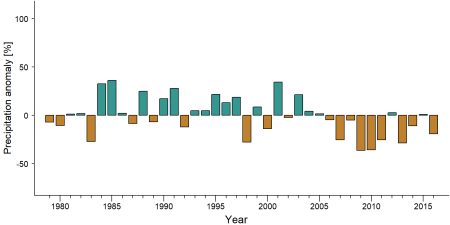
Precipitation anomaly in Bulindi Area -
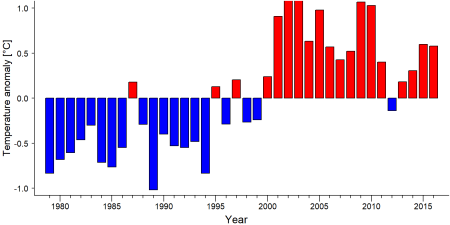
Temperature anomaly in Bulindi Area


External links
References
BCCP. (2024). 2024 progress report to friends & funders. Bulindi Chimpanzee and Community Project, Hoima, Uganda.
Cibot, M., Le Roux, S., Rohen, J., & McLennan, M. R. (2019a). Death of a trapped chimpanzee: Survival and conservation of great apes in unprotected agricultural areas of Uganda. African Primates, 13, 47–56. link
Cibot, M., McCarthy, M. S., Lester, J. D., Vigilant, L., Sabiiti, T., & McLennan, M. R. (2019b). Infant carrying by a wild chimpanzee father at Bulindi, Uganda. Primates, 60(4), 333–338. https://doi.org/10.1007/s10329-019-00726-z
Cibot, M., Sabiiti, T., & McLennan, M. R. (2017). Two Cases of Chimpanzees Interacting with Dead Animals without Food Consumption at Bulindi, Hoima District, Uganda. Pan Africa News, 24(1), 6-8. doi:10.5134/226632
McCarthy, M. S., Lester, J. D., Cibot, M., Vigilant, L., & McLennan, M. R. (2020). Atypically High Reproductive Skew in a Small Wild Chimpanzee Community in a Human-Dominated Landscape. Folia Primatologica, 91(6), 688-696. doi:10.1159/000508609
McLennan, M. R. (2008). Beleaguered Chimpanzees in the Agricultural District of Hoima, Western Uganda. Primate Conservation, 23(1), 45-54. doi:10.1896/052.023.0105
McLennan, M. (2010). Case study of an unusual human–chimpanzee conflict at Bulindi, Uganda. Pan Africa News, 17(1), 1-4. doi:10.5134/143516
McLennan, M. R. (2011a). Preliminary observations of hand-clasp grooming by chimpanzees at Bulindi, Uganda. Pan Africa News, 18(2), 18–20. doi:10.5134/152162
McLennan, M. R. (2011b). Tool-use to obtain honey by chimpanzees at Bulindi: New record from Uganda. Primates, 52(4), 315–322. https://doi.org/10.1007/s10329-011-0254-6
Mclennan, M. R., & Huffman, M. A. (2012). High Frequency of Leaf Swallowing and its Relationship to Intestinal Parasite Expulsion in “Village” Chimpanzees at Bulindi, Uganda. American Journal of Primatology, 74(7), 642-650. doi:10.1002/ajp.22017
McLennan, M. R., & Asiimwe, C. (2016). Cars kill chimpanzees: case report of a wild chimpanzee killed on a road at Bulindi, Uganda. Primates, 57(3), 377-388. doi:10.1007/s10329-016-0528-0
McLennan, M. R., & Hill, C. M. (2010). Chimpanzee responses to researchers in a disturbed forest–farm mosaic at Bulindi, western Uganda. American Journal of Primatology, 72(10), 907-918. doi:10.1002/ajp.20839
McLennan, M. R., & Hill, C. M. (2012). Troublesome neighbours: Changing attitudes towards chimpanzees (Pan troglodytes) in a human-dominated landscape in Uganda. Journal for Nature Conservation, 20(4), 219-227. doi:10.1016/j.jnc.2012.03.002
McLennan, M. R., & Hill, C. M. (2013). Ethical issues in the study and conservation of an African great ape in an unprotected, human-dominated landscape in western Uganda. In J. MacClancy & A. Fuentes (Eds.), Ethics in the field: Contemporary challenges (pp. 42–66). Berghahn.
McLennan, M. R., & Hill, C. M. (2015). Changing agricultural practices and human-chimpanzee interactions: Tobacco and sugarcane farming in and around Bulindi, Uganda. In Arcus Foundation (Ed.), State of the apes. Volume II: Industrial agriculture and ape conservation (pp. 29–31). Cambridge University Press.
Mclennan, M. R., & Huffman, M. A. (2012). High Frequency of Leaf Swallowing and its Relationship to Intestinal Parasite Expulsion in “Village” Chimpanzees at Bulindi, Uganda. American Journal of Primatology, 74(7), 642-650. doi:10.1002/ajp.22017
McLennan, M. R., & Plumptre, A. J. (2012). Protected Apes, Unprotected Forest: Composition, Structure and Diversity of Riverine Forest Fragments and Their Conservation Value in Uganda. Tropical Conservation Science, 5(1), 79-103. doi:10.1177/194008291200500108
McLennan, M. R., Hasegawa, H., Bardi, M., & Huffman, M. A. (2017). Gastrointestinal parasite infections and self-medication in wild chimpanzees surviving in degraded forest fragments within an agricultural landscape mosaic in Uganda. PLOS ONE, 12(7), e0180431. doi:10.1371/journal.pone.0180431
McLennan, M. R., Howell, C. P., Bardi, M., & Heistermann, M. (2019a). Are human-dominated landscapes stressful for wild chimpanzees (Pan troglodytes)?. Biological Conservation, 233, 73-82. doi:10.1016/j.biocon.2019.02.028
McLennan, M. R., & Hockings, K. J. (2014). Wild chimpanzees show group differences in selection of agricultural crops. Scientific Reports, 4(1), 5956. doi:10.1038/srep05956
McLennan, M. R., Lorenti, G. A., Sabiiti, T., & Bardi, M. (2020). Forest fragments become farmland: Dietary Response of wild chimpanzees (Pan troglodytes) to fast‐changing anthropogenic landscapes. American Journal of Primatology, 82(4). doi:10.1002/ajp.23090
McLennan, M. R., Mori, H., Mahittikorn, A., Prasertbun, R., Hagiwara, K., & Huffman, M. A. (2018). Zoonotic enterobacterial pathogens detected in wild chimpanzees. EcoHealth, 15(1), 143–147. https://doi.org/10.1007/s10393-017-1303-4
McLennan, M. R., Rohen, J., Satsias, Z., Sabiiti, T., Baruzaliire, J. M., & Cibot, M. (2019b). “Customary” use of stick tools by chimpanzees in Bulindi, Uganda: Update and analysis of digging techniques from behavioural observations. Revue de Primatologie, 10. https://doi.org/10.4000/primatologie.6706
McLennan, M. R., Hyeroba, D., Asiimwe, C., Reynolds, V., & Wallis, J. (2012). Chimpanzees in mantraps: lethal crop protection and conservation in Uganda. Oryx, 46(4), 598-603. doi:10.1017/s0030605312000592
Ota, N., Hasegawa, H., McLennan, M. R., Kooriyama, T., Sato, H., Pebsworth, P. A., & Huffman, M. A. (2015). Molecular identification of Oesophagostomum spp. from ‘village’ chimpanzees in Uganda and their phylogenetic relationship with those of other primates. Royal Society Open Science, 2(11), 150471. doi:10.1098/rsos.150471
Satsias, Z. M., Silk, M. J., Hockings, K. J., Cibot, M., Rohen, J., & McLennan, M. R. (2022). Sex-specific responses to anthropogenic risk shape wild chimpanzee social networks in a human-impacted landscape. Animal Behaviour, 186, 29-40. doi:10.1016/j.anbehav.2022.01.016
Tellier, M., Druelle, F., Cibot, M., Baruzaliire, J., Sabiiti, T., & McLennan, M. R. (2025). Running the Risk: Road‐Crossing Behavior in Wild Chimpanzees ( Pan troglodytes ) in an Anthropogenic Habitat in Uganda. American Journal of Primatology, 87(2). doi:10.1002/ajp.70000
Tusiime, P., Weary, T., Pappas, T., Tuhaise, S., Akankwasa, J. W., Sempebwa, D., …, & Goldberg, T. (2024). Pediatric Respiratory Pathogens Circulate in Children and Adults in Communities Near Susceptible Wild Great Ape Populations in Uganda. Transboundary and Emerging Diseases, 2024(1), 1771163. doi:10.1155/2024/1771163
BCCP. (2020). 2019 annual report to friends & funders. Bulindi Chimpanzee and Community Project, Hoima, Uganda.
Kiribou, R., Tehoda, P., Chukwu, O., Bempah, G., Kühl, H. S., Ferreira, J., …, & Heinicke, S. (2024). Exposure of African ape sites to climate change impacts. PLOS Climate, 3(2), e0000345. doi:10.1371/journal.pclm.0000345
Page created by: Matthew McLennan, Maureen McCarthy & Jack Lester Date: 2021-01-04
Page updated by: Matthew McLennan Date: 2024-12-23