
Cantanhez National Park: Difference between revisions
No edit summary |
No edit summary Tag: Manual revert |
||
| (7 intermediate revisions by the same user not shown) | |||
| Line 17: | Line 17: | ||
= Site characteristics = | = Site characteristics = | ||
Cantanhez is one of the last remaining fragments of humid forest in West Africa. It has been identified as one of the 200 most important ecoregions in the world by WWF and as one of seven priority areas in West Africa for chimpanzee conservation efforts (Kormos et al. 2003). The Cantanhez National Park (CNP) is a mosaic of settlements, agricultural fields, sub-humid forest, secondary forest, mangrove, and savanna (Catarino 2004). The rainfall in Guinea-Bissau is bimodal with a long dry season from November to May and a rainy season from mid-May to October (Catarino 2004). An average of 1400–2500 mm of rain falls per year and temperatures are at their lowest in January (24.7°C) and their highest in July (28.0°C) (Gippoliti et al. 2003). | Cantanhez is one of the last remaining fragments of humid forest in West Africa. It has been identified as one of the 200 most important ecoregions in the world by WWF and as one of seven priority areas in West Africa for chimpanzee conservation efforts ([[#R00352|Kormos et al. 2003]]). The Cantanhez National Park (CNP) is a mosaic of settlements, agricultural fields, sub-humid forest, secondary forest, mangrove, and savanna ([[#R00340|Catarino 2004]]). The rainfall in Guinea-Bissau is bimodal with a long dry season from November to May and a rainy season from mid-May to October ([[#R00340|Catarino 2004]]). An average of 1400–2500 mm of rain falls per year and temperatures are at their lowest in January (24.7°C) and their highest in July (28.0°C) ([[#R00344|Gippoliti et al. 2003]]). | ||
A range of non-human primate species occur in the CNP, including Campbell’s monkey (''Cercopithecus campbelli''), green monkey (''Chlorocebus sabaeus''), western black and white colobus (''Colobus polykomos''), bush baby (''Galago senegalensis''), Demidoff’s galago (''Galagoides demidoff''), and Temminck’s red colobus (''Piliocolobus badius temminckii'', Bersacola 2019, Hockings & Sousa 2013). Western red colobus (''Piliocolobus badius temminckii'') and king colobus (''Colobus polykomos''), both classified as ''Endangered'', are present within some of the protected forest blocks in Cantanhez NP. The main threats are habitat loss and hunting, and these primates are rapidly disappearing from Cantanhez NP. Other conservation important species present in Cantanhez NP include the Guinea baboon (''Papio papio'', Near Threatened) that occurs within some forest blocks in southern Cantanhez NP, and the African forest elephant (''Loxodonta cyclotis'', ''Critically Endangered'') which uses the northern parts of Cantanhez NP as a migration corridor. For other mammal species present and their conservation status, please see Bersacola & Hockings (2023) "Action plan for the conservation of medium- and large-sized terrestrial mammals in Cantanhez National Park, Guinea-Bissau". | A range of non-human primate species occur in the CNP, including Campbell’s monkey (''Cercopithecus campbelli''), green monkey (''Chlorocebus sabaeus''), western black and white colobus (''Colobus polykomos''), bush baby (''Galago senegalensis''), Demidoff’s galago (''Galagoides demidoff''), and Temminck’s red colobus (''Piliocolobus badius temminckii'', [[#R00328|Bersacola 2019]], [[#R00346|Hockings & Sousa 2013]]). Western red colobus (''Piliocolobus badius temminckii'') and king colobus (''Colobus polykomos''), both classified as ''Endangered'', are present within some of the protected forest blocks in Cantanhez NP. The main threats are habitat loss and hunting, and these primates are rapidly disappearing from Cantanhez NP. Other conservation important species present in Cantanhez NP include the Guinea baboon (''Papio papio'', Near Threatened) that occurs within some forest blocks in southern Cantanhez NP, and the African forest elephant (''Loxodonta cyclotis'', ''Critically Endangered'') which uses the northern parts of Cantanhez NP as a migration corridor. For other mammal species present and their conservation status, please see [[#R00331|Bersacola & Hockings (2023)]] "Action plan for the conservation of medium- and large-sized terrestrial mammals in Cantanhez National Park, Guinea-Bissau". | ||
Western red colobus (Piliocolobus badius temminckii) and king colobus (Colobus polykomos), both classified as Endangered, are present within some of the protected forest blocks in Cantanhez NP. The main threats are habitat loss and hunting, and these primates are rapidly disappearing from Cantanhez NP. Other conservation important species present in Cantanhez NP include the Guinea baboon (Papio papio, Near Threatened) that occurs within some forest blocks in southern Cantanhez NP, and the African forest elephant (Loxodonta cyclotis, Critically Endangered) which uses the northern parts of Cantanhez NP as a migration corridor. For other mamma species present and their conservation status, please see Bersacola & Hockings (2023) "Action plan for the conservation of medium- and large-sized terrestrial mammals in Cantanhez National Park, Guinea-Bissau". | Western red colobus (Piliocolobus badius temminckii) and king colobus (Colobus polykomos), both classified as Endangered, are present within some of the protected forest blocks in Cantanhez NP. The main threats are habitat loss and hunting, and these primates are rapidly disappearing from Cantanhez NP. Other conservation important species present in Cantanhez NP include the Guinea baboon (Papio papio, Near Threatened) that occurs within some forest blocks in southern Cantanhez NP, and the African forest elephant (Loxodonta cyclotis, Critically Endangered) which uses the northern parts of Cantanhez NP as a migration corridor. For other mamma species present and their conservation status, please see [[#R00331|Bersacola & Hockings (2023)]] "Action plan for the conservation of medium- and large-sized terrestrial mammals in Cantanhez National Park, Guinea-Bissau". | ||
'''Table 1. Basic site information for Cantanhez National Park''' | '''Table 1. Basic site information for Cantanhez National Park''' | ||
| Line 65: | Line 65: | ||
|- | |- | ||
|''Pan troglodytes verus'' | |''Pan troglodytes verus'' | ||
| | |2022 | ||
| | | | ||
| | |5.28 | ||
| | | | ||
| | | | ||
| | |Cantanhez National Park (708 km²) | ||
| | |Reconnaissance walk | ||
|Predictive model | |Predictive model | ||
|Bersacola et al | |IBAP, Cantanhez Chimpanzee Project; Bersacola et al (in prep) | ||
| | |Whole park grid-based survey where each 4km2 cell is covered once (>2km walked). Final estimates tbc. | ||
| | | | ||
|- | |- | ||
| Line 91: | Line 91: | ||
|- | |- | ||
|''Pan troglodytes verus'' | |''Pan troglodytes verus'' | ||
| | |2021 | ||
| | |||
|0.74 | |||
| | | | ||
| | | | ||
| | |Cantanhez National Park (550 km²) | ||
|Line transects | |Line transects | ||
|Distance sampling (decay time unknown) | |||
|Cantanhez Chimpanzee Project; Bersacola et al (in prep) | |||
|Final density estimates tbc | |||
| | |||
|- | |||
|''Pan troglodytes verus'' | |||
|2016-2017 | |||
| | |||
|7.1 | |||
| | |||
| | | | ||
| | |Central Cantanhez National Park (180 km²) | ||
| | |Camera trap | ||
|Predictive model | |||
|[[#R00330|Bersacola et al 2022]] | |||
|Occupancy model. Occupancy probability 0.55 (±SE 0.07); 7.1 independent events / camera trap days. | |||
| | | | ||
|- | |- | ||
|''Pan troglodytes verus'' | |''Pan troglodytes verus'' | ||
| | |2007 | ||
| | |||
| | | | ||
| | |1.94-2.34 | ||
|33-40 | |||
|Cantanhez National Park | |||
|Unknown | |||
| | | | ||
|[[#R00358|Sousa 2007]] | |||
| | | | ||
| | | | ||
|- | |- | ||
| Line 120: | Line 133: | ||
| | | | ||
| | | | ||
|6.18 | |1.1-6.18 | ||
|106.0 | |106.0 | ||
|4 forests (Caiquene, Cibe Cadique, Lautchande, Madina) | |4 forests (Caiquene, Cibe Cadique, Lautchande, Madina) | ||
|Line transects | |Line transects | ||
| | | | ||
|[[#R00356|Sousa et al. 2011]] | |||
|Total survey effort: 28.35km, no robust results, density estimates range between 1.1-6.18 weaned individuals/km² and between 376 to 2,632 chimpanzees | |||
| | | | ||
|- | |- | ||
| Line 138: | Line 151: | ||
|Reconnaissance walk | |Reconnaissance walk | ||
| | | | ||
|Torres et al. 2010 | |[[#R00359|Torres et al. 2010]] | ||
|Presence of chimpanzee nests recorded walking line transects, method for estimating population abundance not reported | |Presence of chimpanzee nests recorded walking line transects, method for estimating population abundance not reported | ||
| | | | ||
|- | |- | ||
| Line 164: | Line 164: | ||
|Survey data | |Survey data | ||
|Predictive model | |Predictive model | ||
|Torres et al. 2010 | |[[#R00359|Torres et al. 2010]] | ||
|Based on habitat suitability model, and according to the three different scenarios of population density (range 0.5-3.5 ind/km2). | |Based on habitat suitability model, and according to the three different scenarios of population density (range 0.5-3.5 ind/km2). | ||
| | | | ||
|} | |} | ||
| Line 186: | Line 173: | ||
= Threats = | = Threats = | ||
The chimpanzee populations occur in anthropogenic landscapes and are rarely persecuted through hunting or retaliatory killings (Sousa, Barata, Sousa, Casanova, & Vicente 2011a). Local residents report regular crop foraging by chimpanzees (Bessa et al. 2015). The level of negative interactions over cashew appears to be low, as chimpanzees forage on the economically unprofitable pseudofruit and reportedly leave the nuts in manageable piles thereby making nut collection easier for local farmers (Hockings & Sousa 2013). The foraging of other crops such as oranges in parts of Cantanhez NP are known to have resulted in retaliatory killings of chimpanzees by farmers. Only the greater cane rat (''Thryonomys swinderianus'') and the Gambian pouched rat (''Cricetomys gambianus'') are allowed to be hunted all year round. During the hunting period (1st Nov 1 – 30th April) more species can be hunted, including the common duiker (''Cephalophus dorsalis''), common warthog (''Phacochoerus africanus''), Crested porcupine (''Hytrix cristata'') and Beecroft’s scaly-tailed squirrel (''Anomalurus beecrofti'', IBAP 2018). Primates are under protection (IBAP 2018), but still illegally hunted for meat, mostly green monkeys and Campbell’s monkeys (Minhos et al. 2016, Hockings, Bersacola, Bessa, Ramon pers. obs.) and baboons are sometimes kept as pets (Hockings & Sousa, 2013a). Meanwhile chimpanzees are not hunted for meat due to local taboos and perceived similarity to humans. However, chimpanzees with snare injuries have been recorded on camera traps (Hockings, Bersacola, Bessa, Ramon unpublished data). An illegal pet trade in infant chimpanzees persists (Casanova & Sousa 2006, Hockings, Bersacola, Bessa, Ramon pers. obs.). | The chimpanzee populations occur in anthropogenic landscapes and are rarely persecuted through hunting or retaliatory killings ([[#R00356|Sousa, Barata, Sousa, Casanova, & Vicente 2011a]]). Local residents report regular crop foraging by chimpanzees ([[#R00337|Bessa et al. 2015]]). The level of negative interactions over cashew appears to be low, as chimpanzees forage on the economically unprofitable pseudofruit and reportedly leave the nuts in manageable piles thereby making nut collection easier for local farmers ([[#R00346|Hockings & Sousa 2013]]). The foraging of other crops such as oranges in parts of Cantanhez NP are known to have resulted in retaliatory killings of chimpanzees by farmers. Only the greater cane rat (''Thryonomys swinderianus'') and the Gambian pouched rat (''Cricetomys gambianus'') are allowed to be hunted all year round. During the hunting period (1st Nov 1 – 30th April) more species can be hunted, including the common duiker (''Cephalophus dorsalis''), common warthog (''Phacochoerus africanus''), Crested porcupine (''Hytrix cristata'') and Beecroft’s scaly-tailed squirrel (''Anomalurus beecrofti'', IBAP 2018). Primates are under protection (IBAP 2018), but still illegally hunted for meat, mostly green monkeys and Campbell’s monkeys ([[#R00353|Minhos et al. 2016]], Hockings, Bersacola, Bessa, Ramon pers. obs.) and baboons are sometimes kept as pets ([[#R00346|Hockings & Sousa, 2013a]]). Meanwhile chimpanzees are not hunted for meat due to local taboos and perceived similarity to humans. However, chimpanzees with snare injuries have been recorded on camera traps (Hockings, Bersacola, Bessa, Ramon unpublished data). An illegal pet trade in infant chimpanzees persists ([[#R00339|Casanova & Sousa 2006]], Hockings, Bersacola, Bessa, Ramon pers. obs.). | ||
'''Table 3. Threats to apes reported for Cantanhez National Park''' | '''Table 3. Threats to apes reported for Cantanhez National Park''' | ||
| Line 199: | Line 186: | ||
|1.1 Residential areas | |1.1 Residential areas | ||
|Medium (30-70% of population affected) | |Medium (30-70% of population affected) | ||
|Illegal construction of settlements (Quecuta pers. comm. 2023). The establishment of new settlements within Cantanhez is prohibited though sometimes occurs (Quecuta pers. comm. 2023). Additionally, many settlements are expanding, increasing the demand for areas to farm, and the likelihood of human interactions with chimpanzees. The widespread occurrence of chimpanzees near villages across the park has implications for the sustainability of human-chimpanzee coexistence due to competition over crops (particularly orange), potential risks to human safety (particularly children), and risks of disease transmission (Bersacola et al. 2021, Bersacola & Hockings 2023). | |Illegal construction of settlements (Quecuta pers. comm. 2023). The establishment of new settlements within Cantanhez is prohibited though sometimes occurs (Quecuta pers. comm. 2023). Additionally, many settlements are expanding, increasing the demand for areas to farm, and the likelihood of human interactions with chimpanzees. The widespread occurrence of chimpanzees near villages across the park has implications for the sustainability of human-chimpanzee coexistence due to competition over crops (particularly orange), potential risks to human safety (particularly children), and risks of disease transmission (Bersacola et al. 2021, [[#R00331|Bersacola & Hockings 2023]]). | ||
|Ongoing (2023) | |Ongoing (2023) | ||
|- | |- | ||
| Line 211: | Line 198: | ||
|2.1 Annual & perennial non-timber crops | |2.1 Annual & perennial non-timber crops | ||
|High (more than 70% of population affected) | |High (more than 70% of population affected) | ||
|Expansion of cashew and slash-and-burn agriculture (Hockings & Sousa 2013, Quecuta pers. comm. 2023). Cashew plantations are replacing fallow and forested areas, driving deforestation and declines in wild food sources for chimpanzees (Hockings & Sousa 2013, Bersacola & Hockings 2023). In 2019, an estimated 24% of Cantanhez's core areas (coastal forest blocks and savannahriverine forest mosaics) have been lost to cashew and it is a main threat to chimpanzee conservation (Pereira et al. 2022, Cantanhez Chimpanzee Project unpubl. data). | |Expansion of cashew and slash-and-burn agriculture ([[#R00346|Hockings & Sousa 2013]], Quecuta pers. comm. 2023). Cashew plantations are replacing fallow and forested areas, driving deforestation and declines in wild food sources for chimpanzees ([[#R00346|Hockings & Sousa 2013]], [[#R00331|Bersacola & Hockings 2023]]). In 2019, an estimated 24% of Cantanhez's core areas (coastal forest blocks and savannahriverine forest mosaics) have been lost to cashew and it is a main threat to chimpanzee conservation (Pereira et al. 2022, Cantanhez Chimpanzee Project unpubl. data). | ||
|2013-Ongoing (2023) | |2013-Ongoing (2023) | ||
|- | |- | ||
| Line 247: | Line 234: | ||
|5.1.5 Persecution/human wildlife conflict | |5.1.5 Persecution/human wildlife conflict | ||
|Medium (30-70% of population affected) | |Medium (30-70% of population affected) | ||
|Some killings of chimpanzees by farmers occurred when they foraged oranges (Hockings & Sousa, 2013). Reports of conflict with chimpanzees usually increase during the orange fruiting season, when wild fruit is scarce and chimpanzees intensify the use of villages in search of orange and papaya (Bersacola et al 2021). Human retaliatory killings of chimpanzees are infrequent but do occur. Attacks by chimpanzees on local persons are currently rare but have the propensity to increase with increasing habitat loss and human-chimpanzee encounters (Bersacola, Hockings & Quecuta pers. obs. 2024). One chimpanzee was killed in December 2024 due to aggression towards a child (Quecuta pers. obs. 2024). | |Some killings of chimpanzees by farmers occurred when they foraged oranges ([[#R00346|Hockings & Sousa, 2013]]). Reports of conflict with chimpanzees usually increase during the orange fruiting season, when wild fruit is scarce and chimpanzees intensify the use of villages in search of orange and papaya (Bersacola et al 2021). Human retaliatory killings of chimpanzees are infrequent but do occur. Attacks by chimpanzees on local persons are currently rare but have the propensity to increase with increasing habitat loss and human-chimpanzee encounters (Bersacola, Hockings & Quecuta pers. obs. 2024). One chimpanzee was killed in December 2024 due to aggression towards a child (Quecuta pers. obs. 2024). | ||
|2013-Ongoing (2024) | |2013-Ongoing (2024) | ||
|- | |- | ||
| Line 253: | Line 240: | ||
|5.2 Gathering terrestrial plants | |5.2 Gathering terrestrial plants | ||
|Low (up to 30% of population affected) | |Low (up to 30% of population affected) | ||
|Palm oil is frequently collected (Sousa et al. 2011a, Costa et al. 2017), and there is overlap in use of wild plants by chimpanzees and humans (Hockings et al. in review) | |Palm oil is frequently collected ([[#R00356|Sousa et al. 2011a]], [[#R00341|Costa et al. 2017]]), and there is overlap in use of wild plants by chimpanzees and humans (Hockings et al. in review) | ||
|2011-Ongoing (2017) | |2011-Ongoing (2017) | ||
|- | |- | ||
| Line 265: | Line 252: | ||
|7.1 Fire & fire suppression | |7.1 Fire & fire suppression | ||
|Present (unknown severity) | |Present (unknown severity) | ||
|Slash-and-burn agriculture (Hockings & Sousa 2013). Fires set at the end of the dry season to clear land for shifting agriculture can sometimes become out of control, affecting the edges of forests and orchards. It is unclear whether these fires threaten the health and safety of chimpanzees or how severe the impact might be (Bersacola & Hockings pers. obs. 2024). | |Slash-and-burn agriculture ([[#R00346|Hockings & Sousa 2013]]). Fires set at the end of the dry season to clear land for shifting agriculture can sometimes become out of control, affecting the edges of forests and orchards. It is unclear whether these fires threaten the health and safety of chimpanzees or how severe the impact might be (Bersacola & Hockings pers. obs. 2024). | ||
|2013-Ongoing (2024) | |2013-Ongoing (2024) | ||
|- | |- | ||
| Line 271: | Line 258: | ||
|8.4 Pathogens | |8.4 Pathogens | ||
|High (more than 70% of population affected) | |High (more than 70% of population affected) | ||
|Human-chimpanzee interactions are frequent, though most are not direct (i.e. without direct physical contact). However, human interactions with other wildlife, including hunting, keeping non-human primates as pets, and releasing them back into the wild, may affect chimpanzees. Leprosy, caused by ''Mycobacterium leprae'', has been identified in chimpanzees across Cantanhez (Hockings et al. 2021). It is unclear whether transmission to chimpanzees occurred directly from humans, possibly from a released pet chimpanzee, or through another animal host or the environment. The discovery of leprosy in chimpanzees in Cantanhez underscores the potentially high risk of human-derived infectious disease outbreaks in this population. To reduce the threat of disease transmission (especially of respiratory viruses) and negative interactions, chimpanzees have not been habituated for research or for tourism (Bersacola & Hockings pers. obs. 2024). | |Human-chimpanzee interactions are frequent, though most are not direct (i.e. without direct physical contact). However, human interactions with other wildlife, including hunting, keeping non-human primates as pets, and releasing them back into the wild, may affect chimpanzees. Leprosy, caused by ''Mycobacterium leprae'', has been identified in chimpanzees across Cantanhez ([[#R00348|Hockings et al. 2021]]). It is unclear whether transmission to chimpanzees occurred directly from humans, possibly from a released pet chimpanzee, or through another animal host or the environment. The discovery of leprosy in chimpanzees in Cantanhez underscores the potentially high risk of human-derived infectious disease outbreaks in this population. To reduce the threat of disease transmission (especially of respiratory viruses) and negative interactions, chimpanzees have not been habituated for research or for tourism (Bersacola & Hockings pers. obs. 2024). | ||
|2010-Ongoing (2024) | |2010-Ongoing (2024) | ||
|} | |} | ||
| Line 280: | Line 267: | ||
Cantanhez National Park was created in 2011 (Decree 14/2011) and is under the management of the national Institute for Biodiversity and Protected Areas (IBAP). Currently, IBAP is under the supervision of the Minister responsible for the Environment, and has administrative, financial and patrimonial autonomy, and therefore has the capacity to develop policies and regulations relating to the conservation of biodiversity and PAs. | Cantanhez National Park was created in 2011 (Decree 14/2011) and is under the management of the national Institute for Biodiversity and Protected Areas (IBAP). Currently, IBAP is under the supervision of the Minister responsible for the Environment, and has administrative, financial and patrimonial autonomy, and therefore has the capacity to develop policies and regulations relating to the conservation of biodiversity and PAs. | ||
The main management objectives of IBAP in Cantanhez NP are the "preservation, conservation and defence of patches of sub-humid forest with great biological diversity. Cantanhez NP is considered to be the last patch of sub-humid forest in the country with the greatest floral and faunal diversity. Among other objectives are the safeguarding of endangered species of rare animals and plants", including western chimpanzees (''Pan troglodytes verus''), through "the promotion of ecotourism and the valorisation of economic activities as a way of improving the living conditions of the resident populations." (IBAP 2018; https://ibapgbissau.org/pnc-ap/). IBAP implements terrestrial and maritime monitoring missions, so-called "missões de fiscalização". The maritime mission, for example, enables detection of illegal fishing. In addition, IBAP implements law enforcement, and supports local livelihoods by building capacity for using marine resources sustainably, such as oyster farming. An EU funded projects supports farmers in adapting more efficient farming practices. Cantanhez is being developed as a destination for tourists (http://www.ecocantanhez.org/), but the number of visiting tourists is low. It has been reported that local guides were trained and places that could be visited have been identified (Sousa et al. 2014). While current levels of tourism are low, there seems to be strong support from the community to develop it further in the future (Sousa et al. 2014). | The main management objectives of IBAP in Cantanhez NP are the "preservation, conservation and defence of patches of sub-humid forest with great biological diversity. Cantanhez NP is considered to be the last patch of sub-humid forest in the country with the greatest floral and faunal diversity. Among other objectives are the safeguarding of endangered species of rare animals and plants", including western chimpanzees (''Pan troglodytes verus''), through "the promotion of ecotourism and the valorisation of economic activities as a way of improving the living conditions of the resident populations." (IBAP 2018; https://ibapgbissau.org/pnc-ap/). IBAP implements terrestrial and maritime monitoring missions, so-called "missões de fiscalização". The maritime mission, for example, enables detection of illegal fishing. In addition, IBAP implements law enforcement, and supports local livelihoods by building capacity for using marine resources sustainably, such as oyster farming. An EU funded projects supports farmers in adapting more efficient farming practices. Cantanhez is being developed as a destination for tourists (http://www.ecocantanhez.org/), but the number of visiting tourists is low. It has been reported that local guides were trained and places that could be visited have been identified ([[#R00357|Sousa et al. 2014]]). While current levels of tourism are low, there seems to be strong support from the community to develop it further in the future ([[#R00357|Sousa et al. 2014]]). | ||
'''Table 4. Conservation activities reported for Cantanhez National Park''' | '''Table 4. Conservation activities reported for Cantanhez National Park''' | ||
| Line 322: | Line 309: | ||
|3 Species health | |3 Species health | ||
|3.11 Implement continuous health monitoring/permanent vet on site | |3.11 Implement continuous health monitoring/permanent vet on site | ||
|There is no veterinarian on site. In 2017, the Cantanhez Chimpanzee Project, in collaboration with the Robert Koch Institute and IBAP, began efforts to identify the cause of disease-like signs in chimpanzees that had been detected through camera trap footage by CCP members since 2015. Molecular confirmation of leprosy in chimpanzees was obtained in 2018 through faecal sampling (Hockings et al., 2021). In 2020, a biodiversity monitoring programme was implemented by the University of Exeter/Cantanhez Chimpanzee Project and IBAP, using camera traps to identify physical signs of disease in wildlife (Bersacola et al., 2021b). Intensive faecal sampling and high-resolution camera trap monitoring of three chimpanzee communities were carried out by the Cantanhez Chimpanzee Project in 2021–2022 to determine the prevalence of leprosy in chimpanzees (Marina Ramon, unpubl. data). As of 2024, health monitoring by the Cantanhez Chimpanzee Project and IBAP continues using camera traps (Bersacola & Hockings pers. obs. 2024). | |There is no veterinarian on site. In 2017, the Cantanhez Chimpanzee Project, in collaboration with the Robert Koch Institute and IBAP, began efforts to identify the cause of disease-like signs in chimpanzees that had been detected through camera trap footage by CCP members since 2015. Molecular confirmation of leprosy in chimpanzees was obtained in 2018 through faecal sampling ([[#R00348|Hockings et al., 2021]]). In 2020, a biodiversity monitoring programme was implemented by the University of Exeter/Cantanhez Chimpanzee Project and IBAP, using camera traps to identify physical signs of disease in wildlife ([[#R00334|Bersacola et al., 2021b]]). Intensive faecal sampling and high-resolution camera trap monitoring of three chimpanzee communities were carried out by the Cantanhez Chimpanzee Project in 2021–2022 to determine the prevalence of leprosy in chimpanzees (Marina Ramon, unpubl. data). As of 2024, health monitoring by the Cantanhez Chimpanzee Project and IBAP continues using camera traps (Bersacola & Hockings pers. obs. 2024). | ||
|CCP, IBAP | |CCP, IBAP | ||
|2020-Ongoing (2024) | |2020-Ongoing (2024) | ||
| Line 352: | Line 339: | ||
|4 Education & awareness | |4 Education & awareness | ||
|4.2 Involve local community in ape research and conservation management | |4.2 Involve local community in ape research and conservation management | ||
|Cantanhez chiefs (Régulos), some local group associations, and around 30 representatives of villages associated with protected forest blocks are part of the conservation management council, which is formally involved in the management of the park (IBAP 2018a, 2018b). | |Cantanhez chiefs (Régulos), some local group associations, and around 30 representatives of villages associated with protected forest blocks are part of the conservation management council, which is formally involved in the management of the park ([[#R00349|IBAP 2018a]], 2018b). | ||
|IBAP | |IBAP | ||
|2016-Ongoing (2024) | |2016-Ongoing (2024) | ||
| Line 370: | Line 357: | ||
|5 Protection & restoration | |5 Protection & restoration | ||
|5.2 Legally protect ape habitat | |5.2 Legally protect ape habitat | ||
|Designated as national park since 2007 (UNEP-WCMC & IUCN 2019). | |Designated as national park since 2007 ([[#R00360|UNEP-WCMC & IUCN 2019]]). | ||
| | | | ||
|2007-Ongoing (2026) | |2007-Ongoing (2026) | ||
| Line 382: | Line 369: | ||
|8 Permanent presence | |8 Permanent presence | ||
|8.2 Run tourist projects and ensure permanent human presence at site | |8.2 Run tourist projects and ensure permanent human presence at site | ||
|Low levels of tourism (Sousa et al. 2014). Ecotourism has existed in the area since 1996 (Quecuta pers. comm. 2023). | |Low levels of tourism ([[#R00357|Sousa et al. 2014]]). Ecotourism has existed in the area since 1996 (Quecuta pers. comm. 2023). | ||
| | | | ||
|1996-Ongoing (2023) | |1996-Ongoing (2023) | ||
| Line 404: | Line 391: | ||
|2 Resources and capacity | |2 Resources and capacity | ||
|2.1 Lack of capacity/training | |2.1 Lack of capacity/training | ||
|IBAP, unpublished reports; Hockings and Bersacola 2022 | |IBAP, unpublished reports; [[#R00347|Hockings and Bersacola 2022]] | ||
|2011-2020 | |2011-2020 | ||
|- | |- | ||
| Line 419: | Line 406: | ||
|2 Resources and capacity | |2 Resources and capacity | ||
|2.6 Lack of biomonitoring/survey data | |2.6 Lack of biomonitoring/survey data | ||
|Bersacola et al. 2022; Bersacola et al 2021b; IBAP unpubl. data; Houldcroft et al in review; Bersacola and Hockings 2023; Bersacola et al. in prep | |[[#R00330|Bersacola et al. 2022]]; [[#R00334|Bersacola et al 2021b]]; IBAP unpubl. data; Houldcroft et al in review; [[#R00331|Bersacola and Hockings 2023]]; Bersacola et al. in prep | ||
|2011-2017 | |2011-2017 | ||
|- | |- | ||
| Line 434: | Line 421: | ||
|3 Engaged community | |3 Engaged community | ||
|3.4 Eroding taboos in favor of conservation | |3.4 Eroding taboos in favor of conservation | ||
|Chloe Chesney, unpubl. data; Bersacola & Hockings 2023 | |Chloe Chesney, unpubl. data; [[#R00331|Bersacola & Hockings 2023]] | ||
|2011-Ongoing (2024) | |2011-Ongoing (2024) | ||
|- | |- | ||
| Line 443: | Line 430: | ||
|- | |- | ||
|6 Safety and stability | |6 Safety and stability | ||
|6.1 Political/economic | |6.1 Political/economic instability | ||
|WorldBank 2024 | |WorldBank 2024 | ||
|2011-Ongoing (2024) | |2011-Ongoing (2024) | ||
| Line 463: | Line 450: | ||
|2 Resources and capacity | |2 Resources and capacity | ||
|2.4 Adequate data to inform and evaluate conservation actions | |2.4 Adequate data to inform and evaluate conservation actions | ||
|Bersacola & Hockings 2023 | |[[#R00331|Bersacola & Hockings 2023]] | ||
|2022-Ongoing (2024) | |2022-Ongoing (2024) | ||
|- | |- | ||
|2 Resources and capacity | |2 Resources and capacity | ||
|2.5 Sufficient capacity/expertise to advise, design, or implement actions | |2.5 Sufficient capacity/expertise to advise, design, or implement actions | ||
|Bersacola et al 2021b | |[[#R00334|Bersacola et al 2021b]] | ||
|2021-Ongoing (2024) | |2021-Ongoing (2024) | ||
|- | |- | ||
|2 Resources and capacity | |2 Resources and capacity | ||
|2.6 External partnerships that add expertise or resources | |2.6 External partnerships that add expertise or resources | ||
|Bersacola et al 2021b | |[[#R00334|Bersacola et al 2021b]] | ||
|2019-Ongoing (2024) | |2019-Ongoing (2024) | ||
|- | |- | ||
|3 Engaged community | |3 Engaged community | ||
|3.1 Strong local environmental knowledge | |3.1 Strong local environmental knowledge | ||
|Sousa et al. 2014, 2017, 2018;Chesney unpubl. data | |[[#R00357|Sousa et al. 2014]], 2017, 2018;Chesney unpubl. data | ||
|2000-Ongoing (2024) | |2000-Ongoing (2024) | ||
|- | |- | ||
| Line 488: | Line 475: | ||
|3 Engaged community | |3 Engaged community | ||
|3.6 Local community engagement and support | |3.6 Local community engagement and support | ||
|IBAP 2018a, 2018b; Bersacola et al. 2021b, DAR31009 | |[[#R00349|IBAP 2018a]], 2018b; [[#R00334|Bersacola et al. 2021b]], DAR31009 | ||
|2016-Ongoing (2024) | |2016-Ongoing (2024) | ||
|- | |- | ||
|3 Engaged community | |3 Engaged community | ||
|3.7 Site has high cultural/religious value | |3.7 Site has high cultural/religious value | ||
|IBAP 2018a, 2018b | |[[#R00349|IBAP 2018a]], 2018b | ||
|2011-Ongoing (2024) | |2011-Ongoing (2024) | ||
|} | |} | ||
| Line 501: | Line 488: | ||
= Research activities = | = Research activities = | ||
Chimpanzee research in Cantanhez NP began before the establishment of the park and is ongoing. Chimpanzees in Cantanhez NP have not been habituated for research to reduce the potential negative impacts associated with reducing fear of humans and the high overlap in space and resource use with the local human population across the entire park. Chimpanzee research therefore relies on indirect methods of data collection. Studies have been conducted on chimpanzee feeding ecology (Bessa et al 2015; Hockings et al 2020); habitat use, densities and distribution (Sousa et al 2011; Torres et al 2010; Bersacola et al 2021a; 2021b; 2022); parasitology (Sá et al 2013), behaviour and cultural repertoires (Bain et al., 2021; Bessa et al., 2022, 2021; Bersacola et al, in review), interactions with humans (Hockings and Sousa 2012; 2013; Bersacola et al 2019; Sousa et al 2014; 2017; 2018), disease and genetics (Hockings et al 2021; Marina Ramon, in prep). | Chimpanzee research in Cantanhez NP began before the establishment of the park and is ongoing. Chimpanzees in Cantanhez NP have not been habituated for research to reduce the potential negative impacts associated with reducing fear of humans and the high overlap in space and resource use with the local human population across the entire park. Chimpanzee research therefore relies on indirect methods of data collection. Studies have been conducted on chimpanzee feeding ecology ([[#R00337|Bessa et al 2015]]; Hockings et al 2020); habitat use, densities and distribution ([[#R00356|Sousa et al 2011]]; [[#R00359|Torres et al 2010]]; [[#R00329|Bersacola et al 2021a]]; 2021b; 2022); parasitology (Sá et al 2013), behaviour and cultural repertoires (Bain et al., 2021; [[#R00335|Bessa et al., 2022]], 2021; Bersacola et al, in review), interactions with humans ([[#R00345|Hockings and Sousa 2012]]; 2013; [[#R00328|Bersacola et al 2019]]; [[#R00357|Sousa et al 2014]]; 2017; 2018), disease and genetics ([[#R00348|Hockings et al 2021]]; Marina Ramon, in prep). | ||
The Cantanhez Chimpanzee Project (CCP, co-directed by Dr K Hockings and Dr E Bersacola) is currently working in collaboration with IBAP to conduct long-term research on the behaviour, ecology and conservation of chimpanzees in Cantanhez NP. In particular, we carry out research on human-chimpanzee interactions at the landscape scale, using both biological and social sciences approaches. The primary aim of CCP is to carry out inter-disciplinary research to inform the development of evidence-based conservation and management strategies to promote human-chimpanzee coexistence in Cantanhez Np, and to inform conservation efforts in other protected areas in Guinea-Bissau (Bersacola and Hockings 2023). Additionally, CCP works in collaboration with IBAP, NGOs (including Nadel, Palmeirinha) and local stakeholders to promote multi-stakeholder involvement and public support for chimpanzee conservation through information sharing and knowledge exchange in informal and formal meetings with adult residents and through children's education. | The Cantanhez Chimpanzee Project (CCP, co-directed by Dr K Hockings and Dr E Bersacola) is currently working in collaboration with IBAP to conduct long-term research on the behaviour, ecology and conservation of chimpanzees in Cantanhez NP. In particular, we carry out research on human-chimpanzee interactions at the landscape scale, using both biological and social sciences approaches. The primary aim of CCP is to carry out inter-disciplinary research to inform the development of evidence-based conservation and management strategies to promote human-chimpanzee coexistence in Cantanhez Np, and to inform conservation efforts in other protected areas in Guinea-Bissau ([[#R00331|Bersacola and Hockings 2023]]). Additionally, CCP works in collaboration with IBAP, NGOs (including Nadel, Palmeirinha) and local stakeholders to promote multi-stakeholder involvement and public support for chimpanzee conservation through information sharing and knowledge exchange in informal and formal meetings with adult residents and through children's education. | ||
In 2020, a biodiversity and health monitoring programme was established in Cantanhez NP through a Darwin Initiative funded project (DAR26018) with IBAP and the Cantanhez Chimpanzee Project (CCP)/University of Exeter as the implementation partner institutions (Bersacola et al. 2021b). We conducted standardised surveys, including line transects and camera traps, across the park for three consecutive years (Hockings and Bersacola 2022; Bersacola et al. 2021b). Besides continuing landscape-scale camera trap-based biomonitoring, upcoming research activities supported by the Darwin Initiative (project DAR31009), implemented by IBAP, ONG Palmeirinha, and the University of Exeter through CCP, will include using camera traps, bioacoustics, interviews, participatory mapping, and informal consultations with residents to: (1) identify the ecological, social, and environmental drivers of human-chimpanzee interactions at the chimpanzee-community level across the park; (2) measure the impacts of wildlife, including chimpanzees, on human wellbeing and livelihoods; and (3) co-develop initiatives with local communities to support livelihood diversification and human wellbeing (DAR31009 https://www.biodiversitychallengefunds.org.uk/project/DAR31009). | In 2020, a biodiversity and health monitoring programme was established in Cantanhez NP through a Darwin Initiative funded project (DAR26018) with IBAP and the Cantanhez Chimpanzee Project (CCP)/University of Exeter as the implementation partner institutions ([[#R00334|Bersacola et al. 2021b]]). We conducted standardised surveys, including line transects and camera traps, across the park for three consecutive years ([[#R00347|Hockings and Bersacola 2022]]; [[#R00334|Bersacola et al. 2021b]]). Besides continuing landscape-scale camera trap-based biomonitoring, upcoming research activities supported by the Darwin Initiative (project DAR31009), implemented by IBAP, ONG Palmeirinha, and the University of Exeter through CCP, will include using camera traps, bioacoustics, interviews, participatory mapping, and informal consultations with residents to: (1) identify the ecological, social, and environmental drivers of human-chimpanzee interactions at the chimpanzee-community level across the park; (2) measure the impacts of wildlife, including chimpanzees, on human wellbeing and livelihoods; and (3) co-develop initiatives with local communities to support livelihood diversification and human wellbeing (DAR31009 https://www.biodiversitychallengefunds.org.uk/project/DAR31009). | ||
Cantanhez National Park (Cantanhez NP) was created in 2011 (Decree 14/2011) and is under the management of the national Institute for Biodiversity and Protected Areas (IBAP). Currently, IBAP is under the supervision of the Minister responsible for the Environment, and has administrative, financial and patrimonial autonomy, and therefore has the capacity to develop policies and regulations relating to the conservation of biodiversity and PAs. | Cantanhez National Park (Cantanhez NP) was created in 2011 (Decree 14/2011) and is under the management of the national Institute for Biodiversity and Protected Areas (IBAP). Currently, IBAP is under the supervision of the Minister responsible for the Environment, and has administrative, financial and patrimonial autonomy, and therefore has the capacity to develop policies and regulations relating to the conservation of biodiversity and PAs. | ||
| Line 513: | Line 500: | ||
Chimpanzee research in Cantanhez NP began before the establishment of the park and is ongoing. Chimpanzees in Cantanhez NP have not been habituated for research to reduce the potential negative impacts associated with reducing fear of humans and the high overlap in space and resource use with the local human population across the entire park. Chimpanzee research therefore relies on indirect methods of data collection. Studies have been conducted on chimpanzee feeding ecology (Bessa et al 2015; Hockings et al 2020); habitat use, densities and distribution (Sousa et al 2011; Torres et al 2010; Bersacola et al 2021a; 2021b; 2022); parasitology (Sá et al 2013), behaviour and cultural repertoires (Bain et al., 2021; Bessa et al., 2022, 2021; Bersacola et al, in review), interactions with humans (Hockings and Sousa 2012; 2013; Bersacola et al 2019; Sousa et al 2014; 2017; 2018), disease and genetics (Hockings et al 2021; Marina Ramon, in prep). | Chimpanzee research in Cantanhez NP began before the establishment of the park and is ongoing. Chimpanzees in Cantanhez NP have not been habituated for research to reduce the potential negative impacts associated with reducing fear of humans and the high overlap in space and resource use with the local human population across the entire park. Chimpanzee research therefore relies on indirect methods of data collection. Studies have been conducted on chimpanzee feeding ecology ([[#R00337|Bessa et al 2015]]; Hockings et al 2020); habitat use, densities and distribution ([[#R00356|Sousa et al 2011]]; [[#R00359|Torres et al 2010]]; [[#R00329|Bersacola et al 2021a]]; 2021b; 2022); parasitology (Sá et al 2013), behaviour and cultural repertoires (Bain et al., 2021; [[#R00335|Bessa et al., 2022]], 2021; Bersacola et al, in review), interactions with humans ([[#R00345|Hockings and Sousa 2012]]; 2013; [[#R00328|Bersacola et al 2019]]; [[#R00357|Sousa et al 2014]]; 2017; 2018), disease and genetics ([[#R00348|Hockings et al 2021]]; Marina Ramon, in prep). | ||
The Cantanhez Chimpanzee Project (CCP, co-directed by Dr K Hockings and Dr E Bersacola) is currently working in collaboration with IBAP to conduct long-term research on the behaviour, ecology and conservation of chimpanzees in Cantanhez NP. In particular, we carry out research on human-chimpanzee interactions at the landscape scale, using both biological and social sciences approaches. The primary aim of CCP is to carry out inter-disciplinary research to inform the development of evidence-based conservation and management strategies to promote human-chimpanzee coexistence in Cantanhez Np, and to inform conservation efforts in other protected areas in Guinea-Bissau (Bersacola and Hockings 2023). Additionally, CCP works in collaboration with IBAP, NGOs (including Nadel, Palmeirinha) and local stakeholders to promote multi-stakeholder involvement and public support for chimpanzee conservation through information sharing and knowledge exchange in informal and formal meetings with adult residents and through children's education. | The Cantanhez Chimpanzee Project (CCP, co-directed by Dr K Hockings and Dr E Bersacola) is currently working in collaboration with IBAP to conduct long-term research on the behaviour, ecology and conservation of chimpanzees in Cantanhez NP. In particular, we carry out research on human-chimpanzee interactions at the landscape scale, using both biological and social sciences approaches. The primary aim of CCP is to carry out inter-disciplinary research to inform the development of evidence-based conservation and management strategies to promote human-chimpanzee coexistence in Cantanhez Np, and to inform conservation efforts in other protected areas in Guinea-Bissau ([[#R00331|Bersacola and Hockings 2023]]). Additionally, CCP works in collaboration with IBAP, NGOs (including Nadel, Palmeirinha) and local stakeholders to promote multi-stakeholder involvement and public support for chimpanzee conservation through information sharing and knowledge exchange in informal and formal meetings with adult residents and through children's education. | ||
In 2020, a biodiversity and health monitoring programme was established in Cantanhez NP through a Darwin Initiative funded project (DAR26018) with IBAP and the Cantanhez Chimpanzee Project (CCP)/University of Exeter as the implementation partner institutions (Bersacola et al. 2021b). We conducted standardised surveys, including line transects and camera traps, across the park for three consecutive years (Hockings and Bersacola 2022; Bersacola et al. 2021b). Besides continuing landscape-scale camera trap-based biomonitoring, upcoming research activities supported by the Darwin Initiative (project DAR31009), implemented by IBAP, ONG Palmeirinha, and the University of Exeter through CCP, will include using camera traps, bioacoustics, interviews, participatory mapping, and informal consultations with residents to: (1) identify the ecological, social, and environmental drivers of human-chimpanzee interactions at the chimpanzee-community level across the park; (2) measure the impacts of wildlife, including chimpanzees, on human wellbeing and livelihoods; and (3) co-develop initiatives with local communities to support livelihood diversification and human wellbeing (DAR31009 https://www.biodiversitychallengefunds.org.uk/project/DAR31009). | In 2020, a biodiversity and health monitoring programme was established in Cantanhez NP through a Darwin Initiative funded project (DAR26018) with IBAP and the Cantanhez Chimpanzee Project (CCP)/University of Exeter as the implementation partner institutions ([[#R00334|Bersacola et al. 2021b]]). We conducted standardised surveys, including line transects and camera traps, across the park for three consecutive years ([[#R00347|Hockings and Bersacola 2022]]; [[#R00334|Bersacola et al. 2021b]]). Besides continuing landscape-scale camera trap-based biomonitoring, upcoming research activities supported by the Darwin Initiative (project DAR31009), implemented by IBAP, ONG Palmeirinha, and the University of Exeter through CCP, will include using camera traps, bioacoustics, interviews, participatory mapping, and informal consultations with residents to: (1) identify the ecological, social, and environmental drivers of human-chimpanzee interactions at the chimpanzee-community level across the park; (2) measure the impacts of wildlife, including chimpanzees, on human wellbeing and livelihoods; and (3) co-develop initiatives with local communities to support livelihood diversification and human wellbeing (DAR31009 https://www.biodiversitychallengefunds.org.uk/project/DAR31009). | ||
| Line 545: | Line 532: | ||
| | | | ||
| | | | ||
|Bessa et al. 2021, 2022 | |[[#R00336|Bessa et al. 2021]], 2022 | ||
| | | | ||
| | | | ||
| Line 555: | Line 542: | ||
| | | | ||
| | | | ||
|Bessa et al. 2022 | |[[#R00335|Bessa et al. 2022]] | ||
| | | | ||
| | | | ||
| Line 565: | Line 552: | ||
| | | | ||
| | | | ||
|Bessa et al. 2022 | |[[#R00335|Bessa et al. 2022]] | ||
| | | | ||
| | | | ||
| Line 575: | Line 562: | ||
| | | | ||
| | | | ||
|Bessa et al. 2022 | |[[#R00335|Bessa et al. 2022]] | ||
| | | | ||
| | | | ||
| Line 585: | Line 572: | ||
| | | | ||
| | | | ||
|Bessa et al. 2022 | |[[#R00335|Bessa et al. 2022]] | ||
| | | | ||
| | | | ||
| Line 595: | Line 582: | ||
| | | | ||
| | | | ||
|Bessa et al. 2022 | |[[#R00335|Bessa et al. 2022]] | ||
| | | | ||
| | | | ||
| Line 605: | Line 592: | ||
| | | | ||
| | | | ||
|Bessa et al. 2022 | |[[#R00335|Bessa et al. 2022]] | ||
| | | | ||
| | | | ||
| Line 615: | Line 602: | ||
| | | | ||
| | | | ||
|Bessa et al. 2022 | |[[#R00335|Bessa et al. 2022]] | ||
| | | | ||
| | | | ||
| Line 625: | Line 612: | ||
| | | | ||
| | | | ||
|Bessa et al. 2022 | |[[#R00335|Bessa et al. 2022]] | ||
| | | | ||
| | | | ||
| Line 635: | Line 622: | ||
| | | | ||
| | | | ||
|Bessa et al. 2022, Bowland et al. (in prep) | |[[#R00335|Bessa et al. 2022]], Bowland et al. (in prep) | ||
| | | | ||
| | | | ||
| Line 645: | Line 632: | ||
| | | | ||
| | | | ||
|Bessa et al. 2022 | |[[#R00335|Bessa et al. 2022]] | ||
| | | | ||
| | | | ||
| Line 665: | Line 652: | ||
| | | | ||
| | | | ||
|Sousa et al. 2011 | |[[#R00356|Sousa et al. 2011]] | ||
| | | | ||
| | | | ||
| Line 675: | Line 662: | ||
| | | | ||
| | | | ||
|Bessa et al. 2015, Hockings et al. 2020 | |[[#R00337|Bessa et al. 2015]], Hockings et al. 2020 | ||
| | | | ||
| | | | ||
| Line 695: | Line 682: | ||
= Exposure to climate change impacts = | = Exposure to climate change impacts = | ||
As part of a study on the exposure of African great ape sites to climate change impacts, Kiribou et al. | As part of a study on the exposure of African great ape sites to climate change impacts, [[#R02170|Kiribou et al. (2024)]] extracted climate data and data on projected extreme climate impact events for the site. Climatological characteristics were derived from observation-based climate data provided by the Inter-Sectoral Impact Model Intercomparison Project (ISIMIP, www.isimip.org). Parameters were calculated as the average across each 30-year period. For 1981-2010, the EWEMBI dataset from ISIMIP2a was used. For the two future periods (2021-2050 and 2071-2099) ISIMIP2b climate data based on four CMIP5 global climate models were used. For future projections, two Representative Concentration Pathways (RCP) were used. RCP 2.6 is a scenario with strong mitigation measures in which global temperatures would likely rise below 2°C. RCP 6.0 is a scenario with medium emissions in which global temperatures would likely rise up to 3°C by 2100. For the number of days with heavy precipitation events, the 98th percentile of all precipitation days (>1mm/d) was calculated for the 1979-2013 reference period as a threshold for a heavy precipitation event. Then, for each year, the number of days above that threshold was derived. The figures on temperature and precipitation anomaly show the deviation from the mean temperature and mean precipitation for the 1979-2013 reference period. | ||
The estimated exposure to future extreme climate impact events (crop failure, drought, river flood, wildfire, tropical cyclone, and heatwave) is based on a published dataset by Lange et al. 2020 derived from ISIMIP2b data. The same global climate models and RCPs as described above were used. Within each 30-year period, the number of years with an extreme event and the average proportion of the site affected were calculated ( | The estimated exposure to future extreme climate impact events (crop failure, drought, river flood, wildfire, tropical cyclone, and heatwave) is based on a published dataset by Lange et al. 2020 derived from ISIMIP2b data. The same global climate models and RCPs as described above were used. Within each 30-year period, the number of years with an extreme event and the average proportion of the site affected were calculated ([[#R02170|Kiribou et al. 2024]]). | ||
'''Table 8. Estimated past and projected climatological characteristics in Cantanhez National Park''' | '''Table 8. Estimated past and projected climatological characteristics in Cantanhez National Park''' | ||
| Line 820: | Line 807: | ||
= References = | = References = | ||
Bersacola, E. | <span id="R00328"></span>Bersacola, E. (2019). Zooming in on human-wildlife coexistence: Primate community responses in a shared agroforest landscape in Guinea-Bissau [PhD thesis]. Oxford Brookes University, Oxford, UK. | ||
Bersacola, E., Hill, C.M., Hockings, K.J. | |||
Bersacola, E., Hill, C.M., Nijman, V., Hockings, K.J. | <span id="R00329"></span>Bersacola, E., Hill, C. M., Hockings, K. J. (2021a). Chimpanzees balance resources and risk in an anthropogenic landscape of fear. Scientific Reports, 11, 4569. https://doi.org/10.1038/s41598-021-83852-3 | ||
Bersacola, E., Hockings, K.J. | |||
Bersacola, E., Houldcroft, A., Clarke, L., Jaló, M., Sanhá, A., Quecuta, Q., Benante, J.E., Regalla de Barros, A., De Rivera Ortega, O.R., Hockings, K.J. | <span id="R00330"></span>Bersacola, E., Hill, C. M., Nijman, V., & Hockings, K. J. (2022). Examining primate community occurrence patterns in agroforest landscapes using arboreal and terrestrial camera traps. ''Landscape Ecology'', 37(12), 3103-3121. [https://doi.org/10.1007/s10980-022-01524-7 doi:10.1007/s10980-022-01524-7] | ||
Bersacola, E., McLennan, M.R., Bessa, J., Camara, H., Jaló, M., Kiiza, V., Mamy, G., Mpanga, N., Oelze, V.M., Ramon, M., Sanhá, A., van Holstein, L., Fitzgerald, M., Stewart, F.A., Koops, K., Hockings, K.J. | |||
<span id="R00331"></span>Bersacola, E., Hockings, K. J. (2023). Action plan for the conservation of medium- and large-sized terrestrial mammals in Cantanhez National Park, Guinea-Bissau (2023–2033). IBAP, Bissau, Guinea-Bissau. | |||
Bessa, J., | |||
<span id="R00332"></span>Bersacola, E., Houldcroft, A., Clarke, L., Jaló, M., Sanhá, A., Quecuta, Q., Benante, J. E., Regalla de Barros, A., De Rivera Ortega, O. R., & Hockings, K. J. (in preparation). Improving great ape monitoring across the heterogeneous continuum: A spatially explicit joint model using standard surveys. | |||
<span id="R00333"></span>Bersacola, E., McLennan, M. R., Bessa, J., Camara, H., Jaló, M., Kiiza, V., Mamy, G., Mpanga, N., Oelze, V. M., Ramon, M., Sanhá, A., van Holstein, L., Fitzgerald, M., Stewart, F. A., Koops, K., & Hockings, K. J. (in review). Camera traps document infant corpse carrying behaviour in multiple unhabituated chimpanzee populations. Ecology and Evolution. [https://doi.org/10.1002/ece3.71698 doi:10.1002/ece3.71698] | |||
<span id="R00334"></span>Bersacola, E., Parathian, H., Frazão-Moreira, A., Jaló, M., Sanhá, A., Regalla, A., …, & Hockings, K. J. (2021b). Developing an Evidence-Based Coexistence Strategy to Promote Human and Wildlife Health in a Biodiverse Agroforest Landscape. ''Frontiers in Conservation Science'', 2, 735367. [https://doi.org/10.3389/fcosc.2021.735367 doi:10.3389/fcosc.2021.735367] | |||
Gippoliti, S., | <span id="R00335"></span>Bessa, J., Biro, D., & Hockings, K. (2022). Inter-community behavioural variation confirmed through indirect methods in four neighbouring chimpanzee communities in Cantanhez NP, Guinea-Bissau. ''Royal Society Open Science'', 9(2), 211518. [https://doi.org/10.1098/rsos.211518 doi:10.1098/rsos.211518] | ||
<span id="R00336"></span>Bessa, J., Hockings, K., & Biro, D. (2021). First Evidence of Chimpanzee Extractive Tool Use in Cantanhez, Guinea-Bissau: Cross-Community Variation in Honey Dipping. ''Frontiers in Ecology and Evolution'', 9. [https://doi.org/10.3389/fevo.2021.625303 doi:10.3389/fevo.2021.625303] | |||
Hockings | <span id="R00337"></span>Bessa, J., Sousa, C., & Hockings, K. J. (2015). Feeding ecology of chimpanzees (Pan troglodytes verus) inhabiting a forest‐mangrove‐savanna‐agricultural matrix at Caiquene‐Cadique, Cantanhez National Park, Guinea‐Bissau. ''American Journal of Primatology'', 77(6), 651-665. [https://doi.org/10.1002/ajp.22388 doi:10.1002/ajp.22388] | ||
Hockings, K.J., Bersacola, E. | |||
Hockings, K.J., Mubemba, B., Avanzi, C., Pleh, K., Düx, A., Bersacola, E., | <span id="R00338"></span>Brugiere, D., Badjinca, I., Silva, C., & Serra, A. (2009). Distribution of Chimpanzees and Interactions with Humans in Guinea-Bissau and Western Guinea, West Africa. ''Folia Primatologica'', 80(5), 353-358. [https://doi.org/10.1159/000259335 doi:10.1159/000259335] | ||
<span id="R00339"></span>Casanova, C., & Sousa, C. (2006). Distribuição das comunidades de chimpanzés (Pan troglodytes verus) na região costeira da República da Guiné-Bissau e a sua relação com as comunidades humanas locais. Mission Report, March 2006. Lisboa, Portugal. | |||
<span id="R00340"></span>Catarino, L. (2004). Fitogeografia da Guiné-Bissau [PhD thesis]. Instituto Superior de Agronomia, Lisboa. | |||
Parathian, H.E., McLennan, M.R., Hill, C.M., Frazão-Moreira, A., Hockings, K.J. | <span id="R00341"></span>Costa, S., Casanova, C., & Lee, P. (2017). What Does Conservation Mean for Women? the Case of the Cantanhez Forest National Park. ''Conservation and Society'', 15(2), 168. [https://doi.org/10.4103/cs.cs_14_91 doi:10.4103/cs.cs_14_91] | ||
Sousa, J., | <span id="R00342"></span>Gippoliti, S., & Dell'Omo, G. (1996). Primates of the Cantanhez Forest and the Cacine Basin, Guinea-Bissau. ''Oryx'', 30(1), 74-80. [https://doi.org/10.1017/s0030605300021414 doi:10.1017/s0030605300021414] | ||
Sousa | |||
<span id="R00343"></span>Gippoliti, S., & Dell’Omo, G. (2003). Primates of Guinea-Bissau, West Africa: Distribution and conservation status. Primate Conservation, 19, 73–77. [http://www.primate-sg.org/primate_conservation/ link] | |||
Sousa J | |||
Torres J, Brito | <span id="R00344"></span>Gippoliti, S., Embalo, D., & Sousa, C. (2003). Chimpanzee conservation status in Guinea-Bissau. In R. Kormos, C. Boesch, M. I. Bakarr, & T. M. Butynski (Eds.), West African chimpanzees: Status survey and conservation action plan (pp. 55–61). IUCN/SSC Primate Specialist Group, Gland, Switzerland, and Cambridge, UK. [http://www.primate-sg.org/african_primates/ link] | ||
<span id="R00345"></span>Hockings, K. J., & Sousa, C. (2012). Differential utilization of cashew—a low-conflict crop—by sympatric humans and chimpanzees. ''Oryx'', 46(3), 375-381. [https://doi.org/10.1017/s003060531100130x doi:10.1017/s003060531100130x] | |||
<span id="R00346"></span>Hockings, K. J., & Sousa, C. (2013). Human-Chimpanzee Sympatry and Interactions in Cantanhez National Park, Guinea-Bissau: Current Research and Future Directions. ''Primate Conservation'', 26(1), 57-65. [https://doi.org/10.1896/052.026.0104 doi:10.1896/052.026.0104] | |||
<span id="R00347"></span>Hockings, K. J., & Bersacola, E. (2022). Darwin Initiative Main Project 26-018: Final report. | |||
<span id="R00348"></span>Hockings, K. J., Mubemba, B., Avanzi, C., Pleh, K., Düx, A., Bersacola, E., …, & Leendertz, F. H. (2021). Leprosy in wild chimpanzees. ''Nature'', 598(7882), 652-656. [https://doi.org/10.1038/s41586-021-03968-4 doi:10.1038/s41586-021-03968-4] | |||
<span id="R00349"></span>IBAP. (2018a). Plano de Gestão do Parque Nacional Cantanhez. Instituto da Biodiversidade e das Áreas Protegidas, Bissau, Guinea-Bissau. | |||
<span id="R00350"></span>IBAP. (2018b). Parque Nacional de Cantanhez: Regulamento interno. Instituto da Biodiversidade e das Áreas Protegidas, Bissau, Guinea-Bissau. | |||
<span id="R00351"></span>IUCN & Chimbo. (2016). The conservation of the Savannah chimpanzees of Guinea-Bissau and Senegal. Retrieved from http://chimbo.org/wp-content/uploads/2015/06/The-conservation-of-the-Savannah-Chimpanzees-of-Guinea-Bissau-and-Senegal-Report-Workshop-Beli-14-16.2.2016.pdf | |||
<span id="R00352"></span>Kormos, R., Boesch, C., Bakarr, M. I., & Butynski, T. M. (2003). West African chimpanzees: Status survey and conservation action plan. IUCN/SSC Primate Specialist Group, IUCN, Gland, Switzerland, and Cambridge, UK. [https://web.archive.org/web/20120514150708/http://data.iucn.org/dbtw-wpd/edocs/2003-059.pdf link] | |||
<span id="R00353"></span>Minhós, T., Chikhi, L., Sousa, C., Vicente, L. M., Ferreira da Silva, M., Heller, R., …, & Bruford, M. W. (2016). Genetic consequences of human forest exploitation in two colobus monkeys in Guinea Bissau. ''Biological Conservation'', 194, 194-208. [https://doi.org/10.1016/j.biocon.2015.12.019 doi:10.1016/j.biocon.2015.12.019] | |||
<span id="R00354"></span>Parathian, H. E., McLennan, M. R., Hill, C. M., Frazão-Moreira, A., & Hockings, K. J. (2018). Breaking Through Disciplinary Barriers: Human–Wildlife Interactions and Multispecies Ethnography. ''International Journal of Primatology'', 39(5), 749-775. [https://doi.org/10.1007/s10764-018-0027-9 doi:10.1007/s10764-018-0027-9] | |||
<span id="R00355"></span>Sá, R. M., Petrášová, J., Pomajbíková, K., Profousová, I., Petrželková, K. J., Sousa, C., …, & Modrý, D. (2013). Gastrointestinal symbionts of chimpanzees in Cantanhez National Park, guinea‐bissau with respect to habitat fragmentation. ''American Journal of Primatology'', 75(10), 1032-1041. [https://doi.org/10.1002/ajp.22170 doi:10.1002/ajp.22170] | |||
<span id="R00356"></span>Sousa, J., Barata, A. V., Sousa, C., Casanova, C. C. N., & Vicente, L. (2011). Chimpanzee oil‐palm use in southern Cantanhez National Park, Guinea‐Bissau. ''American Journal of Primatology'', 73(5), 485-497. [https://doi.org/10.1002/ajp.20926 doi:10.1002/ajp.20926] | |||
<span id="R00357"></span>Sousa, J., Vicente, L., Gippoliti, S., Casanova, C., & Sousa, C. (2014). Local knowledge and perceptions of chimpanzees in Cantanhez National Park, Guinea-Bissau. American Journal of Primatology, 76, 122–134. https://doi.org/10.1002/ajp.22215 | |||
<span id="R00358"></span>Sousa, J. V. (2007). Densidade de Pan troglodytes verus e veículos de sensibilização ambiental: Quatro florestas de Cantanhez, República da Guiné-Bissau. Faculdade de Ciências da Universidade de Lisboa, Lisboa, Portugal. 130 p. | |||
<span id="R00359"></span>Torres, J., Brito, J. C., Vasconcelos, M. J., Catarino, L., Gonçalves, J., & Honrado, J. (2010). Ensemble models of habitat suitability relate chimpanzee (Pan troglodytes) conservation to forest and landscape dynamics in Western Africa. ''Biological Conservation'', 143(2), 416-425. [https://doi.org/10.1016/j.biocon.2009.11.007 doi:10.1016/j.biocon.2009.11.007] | |||
<span id="R00360"></span>UNEP-WCMC & IUCN. (2019). Protected Planet: The World Database on Protected Areas (WDPA). Cambridge, UK: UNEP-WCMC and IUCN. Online: [www.protectedplanet.net](http://www.protectedplanet.net) [https://web.archive.org/web/20200930170440/https://www.protectedplanet.net/country/GN link] | |||
<span id="R00361"></span>World Bank (2024). Guinea-Bissau Economic Update, Spring 2024: Retiring the Fiscal Risk. World Bank. [https://doi.org/10.1596/41539 doi:10.1596/41539] | |||
<span id="R02170"></span>Kiribou, R., Tehoda, P., Chukwu, O., Bempah, G., Kühl, H. S., Ferreira, J., …, & Heinicke, S. (2024). Exposure of African ape sites to climate change impacts. ''PLOS Climate'', 3(2), e0000345. [https://doi.org/10.1371/journal.pclm.0000345 doi:10.1371/journal.pclm.0000345] | |||
Latest revision as of 17:52, 15 October 2026
West Africa > Guinea-Bissau > Cantanhez National Park
Français | Português | Español | Bahasa Indonesia | Melayu
Summary
- Western chimpanzees (Pan troglodytes verus) are present in Cantanhez National Park.
- It has been estimated that between 376 and 2,632 individuals occur at the site.
- The chimpanzee population trend is unknown.
- This site has a total size of 1057.67 km².
- Key threats to chimpanzees is the loss of habitat due to land-use conversion to agriculture.
- There are efforts to establish tourism at the site.

Site characteristics
Cantanhez is one of the last remaining fragments of humid forest in West Africa. It has been identified as one of the 200 most important ecoregions in the world by WWF and as one of seven priority areas in West Africa for chimpanzee conservation efforts (Kormos et al. 2003). The Cantanhez National Park (CNP) is a mosaic of settlements, agricultural fields, sub-humid forest, secondary forest, mangrove, and savanna (Catarino 2004). The rainfall in Guinea-Bissau is bimodal with a long dry season from November to May and a rainy season from mid-May to October (Catarino 2004). An average of 1400–2500 mm of rain falls per year and temperatures are at their lowest in January (24.7°C) and their highest in July (28.0°C) (Gippoliti et al. 2003). A range of non-human primate species occur in the CNP, including Campbell’s monkey (Cercopithecus campbelli), green monkey (Chlorocebus sabaeus), western black and white colobus (Colobus polykomos), bush baby (Galago senegalensis), Demidoff’s galago (Galagoides demidoff), and Temminck’s red colobus (Piliocolobus badius temminckii, Bersacola 2019, Hockings & Sousa 2013). Western red colobus (Piliocolobus badius temminckii) and king colobus (Colobus polykomos), both classified as Endangered, are present within some of the protected forest blocks in Cantanhez NP. The main threats are habitat loss and hunting, and these primates are rapidly disappearing from Cantanhez NP. Other conservation important species present in Cantanhez NP include the Guinea baboon (Papio papio, Near Threatened) that occurs within some forest blocks in southern Cantanhez NP, and the African forest elephant (Loxodonta cyclotis, Critically Endangered) which uses the northern parts of Cantanhez NP as a migration corridor. For other mammal species present and their conservation status, please see Bersacola & Hockings (2023) "Action plan for the conservation of medium- and large-sized terrestrial mammals in Cantanhez National Park, Guinea-Bissau".
Western red colobus (Piliocolobus badius temminckii) and king colobus (Colobus polykomos), both classified as Endangered, are present within some of the protected forest blocks in Cantanhez NP. The main threats are habitat loss and hunting, and these primates are rapidly disappearing from Cantanhez NP. Other conservation important species present in Cantanhez NP include the Guinea baboon (Papio papio, Near Threatened) that occurs within some forest blocks in southern Cantanhez NP, and the African forest elephant (Loxodonta cyclotis, Critically Endangered) which uses the northern parts of Cantanhez NP as a migration corridor. For other mamma species present and their conservation status, please see Bersacola & Hockings (2023) "Action plan for the conservation of medium- and large-sized terrestrial mammals in Cantanhez National Park, Guinea-Bissau".
Table 1. Basic site information for Cantanhez National Park
| Species | Pan troglodytes verus |
| Area | 1,057.67 km² |
| Coordinates | Lat: 11.19 , Lon: -15.12 |
| Type of site | Protected area (National Park) |
| Habitat types | Subtropical/tropical dry forest, Subtropical/tropical moist lowland forest, Savanna, Grassland, Wetlands (lakes, rivers, streams, bogs, marshes), Marine coastal/supratidal, Agricultural land, Urban areas, Subtropical/tropical heavily degraded former forest |
| Type of governance | Governance by government |
Types of sites Governance types Habitat types

Ape status
There are no regular surveys for chimpanzees and the national park as a whole was never surveyed. Recent research suggests that at least 12 chimpanzee communities occur in Cantanhez (Hockings in prep.). There is ongoing research by Kimberley Hockings and colleagues to assess population numbers and identify land-scape factors that affect the density and distribution of chimpanzees.
Table 2. Ape population estimates reported for Cantanhez National Park
| Species | Year | Occurrence | Encounter or vistation rate (nests/km; ind/day) | Density estimate [ind./ km²] (95% CI) | Abundance estimate (95% CI) | Survey area | Sampling method | Analytical framework | Source | Comments | A.P.E.S. database ID |
|---|---|---|---|---|---|---|---|---|---|---|---|
| Pan troglodytes verus | 2022 | 5.28 | Cantanhez National Park (708 km²) | Reconnaissance walk | Predictive model | IBAP, Cantanhez Chimpanzee Project; Bersacola et al (in prep) | Whole park grid-based survey where each 4km2 cell is covered once (>2km walked). Final estimates tbc. | ||||
| Pan troglodytes verus | 2020-2022 | Present | Cantanhez National Park (550 km²) | Camera trap | Predictive model | Cantanhez Chimpanzee Project; Bersacola et al (in prep) | Final density estimates tbc. | ||||
| Pan troglodytes verus | 2021 | 0.74 | Cantanhez National Park (550 km²) | Line transects | Distance sampling (decay time unknown) | Cantanhez Chimpanzee Project; Bersacola et al (in prep) | Final density estimates tbc | ||||
| Pan troglodytes verus | 2016-2017 | 7.1 | Central Cantanhez National Park (180 km²) | Camera trap | Predictive model | Bersacola et al 2022 | Occupancy model. Occupancy probability 0.55 (±SE 0.07); 7.1 independent events / camera trap days. | ||||
| Pan troglodytes verus | 2007 | 1.94-2.34 | 33-40 | Cantanhez National Park | Unknown | Sousa 2007 | |||||
| Pan troglodytes verus | 2007 | 1.1-6.18 | 106.0 | 4 forests (Caiquene, Cibe Cadique, Lautchande, Madina) | Line transects | Sousa et al. 2011 | Total survey effort: 28.35km, no robust results, density estimates range between 1.1-6.18 weaned individuals/km² and between 376 to 2,632 chimpanzees | ||||
| Pan troglodytes verus | 2003 | 376-2,632 | Cantanhez region (including areas outside the NP such as Cacine and Catio) | Reconnaissance walk | Torres et al. 2010 | Presence of chimpanzee nests recorded walking line transects, method for estimating population abundance not reported | |||||
| Pan troglodytes verus | 2003 | 376-2,632 | Cantanhez region (including areas outside the NP such as Cacine and Catio). Estimates are for Cantanhez National Park | Survey data | Predictive model | Torres et al. 2010 | Based on habitat suitability model, and according to the three different scenarios of population density (range 0.5-3.5 ind/km2). |
Sampling methods Analytical frameworks
Threats
The chimpanzee populations occur in anthropogenic landscapes and are rarely persecuted through hunting or retaliatory killings (Sousa, Barata, Sousa, Casanova, & Vicente 2011a). Local residents report regular crop foraging by chimpanzees (Bessa et al. 2015). The level of negative interactions over cashew appears to be low, as chimpanzees forage on the economically unprofitable pseudofruit and reportedly leave the nuts in manageable piles thereby making nut collection easier for local farmers (Hockings & Sousa 2013). The foraging of other crops such as oranges in parts of Cantanhez NP are known to have resulted in retaliatory killings of chimpanzees by farmers. Only the greater cane rat (Thryonomys swinderianus) and the Gambian pouched rat (Cricetomys gambianus) are allowed to be hunted all year round. During the hunting period (1st Nov 1 – 30th April) more species can be hunted, including the common duiker (Cephalophus dorsalis), common warthog (Phacochoerus africanus), Crested porcupine (Hytrix cristata) and Beecroft’s scaly-tailed squirrel (Anomalurus beecrofti, IBAP 2018). Primates are under protection (IBAP 2018), but still illegally hunted for meat, mostly green monkeys and Campbell’s monkeys (Minhos et al. 2016, Hockings, Bersacola, Bessa, Ramon pers. obs.) and baboons are sometimes kept as pets (Hockings & Sousa, 2013a). Meanwhile chimpanzees are not hunted for meat due to local taboos and perceived similarity to humans. However, chimpanzees with snare injuries have been recorded on camera traps (Hockings, Bersacola, Bessa, Ramon unpublished data). An illegal pet trade in infant chimpanzees persists (Casanova & Sousa 2006, Hockings, Bersacola, Bessa, Ramon pers. obs.).
Table 3. Threats to apes reported for Cantanhez National Park
| Category | Specific threats | Threat level | Description | Year of threat |
|---|---|---|---|---|
| 1 Residential & commercial development | 1.1 Residential areas | Medium (30-70% of population affected) | Illegal construction of settlements (Quecuta pers. comm. 2023). The establishment of new settlements within Cantanhez is prohibited though sometimes occurs (Quecuta pers. comm. 2023). Additionally, many settlements are expanding, increasing the demand for areas to farm, and the likelihood of human interactions with chimpanzees. The widespread occurrence of chimpanzees near villages across the park has implications for the sustainability of human-chimpanzee coexistence due to competition over crops (particularly orange), potential risks to human safety (particularly children), and risks of disease transmission (Bersacola et al. 2021, Bersacola & Hockings 2023). | Ongoing (2023) |
| 11 Climate change & severe weather | 11.2 Droughts | Present (unknown severity) | Dry seasons are becoming longer as the rainy season is starting several weeks later. Residents report an increasing lack of freshwater during the second half of the dry season (beginning in March), with natural water sources drying out more quickly or previously permanent sources now drying out. It is unclear to what extent this impacts chimpanzees and the implications for human-chimpanzee coexistence (Bersacola & Hockings pers. ob. 2024). | Ongoing (2024) |
| 2 Agriculture & aquaculture | 2.1 Annual & perennial non-timber crops | High (more than 70% of population affected) | Expansion of cashew and slash-and-burn agriculture (Hockings & Sousa 2013, Quecuta pers. comm. 2023). Cashew plantations are replacing fallow and forested areas, driving deforestation and declines in wild food sources for chimpanzees (Hockings & Sousa 2013, Bersacola & Hockings 2023). In 2019, an estimated 24% of Cantanhez's core areas (coastal forest blocks and savannahriverine forest mosaics) have been lost to cashew and it is a main threat to chimpanzee conservation (Pereira et al. 2022, Cantanhez Chimpanzee Project unpubl. data). | 2013-Ongoing (2023) |
| 3 Energy production & mining | 3.2.3 Artisanal mining | Present (unknown severity) | Small scale charcoal mining is present in the northern areas of the park. It is unclear to what extent this impacts chimpanzees (Bersacola & Hockings 2024). | Ongoing (2024) |
| 4 Transportation & service corridors | 4.1 Roads & railroads | Present (unknown severity) | Road renovations since 2018 across the park have increased the number and speed of vehicles, with inadequate speed-limiting measures in place to prevent wildlife road mortalities (Bersacola & Hockings pers. obs. 2024). | 2018-Ongoing (2024) |
| 4 Transportation & service corridors | 4.2 Utility & service lines | Present (unknown severity) | A new power line is currently (2024) being established along the roads across the park. It is unclear to what extent the widening of roads and loss of trees will directly impact chimpanzees, and attract people to migrate into Cantanhez (Bersacola & Hockings pers. obs. 2024). | Ongoing (2024) |
| 5 Biological resource use | 5.1.2 Unintentional effects | High (more than 70% of population affected) | Wire cable snares set up to capture other mammals unintentionally harm chimpanzees. Camera trap data since 2015 show multiple individuals across several chimpanzee communities with signs of snare injuries (Jones et al in prep). | 2015-Ongoing (2024) |
| 5 Biological resource use | 5.1.4 Capture for the live animal trade | Present (unknown severity) | Capture of chimpanzee infants for pet trade (Quecuta pers. comm. 2023). The pet trade of chimpanzees in Guinea-Bissau is small compared to other countries, with fewer than 10 captive individuals identified between 2016 and 2024. Contextual information about some of these captive chimpanzees suggests that they originated from the southern part of the country, possibly including Cantanhez (Bersacola & Hockings pers. obs. 2024). | 2015-Ongoing (2024) |
| 5 Biological resource use | 5.1.5 Persecution/human wildlife conflict | Medium (30-70% of population affected) | Some killings of chimpanzees by farmers occurred when they foraged oranges (Hockings & Sousa, 2013). Reports of conflict with chimpanzees usually increase during the orange fruiting season, when wild fruit is scarce and chimpanzees intensify the use of villages in search of orange and papaya (Bersacola et al 2021). Human retaliatory killings of chimpanzees are infrequent but do occur. Attacks by chimpanzees on local persons are currently rare but have the propensity to increase with increasing habitat loss and human-chimpanzee encounters (Bersacola, Hockings & Quecuta pers. obs. 2024). One chimpanzee was killed in December 2024 due to aggression towards a child (Quecuta pers. obs. 2024). | 2013-Ongoing (2024) |
| 5 Biological resource use | 5.2 Gathering terrestrial plants | Low (up to 30% of population affected) | Palm oil is frequently collected (Sousa et al. 2011a, Costa et al. 2017), and there is overlap in use of wild plants by chimpanzees and humans (Hockings et al. in review) | 2011-Ongoing (2017) |
| 5 Biological resource use | 5.3 Logging & wood harvesting | Present (unknown severity) | Wood harvesting for charcoal production (Quecuta pers. comm. 2023). Logging is prohibited within protected forests, and subject to legal permits within buffer zones. No commercial logging is allowed within the National Park. However, illegal logging is present in some parts of the park, particularly of African fan palm (Borassus aethiopum) which can be sold commercially for construction (Bersacola & Hockings 2024). | Ongoing (2024) |
| 7 Natural system modifications | 7.1 Fire & fire suppression | Present (unknown severity) | Slash-and-burn agriculture (Hockings & Sousa 2013). Fires set at the end of the dry season to clear land for shifting agriculture can sometimes become out of control, affecting the edges of forests and orchards. It is unclear whether these fires threaten the health and safety of chimpanzees or how severe the impact might be (Bersacola & Hockings pers. obs. 2024). | 2013-Ongoing (2024) |
| 8 Invasive & other problematic species, genes & diseases | 8.4 Pathogens | High (more than 70% of population affected) | Human-chimpanzee interactions are frequent, though most are not direct (i.e. without direct physical contact). However, human interactions with other wildlife, including hunting, keeping non-human primates as pets, and releasing them back into the wild, may affect chimpanzees. Leprosy, caused by Mycobacterium leprae, has been identified in chimpanzees across Cantanhez (Hockings et al. 2021). It is unclear whether transmission to chimpanzees occurred directly from humans, possibly from a released pet chimpanzee, or through another animal host or the environment. The discovery of leprosy in chimpanzees in Cantanhez underscores the potentially high risk of human-derived infectious disease outbreaks in this population. To reduce the threat of disease transmission (especially of respiratory viruses) and negative interactions, chimpanzees have not been habituated for research or for tourism (Bersacola & Hockings pers. obs. 2024). | 2010-Ongoing (2024) |
Conservation activities
Cantanhez National Park was created in 2011 (Decree 14/2011) and is under the management of the national Institute for Biodiversity and Protected Areas (IBAP). Currently, IBAP is under the supervision of the Minister responsible for the Environment, and has administrative, financial and patrimonial autonomy, and therefore has the capacity to develop policies and regulations relating to the conservation of biodiversity and PAs. The main management objectives of IBAP in Cantanhez NP are the "preservation, conservation and defence of patches of sub-humid forest with great biological diversity. Cantanhez NP is considered to be the last patch of sub-humid forest in the country with the greatest floral and faunal diversity. Among other objectives are the safeguarding of endangered species of rare animals and plants", including western chimpanzees (Pan troglodytes verus), through "the promotion of ecotourism and the valorisation of economic activities as a way of improving the living conditions of the resident populations." (IBAP 2018; https://ibapgbissau.org/pnc-ap/). IBAP implements terrestrial and maritime monitoring missions, so-called "missões de fiscalização". The maritime mission, for example, enables detection of illegal fishing. In addition, IBAP implements law enforcement, and supports local livelihoods by building capacity for using marine resources sustainably, such as oyster farming. An EU funded projects supports farmers in adapting more efficient farming practices. Cantanhez is being developed as a destination for tourists (http://www.ecocantanhez.org/), but the number of visiting tourists is low. It has been reported that local guides were trained and places that could be visited have been identified (Sousa et al. 2014). While current levels of tourism are low, there seems to be strong support from the community to develop it further in the future (Sousa et al. 2014).
Table 4. Conservation activities reported for Cantanhez National Park
| Category | Specific activity | Description | Implementing organization(s) | Year of activity |
|---|---|---|---|---|
| 1 Development impact mitigation | 1.13 Avoid/minimize logging of important food tree species for primates | Not formally implemented, but when clearing agricultural fields, local farmers in Cantanhez tend to avoid cutting large trees and palms that are important food sources for chimpanzees and are also used by people for food, medicine, shade, and spiritual reasons. Species protected by farmers include Parinari excelsa, Ceiba pentandra, and Elaeis guineensis (Hockings et al. 2020). | 1990-Ongoing (2024) | |
| 1 Development impact mitigation | 1.4 Farm more intensively and effectively in selected areas and spare more natural land | Support efficient farming practices (Hockings pers. obs. 2019). | Ongoing (2019) | |
| 2 Counter-wildlife crime | 2.1 Implement road blocks to inspect cars for illegal ape bushmeat | Random road blocks to check for illegal bushmeat, including primate bushmeat, are sometimes carried out outside the park on the main road to Bissau (Bersacola & Hockings pers. obs. 2024). | Direção Geral das Florestas e Fauna do Ministério de Agricultura, Floresta e Desenvolvimento Rural | 2020-Ongoing (2024) |
| 2 Counter-wildlife crime | 2.3 Conduct regular anti-poaching patrols | IBAP (responsible park authority) employs local communities to conduct patrols (IBAP 2018). Eight guards are employed to patrol the park (Quecuta pers. comm. 2023). | IBAP | 2013-Ongoing (2023) |
| 3 Species health | 3.1 Wear face-masks to avoid transmission of viral and bacterial diseases to primates | A research health protocol with stricter rules was implemented during the COVID-19 pandemic when research resumed in May 2020. The rules included regular disinfection of hands, boots, and equipment; the use of face masks and gloves when deploying and handling camera traps in the forest; and the use of face masks during survey encounters with (unhabituated) primates. Though the protocol is no longer enforced, parts of it, such as frequent hand washing, defecating in holes, and avoiding work when feeling unwell, remain as recommendations (Bersacola & Hockings pers. obs. 2024). | CCP, IBAP | 2020-2021 |
| 3 Species health | 3.11 Implement continuous health monitoring/permanent vet on site | There is no veterinarian on site. In 2017, the Cantanhez Chimpanzee Project, in collaboration with the Robert Koch Institute and IBAP, began efforts to identify the cause of disease-like signs in chimpanzees that had been detected through camera trap footage by CCP members since 2015. Molecular confirmation of leprosy in chimpanzees was obtained in 2018 through faecal sampling (Hockings et al., 2021). In 2020, a biodiversity monitoring programme was implemented by the University of Exeter/Cantanhez Chimpanzee Project and IBAP, using camera traps to identify physical signs of disease in wildlife (Bersacola et al., 2021b). Intensive faecal sampling and high-resolution camera trap monitoring of three chimpanzee communities were carried out by the Cantanhez Chimpanzee Project in 2021–2022 to determine the prevalence of leprosy in chimpanzees (Marina Ramon, unpubl. data). As of 2024, health monitoring by the Cantanhez Chimpanzee Project and IBAP continues using camera traps (Bersacola & Hockings pers. obs. 2024). | CCP, IBAP | 2020-Ongoing (2024) |
| 3 Species health | 3.12 Detect & report dead apes and clinically determine their cause of death to avoid disease transmission | A carcass swabbing protocol, including health and safety rules, has been operational since 2021 by the Cantanhez Chimpanzee Project (CCP) and IBAP, in collaboration with the Helmholtz Institute for One Health. Due to the lack of veterinarians in Cantanhez, primate carcasses are only swabbed and then buried on site. Residents are informed of the potential dangers posed by wildlife carcasses – particularly those of chimpanzees and other non-human primates – to human health, and are advised to avoid touching or approaching carcasses and to report any sightings to IBAP or CCP immediately (Bersacola & Hockings pers. obs. 2024). | IBAP, CCP, Helmholtz Institute for One Health | 2021-Ongoing (2024) |
| 3 Species health | 3.2 Keep safety distance to habituated apes | Tourism guides in Cantanhez have been trained by the Cantanhez Chimpanzee Project in best practice guidelines (https://www.iucngreatapes.org/pr otect-great-apes-from-disease). Although the chimpanzees are unhabituated and usually move away in the presence of people during tourism encounters, a minimum distance of 10 meters is recommended. Guides also avoid allowing people to stand directly beneath chimpanzee nests during tourist visits. Guides report a lack of willingness by tourists to engage in disease prevention methods since the end of strict COVID-19 restrictions (Bersacola & Hockings pers. obs. 2024). | CCP, IBAP | 2021-Ongoing (2024) |
| 3 Species health | 3.7 Regularly disinfect clothes, boots etc. | As per research health protocol and tourism best practice guidelines. No longer enforced as of 2024 (Bersacola & Hockings pers. obs. 2024). | CCP, IBAP | 2020-2022 |
| 4 Education & awareness | 4.1 Educate local communities about apes and sustainable use | One Health knowledge sharing sessions have been implemented in 2021 by CCP and ONG NADEL with local communities (142 local women and men) across 11 villages in central Cantanhez (CCP unpubl. data). In 2023, IBAP and CCP implemented an education activity programme with over 500 children (7-14 yrs) at villages across the whole of Cantanhez (A Sanhá, in prep). | NADEL, IBAP, CCP | 2021-2023 |
| 4 Education & awareness | 4.2 Involve local community in ape research and conservation management | Cantanhez chiefs (Régulos), some local group associations, and around 30 representatives of villages associated with protected forest blocks are part of the conservation management council, which is formally involved in the management of the park (IBAP 2018a, 2018b). | IBAP | 2016-Ongoing (2024) |
| 4 Education & awareness | 4.3 Install billboards to raise ape conservation awareness | Protect Great Apes from Disease posters have been disseminated across Cantanhez, including at the local hospital in Iemberem. | CCP, IBAP | 2021 |
| 4 Education & awareness | 4.5 Implement multimedia campaigns using theatre, film, print media, discussions | See 4.1 (One Health knowledge sharing and children education sessions). | NADEL, IBAP, CCP | 2021-2023 |
| 5 Protection & restoration | 5.2 Legally protect ape habitat | Designated as national park since 2007 (UNEP-WCMC & IUCN 2019). | 2007-Ongoing (2026) | |
| 7 Economic & other incentives | 7.1 Provide monetary benefits to local communities for sustainably managing their forest and its wildlife (e.g., REDD, alternative income, employment) | Local people are employed to conduct patrols (IBAP 2018). | Ongoing (2018) | |
| 8 Permanent presence | 8.2 Run tourist projects and ensure permanent human presence at site | Low levels of tourism (Sousa et al. 2014). Ecotourism has existed in the area since 1996 (Quecuta pers. comm. 2023). | 1996-Ongoing (2023) |

Challenges
The park has faced several long-standing challenges, including a lack of continuous funding, insufficient equipment, and limited transportation, which have complicated effective management since 2011. While funding remains largely dependent on short-term project cycles, transportation is expected to improve in 2025 with new vehicles and motorbikes provided by the GCCA+ project. Infrastructure has also been a concern, but progress has been made with the partial completion of a new park headquarters in 2024, and additional guard outposts are planned for 2025. Additionally, biomonitoring efforts have improved since 2016, with significant capacity-building initiatives taking place since 2020.
Other ongoing challenges include eroding traditional conservation taboos due to expanding cashew farming, limited community engagement, and weak law enforcement. While forest guards conduct patrols, further training and strategy development are scheduled for 2025 through GCCA+ and the Darwin Initiative. Broader issues such as political and economic instability continue to impact conservation efforts, as highlighted by the World Bank. Addressing these challenges will require sustained funding, stronger community involvement, and enhanced enforcement measures to ensure long-term conservation success (Bersacola & Hockings pers. comm. 2024).
Table 5. Challenges reported for Cantanhez National Park
| Challenges | Specific challenges | Source | Year(s) |
|---|---|---|---|
| 2 Resources and capacity | 2.1 Lack of capacity/training | IBAP, unpublished reports; Hockings and Bersacola 2022 | 2011-2020 |
| 2 Resources and capacity | 2.4 Lack of continuous/long-term funding | Bersacola & Hockings pers. obs. 2024 | 2011-Ongoing (2024) |
| 2 Resources and capacity | 2.5 Lack of equipment/transportation | Quecuta pers. obs. 2023 | 2011-Ongoing (2024) |
| 2 Resources and capacity | 2.6 Lack of biomonitoring/survey data | Bersacola et al. 2022; Bersacola et al 2021b; IBAP unpubl. data; Houldcroft et al in review; Bersacola and Hockings 2023; Bersacola et al. in prep | 2011-2017 |
| 2 Resources and capacity | 2.7 Lack of infrastructure | Bersacola & Hockings pers. obs. 2024 | 2011-2025 |
| 3 Engaged community | 3.1 General lack of community engagement or support | Quecuta pers. obs. 2023 | 2018-Ongoing (2024) |
| 3 Engaged community | 3.4 Eroding taboos in favor of conservation | Chloe Chesney, unpubl. data; Bersacola & Hockings 2023 | 2011-Ongoing (2024) |
| 4 Institutional support | 4.1 Lack of law enforcement | Bersacola & Hockings pers. obs. 2024 | 2011-Ongoing (2024) |
| 6 Safety and stability | 6.1 Political/economic instability | WorldBank 2024 | 2011-Ongoing (2024) |
Enablers
Table 6. Enablers reported for Cantanhez National Park
| Enablers | Specific enablers | Source | Year(s) |
|---|---|---|---|
| 2 Resources and capacity | 2.4 Adequate data to inform and evaluate conservation actions | Bersacola & Hockings 2023 | 2022-Ongoing (2024) |
| 2 Resources and capacity | 2.5 Sufficient capacity/expertise to advise, design, or implement actions | Bersacola et al 2021b | 2021-Ongoing (2024) |
| 2 Resources and capacity | 2.6 External partnerships that add expertise or resources | Bersacola et al 2021b | 2019-Ongoing (2024) |
| 3 Engaged community | 3.1 Strong local environmental knowledge | Sousa et al. 2014, 2017, 2018;Chesney unpubl. data | 2000-Ongoing (2024) |
| 3 Engaged community | 3.5 Positive past experience/associations with conservation (e.g. positive image of conservation) | Chesney unpubl. data | 2023-Ongoing (2024) |
| 3 Engaged community | 3.6 Local community engagement and support | IBAP 2018a, 2018b; Bersacola et al. 2021b, DAR31009 | 2016-Ongoing (2024) |
| 3 Engaged community | 3.7 Site has high cultural/religious value | IBAP 2018a, 2018b | 2011-Ongoing (2024) |
Research activities
Chimpanzee research in Cantanhez NP began before the establishment of the park and is ongoing. Chimpanzees in Cantanhez NP have not been habituated for research to reduce the potential negative impacts associated with reducing fear of humans and the high overlap in space and resource use with the local human population across the entire park. Chimpanzee research therefore relies on indirect methods of data collection. Studies have been conducted on chimpanzee feeding ecology (Bessa et al 2015; Hockings et al 2020); habitat use, densities and distribution (Sousa et al 2011; Torres et al 2010; Bersacola et al 2021a; 2021b; 2022); parasitology (Sá et al 2013), behaviour and cultural repertoires (Bain et al., 2021; Bessa et al., 2022, 2021; Bersacola et al, in review), interactions with humans (Hockings and Sousa 2012; 2013; Bersacola et al 2019; Sousa et al 2014; 2017; 2018), disease and genetics (Hockings et al 2021; Marina Ramon, in prep). The Cantanhez Chimpanzee Project (CCP, co-directed by Dr K Hockings and Dr E Bersacola) is currently working in collaboration with IBAP to conduct long-term research on the behaviour, ecology and conservation of chimpanzees in Cantanhez NP. In particular, we carry out research on human-chimpanzee interactions at the landscape scale, using both biological and social sciences approaches. The primary aim of CCP is to carry out inter-disciplinary research to inform the development of evidence-based conservation and management strategies to promote human-chimpanzee coexistence in Cantanhez Np, and to inform conservation efforts in other protected areas in Guinea-Bissau (Bersacola and Hockings 2023). Additionally, CCP works in collaboration with IBAP, NGOs (including Nadel, Palmeirinha) and local stakeholders to promote multi-stakeholder involvement and public support for chimpanzee conservation through information sharing and knowledge exchange in informal and formal meetings with adult residents and through children's education. In 2020, a biodiversity and health monitoring programme was established in Cantanhez NP through a Darwin Initiative funded project (DAR26018) with IBAP and the Cantanhez Chimpanzee Project (CCP)/University of Exeter as the implementation partner institutions (Bersacola et al. 2021b). We conducted standardised surveys, including line transects and camera traps, across the park for three consecutive years (Hockings and Bersacola 2022; Bersacola et al. 2021b). Besides continuing landscape-scale camera trap-based biomonitoring, upcoming research activities supported by the Darwin Initiative (project DAR31009), implemented by IBAP, ONG Palmeirinha, and the University of Exeter through CCP, will include using camera traps, bioacoustics, interviews, participatory mapping, and informal consultations with residents to: (1) identify the ecological, social, and environmental drivers of human-chimpanzee interactions at the chimpanzee-community level across the park; (2) measure the impacts of wildlife, including chimpanzees, on human wellbeing and livelihoods; and (3) co-develop initiatives with local communities to support livelihood diversification and human wellbeing (DAR31009 https://www.biodiversitychallengefunds.org.uk/project/DAR31009).
Cantanhez National Park (Cantanhez NP) was created in 2011 (Decree 14/2011) and is under the management of the national Institute for Biodiversity and Protected Areas (IBAP). Currently, IBAP is under the supervision of the Minister responsible for the Environment, and has administrative, financial and patrimonial autonomy, and therefore has the capacity to develop policies and regulations relating to the conservation of biodiversity and PAs.
The main management objectives of IBAP in Cantanhez NP are the "preservation, conservation and defence of patches of sub-humid forest with great biological diversity. Cantanhez NP is considered to be the last patch of sub-humid forest in the country with the greatest floral and faunal diversity. Among other objectives are the safeguarding of endangered species of rare animals and plants", including western chimpanzees (Pan troglodytes verus), through "the promotion of ecotourism and the valorisation of economic activities as a way of improving the living conditions of the resident populations." (IBAP 2018; https://ibapgbissau.org/pnc-ap/).
Chimpanzee research in Cantanhez NP began before the establishment of the park and is ongoing. Chimpanzees in Cantanhez NP have not been habituated for research to reduce the potential negative impacts associated with reducing fear of humans and the high overlap in space and resource use with the local human population across the entire park. Chimpanzee research therefore relies on indirect methods of data collection. Studies have been conducted on chimpanzee feeding ecology (Bessa et al 2015; Hockings et al 2020); habitat use, densities and distribution (Sousa et al 2011; Torres et al 2010; Bersacola et al 2021a; 2021b; 2022); parasitology (Sá et al 2013), behaviour and cultural repertoires (Bain et al., 2021; Bessa et al., 2022, 2021; Bersacola et al, in review), interactions with humans (Hockings and Sousa 2012; 2013; Bersacola et al 2019; Sousa et al 2014; 2017; 2018), disease and genetics (Hockings et al 2021; Marina Ramon, in prep).
The Cantanhez Chimpanzee Project (CCP, co-directed by Dr K Hockings and Dr E Bersacola) is currently working in collaboration with IBAP to conduct long-term research on the behaviour, ecology and conservation of chimpanzees in Cantanhez NP. In particular, we carry out research on human-chimpanzee interactions at the landscape scale, using both biological and social sciences approaches. The primary aim of CCP is to carry out inter-disciplinary research to inform the development of evidence-based conservation and management strategies to promote human-chimpanzee coexistence in Cantanhez Np, and to inform conservation efforts in other protected areas in Guinea-Bissau (Bersacola and Hockings 2023). Additionally, CCP works in collaboration with IBAP, NGOs (including Nadel, Palmeirinha) and local stakeholders to promote multi-stakeholder involvement and public support for chimpanzee conservation through information sharing and knowledge exchange in informal and formal meetings with adult residents and through children's education.
In 2020, a biodiversity and health monitoring programme was established in Cantanhez NP through a Darwin Initiative funded project (DAR26018) with IBAP and the Cantanhez Chimpanzee Project (CCP)/University of Exeter as the implementation partner institutions (Bersacola et al. 2021b). We conducted standardised surveys, including line transects and camera traps, across the park for three consecutive years (Hockings and Bersacola 2022; Bersacola et al. 2021b). Besides continuing landscape-scale camera trap-based biomonitoring, upcoming research activities supported by the Darwin Initiative (project DAR31009), implemented by IBAP, ONG Palmeirinha, and the University of Exeter through CCP, will include using camera traps, bioacoustics, interviews, participatory mapping, and informal consultations with residents to: (1) identify the ecological, social, and environmental drivers of human-chimpanzee interactions at the chimpanzee-community level across the park; (2) measure the impacts of wildlife, including chimpanzees, on human wellbeing and livelihoods; and (3) co-develop initiatives with local communities to support livelihood diversification and human wellbeing (DAR31009 https://www.biodiversitychallengefunds.org.uk/project/DAR31009).
Documented behaviours
Table 7. Behaviours documented for Cantanhez National Park
| Category | Behavior | Observation type | Prevalence | Observation dates | Source | Habituation | Species | Comment |
|---|---|---|---|---|---|---|---|---|
| Honey dipping | Bessa et al. 2021, 2022 | |||||||
| Fluid dipping | Bessa et al. 2022 | |||||||
| Leaf-sponge | Bessa et al. 2022 | |||||||
| Honey-feed, no tools | Bessa et al. 2022 | |||||||
| Mangrove-eat | Bessa et al. 2022 | |||||||
| Saltwater-drink | Bessa et al. 2022 | |||||||
| Leaf-clipping (fingers and mouth) | Bessa et al. 2022 | |||||||
| Leaf dragging, leaf pulling | Bessa et al. 2022 | |||||||
| Rain-dance | Bessa et al. 2022 | |||||||
| Plant food sharing | Bessa et al. 2022, Bowland et al. (in prep) | |||||||
| Raspberry vocalisation | Bessa et al. 2022 | |||||||
| Infant corpse carrying | Bersacola et al (in review) | |||||||
| Nesting on oil palms | Sousa et al. 2011 | |||||||
| Crop feeding | Bessa et al. 2015, Hockings et al. 2020 | |||||||
| Meat consumption | CCP unpubl. data |
Exposure to climate change impacts
As part of a study on the exposure of African great ape sites to climate change impacts, Kiribou et al. (2024) extracted climate data and data on projected extreme climate impact events for the site. Climatological characteristics were derived from observation-based climate data provided by the Inter-Sectoral Impact Model Intercomparison Project (ISIMIP, www.isimip.org). Parameters were calculated as the average across each 30-year period. For 1981-2010, the EWEMBI dataset from ISIMIP2a was used. For the two future periods (2021-2050 and 2071-2099) ISIMIP2b climate data based on four CMIP5 global climate models were used. For future projections, two Representative Concentration Pathways (RCP) were used. RCP 2.6 is a scenario with strong mitigation measures in which global temperatures would likely rise below 2°C. RCP 6.0 is a scenario with medium emissions in which global temperatures would likely rise up to 3°C by 2100. For the number of days with heavy precipitation events, the 98th percentile of all precipitation days (>1mm/d) was calculated for the 1979-2013 reference period as a threshold for a heavy precipitation event. Then, for each year, the number of days above that threshold was derived. The figures on temperature and precipitation anomaly show the deviation from the mean temperature and mean precipitation for the 1979-2013 reference period.
The estimated exposure to future extreme climate impact events (crop failure, drought, river flood, wildfire, tropical cyclone, and heatwave) is based on a published dataset by Lange et al. 2020 derived from ISIMIP2b data. The same global climate models and RCPs as described above were used. Within each 30-year period, the number of years with an extreme event and the average proportion of the site affected were calculated (Kiribou et al. 2024).
Table 8. Estimated past and projected climatological characteristics in Cantanhez National Park
| Value | 1981-2010 | 2021-2050, RCP 2.6 | 2021-2050, RCP 6.0 | 2071-2099, RCP 2.6 | 2071-2099, RCP 6.0 |
|---|---|---|---|---|---|
| Mean temperature [°C] | 26.8 | 27.7 | 27.7 | 27.8 | 29 |
| Annual precipitation [mm] | 2036 | 1911 | 1890 | 1934 | 1665 |
| Max no. consecutive dry days (per year) | 136.6 | 127.9 | 127.2 | 128.9 | 128.5 |
| No. days with heavy precipitation (per year) | 3.8 | 6.6 | 6.2 | 7 | 5.5 |
Table 9. Projected exposure of apes to extreme climate impact events in Cantanhez National Park
| Type | No. of years with event (2021-2050, RCP 2.6) | % of site exposed (2021-2050, RCP 2.6) | No. of years with event (2021-2050, RCP 6.0) | % of site exposed (2021-2050, RCP 6.0) | No. of years with event (2070-2099, RCP 2.6) | % of site exposed (2070-2099, RCP 2.6) | No. of years with event (2070-2099, RCP 6.0) | % of site exposed (2070-2099, RCP 6.0) |
|---|---|---|---|---|---|---|---|---|
| Crop failure | 4 | 0.13 | 3 | 0.07 | 3.5 | 0.08 | 7 | 0.13 |
| Drought | 0 | 0 | 0.25 | 25 | 0 | 0 | 4.5 | 100 |
| Heatwave | 1 | 50 | 0.5 | 50 | 0 | 0 | 1.5 | 50 |
| River flood | 0 | 0 | 1 | 2.03 | 1 | 0.21 | 1.25 | 3.94 |
| Tropical cyclone | 1 | 7.7 | 2 | 6.91 | 2.5 | 3.94 | 1 | 1.09 |
| Wildfire | 30 | 2.5 | 30 | 2.4 | 29 | 2.4 | 29 | 1.8 |
-
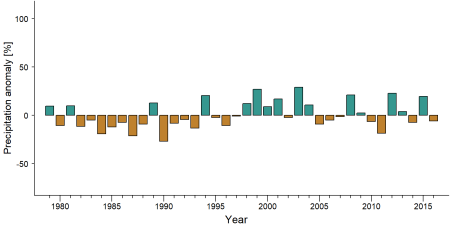
Precipitation anomaly in Cantanhez National Park -
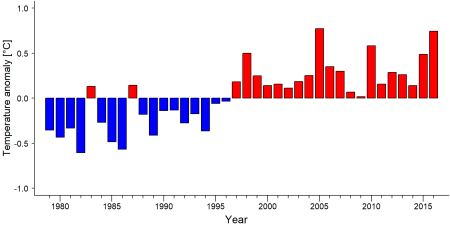
Temperature anomaly in Cantanhez National Park


External links
References
Bersacola, E. (2019). Zooming in on human-wildlife coexistence: Primate community responses in a shared agroforest landscape in Guinea-Bissau [PhD thesis]. Oxford Brookes University, Oxford, UK.
Bersacola, E., Hill, C. M., Hockings, K. J. (2021a). Chimpanzees balance resources and risk in an anthropogenic landscape of fear. Scientific Reports, 11, 4569. https://doi.org/10.1038/s41598-021-83852-3
Bersacola, E., Hill, C. M., Nijman, V., & Hockings, K. J. (2022). Examining primate community occurrence patterns in agroforest landscapes using arboreal and terrestrial camera traps. Landscape Ecology, 37(12), 3103-3121. doi:10.1007/s10980-022-01524-7
Bersacola, E., Hockings, K. J. (2023). Action plan for the conservation of medium- and large-sized terrestrial mammals in Cantanhez National Park, Guinea-Bissau (2023–2033). IBAP, Bissau, Guinea-Bissau.
Bersacola, E., Houldcroft, A., Clarke, L., Jaló, M., Sanhá, A., Quecuta, Q., Benante, J. E., Regalla de Barros, A., De Rivera Ortega, O. R., & Hockings, K. J. (in preparation). Improving great ape monitoring across the heterogeneous continuum: A spatially explicit joint model using standard surveys.
Bersacola, E., McLennan, M. R., Bessa, J., Camara, H., Jaló, M., Kiiza, V., Mamy, G., Mpanga, N., Oelze, V. M., Ramon, M., Sanhá, A., van Holstein, L., Fitzgerald, M., Stewart, F. A., Koops, K., & Hockings, K. J. (in review). Camera traps document infant corpse carrying behaviour in multiple unhabituated chimpanzee populations. Ecology and Evolution. doi:10.1002/ece3.71698
Bersacola, E., Parathian, H., Frazão-Moreira, A., Jaló, M., Sanhá, A., Regalla, A., …, & Hockings, K. J. (2021b). Developing an Evidence-Based Coexistence Strategy to Promote Human and Wildlife Health in a Biodiverse Agroforest Landscape. Frontiers in Conservation Science, 2, 735367. doi:10.3389/fcosc.2021.735367
Bessa, J., Biro, D., & Hockings, K. (2022). Inter-community behavioural variation confirmed through indirect methods in four neighbouring chimpanzee communities in Cantanhez NP, Guinea-Bissau. Royal Society Open Science, 9(2), 211518. doi:10.1098/rsos.211518
Bessa, J., Hockings, K., & Biro, D. (2021). First Evidence of Chimpanzee Extractive Tool Use in Cantanhez, Guinea-Bissau: Cross-Community Variation in Honey Dipping. Frontiers in Ecology and Evolution, 9. doi:10.3389/fevo.2021.625303
Bessa, J., Sousa, C., & Hockings, K. J. (2015). Feeding ecology of chimpanzees (Pan troglodytes verus) inhabiting a forest‐mangrove‐savanna‐agricultural matrix at Caiquene‐Cadique, Cantanhez National Park, Guinea‐Bissau. American Journal of Primatology, 77(6), 651-665. doi:10.1002/ajp.22388
Brugiere, D., Badjinca, I., Silva, C., & Serra, A. (2009). Distribution of Chimpanzees and Interactions with Humans in Guinea-Bissau and Western Guinea, West Africa. Folia Primatologica, 80(5), 353-358. doi:10.1159/000259335
Casanova, C., & Sousa, C. (2006). Distribuição das comunidades de chimpanzés (Pan troglodytes verus) na região costeira da República da Guiné-Bissau e a sua relação com as comunidades humanas locais. Mission Report, March 2006. Lisboa, Portugal.
Catarino, L. (2004). Fitogeografia da Guiné-Bissau [PhD thesis]. Instituto Superior de Agronomia, Lisboa.
Costa, S., Casanova, C., & Lee, P. (2017). What Does Conservation Mean for Women? the Case of the Cantanhez Forest National Park. Conservation and Society, 15(2), 168. doi:10.4103/cs.cs_14_91
Gippoliti, S., & Dell'Omo, G. (1996). Primates of the Cantanhez Forest and the Cacine Basin, Guinea-Bissau. Oryx, 30(1), 74-80. doi:10.1017/s0030605300021414
Gippoliti, S., & Dell’Omo, G. (2003). Primates of Guinea-Bissau, West Africa: Distribution and conservation status. Primate Conservation, 19, 73–77. link
Gippoliti, S., Embalo, D., & Sousa, C. (2003). Chimpanzee conservation status in Guinea-Bissau. In R. Kormos, C. Boesch, M. I. Bakarr, & T. M. Butynski (Eds.), West African chimpanzees: Status survey and conservation action plan (pp. 55–61). IUCN/SSC Primate Specialist Group, Gland, Switzerland, and Cambridge, UK. link
Hockings, K. J., & Sousa, C. (2012). Differential utilization of cashew—a low-conflict crop—by sympatric humans and chimpanzees. Oryx, 46(3), 375-381. doi:10.1017/s003060531100130x
Hockings, K. J., & Sousa, C. (2013). Human-Chimpanzee Sympatry and Interactions in Cantanhez National Park, Guinea-Bissau: Current Research and Future Directions. Primate Conservation, 26(1), 57-65. doi:10.1896/052.026.0104
Hockings, K. J., & Bersacola, E. (2022). Darwin Initiative Main Project 26-018: Final report.
Hockings, K. J., Mubemba, B., Avanzi, C., Pleh, K., Düx, A., Bersacola, E., …, & Leendertz, F. H. (2021). Leprosy in wild chimpanzees. Nature, 598(7882), 652-656. doi:10.1038/s41586-021-03968-4
IBAP. (2018a). Plano de Gestão do Parque Nacional Cantanhez. Instituto da Biodiversidade e das Áreas Protegidas, Bissau, Guinea-Bissau.
IBAP. (2018b). Parque Nacional de Cantanhez: Regulamento interno. Instituto da Biodiversidade e das Áreas Protegidas, Bissau, Guinea-Bissau.
IUCN & Chimbo. (2016). The conservation of the Savannah chimpanzees of Guinea-Bissau and Senegal. Retrieved from http://chimbo.org/wp-content/uploads/2015/06/The-conservation-of-the-Savannah-Chimpanzees-of-Guinea-Bissau-and-Senegal-Report-Workshop-Beli-14-16.2.2016.pdf
Kormos, R., Boesch, C., Bakarr, M. I., & Butynski, T. M. (2003). West African chimpanzees: Status survey and conservation action plan. IUCN/SSC Primate Specialist Group, IUCN, Gland, Switzerland, and Cambridge, UK. link
Minhós, T., Chikhi, L., Sousa, C., Vicente, L. M., Ferreira da Silva, M., Heller, R., …, & Bruford, M. W. (2016). Genetic consequences of human forest exploitation in two colobus monkeys in Guinea Bissau. Biological Conservation, 194, 194-208. doi:10.1016/j.biocon.2015.12.019
Parathian, H. E., McLennan, M. R., Hill, C. M., Frazão-Moreira, A., & Hockings, K. J. (2018). Breaking Through Disciplinary Barriers: Human–Wildlife Interactions and Multispecies Ethnography. International Journal of Primatology, 39(5), 749-775. doi:10.1007/s10764-018-0027-9
Sá, R. M., Petrášová, J., Pomajbíková, K., Profousová, I., Petrželková, K. J., Sousa, C., …, & Modrý, D. (2013). Gastrointestinal symbionts of chimpanzees in Cantanhez National Park, guinea‐bissau with respect to habitat fragmentation. American Journal of Primatology, 75(10), 1032-1041. doi:10.1002/ajp.22170
Sousa, J., Barata, A. V., Sousa, C., Casanova, C. C. N., & Vicente, L. (2011). Chimpanzee oil‐palm use in southern Cantanhez National Park, Guinea‐Bissau. American Journal of Primatology, 73(5), 485-497. doi:10.1002/ajp.20926
Sousa, J., Vicente, L., Gippoliti, S., Casanova, C., & Sousa, C. (2014). Local knowledge and perceptions of chimpanzees in Cantanhez National Park, Guinea-Bissau. American Journal of Primatology, 76, 122–134. https://doi.org/10.1002/ajp.22215
Sousa, J. V. (2007). Densidade de Pan troglodytes verus e veículos de sensibilização ambiental: Quatro florestas de Cantanhez, República da Guiné-Bissau. Faculdade de Ciências da Universidade de Lisboa, Lisboa, Portugal. 130 p.
Torres, J., Brito, J. C., Vasconcelos, M. J., Catarino, L., Gonçalves, J., & Honrado, J. (2010). Ensemble models of habitat suitability relate chimpanzee (Pan troglodytes) conservation to forest and landscape dynamics in Western Africa. Biological Conservation, 143(2), 416-425. doi:10.1016/j.biocon.2009.11.007
UNEP-WCMC & IUCN. (2019). Protected Planet: The World Database on Protected Areas (WDPA). Cambridge, UK: UNEP-WCMC and IUCN. Online: [www.protectedplanet.net](http://www.protectedplanet.net) link
World Bank (2024). Guinea-Bissau Economic Update, Spring 2024: Retiring the Fiscal Risk. World Bank. doi:10.1596/41539
Kiribou, R., Tehoda, P., Chukwu, O., Bempah, G., Kühl, H. S., Ferreira, J., …, & Heinicke, S. (2024). Exposure of African ape sites to climate change impacts. PLOS Climate, 3(2), e0000345. doi:10.1371/journal.pclm.0000345
Page created by: Elena Bersacola, Kimberley Hockings Date: 2024-08-09
Page updated by: Elena Bersacola, Kimberley Hockings Date: 2024-09-30