
Conkouati-Douli National Park: Difference between revisions
No edit summary |
No edit summary Tag: Manual revert |
||
| (13 intermediate revisions by the same user not shown) | |||
| Line 14: | Line 14: | ||
* Conservation activities at the site include a reintroduction program for rescued chimpanzees, employing local people in conservation projets, habitat restoration and conducting field patrols. | * Conservation activities at the site include a reintroduction program for rescued chimpanzees, employing local people in conservation projets, habitat restoration and conducting field patrols. | ||
* The site is designated as a Ramsar Site. | * The site is designated as a Ramsar Site. | ||
= Site characteristics = | = Site characteristics = | ||
Conkouati-Douli National Park (CDNP) was established in 1999, replacing the Conkouati Wildlife Reserve existing since 1980. CDNP is situated in the southwest corner of the Republic of Congo, bordering Gabon's Mayumba National Park to the north. Together, Mayumba National Park and CDNP form the Conkouati-Mayumba landscape, characterised by coastal lowland forest that extends into higher altitude forest in the mountains to the east, and descends to the inland savanna plain (Tutin et al. 2005). As a result of CDNP's broad habitat diversity, the park is the most biodiverse in Congo. In addition to chimpanzees and gorillas, CDNP is home to many threatened species, including forest elephants, mandrills, and forest buffalo. Marine species, such as manatees, turtles, dolphins and whales, are also found at the site. The coastline of the park, which comprises 35% of the country's coastline, is an important site for sea turtle nesting, particularly for Leatherback and Olive Ridley turtles ([http://wcscongoblog.org/portfolio_page/conkouati-douli-national-park/ WCS; BirdLife International 2020]). The site is also an Important Bird Area, with at least 288 species present (BirdLife International 2020). CDNP is also designated as a Ramsar Site and is registered on the indicative list of UNESCO World Heritage ([http://parcsdenoe.org/en/parcs-congo/# Parcs de Noé]). | Conkouati-Douli National Park (CDNP) was established in 1999, replacing the Conkouati Wildlife Reserve existing since 1980. CDNP is situated in the southwest corner of the Republic of Congo, bordering Gabon's Mayumba National Park to the north. Together, Mayumba National Park and CDNP form the Conkouati-Mayumba landscape, characterised by coastal lowland forest that extends into higher altitude forest in the mountains to the east, and descends to the inland savanna plain ([[#R00417|Tutin et al. 2005]]). As a result of CDNP's broad habitat diversity, the park is the most biodiverse in Congo. In addition to chimpanzees and gorillas, CDNP is home to many threatened species, including forest elephants, mandrills, and forest buffalo. Marine species, such as manatees, turtles, dolphins and whales, are also found at the site. The coastline of the park, which comprises 35% of the country's coastline, is an important site for sea turtle nesting, particularly for Leatherback and Olive Ridley turtles ([http://wcscongoblog.org/portfolio_page/conkouati-douli-national-park/ WCS; BirdLife International 2020]). The site is also an Important Bird Area, with at least 288 species present ([[#R00415|BirdLife International 2020]]). CDNP is also designated as a Ramsar Site and is registered on the indicative list of UNESCO World Heritage ([http://parcsdenoe.org/en/parcs-congo/# Parcs de Noé]). | ||
'''Table 1. Basic site information for Conkouati-Douli National Park''' | '''Table 1. Basic site information for Conkouati-Douli National Park''' | ||
| Line 44: | Line 41: | ||
[[Types of sites]] [[Governance types]] [[Habitat types]] | [[Types of sites]] [[Governance types]] [[Habitat types]] | ||
= Ape status = | = Ape status = | ||
| Line 78: | Line 76: | ||
[[Sampling methods]] [[Analytical frameworks]] | [[Sampling methods]] [[Analytical frameworks]] | ||
= Threats = | = Threats = | ||
Lack of hunting controls and law enforcement combined with high demand for bushmeat in urban markets threaten the ape population at CDNP (IUCN 2014). | Lack of hunting controls and law enforcement combined with high demand for bushmeat in urban markets threaten the ape population at CDNP ([[#R00416|IUCN 2014]]). | ||
'''Table 3. Threats to apes reported for Conkouati-Douli National Park''' | '''Table 3. Threats to apes reported for Conkouati-Douli National Park''' | ||
| Line 91: | Line 90: | ||
|- | |- | ||
|5 Biological resource use | |5 Biological resource use | ||
| | |3.2.3 Artisanal mining | ||
|High (more than 70% of population affected) | |High (more than 70% of population affected) | ||
| | |The report estimated that around 800 artisanal miners were operating illegally within the protected zone, posing a major threat to ecosystem integrity (RA-PNCD 2023). | ||
| | |Ongoing (2023) | ||
|- | |- | ||
|5 Biological resource use | |5 Biological resource use | ||
|5. | |5.1 Hunting & collecting terrestrial animals | ||
|High (more than 70% of population affected) | |High (more than 70% of population affected) | ||
| | |Hunting driven by considerable demand for bushmeat from urban markets in Congo ([[#R00416|IUCN 2014]]). Hunting and bushmeat trade remain persistent within peripheral villages (RA-PNCD 2023). | ||
|Ongoing (2023) | |2014-Ongoing (2023) | ||
|- | |- | ||
|5 Biological resource use | |5 Biological resource use | ||
|5.1.2 Unintentional effects | |5.1.2 Unintentional effects | ||
|Present (unknown severity) | |Present (unknown severity) | ||
|Great apes often suffer injuries from traps probably intended for other animals, sometimes resulting in the loss of a limb (Van Hoef pers. comm. 2025). | |Great apes often suffer injuries from traps probably intended for other animals, sometimes resulting in the loss of a limb (Van Hoef pers. comm. 2025). | ||
| Line 121: | Line 114: | ||
|Instances of great ape killings, such as those for trade or cultural believes were reported (Van Hoef pers. comm. 2025). | |Instances of great ape killings, such as those for trade or cultural believes were reported (Van Hoef pers. comm. 2025). | ||
|Ongoing (2025) | |Ongoing (2025) | ||
|- | |||
|5 Biological resource use | |||
|5.3 Logging & wood harvesting | |||
|Present (unknown severity) | |||
|Logging concessions present at the site, before and after it was declared a National Park ([[#R00415|BirdLife International 2020]]; [[#R00416|IUCN 2014]]). | |||
|Ongoing (2020) | |||
|- | |- | ||
|8 Invasive & other problematic species, genes & diseases | |8 Invasive & other problematic species, genes & diseases | ||
| Line 130: | Line 129: | ||
[[Threats]] | [[Threats]] | ||
= Conservation activities = | = Conservation activities = | ||
| Line 147: | Line 147: | ||
|Noé, HELP Congo, Renatura, Jane Goodall Institute, Congolese Ministry of Environment, CEERC-USAID, Treevive. | |Noé, HELP Congo, Renatura, Jane Goodall Institute, Congolese Ministry of Environment, CEERC-USAID, Treevive. | ||
|2023-Ongoing (2025) | |2023-Ongoing (2025) | ||
|- | |||
|4 Education & awareness | |||
|4.2 Involve local community in ape research and conservation management | |||
|A Comité de Gestion Communautaire (CGC) was established, comprising 51 representatives from local villages and Indigenous communities (RA-PNCD 2023). | |||
|Noé, HELP Congo, Renatura, Jane Goodall Institute, Congolese Ministry of Environment, CEERC-USAID, Treevive. | |||
|Ongoing (2023) | |||
|- | |- | ||
|5 Protection & restoration | |5 Protection & restoration | ||
| Line 152: | Line 158: | ||
|The site was declared a National Park in 1999; before that, it was a Wildlife Reserve, since 1980. | |The site was declared a National Park in 1999; before that, it was a Wildlife Reserve, since 1980. | ||
| | | | ||
|1999-Ongoing ( | |1999-Ongoing (2026) | ||
|- | |- | ||
|5 Protection & restoration | |5 Protection & restoration | ||
| Line 162: | Line 168: | ||
|6 Species management | |6 Species management | ||
|6.8 Reintroduction of apes (captively-bred or rehabilitated indviduals) | |6.8 Reintroduction of apes (captively-bred or rehabilitated indviduals) | ||
|The NGO [ | |The NGO [[#R02025|HELP Congo]] has a reintroduction program, and has released several rescued chimpanzees into the Triangle site (a forested area bordered by the Conkouati lagoon within the park). | ||
| | | | ||
|Ongoing (2025) | |Ongoing (2025) | ||
| Line 177: | Line 183: | ||
| | | | ||
|Ongoing (2025) | |Ongoing (2025) | ||
|} | |} | ||
[[Conservation activities]] | [[Conservation activities]] | ||
= Challenges = | = Challenges = | ||
| Line 196: | Line 197: | ||
!Source | !Source | ||
!Year(s) | !Year(s) | ||
|- | |||
|2 Resources and capacity | |||
|2.2 Lack of staff | |||
|RA-PNCD 2023 | |||
|Ongoing (2023) | |||
|- | |||
|2 Resources and capacity | |||
|2.7 Lack of infrastructure | |||
|RA-PNCD 2023 | |||
|Ongoing (2023) | |||
|- | |- | ||
|4 Institutional support | |4 Institutional support | ||
|4.1 Lack of law enforcement | |4.1 Lack of law enforcement | ||
|IUCN 2014 | |[[#R00416|IUCN 2014]] | ||
|Ongoing (2014) | |Ongoing (2014) | ||
|- | |- | ||
|4 Institutional support | |4 Institutional support | ||
|4.4 Lack of transboundary cooperation | |4.4 Lack of transboundary cooperation | ||
|IUCN 2014 | |[[#R00416|IUCN 2014]] | ||
|Ongoing (2014) | |Ongoing (2014) | ||
|} | |} | ||
[[Challenges]] | [[Challenges]] | ||
= Enablers = | = Enablers = | ||
| Line 229: | Line 231: | ||
!Source | !Source | ||
!Year(s) | !Year(s) | ||
|- | |- | ||
|2 Resources and capacity | |2 Resources and capacity | ||
| Line 254: | Line 251: | ||
|RA-PNCD 2023 | |RA-PNCD 2023 | ||
|Ongoing (2023) | |Ongoing (2023) | ||
|- | |||
|1 Site management | |||
| | |||
| | |||
| | |||
|- | |- | ||
|4 Institutional support | |4 Institutional support | ||
| Line 272: | Line 274: | ||
[[Enablers]] | [[Enablers]] | ||
= Research activities = | = Research activities = | ||
| Line 281: | Line 284: | ||
[https://bioone.org/journals/primate-conservation/volume-22/issue-1/052.022.0110/Confirmation-of-the-Presence-of-the-Red-Capped-Mangabey-Cercocebus/10.1896/052.022.0110.full Confirmation of the Presence of the Red-Capped Mangabey (Cercocebus torquatus) in Mayumba National Park, Southern Gabon, and Conkouati-Douli National Park, Southern Republic of Congo] | [https://bioone.org/journals/primate-conservation/volume-22/issue-1/052.022.0110/Confirmation-of-the-Presence-of-the-Red-Capped-Mangabey-Cercocebus/10.1896/052.022.0110.full Confirmation of the Presence of the Red-Capped Mangabey (Cercocebus torquatus) in Mayumba National Park, Southern Gabon, and Conkouati-Douli National Park, Southern Republic of Congo] | ||
= Documented behaviours = | = Documented behaviours = | ||
| Line 310: | Line 314: | ||
[[Behaviours]] | [[Behaviours]] | ||
= Exposure to climate change impacts = | = Exposure to climate change impacts = | ||
As part of a study on the exposure of African great ape sites to climate change impacts, Kiribou et al. | As part of a study on the exposure of African great ape sites to climate change impacts, [[#R02176|Kiribou et al. (2024)]] extracted climate data and data on projected extreme climate impact events for the site. Climatological characteristics were derived from observation-based climate data provided by the Inter-Sectoral Impact Model Intercomparison Project (ISIMIP, www.isimip.org). Parameters were calculated as the average across each 30-year period. For 1981-2010, the EWEMBI dataset from ISIMIP2a was used. For the two future periods (2021-2050 and 2071-2099) ISIMIP2b climate data based on four CMIP5 global climate models were used. For future projections, two Representative Concentration Pathways (RCP) were used. RCP 2.6 is a scenario with strong mitigation measures in which global temperatures would likely rise below 2C. RCP 6.0 is a scenario with medium emissions in which global temperatures would likely rise up to 3C by 2100. For the number of days with heavy precipitation events, the 98th percentile of all precipitation days (>1mm/d) was calculated for the 1979-2013 reference period as a threshold for a heavy precipitation event. Then, for each year, the number of days above that threshold was derived. The figures on temperature and precipitation anomaly show the deviation from the mean temperature and mean precipitation for the 1979-2013 reference period. | ||
The estimated exposure to future extreme climate impact events (crop failure, drought, river flood, wildfire, tropical cyclone, and heatwave) is based on a published dataset by Lange et al. 2020 derived from ISIMIP2b data. The same global climate models and RCPs as described above were used. Within each 30-year period, the number of years with an extreme event and the average proportion of the site affected were calculated ( | The estimated exposure to future extreme climate impact events (crop failure, drought, river flood, wildfire, tropical cyclone, and heatwave) is based on a published dataset by Lange et al. 2020 derived from ISIMIP2b data. The same global climate models and RCPs as described above were used. Within each 30-year period, the number of years with an extreme event and the average proportion of the site affected were calculated ([[#R02176|Kiribou et al. 2024]]). | ||
'''Table 8. Estimated past and projected climatological characteristics in Conkouati-Douli National Park''' | '''Table 8. Estimated past and projected climatological characteristics in Conkouati-Douli National Park''' | ||
| Line 428: | Line 433: | ||
|} | |} | ||
<div><ul><li style="display: inline-block; vertical-align: top;"> [[File:PrecipAnomaly_Conkouati-Douli_NP.png| 450px | thumb| none | Precipitation anomaly in Conkouati-Douli National Park]] </li><li style="display: inline-block; vertical-align: top;"> [[File:TempAnomaly_Conkouati-Douli_NP.png | 450px | thumb| none | Temperature anomaly in Conkouati-Douli National Park]] </li></ul></div> | |||
= External links = | = External links = | ||
| Line 439: | Line 446: | ||
= References = | = References = | ||
BirdLife International (2020) Important Bird Areas factsheet: Conkouati National Park. | <span id="R00415"></span>BirdLife International. (2020). Important Bird Areas factsheet: Conkouati National Park. Retrieved from http://www.birdlife.org on 10 December 2020. | ||
<span id="R00416"></span>IUCN - International Union for Conservation of Nature (2014). Regional Action Plan for the Conservation of Western Lowland Gorillas and Central Chimpanzees 2015–2025. International Union for Conservation of Nature. [https://doi.org/10.2305/iucn.ch.2005.ssc-rap.1.en doi:10.2305/iucn.ch.2005.ssc-rap.1.en] | |||
<span id="R00417"></span>Tutin, C., Stokes, E., Boesch, C., Morgan, D., Sanz, C., Reed, T., …, & Kormos, R. (2005). Regional Action Plan for the Conservation of Chimpanzees and Gorillas in Western Equatorial Africa. IUCN/SSC Primate Specialist Group and Conservation International, Washington D.C. [http://www.primate-sg.org/PDF/ApesRAP.English.pdf link] | |||
<span id="R02176"></span>Kiribou, R., Tehoda, P., Chukwu, O., Bempah, G., Kühl, H. S., Ferreira, J., …, & Heinicke, S. (2024). Exposure of African ape sites to climate change impacts. ''PLOS Climate'', 3(2), e0000345. [https://doi.org/10.1371/journal.pclm.0000345 doi:10.1371/journal.pclm.0000345] | |||
<span id="R02025"></span>HELP Congo. http://www.help-primates.org/en/actions.html [https://web.archive.org/web/20230928010659/http://help-primates.org/en/actions.html link] | |||
Latest revision as of 17:52, 15 October 2026
Central Africa > Republic of the Congo > Conkouati-Douli National Park
Français | Português | Español | Bahasa Indonesia | Melayu
Summary
- Central chimpanzees (Pan troglodytes troglodytes) and western lowland gorillas (Gorilla gorilla gorilla) are present in Conkouati-Douli National Park.
- It is estimated that 7,000 chimpanzees and 900 gorillas occur at the site.
- The population trends are unknown.
- The site has a total size of 7,955.5 km².
- Key threats to great apes are bushmeat hunting and mining, human wildlife conflict and diseases transmission.
- Conservation activities at the site include a reintroduction program for rescued chimpanzees, employing local people in conservation projets, habitat restoration and conducting field patrols.
- The site is designated as a Ramsar Site.
Site characteristics
Conkouati-Douli National Park (CDNP) was established in 1999, replacing the Conkouati Wildlife Reserve existing since 1980. CDNP is situated in the southwest corner of the Republic of Congo, bordering Gabon's Mayumba National Park to the north. Together, Mayumba National Park and CDNP form the Conkouati-Mayumba landscape, characterised by coastal lowland forest that extends into higher altitude forest in the mountains to the east, and descends to the inland savanna plain (Tutin et al. 2005). As a result of CDNP's broad habitat diversity, the park is the most biodiverse in Congo. In addition to chimpanzees and gorillas, CDNP is home to many threatened species, including forest elephants, mandrills, and forest buffalo. Marine species, such as manatees, turtles, dolphins and whales, are also found at the site. The coastline of the park, which comprises 35% of the country's coastline, is an important site for sea turtle nesting, particularly for Leatherback and Olive Ridley turtles (WCS; BirdLife International 2020). The site is also an Important Bird Area, with at least 288 species present (BirdLife International 2020). CDNP is also designated as a Ramsar Site and is registered on the indicative list of UNESCO World Heritage (Parcs de Noé).
Table 1. Basic site information for Conkouati-Douli National Park
| Species | Pan troglodytes troglodytes, Gorilla gorilla gorilla |
| Area | 7,955.5 km² |
| Coordinates | Lat: -3.797862 , Lon: 11.487369 |
| Type of site | Protected area (National Park) |
| Habitat types | Subtropical/tropical moist lowland forest, Subtropical/tropical swamp forest, Savanna, Marine coastal/supratidal |
| Type of governance | Shared governance |
Types of sites Governance types Habitat types
Ape status
An estimated 7,000 chimpanzees and 900 gorillas occur in the park (Parcs de Noé).
Table 2. Ape population estimates reported for Conkouati-Douli National Park
| Species | Year | Occurrence | Encounter or vistation rate (nests/km; ind/day) | Density estimate [ind./ km²] (95% CI) | Abundance estimate (95% CI) | Survey area | Sampling method | Analytical framework | Source | Comments | A.P.E.S. database ID |
|---|---|---|---|---|---|---|---|---|---|---|---|
| Pan troglodytes troglodytes & Gorilla gorilla gorilla | Conkouati-Douli National Park | Unknown |
Sampling methods Analytical frameworks
Threats
Lack of hunting controls and law enforcement combined with high demand for bushmeat in urban markets threaten the ape population at CDNP (IUCN 2014).
Table 3. Threats to apes reported for Conkouati-Douli National Park
| Category | Specific threats | Threat level | Description | Year of threat |
|---|---|---|---|---|
| 5 Biological resource use | 3.2.3 Artisanal mining | High (more than 70% of population affected) | The report estimated that around 800 artisanal miners were operating illegally within the protected zone, posing a major threat to ecosystem integrity (RA-PNCD 2023). | Ongoing (2023) |
| 5 Biological resource use | 5.1 Hunting & collecting terrestrial animals | High (more than 70% of population affected) | Hunting driven by considerable demand for bushmeat from urban markets in Congo (IUCN 2014). Hunting and bushmeat trade remain persistent within peripheral villages (RA-PNCD 2023). | 2014-Ongoing (2023) |
| 5 Biological resource use | 5.1.2 Unintentional effects | Present (unknown severity) | Great apes often suffer injuries from traps probably intended for other animals, sometimes resulting in the loss of a limb (Van Hoef pers. comm. 2025).
|
Ongoing (2025) |
| 5 Biological resource use | 5.1.5 Persecution/human wildlife conflict | Present (unknown severity) | Instances of great ape killings, such as those for trade or cultural believes were reported (Van Hoef pers. comm. 2025). | Ongoing (2025) |
| 5 Biological resource use | 5.3 Logging & wood harvesting | Present (unknown severity) | Logging concessions present at the site, before and after it was declared a National Park (BirdLife International 2020; IUCN 2014). | Ongoing (2020) |
| 8 Invasive & other problematic species, genes & diseases | 8.4 Pathogens | Present (unknown severity) | There is a significant risk of disease transmission between humans and great apes (Van Hoef pers. comm. 2025). | Ongoing (2025) |
Conservation activities
Table 4. Conservation activities reported for Conkouati-Douli National Park
| Category | Specific activity | Description | Implementing organization(s) | Year of activity |
|---|---|---|---|---|
| 2 Counter-wildlife crime | 2.3 Conduct regular anti-poaching patrols | Anti-poaching patrols were strengthened, with effort increasing from 5,537 to 6,619 man-days (RA-PNCD 2023). Conducting field patrols to uphold legal regulations (Van Hoef pers. comm. 2025). | Noé, HELP Congo, Renatura, Jane Goodall Institute, Congolese Ministry of Environment, CEERC-USAID, Treevive. | 2023-Ongoing (2025) |
| 4 Education & awareness | 4.2 Involve local community in ape research and conservation management | A Comité de Gestion Communautaire (CGC) was established, comprising 51 representatives from local villages and Indigenous communities (RA-PNCD 2023). | Noé, HELP Congo, Renatura, Jane Goodall Institute, Congolese Ministry of Environment, CEERC-USAID, Treevive. | Ongoing (2023) |
| 5 Protection & restoration | 5.2 Legally protect ape habitat | The site was declared a National Park in 1999; before that, it was a Wildlife Reserve, since 1980. | 1999-Ongoing (2026) | |
| 5 Protection & restoration | 5.6 Habitat restoration | Forest rehabilitation and protection activities are reported (Van Hoef pers. comm. 2025). | Ongoing (2025) | |
| 6 Species management | 6.8 Reintroduction of apes (captively-bred or rehabilitated indviduals) | The NGO HELP Congo has a reintroduction program, and has released several rescued chimpanzees into the Triangle site (a forested area bordered by the Conkouati lagoon within the park). | Ongoing (2025) | |
| 7 Economic & other incentives | 7.1 Provide monetary benefits to local communities for sustainably managing their forest and its wildlife (e.g., REDD, alternative income, employment) | Development of tourism and carbon finance projects (REDD+) to support park sustainability (RA-PNCD 2023). Hiring local people to work in conservation (Van Hoef pers. comm. 2025). | Noé, HELP Congo, Renatura, Jane Goodall Institute, Congolese Ministry of Environment, CEERC-USAID, Treevive. | 2023-Ongoing (2025) |
| 7 Economic & other incentives | 7.2 Provide non-monetary benefits to local communities for sustainably managing their forest and its wildlife (e.g., better education, infrastructure development) | Providing services for community health and wellbeing, as well supporting ecotourism ventures (Van Hoef pers. comm. 2025). | Ongoing (2025) |
Challenges
Table 5. Challenges reported for Conkouati-Douli National Park
| Challenges | Specific challenges | Source | Year(s) |
|---|---|---|---|
| 2 Resources and capacity | 2.2 Lack of staff | RA-PNCD 2023 | Ongoing (2023) |
| 2 Resources and capacity | 2.7 Lack of infrastructure | RA-PNCD 2023 | Ongoing (2023) |
| 4 Institutional support | 4.1 Lack of law enforcement | IUCN 2014 | Ongoing (2014) |
| 4 Institutional support | 4.4 Lack of transboundary cooperation | IUCN 2014 | Ongoing (2014) |
Enablers
Table 6. Enablers reported for Conkouati-Douli National Park
| Enablers | Specific enablers | Source | Year(s) |
|---|---|---|---|
| 2 Resources and capacity | 2.2 Sufficient funding | RA-PNCD 2023, Van Hoef pers. comm. 2025 | 2023-Ongoing (2025) |
| 2 Resources and capacity | 2.3 Continuous/long-term funding | RA-PNCD 2023, Van Hoef pers. comm. 2025 | 2023-Ongoing (2025) |
| 2 Resources and capacity | 2.6 External partnerships that add expertise or resources | RA-PNCD 2023 | Ongoing (2023) |
| 3 Engaged community | 3.6 Local community engagement and support | RA-PNCD 2023 | Ongoing (2023) |
| 1 Site management | |||
| 4 Institutional support | |||
| 5 Ecological context | |||
| 6 Safety and stability |
Research activities
Documented behaviours
Table 7. Behaviours documented for Conkouati-Douli National Park
| Category | Behavior | Observation type | Prevalence | Observation dates | Source | Habituation | Species | Comment |
|---|---|---|---|---|---|---|---|---|
| Not reported |
Exposure to climate change impacts
As part of a study on the exposure of African great ape sites to climate change impacts, Kiribou et al. (2024) extracted climate data and data on projected extreme climate impact events for the site. Climatological characteristics were derived from observation-based climate data provided by the Inter-Sectoral Impact Model Intercomparison Project (ISIMIP, www.isimip.org). Parameters were calculated as the average across each 30-year period. For 1981-2010, the EWEMBI dataset from ISIMIP2a was used. For the two future periods (2021-2050 and 2071-2099) ISIMIP2b climate data based on four CMIP5 global climate models were used. For future projections, two Representative Concentration Pathways (RCP) were used. RCP 2.6 is a scenario with strong mitigation measures in which global temperatures would likely rise below 2C. RCP 6.0 is a scenario with medium emissions in which global temperatures would likely rise up to 3C by 2100. For the number of days with heavy precipitation events, the 98th percentile of all precipitation days (>1mm/d) was calculated for the 1979-2013 reference period as a threshold for a heavy precipitation event. Then, for each year, the number of days above that threshold was derived. The figures on temperature and precipitation anomaly show the deviation from the mean temperature and mean precipitation for the 1979-2013 reference period.
The estimated exposure to future extreme climate impact events (crop failure, drought, river flood, wildfire, tropical cyclone, and heatwave) is based on a published dataset by Lange et al. 2020 derived from ISIMIP2b data. The same global climate models and RCPs as described above were used. Within each 30-year period, the number of years with an extreme event and the average proportion of the site affected were calculated (Kiribou et al. 2024).
Table 8. Estimated past and projected climatological characteristics in Conkouati-Douli National Park
| Value | 1981-2010 | 2021-2050, RCP 2.6 | 2021-2050, RCP 6.0 | 2071-2099, RCP 2.6 | 2071-2099, RCP 6.0 |
|---|---|---|---|---|---|
| Mean temperature [C] | 25.2 | 26.3 | 26.1 | 26.3 | 27.4 |
| Annual precipitation [mm] | 1889 | 1970 | 1894 | 1912 | 1947 |
| Max no. consecutive dry days (per year) | 75.5 | 55.6 | 51.3 | 57.8 | 50.8 |
| No. days with heavy precipitation (per year) | 5.7 | 8.7 | 8.2 | 9.3 | 9.1 |
Table 9. Projected exposure of apes to extreme climate impact events in Conkouati-Douli National Park
| Type | No. of years with event (2021-2050, RCP 2.6) | % of site exposed (2021-2050, RCP 2.6) | No. of years with event (2021-2050, RCP 6.0) | % of site exposed (2021-2050, RCP 6.0) | No. of years with event (2070-2099, RCP 2.6) | % of site exposed (2070-2099, RCP 2.6) | No. of years with event (2070-2099, RCP 6.0) | % of site exposed (2070-2099, RCP 6.0) |
|---|---|---|---|---|---|---|---|---|
| Crop failure | 11 | 0.01 | 10 | 0.01 | 10 | 0.01 | 18.5 | 0.01 |
| Drought | 0 | 0 | 0.5 | 16.67 | 0.5 | 16.67 | 0.5 | 25 |
| Heatwave | 10 | 58.04 | 8.5 | 55.71 | 8 | 44.17 | 26 | 74.25 |
| River flood | 1 | 0.89 | 2.75 | 0.19 | 2.75 | 0.69 | 4 | 0.34 |
| Tropical cyclone | 0 | 0 | 0 | 0 | 0 | 0 | 0.5 | 1.26 |
| Wildfire | 30 | 0.78 | 30 | 0.77 | 29 | 0.78 | 29 | 0.77 |
-
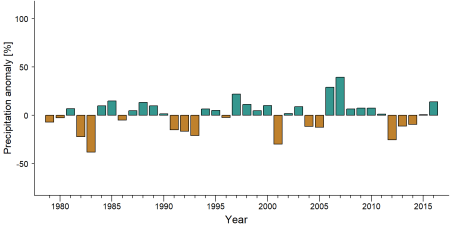
Precipitation anomaly in Conkouati-Douli National Park -
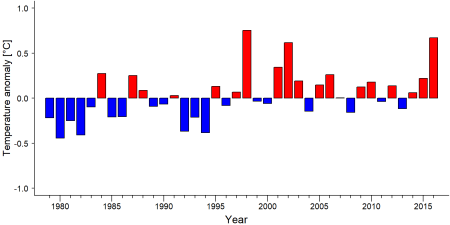
Temperature anomaly in Conkouati-Douli National Park


External links
WCS Conkouati-Douli National Park
Noé (Préservation du Parc national de Conkouati-Douli)
The National park of Conkouati-Douli
References
BirdLife International. (2020). Important Bird Areas factsheet: Conkouati National Park. Retrieved from http://www.birdlife.org on 10 December 2020.
IUCN - International Union for Conservation of Nature (2014). Regional Action Plan for the Conservation of Western Lowland Gorillas and Central Chimpanzees 2015–2025. International Union for Conservation of Nature. doi:10.2305/iucn.ch.2005.ssc-rap.1.en
Tutin, C., Stokes, E., Boesch, C., Morgan, D., Sanz, C., Reed, T., …, & Kormos, R. (2005). Regional Action Plan for the Conservation of Chimpanzees and Gorillas in Western Equatorial Africa. IUCN/SSC Primate Specialist Group and Conservation International, Washington D.C. link
Kiribou, R., Tehoda, P., Chukwu, O., Bempah, G., Kühl, H. S., Ferreira, J., …, & Heinicke, S. (2024). Exposure of African ape sites to climate change impacts. PLOS Climate, 3(2), e0000345. doi:10.1371/journal.pclm.0000345
HELP Congo. http://www.help-primates.org/en/actions.html link
Page created by: APES Atlas Team Date: 2020-12-29
Page updated by: Yorick Van Hoef Date: 2025-09-08