
Cross River National Park: Difference between revisions
No edit summary |
No edit summary Tag: Manual revert |
||
| (6 intermediate revisions by the same user not shown) | |||
| Line 17: | Line 17: | ||
= Site characteristics = | = Site characteristics = | ||
Situated in southeast Nigeria, Cross River National Park (CRNP) was established in 1991. It is divided into two sections: the smaller Okwangwo division (640 sq. km), and the larger Oban division (about 3,000 sq. km) (Dunn et al. 2014, [https://nigeria.wcs.org/wild-places/cross-river-np-oban.aspx WCS]). Gorillas are known to occur in two areas of the Okwangwo division; the former Boshi Extension Forest Reserve (established in 1958 to protect gorillas), and the Okwa Hills in the central region of Okwangwo, bordering Cameroon’s Takamanda National Park to the west (Dunn et al. 2014). | Situated in southeast Nigeria, Cross River National Park (CRNP) was established in 1991. It is divided into two sections: the smaller Okwangwo division (640 sq. km), and the larger Oban division (about 3,000 sq. km) ([[#R00421|Dunn et al. 2014]], [https://nigeria.wcs.org/wild-places/cross-river-np-oban.aspx WCS]). Gorillas are known to occur in two areas of the Okwangwo division; the former Boshi Extension Forest Reserve (established in 1958 to protect gorillas), and the Okwa Hills in the central region of Okwangwo, bordering Cameroon’s Takamanda National Park to the west ([[#R00421|Dunn et al. 2014]]). | ||
Both sections of CRNP are home to several important species including Cross River gorillas and Nigeria-Cameroon chimpanzees, forest elephants, drills, Preuss’s guenons, leopards and the grey-necked rockfowl (Dunn et al. 2014, BirdLife International 2020). Over 350 species have been observed in the park, which is one of the most ornithologically diverse sites in Nigeria and is designated as an Important Bird Area. Oban is contiguous with Korup National Park in Cameroon, and it is an important watershed, draining into the Cross river in the northern part, and Calabar, Kwa, and Korup rivers in the south. A total of 1,303 flowering plants, 141 lichens, and 56 moss species have so far been documented in Oban, making it remarkably rich in floral diversity (BirdLife International 2020). The contiguous Oban-Korup forest is also famous for its rich butterfly diversity ([https://nigeria.wcs.org/wild-places/cross-river-np-oban.aspx WCS]). | Both sections of CRNP are home to several important species including Cross River gorillas and Nigeria-Cameroon chimpanzees, forest elephants, drills, Preuss’s guenons, leopards and the grey-necked rockfowl ([[#R00421|Dunn et al. 2014]], [[#R00420|BirdLife International 2020]]). Over 350 species have been observed in the park, which is one of the most ornithologically diverse sites in Nigeria and is designated as an Important Bird Area. Oban is contiguous with Korup National Park in Cameroon, and it is an important watershed, draining into the Cross river in the northern part, and Calabar, Kwa, and Korup rivers in the south. A total of 1,303 flowering plants, 141 lichens, and 56 moss species have so far been documented in Oban, making it remarkably rich in floral diversity ([[#R00420|BirdLife International 2020]]). The contiguous Oban-Korup forest is also famous for its rich butterfly diversity ([https://nigeria.wcs.org/wild-places/cross-river-np-oban.aspx WCS]). | ||
'''Table 1. Basic site information for Cross River National Park''' | '''Table 1. Basic site information for Cross River National Park''' | ||
| Line 46: | Line 46: | ||
= Ape status = | = Ape status = | ||
The largest and most important area for Cross River gorillas is the transboundary area between the Okwangwo Division of CRNP and Takamanda National Park in Cameroon, which has been estimated to support approximately one-third of the known gorilla population (Dunn et al. 2014). | The largest and most important area for Cross River gorillas is the transboundary area between the Okwangwo Division of CRNP and Takamanda National Park in Cameroon, which has been estimated to support approximately one-third of the known gorilla population ([[#R00421|Dunn et al. 2014]]). | ||
'''Table 2. Ape population estimates reported for Cross River National Park''' | '''Table 2. Ape population estimates reported for Cross River National Park''' | ||
| Line 64: | Line 64: | ||
|- | |- | ||
|''Gorilla gorilla diehli'' | |''Gorilla gorilla diehli'' | ||
| | |2007 | ||
| | | | ||
| | | | ||
| | | | ||
| | |25-50 | ||
| | |Okwangwo Division | ||
| | |Unknown | ||
| | | | ||
| | |[[#R00423|Oates et al. 2007]] | ||
| | | | ||
| | | | ||
|- | |- | ||
|''Gorilla gorilla diehli'' | |''Gorilla gorilla diehli'' | ||
| | |Unknown | ||
| | | | ||
| | | | ||
| | | | ||
|25 | |20-25 | ||
| | |Cross River National Park-Boshi Extension | ||
| | |Reconnaissance walk | ||
| | | | ||
| | |WCS as cited by [[#R00421|Dunn et al. 2014]] | ||
| | | | ||
| | | | ||
| Line 94: | Line 94: | ||
= Threats = | = Threats = | ||
Nearly 30,000 people from at least 39 villages live along the edge of the Okwangwo Division of CRNP. The large villages of Okwa 1, Okwa 2 and Okwangwo are situated within the park, and the expansion of village farmland outside of their enclave boundaries threatens to fragment the forest and further isolate two gorilla subpopulations. Poaching in the park is still widespread and its montane forests on the edge of the Obudu Plateau are being affected by fire. There is also some agricultural encroachment by cocoa farmers on the edge of the park at Bashu, Obonyi and Mbuli, and illegal farming in the Boshi Forest (Dunn et al. 2014). | Nearly 30,000 people from at least 39 villages live along the edge of the Okwangwo Division of CRNP. The large villages of Okwa 1, Okwa 2 and Okwangwo are situated within the park, and the expansion of village farmland outside of their enclave boundaries threatens to fragment the forest and further isolate two gorilla subpopulations. Poaching in the park is still widespread and its montane forests on the edge of the Obudu Plateau are being affected by fire. There is also some agricultural encroachment by cocoa farmers on the edge of the park at Bashu, Obonyi and Mbuli, and illegal farming in the Boshi Forest ([[#R00421|Dunn et al. 2014]]). | ||
'''Table 3. Threats to apes reported for Cross River National Park''' | '''Table 3. Threats to apes reported for Cross River National Park''' | ||
| Line 107: | Line 107: | ||
|1.1 Residential areas | |1.1 Residential areas | ||
|Present (unknown severity) | |Present (unknown severity) | ||
|In the Oban Division, human settlements along the Calabar to Ekang road has divided the are into two (Morgan et al. 2011). | |In the Oban Division, human settlements along the Calabar to Ekang road has divided the are into two ([[#R00422|Morgan et al. 2011]]). | ||
|Ongoing (2011) | |Ongoing (2011) | ||
|- | |- | ||
| Line 113: | Line 113: | ||
|2.1 Annual & perennial non-timber crops | |2.1 Annual & perennial non-timber crops | ||
|Present (unknown severity) | |Present (unknown severity) | ||
|Agricultural concessions for oil palm and pineapple were illegally awarded inside the park boundary ([ | |Agricultural concessions for oil palm and pineapple were illegally awarded inside the park boundary ([[#R01996|WCS]]). Farmland expansion within the park ([[#R00421|Dunn et al. 2014]]) and encroachment ([[#R00424|PAPfor 2024]]). In the Oban Division, agricultural expansion and human settlement along the Calabar to Ekang road has fragmented the are into two ([[#R00422|Morgan et al. 2011]]). | ||
|2011-Ongoing (2024) | |2011-Ongoing (2024) | ||
|- | |- | ||
| Line 119: | Line 119: | ||
|5.1 Hunting & collecting terrestrial animals | |5.1 Hunting & collecting terrestrial animals | ||
|High (more than 70% of population affected) | |High (more than 70% of population affected) | ||
|Joint patrols between CRNP rangers and WCS staff have destroyed numerous hunting camps and wire snares in the park, but poaching continues (PAPfor 2024). The large numbers of snares in Okwangwo are a significant threat to the gorillas (Dunn et al. 2014). Hunting is also widespread in the Oban Division (Morgan et al. 2011). | |Joint patrols between CRNP rangers and WCS staff have destroyed numerous hunting camps and wire snares in the park, but poaching continues ([[#R00424|PAPfor 2024]]). The large numbers of snares in Okwangwo are a significant threat to the gorillas ([[#R00421|Dunn et al. 2014]]). Hunting is also widespread in the Oban Division ([[#R00422|Morgan et al. 2011]]). | ||
|2011-Ongoing (2024) | |2011-Ongoing (2024) | ||
|- | |- | ||
| Line 125: | Line 125: | ||
|5.2 Gathering terrestrial plants | |5.2 Gathering terrestrial plants | ||
|Present (unknown severity) | |Present (unknown severity) | ||
|Collection of NTFPs such as bush mango is widespread and leads to the seasonal establishment of camps in the park that are also used by poachers (Dunn et al. 2014). Unsustainable harvesting methods contribute to deforestation and reduce food sources for wild animals, including gorillas (PAPFor 2024). | |Collection of NTFPs such as bush mango is widespread and leads to the seasonal establishment of camps in the park that are also used by poachers ([[#R00421|Dunn et al. 2014]]). Unsustainable harvesting methods contribute to deforestation and reduce food sources for wild animals, including gorillas ([[#R00424|PAPFor 2024]]). | ||
|2014-Ongoing (2024) | |2014-Ongoing (2024) | ||
|- | |- | ||
| Line 131: | Line 131: | ||
|5.3 Logging & wood harvesting | |5.3 Logging & wood harvesting | ||
|High (more than 70% of population affected) | |High (more than 70% of population affected) | ||
|Timber is often floated out of the park along major rivers (WCS; Adetola & Adetoro 2014). | |Timber is often floated out of the park along major rivers (WCS; [[#R00418|Adetola & Adetoro 2014]]). | ||
|Ongoing (2014) | |Ongoing (2014) | ||
|} | |} | ||
| Line 151: | Line 151: | ||
|1 Development impact mitigation | |1 Development impact mitigation | ||
|1.4 Farm more intensively and effectively in selected areas and spare more natural land | |1.4 Farm more intensively and effectively in selected areas and spare more natural land | ||
|Since 2018, WCS has distributed 11,045 bush mango seedlings to women for planting on farmlands more sustainably, and rely less on collecting them from the forest. The PAPFor project also created 32 new nurseries in communities surrounding the park to raise 195,732 improved cocoa plants. In exchange for the seedlings farmers signed a ‘conservation contract’ and agreed to limit the expansion of cocoa into forest areas (PAPFor 2024). | |Since 2018, WCS has distributed 11,045 bush mango seedlings to women for planting on farmlands more sustainably, and rely less on collecting them from the forest. The PAPFor project also created 32 new nurseries in communities surrounding the park to raise 195,732 improved cocoa plants. In exchange for the seedlings farmers signed a ‘conservation contract’ and agreed to limit the expansion of cocoa into forest areas ([[#R00424|PAPFor 2024]]). | ||
|Wildlife Conservation Society | |Wildlife Conservation Society | ||
|2018-2024 | |2018-2024 | ||
| Line 157: | Line 157: | ||
|2 Counter-wildlife crime | |2 Counter-wildlife crime | ||
|2.11 Implement monitoring surveillance strategies (e.g., SMART) or use monitoring data to improve effectiveness of patrols | |2.11 Implement monitoring surveillance strategies (e.g., SMART) or use monitoring data to improve effectiveness of patrols | ||
|From 2009 on, monitoring using CyberTracker to record data on wildlife, threats and law enforcement action (Dunn et al. 2014). In 2016, SMART replaced CyberTracker to continue monitoring the park ([ | |From 2009 on, monitoring using CyberTracker to record data on wildlife, threats and law enforcement action ([[#R00421|Dunn et al. 2014]]). In 2016, SMART replaced CyberTracker to continue monitoring the park ([[#R02026|WCS]]). | ||
|Wildlife Conservation Society | |Wildlife Conservation Society | ||
|2009-Ongoing (2016) | |2009-Ongoing (2016) | ||
| Line 163: | Line 163: | ||
|2 Counter-wildlife crime | |2 Counter-wildlife crime | ||
|2.13 Provide sustainable alternative livelihoods; establish fish- or domestic meat farms | |2.13 Provide sustainable alternative livelihoods; establish fish- or domestic meat farms | ||
|WCS has trained 25 hunters from around Okwangwo in bee keeping and the rearing of African giant snails in an attempt to provide them with an alternative source of income ([ | |WCS has trained 25 hunters from around Okwangwo in bee keeping and the rearing of African giant snails in an attempt to provide them with an alternative source of income ([[#R02026|WCS]]). | ||
|Wildlife Conservation Society | |Wildlife Conservation Society | ||
|Unknown | |Unknown | ||
| Line 169: | Line 169: | ||
|2 Counter-wildlife crime | |2 Counter-wildlife crime | ||
|2.3 Conduct regular anti-poaching patrols | |2.3 Conduct regular anti-poaching patrols | ||
|Patrolling of the park and joint transboundary patrols of the Okwangwo division together with Takamanda National Park rangers (Dunn et al. 2014). Through the PAPFor programme, WCS supported 321 anti-poaching patrols over two years, resulting in the arrest of 177 individuals for illegal logging and hunting activities within the park; the rate at which patrols encountered metal traps was reduced by over 87%, from 0.85/km in 2021 to 0.11/km in 2023 (PAPfor 2024). | |Patrolling of the park and joint transboundary patrols of the Okwangwo division together with Takamanda National Park rangers ([[#R00421|Dunn et al. 2014]]). Through the PAPFor programme, WCS supported 321 anti-poaching patrols over two years, resulting in the arrest of 177 individuals for illegal logging and hunting activities within the park; the rate at which patrols encountered metal traps was reduced by over 87%, from 0.85/km in 2021 to 0.11/km in 2023 ([[#R00424|PAPfor 2024]]). | ||
|Wildlife Conservation Society | |Wildlife Conservation Society | ||
|2014, 2019-Ongoing (2024) | |2014, 2019-Ongoing (2024) | ||
| Line 175: | Line 175: | ||
|2 Counter-wildlife crime | |2 Counter-wildlife crime | ||
|2.6 Regularly de-activate/remove ground snares | |2.6 Regularly de-activate/remove ground snares | ||
|Dunn et al. 2014 | |[[#R00421|Dunn et al. 2014]] | ||
| | | | ||
|Ongoing (2014) | |Ongoing (2014) | ||
| Line 181: | Line 181: | ||
|2 Counter-wildlife crime | |2 Counter-wildlife crime | ||
|2.8 Provide training to anti-poaching ranger patrols | |2.8 Provide training to anti-poaching ranger patrols | ||
|WCS supports ranger training ([ | |WCS supports ranger training ([[#R02026|WCS]], [[#R00419|Akpan 2021]]). | ||
|Wildlife Conservation Society | |Wildlife Conservation Society | ||
|2021 | |2021 | ||
| Line 187: | Line 187: | ||
|4 Education & awareness | |4 Education & awareness | ||
|4.1 Educate local communities about apes and sustainable use | |4.1 Educate local communities about apes and sustainable use | ||
|The PAPFor programme expanded its network of conservation clubs in schools surrounding the park from 72 to 172. Awareness-raising activities included school visits, film screenings and teacher training (PAPFor 2024). | |The PAPFor programme expanded its network of conservation clubs in schools surrounding the park from 72 to 172. Awareness-raising activities included school visits, film screenings and teacher training ([[#R00424|PAPFor 2024]]). | ||
|Wildlife Conservation Society | |Wildlife Conservation Society | ||
|2019-2024 | |2019-2024 | ||
| Line 193: | Line 193: | ||
|4 Education & awareness | |4 Education & awareness | ||
|4.5 Implement multimedia campaigns using theatre, film, print media, discussions | |4.5 Implement multimedia campaigns using theatre, film, print media, discussions | ||
|Mobile film shows for raising conservation awareness ([https://nigeria.wcs.org/wild-places/cross-river-np-okwangwo.aspx], PAPFor 2024). | |Mobile film shows for raising conservation awareness ([https://nigeria.wcs.org/wild-places/cross-river-np-okwangwo.aspx], [[#R00424|PAPFor 2024]]). | ||
|Wildlife Conservation Society | |Wildlife Conservation Society | ||
|2019-2024 | |2019-2024 | ||
| Line 208: | Line 208: | ||
= Challenges = | = Challenges = | ||
The expectations of local people were very high when the park was created and many people feel that the park has failed to provide promised development; in consequence, the levels of support for conservation are low, particularly in the enclaves (Dunn et al. 2014). | The expectations of local people were very high when the park was created and many people feel that the park has failed to provide promised development; in consequence, the levels of support for conservation are low, particularly in the enclaves ([[#R00421|Dunn et al. 2014]]). | ||
'''Table 5. Challenges reported for Cross River National Park''' | '''Table 5. Challenges reported for Cross River National Park''' | ||
| Line 216: | Line 216: | ||
!Source | !Source | ||
!Year(s) | !Year(s) | ||
|- | |||
|1 Site management | |||
|1.2 Need for improved coordination | |||
|[[#R00421|Dunn et al. 2014]] | |||
| | |||
|- | |- | ||
|2 Resources and capacity | |2 Resources and capacity | ||
|2.3 General lack of funding | |2.3 General lack of funding | ||
|Adetola & Adetoro 2014 | |[[#R00418|Adetola & Adetoro 2014]] | ||
| | | | ||
|- | |- | ||
|2 Resources and capacity | |2 Resources and capacity | ||
|2.5 Lack of equipment/transportation | |2.5 Lack of equipment/transportation | ||
|Adetola & Adetoro 2014 | |[[#R00418|Adetola & Adetoro 2014]] | ||
| | | | ||
|- | |- | ||
|3 Engaged community | |3 Engaged community | ||
|3.1 General lack of community engagement or support | |3.1 General lack of community engagement or support | ||
|Adetola & Adetoro 2014, Dunn et al. 2014, Morgan et al. 2011 | |[[#R00418|Adetola & Adetoro 2014]], [[#R00421|Dunn et al. 2014]], [[#R00422|Morgan et al. 2011]] | ||
| | | | ||
|} | |} | ||
| Line 253: | Line 253: | ||
|4 Institutional support | |4 Institutional support | ||
|4.3 Strong transboundary cooperation | |4.3 Strong transboundary cooperation | ||
|Morgan et al. 2011 | |[[#R00422|Morgan et al. 2011]] | ||
|Ongoing (2011) | |Ongoing (2011) | ||
|- | |- | ||
| Line 320: | Line 320: | ||
= Exposure to climate change impacts = | = Exposure to climate change impacts = | ||
As part of a study on the exposure of African great ape sites to climate change impacts, Kiribou et al. | As part of a study on the exposure of African great ape sites to climate change impacts, [[#R02177|Kiribou et al. (2024)]] extracted climate data and data on projected extreme climate impact events for the site. Climatological characteristics were derived from observation-based climate data provided by the Inter-Sectoral Impact Model Intercomparison Project (ISIMIP, www.isimip.org). Parameters were calculated as the average across each 30-year period. For 1981-2010, the EWEMBI dataset from ISIMIP2a was used. For the two future periods (2021-2050 and 2071-2099) ISIMIP2b climate data based on four CMIP5 global climate models were used. For future projections, two Representative Concentration Pathways (RCP) were used. RCP 2.6 is a scenario with strong mitigation measures in which global temperatures would likely rise below 2C. RCP 6.0 is a scenario with medium emissions in which global temperatures would likely rise up to 3C by 2100. For the number of days with heavy precipitation events, the 98th percentile of all precipitation days (>1mm/d) was calculated for the 1979-2013 reference period as a threshold for a heavy precipitation event. Then, for each year, the number of days above that threshold was derived. The figures on temperature and precipitation anomaly show the deviation from the mean temperature and mean precipitation for the 1979-2013 reference period. | ||
The estimated exposure to future extreme climate impact events (crop failure, drought, river flood, wildfire, tropical cyclone, and heatwave) is based on a published dataset by Lange et al. 2020 derived from ISIMIP2b data. The same global climate models and RCPs as described above were used. Within each 30-year period, the number of years with an extreme event and the average proportion of the site affected were calculated ( | The estimated exposure to future extreme climate impact events (crop failure, drought, river flood, wildfire, tropical cyclone, and heatwave) is based on a published dataset by Lange et al. 2020 derived from ISIMIP2b data. The same global climate models and RCPs as described above were used. Within each 30-year period, the number of years with an extreme event and the average proportion of the site affected were calculated ([[#R02177|Kiribou et al. 2024]]). | ||
'''Table 8. Estimated past and projected climatological characteristics in Cross River National Park''' | '''Table 8. Estimated past and projected climatological characteristics in Cross River National Park''' | ||
| Line 447: | Line 447: | ||
= References = | = References = | ||
Adetola, B.O. & Adetoro, A.O. (2014). Threats to biodiversity conservation in Cross River National Park, Nigeria. International Journal of Conservation Science, 5(4), | <span id="R00418"></span>Adetola, B. O., & Adetoro, A. O. (2014). Threats to biodiversity conservation in Cross River National Park, Nigeria. International Journal of Conservation Science, 5(4), 547–552. [https://www.semanticscholar.org/paper/5ea4c37c7eb15bede61bc5dc008939c942bdf860 link] | ||
Akpan, A. (2021, December 20). WCS trains Cross River forest rangers. The Guardian Nigeria. https://guardian.ng/news/wcs-trains-cross-river-forest-rangers/ < | |||
BirdLife International (2020) Important Bird Areas factsheet: Cross River National Park (Oban Division). Retrieved from http://www.birdlife.org on 26 | <span id="R00419"></span>Akpan, A. (2021, December 20). WCS trains Cross River forest rangers. The Guardian Nigeria. https://guardian.ng/news/wcs-trains-cross-river-forest-rangers/ | ||
Dunn, A., | |||
Morgan, B. | <span id="R00420"></span>BirdLife International. (2020). Important Bird Areas factsheet: Cross River National Park (Oban Division). Retrieved from http://www.birdlife.org on 26 November 2020. | ||
Oates | <span id="R00421"></span>Dunn, A., Berg, R., Byler, D., Eben-Ebai, S., Etiendem, D. N., Fotso, R., …, & Williamson, E. A. (2014). Revised Regional Action Plan for the Conservation of the Cross River Gorilla (Gorilla gorilla diehli) 2014–2019. New York: IUCN/SSC Primate Specialist Group and Wildlife Conservation Society. [http://primates.squarespace.com/storage/pdf/CRG_action_plan_2014.pdf link] | ||
PAPFor. (2024, May 10). Fact | |||
<span id="R00422"></span>Morgan, B., Adeleke, A., Bassey, T., Bergl, R., Dunn, A., Fotso, R., …, & Williamson, E. (2011). Regional Action Plan for the Conservation of the Nigeria-Cameroon chimpanzee (Pan troglodytes ellioti). IUCN/SSC Primate Specialist Group and Zoological Society of San Diego. [https://portals.iucn.org/library/sites/library/files/documents/2011-123-Fr.pdf link] | |||
<span id="R00423"></span>Oates, J., Sunderland-Groves, J., Bergl, R., Dunn, A., Nicholas, A., Takang, E., …, & Williamson, L. (2007). Regional Action Plan for the conservation of the cross river gorilla (Gorilla gorilla diehli). IUCN/SSC Primate Specialist Group and Conservation International, Arlington VA. [http://www.primate-sg.org/PDF/CRG.Action.Plan.pdf link] | |||
<span id="R00424"></span>PAPFor. (2024, May 10). Fact sheet: Nigeria – Cross River Landscape. https://www.papfor.org/IMG/pdf/fiche_papfor-cross_river_eng_10_maj_2024.pdf | |||
<span id="R02177"></span>Kiribou, R., Tehoda, P., Chukwu, O., Bempah, G., Kühl, H. S., Ferreira, J., …, & Heinicke, S. (2024). Exposure of African ape sites to climate change impacts. ''PLOS Climate'', 3(2), e0000345. [https://doi.org/10.1371/journal.pclm.0000345 doi:10.1371/journal.pclm.0000345] | |||
<span id="R01996"></span>WCS. https://nigeria.wcs.org/wild-places/cross-river-np-oban.aspx | |||
<span id="R02026"></span>WCS. https://nigeria.wcs.org/wild-places/cross-river-np-okwangwo.aspx | |||
'''Page created by: '''APES Atlas Team''' Date:''' 2023-09-28 | '''Page created by: '''APES Atlas Team''' Date:''' 2023-09-28 | ||
Latest revision as of 17:52, 15 October 2026
West Africa > Nigeria > Cross River National Park
Français | Português | Español | Bahasa Indonesia | Melayu
Summary
- Nigeria-Cameroon chimpanzees (Pan troglodytes ellioti) & Cross river gorillas (Gorilla gorilla diehli) are present in Cross River National Park.
- The population sizes are unknown.
- The population trends are unknown.
- The site has a total size of 3,640 km².
- Poaching and illegal logging are the primary threats to great apes in the park.
- Conservation activities have focused on reducing poaching by conducting patrols, removing snares, and providing sustainable alternative livelihoods e.g., snail farming.
Site characteristics
Situated in southeast Nigeria, Cross River National Park (CRNP) was established in 1991. It is divided into two sections: the smaller Okwangwo division (640 sq. km), and the larger Oban division (about 3,000 sq. km) (Dunn et al. 2014, WCS). Gorillas are known to occur in two areas of the Okwangwo division; the former Boshi Extension Forest Reserve (established in 1958 to protect gorillas), and the Okwa Hills in the central region of Okwangwo, bordering Cameroon’s Takamanda National Park to the west (Dunn et al. 2014).
Both sections of CRNP are home to several important species including Cross River gorillas and Nigeria-Cameroon chimpanzees, forest elephants, drills, Preuss’s guenons, leopards and the grey-necked rockfowl (Dunn et al. 2014, BirdLife International 2020). Over 350 species have been observed in the park, which is one of the most ornithologically diverse sites in Nigeria and is designated as an Important Bird Area. Oban is contiguous with Korup National Park in Cameroon, and it is an important watershed, draining into the Cross river in the northern part, and Calabar, Kwa, and Korup rivers in the south. A total of 1,303 flowering plants, 141 lichens, and 56 moss species have so far been documented in Oban, making it remarkably rich in floral diversity (BirdLife International 2020). The contiguous Oban-Korup forest is also famous for its rich butterfly diversity (WCS).
Table 1. Basic site information for Cross River National Park
| Species | Gorilla gorilla diehli, Pan troglodytes ellioti |
| Area | 3,640 km² |
| Coordinates | Lat: 5.579848 , Lon: 8.748074 |
| Type of site | Protected area (National Park) |
| Habitat types | Subtropical/tropical moist lowland forest, Subtropical/tropical moist montane forest, Wetlands (lakes, rivers, streams, bogs, marshes), Subtropical/tropical heavily degraded former forest |
| Type of governance |
Types of sites Governance types Habitat types
Ape status
The largest and most important area for Cross River gorillas is the transboundary area between the Okwangwo Division of CRNP and Takamanda National Park in Cameroon, which has been estimated to support approximately one-third of the known gorilla population (Dunn et al. 2014).
Table 2. Ape population estimates reported for Cross River National Park
| Species | Year | Occurrence | Encounter or vistation rate (nests/km; ind/day) | Density estimate [ind./ km²] (95% CI) | Abundance estimate (95% CI) | Survey area | Sampling method | Analytical framework | Source | Comments | A.P.E.S. database ID |
|---|---|---|---|---|---|---|---|---|---|---|---|
| Gorilla gorilla diehli | 2007 | 25-50 | Okwangwo Division | Unknown | Oates et al. 2007 | ||||||
| Gorilla gorilla diehli | Unknown | 20-25 | Cross River National Park-Boshi Extension | Reconnaissance walk | WCS as cited by Dunn et al. 2014 |
Sampling methods Analytical frameworks
Threats
Nearly 30,000 people from at least 39 villages live along the edge of the Okwangwo Division of CRNP. The large villages of Okwa 1, Okwa 2 and Okwangwo are situated within the park, and the expansion of village farmland outside of their enclave boundaries threatens to fragment the forest and further isolate two gorilla subpopulations. Poaching in the park is still widespread and its montane forests on the edge of the Obudu Plateau are being affected by fire. There is also some agricultural encroachment by cocoa farmers on the edge of the park at Bashu, Obonyi and Mbuli, and illegal farming in the Boshi Forest (Dunn et al. 2014).
Table 3. Threats to apes reported for Cross River National Park
| Category | Specific threats | Threat level | Description | Year of threat |
|---|---|---|---|---|
| 1 Residential & commercial development | 1.1 Residential areas | Present (unknown severity) | In the Oban Division, human settlements along the Calabar to Ekang road has divided the are into two (Morgan et al. 2011). | Ongoing (2011) |
| 2 Agriculture & aquaculture | 2.1 Annual & perennial non-timber crops | Present (unknown severity) | Agricultural concessions for oil palm and pineapple were illegally awarded inside the park boundary (WCS). Farmland expansion within the park (Dunn et al. 2014) and encroachment (PAPfor 2024). In the Oban Division, agricultural expansion and human settlement along the Calabar to Ekang road has fragmented the are into two (Morgan et al. 2011). | 2011-Ongoing (2024) |
| 5 Biological resource use | 5.1 Hunting & collecting terrestrial animals | High (more than 70% of population affected) | Joint patrols between CRNP rangers and WCS staff have destroyed numerous hunting camps and wire snares in the park, but poaching continues (PAPfor 2024). The large numbers of snares in Okwangwo are a significant threat to the gorillas (Dunn et al. 2014). Hunting is also widespread in the Oban Division (Morgan et al. 2011). | 2011-Ongoing (2024) |
| 5 Biological resource use | 5.2 Gathering terrestrial plants | Present (unknown severity) | Collection of NTFPs such as bush mango is widespread and leads to the seasonal establishment of camps in the park that are also used by poachers (Dunn et al. 2014). Unsustainable harvesting methods contribute to deforestation and reduce food sources for wild animals, including gorillas (PAPFor 2024). | 2014-Ongoing (2024) |
| 5 Biological resource use | 5.3 Logging & wood harvesting | High (more than 70% of population affected) | Timber is often floated out of the park along major rivers (WCS; Adetola & Adetoro 2014). | Ongoing (2014) |
Conservation activities
Table 4. Conservation activities reported for Cross River National Park
| Category | Specific activity | Description | Implementing organization(s) | Year of activity |
|---|---|---|---|---|
| 1 Development impact mitigation | 1.4 Farm more intensively and effectively in selected areas and spare more natural land | Since 2018, WCS has distributed 11,045 bush mango seedlings to women for planting on farmlands more sustainably, and rely less on collecting them from the forest. The PAPFor project also created 32 new nurseries in communities surrounding the park to raise 195,732 improved cocoa plants. In exchange for the seedlings farmers signed a ‘conservation contract’ and agreed to limit the expansion of cocoa into forest areas (PAPFor 2024). | Wildlife Conservation Society | 2018-2024 |
| 2 Counter-wildlife crime | 2.11 Implement monitoring surveillance strategies (e.g., SMART) or use monitoring data to improve effectiveness of patrols | From 2009 on, monitoring using CyberTracker to record data on wildlife, threats and law enforcement action (Dunn et al. 2014). In 2016, SMART replaced CyberTracker to continue monitoring the park (WCS). | Wildlife Conservation Society | 2009-Ongoing (2016) |
| 2 Counter-wildlife crime | 2.13 Provide sustainable alternative livelihoods; establish fish- or domestic meat farms | WCS has trained 25 hunters from around Okwangwo in bee keeping and the rearing of African giant snails in an attempt to provide them with an alternative source of income (WCS). | Wildlife Conservation Society | Unknown |
| 2 Counter-wildlife crime | 2.3 Conduct regular anti-poaching patrols | Patrolling of the park and joint transboundary patrols of the Okwangwo division together with Takamanda National Park rangers (Dunn et al. 2014). Through the PAPFor programme, WCS supported 321 anti-poaching patrols over two years, resulting in the arrest of 177 individuals for illegal logging and hunting activities within the park; the rate at which patrols encountered metal traps was reduced by over 87%, from 0.85/km in 2021 to 0.11/km in 2023 (PAPfor 2024). | Wildlife Conservation Society | 2014, 2019-Ongoing (2024) |
| 2 Counter-wildlife crime | 2.6 Regularly de-activate/remove ground snares | Dunn et al. 2014 | Ongoing (2014) | |
| 2 Counter-wildlife crime | 2.8 Provide training to anti-poaching ranger patrols | WCS supports ranger training (WCS, Akpan 2021). | Wildlife Conservation Society | 2021 |
| 4 Education & awareness | 4.1 Educate local communities about apes and sustainable use | The PAPFor programme expanded its network of conservation clubs in schools surrounding the park from 72 to 172. Awareness-raising activities included school visits, film screenings and teacher training (PAPFor 2024). | Wildlife Conservation Society | 2019-2024 |
| 4 Education & awareness | 4.5 Implement multimedia campaigns using theatre, film, print media, discussions | Mobile film shows for raising conservation awareness ([1], PAPFor 2024). | Wildlife Conservation Society | 2019-2024 |
| 5 Protection & restoration | 5.2 Legally protect ape habitat | The site is a National Park. | 1991-Ongoing (2026) |
Challenges
The expectations of local people were very high when the park was created and many people feel that the park has failed to provide promised development; in consequence, the levels of support for conservation are low, particularly in the enclaves (Dunn et al. 2014).
Table 5. Challenges reported for Cross River National Park
| Challenges | Specific challenges | Source | Year(s) |
|---|---|---|---|
| 1 Site management | 1.2 Need for improved coordination | Dunn et al. 2014 | |
| 2 Resources and capacity | 2.3 General lack of funding | Adetola & Adetoro 2014 | |
| 2 Resources and capacity | 2.5 Lack of equipment/transportation | Adetola & Adetoro 2014 | |
| 3 Engaged community | 3.1 General lack of community engagement or support | Adetola & Adetoro 2014, Dunn et al. 2014, Morgan et al. 2011 |
Enablers
Table 6. Enablers reported for Cross River National Park
| Enablers | Specific enablers | Source | Year(s) |
|---|---|---|---|
| 4 Institutional support | 4.3 Strong transboundary cooperation | Morgan et al. 2011 | Ongoing (2011) |
| 1 Site management | |||
| 2 Resources and capacity | |||
| 3 Engaged community | |||
| 5 Ecological context | |||
| 6 Safety and stability |
Research activities
Documented behaviours
Table 7. Behaviours documented for Cross River National Park
| Category | Behavior | Observation type | Prevalence | Observation dates | Source | Habituation | Species | Comment |
|---|---|---|---|---|---|---|---|---|
| Not reported |
Exposure to climate change impacts
As part of a study on the exposure of African great ape sites to climate change impacts, Kiribou et al. (2024) extracted climate data and data on projected extreme climate impact events for the site. Climatological characteristics were derived from observation-based climate data provided by the Inter-Sectoral Impact Model Intercomparison Project (ISIMIP, www.isimip.org). Parameters were calculated as the average across each 30-year period. For 1981-2010, the EWEMBI dataset from ISIMIP2a was used. For the two future periods (2021-2050 and 2071-2099) ISIMIP2b climate data based on four CMIP5 global climate models were used. For future projections, two Representative Concentration Pathways (RCP) were used. RCP 2.6 is a scenario with strong mitigation measures in which global temperatures would likely rise below 2C. RCP 6.0 is a scenario with medium emissions in which global temperatures would likely rise up to 3C by 2100. For the number of days with heavy precipitation events, the 98th percentile of all precipitation days (>1mm/d) was calculated for the 1979-2013 reference period as a threshold for a heavy precipitation event. Then, for each year, the number of days above that threshold was derived. The figures on temperature and precipitation anomaly show the deviation from the mean temperature and mean precipitation for the 1979-2013 reference period.
The estimated exposure to future extreme climate impact events (crop failure, drought, river flood, wildfire, tropical cyclone, and heatwave) is based on a published dataset by Lange et al. 2020 derived from ISIMIP2b data. The same global climate models and RCPs as described above were used. Within each 30-year period, the number of years with an extreme event and the average proportion of the site affected were calculated (Kiribou et al. 2024).
Table 8. Estimated past and projected climatological characteristics in Cross River National Park
| Value | 1981-2010 | 2021-2050, RCP 2.6 | 2021-2050, RCP 6.0 | 2071-2099, RCP 2.6 | 2071-2099, RCP 6.0 |
|---|---|---|---|---|---|
| Mean temperature [C] | 25.6 | 26.7 | 26.6 | 26.8 | 27.9 |
| Annual precipitation [mm] | 2505 | 2579 | 2633 | 2636 | 2600 |
| Max no. consecutive dry days (per year) | 36.2 | 32.6 | 34.3 | 31.2 | 35.9 |
| No. days with heavy precipitation (per year) | 5.6 | 4.3 | 4.8 | 4.9 | 5.5 |
Table 9. Projected exposure of apes to extreme climate impact events in Cross River National Park
| Type | No. of years with event (2021-2050, RCP 2.6) | % of site exposed (2021-2050, RCP 2.6) | No. of years with event (2021-2050, RCP 6.0) | % of site exposed (2021-2050, RCP 6.0) | No. of years with event (2070-2099, RCP 2.6) | % of site exposed (2070-2099, RCP 2.6) | No. of years with event (2070-2099, RCP 6.0) | % of site exposed (2070-2099, RCP 6.0) |
|---|---|---|---|---|---|---|---|---|
| Crop failure | 10.5 | 0.11 | 10.5 | 0.12 | 6.5 | 0.1 | 21 | 0.14 |
| Drought | 0 | 0 | 0 | 0 | 0 | 0 | 0 | 0 |
| Heatwave | 13.5 | 58.11 | 14.5 | 51.67 | 14 | 48.91 | 15 | 61.43 |
| River flood | 3.25 | 0.25 | 1.25 | 1.84 | 3.5 | 1.4 | 4 | 1.24 |
| Tropical cyclone | 0 | 0 | 0 | 0 | 0 | 0 | 0 | 0 |
| Wildfire | 30 | 0.69 | 30 | 0.7 | 29 | 0.69 | 29 | 0.72 |
-
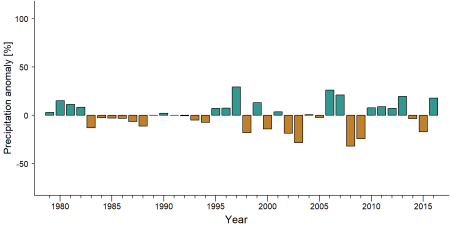
Precipitation anomaly in Cross River National Park -
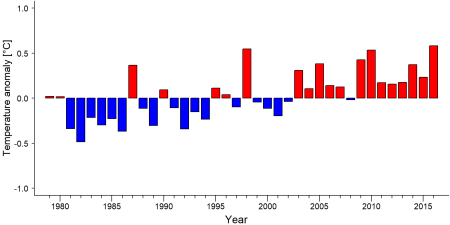
Temperature anomaly in Cross River National Park


External links
WCS Cross River National Park, Oban Division
WCS Cross River National Park, Okwango Division
References
Adetola, B. O., & Adetoro, A. O. (2014). Threats to biodiversity conservation in Cross River National Park, Nigeria. International Journal of Conservation Science, 5(4), 547–552. link
Akpan, A. (2021, December 20). WCS trains Cross River forest rangers. The Guardian Nigeria. https://guardian.ng/news/wcs-trains-cross-river-forest-rangers/
BirdLife International. (2020). Important Bird Areas factsheet: Cross River National Park (Oban Division). Retrieved from http://www.birdlife.org on 26 November 2020.
Dunn, A., Berg, R., Byler, D., Eben-Ebai, S., Etiendem, D. N., Fotso, R., …, & Williamson, E. A. (2014). Revised Regional Action Plan for the Conservation of the Cross River Gorilla (Gorilla gorilla diehli) 2014–2019. New York: IUCN/SSC Primate Specialist Group and Wildlife Conservation Society. link
Morgan, B., Adeleke, A., Bassey, T., Bergl, R., Dunn, A., Fotso, R., …, & Williamson, E. (2011). Regional Action Plan for the Conservation of the Nigeria-Cameroon chimpanzee (Pan troglodytes ellioti). IUCN/SSC Primate Specialist Group and Zoological Society of San Diego. link
Oates, J., Sunderland-Groves, J., Bergl, R., Dunn, A., Nicholas, A., Takang, E., …, & Williamson, L. (2007). Regional Action Plan for the conservation of the cross river gorilla (Gorilla gorilla diehli). IUCN/SSC Primate Specialist Group and Conservation International, Arlington VA. link
PAPFor. (2024, May 10). Fact sheet: Nigeria – Cross River Landscape. https://www.papfor.org/IMG/pdf/fiche_papfor-cross_river_eng_10_maj_2024.pdf
Kiribou, R., Tehoda, P., Chukwu, O., Bempah, G., Kühl, H. S., Ferreira, J., …, & Heinicke, S. (2024). Exposure of African ape sites to climate change impacts. PLOS Climate, 3(2), e0000345. doi:10.1371/journal.pclm.0000345
WCS. https://nigeria.wcs.org/wild-places/cross-river-np-oban.aspx
WCS. https://nigeria.wcs.org/wild-places/cross-river-np-okwangwo.aspx
Page created by: APES Atlas Team Date: 2023-09-28