
Djoua-Zadie Forest: Difference between revisions
Created page with "Central Africa > Gabon > Djoua-Zadie Forest '''[https://apesatlas-iucnapesportal-org.translate.goog/index.php/Djoua-Zadie_Forest?_x_tr_sl=auto&_x_tr_tl=fr&_x_tr_hl=en&_x_tr_pto=wapp Français]''' | '''[https://apesatlas-iucnapesportal-org.translate.goog/index.php/Djoua-Zadie_Forest?_x_tr_sl=auto&_x_tr_tl=pt&_x_tr_hl=en&_x_tr_pto=wapp Português]''' | '''[https://apesatlas-iucnapesportal-org.translate.goog/index.php/Djoua-Zadie_Forest?_x_tr_sl=auto&_x_tr_tl=e..." |
No edit summary Tag: Manual revert |
||
| (8 intermediate revisions by the same user not shown) | |||
| Line 10: | Line 10: | ||
* In 2016 it was estimated that 2,217 chimpanzees and gorillas occur in the area. | * In 2016 it was estimated that 2,217 chimpanzees and gorillas occur in the area. | ||
* The population trend is unknown. | * The population trend is unknown. | ||
| Line 20: | Line 17: | ||
= Site characteristics = | = Site characteristics = | ||
Yeno & Ngoran (2016) suggest that the Djoua-Zadié Forest should undergo a change in its conservation designation. The authors propose to the Gabonese government to reclassify a portion of the forest as a protected area in order to establish a vital corridor for large mammal populations between the Odzala-Kokoua NP (Congo) and Minkébé National Park (Gabon) as this will significantly contribute to regional biodiversity conservation. | [[#R00508|Yeno & Ngoran (2016)]] suggest that the Djoua-Zadié Forest should undergo a change in its conservation designation. The authors propose to the Gabonese government to reclassify a portion of the forest as a protected area in order to establish a vital corridor for large mammal populations between the Odzala-Kokoua NP (Congo) and Minkébé National Park (Gabon) as this will significantly contribute to regional biodiversity conservation. | ||
'''Table 1. Basic site information for Djoua-Zadie Forest''' | '''Table 1. Basic site information for Djoua-Zadie Forest''' | ||
| Line 44: | Line 41: | ||
[[Types of sites]] [[Governance types]] [[Habitat types]] | [[Types of sites]] [[Governance types]] [[Habitat types]] | ||
= Ape status = | = Ape status = | ||
| Line 72: | Line 70: | ||
|Line transects & recces | |Line transects & recces | ||
|Distance sampling | |Distance sampling | ||
|Yeno & Ngoran 2016 | |[[#R00508|Yeno & Ngoran 2016]] | ||
|The abundance , as well as the nest encounter rate, of chimpanzees and gorillas was merged | |The abundance , as well as the nest encounter rate, of chimpanzees and gorillas was merged | ||
| | |GAB0010 | ||
|} | |} | ||
[[Sampling methods]] [[Analytical frameworks]] | [[Sampling methods]] [[Analytical frameworks]] | ||
= Threats = | = Threats = | ||
| Line 89: | Line 88: | ||
!Description | !Description | ||
!Year of threat | !Year of threat | ||
|- | |- | ||
|2 Agriculture & aquaculture | |2 Agriculture & aquaculture | ||
|2.1.1 Shifting agriculture | |2.1.1 Shifting agriculture | ||
|Present (unknown severity) | |Present (unknown severity) | ||
|A variety of human activities occur both within the forest and in its surrounding areas, including hunting, fishing, farming, forestry, and artisanal mining. These practices reflect the diverse ways in which people interact with and utilize the landscape (Yeno & Ngoran, 2016). | |A variety of human activities occur both within the forest and in its surrounding areas, including hunting, fishing, farming, forestry, and artisanal mining. These practices reflect the diverse ways in which people interact with and utilize the landscape ([[#R00508|Yeno & Ngoran, 2016]]). | ||
|Ongoing (2015) | |Ongoing (2015) | ||
|- | |- | ||
| Line 111: | Line 104: | ||
|3.2.3 Artisanal mining | |3.2.3 Artisanal mining | ||
|Present (unknown severity) | |Present (unknown severity) | ||
|A variety of human activities occur both within the forest and in its surrounding areas, including hunting, fishing, farming, forestry, and artisanal mining. These practices reflect the diverse ways in which people interact with and utilize the landscape (Yeno & Ngoran, 2016). | |A variety of human activities occur both within the forest and in its surrounding areas, including hunting, fishing, farming, forestry, and artisanal mining. These practices reflect the diverse ways in which people interact with and utilize the landscape ([[#R00508|Yeno & Ngoran, 2016]]). | ||
|Ongoing (2015) | |Ongoing (2015) | ||
|- | |||
|5 Biological resource use | |||
|5.1 Hunting & collecting terrestrial animals | |||
|Medium (30-70% of population affected) | |||
|Since the Djoua-Zadié Forest is not currently covered by the ANPN's (National Agency for National Parks) anti-poaching patrols, it is crucial for the ANPN and the Ministry of Wildlife to urgently develop a strategy for patrolling this area. Utilizing the rivers as a patrol route could be an effective approach to enhance the protection of this vulnerable zone ([[#R00508|Yeno and Ngoran, 2016]]) | |||
|2015-Ongoing | |||
|- | |- | ||
|5 Biological resource use | |5 Biological resource use | ||
| Line 122: | Line 121: | ||
[[Threats]] | [[Threats]] | ||
= Conservation activities = | = Conservation activities = | ||
| Line 138: | Line 139: | ||
|- | |- | ||
|4 Institutional support | |4 Institutional support | ||
|4. | |4.1 Lack of law enforcement | ||
|Yeno & Ngoran 2016 | |[[#R00508|Yeno & Ngoran 2016]] | ||
|2015-Unknown | |2015-Unknown | ||
|- | |- | ||
|4 Institutional support | |4 Institutional support | ||
|4. | |4.3 Lack of protected area status | ||
|Yeno & Ngoran 2016 | |[[#R00508|Yeno & Ngoran 2016]] | ||
|2015-Unknown | |2015-Unknown | ||
|} | |} | ||
[[Challenges]] | [[Challenges]] | ||
= Enablers = | = Enablers = | ||
| Line 162: | Line 164: | ||
|4 Institutional support | |4 Institutional support | ||
|4.3 Strong transboundary cooperation | |4.3 Strong transboundary cooperation | ||
|Yeno & Ngoran 2016 | |[[#R00508|Yeno & Ngoran 2016]] | ||
|2015-2024 | |2015-2024 | ||
|- | |- | ||
|5 Ecological context | |5 Ecological context | ||
|5.1 Ecological characteristics (e.g. terrain) conducive to conservation | |5.1 Ecological characteristics (e.g. terrain) conducive to conservation | ||
|Yeno & Ngoran 2016 | |[[#R00508|Yeno & Ngoran 2016]] | ||
|2015-2024 | |2015-2024 | ||
|} | |} | ||
[[Enablers]] | [[Enablers]] | ||
= Research activities = | = Research activities = | ||
| Line 204: | Line 208: | ||
[[Behaviours]] | [[Behaviours]] | ||
= Exposure to climate change impacts = | = Exposure to climate change impacts = | ||
As part of a study on the exposure of African great ape sites to climate change impacts, Kiribou et al. | As part of a study on the exposure of African great ape sites to climate change impacts, [[#R02186|Kiribou et al. (2024)]] extracted climate data and data on projected extreme climate impact events for the site. Climatological characteristics were derived from observation-based climate data provided by the Inter-Sectoral Impact Model Intercomparison Project (ISIMIP, www.isimip.org). Parameters were calculated as the average across each 30-year period. For 1981-2010, the EWEMBI dataset from ISIMIP2a was used. For the two future periods (2021-2050 and 2071-2099) ISIMIP2b climate data based on four CMIP5 global climate models were used. For future projections, two Representative Concentration Pathways (RCP) were used. RCP 2.6 is a scenario with strong mitigation measures in which global temperatures would likely rise below 2C. RCP 6.0 is a scenario with medium emissions in which global temperatures would likely rise up to 3C by 2100. For the number of days with heavy precipitation events, the 98th percentile of all precipitation days (>1mm/d) was calculated for the 1979-2013 reference period as a threshold for a heavy precipitation event. Then, for each year, the number of days above that threshold was derived. The figures on temperature and precipitation anomaly show the deviation from the mean temperature and mean precipitation for the 1979-2013 reference period. | ||
The estimated exposure to future extreme climate impact events (crop failure, drought, river flood, wildfire, tropical cyclone, and heatwave) is based on a published dataset by Lange et al. 2020 derived from ISIMIP2b data. The same global climate models and RCPs as described above were used. Within each 30-year period, the number of years with an extreme event and the average proportion of the site affected were calculated ( | The estimated exposure to future extreme climate impact events (crop failure, drought, river flood, wildfire, tropical cyclone, and heatwave) is based on a published dataset by Lange et al. 2020 derived from ISIMIP2b data. The same global climate models and RCPs as described above were used. Within each 30-year period, the number of years with an extreme event and the average proportion of the site affected were calculated ([[#R02186|Kiribou et al. 2024]]). | ||
'''Table 8. Estimated past and projected climatological characteristics in Djoua-Zadie Forest''' | '''Table 8. Estimated past and projected climatological characteristics in Djoua-Zadie Forest''' | ||
| Line 242: | Line 247: | ||
|No. days with heavy precipitation (per year) | |No. days with heavy precipitation (per year) | ||
|7.3 | |7.3 | ||
|9. | |9.2 | ||
|9.4 | |9.4 | ||
|9. | |9.2 | ||
|9. | |9.8 | ||
|} | |} | ||
| Line 295: | Line 300: | ||
|1 | |1 | ||
|1 | |1 | ||
|1. | |1.14 | ||
|3 | |3 | ||
|4.74 | |4.74 | ||
| Line 322: | Line 327: | ||
|} | |} | ||
<div><ul><li style="display: inline-block; vertical-align: top;"> [[File:PrecipAnomaly_Djoua-Zadie_forest.png| 450px | thumb| none | Precipitation anomaly in Djoua-Zadie Forest]] </li><li style="display: inline-block; vertical-align: top;"> [[File:TempAnomaly_Djoua-Zadie_forest.png | 450px | thumb| none | Temperature anomaly in Djoua-Zadie Forest]] </li></ul></div> | |||
= External links = | = External links = | ||
| Line 329: | Line 336: | ||
= References = | = References = | ||
Yeno, S.L. and Ngoran P.K (2016). Rapport d'inventaire de grands et moyens mammifères dans la forêt de Djoua-Zadié, Gabon. WWF report. | <span id="R00508"></span>Yeno, S.L. and Ngoran P.K (2016). Rapport d'inventaire de grands et moyens mammifères dans la forêt de Djoua-Zadié, Gabon. WWF report. | ||
<span id="R02186"></span>Kiribou, R., Tehoda, P., Chukwu, O., Bempah, G., Kühl, H. S., Ferreira, J., …, & Heinicke, S. (2024). Exposure of African ape sites to climate change impacts. ''PLOS Climate'', 3(2), e0000345. [https://doi.org/10.1371/journal.pclm.0000345 doi:10.1371/journal.pclm.0000345] | |||
'''Page created by: '''Tene Sop''' Date:''' 2024-11-28 12:23:00 | '''Page created by: '''Tene Sop''' Date:''' 2024-11-28 12:23:00 | ||
Latest revision as of 17:52, 15 October 2026
Central Africa > Gabon > Djoua-Zadie Forest
Français | Português | Español | Bahasa Indonesia | Melayu
Summary
- Central chimpanzees (Pan troglodytes troglodytes) & western lowland gorillas (Gorilla gorilla gorilla) are present in Djoua-Zadie Forest.
- In 2016 it was estimated that 2,217 chimpanzees and gorillas occur in the area.
- The population trend is unknown.
Site characteristics
Yeno & Ngoran (2016) suggest that the Djoua-Zadié Forest should undergo a change in its conservation designation. The authors propose to the Gabonese government to reclassify a portion of the forest as a protected area in order to establish a vital corridor for large mammal populations between the Odzala-Kokoua NP (Congo) and Minkébé National Park (Gabon) as this will significantly contribute to regional biodiversity conservation.
Table 1. Basic site information for Djoua-Zadie Forest
| Species | Pan troglodytes troglodytes, Gorilla gorilla gorilla |
| Area | 5,444 km² |
| Coordinates | Lat: 1.1080 , Lon: 13.556 |
| Type of site | Non-protected area |
| Habitat types | Subtropical/tropical dry forest, Subtropical/tropical moist lowland forest, Subtropical/tropical swamp forest |
| Type of governance |
Types of sites Governance types Habitat types
Ape status
Table 2. Ape population estimates reported for Djoua-Zadie Forest
| Species | Year | Occurrence | Encounter or vistation rate (nests/km; ind/day) | Density estimate [ind./ km²] (95% CI) | Abundance estimate (95% CI) | Survey area | Sampling method | Analytical framework | Source | Comments | A.P.E.S. database ID |
|---|---|---|---|---|---|---|---|---|---|---|---|
| Pan troglodytes troglodytes & Gorilla gorilla gorilla | 2015-2016 | Present | 1.12 | 0.407 | 2,217 (1,390-3,537) | Djoua-Zadie Forest | Line transects & recces | Distance sampling | Yeno & Ngoran 2016 | The abundance , as well as the nest encounter rate, of chimpanzees and gorillas was merged | GAB0010 |
Sampling methods Analytical frameworks
Threats
Table 3. Threats to apes reported for Djoua-Zadie Forest
| Category | Specific threats | Threat level | Description | Year of threat |
|---|---|---|---|---|
| 2 Agriculture & aquaculture | 2.1.1 Shifting agriculture | Present (unknown severity) | A variety of human activities occur both within the forest and in its surrounding areas, including hunting, fishing, farming, forestry, and artisanal mining. These practices reflect the diverse ways in which people interact with and utilize the landscape (Yeno & Ngoran, 2016). | Ongoing (2015) |
| 3 Energy production & mining | 3.2.1 Industrial mining | Low (up to 30% of population affected) | The area holds considerable mining potential, with notable iron deposits such as Belinga and Boka Boka. To address the ecological impact of these mining activities, it is proposed that environmental offsets be implemented. These would include the creation of conservation areas equipped with strong anti-poaching measures, ensuring effective biodiversity protection while supporting industrial development. | Ongoing (2015) |
| 3 Energy production & mining | 3.2.3 Artisanal mining | Present (unknown severity) | A variety of human activities occur both within the forest and in its surrounding areas, including hunting, fishing, farming, forestry, and artisanal mining. These practices reflect the diverse ways in which people interact with and utilize the landscape (Yeno & Ngoran, 2016). | Ongoing (2015) |
| 5 Biological resource use | 5.1 Hunting & collecting terrestrial animals | Medium (30-70% of population affected) | Since the Djoua-Zadié Forest is not currently covered by the ANPN's (National Agency for National Parks) anti-poaching patrols, it is crucial for the ANPN and the Ministry of Wildlife to urgently develop a strategy for patrolling this area. Utilizing the rivers as a patrol route could be an effective approach to enhance the protection of this vulnerable zone (Yeno and Ngoran, 2016) | 2015-Ongoing |
| 5 Biological resource use | 5.3.2 Commercial logging | Medium (30-70% of population affected) | Logging companies operating in the area, which is located within the ecological corridor connecting Odzala-Kokoua and Minkébé National Parks must adopt FSC (Forest Stewardship Council) standards. These guidelines promote sustainable forest management, ensuring resource extraction is carried out responsibly while preserving the integrity of these untouched areas and maintaining ecological connectivity. | Ongoing (2015) |
Conservation activities
Challenges
Table 5. Challenges reported for Djoua-Zadie Forest
| Challenges | Specific challenges | Source | Year(s) |
|---|---|---|---|
| 4 Institutional support | 4.1 Lack of law enforcement | Yeno & Ngoran 2016 | 2015-Unknown |
| 4 Institutional support | 4.3 Lack of protected area status | Yeno & Ngoran 2016 | 2015-Unknown |
Enablers
Table 6. Enablers reported for Djoua-Zadie Forest
| Enablers | Specific enablers | Source | Year(s) |
|---|---|---|---|
| 4 Institutional support | 4.3 Strong transboundary cooperation | Yeno & Ngoran 2016 | 2015-2024 |
| 5 Ecological context | 5.1 Ecological characteristics (e.g. terrain) conducive to conservation | Yeno & Ngoran 2016 | 2015-2024 |
Research activities
Documented behaviours
Table 7. Behaviours documented for Djoua-Zadie Forest
| Category | Behavior | Observation type | Prevalence | Observation dates | Source | Habituation | Species | Comment |
|---|---|---|---|---|---|---|---|---|
| Not reported |
Exposure to climate change impacts
As part of a study on the exposure of African great ape sites to climate change impacts, Kiribou et al. (2024) extracted climate data and data on projected extreme climate impact events for the site. Climatological characteristics were derived from observation-based climate data provided by the Inter-Sectoral Impact Model Intercomparison Project (ISIMIP, www.isimip.org). Parameters were calculated as the average across each 30-year period. For 1981-2010, the EWEMBI dataset from ISIMIP2a was used. For the two future periods (2021-2050 and 2071-2099) ISIMIP2b climate data based on four CMIP5 global climate models were used. For future projections, two Representative Concentration Pathways (RCP) were used. RCP 2.6 is a scenario with strong mitigation measures in which global temperatures would likely rise below 2C. RCP 6.0 is a scenario with medium emissions in which global temperatures would likely rise up to 3C by 2100. For the number of days with heavy precipitation events, the 98th percentile of all precipitation days (>1mm/d) was calculated for the 1979-2013 reference period as a threshold for a heavy precipitation event. Then, for each year, the number of days above that threshold was derived. The figures on temperature and precipitation anomaly show the deviation from the mean temperature and mean precipitation for the 1979-2013 reference period.
The estimated exposure to future extreme climate impact events (crop failure, drought, river flood, wildfire, tropical cyclone, and heatwave) is based on a published dataset by Lange et al. 2020 derived from ISIMIP2b data. The same global climate models and RCPs as described above were used. Within each 30-year period, the number of years with an extreme event and the average proportion of the site affected were calculated (Kiribou et al. 2024).
Table 8. Estimated past and projected climatological characteristics in Djoua-Zadie Forest
| Value | 1981-2010 | 2021-2050, RCP 2.6 | 2021-2050, RCP 6.0 | 2071-2099, RCP 2.6 | 2071-2099, RCP 6.0 |
|---|---|---|---|---|---|
| Mean temperature [C] | 24.1 | 25.3 | 25.2 | 25.6 | 26.5 |
| Annual precipitation [mm] | 2894 | 2931 | 2904 | 2933 | 2907 |
| Max no. consecutive dry days (per year) | 12.7 | 10.5 | 9.5 | 11.1 | 10 |
| No. days with heavy precipitation (per year) | 7.3 | 9.2 | 9.4 | 9.2 | 9.8 |
Table 9. Projected exposure of apes to extreme climate impact events in Djoua-Zadie Forest
| Type | No. of years with event (2021-2050, RCP 2.6) | % of site exposed (2021-2050, RCP 2.6) | No. of years with event (2021-2050, RCP 6.0) | % of site exposed (2021-2050, RCP 6.0) | No. of years with event (2070-2099, RCP 2.6) | % of site exposed (2070-2099, RCP 2.6) | No. of years with event (2070-2099, RCP 6.0) | % of site exposed (2070-2099, RCP 6.0) |
|---|---|---|---|---|---|---|---|---|
| Crop failure | 6 | 0 | 4 | 0 | 5.5 | 0 | 14 | 0 |
| Drought | 0 | 0 | 0 | 0 | 0 | 0 | 0 | 0 |
| Heatwave | 3 | 100 | 5.5 | 100 | 3.5 | 100 | 12 | 100 |
| River flood | 1 | 1 | 1 | 1.14 | 3 | 4.74 | 2 | 3.18 |
| Tropical cyclone | 0 | 0 | 0 | 0 | 0 | 0 | 0 | 0 |
| Wildfire | 29 | 0.21 | 29.25 | 0.2 | 28.5 | 0.22 | 29 | 0.21 |
-
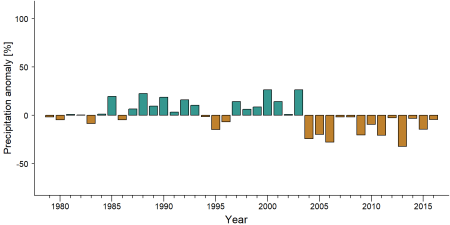
Precipitation anomaly in Djoua-Zadie Forest -
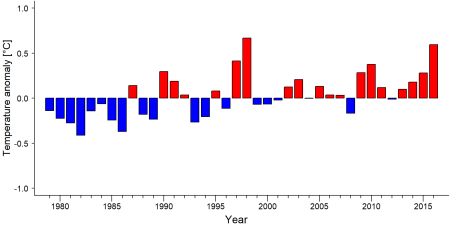
Temperature anomaly in Djoua-Zadie Forest


External links
References
Yeno, S.L. and Ngoran P.K (2016). Rapport d'inventaire de grands et moyens mammifères dans la forêt de Djoua-Zadié, Gabon. WWF report.
Kiribou, R., Tehoda, P., Chukwu, O., Bempah, G., Kühl, H. S., Ferreira, J., …, & Heinicke, S. (2024). Exposure of African ape sites to climate change impacts. PLOS Climate, 3(2), e0000345. doi:10.1371/journal.pclm.0000345
Page created by: Tene Sop Date: 2024-11-28 12:23:00