
Gola Forest National Park: Difference between revisions
No edit summary |
No edit summary |
||
| (10 intermediate revisions by the same user not shown) | |||
| Line 14: | Line 14: | ||
* BirdLife International, the Society for the Conservation of Nature in Liberia, and the Forestry Development Authority of Liberia worked together on the establishment of Gola Forest National Park; these are also the main organizations implementing conservation activities in the park. | * BirdLife International, the Society for the Conservation of Nature in Liberia, and the Forestry Development Authority of Liberia worked together on the establishment of Gola Forest National Park; these are also the main organizations implementing conservation activities in the park. | ||
* Gola Forest National Park is adjacent to the Gola Rainforest National Park in Sierra Leone, forming a transboundary peace park. | * Gola Forest National Park is adjacent to the Gola Rainforest National Park in Sierra Leone, forming a transboundary peace park. | ||
= Site characteristics = | = Site characteristics = | ||
Situated in northwest Liberia, the site was first classified as a National Forest in 1960 (Hoke et al. 2007), and designated as National Park in 2016 (Rainforest Trust 2018). The park is located in the Upper Guinea Forest of West Africa, a biodiversity hotspot with very high rates of endemism (Hoke et al. 2007). In addition to chimpanzees, other endangered mammal species occur, including Jentink’s duiker (''Cephalophus jentinki''), forest elephant (''Loxodonta africana''), pygmy hippopotamus (''Hexaprotodon liberiensis''), leopard (''Panthera pardus''), and bongo (''Tragelaphus eurycerus'') (Barrie et al. 2007). The site has also been declared an Important Bird Area (BirdLife International 2019). Gola Forest National Park is strategically connected to Sierra Leone’s [[Gola Rainforest National Park]] to establish a bi-national peace park (Rainforest Trust 2018). | Situated in northwest Liberia, the site was first classified as a National Forest in 1960 ([[#R00628|Hoke et al. 2007]]), and designated as National Park in 2016 ([[#R00631|Rainforest Trust 2018]]). The park is located in the Upper Guinea Forest of West Africa, a biodiversity hotspot with very high rates of endemism ([[#R00628|Hoke et al. 2007]]). In addition to chimpanzees, other endangered mammal species occur, including Jentink’s duiker (''Cephalophus jentinki''), forest elephant (''Loxodonta africana''), pygmy hippopotamus (''Hexaprotodon liberiensis''), leopard (''Panthera pardus''), and bongo (''Tragelaphus eurycerus'') ([[#R00625|Barrie et al. 2007]]). The site has also been declared an Important Bird Area ([[#R00627|BirdLife International 2019]]). Gola Forest National Park is strategically connected to Sierra Leone’s [[Gola Rainforest National Park]] to establish a bi-national peace park ([[#R00631|Rainforest Trust 2018]]). | ||
'''Table 1. Basic site information for Gola Forest National Park''' | '''Table 1. Basic site information for Gola Forest National Park''' | ||
| Line 44: | Line 41: | ||
[[Types of sites]] [[Governance types]] [[Habitat types]] | [[Types of sites]] [[Governance types]] [[Habitat types]] | ||
= Ape status = | = Ape status = | ||
The most recent estimate of chimpanzee abundance was 94 individuals in the year 2012 (Tweh et al. 2014). | The most recent estimate of chimpanzee abundance was 94 individuals in the year 2012 ([[#R00633|Tweh et al. 2014]]). | ||
Through the GolaMA project, line transect surveys with nest counts were conducted across a small portion of the northern sector and the adjacent community forest. Lines were surveyed in 2016-2017 and repeated in 2018-2019 The data have not yet been analyzed to obtain a density estimate. | Through the GolaMA project, line transect surveys with nest counts were conducted across a small portion of the northern sector and the adjacent community forest. Lines were surveyed in 2016-2017 and repeated in 2018-2019 The data have not yet been analyzed to obtain a density estimate. | ||
| Line 66: | Line 64: | ||
|- | |- | ||
|''Pan troglodytes verus'' | |''Pan troglodytes verus'' | ||
| | |2019 | ||
|Present | |||
| | | | ||
| | | | ||
| | | | ||
|Eastern part of Gola Forest National Park | |||
|Reconnaissance walk | |||
| | | | ||
| | |ELRECO Nationwide Forest Elephant Status Survey | ||
| | | | ||
| | | | ||
|- | |- | ||
|''Pan troglodytes verus'' | |''Pan troglodytes verus'' | ||
| | |2018-2019 | ||
| | |||
| | |||
| | | | ||
| | | | ||
| | |Northern part of Gola Forest National Park | ||
|Line transects | |Line transects | ||
| | | | ||
| | |Jones unpublished data | ||
| | | | ||
| | | | ||
|- | |- | ||
| Line 105: | Line 103: | ||
|- | |- | ||
|''Pan troglodytes verus'' | |''Pan troglodytes verus'' | ||
| | |2012 | ||
| | | | ||
| | | | ||
| | |0.110 | ||
| | |94 (225-539) | ||
| | |Gola National Forest | ||
|Line transects | |Line transects | ||
| | | | ||
| | |[[#R00633|Tweh et al. 2014]] | ||
| | |Survey effort: 118.3 km | ||
| | |LBR0026 | ||
|- | |- | ||
|''Pan troglodytes verus'' | |''Pan troglodytes verus'' | ||
| | |2005 | ||
| | | | ||
| | | | ||
| | | | ||
| | | | ||
| | |Gola National Forest | ||
|Genetic (dung/hair), Reconnaissance walk | |||
| | | | ||
|[[#R00625|Barrie et al. 2007]] | |||
|Only hunters reported that chimpanzees were still present in parts of the forest | |||
| | | | ||
|} | |} | ||
[[Sampling methods]] [[Analytical frameworks]] | [[Sampling methods]] [[Analytical frameworks]] | ||
= Threats = | = Threats = | ||
Several years of civil conflict in Liberia (1989-2003) led to the encroachment of Gola National Forest by displaced people and increased illegal mining and farming activities, as well as bushmeat hunting (Hoke et al. 2007). Illegal mining and logging activities were particularly aggravated by the civil wars (Hoke et al. 2007). Other major threats include bushmeat hunting and illegal farming activities (Hoke et al. 2007). Furthermore, since the end of the second civil war, the interest from international logging and mining companies to extract timber and mineral resources in the country was renewed (Tweh et al. 2014). In 2005, two mining companies were large-scale prospecting at Gola National Forest (Barrie et al. 2007). | Several years of civil conflict in Liberia (1989-2003) led to the encroachment of Gola National Forest by displaced people and increased illegal mining and farming activities, as well as bushmeat hunting ([[#R00628|Hoke et al. 2007]]). Illegal mining and logging activities were particularly aggravated by the civil wars ([[#R00628|Hoke et al. 2007]]). Other major threats include bushmeat hunting and illegal farming activities ([[#R00628|Hoke et al. 2007]]). Furthermore, since the end of the second civil war, the interest from international logging and mining companies to extract timber and mineral resources in the country was renewed ([[#R00633|Tweh et al. 2014]]). In 2005, two mining companies were large-scale prospecting at Gola National Forest ([[#R00625|Barrie et al. 2007]]). | ||
'''Table 3. Threats to apes reported for Gola Forest National Park''' | '''Table 3. Threats to apes reported for Gola Forest National Park''' | ||
| Line 147: | Line 146: | ||
|1.1 Residential areas | |1.1 Residential areas | ||
|Present (unknown severity) | |Present (unknown severity) | ||
|Illegal settlement of displaced people due to civil conflict (Hoke et al. 2007) | |Illegal settlement of displaced people due to civil conflict ([[#R00628|Hoke et al. 2007]]) | ||
|1989-2003 | |1989-2003 | ||
|- | |- | ||
| | |2 Agriculture & aquaculture | ||
| | |2.1 Annual & perennial non-timber crops | ||
|Present (unknown severity) | |||
|Illegal farming activities ([[#R00628|Hoke et al. 2007]]) | |||
|Ongoing (2007) | |||
|- | |||
|3 Energy production & mining | |||
|3.2 Mining & quarrying | |||
|High (more than 70% of population affected) | |High (more than 70% of population affected) | ||
| | |Illegal artisanal mining, especially during the Liberian civil wars ([[#R00625|Barrie et al. 2007]], [[#R00633|Tweh et al. 2014]]) | ||
| | |Ongoing (2014) | ||
|- | |- | ||
|4 Transportation & service corridors | |4 Transportation & service corridors | ||
|4.1 Roads & railroads | |4.1 Roads & railroads | ||
|Present (unknown severity) | |Present (unknown severity) | ||
|Trails created by heavy machinery and poachers (Barrie et al. 2007) | |Trails created by heavy machinery and poachers ([[#R00625|Barrie et al. 2007]]) | ||
|2005 | |2005 | ||
|- | |- | ||
| | |5 Biological resource use | ||
| | |5.1 Hunting & collecting terrestrial animals | ||
| | |High (more than 70% of population affected) | ||
| | |Bushmeat hunting ([[#R00625|Barrie et al. 2007]], [[#R00633|Tweh et al. 2014]], Jones et al. 2019 a,b) | ||
|Ongoing ( | |Ongoing (2014) | ||
|- | |- | ||
|5 Biological resource use | |5 Biological resource use | ||
|5.3 Logging & wood harvesting | |5.3 Logging & wood harvesting | ||
|High (more than 70% of population affected) | |High (more than 70% of population affected) | ||
|Logging and pit-sawing (Hoke et al. 2007) | |Logging and pit-sawing ([[#R00628|Hoke et al. 2007]]) | ||
|Ongoing (2007) | |Ongoing (2007) | ||
|- | |- | ||
| | |6 Human intrusions & disturbance | ||
| | |6.2 War, civil unrest & military exercises | ||
|High (more than 70% of population affected) | |High (more than 70% of population affected) | ||
| | |Two civil wars resulted in the encroachment of the park by displaced people; illegal mining and logging activities were also aggravated during this time ([[#R00628|Hoke et al. 2007]]) | ||
|1989-2003 | |||
|- | |||
|} | |} | ||
[[Threats]] | [[Threats]] | ||
= Conservation activities = | = Conservation activities = | ||
The site is part of BirdLife International´s ([http://www.birdlife.org/worldwide/programmes/forests-hope Forests of Hope program]), which aims to restore natural forests and support their long-term management. BirdLife International is also carrying out ([https://www.rspb.org.uk/our-work/conservation/projects/tropical-forests-research/ monitoring projects]) in the site. As part of the ([https://www.scnlliberia.org/our-work GolaMa Project]), the Society for Conservation of Nature in Liberia (SCNL) works to manage and protect the surrounding parts of the Gola forest that are not protected. | The site is part of BirdLife International´s ([http://www.birdlife.org/worldwide/programmes/forests-hope Forests of Hope program]), which aims to restore natural forests and support their long-term management. BirdLife International is also carrying out ([https://www.rspb.org.uk/our-work/conservation/projects/tropical-forests-research/ monitoring projects]) in the site. As part of the ([https://www.scnlliberia.org/our-work GolaMa Project]), the Society for Conservation of Nature in Liberia (SCNL) works to manage and protect the surrounding parts of the Gola forest that are not protected. | ||
Jones et al. (2019a) used cluster analysis to group hunters based on their behavioural and demographic profiles. It showed that groups with different hunting impacts also had distinct livelihood profiles, so would probably be expected to respond differently to different interventions. In a further survey of the same park-adjacent villages, Jones et al (2019b) gives a description of the species hunted and the financial returns obtained by hunters and traders. Chimpanzees and several other threatened taxa were recorded among hunters catch. The study found that traders were highly discouraged from continuing their activities by law enforcement efforts at road blocks. A household survey conducted in 2017 and 2019 found bushmeat hunting levels remained relatively unchanged at about 30-40% of households, whereas bushmeat trading may have decreased somewhat (from about 40 to 20%). This is most likely to be related to increased law enforcement efforts and meat confiscations. | [[#R00629|Jones et al. (2019a)]] used cluster analysis to group hunters based on their behavioural and demographic profiles. It showed that groups with different hunting impacts also had distinct livelihood profiles, so would probably be expected to respond differently to different interventions. In a further survey of the same park-adjacent villages, [[#R00630|Jones et al (2019b)]] gives a description of the species hunted and the financial returns obtained by hunters and traders. Chimpanzees and several other threatened taxa were recorded among hunters catch. The study found that traders were highly discouraged from continuing their activities by law enforcement efforts at road blocks. A household survey conducted in 2017 and 2019 found bushmeat hunting levels remained relatively unchanged at about 30-40% of households, whereas bushmeat trading may have decreased somewhat (from about 40 to 20%). This is most likely to be related to increased law enforcement efforts and meat confiscations. | ||
'''Table 4. Conservation activities reported for Gola Forest National Park''' | '''Table 4. Conservation activities reported for Gola Forest National Park''' | ||
| Line 201: | Line 201: | ||
!Implementing organization(s) | !Implementing organization(s) | ||
!Year of activity | !Year of activity | ||
|- | |- | ||
|2 Counter-wildlife crime | |2 Counter-wildlife crime | ||
|2. | |2.1 Implement road blocks to inspect cars for illegal ape bushmeat | ||
| | |Road blocks to inspect bushmeat traders ([[#R00630|Jones et al. 2019b]]) | ||
| | | | ||
|Ongoing ( | |Ongoing (2019) | ||
|- | |- | ||
|2 Counter-wildlife crime | |2 Counter-wildlife crime | ||
| Line 221: | Line 215: | ||
|- | |- | ||
|2 Counter-wildlife crime | |2 Counter-wildlife crime | ||
|2. | |2.3 Conduct regular anti-poaching patrols | ||
| | |Forest guards of the Forestry Development Authority conduct poaching patrols ([[#R00626|BirdLife International 2014]]) | ||
| | |||
|Ongoing (2014) | |||
|- | |||
|5 Protection & restoration | |||
|5.2 Legally protect ape habitat | |||
|The area was designated as National Park in 2016 ([[#R00631|Rainforest Trust 2018]]). | |||
| | | | ||
|Ongoing ( | |2016-Ongoing (2026) | ||
|} | |} | ||
[[Conservation activities]] | [[Conservation activities]] | ||
= Challenges = | = Challenges = | ||
| Line 241: | Line 242: | ||
|4 Institutional support | |4 Institutional support | ||
|4.1 Lack of law enforcement | |4.1 Lack of law enforcement | ||
|Barrie et al. 2007, Jones et al. 2019a | |[[#R00625|Barrie et al. 2007]], [[#R00629|Jones et al. 2019a]] | ||
| | | | ||
|} | |} | ||
[[Challenges]] | [[Challenges]] | ||
= Enablers = | = Enablers = | ||
| Line 289: | Line 291: | ||
[[Enablers]] | [[Enablers]] | ||
= Research activities = | = Research activities = | ||
Research activities in Gola Forest National Park focus on the monitoring of western chimpanzees (details in section on ape status), the bushmeat trade and appropriate conservation interventions (Jones et al. 2019 a,b; details section on conservation activities). | Research activities in Gola Forest National Park focus on the monitoring of western chimpanzees (details in section on ape status), the bushmeat trade and appropriate conservation interventions (Jones et al. 2019 a,b; details section on conservation activities). | ||
= Documented behaviours = | = Documented behaviours = | ||
| Line 321: | Line 325: | ||
[[Behaviours]] | [[Behaviours]] | ||
= Exposure to climate change impacts = | = Exposure to climate change impacts = | ||
As part of a study on the exposure of African great ape sites to climate change impacts, Kiribou et al. | As part of a study on the exposure of African great ape sites to climate change impacts, [[#R02203|Kiribou et al. (2024)]] extracted climate data and data on projected extreme climate impact events for the site. Climatological characteristics were derived from observation-based climate data provided by the Inter-Sectoral Impact Model Intercomparison Project (ISIMIP, www.isimip.org). Parameters were calculated as the average across each 30-year period. For 1981-2010, the EWEMBI dataset from ISIMIP2a was used. For the two future periods (2021-2050 and 2071-2099) ISIMIP2b climate data based on four CMIP5 global climate models were used. For future projections, two Representative Concentration Pathways (RCP) were used. RCP 2.6 is a scenario with strong mitigation measures in which global temperatures would likely rise below 2C. RCP 6.0 is a scenario with medium emissions in which global temperatures would likely rise up to 3C by 2100. For the number of days with heavy precipitation events, the 98th percentile of all precipitation days (>1mm/d) was calculated for the 1979-2013 reference period as a threshold for a heavy precipitation event. Then, for each year, the number of days above that threshold was derived. The figures on temperature and precipitation anomaly show the deviation from the mean temperature and mean precipitation for the 1979-2013 reference period. | ||
The estimated exposure to future extreme climate impact events (crop failure, drought, river flood, wildfire, tropical cyclone, and heatwave) is based on a published dataset by Lange et al. 2020 derived from ISIMIP2b data. The same global climate models and RCPs as described above were used. Within each 30-year period, the number of years with an extreme event and the average proportion of the site affected were calculated ( | The estimated exposure to future extreme climate impact events (crop failure, drought, river flood, wildfire, tropical cyclone, and heatwave) is based on a published dataset by Lange et al. 2020 derived from ISIMIP2b data. The same global climate models and RCPs as described above were used. Within each 30-year period, the number of years with an extreme event and the average proportion of the site affected were calculated ([[#R02203|Kiribou et al. 2024]]). | ||
'''Table 8. Estimated past and projected climatological characteristics in Gola Forest National Park''' | '''Table 8. Estimated past and projected climatological characteristics in Gola Forest National Park''' | ||
| Line 439: | Line 444: | ||
|} | |} | ||
<div><ul><li style="display: inline-block; vertical-align: top;"> [[File:PrecipAnomaly_Gola_Forest_NP.png| 450px | thumb| none | Precipitation anomaly in Gola Forest National Park]] </li><li style="display: inline-block; vertical-align: top;"> [[File:TempAnomaly_Gola_Forest_NP.png | 450px | thumb| none | Temperature anomaly in Gola Forest National Park]] </li></ul></div> | |||
= External links = | = External links = | ||
| Line 446: | Line 453: | ||
= References = | = References = | ||
Barrie, A., Zwuen, S., Kota, A.N., Lou, M. Sr, Luke, R. 2007. Rapid survey of large mammals of North Lorma, Gola and Grebo National Forests. In A Rapid Biological Assessment of North Lorma, Gola and Grebo National Forests, Liberia (eds P. Hoke, R. Demey & A. Peal), pp. 59–64. Conservation International, Washington, DC, USA. | <span id="R00625"></span>Barrie, A., Zwuen, S., Kota, A.N., Lou, M. Sr, Luke, R. 2007. Rapid survey of large mammals of North Lorma, Gola and Grebo National Forests. In A Rapid Biological Assessment of North Lorma, Gola and Grebo National Forests, Liberia (eds P. Hoke, R. Demey & A. Peal), pp. 59–64. Conservation International, Washington, DC, USA. | ||
<span id="R00626"></span>BirdLife International. 2014. Are we finally almost there? The Gola Forest National Park gazettement in Liberia: an update. Online: https://www.birdlife.org/africa/news/are-we-finally-almost-there-gola-forest-national-park-gazettement-liberia-update [https://web.archive.org/web/20210921072913/http://www.birdlife.org/africa/news/are-we-finally-almost-there-gola-forest-national-park-gazettement-liberia-update link] | |||
BirdLife International. | <span id="R00627"></span>BirdLife International. 2019. Important Bird Areas factsheet: Lofa-Gola-Mano Complex. Downloaded from http://www.birdlife.org on 23/03/2019. | ||
<span id="R00628"></span>Hoke, P., R. Demey and A. Peal (eds.). 2007. A rapid biological assessment of North Lorma, Gola and Grebo National Forests, Liberia. RAP Bulletin of Biological Assessment 44. Conservation International, Arlington, VA, USA. [https://web.archive.org/web/20240712003447/https://www.conservation.org/Documents/RAP_Reports/RAP44_National_Forests_Liberia_Nov-2005.pdf link] | |||
<span id="R00629"></span>Jones S et al. 2019a. Audience segmentation to improve targeting of conservation interventions for hunters: Audience Segmentation. Conservation Biology. DOI: 10.1111/cobi.13275. | |||
Jones S | <span id="R00630"></span>Jones, S., Papworth, S., Keane, A., St John, F., Smith, E., Flomo, A., …, & Vickery, J. (2019b). Incentives and social relationships of hunters and traders in a Liberian bushmeat system. ''Biological Conservation'', 237, 338-347. [https://doi.org/10.1016/j.biocon.2019.06.006 doi:10.1016/j.biocon.2019.06.006] | ||
<span id="R00631"></span>Rainforest Trust. 2018. Liberia Marks Official Launch of Gola Forest National Park With Community Ceremony. Online: https://www.rainforesttrust.org/liberia-marks-official-launch-of-gola-forest-national-park-with-community-ceremony/ | |||
<span id="R00632"></span>RSPB. 2019. Tropical Forests Research. Online: https://www.rspb.org.uk/our-work/conservation/projects/tropical-forests-research/) | |||
<span id="R00633"></span>Tweh, C. G., Lormie, M. M., Kouakou, C. Y., Hillers, A., Kühl, H. S., & Junker, J. (2015). Conservation status of chimpanzees Pan troglodytes verus and other large mammals in Liberia: a nationwide survey. ''Oryx'', 49(4), 710-718. [https://doi.org/10.1017/s0030605313001191 doi:10.1017/s0030605313001191] | |||
<span id="R02203"></span>Kiribou, R., Tehoda, P., Chukwu, O., Bempah, G., Kühl, H. S., Ferreira, J., …, & Heinicke, S. (2024). Exposure of African ape sites to climate change impacts. ''PLOS Climate'', 3(2), e0000345. [https://doi.org/10.1371/journal.pclm.0000345 doi:10.1371/journal.pclm.0000345] | |||
'''Page created by: '''Martina Vogt & Sorrel Jones''' Date:''' 2019-12-12 | '''Page created by: '''Martina Vogt & Sorrel Jones''' Date:''' 2019-12-12 | ||
Latest revision as of 17:53, 15 October 2026
West Africa > Liberia > Gola Forest National Park
Français | Português | Español | Bahasa Indonesia | Melayu
Summary
- Western chimpanzees (Pan troglodytes verus) are present in Gola Forest National Park.
- It has been estimated that 94 (CI: 225-539) individuals occur in the site.
- The chimpanzee population trend is unknown.
- This site has a total size of 880 km².
- Key threats to chimpanzees are hunting and habitat disturbance due to illegal farming, logging and mining activities.
- BirdLife International, the Society for the Conservation of Nature in Liberia, and the Forestry Development Authority of Liberia worked together on the establishment of Gola Forest National Park; these are also the main organizations implementing conservation activities in the park.
- Gola Forest National Park is adjacent to the Gola Rainforest National Park in Sierra Leone, forming a transboundary peace park.
Site characteristics
Situated in northwest Liberia, the site was first classified as a National Forest in 1960 (Hoke et al. 2007), and designated as National Park in 2016 (Rainforest Trust 2018). The park is located in the Upper Guinea Forest of West Africa, a biodiversity hotspot with very high rates of endemism (Hoke et al. 2007). In addition to chimpanzees, other endangered mammal species occur, including Jentink’s duiker (Cephalophus jentinki), forest elephant (Loxodonta africana), pygmy hippopotamus (Hexaprotodon liberiensis), leopard (Panthera pardus), and bongo (Tragelaphus eurycerus) (Barrie et al. 2007). The site has also been declared an Important Bird Area (BirdLife International 2019). Gola Forest National Park is strategically connected to Sierra Leone’s Gola Rainforest National Park to establish a bi-national peace park (Rainforest Trust 2018).
Table 1. Basic site information for Gola Forest National Park
| Species | Pan troglodytes verus |
| Area | 880 km² |
| Coordinates | Lat: 7.48 , Lon: -10.81 |
| Type of site | Protected area (National Park) |
| Habitat types | Subtropical/tropical moist lowland forest |
| Type of governance |
Types of sites Governance types Habitat types
Ape status
The most recent estimate of chimpanzee abundance was 94 individuals in the year 2012 (Tweh et al. 2014).
Through the GolaMA project, line transect surveys with nest counts were conducted across a small portion of the northern sector and the adjacent community forest. Lines were surveyed in 2016-2017 and repeated in 2018-2019 The data have not yet been analyzed to obtain a density estimate.
Table 2. Ape population estimates reported for Gola Forest National Park
| Species | Year | Occurrence | Encounter or vistation rate (nests/km; ind/day) | Density estimate [ind./ km²] (95% CI) | Abundance estimate (95% CI) | Survey area | Sampling method | Analytical framework | Source | Comments | A.P.E.S. database ID |
|---|---|---|---|---|---|---|---|---|---|---|---|
| Pan troglodytes verus | 2019 | Present | Eastern part of Gola Forest National Park | Reconnaissance walk | ELRECO Nationwide Forest Elephant Status Survey | ||||||
| Pan troglodytes verus | 2018-2019 | Northern part of Gola Forest National Park | Line transects | Jones unpublished data | |||||||
| Pan troglodytes verus | 2016-2017 | Northern part of Gola Forest National Park | Line transects | Jones unpublished data | |||||||
| Pan troglodytes verus | 2012 | 0.110 | 94 (225-539) | Gola National Forest | Line transects | Tweh et al. 2014 | Survey effort: 118.3 km | LBR0026 | |||
| Pan troglodytes verus | 2005 | Gola National Forest | Genetic (dung/hair), Reconnaissance walk | Barrie et al. 2007 | Only hunters reported that chimpanzees were still present in parts of the forest |
Sampling methods Analytical frameworks
Threats
Several years of civil conflict in Liberia (1989-2003) led to the encroachment of Gola National Forest by displaced people and increased illegal mining and farming activities, as well as bushmeat hunting (Hoke et al. 2007). Illegal mining and logging activities were particularly aggravated by the civil wars (Hoke et al. 2007). Other major threats include bushmeat hunting and illegal farming activities (Hoke et al. 2007). Furthermore, since the end of the second civil war, the interest from international logging and mining companies to extract timber and mineral resources in the country was renewed (Tweh et al. 2014). In 2005, two mining companies were large-scale prospecting at Gola National Forest (Barrie et al. 2007).
Table 3. Threats to apes reported for Gola Forest National Park
| Category | Specific threats | Threat level | Description | Year of threat |
|---|---|---|---|---|
| 1 Residential & commercial development | 1.1 Residential areas | Present (unknown severity) | Illegal settlement of displaced people due to civil conflict (Hoke et al. 2007) | 1989-2003 |
| 2 Agriculture & aquaculture | 2.1 Annual & perennial non-timber crops | Present (unknown severity) | Illegal farming activities (Hoke et al. 2007) | Ongoing (2007) |
| 3 Energy production & mining | 3.2 Mining & quarrying | High (more than 70% of population affected) | Illegal artisanal mining, especially during the Liberian civil wars (Barrie et al. 2007, Tweh et al. 2014) | Ongoing (2014) |
| 4 Transportation & service corridors | 4.1 Roads & railroads | Present (unknown severity) | Trails created by heavy machinery and poachers (Barrie et al. 2007) | 2005 |
| 5 Biological resource use | 5.1 Hunting & collecting terrestrial animals | High (more than 70% of population affected) | Bushmeat hunting (Barrie et al. 2007, Tweh et al. 2014, Jones et al. 2019 a,b) | Ongoing (2014) |
| 5 Biological resource use | 5.3 Logging & wood harvesting | High (more than 70% of population affected) | Logging and pit-sawing (Hoke et al. 2007) | Ongoing (2007) |
| 6 Human intrusions & disturbance | 6.2 War, civil unrest & military exercises | High (more than 70% of population affected) | Two civil wars resulted in the encroachment of the park by displaced people; illegal mining and logging activities were also aggravated during this time (Hoke et al. 2007) | 1989-2003 |
Conservation activities
The site is part of BirdLife International´s (Forests of Hope program), which aims to restore natural forests and support their long-term management. BirdLife International is also carrying out (monitoring projects) in the site. As part of the (GolaMa Project), the Society for Conservation of Nature in Liberia (SCNL) works to manage and protect the surrounding parts of the Gola forest that are not protected.
Jones et al. (2019a) used cluster analysis to group hunters based on their behavioural and demographic profiles. It showed that groups with different hunting impacts also had distinct livelihood profiles, so would probably be expected to respond differently to different interventions. In a further survey of the same park-adjacent villages, Jones et al (2019b) gives a description of the species hunted and the financial returns obtained by hunters and traders. Chimpanzees and several other threatened taxa were recorded among hunters catch. The study found that traders were highly discouraged from continuing their activities by law enforcement efforts at road blocks. A household survey conducted in 2017 and 2019 found bushmeat hunting levels remained relatively unchanged at about 30-40% of households, whereas bushmeat trading may have decreased somewhat (from about 40 to 20%). This is most likely to be related to increased law enforcement efforts and meat confiscations.
Table 4. Conservation activities reported for Gola Forest National Park
| Category | Specific activity | Description | Implementing organization(s) | Year of activity |
|---|---|---|---|---|
| 2 Counter-wildlife crime | 2.1 Implement road blocks to inspect cars for illegal ape bushmeat | Road blocks to inspect bushmeat traders (Jones et al. 2019b) | Ongoing (2019) | |
| 2 Counter-wildlife crime | 2.11 Implement monitoring surveillance strategies (e.g., SMART) or use monitoring data to improve effectiveness of patrols | Monitoring work done by BirdLife International (RSPB 2018) | Ongoing (2018) | |
| 2 Counter-wildlife crime | 2.3 Conduct regular anti-poaching patrols | Forest guards of the Forestry Development Authority conduct poaching patrols (BirdLife International 2014) | Ongoing (2014) | |
| 5 Protection & restoration | 5.2 Legally protect ape habitat | The area was designated as National Park in 2016 (Rainforest Trust 2018). | 2016-Ongoing (2026) |
Challenges
Table 5. Challenges reported for Gola Forest National Park
| Challenges | Specific challenges | Source | Year(s) |
|---|---|---|---|
| 4 Institutional support | 4.1 Lack of law enforcement | Barrie et al. 2007, Jones et al. 2019a |
Enablers
Table 6. Enablers reported for Gola Forest National Park
| Enablers | Specific enablers | Source | Year(s) |
|---|---|---|---|
| 1 Site management | |||
| 2 Resources and capacity | |||
| 3 Engaged community | |||
| 4 Institutional support | |||
| 5 Ecological context | |||
| 6 Safety and stability |
Research activities
Research activities in Gola Forest National Park focus on the monitoring of western chimpanzees (details in section on ape status), the bushmeat trade and appropriate conservation interventions (Jones et al. 2019 a,b; details section on conservation activities).
Documented behaviours
Table 7. Behaviours documented for Gola Forest National Park
| Category | Behavior | Observation type | Prevalence | Observation dates | Source | Habituation | Species | Comment |
|---|---|---|---|---|---|---|---|---|
| Not reported |
Exposure to climate change impacts
As part of a study on the exposure of African great ape sites to climate change impacts, Kiribou et al. (2024) extracted climate data and data on projected extreme climate impact events for the site. Climatological characteristics were derived from observation-based climate data provided by the Inter-Sectoral Impact Model Intercomparison Project (ISIMIP, www.isimip.org). Parameters were calculated as the average across each 30-year period. For 1981-2010, the EWEMBI dataset from ISIMIP2a was used. For the two future periods (2021-2050 and 2071-2099) ISIMIP2b climate data based on four CMIP5 global climate models were used. For future projections, two Representative Concentration Pathways (RCP) were used. RCP 2.6 is a scenario with strong mitigation measures in which global temperatures would likely rise below 2C. RCP 6.0 is a scenario with medium emissions in which global temperatures would likely rise up to 3C by 2100. For the number of days with heavy precipitation events, the 98th percentile of all precipitation days (>1mm/d) was calculated for the 1979-2013 reference period as a threshold for a heavy precipitation event. Then, for each year, the number of days above that threshold was derived. The figures on temperature and precipitation anomaly show the deviation from the mean temperature and mean precipitation for the 1979-2013 reference period.
The estimated exposure to future extreme climate impact events (crop failure, drought, river flood, wildfire, tropical cyclone, and heatwave) is based on a published dataset by Lange et al. 2020 derived from ISIMIP2b data. The same global climate models and RCPs as described above were used. Within each 30-year period, the number of years with an extreme event and the average proportion of the site affected were calculated (Kiribou et al. 2024).
Table 8. Estimated past and projected climatological characteristics in Gola Forest National Park
| Value | 1981-2010 | 2021-2050, RCP 2.6 | 2021-2050, RCP 6.0 | 2071-2099, RCP 2.6 | 2071-2099, RCP 6.0 |
|---|---|---|---|---|---|
| Mean temperature [C] | 25.8 | 26.9 | 26.9 | 27 | 28.1 |
| Annual precipitation [mm] | 2329 | 2293 | 2365 | 2336 | 2381 |
| Max no. consecutive dry days (per year) | 33.1 | 33.9 | 28.9 | 28.6 | 33.7 |
| No. days with heavy precipitation (per year) | 6.6 | 7.3 | 7.2 | 7.4 | 9.2 |
Table 9. Projected exposure of apes to extreme climate impact events in Gola Forest National Park
| Type | No. of years with event (2021-2050, RCP 2.6) | % of site exposed (2021-2050, RCP 2.6) | No. of years with event (2021-2050, RCP 6.0) | % of site exposed (2021-2050, RCP 6.0) | No. of years with event (2070-2099, RCP 2.6) | % of site exposed (2070-2099, RCP 2.6) | No. of years with event (2070-2099, RCP 6.0) | % of site exposed (2070-2099, RCP 6.0) |
|---|---|---|---|---|---|---|---|---|
| Crop failure | 5 | 0.01 | 1.5 | 0.01 | 2 | 0.01 | 4 | 0.01 |
| Drought | 0 | 0 | 0 | 0 | 0.25 | 25 | 0.5 | 25 |
| Heatwave | 5.5 | 100 | 8.5 | 100 | 10 | 100 | 16.5 | 100 |
| River flood | 1.5 | 0.62 | 1.25 | 0.97 | 2.75 | 1.75 | 5.25 | 2.17 |
| Tropical cyclone | 0 | 0 | 0 | 0 | 0 | 0 | 0.5 | 3.59 |
| Wildfire | 30 | 0.66 | 30 | 0.63 | 29 | 0.68 | 29 | 0.64 |
-
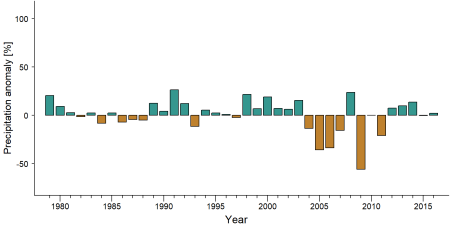
Precipitation anomaly in Gola Forest National Park -
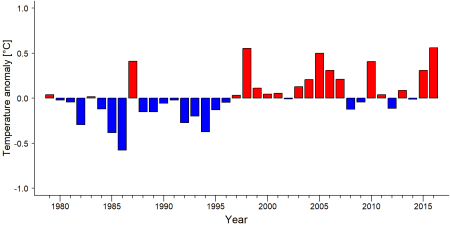
Temperature anomaly in Gola Forest National Park


External links
References
Barrie, A., Zwuen, S., Kota, A.N., Lou, M. Sr, Luke, R. 2007. Rapid survey of large mammals of North Lorma, Gola and Grebo National Forests. In A Rapid Biological Assessment of North Lorma, Gola and Grebo National Forests, Liberia (eds P. Hoke, R. Demey & A. Peal), pp. 59–64. Conservation International, Washington, DC, USA.
BirdLife International. 2014. Are we finally almost there? The Gola Forest National Park gazettement in Liberia: an update. Online: https://www.birdlife.org/africa/news/are-we-finally-almost-there-gola-forest-national-park-gazettement-liberia-update link
BirdLife International. 2019. Important Bird Areas factsheet: Lofa-Gola-Mano Complex. Downloaded from http://www.birdlife.org on 23/03/2019.
Hoke, P., R. Demey and A. Peal (eds.). 2007. A rapid biological assessment of North Lorma, Gola and Grebo National Forests, Liberia. RAP Bulletin of Biological Assessment 44. Conservation International, Arlington, VA, USA. link
Jones S et al. 2019a. Audience segmentation to improve targeting of conservation interventions for hunters: Audience Segmentation. Conservation Biology. DOI: 10.1111/cobi.13275.
Jones, S., Papworth, S., Keane, A., St John, F., Smith, E., Flomo, A., …, & Vickery, J. (2019b). Incentives and social relationships of hunters and traders in a Liberian bushmeat system. Biological Conservation, 237, 338-347. doi:10.1016/j.biocon.2019.06.006
Rainforest Trust. 2018. Liberia Marks Official Launch of Gola Forest National Park With Community Ceremony. Online: https://www.rainforesttrust.org/liberia-marks-official-launch-of-gola-forest-national-park-with-community-ceremony/
RSPB. 2019. Tropical Forests Research. Online: https://www.rspb.org.uk/our-work/conservation/projects/tropical-forests-research/)
Tweh, C. G., Lormie, M. M., Kouakou, C. Y., Hillers, A., Kühl, H. S., & Junker, J. (2015). Conservation status of chimpanzees Pan troglodytes verus and other large mammals in Liberia: a nationwide survey. Oryx, 49(4), 710-718. doi:10.1017/s0030605313001191
Kiribou, R., Tehoda, P., Chukwu, O., Bempah, G., Kühl, H. S., Ferreira, J., …, & Heinicke, S. (2024). Exposure of African ape sites to climate change impacts. PLOS Climate, 3(2), e0000345. doi:10.1371/journal.pclm.0000345
Page created by: Martina Vogt & Sorrel Jones Date: 2019-12-12