
Haute Dodo Classified Forest: Difference between revisions
No edit summary |
No edit summary Tag: Manual revert |
||
| (2 intermediate revisions by the same user not shown) | |||
| Line 44: | Line 44: | ||
= Ape status = | = Ape status = | ||
Current data on the population status of chimpanzees is lacking for the site, but it has been thought that the forest still holds a significant population (Kormos et al. 2003). | Current data on the population status of chimpanzees is lacking for the site, but it has been thought that the forest still holds a significant population ([[#R00747|Kormos et al. 2003]]). | ||
'''Table 2. Ape population estimates reported for Haute Dodo Classified Forest''' | '''Table 2. Ape population estimates reported for Haute Dodo Classified Forest''' | ||
| Line 70: | Line 70: | ||
|Unknown | |Unknown | ||
| | | | ||
|Sanderson et al. 2005 | |[[#R00748|Sanderson et al. 2005]] | ||
| | | | ||
| | | | ||
| Line 83: | Line 83: | ||
|Unknown | |Unknown | ||
| | | | ||
|Hoppe-Dominik 1991 | |[[#R00746|Hoppe-Dominik 1991]] | ||
| | | | ||
| | | | ||
| Line 142: | Line 142: | ||
= Enablers = | = Enablers = | ||
| Line 174: | Line 160: | ||
= Exposure to climate change impacts = | = Exposure to climate change impacts = | ||
As part of a study on the exposure of African great ape sites to climate change impacts, Kiribou et al. (2024) extracted climate data and data on projected extreme climate impact events for the site. Climatological characteristics were derived from observation-based climate data provided by the Inter-Sectoral Impact Model Intercomparison Project (ISIMIP, www.isimip.org). Parameters were calculated as the average across each 30-year period. For 1981-2010, the EWEMBI dataset from ISIMIP2a was used. For the two future periods (2021-2050 and 2071-2099) ISIMIP2b climate data based on four CMIP5 global climate models were used. For future projections, two Representative Concentration Pathways (RCP) were used. RCP 2.6 is a scenario with strong mitigation measures in which global temperatures would likely rise below 2C. RCP 6.0 is a scenario with medium emissions in which global temperatures would likely rise up to 3C by 2100. For the number of days with heavy precipitation events, the 98th percentile of all precipitation days (>1mm/d) was calculated for the 1979-2013 reference period as a threshold for a heavy precipitation event. Then, for each year, the number of days above that threshold was derived. The figures on temperature and precipitation anomaly show the deviation from the mean temperature and mean precipitation for the 1979-2013 reference period. | As part of a study on the exposure of African great ape sites to climate change impacts, [[#R02212|Kiribou et al. (2024)]] extracted climate data and data on projected extreme climate impact events for the site. Climatological characteristics were derived from observation-based climate data provided by the Inter-Sectoral Impact Model Intercomparison Project (ISIMIP, www.isimip.org). Parameters were calculated as the average across each 30-year period. For 1981-2010, the EWEMBI dataset from ISIMIP2a was used. For the two future periods (2021-2050 and 2071-2099) ISIMIP2b climate data based on four CMIP5 global climate models were used. For future projections, two Representative Concentration Pathways (RCP) were used. RCP 2.6 is a scenario with strong mitigation measures in which global temperatures would likely rise below 2C. RCP 6.0 is a scenario with medium emissions in which global temperatures would likely rise up to 3C by 2100. For the number of days with heavy precipitation events, the 98th percentile of all precipitation days (>1mm/d) was calculated for the 1979-2013 reference period as a threshold for a heavy precipitation event. Then, for each year, the number of days above that threshold was derived. The figures on temperature and precipitation anomaly show the deviation from the mean temperature and mean precipitation for the 1979-2013 reference period. | ||
The estimated exposure to future extreme climate impact events (crop failure, drought, river flood, wildfire, tropical cyclone, and heatwave) is based on a published dataset by Lange et al. 2020 derived from ISIMIP2b data. The same global climate models and RCPs as described above were used. Within each 30-year period, the number of years with an extreme event and the average proportion of the site affected were calculated (Kiribou et al. 2024). | The estimated exposure to future extreme climate impact events (crop failure, drought, river flood, wildfire, tropical cyclone, and heatwave) is based on a published dataset by Lange et al. 2020 derived from ISIMIP2b data. The same global climate models and RCPs as described above were used. Within each 30-year period, the number of years with an extreme event and the average proportion of the site affected were calculated ([[#R02212|Kiribou et al. 2024]]). | ||
'''Table 8. Estimated past and projected climatological characteristics in Haute Dodo Classified Forest''' | '''Table 8. Estimated past and projected climatological characteristics in Haute Dodo Classified Forest''' | ||
| Line 299: | Line 285: | ||
= References = | = References = | ||
Hoppe-Dominik, B. (1991). Distribution and status of chimpanzees (Pan troglodytes verus) on the Ivory Coast. Primate Report, 31, 45–57. < | <span id="R00746"></span>Hoppe-Dominik, B. (1991). Distribution and status of chimpanzees (Pan troglodytes verus) on the Ivory Coast. Primate Report, 31, 45–57. | ||
<span id="R00747"></span>Kormos, R., Boesch, C., Bakarr, M. I., & Butynski, T. (Eds.). (2003). West African chimpanzees: Status survey and conservation action plan. IUCN/SSC Primate Specialist Group. IUCN, Gland, Switzerland, and Cambridge, UK. ix + 219 pp. [https://web.archive.org/web/20120514150708/http://data.iucn.org/dbtw-wpd/edocs/2003-059.pdf link] | |||
<span id="R00748"></span>Sanderson, J., Barrie, A., Coleman, J. E., et al. (2005). A rapid survey of mammals from the Haute Dodo and Cavally Forests, Côte d’Ivoire. In L. E. Alonso, F. Lauginie, & G. Rondeau (Eds.), A rapid biological assessment of two classified forests in south-western Côte d’Ivoire (RAP Bulletin of Biological Assessment 34, pp. 118–124). Conservation International, Washington, DC. | |||
<span id="R02212"></span>Kiribou, R., Tehoda, P., Chukwu, O., Bempah, G., Kühl, H. S., Ferreira, J., …, & Heinicke, S. (2024). Exposure of African ape sites to climate change impacts. ''PLOS Climate'', 3(2), e0000345. [https://doi.org/10.1371/journal.pclm.0000345 doi:10.1371/journal.pclm.0000345] | |||
'''Page created by: '''Serge Soiret''' Date:''' 2025-05-27 | '''Page created by: '''Serge Soiret''' Date:''' 2025-05-27 | ||
Latest revision as of 17:53, 15 October 2026
West Africa > Côte d'Ivoire > Haute Dodo Classified Forest
Français | Português | Español | Bahasa Indonesia | Melayu
Summary
- West African chimpanzees (Pan troglodytes verus) are present in Haute Dodo Classified Forest.
- Population size is unknown.
- The population trend is unknown.
- This site has a total surface area of 1,094 km².
- The forest is quite degraded, with several rubber tree plantations, and it is home to many gold miners which also infiltrate Taï Ntional Park
- Conservation activities are unknown.
Site characteristics
The Haute Dodo Classified Forest has been assigned Category 3 in terms of forest degradation (the most severe level) by OIPR. It is managed by SODEFOR. It lies between the towns of Grabo, Dogbo, Doba and Djouroutou, south from the Taï National Park.
Table 1. Basic site information for Haute Dodo Classified Forest
| Species | Pan troglodytes verus |
| Area | 1,094 km² |
| Coordinates | Lat: 4.954447 , Lon: -7.093513 |
| Type of site | Protected area (Classified Forest) |
| Habitat types | Subtropical/tropical heavily degraded former forest |
| Type of governance | Governance by government |
Types of sites Governance types Habitat types
Ape status
Current data on the population status of chimpanzees is lacking for the site, but it has been thought that the forest still holds a significant population (Kormos et al. 2003).
Table 2. Ape population estimates reported for Haute Dodo Classified Forest
| Species | Year | Occurrence | Encounter or vistation rate (nests/km; ind/day) | Density estimate [ind./ km²] (95% CI) | Abundance estimate (95% CI) | Survey area | Sampling method | Analytical framework | Source | Comments | A.P.E.S. database ID |
|---|---|---|---|---|---|---|---|---|---|---|---|
| Pan troglodytes verus | 2002 | Present | Haute Dodo Classified Forest | Unknown | Sanderson et al. 2005 | ||||||
| Pan troglodytes verus | 1988 | 0.4 | 400.0 | Haute Dodo Classified Forest | Unknown | Hoppe-Dominik 1991 |
Sampling methods Analytical frameworks
Threats
This classified forest is much degraded, with rubber tree fields. It is home to many gold miners. It is from this forest that the majority of gold miners leave to infiltrate the Taï National Park (Soiret pers. comm. 2025).
Table 3. Threats to apes reported for Haute Dodo Classified Forest
| Category | Specific threats | Threat level | Description | Year of threat |
|---|---|---|---|---|
| 2 Agriculture & aquaculture | 2.1 Annual & perennial non-timber crops | Present (unknown severity) | Rubber tree plantations present in the site (Soiret pers. comm. 2025). | Ongoing (2025) |
| 3 Energy production & mining | 3.2 Mining & quarrying | Present (unknown severity) | Gold miners inhabit the site and move to Tai National Park from this site (Soiret pers. comm. 2025). | Ongoing (2025) |
Conservation activities
Table 4. Conservation activities reported for Haute Dodo Classified Forest
| Category | Specific activity | Description | Implementing organization(s) | Year of activity |
|---|---|---|---|---|
| 5 Protection & restoration | 5.2 Legally protect ape habitat | Ongoing (2025) |
Challenges
Enablers
Research activities
Documented behaviours
Exposure to climate change impacts
As part of a study on the exposure of African great ape sites to climate change impacts, Kiribou et al. (2024) extracted climate data and data on projected extreme climate impact events for the site. Climatological characteristics were derived from observation-based climate data provided by the Inter-Sectoral Impact Model Intercomparison Project (ISIMIP, www.isimip.org). Parameters were calculated as the average across each 30-year period. For 1981-2010, the EWEMBI dataset from ISIMIP2a was used. For the two future periods (2021-2050 and 2071-2099) ISIMIP2b climate data based on four CMIP5 global climate models were used. For future projections, two Representative Concentration Pathways (RCP) were used. RCP 2.6 is a scenario with strong mitigation measures in which global temperatures would likely rise below 2C. RCP 6.0 is a scenario with medium emissions in which global temperatures would likely rise up to 3C by 2100. For the number of days with heavy precipitation events, the 98th percentile of all precipitation days (>1mm/d) was calculated for the 1979-2013 reference period as a threshold for a heavy precipitation event. Then, for each year, the number of days above that threshold was derived. The figures on temperature and precipitation anomaly show the deviation from the mean temperature and mean precipitation for the 1979-2013 reference period.
The estimated exposure to future extreme climate impact events (crop failure, drought, river flood, wildfire, tropical cyclone, and heatwave) is based on a published dataset by Lange et al. 2020 derived from ISIMIP2b data. The same global climate models and RCPs as described above were used. Within each 30-year period, the number of years with an extreme event and the average proportion of the site affected were calculated (Kiribou et al. 2024).
Table 8. Estimated past and projected climatological characteristics in Haute Dodo Classified Forest
| Value | 1981-2010 | 2021-2050, RCP 2.6 | 2021-2050, RCP 6.0 | 2071-2099, RCP 2.6 | 2071-2099, RCP 6.0 |
|---|---|---|---|---|---|
| Mean temperature [C] | 25.5 | 26.5 | 26.3 | 26.6 | 27.6 |
| Annual precipitation [mm] | 2094 | 2044 | 2139 | 2078 | 2147 |
| Max no. consecutive dry days (per year) | 13.3 | 17.2 | 15.9 | 16.3 | 17.8 |
| No. days with heavy precipitation (per year) | 6.2 | 8.8 | 10.2 | 9 | 12.7 |
Table 9. Projected exposure of apes to extreme climate impact events in Haute Dodo Classified Forest
| Type | No. of years with event (2021-2050, RCP 2.6) | % of site exposed (2021-2050, RCP 2.6) | No. of years with event (2021-2050, RCP 6.0) | % of site exposed (2021-2050, RCP 6.0) | No. of years with event (2070-2099, RCP 2.6) | % of site exposed (2070-2099, RCP 2.6) | No. of years with event (2070-2099, RCP 6.0) | % of site exposed (2070-2099, RCP 6.0) |
|---|---|---|---|---|---|---|---|---|
| Crop failure | 5 | 1.96 | 5 | 1.45 | 5.5 | 1.83 | 8 | 1.82 |
| Drought | 0 | 0 | 0 | 0 | 0 | 0 | 0 | 0 |
| Heatwave | 15 | 87.29 | 16.5 | 88.75 | 18.5 | 89.93 | 17 | 82.11 |
| River flood | 0.75 | 0.03 | 3 | 2.21 | 3 | 0.96 | 2.5 | 0.68 |
| Tropical cyclone | 0 | 0 | 0.5 | 1.21 | 0 | 0 | 0 | 0 |
| Wildfire | 30 | 0.25 | 30 | 0.22 | 29 | 0.27 | 29 | 0.26 |
-
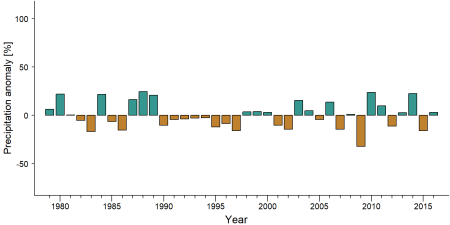
Precipitation anomaly in Haute Dodo Classified Forest -
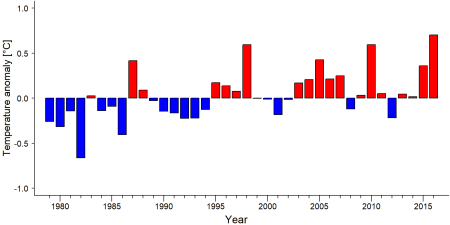
Temperature anomaly in Haute Dodo Classified Forest


External links
References
Hoppe-Dominik, B. (1991). Distribution and status of chimpanzees (Pan troglodytes verus) on the Ivory Coast. Primate Report, 31, 45–57.
Kormos, R., Boesch, C., Bakarr, M. I., & Butynski, T. (Eds.). (2003). West African chimpanzees: Status survey and conservation action plan. IUCN/SSC Primate Specialist Group. IUCN, Gland, Switzerland, and Cambridge, UK. ix + 219 pp. link
Sanderson, J., Barrie, A., Coleman, J. E., et al. (2005). A rapid survey of mammals from the Haute Dodo and Cavally Forests, Côte d’Ivoire. In L. E. Alonso, F. Lauginie, & G. Rondeau (Eds.), A rapid biological assessment of two classified forests in south-western Côte d’Ivoire (RAP Bulletin of Biological Assessment 34, pp. 118–124). Conservation International, Washington, DC.
Kiribou, R., Tehoda, P., Chukwu, O., Bempah, G., Kühl, H. S., Ferreira, J., …, & Heinicke, S. (2024). Exposure of African ape sites to climate change impacts. PLOS Climate, 3(2), e0000345. doi:10.1371/journal.pclm.0000345
Page created by: Serge Soiret Date: 2025-05-27