
Itwara Central Forest Reserve: Difference between revisions
No edit summary |
No edit summary Tag: Manual revert |
| (One intermediate revision by the same user not shown) | |
(No difference)
| |
Latest revision as of 17:53, 15 October 2026
East Africa > Uganda > Itwara Central Forest Reserve
Français | Português | Español | Bahasa Indonesia | Melayu
Summary
- Eastern chimpanzees (Pan troglodytes schweinfurthii) are present in Itwara Central Forest Reserve.
- The population size was estimated at 120 individuals in 2002.
- The population trend is unknown.
- Key threats to chimpanzees are logging, hunting and expansion of farmland.
Site characteristics
Itwara Forest is a medium-altitude, moist semi-deciduous forest located in Kyenjojo District, north of Kagura, within the Albertine Rift Region of Western Uganda. Covering a relatively small area of 87 km², the reserve features a steep, undulating terrain with elevations ranging from 1,220 to 1,510 meters. It is traversed by two rivers, Wamisu and Sogahi, which drain northward (Key Biodiversity Areas Partnership 2024).
The forest, which covers most of the reserve, supports approximately 258 plant species (NFA 2024), with dominant tree species including Parinari excelsa, Olea welwitschii, Carapa grandiflora, and Aningeria altissima, while grasslands make up only 20% of the reserve (Ministry of Water and Environment 2008; Howard 1991).
Itwara Forest provides habitat for 183 bird species, nine small mammal species, 256 tree and shrub species, 127 butterfly species, and 56 large moth species (Ministry of Water and Environment 2008). Notably, it supports a significant population of the butterfly species Telipna sheffieldii, qualifying it as a global Key Biodiversity Area (KBA) (Key Biodiversity Areas Partnership 2024). In addition to chimpanzees, other primate species reported in the reserve include black and white colobus, baboons, red-tail monkeys, L'Hoests monkeys and blue monkeys.
Table 1. Basic site information for Itwara Central Forest Reserve
| Species | Pan troglodytes schweinfurthii |
| Area | 87 km² |
| Coordinates | Lat: 0.791389 , Lon: 30.471944 |
| Type of site | Protected area (Forest Reserve) |
| Habitat types | Subtropical/tropical dry forest, Grassland |
| Type of governance | Governance by government |
Types of sites Governance types Habitat types
Ape status
Chimpanzees have been reported in the site since the early 90s and their abundance has been estimated at 120 individuals by (Plumptre, Cox & Mugume 2003). The chimpanzees are not fully habituated to human presence and an estimate of the number of communities is not available.
Table 2. Ape population estimates reported for Itwara Central Forest Reserve
| Species | Year | Occurrence | Encounter or vistation rate (nests/km; ind/day) | Density estimate [ind./ km²] (95% CI) | Abundance estimate (95% CI) | Survey area | Sampling method | Analytical framework | Source | Comments | A.P.E.S. database ID |
|---|---|---|---|---|---|---|---|---|---|---|---|
| Pan troglodytes schweinfurthii | 1999-2002 | 1.35 | 120 (67-215) | Itwara Forest Reserve | Line transects | Distance sampling (decay time unknown) | Plumptre, Cox & Mugume 2003 |
Sampling methods Analytical frameworks
Threats
Itwara Forest has been severely encroached and destroyed due to timber harvesting. It falls on the list of most affected forests, which includes Matiri, Muzizi, Bugoma and Oruha Forest Reserves (NFA 2024).
Table 3. Threats to apes reported for Itwara Central Forest Reserve
| Category | Specific threats | Threat level | Description | Year of threat |
|---|---|---|---|---|
| 2 Agriculture & aquaculture | 2.1 Annual & perennial non-timber crops | Present (unknown severity) | The forest has been encroached for farmland, resulting in the loss of critical chimpanzee habitat and reduction in forest cover. More critically, forest connectivity and dispersal opportunities for chimpanzees has also been significantly reduced, preventing gene flow necessary to maintain viable metapopulations. In the long term, the inability to disperse could be the greatest threat to chimpanzee communities in these forests (Plumptre, Cox & Mugume 2003). | Ongoing (2003) |
| 5 Biological resource use | 5.1 Hunting & collecting terrestrial animals | Low (up to 30% of population affected) | Hunting of chimpanzees is rare and not deliberate, as chimpanzees are not the target (Plumptre, Cox & Mugume 2003). Poaching reported in 1994 (Edroma et al. 1997). | 1994-Ongoing (2003) |
| 5 Biological resource use | 5.3.1 Subsistence logging | Present (unknown severity) | Illegal harvesting for for charcoal burning is also having an impact on the forest reserves and chimpanzees. Charcoal burning has the potential to cause more damage if not carefully controlled, as people are less selective in the tree species they harvest for charcoal (Plumptre, Cox & Mugume 2003). | Ongoing (2003) |
| 5 Biological resource use | 5.3.2 Commercial logging | Present (unknown severity) | Timber harvesting has been reported (NFA 2024). 13.2 ha of the reserve were logged by 1994, 3.0 ha lightly pitsawn, and 3.5 ha heavily pitsawn (Edroma et al. 1997; Howard 1991). | 1970-Ongoing (2024) |
Conservation activities
Table 4. Conservation activities reported for Itwara Central Forest Reserve
| Category | Specific activity | Description | Implementing organization(s) | Year of activity |
|---|---|---|---|---|
| 2 Counter-wildlife crime | 2.11 Implement monitoring surveillance strategies (e.g., SMART) or use monitoring data to improve effectiveness of patrols | In 2023, WCS supported NFA in SMART training. | Wildlife Conservation Society and National Forest Authority | Ongoing (2023) |
| 2 Counter-wildlife crime | 2.13 Provide sustainable alternative livelihoods; establish fish- or domestic meat farms | Under Collaborative Forest Management groups, extra-forest activities like poultry keeping, pig-keeping, coffee, onion and/or potato growing and marketing are carried out so as to reduce pressure on reserve (Kazoora et al. 2020). | Kajuma Itwara Farmers and Environmental Conservation Association and National Forest Authority | Ongoing (2020) |
| 5 Protection & restoration | 5.2 Legally protect ape habitat | Designated a central forest reserve in 1948. Additionally, It contains sufficient numbers of the butterfly Telipna sheffieldii to qualify as a global KBA (Key Biodiversity Areas Partnership 2024). | Key Biodiversity Areas Partnership | 1948-Ongoing (2026) |
Challenges
Table 5. Challenges reported for Itwara Central Forest Reserve
| Challenges | Specific challenges | Source | Year(s) |
|---|---|---|---|
| 2 Resources and capacity | 2.2 Lack of staff | Ministry of Water and Environment 2008; NFA 2024 | 2008-Ongoing (2024) |
| 2 Resources and capacity | 2.5 Lack of equipment/transportation | Ministry of Water and Environment 2008 | 2008-Ongoing (2024) |
| 3 Engaged community | 3.1 General lack of community engagement or support | Kazoora et al. 2020 | 2003 |
| 4 Institutional support | 4.1 Lack of law enforcement | Kazoora et al. 2020; NFA 2024 | 2003-Ongoing (2024) |
Enablers
Table 6. Enablers reported for Itwara Central Forest Reserve
| Enablers | Specific enablers | Source | Year(s) |
|---|---|---|---|
| 3 Engaged community | 3.6 Local community engagement and support | Kazoora et al. 2020 | 2003-Ongoing (2024) |
Research activities
Documented behaviours
Exposure to climate change impacts
As part of a study on the exposure of African great ape sites to climate change impacts, Kiribou et al. (2024) extracted climate data and data on projected extreme climate impact events for the site. Climatological characteristics were derived from observation-based climate data provided by the Inter-Sectoral Impact Model Intercomparison Project (ISIMIP, www.isimip.org). Parameters were calculated as the average across each 30-year period. For 1981-2010, the EWEMBI dataset from ISIMIP2a was used. For the two future periods (2021-2050 and 2071-2099) ISIMIP2b climate data based on four CMIP5 global climate models were used. For future projections, two Representative Concentration Pathways (RCP) were used. RCP 2.6 is a scenario with strong mitigation measures in which global temperatures would likely rise below 2C. RCP 6.0 is a scenario with medium emissions in which global temperatures would likely rise up to 3C by 2100. For the number of days with heavy precipitation events, the 98th percentile of all precipitation days (>1mm/d) was calculated for the 1979-2013 reference period as a threshold for a heavy precipitation event. Then, for each year, the number of days above that threshold was derived. The figures on temperature and precipitation anomaly show the deviation from the mean temperature and mean precipitation for the 1979-2013 reference period.
The estimated exposure to future extreme climate impact events (crop failure, drought, river flood, wildfire, tropical cyclone, and heatwave) is based on a published dataset by Lange et al. 2020 derived from ISIMIP2b data. The same global climate models and RCPs as described above were used. Within each 30-year period, the number of years with an extreme event and the average proportion of the site affected were calculated (Kiribou et al. 2024).
Table 8. Estimated past and projected climatological characteristics in Itwara Central Forest Reserve
| Value | 1981-2010 | 2021-2050, RCP 2.6 | 2021-2050, RCP 6.0 | 2071-2099, RCP 2.6 | 2071-2099, RCP 6.0 |
|---|---|---|---|---|---|
| Mean temperature [C] | 22 | 23.1 | 23.2 | 23.4 | 24.5 |
| Annual precipitation [mm] | 1345 | 1387 | 1479 | 1300 | 1575 |
| Max no. consecutive dry days (per year) | 12.3 | 19.7 | 23.6 | 22.5 | 21.3 |
| No. days with heavy precipitation (per year) | 6.8 | 10.1 | 9.7 | 10.5 | 16 |
Table 9. Projected exposure of apes to extreme climate impact events in Itwara Central Forest Reserve
| Type | No. of years with event (2021-2050, RCP 2.6) | % of site exposed (2021-2050, RCP 2.6) | No. of years with event (2021-2050, RCP 6.0) | % of site exposed (2021-2050, RCP 6.0) | No. of years with event (2070-2099, RCP 2.6) | % of site exposed (2070-2099, RCP 2.6) | No. of years with event (2070-2099, RCP 6.0) | % of site exposed (2070-2099, RCP 6.0) |
|---|---|---|---|---|---|---|---|---|
| Crop failure | 2.5 | 0.04 | 0 | 0 | 2.5 | 0.34 | 1.5 | 0.02 |
| Drought | 0 | 0 | 0 | 0 | 0 | 0 | 0 | 0 |
| Heatwave | 0 | 0 | 0 | 0 | 0 | 0 | 0 | 0 |
| River flood | 1.75 | 0.05 | 4 | 1.37 | 1 | 0.01 | 5.75 | 0.95 |
| Tropical cyclone | 0 | 0 | 0 | 0 | 0 | 0 | 0 | 0 |
| Wildfire | 30 | 1.03 | 30 | 1.01 | 29 | 0.98 | 29 | 0.79 |
-
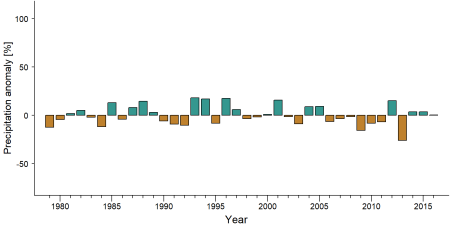
Precipitation anomaly in Itwara Central Forest Reserve -
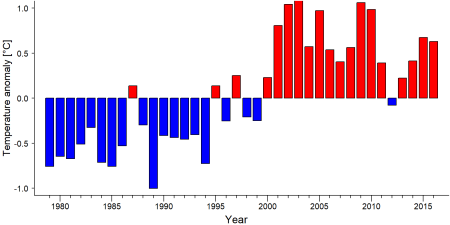
Temperature anomaly in Itwara Central Forest Reserve


External links
References
Edroma, E., Rosen, N., & Miller, P. (1997). Population and habitat viability assessment for Pan troglodytes schweinfurthii. IUCN/SSC Conservation Breeding Specialist Group, Aplle Valley, MN.
Howard, P. C. (1991). Nature conservation in Uganda's tropical forest reserves (pp. xvii+-313).
Kazoora, C., Irumba, D., Smith, N., Mutamba, M., Nkabiheebwa, P., Katumba, G., & Nakiyingi, E. (2020). A review of collaborative forest management in Uganda. Kampala, Uganda: National Forestry Authority, Ministry of Water and Environment.
Key Biodiversity Areas Partnership (2024) Key Biodiversity Areas factsheet: Itwara Forest. Reserve.https://www.keybiodiversityareas.org/site/factsheet/28632. Retrieved on Nov 19, 2024.
Ministry of Water and Environment (MWE) (2008). Forest Management Plan for Itwara Group of Central Forest Reserves, for period 1st July 2008 – 30th June 2018. Kampala, Uganda: Ministry of Water and Environment.
NFA, Uganda. (2024). Itwara Forest. https://www.nfa.org.ug/forests/itwara-forest/. Retrieved on 20th Novemeber, 2024.
Plumptre, A. J., & Cox, D. (2006). Counting primates for conservation: primate surveys in Uganda. Primates, 47(1), 65-73. doi:10.1007/s10329-005-0146-8
Plumptre, A. J., Cox, D., & Mugume, S. (2003). The status of chimpanzees in Uganda. Albertine Rift Technical Report Series No. 2. Wildlife Conservation Society link
Kiribou, R., Tehoda, P., Chukwu, O., Bempah, G., Kühl, H. S., Ferreira, J., …, & Heinicke, S. (2024). Exposure of African ape sites to climate change impacts. PLOS Climate, 3(2), e0000345. doi:10.1371/journal.pclm.0000345
Page created by: Steven Joel Basiibye Date: 2024-11-01