
Kagwene Gorilla Sanctuary: Difference between revisions
No edit summary |
No edit summary Tag: Manual revert |
| (One intermediate revision by the same user not shown) | |
(No difference)
| |
Latest revision as of 17:53, 15 October 2026
Central Africa > Cameroon > Kagwene Gorilla Sanctuary
Français | Português | Español | Bahasa Indonesia | Melayu
Summary
- Cross river gorillas (Gorilla gorilla diehli) are present in Kagwene Gorilla Sanctuary.
- Two groups occur in the site; the total population size is unknown.
- The gorilla population trend is unknown.
- The site has a total size of 19.44 km².
- Key threats to gorillas are livestock farming, conversion of land for agriculture, and hunting.
- Conservation activities have focused on anti-poaching patrols and research activities.
-
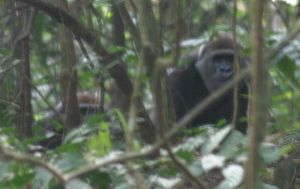
© Sunderland-Groves -
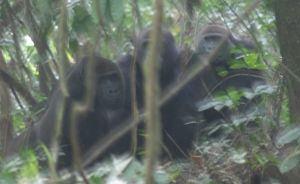
© Sunderland-Groves


Site characteristics
Kagwene Gorilla Sanctuary was created in April 2008, in the Kagwene mountain range in northwestern Cameroon (Sunderland-Groves & Mboh 2009). The vegetation is a submontane forest-grassland mosaic, and the terrain is rocky, reaching an elevation of up to 2,037 m above sea level (Sunderland-Groves & Mboh 2009).
Table 1. Basic site information for Kagwene Gorilla Sanctuary
| Species | Gorilla gorilla diehli |
| Area | 19.44 km² |
| Coordinates | Lat: 6.1333 , Lon: 9.7000 |
| Type of site | Protected area (Wildlife Sanctuary) |
| Habitat types | Subtropical/tropical moist montane forest, Grassland, Subtropical/tropical heavily degraded former forest |
| Type of governance |
Types of sites Governance types Habitat types
Ape status
During a survey between 2003 and 2005, a total of 569 fresh night-nest sites containing 7,032 individual nests, including 7 solitary nests, were recorded (Sunderland-Groves & Mboh 2009). The mean night nest group size was 12.4. The survey results, coupled with a genetic study that identified 15 individuals (Bergl & Vigilant 2007), indicate the presence of an additional group at the site, outside of the core group of 13 (Sunderland-Groves & Mboh 2009).
A 2012-2013 survey recorded 249 fresh night nest sites, comprising 1,877 individual nests in Kagwene (Ikfuingei 2013). The mean count of nests of weaned individuals was 7.54 per nest site with a range from 2-12. The majority of nest sites were recorded in the northwest and centre of the sanctuary (Ikfuingei 2013).
Table 2. Ape population estimates reported for Kagwene Gorilla Sanctuary
| Species | Year | Occurrence | Encounter or vistation rate (nests/km; ind/day) | Density estimate [ind./ km²] (95% CI) | Abundance estimate (95% CI) | Survey area | Sampling method | Analytical framework | Source | Comments | A.P.E.S. database ID |
|---|---|---|---|---|---|---|---|---|---|---|---|
| Gorilla gorilla diehli | 2012-2013 | Present | Kagwene Gorilla Sanctuary | Reconnaissance walk | Ikfuingei 2013 | survey effort: 1005.19 km in 268 days | |||||
| Gorilla gorilla diehli | 2003-2005 | Present | Kagwene Gorilla Sanctuary | Reconnaissance walk | Sunderland-Groves & Mboh 2009 | CMR0015 |
Sampling methods Analytical frameworks
Threats
Livestock farming and herding, agricultural activities and hunting are the main human pressures within the sanctuary (Ikfuingei 2013). Domestic animals (cattle, goats, sheep and horses) are common on the grassland patches within the sanctuary (Ikfuingei 2013). Wire snares have been recorded mainly around the Kenchi-Alumfa section of the sanctuary, coinciding with the core area for gorillas (Ikfuingei 2013).
Table 3. Threats to apes reported for Kagwene Gorilla Sanctuary
| Category | Specific threats | Threat level | Description | Year of threat |
|---|---|---|---|---|
| 1 Residential & commercial development | 1.1 Residential areas | Present (unknown severity) | Eight farming communities and ca. 2,600 people live around the base of the mountain (Sunderland-Groves & Mboh 2009). | Ongoing (2009) |
| 2 Agriculture & aquaculture | 2.1 Annual & perennial non-timber crops | High (more than 70% of population affected) | Active farms with annual crops have been recorded on the Kenchi section of the sanctuary (Ikfuingei 2013). | Ongoing (2013) |
| 2 Agriculture & aquaculture | 2.3 Livestock farming & ranching | High (more than 70% of population affected) | Cattle herding on grassland patches within the sanctuary (Sunderland-Groves & Mboh 2009, Ikfuingei 2013). | Ongoing (2013) |
| 5 Biological resource use | 5.1 Hunting & collecting terrestrial animals | High (more than 70% of population affected) | Wire snares targeting other wildlife species in the sanctuary (Ikfuingei 2013). A local belief that gorillas are in fact humans has significantly protected them (Sunderland-Groves & Mboh 2009). | Ongoing (2013) |
| 5 Biological resource use | 5.2 Gathering terrestrial plants | Present (unknown severity) | Traditionally, local communities enter the forest to gather non timber forest products (Sunderland-Groves & Mboh 2009). | Ongoing (2009) |
Conservation activities
Table 4. Conservation activities reported for Kagwene Gorilla Sanctuary
| Category | Specific activity | Description | Implementing organization(s) | Year of activity |
|---|---|---|---|---|
| 2 Counter-wildlife crime | 2.3 Conduct regular anti-poaching patrols | In 2009, two MINFOF Ecoguards were appointed. The entire sanctuary is patrolled by MINFOF Eco-guards (Ikfuingei 2013). | Ongoing (2013) | |
| 2 Counter-wildlife crime | 2.6 Regularly de-activate/remove ground snares | Since early 2006 a greater effort has been made in patrolling and removing snares at the site (Ikfuingei 2013). | 2006-Ongoing (2013) | |
| 8 Permanent presence | 8.1 Run research project and ensure permanent human presence at site | The Kagwene Gorilla Sanctuary is the site of a permanent WCS Research Camp (Ikfuingei 2013). | Ongoing (2013) |
Challenges
Table 5. Challenges reported for Kagwene Gorilla Sanctuary
| Challenges | Specific challenges | Source | Year(s) |
|---|---|---|---|
| Not reported |
Enablers
Table 6. Enablers reported for Kagwene Gorilla Sanctuary
| Enablers | Specific enablers | Source | Year(s) |
|---|---|---|---|
| 1 Site management | |||
| 2 Resources and capacity | |||
| 3 Engaged community | |||
| 4 Institutional support | |||
| 5 Ecological context | |||
| 6 Safety and stability |
Research activities
A study on gorilla nesting behaviour discovered that Kagwene gorillas are reusing nests sites (Sunderland-Groves & Mboh 2009). Furthermore, 55% of night nests were constructed on the ground and 45% in trees. Significantly more arboreal nests were constructed in the wet season (69%), vs. the dry season (19%). Nest site reuse was common (35%), but not related to season (Sunderland-Groves & Mboh 2009). In 2012-2013, analyses of fresh and recent gorilla feeding found on trails showed that the most commonly eaten plant parts were pith (78.94%), fruits (7.11%) leaves (6.59%) and bark (6.47%) (Ikfuingei 2013). Gorillas feed on bark throughout the year (Ikfuingei 2013).
Documented behaviours
Table 7. Behaviours documented for Kagwene Gorilla Sanctuary
| Category | Behavior | Observation type | Prevalence | Observation dates | Source | Habituation | Species | Comment |
|---|---|---|---|---|---|---|---|---|
| Not reported |
Exposure to climate change impacts
As part of a study on the exposure of African great ape sites to climate change impacts, Kiribou et al. (2024) extracted climate data and data on projected extreme climate impact events for the site. Climatological characteristics were derived from observation-based climate data provided by the Inter-Sectoral Impact Model Intercomparison Project (ISIMIP, www.isimip.org). Parameters were calculated as the average across each 30-year period. For 1981-2010, the EWEMBI dataset from ISIMIP2a was used. For the two future periods (2021-2050 and 2071-2099) ISIMIP2b climate data based on four CMIP5 global climate models were used. For future projections, two Representative Concentration Pathways (RCP) were used. RCP 2.6 is a scenario with strong mitigation measures in which global temperatures would likely rise below 2C. RCP 6.0 is a scenario with medium emissions in which global temperatures would likely rise up to 3C by 2100. For the number of days with heavy precipitation events, the 98th percentile of all precipitation days (>1mm/d) was calculated for the 1979-2013 reference period as a threshold for a heavy precipitation event. Then, for each year, the number of days above that threshold was derived. The figures on temperature and precipitation anomaly show the deviation from the mean temperature and mean precipitation for the 1979-2013 reference period.
The estimated exposure to future extreme climate impact events (crop failure, drought, river flood, wildfire, tropical cyclone, and heatwave) is based on a published dataset by Lange et al. 2020 derived from ISIMIP2b data. The same global climate models and RCPs as described above were used. Within each 30-year period, the number of years with an extreme event and the average proportion of the site affected were calculated (Kiribou et al. 2024).
Table 8. Estimated past and projected climatological characteristics in Kagwene Gorilla Sanctuary
| Value | 1981-2010 | 2021-2050, RCP 2.6 | 2021-2050, RCP 6.0 | 2071-2099, RCP 2.6 | 2071-2099, RCP 6.0 |
|---|---|---|---|---|---|
| Mean temperature [C] | 23.5 | 24.7 | 24.3 | 24.8 | 25.8 |
| Annual precipitation [mm] | 2406 | 2512 | 2547 | 2526 | 2481 |
| Max no. consecutive dry days (per year) | 43.5 | 39.4 | 41.3 | 40.6 | 44.4 |
| No. days with heavy precipitation (per year) | 5.1 | 5.3 | 5.4 | 5.7 | 6.9 |
Table 9. Projected exposure of apes to extreme climate impact events in Kagwene Gorilla Sanctuary
| Type | No. of years with event (2021-2050, RCP 2.6) | % of site exposed (2021-2050, RCP 2.6) | No. of years with event (2021-2050, RCP 6.0) | % of site exposed (2021-2050, RCP 6.0) | No. of years with event (2070-2099, RCP 2.6) | % of site exposed (2070-2099, RCP 2.6) | No. of years with event (2070-2099, RCP 6.0) | % of site exposed (2070-2099, RCP 6.0) |
|---|---|---|---|---|---|---|---|---|
| Crop failure | 5 | 0.97 | 4 | 0.76 | 3.5 | 0.7 | 7 | 0.75 |
| Drought | 0 | 0 | 0 | 0 | 0 | 0 | 0 | 0 |
| Heatwave | 0.5 | 50 | 1.5 | 100 | 1 | 100 | 4 | 100 |
| River flood | 0.75 | 0 | 2.5 | 1.07 | 1.5 | 1.41 | 3 | 0.75 |
| Tropical cyclone | 0 | 0 | 0 | 0 | 0 | 0 | 0 | 0 |
| Wildfire | 30 | 0.7 | 30 | 0.7 | 29 | 0.7 | 29 | 0.7 |
-
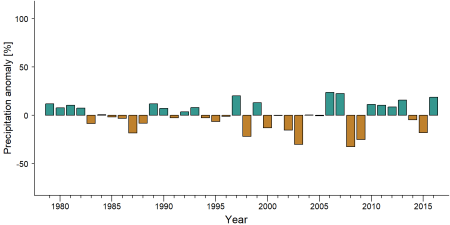
Precipitation anomaly in Kagwene Gorilla Sanctuary -
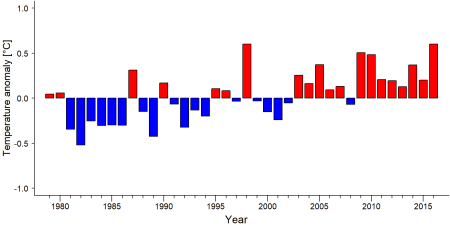
Temperature anomaly in Kagwene Gorilla Sanctuary


External links
References
Bergl, R. A., & Vigilant, L. (2007). Genetic analysis reveals population structure and recent migration within the highly fragmented range of the Cross River gorilla (Gorilla gorilla diehli). Molecular Ecology, 16(3), 501-516. doi:10.1111/j.1365-294x.2006.03159.x
Ikfuingei, R. (2013). Annual Report of Cross River Gorilla Ecological Monitoring at the Kagwene Gorilla Sanctuary, Cameroon Progress Report for July 2012 – June 2013. An unpublished report submitted to the Wildlife Conservation Society, the U.S. Fish & Wildlife Service, the World Wide Fund for Nature, and the Cameroon Ministry of Forestry and Wildlife. Edits; Andrew Fowler.
Sunderland-Groves, J. L., Ekinde, A., & Mboh, H. (2009). Nesting Behavior of Gorilla gorilla diehli at Kagwene Mountain, Cameroon: Implications for Assessing Group Size and Density. International Journal of Primatology, 30(2), 253-266. doi:10.1007/s10764-009-9340-7
Kiribou, R., Tehoda, P., Chukwu, O., Bempah, G., Kühl, H. S., Ferreira, J., …, & Heinicke, S. (2024). Exposure of African ape sites to climate change impacts. PLOS Climate, 3(2), e0000345. doi:10.1371/journal.pclm.0000345
Page created by: APES Atlas Team Date: 2022-04-04