
Kankan Faunal Reserve: Difference between revisions
No edit summary |
No edit summary Tag: Manual revert |
||
| (3 intermediate revisions by the same user not shown) | |||
| Line 17: | Line 17: | ||
= Site characteristics = | = Site characteristics = | ||
Kankan Faunal Reserve (also called “Réserve Naturelle de Kankan”) is located in western Guinea and shares a border with Côte d’Ivoire. It is part of the region “Haute-Guinée” and the prefecture Kankan. Kankan was initially established as a national park in 1925 when Guinea was still a French colony (Brugière & Kormos 2009). The Guinean government now recognizes Kankan as a ‘Faunal Reserve’ but its legal status is not clear (Brugière & Kormos 2009). The reserve does not have a designated IUCN category nor is it listed in the World Database on Protected Areas ([https://www.protectedplanet.net/country/GN UNEP-WCMC and IUCN 2018]). | Kankan Faunal Reserve (also called “Réserve Naturelle de Kankan”) is located in western Guinea and shares a border with Côte d’Ivoire. It is part of the region “Haute-Guinée” and the prefecture Kankan. Kankan was initially established as a national park in 1925 when Guinea was still a French colony ([[#R00827|Brugière & Kormos 2009]]). The Guinean government now recognizes Kankan as a ‘Faunal Reserve’ but its legal status is not clear ([[#R00827|Brugière & Kormos 2009]]). The reserve does not have a designated IUCN category nor is it listed in the World Database on Protected Areas ([https://www.protectedplanet.net/country/GN UNEP-WCMC and IUCN 2018]). | ||
Kankan Faunal Reserve covers a total area of 5,314.48 km2 and is characterized by savanna habitat with permanent waterways (Brugière & Kormos 2009). The reserve is an important area for antelopes as it has the highest diversity in antelope species across Guinea, including the three rarest species found in Guinea (Brugière 2012). The presence of leopards (''Panthera pardus''), baboons (''Papio sp.”), green monkeys (''Chlorocebus sabaeus'') and hippopotamus (''Hippopotamus amphibius'') has been confirmed (Brugière & Kormos 2009, [http://www.wildchimps.org WCF 2012]). Lions (''Panthera leo'') might also still be present in the reserve (Henschel et al. 2014) | Kankan Faunal Reserve covers a total area of 5,314.48 km2 and is characterized by savanna habitat with permanent waterways ([[#R00827|Brugière & Kormos 2009]]). The reserve is an important area for antelopes as it has the highest diversity in antelope species across Guinea, including the three rarest species found in Guinea ([[#R00828|Brugière 2012]]). The presence of leopards (''Panthera pardus''), baboons (''Papio sp.”), green monkeys (''Chlorocebus sabaeus'') and hippopotamus (''Hippopotamus amphibius'') has been confirmed ([[#R00827|Brugière & Kormos 2009]], [http://www.wildchimps.org WCF 2012]). Lions (''Panthera leo'') might also still be present in the reserve ([[#R00832|Henschel et al. 2014]]) | ||
Kankan Faunal Reserve is part of the Sankarani-Fié Ramsar, situated within the Sankarani River basin ([https://rsis.ramsar.org/ris/1167 Ramsar 2017]). This Ramsar site is characterized by important fish spawning grounds (Ramsar 2017). | Kankan Faunal Reserve is part of the Sankarani-Fié Ramsar, situated within the Sankarani River basin ([https://rsis.ramsar.org/ris/1167 Ramsar 2017]). This Ramsar site is characterized by important fish spawning grounds ([[#R00835|Ramsar 2017]]). | ||
'''Table 1. Basic site information for Kankan Faunal Reserve''' | '''Table 1. Basic site information for Kankan Faunal Reserve''' | ||
| Line 48: | Line 48: | ||
= Ape status = | = Ape status = | ||
In the nationwide chimpanzee survey, Rebecca Kormos found no signs of chimpanzees in the northern part of Kankan Faunal Reserve and suggested that chimpanzee might be extinct in the area or persist at very low numbers (Ham 1998). According to Fleury-Brugière & Brugière (2010), a survey by Dufour (2007) observed chimpanzee nests in the southern part of the reserve. In 2009 the Wild Chimpanzee Foundation surveyed the central part of the reserve, but found no signs of chimpanzees on the 74 km of transects that were surveyed (WCF 2012). The survey team also conducted a questionnaire survey and local residents reported that chimpanzees are present in the area. The WCF team also encountered a small group of chimpanzees the western sector of Kankan, and one group in the northern part of the reserve (WCF 2012). | In the nationwide chimpanzee survey, Rebecca Kormos found no signs of chimpanzees in the northern part of Kankan Faunal Reserve and suggested that chimpanzee might be extinct in the area or persist at very low numbers ([[#R00831|Ham 1998]]). According to [[#R00830|Fleury-Brugière & Brugière (2010)]], a survey by [[#R00829|Dufour (2007)]] observed chimpanzee nests in the southern part of the reserve. In 2009 the Wild Chimpanzee Foundation surveyed the central part of the reserve, but found no signs of chimpanzees on the 74 km of transects that were surveyed ([[#R00837|WCF 2012]]). The survey team also conducted a questionnaire survey and local residents reported that chimpanzees are present in the area. The WCF team also encountered a small group of chimpanzees the western sector of Kankan, and one group in the northern part of the reserve ([[#R00837|WCF 2012]]). | ||
'''Table 2. Ape population estimates reported for Kankan Faunal Reserve''' | '''Table 2. Ape population estimates reported for Kankan Faunal Reserve''' | ||
| Line 74: | Line 74: | ||
|Line transects | |Line transects | ||
| | | | ||
|WCF 2012 | |[[#R00837|WCF 2012]] | ||
|Total survey effort: 74 km, no signs of chimpanzees found, but local residence reported presence of chimpanzees | |Total survey effort: 74 km, no signs of chimpanzees found, but local residence reported presence of chimpanzees | ||
| | |GIN0002, GIN0010<div class="mw-collapsible mw-collapsed" data-expandtext="+9 more" data-collapsetext="less">GIN0016, GIN0020, GIN0023, GIN0024, GIN0025, GIN0027, GIN0029, GIN0036, GIN0069</div> | ||
|- | |- | ||
|''Pan troglodytes verus'' | |''Pan troglodytes verus'' | ||
| Line 87: | Line 87: | ||
|Unknown | |Unknown | ||
| | | | ||
|Dufour 2007 as found in Fleury-Brugière & Brugière (2010) | |[[#R00829|Dufour 2007]] as found in [[#R00830|Fleury-Brugière & Brugière (2010)]] | ||
|The original report by Dufour was not found in the public domain | |The original report by Dufour was not found in the public domain | ||
| | |GIN0022 | ||
|} | |} | ||
| Line 96: | Line 96: | ||
= Threats = | = Threats = | ||
There are approximately 17,000 people living in the reserve (WCF 2012). During their survey of the northern part of Kankan, the Wild Chimpanzee Foundation found agriculture to be the most prevalent threat, with 0.77 signs/km, followed by roads (WCF 2012). However, there were only few signs of hunting and wood extraction (WCF 2012). In contrast, the evaluation of management effectiveness of protected areas based on questionnaires found poaching to be an important threat (METT 2009). Most human activities were found in the western part of the reserve close to the town of Kankan (WCF 2012). | There are approximately 17,000 people living in the reserve ([[#R00837|WCF 2012]]). During their survey of the northern part of Kankan, the Wild Chimpanzee Foundation found agriculture to be the most prevalent threat, with 0.77 signs/km, followed by roads ([[#R00837|WCF 2012]]). However, there were only few signs of hunting and wood extraction ([[#R00837|WCF 2012]]). In contrast, the evaluation of management effectiveness of protected areas based on questionnaires found poaching to be an important threat ([[#R00833|METT 2009]]). Most human activities were found in the western part of the reserve close to the town of Kankan ([[#R00837|WCF 2012]]). | ||
'''Table 3. Threats to apes reported for Kankan Faunal Reserve''' | '''Table 3. Threats to apes reported for Kankan Faunal Reserve''' | ||
| Line 109: | Line 109: | ||
|1.1 Residential areas | |1.1 Residential areas | ||
|Medium (30-70% of population affected) | |Medium (30-70% of population affected) | ||
|17,000 people live in the reserve (WCF 2012). | |17,000 people live in the reserve ([[#R00837|WCF 2012]]). | ||
|Ongoing (2012) | |Ongoing (2012) | ||
|- | |- | ||
| Line 115: | Line 115: | ||
|2.1 Annual & perennial non-timber crops | |2.1 Annual & perennial non-timber crops | ||
|High (more than 70% of population affected) | |High (more than 70% of population affected) | ||
|Highest encounter rate found for signs of agricultural (WCF 2012). | |Highest encounter rate found for signs of agricultural ([[#R00837|WCF 2012]]). | ||
|Ongoing (2012) | |Ongoing (2012) | ||
|- | |- | ||
| Line 121: | Line 121: | ||
|4.1 Roads & railroads | |4.1 Roads & railroads | ||
|High (more than 70% of population affected) | |High (more than 70% of population affected) | ||
|Second highest encounter rate (WCF 2012). | |Second highest encounter rate ([[#R00837|WCF 2012]]). | ||
|Ongoing (2012) | |Ongoing (2012) | ||
|- | |- | ||
| Line 127: | Line 127: | ||
|5.1 Hunting & collecting terrestrial animals | |5.1 Hunting & collecting terrestrial animals | ||
|Medium (30-70% of population affected) | |Medium (30-70% of population affected) | ||
|Few signs of hunting encountered by WCF survey (WCF 2012), but METT questionnaire survey found it to be an important threat (METT 2009). | |Few signs of hunting encountered by WCF survey ([[#R00837|WCF 2012]]), but METT questionnaire survey found it to be an important threat ([[#R00833|METT 2009]]). | ||
|2009-Ongoing (2012) | |2009-Ongoing (2012) | ||
|- | |- | ||
| Line 133: | Line 133: | ||
|5.3 Logging & wood harvesting | |5.3 Logging & wood harvesting | ||
|Low (up to 30% of population affected) | |Low (up to 30% of population affected) | ||
|Few signs of wood harvesting encountered (WCF 2012), commercial wood extraction present (METT 2009). | |Few signs of wood harvesting encountered ([[#R00837|WCF 2012]]), commercial wood extraction present ([[#R00833|METT 2009]]). | ||
|2009-Ongoing (2012) | |2009-Ongoing (2012) | ||
|- | |- | ||
| Line 139: | Line 139: | ||
|5.3 Logging & wood harvesting | |5.3 Logging & wood harvesting | ||
|Medium (30-70% of population affected) | |Medium (30-70% of population affected) | ||
|Fishing in rivers with fine mesh nets (METT 2009). | |Fishing in rivers with fine mesh nets ([[#R00833|METT 2009]]). | ||
|Ongoing (2009) | |Ongoing (2009) | ||
|- | |- | ||
| Line 145: | Line 145: | ||
|7.1 Fire & fire suppression | |7.1 Fire & fire suppression | ||
|Medium (30-70% of population affected) | |Medium (30-70% of population affected) | ||
|Few signs of fire (WCF 2012), but METT questionnaire survey found it to used frequently by hunters (METT 2009). | |Few signs of fire ([[#R00837|WCF 2012]]), but METT questionnaire survey found it to used frequently by hunters ([[#R00833|METT 2009]]). | ||
|2009-Ongoing (2012) | |2009-Ongoing (2012) | ||
|- | |- | ||
| Line 151: | Line 151: | ||
|9.1 Domestic & urban waste water | |9.1 Domestic & urban waste water | ||
|Present (unknown severity) | |Present (unknown severity) | ||
|Fishers use a toxic plant for fishing which leads to water pollution, plant reduces oxygen content in water and degrades river ecosystem (METT 2009). | |Fishers use a toxic plant for fishing which leads to water pollution, plant reduces oxygen content in water and degrades river ecosystem ([[#R00833|METT 2009]]). | ||
|2007-Ongoing (2009) | |2007-Ongoing (2009) | ||
|} | |} | ||
| Line 159: | Line 159: | ||
= Conservation activities = | = Conservation activities = | ||
The non-governmental organization [http://www.non-nobis.org/index.php Non Nobis] is active in the western part of Kankan. This area is called “Diwasi”. The NGO is especially active in the fields of sanitation and education. It is not clear what kind of environmental activities are or have been implemented. The NGO, however, seems to propose to create a protected area. It has also been suggested that a privately owned protected area for game hunting will be created but the specificity and who is leading these efforts is not clear (WCF 2012). | The non-governmental organization [http://www.non-nobis.org/index.php Non Nobis] is active in the western part of Kankan. This area is called “Diwasi”. The NGO is especially active in the fields of sanitation and education. It is not clear what kind of environmental activities are or have been implemented. The NGO, however, seems to propose to create a protected area. It has also been suggested that a privately owned protected area for game hunting will be created but the specificity and who is leading these efforts is not clear ([[#R00837|WCF 2012]]). | ||
'''Table 4. Conservation activities reported for Kankan Faunal Reserve''' | '''Table 4. Conservation activities reported for Kankan Faunal Reserve''' | ||
| Line 171: | Line 171: | ||
|2 Counter-wildlife crime | |2 Counter-wildlife crime | ||
|2.11 Implement monitoring surveillance strategies (e.g., SMART) or use monitoring data to improve effectiveness of patrols | |2.11 Implement monitoring surveillance strategies (e.g., SMART) or use monitoring data to improve effectiveness of patrols | ||
|Implementation of SMART patrols and coordination with rangers to improve law enforcement and reduce illegal activities, as well as integration of monitoring data into management planning (WCF 2025). | |Implementation of SMART patrols and coordination with rangers to improve law enforcement and reduce illegal activities, as well as integration of monitoring data into management planning ([[#R00838|WCF 2025]]). | ||
|Wild Chimpanzee Foundation (WCF), protected area managers; local stakeholders | |Wild Chimpanzee Foundation (WCF), protected area managers; local stakeholders | ||
|2019-Ongoing (2024) | |2019-Ongoing (2024) | ||
| Line 177: | Line 177: | ||
|4 Education & awareness | |4 Education & awareness | ||
|4.1 Educate local communities about apes and sustainable use | |4.1 Educate local communities about apes and sustainable use | ||
|Environmental awareness raising activities targeted at reducing fires and poaching (but not explicitly targeted towards primates, METT 2009) | |Environmental awareness raising activities targeted at reducing fires and poaching (but not explicitly targeted towards primates, [[#R00833|METT 2009]]) | ||
| | | | ||
|Ongoing (2009) | |Ongoing (2009) | ||
| Line 183: | Line 183: | ||
|4 Education & awareness | |4 Education & awareness | ||
|4.2 Involve local community in ape research and conservation management | |4.2 Involve local community in ape research and conservation management | ||
|Building technical capacity of staff in field survey, camera-trap methods, and data management (WCF 2025). | |Building technical capacity of staff in field survey, camera-trap methods, and data management ([[#R00838|WCF 2025]]). | ||
|WCF; academic and technical partners. | |WCF; academic and technical partners. | ||
|2019-Ongoing (2024) | |2019-Ongoing (2024) | ||
| Line 189: | Line 189: | ||
|5 Protection & restoration | |5 Protection & restoration | ||
|5.2 Legally protect ape habitat | |5.2 Legally protect ape habitat | ||
|Designated as Faunal Reserve since 1925 but current legal status is unclear (METT 2009). | |Designated as Faunal Reserve since 1925 but current legal status is unclear ([[#R00833|METT 2009]]). | ||
| | | | ||
|1925-Ongoing (2026) | |1925-Ongoing (2026) | ||
| Line 198: | Line 198: | ||
= Challenges = | = Challenges = | ||
The report on the evaluation of management activities stated that the park employees are paid by the state but that there is no additional budget to manage the park. It also stated a lack of infrastructure and equipment (METT 2009). | The report on the evaluation of management activities stated that the park employees are paid by the state but that there is no additional budget to manage the park. It also stated a lack of infrastructure and equipment ([[#R00833|METT 2009]]). | ||
'''Table 5. Challenges reported for Kankan Faunal Reserve''' | '''Table 5. Challenges reported for Kankan Faunal Reserve''' | ||
| Line 209: | Line 209: | ||
|2 Resources and capacity | |2 Resources and capacity | ||
|2.2 Lack of staff | |2.2 Lack of staff | ||
|WCF 2025 | |[[#R00838|WCF 2025]] | ||
|Ongoing (2024) | |Ongoing (2024) | ||
|- | |- | ||
|2 Resources and capacity | |2 Resources and capacity | ||
|2.3 General lack of funding | |2.3 General lack of funding | ||
|METT 2009 | |[[#R00833|METT 2009]] | ||
| | | | ||
|- | |- | ||
|2 Resources and capacity | |2 Resources and capacity | ||
|2.5 Lack of equipment/transportation | |2.5 Lack of equipment/transportation | ||
|METT 2009 | |[[#R00833|METT 2009]] | ||
| | | | ||
|- | |- | ||
|2 Resources and capacity | |2 Resources and capacity | ||
|2.6 Lack of biomonitoring/survey data | |2.6 Lack of biomonitoring/survey data | ||
|WCF 2025 | |[[#R00838|WCF 2025]] | ||
|2012-Ongoing (2024) | |2012-Ongoing (2024) | ||
|- | |- | ||
|4 Institutional support | |4 Institutional support | ||
|4.1 Lack of law enforcement | |4.1 Lack of law enforcement | ||
|WCF 2025 | |[[#R00838|WCF 2025]] | ||
|Ongoing (2024) | |Ongoing (2024) | ||
|} | |} | ||
| Line 248: | Line 248: | ||
|2 Resources and capacity | |2 Resources and capacity | ||
|2.6 External partnerships that add expertise or resources | |2.6 External partnerships that add expertise or resources | ||
|WCF 2025 | |[[#R00838|WCF 2025]] | ||
|2018-Ongoing (2024) | |2018-Ongoing (2024) | ||
|- | |- | ||
|3 Engaged community | |3 Engaged community | ||
|3.6 Local community engagement and support | |3.6 Local community engagement and support | ||
|WCF 2025 | |[[#R00838|WCF 2025]] | ||
|2018-Ongoing (2024) | |2018-Ongoing (2024) | ||
|- | |- | ||
|5 Ecological context | |5 Ecological context | ||
|5.1 Ecological characteristics (e.g. terrain) conducive to conservation | |5.1 Ecological characteristics (e.g. terrain) conducive to conservation | ||
|WCF 2025 | |[[#R00838|WCF 2025]] | ||
|2018-Ongoing (2024) | |2018-Ongoing (2024) | ||
|- | |- | ||
| Line 281: | Line 281: | ||
= Research activities = | = Research activities = | ||
Two wildlife surveys have been conducted in Kankan Faunal Reserve: one by Sylvain Dufour for Sylvatrop (Dufour 2007) and one by the Wild Chimpanzee Foundation in 2009 (WCF 2012). Although no new site-specific surveys have been undertaken since 2009, the WCF Annual Report 2024 documents the use of advanced Line-Transect Distance Sampling (LTDS) and Camera-Trap Distance Sampling (CTDS) methods—including video radial-distance estimation across Guinea’s chimpanzee landscapes. These methodological improvements and regional monitoring frameworks provide a basis for future survey updates in Kankan. | Two wildlife surveys have been conducted in Kankan Faunal Reserve: one by Sylvain Dufour for Sylvatrop ([[#R00829|Dufour 2007]]) and one by the Wild Chimpanzee Foundation in 2009 ([[#R00837|WCF 2012]]). Although no new site-specific surveys have been undertaken since 2009, the WCF Annual Report 2024 documents the use of advanced Line-Transect Distance Sampling (LTDS) and Camera-Trap Distance Sampling (CTDS) methods—including video radial-distance estimation across Guinea’s chimpanzee landscapes. These methodological improvements and regional monitoring frameworks provide a basis for future survey updates in Kankan. | ||
| Line 315: | Line 315: | ||
= Exposure to climate change impacts = | = Exposure to climate change impacts = | ||
As part of a study on the exposure of African great ape sites to climate change impacts, Kiribou et al. (2024) extracted climate data and data on projected extreme climate impact events for the site. Climatological characteristics were derived from observation-based climate data provided by the Inter-Sectoral Impact Model Intercomparison Project (ISIMIP, www.isimip.org). Parameters were calculated as the average across each 30-year period. For 1981-2010, the EWEMBI dataset from ISIMIP2a was used. For the two future periods (2021-2050 and 2071-2099) ISIMIP2b climate data based on four CMIP5 global climate models were used. For future projections, two Representative Concentration Pathways (RCP) were used. RCP 2.6 is a scenario with strong mitigation measures in which global temperatures would likely rise below 2C. RCP 6.0 is a scenario with medium emissions in which global temperatures would likely rise up to 3C by 2100. For the number of days with heavy precipitation events, the 98th percentile of all precipitation days (>1mm/d) was calculated for the 1979-2013 reference period as a threshold for a heavy precipitation event. Then, for each year, the number of days above that threshold was derived. The figures on temperature and precipitation anomaly show the deviation from the mean temperature and mean precipitation for the 1979-2013 reference period. | As part of a study on the exposure of African great ape sites to climate change impacts, [[#R02223|Kiribou et al. (2024)]] extracted climate data and data on projected extreme climate impact events for the site. Climatological characteristics were derived from observation-based climate data provided by the Inter-Sectoral Impact Model Intercomparison Project (ISIMIP, www.isimip.org). Parameters were calculated as the average across each 30-year period. For 1981-2010, the EWEMBI dataset from ISIMIP2a was used. For the two future periods (2021-2050 and 2071-2099) ISIMIP2b climate data based on four CMIP5 global climate models were used. For future projections, two Representative Concentration Pathways (RCP) were used. RCP 2.6 is a scenario with strong mitigation measures in which global temperatures would likely rise below 2C. RCP 6.0 is a scenario with medium emissions in which global temperatures would likely rise up to 3C by 2100. For the number of days with heavy precipitation events, the 98th percentile of all precipitation days (>1mm/d) was calculated for the 1979-2013 reference period as a threshold for a heavy precipitation event. Then, for each year, the number of days above that threshold was derived. The figures on temperature and precipitation anomaly show the deviation from the mean temperature and mean precipitation for the 1979-2013 reference period. | ||
The estimated exposure to future extreme climate impact events (crop failure, drought, river flood, wildfire, tropical cyclone, and heatwave) is based on a published dataset by Lange et al. 2020 derived from ISIMIP2b data. The same global climate models and RCPs as described above were used. Within each 30-year period, the number of years with an extreme event and the average proportion of the site affected were calculated (Kiribou et al. 2024). | The estimated exposure to future extreme climate impact events (crop failure, drought, river flood, wildfire, tropical cyclone, and heatwave) is based on a published dataset by Lange et al. 2020 derived from ISIMIP2b data. The same global climate models and RCPs as described above were used. Within each 30-year period, the number of years with an extreme event and the average proportion of the site affected were calculated ([[#R02223|Kiribou et al. 2024]]). | ||
'''Table 8. Estimated past and projected climatological characteristics in Kankan Faunal Reserve''' | '''Table 8. Estimated past and projected climatological characteristics in Kankan Faunal Reserve''' | ||
| Line 440: | Line 440: | ||
= References = | = References = | ||
Brugière D, Kormos R. 2009. Review of the protected area network in Guinea, West Africa, and recommendations for new sites for biodiversity conservation, Biodiversity and Conservation, 18:847 | <span id="R00827"></span>Brugière D, Kormos R. 2009. Review of the protected area network in Guinea, West Africa, and recommendations for new sites for biodiversity conservation, Biodiversity and Conservation, 18:847 [https://doi.org/10.1007/s10531-008-9508-z doi:10.1007/s10531-008-9508-z] | ||
<span id="R00828"></span>Brugière, D. (2012). Identifying priority areas for the conservation of antelopes in the Republic of Guinea, West Africa, using the complementarity approach. ''Oryx'', 46(2), 253-259. [https://doi.org/10.1017/s0030605311000391 doi:10.1017/s0030605311000391] | |||
<span id="R00829"></span>Dufour S. 2007. Programme de gestion communautaire et participative de la faune sauvage dans la Réserve de Faune de Kankan, République de Guinée. Conakry: Rapport pour Sylvatrop | |||
<span id="R00830"></span>Fleury-Brugiere, M., & Brugiere, D. (2010). High Population Density of Pan troglodytes verus in the Haut Niger National Park, Republic of Guinea: Implications for Local and Regional Conservation. ''International Journal of Primatology'', 31(3), 383-392. [https://doi.org/10.1007/s10764-010-9391-9 doi:10.1007/s10764-010-9391-9] | |||
<span id="R00831"></span>Ham R. 1998. Nationwide chimpanzee census and large mammal survey Republic of Guinea. | |||
<span id="R00832"></span>Henschel, P., Coad, L., Burton, C., Chataigner, B., Dunn, A., MacDonald, D., …, & Hunter, L. T. B. (2014). The Lion in West Africa Is Critically Endangered. ''PLoS ONE'', 9(1), e83500. [https://doi.org/10.1371/journal.pone.0083500 doi:10.1371/journal.pone.0083500] | |||
<span id="R00833"></span>METT. 2009. Management Effectiveness Evaluations – Reserve de faune de Kankan et parc Diwasi. Online: [https://papaco.org/guinea/ papaco.org] [https://web.archive.org/web/20171210121530/http://papaco.org:80/guinea/ link] | |||
<span id="R00834"></span>Non Nobis Online: [http://www.non-nobis.org/index.php www.non-nobis.org] | |||
<span id="R00835"></span>Ramsar. 2017. Online: [https://rsis.ramsar.org/ris/1167 Ramsar 2017] [https://web.archive.org/web/20240914000423/https://rsis.ramsar.org/ris/1164 link] | |||
<span id="R00836"></span>UNEP-WCMC, IUCN. 2018. Protected Planet: The World Database on Protected Areas (WDPA), Cambridge, UK: UNEP-WCMC and IUCN Online: [https://www.protectedplanet.net/country/GN www.protectedplanet.net] [https://web.archive.org/web/20200930170440/https://www.protectedplanet.net/country/GN link] | |||
<span id="R00837"></span>WCF. 2012. Etat de la faune et des menaces dans les aires protégées terrestres et principales zones de forte biodiversité de Rep. de Guinée. Report. Wild Chimpanzee Foundation, Sangaredi, Republic of Guinea. Online: [http://www.wildchimps.org www.wildchimps.org] | |||
<span id="R00838"></span>Wild Chimpanzee Foundation. (2025). Annual report 2024: Activities of the Wild Chimpanzee Foundation for improved conservation of chimpanzees and their habitat in West Africa. https://www.wildchimps.org/fileadmin/content_files/pdfs/reports/2024_WCF_Annual_Report_2024_01.pdf [https://web.archive.org/web/20250426173622/https://www.wildchimps.org/fileadmin/content_files/pdfs/reports/2024_WCF_Annual_Report_2024_01.pdf link] | |||
Wild Chimpanzee Foundation. (2025). Annual report 2024: Activities of the Wild Chimpanzee Foundation for improved conservation of chimpanzees and their habitat in West Africa. https://www.wildchimps.org/fileadmin/content_files/pdfs/reports/2024_WCF_Annual_Report_2024_01.pdf | |||
<span id="R02223"></span>Kiribou, R., Tehoda, P., Chukwu, O., Bempah, G., Kühl, H. S., Ferreira, J., …, & Heinicke, S. (2024). Exposure of African ape sites to climate change impacts. ''PLOS Climate'', 3(2), e0000345. [https://doi.org/10.1371/journal.pclm.0000345 doi:10.1371/journal.pclm.0000345] | |||
Latest revision as of 17:53, 15 October 2026
West Africa > Republic of Guinea > Kankan Faunal Reserve
Français | Português | Español | Bahasa Indonesia | Melayu
Summary
- Western chimpanzees (Pan troglodytes verus) are present in Kankan Faunal Reserve.
- Chimpanzee densities are too low to estimate the total size of the population.
- The chimpanzee population trend is unknown.
- This site has a total size of 5,314 km².
- Agricultural activities are the most prevalent threat to chimpanzees.
- The extent of on-going conservation activities is unknown.
- Kankan Faunal Reserve features a high diversity of antelopes and is part of the Sankarani-Fié Ramsar site.
Site characteristics
Kankan Faunal Reserve (also called “Réserve Naturelle de Kankan”) is located in western Guinea and shares a border with Côte d’Ivoire. It is part of the region “Haute-Guinée” and the prefecture Kankan. Kankan was initially established as a national park in 1925 when Guinea was still a French colony (Brugière & Kormos 2009). The Guinean government now recognizes Kankan as a ‘Faunal Reserve’ but its legal status is not clear (Brugière & Kormos 2009). The reserve does not have a designated IUCN category nor is it listed in the World Database on Protected Areas (UNEP-WCMC and IUCN 2018).
Kankan Faunal Reserve covers a total area of 5,314.48 km2 and is characterized by savanna habitat with permanent waterways (Brugière & Kormos 2009). The reserve is an important area for antelopes as it has the highest diversity in antelope species across Guinea, including the three rarest species found in Guinea (Brugière 2012). The presence of leopards (Panthera pardus), baboons (Papio sp.”), green monkeys (Chlorocebus sabaeus) and hippopotamus (Hippopotamus amphibius) has been confirmed (Brugière & Kormos 2009, WCF 2012). Lions (Panthera leo) might also still be present in the reserve (Henschel et al. 2014)
Kankan Faunal Reserve is part of the Sankarani-Fié Ramsar, situated within the Sankarani River basin (Ramsar 2017). This Ramsar site is characterized by important fish spawning grounds (Ramsar 2017).
Table 1. Basic site information for Kankan Faunal Reserve
| Species | Pan troglodytes verus |
| Area | 5,314.48 km² |
| Coordinates | Lat: 9.77 , Lon: -8.38 |
| Type of site | Unknown |
| Habitat types | Savanna, Wetlands (lakes, rivers, streams, bogs, marshes), Agricultural land |
| Type of governance |
Types of sites Governance types Habitat types
Ape status
In the nationwide chimpanzee survey, Rebecca Kormos found no signs of chimpanzees in the northern part of Kankan Faunal Reserve and suggested that chimpanzee might be extinct in the area or persist at very low numbers (Ham 1998). According to Fleury-Brugière & Brugière (2010), a survey by Dufour (2007) observed chimpanzee nests in the southern part of the reserve. In 2009 the Wild Chimpanzee Foundation surveyed the central part of the reserve, but found no signs of chimpanzees on the 74 km of transects that were surveyed (WCF 2012). The survey team also conducted a questionnaire survey and local residents reported that chimpanzees are present in the area. The WCF team also encountered a small group of chimpanzees the western sector of Kankan, and one group in the northern part of the reserve (WCF 2012).
Table 2. Ape population estimates reported for Kankan Faunal Reserve
| Species | Year | Occurrence | Encounter or vistation rate (nests/km; ind/day) | Density estimate [ind./ km²] (95% CI) | Abundance estimate (95% CI) | Survey area | Sampling method | Analytical framework | Source | Comments | A.P.E.S. database ID |
|---|---|---|---|---|---|---|---|---|---|---|---|
| Pan troglodytes verus | 2009 | 0 | Central part of the reserve | Line transects | WCF 2012 | Total survey effort: 74 km, no signs of chimpanzees found, but local residence reported presence of chimpanzees | GIN0002, GIN0010 GIN0016, GIN0020, GIN0023, GIN0024, GIN0025, GIN0027, GIN0029, GIN0036, GIN0069
| ||||
| Pan troglodytes verus | Unknown | Present | Southern part of the reserve | Unknown | Dufour 2007 as found in Fleury-Brugière & Brugière (2010) | The original report by Dufour was not found in the public domain | GIN0022 |
Sampling methods Analytical frameworks
Threats
There are approximately 17,000 people living in the reserve (WCF 2012). During their survey of the northern part of Kankan, the Wild Chimpanzee Foundation found agriculture to be the most prevalent threat, with 0.77 signs/km, followed by roads (WCF 2012). However, there were only few signs of hunting and wood extraction (WCF 2012). In contrast, the evaluation of management effectiveness of protected areas based on questionnaires found poaching to be an important threat (METT 2009). Most human activities were found in the western part of the reserve close to the town of Kankan (WCF 2012).
Table 3. Threats to apes reported for Kankan Faunal Reserve
| Category | Specific threats | Threat level | Description | Year of threat |
|---|---|---|---|---|
| 1 Residential & commercial development | 1.1 Residential areas | Medium (30-70% of population affected) | 17,000 people live in the reserve (WCF 2012). | Ongoing (2012) |
| 2 Agriculture & aquaculture | 2.1 Annual & perennial non-timber crops | High (more than 70% of population affected) | Highest encounter rate found for signs of agricultural (WCF 2012). | Ongoing (2012) |
| 4 Transportation & service corridors | 4.1 Roads & railroads | High (more than 70% of population affected) | Second highest encounter rate (WCF 2012). | Ongoing (2012) |
| 5 Biological resource use | 5.1 Hunting & collecting terrestrial animals | Medium (30-70% of population affected) | Few signs of hunting encountered by WCF survey (WCF 2012), but METT questionnaire survey found it to be an important threat (METT 2009). | 2009-Ongoing (2012) |
| 5 Biological resource use | 5.3 Logging & wood harvesting | Low (up to 30% of population affected) | Few signs of wood harvesting encountered (WCF 2012), commercial wood extraction present (METT 2009). | 2009-Ongoing (2012) |
| 5 Biological resource use | 5.3 Logging & wood harvesting | Medium (30-70% of population affected) | Fishing in rivers with fine mesh nets (METT 2009). | Ongoing (2009) |
| 7 Natural system modifications | 7.1 Fire & fire suppression | Medium (30-70% of population affected) | Few signs of fire (WCF 2012), but METT questionnaire survey found it to used frequently by hunters (METT 2009). | 2009-Ongoing (2012) |
| 9 Pollution | 9.1 Domestic & urban waste water | Present (unknown severity) | Fishers use a toxic plant for fishing which leads to water pollution, plant reduces oxygen content in water and degrades river ecosystem (METT 2009). | 2007-Ongoing (2009) |
Conservation activities
The non-governmental organization Non Nobis is active in the western part of Kankan. This area is called “Diwasi”. The NGO is especially active in the fields of sanitation and education. It is not clear what kind of environmental activities are or have been implemented. The NGO, however, seems to propose to create a protected area. It has also been suggested that a privately owned protected area for game hunting will be created but the specificity and who is leading these efforts is not clear (WCF 2012).
Table 4. Conservation activities reported for Kankan Faunal Reserve
| Category | Specific activity | Description | Implementing organization(s) | Year of activity |
|---|---|---|---|---|
| 2 Counter-wildlife crime | 2.11 Implement monitoring surveillance strategies (e.g., SMART) or use monitoring data to improve effectiveness of patrols | Implementation of SMART patrols and coordination with rangers to improve law enforcement and reduce illegal activities, as well as integration of monitoring data into management planning (WCF 2025). | Wild Chimpanzee Foundation (WCF), protected area managers; local stakeholders | 2019-Ongoing (2024) |
| 4 Education & awareness | 4.1 Educate local communities about apes and sustainable use | Environmental awareness raising activities targeted at reducing fires and poaching (but not explicitly targeted towards primates, METT 2009) | Ongoing (2009) | |
| 4 Education & awareness | 4.2 Involve local community in ape research and conservation management | Building technical capacity of staff in field survey, camera-trap methods, and data management (WCF 2025). | WCF; academic and technical partners. | 2019-Ongoing (2024) |
| 5 Protection & restoration | 5.2 Legally protect ape habitat | Designated as Faunal Reserve since 1925 but current legal status is unclear (METT 2009). | 1925-Ongoing (2026) |
Challenges
The report on the evaluation of management activities stated that the park employees are paid by the state but that there is no additional budget to manage the park. It also stated a lack of infrastructure and equipment (METT 2009).
Table 5. Challenges reported for Kankan Faunal Reserve
| Challenges | Specific challenges | Source | Year(s) |
|---|---|---|---|
| 2 Resources and capacity | 2.2 Lack of staff | WCF 2025 | Ongoing (2024) |
| 2 Resources and capacity | 2.3 General lack of funding | METT 2009 | |
| 2 Resources and capacity | 2.5 Lack of equipment/transportation | METT 2009 | |
| 2 Resources and capacity | 2.6 Lack of biomonitoring/survey data | WCF 2025 | 2012-Ongoing (2024) |
| 4 Institutional support | 4.1 Lack of law enforcement | WCF 2025 | Ongoing (2024) |
Enablers
Table 6. Enablers reported for Kankan Faunal Reserve
| Enablers | Specific enablers | Source | Year(s) |
|---|---|---|---|
| 2 Resources and capacity | 2.6 External partnerships that add expertise or resources | WCF 2025 | 2018-Ongoing (2024) |
| 3 Engaged community | 3.6 Local community engagement and support | WCF 2025 | 2018-Ongoing (2024) |
| 5 Ecological context | 5.1 Ecological characteristics (e.g. terrain) conducive to conservation | WCF 2025 | 2018-Ongoing (2024) |
| 1 Site management | |||
| 4 Institutional support | |||
| 6 Safety and stability |
Research activities
Two wildlife surveys have been conducted in Kankan Faunal Reserve: one by Sylvain Dufour for Sylvatrop (Dufour 2007) and one by the Wild Chimpanzee Foundation in 2009 (WCF 2012). Although no new site-specific surveys have been undertaken since 2009, the WCF Annual Report 2024 documents the use of advanced Line-Transect Distance Sampling (LTDS) and Camera-Trap Distance Sampling (CTDS) methods—including video radial-distance estimation across Guinea’s chimpanzee landscapes. These methodological improvements and regional monitoring frameworks provide a basis for future survey updates in Kankan.
Documented behaviours
Table 7. Behaviours documented for Kankan Faunal Reserve
| Category | Behavior | Observation type | Prevalence | Observation dates | Source | Habituation | Species | Comment |
|---|---|---|---|---|---|---|---|---|
| Not reported |
Exposure to climate change impacts
As part of a study on the exposure of African great ape sites to climate change impacts, Kiribou et al. (2024) extracted climate data and data on projected extreme climate impact events for the site. Climatological characteristics were derived from observation-based climate data provided by the Inter-Sectoral Impact Model Intercomparison Project (ISIMIP, www.isimip.org). Parameters were calculated as the average across each 30-year period. For 1981-2010, the EWEMBI dataset from ISIMIP2a was used. For the two future periods (2021-2050 and 2071-2099) ISIMIP2b climate data based on four CMIP5 global climate models were used. For future projections, two Representative Concentration Pathways (RCP) were used. RCP 2.6 is a scenario with strong mitigation measures in which global temperatures would likely rise below 2C. RCP 6.0 is a scenario with medium emissions in which global temperatures would likely rise up to 3C by 2100. For the number of days with heavy precipitation events, the 98th percentile of all precipitation days (>1mm/d) was calculated for the 1979-2013 reference period as a threshold for a heavy precipitation event. Then, for each year, the number of days above that threshold was derived. The figures on temperature and precipitation anomaly show the deviation from the mean temperature and mean precipitation for the 1979-2013 reference period.
The estimated exposure to future extreme climate impact events (crop failure, drought, river flood, wildfire, tropical cyclone, and heatwave) is based on a published dataset by Lange et al. 2020 derived from ISIMIP2b data. The same global climate models and RCPs as described above were used. Within each 30-year period, the number of years with an extreme event and the average proportion of the site affected were calculated (Kiribou et al. 2024).
Table 8. Estimated past and projected climatological characteristics in Kankan Faunal Reserve
| Value | 1981-2010 | 2021-2050, RCP 2.6 | 2021-2050, RCP 6.0 | 2071-2099, RCP 2.6 | 2071-2099, RCP 6.0 |
|---|---|---|---|---|---|
| Mean temperature [C] | 25.7 | 26.9 | 26.8 | 27.1 | 28.2 |
| Annual precipitation [mm] | 1569 | 1586 | 1623 | 1600 | 1674 |
| Max no. consecutive dry days (per year) | 47.5 | 55.1 | 58.3 | 57.5 | 56.7 |
| No. days with heavy precipitation (per year) | 4.6 | 8.1 | 7.6 | 8.5 | 8.9 |
Table 9. Projected exposure of apes to extreme climate impact events in Kankan Faunal Reserve
| Type | No. of years with event (2021-2050, RCP 2.6) | % of site exposed (2021-2050, RCP 2.6) | No. of years with event (2021-2050, RCP 6.0) | % of site exposed (2021-2050, RCP 6.0) | No. of years with event (2070-2099, RCP 2.6) | % of site exposed (2070-2099, RCP 2.6) | No. of years with event (2070-2099, RCP 6.0) | % of site exposed (2070-2099, RCP 6.0) |
|---|---|---|---|---|---|---|---|---|
| Crop failure | 5.5 | 0.02 | 3 | 0.02 | 4 | 0.02 | 9.5 | 0.02 |
| Drought | 0 | 0 | 0 | 0 | 0 | 0 | 0 | 0 |
| Heatwave | 4 | 76.67 | 7 | 100 | 5 | 82.69 | 10 | 91.27 |
| River flood | 2 | 1.56 | 2 | 1.14 | 3.5 | 2.91 | 6 | 3.34 |
| Tropical cyclone | 0 | 0 | 0 | 0 | 0 | 0 | 0 | 0 |
| Wildfire | 30 | 1.2 | 30 | 1.07 | 29 | 1.11 | 29 | 1.11 |
-
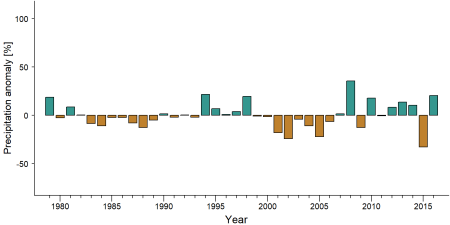
Precipitation anomaly in Kankan Faunal Reserve -
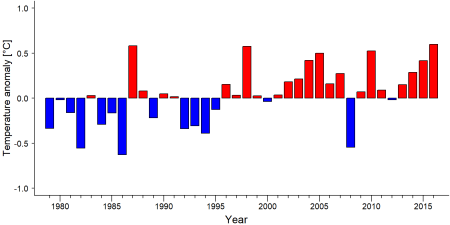
Temperature anomaly in Kankan Faunal Reserve


External links
References
Brugière D, Kormos R. 2009. Review of the protected area network in Guinea, West Africa, and recommendations for new sites for biodiversity conservation, Biodiversity and Conservation, 18:847 doi:10.1007/s10531-008-9508-z
Brugière, D. (2012). Identifying priority areas for the conservation of antelopes in the Republic of Guinea, West Africa, using the complementarity approach. Oryx, 46(2), 253-259. doi:10.1017/s0030605311000391
Dufour S. 2007. Programme de gestion communautaire et participative de la faune sauvage dans la Réserve de Faune de Kankan, République de Guinée. Conakry: Rapport pour Sylvatrop
Fleury-Brugiere, M., & Brugiere, D. (2010). High Population Density of Pan troglodytes verus in the Haut Niger National Park, Republic of Guinea: Implications for Local and Regional Conservation. International Journal of Primatology, 31(3), 383-392. doi:10.1007/s10764-010-9391-9
Ham R. 1998. Nationwide chimpanzee census and large mammal survey Republic of Guinea.
Henschel, P., Coad, L., Burton, C., Chataigner, B., Dunn, A., MacDonald, D., …, & Hunter, L. T. B. (2014). The Lion in West Africa Is Critically Endangered. PLoS ONE, 9(1), e83500. doi:10.1371/journal.pone.0083500
METT. 2009. Management Effectiveness Evaluations – Reserve de faune de Kankan et parc Diwasi. Online: papaco.org link
Non Nobis Online: www.non-nobis.org
Ramsar. 2017. Online: Ramsar 2017 link
UNEP-WCMC, IUCN. 2018. Protected Planet: The World Database on Protected Areas (WDPA), Cambridge, UK: UNEP-WCMC and IUCN Online: www.protectedplanet.net link
WCF. 2012. Etat de la faune et des menaces dans les aires protégées terrestres et principales zones de forte biodiversité de Rep. de Guinée. Report. Wild Chimpanzee Foundation, Sangaredi, Republic of Guinea. Online: www.wildchimps.org
Wild Chimpanzee Foundation. (2025). Annual report 2024: Activities of the Wild Chimpanzee Foundation for improved conservation of chimpanzees and their habitat in West Africa. https://www.wildchimps.org/fileadmin/content_files/pdfs/reports/2024_WCF_Annual_Report_2024_01.pdf link
Kiribou, R., Tehoda, P., Chukwu, O., Bempah, G., Kühl, H. S., Ferreira, J., …, & Heinicke, S. (2024). Exposure of African ape sites to climate change impacts. PLOS Climate, 3(2), e0000345. doi:10.1371/journal.pclm.0000345
Page created by: APES Atlas Team Date: 2018-12-17
Page updated by: Onella Mundi Date: 2025-10-14