
Kimbi Fungom National Park: Difference between revisions
No edit summary |
No edit summary Tag: Manual revert |
| (One intermediate revision by the same user not shown) | |
(No difference)
| |
Latest revision as of 17:53, 15 October 2026
Central Africa > Cameroon > Kimbi Fungom National Park
Français | Português | Español | Bahasa Indonesia | Melayu
Summary
- Nigeria-Cameroon chimpanzees (Pan troglodytes ellioti) are present in Kimbi Fungom National Park.
- The population size is unknown.
- The population trend is decreasing.
- The site has a total size of 953.8 km².
- Key threats to chimpanzees are hunting, logging and habitat fragmentation and degradation due to agriculture.
- Conservation activities are not documented.
Site characteristics
The Kimbi-Fungom National Park was created in 2015. It is located in northwestern Cameroon, bordering Nigeria to the North. With the establishment of the park, two reserves were merged; the Fungom Forest Reserve, established in 1936, and the Kimbi Game Reserve,established in 1964. The main rivers flowing through the site are the rivers Ivin, Menchum, and Kimbi (Chuo & Tsi 2017). Six primate species have been found to inhabit the site: Olive baboons (Papio anubis), patas monkey (Erythrocebus patas), vervet monkeys (Chlorocebus pygerythrus), white nosed monkey (Cercopithecus nictitans) and Mona monkeys (Cercopithecus mona) and the Nigeria- Cameroon chimpanzee (Pan troglodytes ellioti) (Atembeh 2020). The park is also home to giant ground pangolins (Smutsia gigantea), white-bellied tree pangolins (Phataginus tricuspis) and black-bellied tree pangolins (Phataginus tetradactyla) (Angwafo et al. 2019).
Table 1. Basic site information for Kimbi Fungom National Park
| Species | Pan troglodytes ellioti |
| Area | 953.8 km² |
| Coordinates | Lat: 6.782047 , Lon: 10.111895 |
| Type of site | Protected area (National Park) |
| Habitat types | Subtropical/tropical moist lowland forest, Subtropical/tropical moist montane forest, Savanna, Grassland, Subtropical/tropical swamp forest |
| Type of governance |
Types of sites Governance types Habitat types
Ape status
Table 2. Ape population estimates reported for Kimbi Fungom National Park
| Species | Year | Occurrence | Encounter or vistation rate (nests/km; ind/day) | Density estimate [ind./ km²] (95% CI) | Abundance estimate (95% CI) | Survey area | Sampling method | Analytical framework | Source | Comments | A.P.E.S. database ID |
|---|---|---|---|---|---|---|---|---|---|---|---|
| Pan troglodytes ellioti | 2017 | 0.06 | Kimbi Fungom National Park | Line transects | Zeh, Fuashi & Maurice 2019 | Survey effort 274 km | |||||
| Pan troglodytes ellioti | 2015- 2016 | 1.09 | Kimbi Fungom National Park | Reconnaissance walk | Chuo et al. 2017b | Survey effort 44 km. No direct observation of chimpanzees, only indirect |
Sampling methods Analytical frameworks
Threats
Hunting is the main threat to chimpanzees and other wildlife in the park. A survey of 22 villages in close proximity to the park (288 interviews in total) revealed that most of the respondents, 94%, 72% and 98%, reported that chimpanzee’s body parts/meats are used for medicinal value, rituals and as food in special occasion respectively (Chuo & Tsi 2017). Furthermore, the impacts of agriculture also represent a threat to wildlife; farmland and fallow land increased from 9467.87ha (9.75%) in 1987 to 15096ha (15.8%) in 2017 (Zeh, Fuashi & Maurice 2019).
Table 3. Threats to apes reported for Kimbi Fungom National Park
| Category | Specific threats | Threat level | Description | Year of threat |
|---|---|---|---|---|
| 2 Agriculture & aquaculture | 2.1 Annual & perennial non-timber crops | High (more than 70% of population affected) | Habitat fragmentation and degradation due to expansion of land for agriculture (Zeh, Fuashi & Maurice 2019). | Ongoing (2019) |
| 5 Biological resource use | 5.1 Hunting & collecting terrestrial animals | High (more than 70% of population affected) | Chimpanzees are hunted for bushmeat consumption, rituals and medicinal purposes, and for the illegal pet trade (Chuo & Tsi 2017). | Ongoing (2017) |
| 5 Biological resource use | 5.2 Gathering terrestrial plants | High (more than 70% of population affected) | Exploitation of forest and non-timber products (Chuo et al. 2017b). | Ongoing (2017) |
| 5 Biological resource use | 5.3 Logging & wood harvesting | High (more than 70% of population affected) | Timber harvesting (Chuo et al. 2017b). | Ongoing (2017) |
Conservation activities
Challenges
Table 5. Challenges reported for Kimbi Fungom National Park
| Challenges | Specific challenges | Source | Year(s) |
|---|---|---|---|
| Not reported |
Enablers
Table 6. Enablers reported for Kimbi Fungom National Park
| Enablers | Specific enablers | Source | Year(s) |
|---|---|---|---|
| 1 Site management | |||
| 2 Resources and capacity | |||
| 3 Engaged community | |||
| 4 Institutional support | |||
| 5 Ecological context | |||
| 6 Safety and stability |
Research activities
Documented behaviours
Table 7. Behaviours documented for Kimbi Fungom National Park
| Category | Behavior | Observation type | Prevalence | Observation dates | Source | Habituation | Species | Comment |
|---|---|---|---|---|---|---|---|---|
| Not reported |
Exposure to climate change impacts
As part of a study on the exposure of African great ape sites to climate change impacts, Kiribou et al. (2024) extracted climate data and data on projected extreme climate impact events for the site. Climatological characteristics were derived from observation-based climate data provided by the Inter-Sectoral Impact Model Intercomparison Project (ISIMIP, www.isimip.org). Parameters were calculated as the average across each 30-year period. For 1981-2010, the EWEMBI dataset from ISIMIP2a was used. For the two future periods (2021-2050 and 2071-2099) ISIMIP2b climate data based on four CMIP5 global climate models were used. For future projections, two Representative Concentration Pathways (RCP) were used. RCP 2.6 is a scenario with strong mitigation measures in which global temperatures would likely rise below 2C. RCP 6.0 is a scenario with medium emissions in which global temperatures would likely rise up to 3C by 2100. For the number of days with heavy precipitation events, the 98th percentile of all precipitation days (>1mm/d) was calculated for the 1979-2013 reference period as a threshold for a heavy precipitation event. Then, for each year, the number of days above that threshold was derived. The figures on temperature and precipitation anomaly show the deviation from the mean temperature and mean precipitation for the 1979-2013 reference period.
The estimated exposure to future extreme climate impact events (crop failure, drought, river flood, wildfire, tropical cyclone, and heatwave) is based on a published dataset by Lange et al. 2020 derived from ISIMIP2b data. The same global climate models and RCPs as described above were used. Within each 30-year period, the number of years with an extreme event and the average proportion of the site affected were calculated (Kiribou et al. 2024).
Table 8. Estimated past and projected climatological characteristics in Kimbi Fungom National Park
| Value | 1981-2010 | 2021-2050, RCP 2.6 | 2021-2050, RCP 6.0 | 2071-2099, RCP 2.6 | 2071-2099, RCP 6.0 |
|---|---|---|---|---|---|
| Mean temperature [C] | 24.5 | 25.7 | 25.4 | 25.8 | 26.9 |
| Annual precipitation [mm] | 2027 | 2115 | 2153 | 2114 | 2120 |
| Max no. consecutive dry days (per year) | 53.2 | 52.7 | 55.9 | 54.7 | 55.1 |
| No. days with heavy precipitation (per year) | 4.9 | 4.2 | 4.3 | 4.5 | 5.4 |
Table 9. Projected exposure of apes to extreme climate impact events in Kimbi Fungom National Park
| Type | No. of years with event (2021-2050, RCP 2.6) | % of site exposed (2021-2050, RCP 2.6) | No. of years with event (2021-2050, RCP 6.0) | % of site exposed (2021-2050, RCP 6.0) | No. of years with event (2070-2099, RCP 2.6) | % of site exposed (2070-2099, RCP 2.6) | No. of years with event (2070-2099, RCP 6.0) | % of site exposed (2070-2099, RCP 6.0) |
|---|---|---|---|---|---|---|---|---|
| Crop failure | 5 | 0.63 | 4 | 0.68 | 3 | 0.91 | 13.5 | 0.61 |
| Drought | 0 | 0 | 0 | 0 | 0 | 0 | 0 | 0 |
| Heatwave | 0.5 | 50 | 1 | 50 | 0 | 0 | 1.5 | 100 |
| River flood | 0.5 | 0.27 | 2.5 | 1.43 | 0.5 | 1.01 | 3.5 | 1.19 |
| Tropical cyclone | 0 | 0 | 0 | 0 | 0 | 0 | 0 | 0 |
| Wildfire | 30 | 0.9 | 30 | 0.86 | 29 | 0.81 | 29 | 0.8 |
-
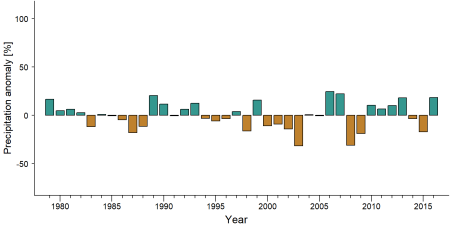
Precipitation anomaly in Kimbi Fungom National Park -
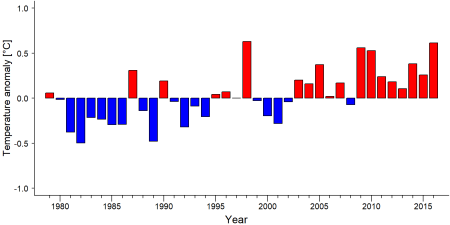
Temperature anomaly in Kimbi Fungom National Park


External links
References
Angwafo, T. E., Kaimo, N. K., Chuo, M. D., & Berinyuy, W. H. (2019). Abundance and distribution of pangolins (Manis spp.) in the kimbi-fungom national park, North West Region, Cameroon. J Entomol Zool Stud, 7(6), 71-78. link
Atembeh, L. (2020). Primates of the Kimbi-Fungom National Park Threatened! Retrieved February 24, 2023 from Green Vision. https://www.greenvision.news/primates-of-the-kimbi-fungom-national-park-threatened/ link
Chuo, M. D., & Tsi, E. A. (2017a). Chimpanzee in ethno-primatological practices and it implications for biodiversity conservation: Kimbi-fungom national park and kom-wum forest reserve, Cameroon. American Journal of Agriculture and Forestry, 5(5), 157-172. doi: 10.11648/j.ajaf.20170505.14
Chuo, M. D., Angwafo, T. E., Chefor, F., & Fru, B. S. (2017b). Estimation of chimpanzee’s (Pan troglodytes ellioti) abundance in the Kimbi-Fungum National Park and Kom-Wum Forest Reserve, Nw, Cameroon. Journal of Biodiversity Management and Forestry, 6(3), 20-30. DOI: 10.4172/2327-4417.1000185
Zeh, A. F., Fuashi, N. A., & Maurice, M. E. (2019). Impact of Land Use Changes on Wildlife Population in The Kimbi-Fungom National Park, North West Region, Cameroon. International Journal of Scientific and Research Publications (IJSRP), 9(1), p8562. doi:10.29322/ijsrp.9.01.2019.p8562
Maurice, M. E., Lionel Ebong, E., Fuashi, N. A., Godwill, I. I., & Zeh, A. F. (2019). The ecological impact on the distribution of pangolins in Deng-Deng National Park, Eastern Region, Cameroon. Global Journal of Ecology, 4(1), 008–014. doi:10.22259/2637-5338.0301004
Kiribou, R., Tehoda, P., Chukwu, O., Bempah, G., Kühl, H. S., Ferreira, J., …, & Heinicke, S. (2024). Exposure of African ape sites to climate change impacts. PLOS Climate, 3(2), e0000345. doi:10.1371/journal.pclm.0000345
Page created by: APES Atlas Team Date: 2023-02-24