
Loma Mountains National Park: Difference between revisions
No edit summary |
No edit summary |
||
| (13 intermediate revisions by the same user not shown) | |||
| Line 14: | Line 14: | ||
* Conservation activities include environmental education, anti-poaching patrols, and reforestation. | * Conservation activities include environmental education, anti-poaching patrols, and reforestation. | ||
* The status of the site was upgraded from non-hunting forest reserve to national park as part of a biodiversity offset for the Bumbuna hydroelectric dam. | * The status of the site was upgraded from non-hunting forest reserve to national park as part of a biodiversity offset for the Bumbuna hydroelectric dam. | ||
= Site characteristics = | = Site characteristics = | ||
The site was first established as a non-hunting reserve in 1972, and upgraded to national park status in 2012 as part of an offset plan to compensate for the environmental impacts caused by the Bumbuna hydroelectric project (Brncic et al. 2010; Kormos et al. 2014). Loma Mountains National park is located in Sierra Leone’s Northern Province (Forestry Division 2012). Mount Bintumani is located in the site, which, at 1,945 m, is the highest peak in West Africa, west of Mount Cameroon (Hanson-Alp et al. 2003). The high elevations in the area gave rise to three main plant communities: closed forests and savanna (from 4,60 to 915 m), sub-montane Shrubland and gallery forests (915 to 1,700 m), and montane grassland (above 1,700, Forestry Division 2012). In addition to the western chimpanzee, the site hosts other endangered and vulnerable species, including western red colobus (''Piliocolobus badius''), Diana monkey (''Cercopithecus diana''), pygmy hippo (''Choeropsis liberiensis''), golden cat (''Caracal aurata''), and zebra duiker (''Cephalophus zebra'', Forestry Division 2012). The site is also an Important Bird Area ([http://datazone.birdlife.org/site/factsheet/loma-mountains-non-hunting-forest-reserve-iba-sierra-leone IBA]) with at least 245 bird species (BirdLife International 2019). | The site was first established as a non-hunting reserve in 1972, and upgraded to national park status in 2012 as part of an offset plan to compensate for the environmental impacts caused by the Bumbuna hydroelectric project ([[#R01078|Brncic et al. 2010]]; [[#R01086|Kormos et al. 2014]]). Loma Mountains National park is located in Sierra Leone’s Northern Province ([[#R01080|Forestry Division 2012]]). Mount Bintumani is located in the site, which, at 1,945 m, is the highest peak in West Africa, west of Mount Cameroon ([[#R01082|Hanson-Alp et al. 2003]]). The high elevations in the area gave rise to three main plant communities: closed forests and savanna (from 4,60 to 915 m), sub-montane Shrubland and gallery forests (915 to 1,700 m), and montane grassland (above 1,700, [[#R01080|Forestry Division 2012]]). In addition to the western chimpanzee, the site hosts other endangered and vulnerable species, including western red colobus (''Piliocolobus badius''), Diana monkey (''Cercopithecus diana''), pygmy hippo (''Choeropsis liberiensis''), golden cat (''Caracal aurata''), and zebra duiker (''Cephalophus zebra'', [[#R01080|Forestry Division 2012]]). The site is also an Important Bird Area ([http://datazone.birdlife.org/site/factsheet/loma-mountains-non-hunting-forest-reserve-iba-sierra-leone IBA]) with at least 245 bird species ([[#R01077|BirdLife International 2019]]). | ||
'''Table 1. Basic site information for Loma Mountains National Park''' | '''Table 1. Basic site information for Loma Mountains National Park''' | ||
| Line 44: | Line 41: | ||
[[Types of sites]] [[Governance types]] [[Habitat types]] | [[Types of sites]] [[Governance types]] [[Habitat types]] | ||
= Ape status = | = Ape status = | ||
According to a nationwide survey in 2009, which included Loma Mountains, an estimated 1,065 chimpanzees inhabit the site (Brncic et al. 2010). Loma is estimated to harbor 20% of the country’s chimpanzee population. The highest chimpanzee densities were found at higher elevations, likely because they are not easily accessed by humans (Brncic et al. 2010). Several studies targeting chimpanzee population status at this site have reported varying density and abundance estimates. A chimpanzee survey conducted in 2008 reported a density 5.75 chimpanzee / km2, and another conducted in 2010 documented chimpanzee density at 2.69 chimpanzee / km2. The most recent survey along systematically paced line transects confirmed a population density of 4.81 chimpanzee / km2 in 2019. The varying densities reported over the last one decade shows an increasingly higher chimpanzee population occurrence at LMNP as compared to other sites in West Africa. | According to a nationwide survey in 2009, which included Loma Mountains, an estimated 1,065 chimpanzees inhabit the site ([[#R01078|Brncic et al. 2010]]). Loma is estimated to harbor 20% of the country’s chimpanzee population. The highest chimpanzee densities were found at higher elevations, likely because they are not easily accessed by humans ([[#R01078|Brncic et al. 2010]]). Several studies targeting chimpanzee population status at this site have reported varying density and abundance estimates. A chimpanzee survey conducted in 2008 reported a density 5.75 chimpanzee / km2, and another conducted in 2010 documented chimpanzee density at 2.69 chimpanzee / km2. The most recent survey along systematically paced line transects confirmed a population density of 4.81 chimpanzee / km2 in 2019. The varying densities reported over the last one decade shows an increasingly higher chimpanzee population occurrence at LMNP as compared to other sites in West Africa. | ||
'''Table 2. Ape population estimates reported for Loma Mountains National Park''' | '''Table 2. Ape population estimates reported for Loma Mountains National Park''' | ||
| Line 62: | Line 60: | ||
!Comments | !Comments | ||
!A.P.E.S. database ID | !A.P.E.S. database ID | ||
|- | |||
|''Pan troglodytes verus'' | |||
|2019 | |||
| | |||
|10.03 | |||
|4.81 (2.83-8.18) | |||
|1,390 (819-2,361) | |||
|Loma Mountains National Park 288.5 km² | |||
|Line transects | |||
| | |||
|[[#R01083|Garriga 2019]] | |||
|35 transects were placed , but 34 transects were walked for a total of 66.08 km of survey effort | |||
|SLE0019 | |||
|- | |- | ||
|''Pan troglodytes verus'' | |''Pan troglodytes verus'' | ||
| Line 72: | Line 83: | ||
|Line transects | |Line transects | ||
| | | | ||
|Brncic et al. 2010 | |[[#R01078|Brncic et al. 2010]] | ||
|Survey effort: 59.8 km | |Survey effort: 59.8 km | ||
| | |SLE0002, SLE0003<div class="mw-collapsible mw-collapsed" data-expandtext="+13 more" data-collapsetext="less">SLE0004, SLE0014, SLE0015, SLE0017, SLE0018, SLE0021, SLE0024, SLE0025, SLE0026, SLE0029, SLE0032, SLE0036, SLE0037</div> | ||
|- | |- | ||
|''Pan troglodytes verus'' | |''Pan troglodytes verus'' | ||
| Line 98: | Line 96: | ||
|Unknown | |Unknown | ||
| | | | ||
|Kortenhoven 2008 as cited by Brncic et al. 2010 | |Kortenhoven 2008 as cited by [[#R01078|Brncic et al. 2010]] | ||
| | | | ||
|SLE0002, SLE0003<div class="mw-collapsible mw-collapsed" data-expandtext="+13 more" data-collapsetext="less">SLE0004, SLE0014, SLE0015, SLE0017, SLE0018, SLE0021, SLE0024, SLE0025, SLE0026, SLE0029, SLE0032, SLE0036, SLE0037</div> | |||
|} | |} | ||
[[Sampling methods]] [[Analytical frameworks]] | [[Sampling methods]] [[Analytical frameworks]] | ||
= Threats = | = Threats = | ||
During a chimpanzee survey in 2009, human activities were observed mostly in the lowland areas of the park, especially farming activities (Brncic et al. 2010). Similarly, hunting signs were less common at higher elevations, near Bintumani peak. Overall, hunting pressure is much lower in Loma Mountains National Park compared to Tingi Hills or WAPFR (Brncic et al. 2010). Human activity such as hunting either for subsistence or commercial purpose are predominant in the central areas, evidence from hunting trails, gun shells and snares, and farming activities more frequent near the park boundaries. However, less signs of human activities have been observed in the areas with higher chimpanzee nest encounters, mostly areas with steeper hills and more difficult access for humans (Garriga & Kanneh 2022). While local people considerably rely on bushmeat, most of it is obtained close to the fields, and larger animals account only for a smaller fraction of bushmeat consumed (Forestry Division 2012). Uncontrolled wildfire is also another serious threat to the ecosystem structure of the park that spread widely in the park at the peak of the dry season. During the 2019 survey, cleared and burnt areas of the forest (suspected source from farming activities and wild fire introduced by cattle herdsmen) close to the boundary and inside the park were frequently walked by the field team (Garriga 2019). | During a chimpanzee survey in 2009, human activities were observed mostly in the lowland areas of the park, especially farming activities ([[#R01078|Brncic et al. 2010]]). Similarly, hunting signs were less common at higher elevations, near Bintumani peak. Overall, hunting pressure is much lower in Loma Mountains National Park compared to Tingi Hills or WAPFR ([[#R01078|Brncic et al. 2010]]). Human activity such as hunting either for subsistence or commercial purpose are predominant in the central areas, evidence from hunting trails, gun shells and snares, and farming activities more frequent near the park boundaries. However, less signs of human activities have been observed in the areas with higher chimpanzee nest encounters, mostly areas with steeper hills and more difficult access for humans ([[#R01084|Garriga & Kanneh 2022]]). While local people considerably rely on bushmeat, most of it is obtained close to the fields, and larger animals account only for a smaller fraction of bushmeat consumed ([[#R01080|Forestry Division 2012]]). Uncontrolled wildfire is also another serious threat to the ecosystem structure of the park that spread widely in the park at the peak of the dry season. During the 2019 survey, cleared and burnt areas of the forest (suspected source from farming activities and wild fire introduced by cattle herdsmen) close to the boundary and inside the park were frequently walked by the field team ([[#R01083|Garriga 2019]]). | ||
'''Table 3. Threats to apes reported for Loma Mountains National Park''' | '''Table 3. Threats to apes reported for Loma Mountains National Park''' | ||
| Line 115: | Line 114: | ||
!Description | !Description | ||
!Year of threat | !Year of threat | ||
|- | |- | ||
|1 Residential & commercial development | |1 Residential & commercial development | ||
|1.1 Residential areas | |1.1 Residential areas | ||
|Present (unknown severity) | |Present (unknown severity) | ||
|Villages and farmland where located within the site before new boundaries where agreed upon in 2012 (Forestry Division 2012) | |Villages and farmland where located within the site before new boundaries where agreed upon in 2012 ([[#R01080|Forestry Division 2012]]) | ||
|Ongoing (2012) | |Ongoing (2012) | ||
|- | |- | ||
| | |2 Agriculture & aquaculture | ||
| | |2.1 Annual & perennial non-timber crops | ||
|Low (up to 30% of population affected) | |Low (up to 30% of population affected) | ||
| | |Vegetation cleared for agriculture ([[#R01078|Brncic et al. 2010]], [[#R01080|Forestry Division 2012]]). Farming along the park boundary and certain areas within the park exist, carried out by the forest edge community members ([[#R01084|Garriga & Kanneh 2022]]). | ||
|Ongoing ( | |Ongoing (2022) | ||
|- | |- | ||
|2 Agriculture & aquaculture | |2 Agriculture & aquaculture | ||
|2.3 Livestock farming & ranching | |2.3 Livestock farming & ranching | ||
|Present (unknown severity) | |Present (unknown severity) | ||
|Cattle rearing at the landscape is predominant mainly in the dry season (Garriga, | |Cattle rearing at the landscape is predominant mainly in the dry season ([[#R01083|Garriga 2019]], [[#R01081|Fofanah 2024]]). | ||
|Ongoing ( | |2019-Ongoing (2024) | ||
|- | |- | ||
|5 Biological resource use | |5 Biological resource use | ||
|5.1 Hunting & collecting terrestrial animals | |5.1 Hunting & collecting terrestrial animals | ||
|Present (unknown severity) | |Present (unknown severity) | ||
|Hunting (hunting trails, gun shells and snares) (Garriga 2019). | |Hunting (hunting trails, gun shells and snares) ([[#R01083|Garriga 2019]], [[#R01085|Molina-Vacas 2023]], [[#R01081|Fofanah 2024]]). | ||
|Ongoing ( | |2019-Ongoing (2024) | ||
|- | |||
|5 Biological resource use | |||
|5.2 Gathering terrestrial plants | |||
|Present (unknown severity) | |||
|The site is a source of medicinal plants, wild fruits, herbs, and building materials for local people ([[#R01080|Forestry Division 2012]]) | |||
|Ongoing (2012) | |||
|- | |- | ||
| | |5 Biological resource use | ||
| | |5.3 Logging & wood harvesting | ||
|Low (up to 30% of population affected) | |Low (up to 30% of population affected) | ||
| | |Logging for subsistence ([[#R01080|Forestry Division 2012]]). LMNP have lost over 6% of it's primary forest cover between 2002–2023; further loss into 2024 ([[#R01081|Fofanah 2024]]). | ||
|Ongoing ( | |2002-Ongoing (2024) | ||
|- | |||
|7 Natural system modifications | |||
|7.1 Fire & fire suppression | |||
|Present (unknown severity) | |||
|Fires to clear vegetation within and around the park sometimes extend beyond the intended field ([[#R01080|Forestry Division 2012]]). Wildfire is also a common threat to the forest ecosystem. This is more frequent in the dry season, and the fire is mostly put on by the cattle herders for fresh and young nutritious grass for their cattle ([[#R01084|Garriga & Kanneh 2022]]). Farmers clear forest due to lack of agricultural land and livelihood options ([[#R01081|Fofanah 2024]]). | |||
|2012-Ongoing (2024) | |||
|} | |} | ||
[[Threats]] | [[Threats]] | ||
= Conservation activities = | = Conservation activities = | ||
The Forestry Division of Sierra Leone is responsible for the management of protected areas (Forestry Division 2012). The World Bank provided initial funding for the setup of the national park, but the long-term, sustainable financing of the park has not been secured (Kormos et al. 2014; Forestry Division 2012). Conservation measures for the park have included the development of a management plan, demarcation of the park’s boundaries, and posting and training staff (Kormos et al. 2014). | The Forestry Division of Sierra Leone is responsible for the management of protected areas ([[#R01080|Forestry Division 2012]]). The World Bank provided initial funding for the setup of the national park, but the long-term, sustainable financing of the park has not been secured ([[#R01086|Kormos et al. 2014]]; [[#R01080|Forestry Division 2012]]). Conservation measures for the park have included the development of a management plan, demarcation of the park’s boundaries, and posting and training staff ([[#R01086|Kormos et al. 2014]]). | ||
The conservation activities undertaken within and outside the park have been restored since 2019 with one year funds from the US Fish and Wildlife Service through TCS to protect the remaining population of western chimpanzees thriving in the park. Since 2019, lots of conservation interventions are ongoing to support the protection of the park and sustain the long-term conservation of the remaining population of western chimpanzees. Before the intervention of TCS in 2019, the Biodiversity Conservation Project (BCP) was implemented that led to the construction of the park centre and other conservation interventions (Garriga & Kanneh 2022). | The conservation activities undertaken within and outside the park have been restored since 2019 with one year funds from the US Fish and Wildlife Service through TCS to protect the remaining population of western chimpanzees thriving in the park. Since 2019, lots of conservation interventions are ongoing to support the protection of the park and sustain the long-term conservation of the remaining population of western chimpanzees. Before the intervention of TCS in 2019, the Biodiversity Conservation Project (BCP) was implemented that led to the construction of the park centre and other conservation interventions ([[#R01084|Garriga & Kanneh 2022]]). | ||
'''Table 4. Conservation activities reported for Loma Mountains National Park''' | '''Table 4. Conservation activities reported for Loma Mountains National Park''' | ||
| Line 176: | Line 176: | ||
|2 Counter-wildlife crime | |2 Counter-wildlife crime | ||
|2.11 Implement monitoring surveillance strategies (e.g., SMART) or use monitoring data to improve effectiveness of patrols | |2.11 Implement monitoring surveillance strategies (e.g., SMART) or use monitoring data to improve effectiveness of patrols | ||
|Law enforcement through active forest patrols. The National Protected Area Authority (NPAA) game guards working in conjunction with the Tacugama community bio-monitors patrol the park and its territories while collecting data on human activities and wildlife presence (Garriga & Kanneh 2022). | |Law enforcement through active forest patrols. The National Protected Area Authority (NPAA) game guards working in conjunction with the Tacugama community bio-monitors patrol the park and its territories while collecting data on human activities and wildlife presence ([[#R01084|Garriga & Kanneh 2022]], [[#R01081|Fofanah 2024]]). | ||
| | |Tacugama, USFWS, USFS, local government | ||
|2019-Ongoing ( | |2019-Ongoing (2024) | ||
|- | |- | ||
|2 Counter-wildlife crime | |2 Counter-wildlife crime | ||
|2.12 Implement community control of patrolling, banning hunting and removing snares | |2.12 Implement community control of patrolling, banning hunting and removing snares | ||
|Active bio-monitoring to support research activities: Since 2019 to date there have been well-planned and active bio-monitoring activities undertaken by the TCS community bio-monitors with the LMNP. The biomonitoring employs specialised software programs (SMART, CyberTracker and Gaia GPS) installed on android mobile devices for data collection on wildlife and human activities presence and distribution within the park (Garriga & Kanneh 2022). | |Active bio-monitoring to support research activities: Since 2019 to date there have been well-planned and active bio-monitoring activities undertaken by the TCS community bio-monitors with the LMNP. The biomonitoring employs specialised software programs (SMART, CyberTracker and Gaia GPS) installed on android mobile devices for data collection on wildlife and human activities presence and distribution within the park ([[#R01084|Garriga & Kanneh 2022]], [[#R01081|Fofanah 2024]]). | ||
| | |Tacugama, USFWS, USFS, local government | ||
|2019-Ongoing ( | |2019-Ongoing (2024) | ||
|- | |- | ||
|2 Counter-wildlife crime | |2 Counter-wildlife crime | ||
|2. | |2.13 Provide sustainable alternative livelihoods; establish fish- or domestic meat farms | ||
| | |Tacugama provides alternatives to bushmeat such as chickens and goats (Marah, K. pers. comm. 2023). | ||
| | |Tacugama, USFWS, USFS, local government | ||
| | |Ongoing (2023) | ||
|- | |- | ||
| | |2 Counter-wildlife crime | ||
| | |2.3 Conduct regular anti-poaching patrols | ||
| | |As of 2012, two rangers were part of the park’s staff ([[#R01080|Forestry Division 2012]]) | ||
| | | | ||
| | |Ongoing (2012) | ||
|- | |- | ||
| | |2 Counter-wildlife crime | ||
| | |2.8 Provide training to anti-poaching ranger patrols | ||
|Training for bio-monitors, TKEEP teachers coordinators and local farmers to support capacity building. The community bio-monitors periodically received training on data collection procedures on wildlife and human signs and activities, and forest patrol techniques. Likewise the TKEEP Teachers coordinators on education following the TKEEP work book. And the farmers on sustainable agricultural practices ([[#R01084|Garriga & Kanneh 2022]], [[#R01081|Fofanah 2024]]). | |||
| | |Tacugama, USFWS, USFS, local government | ||
|2019-Ongoing ( | |2019-Ongoing (2024) | ||
|- | |- | ||
|4 Education & awareness | |4 Education & awareness | ||
|4.1 Educate local communities about apes and sustainable use | |4.1 Educate local communities about apes and sustainable use | ||
|Conservation education in selected schools of the park communities: TCS have extended its education program in the schools working with the schools kids and teacher coordinators to fully implement its Tacugama Kids Environmental Education Program (TKEEP) workbook at the beginning/end of every school year since 2020 (Garriga & Kanneh 2022). | |Conservation education in selected schools of the park communities: TCS have extended its education program in the schools working with the schools kids and teacher coordinators to fully implement its Tacugama Kids Environmental Education Program (TKEEP) workbook at the beginning/end of every school year since 2020 ([[#R01084|Garriga & Kanneh 2022]], [[#R01081|Fofanah 2024]]). | ||
| | |Tacugama, USFWS, USFS, local government | ||
|2020-Ongoing ( | |2020-Ongoing (2024) | ||
|- | |- | ||
|5 Protection & restoration | |5 Protection & restoration | ||
|5.2 Legally protect ape habitat | |5.2 Legally protect ape habitat | ||
|The site is designated as national park since 2012 (Forestry Division 2012) | |The site is designated as national park since 2012 ([[#R01080|Forestry Division 2012]]) | ||
| | | | ||
|Ongoing ( | |2012-Ongoing (2026) | ||
|- | |- | ||
|5 Protection & restoration | |5 Protection & restoration | ||
|5.5 Demarcate and enforce boundaries of protected areas | |5.5 Demarcate and enforce boundaries of protected areas | ||
|Resurveying and physically demarcating park boundary (Kormos et al. 2014) | |Resurveying and physically demarcating park boundary ([[#R01086|Kormos et al. 2014]]) | ||
| | | | ||
|Ongoing (2014) | |Ongoing (2014) | ||
|- | |- | ||
| | |5 Protection & restoration | ||
|2 | |5.6 Habitat restoration | ||
| | |Reforestation: tree planting of native species with high survival rate occurring at the park region. Every year since 2019 to date, the Tacugama Chimpanzee Sanctuary (TCS) organised the local community members and engaged them in tree planting of degraded areas along the park boundary in the months of July and August ([[#R01084|Garriga & Kanneh 2022]], [[#R01081|Fofanah 2024]]). | ||
| | |National Protected Area Authority (NPAA), Local communities | ||
|Ongoing ( | |2019-Ongoing (2024) | ||
|- | |||
|7 Economic & other incentives | |||
|7.2 Provide non-monetary benefits to local communities for sustainably managing their forest and its wildlife (e.g., better education, infrastructure development) | |||
|Agriculture: support with agricultural inputs (groundnut and rice seeds and tools) for cultivation (Marah, K. pers. comm. 2023). Livelihood support to the park communities in the form of agricultural seeds, tools and sustainable cultivation practices training to farmers groups. The community members who practise farming have been formed into small groups (farmer groups) and are supported with the required agriculture inputs every year since 2019 ([[#R01084|Garriga & Kanneh 2022]]). In addition, community engagement and livelihood projects were developed to identify needs and reduce forest dependence ([[#R01081|Fofanah 2024]]). | |||
|National Protected Area Authority (NPAA), European Union partnership | |||
|2019-Ongoing (2024) | |||
|} | |} | ||
[[Conservation activities]] | [[Conservation activities]] | ||
= Challenges = | = Challenges = | ||
Conservation funds to finance the operation of the park for long term meeting community livelihoods: although there are ongoing livelihood activities, the resources are limited to adequately respond to many needs of the residing park communities mainly in terms of infrastructure and other basic needs of life (Garriga & Kanneh 2022). Lack of presence of the National Protected Area Authority, partly due to lack of accommodation in the park and difficulty to reach the area (Marah, K. pers. comm. 2023). | Conservation funds to finance the operation of the park for long term meeting community livelihoods: although there are ongoing livelihood activities, the resources are limited to adequately respond to many needs of the residing park communities mainly in terms of infrastructure and other basic needs of life ([[#R01084|Garriga & Kanneh 2022]]). Lack of presence of the National Protected Area Authority, partly due to lack of accommodation in the park and difficulty to reach the area (Marah, K. pers. comm. 2023). | ||
'''Table 5. Challenges reported for Loma Mountains National Park''' | '''Table 5. Challenges reported for Loma Mountains National Park''' | ||
| Line 246: | Line 247: | ||
!Source | !Source | ||
!Year(s) | !Year(s) | ||
|- | |||
|1 Site management | |||
|1.2 Need for improved coordination | |||
|[[#R01084|Garriga & Kanneh 2022]] | |||
|Ongoing (2022) | |||
|- | |- | ||
|2 Resources and capacity | |2 Resources and capacity | ||
|2.3 General lack of funding | |2.3 General lack of funding | ||
|Kormos et al. 2014 | |[[#R01086|Kormos et al. 2014]], [[#R01081|Fofanah 2024]] | ||
| | |2014-Ongoing (2024) | ||
|- | |- | ||
| | |2 Resources and capacity | ||
| | |2.5 Lack of equipment/transportation | ||
| | |[[#R01081|Fofanah 2024]] | ||
|Ongoing (2024) | |||
| | |||
| | |||
|- | |- | ||
|2 Resources and capacity | |2 Resources and capacity | ||
|2.7 Lack of infrastructure | |2.7 Lack of infrastructure | ||
|Marah, K. pers. comm. 2023 | |Marah, K. pers. comm. 2023, [[#R01081|Fofanah 2024]] | ||
| | |2023-Ongoing (2024) | ||
|- | |||
|4 Institutional support | |||
|4.2 Lack of government support | |||
|[[#R01084|Garriga & Kanneh 2022]], Marah, K. pers. comm. 2023, [[#R01081|Fofanah 2024]] | |||
|2022-Ongoing (2024) | |||
|} | |} | ||
[[Challenges]] | [[Challenges]] | ||
= Enablers = | = Enablers = | ||
| Line 286: | Line 293: | ||
|- | |- | ||
|2 Resources and capacity | |2 Resources and capacity | ||
| | |2.6 External partnerships that add expertise or resources | ||
| | |[[#R01081|Fofanah 2024]] | ||
| | |Ongoing (2024) | ||
|- | |- | ||
|3 Engaged community | |3 Engaged community | ||
| | |3.6 Local community engagement and support | ||
| | |[[#R01081|Fofanah 2024]] | ||
| | |Ongoing (2024) | ||
|- | |- | ||
|4 Institutional support | |4 Institutional support | ||
| Line 312: | Line 319: | ||
[[Enablers]] | [[Enablers]] | ||
= Research activities = | = Research activities = | ||
Research activities include: chimpanzee surveys using systematically placed line transect throughout the park; bio-monitoring using the SMART and CyberTracker applications; environmental education and sensitizations on the Sierra Leone National Animal – National Animal Campaign through questionnaire and survey led by Tacugama within the park communities (Garriga & Kanneh 2022). | Research activities include: chimpanzee surveys using systematically placed line transect throughout the park; bio-monitoring using the SMART and CyberTracker applications; environmental education and sensitizations on the Sierra Leone National Animal – National Animal Campaign through questionnaire and survey led by Tacugama within the park communities ([[#R01084|Garriga & Kanneh 2022]]). | ||
= Documented behaviours = | = Documented behaviours = | ||
| Line 364: | Line 373: | ||
[[Behaviours]] | [[Behaviours]] | ||
= Exposure to climate change impacts = | = Exposure to climate change impacts = | ||
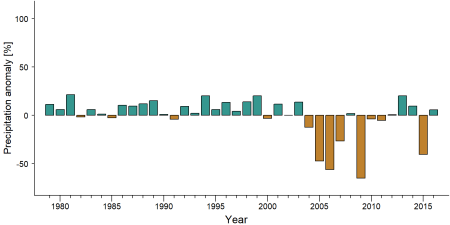
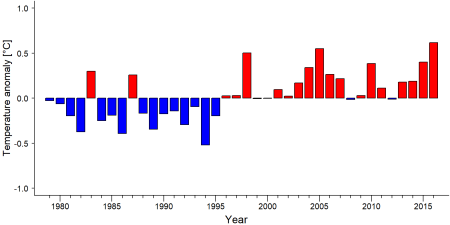
As part of a study on the exposure of African great ape sites to climate change impacts, Kiribou et al. | As part of a study on the exposure of African great ape sites to climate change impacts, [[#R02247|Kiribou et al. (2024)]] extracted climate data and data on projected extreme climate impact events for the site. Climatological characteristics were derived from observation-based climate data provided by the Inter-Sectoral Impact Model Intercomparison Project (ISIMIP, www.isimip.org). Parameters were calculated as the average across each 30-year period. For 1981-2010, the EWEMBI dataset from ISIMIP2a was used. For the two future periods (2021-2050 and 2071-2099) ISIMIP2b climate data based on four CMIP5 global climate models were used. For future projections, two Representative Concentration Pathways (RCP) were used. RCP 2.6 is a scenario with strong mitigation measures in which global temperatures would likely rise below 2C. RCP 6.0 is a scenario with medium emissions in which global temperatures would likely rise up to 3C by 2100. For the number of days with heavy precipitation events, the 98th percentile of all precipitation days (>1mm/d) was calculated for the 1979-2013 reference period as a threshold for a heavy precipitation event. Then, for each year, the number of days above that threshold was derived. The figures on temperature and precipitation anomaly show the deviation from the mean temperature and mean precipitation for the 1979-2013 reference period. | ||
The estimated exposure to future extreme climate impact events (crop failure, drought, river flood, wildfire, tropical cyclone, and heatwave) is based on a published dataset by Lange et al. 2020 derived from ISIMIP2b data. The same global climate models and RCPs as described above were used. Within each 30-year period, the number of years with an extreme event and the average proportion of the site affected were calculated ( | The estimated exposure to future extreme climate impact events (crop failure, drought, river flood, wildfire, tropical cyclone, and heatwave) is based on a published dataset by Lange et al. 2020 derived from ISIMIP2b data. The same global climate models and RCPs as described above were used. Within each 30-year period, the number of years with an extreme event and the average proportion of the site affected were calculated ([[#R02247|Kiribou et al. 2024]]). | ||
'''Table 8. Estimated past and projected climatological characteristics in Loma Mountains National Park''' | '''Table 8. Estimated past and projected climatological characteristics in Loma Mountains National Park''' | ||
| Line 482: | Line 492: | ||
|} | |} | ||
<div><ul><li style="display: inline-block; vertical-align: top;"> [[File:PrecipAnomaly_Loma_Mountains_NP.png| 450px | thumb| none | Precipitation anomaly in Loma Mountains National Park]] </li><li style="display: inline-block; vertical-align: top;"> [[File:TempAnomaly_Loma_Mountains_NP.png | 450px | thumb| none | Temperature anomaly in Loma Mountains National Park]] </li></ul></div> | |||
= External links = | = External links = | ||
| Line 489: | Line 501: | ||
= References = | = References = | ||
BirdLife International. 2019. Important Bird Areas factsheet: Loma Mountains Non-hunting Forest Reserve. Downloaded from http://www.birdlife.org on 19/08/2019. | <span id="R01077"></span>BirdLife International. 2019. Important Bird Areas factsheet: Loma Mountains Non-hunting Forest Reserve. Downloaded from http://www.birdlife.org on 19/08/2019. | ||
Brncic, T.M., Amarasekaran,B. & McKenna,A. 2010. Final Report of the Sierra Leone National Chimpanzee Census Project. Tacugama Chimpanzee Sanctuary, Freetown, Sierra Leone. | <span id="R01078"></span>Brncic, T.M., Amarasekaran,B. & McKenna,A. 2010. Final Report of the Sierra Leone National Chimpanzee Census Project. Tacugama Chimpanzee Sanctuary, Freetown, Sierra Leone. [https://web.archive.org/web/20160308223613/http://tacugama.com/census.html link] | ||
Carlsen,F., Leus, K., Traylor-Holzer, K., McKenna, A.(Editors). 2012. Western Chimpanzee Population and Habitat Viability Assessment for Sierra Leone: Final Report. IUCN/SSC Conservation Breeding Specialist Group – Europe (CBSG Europe), Copenhagen, Denmark. | <span id="R01079"></span>Carlsen,F., Leus, K., Traylor-Holzer, K., McKenna, A.(Editors). 2012. Western Chimpanzee Population and Habitat Viability Assessment for Sierra Leone: Final Report. IUCN/SSC Conservation Breeding Specialist Group – Europe (CBSG Europe), Copenhagen, Denmark. | ||
Forestry Division. 2012. Loma Mountains National Park: Preliminary Management Plan 2013-2017. Ministry of Agriculture, Forestry and Food Security, Sierra Leone | <span id="R01080"></span>Forestry Division. 2012. Loma Mountains National Park: Preliminary Management Plan 2013-2017. Ministry of Agriculture, Forestry and Food Security, Sierra Leone | ||
<span id="R01081"></span>Fofanah, M. (2024, November 4). As deforestation advances, conservationists mobilize to save Sierra Leone national park and its chimpanzees. Mongabay. https://news.mongabay.com/2024/11/as-deforestation-advances-conservationists-mobilize-to-save-sierra-leone-national-park-and-its-chimpanzees/ | |||
<span id="R01082"></span>Hanson-Alp, R., Bakarr, M.I., Lebbie, A., Bangura, K.I. 2003. West African Chimpanzees. Status Survey and Conservation Action Plan, Chapter 10: Sierra Leone. IUCN/SSC Primate Specialist Group. IUCN, Gland, Switzerland and Cambridge, UK | |||
Garriga | <span id="R01083"></span>Garriga R.M., (2019). Loma Mountains National Park Chimpanzee Nest Survey, Report, Tacugama Chimpanzee Sanctuary. Freetown, Sierra Leone. 25p [https://www.tacugama.com/wp-content/uploads/2020/04/2019_Loma-chimpanzee-survey-report_final.pdf link] | ||
Kormos R, Kormos | <span id="R01084"></span>Garriga, R. & Kanneh, A. (2022, October 20-21). Sierra Leone. Regional workshop on IUCN APES wiki, Monrovia, Liberia. | ||
<span id="R01085"></span>Molina‐Vacas, G., Muñoz‐Mas, R., Amarasekaran, B., & Garriga, R. M. (2023). Reaffirming the Loma Mountains National Park in Sierra Leone as a critical site for the conservation of West African chimpanzee (Pan troglodytes verus). ''American Journal of Primatology'', 85(4). [https://doi.org/10.1002/ajp.23469 doi:10.1002/ajp.23469] | |||
<span id="R01086"></span>Kormos, R., Kormos, C. F., Humle, T., Lanjouw, A., Rainer, H., Victurine, R., …, & Williamson, E. A. (2014). Great Apes and Biodiversity Offset Projects in Africa: The Case for National Offset Strategies. ''PLoS ONE'', 9(11), 1-14. [https://doi.org/10.1371/journal.pone.0111671 doi:10.1371/journal.pone.0111671] | |||
<span id="R02247"></span>Kiribou, R., Tehoda, P., Chukwu, O., Bempah, G., Kühl, H. S., Ferreira, J., …, & Heinicke, S. (2024). Exposure of African ape sites to climate change impacts. ''PLOS Climate'', 3(2), e0000345. [https://doi.org/10.1371/journal.pclm.0000345 doi:10.1371/journal.pclm.0000345] | |||
'''Page created by: '''Ambrose Bockarie Kanneh, Rosa M. Garriga & Konkofa Marah''' Date:''' 2023-01-25 | '''Page created by: '''Ambrose Bockarie Kanneh, Rosa M. Garriga & Konkofa Marah''' Date:''' 2023-01-25 | ||
'''Page updated by: '''Aime Mizero''' Date:''' 2025-12-23 | |||
Latest revision as of 17:53, 15 October 2026
West Africa > Sierra Leone > Loma Mountains National Park
Français | Português | Español | Bahasa Indonesia | Melayu
Summary
- Western chimpanzees (Pan troglodytes verus) are present in Loma Mountains National Park.
- It has been estimated that 1,390 (CI: 819-2,361) individuals occur at the site.
- The chimpanzee population trend is increasing.
- This site has a total size of 288.5 km².
- Key threats to chimpanzees are hunting, habitat encroachment due to farming, and fires.
- Conservation activities include environmental education, anti-poaching patrols, and reforestation.
- The status of the site was upgraded from non-hunting forest reserve to national park as part of a biodiversity offset for the Bumbuna hydroelectric dam.
Site characteristics
The site was first established as a non-hunting reserve in 1972, and upgraded to national park status in 2012 as part of an offset plan to compensate for the environmental impacts caused by the Bumbuna hydroelectric project (Brncic et al. 2010; Kormos et al. 2014). Loma Mountains National park is located in Sierra Leone’s Northern Province (Forestry Division 2012). Mount Bintumani is located in the site, which, at 1,945 m, is the highest peak in West Africa, west of Mount Cameroon (Hanson-Alp et al. 2003). The high elevations in the area gave rise to three main plant communities: closed forests and savanna (from 4,60 to 915 m), sub-montane Shrubland and gallery forests (915 to 1,700 m), and montane grassland (above 1,700, Forestry Division 2012). In addition to the western chimpanzee, the site hosts other endangered and vulnerable species, including western red colobus (Piliocolobus badius), Diana monkey (Cercopithecus diana), pygmy hippo (Choeropsis liberiensis), golden cat (Caracal aurata), and zebra duiker (Cephalophus zebra, Forestry Division 2012). The site is also an Important Bird Area (IBA) with at least 245 bird species (BirdLife International 2019).
Table 1. Basic site information for Loma Mountains National Park
| Species | Pan troglodytes verus |
| Area | 288.5 km² |
| Coordinates | Lat: 9.20 , Lon: -11.12 |
| Type of site | Protected area (National Park) |
| Habitat types | Subtropical/tropical moist montane forest, Subtropical/tropical dry forest, Shrubland, Grassland |
| Type of governance | Governance by government |
Types of sites Governance types Habitat types
Ape status
According to a nationwide survey in 2009, which included Loma Mountains, an estimated 1,065 chimpanzees inhabit the site (Brncic et al. 2010). Loma is estimated to harbor 20% of the country’s chimpanzee population. The highest chimpanzee densities were found at higher elevations, likely because they are not easily accessed by humans (Brncic et al. 2010). Several studies targeting chimpanzee population status at this site have reported varying density and abundance estimates. A chimpanzee survey conducted in 2008 reported a density 5.75 chimpanzee / km2, and another conducted in 2010 documented chimpanzee density at 2.69 chimpanzee / km2. The most recent survey along systematically paced line transects confirmed a population density of 4.81 chimpanzee / km2 in 2019. The varying densities reported over the last one decade shows an increasingly higher chimpanzee population occurrence at LMNP as compared to other sites in West Africa.
Table 2. Ape population estimates reported for Loma Mountains National Park
| Species | Year | Occurrence | Encounter or vistation rate (nests/km; ind/day) | Density estimate [ind./ km²] (95% CI) | Abundance estimate (95% CI) | Survey area | Sampling method | Analytical framework | Source | Comments | A.P.E.S. database ID |
|---|---|---|---|---|---|---|---|---|---|---|---|
| Pan troglodytes verus | 2019 | 10.03 | 4.81 (2.83-8.18) | 1,390 (819-2,361) | Loma Mountains National Park 288.5 km² | Line transects | Garriga 2019 | 35 transects were placed , but 34 transects were walked for a total of 66.08 km of survey effort | SLE0019 | ||
| Pan troglodytes verus | 2009 | 8.27 | 2.69 (1.44-5.01) | 1,065 (572-1,986) | Loma Mountains National Park | Line transects | Brncic et al. 2010 | Survey effort: 59.8 km | SLE0002, SLE0003 SLE0004, SLE0014, SLE0015, SLE0017, SLE0018, SLE0021, SLE0024, SLE0025, SLE0026, SLE0029, SLE0032, SLE0036, SLE0037
| ||
| Pan troglodytes verus | 2008 | 5.75-7.41 | 15% of the total area of Loma Mountains National Park | Unknown | Kortenhoven 2008 as cited by Brncic et al. 2010 | SLE0002, SLE0003 SLE0004, SLE0014, SLE0015, SLE0017, SLE0018, SLE0021, SLE0024, SLE0025, SLE0026, SLE0029, SLE0032, SLE0036, SLE0037
|
Sampling methods Analytical frameworks
Threats
During a chimpanzee survey in 2009, human activities were observed mostly in the lowland areas of the park, especially farming activities (Brncic et al. 2010). Similarly, hunting signs were less common at higher elevations, near Bintumani peak. Overall, hunting pressure is much lower in Loma Mountains National Park compared to Tingi Hills or WAPFR (Brncic et al. 2010). Human activity such as hunting either for subsistence or commercial purpose are predominant in the central areas, evidence from hunting trails, gun shells and snares, and farming activities more frequent near the park boundaries. However, less signs of human activities have been observed in the areas with higher chimpanzee nest encounters, mostly areas with steeper hills and more difficult access for humans (Garriga & Kanneh 2022). While local people considerably rely on bushmeat, most of it is obtained close to the fields, and larger animals account only for a smaller fraction of bushmeat consumed (Forestry Division 2012). Uncontrolled wildfire is also another serious threat to the ecosystem structure of the park that spread widely in the park at the peak of the dry season. During the 2019 survey, cleared and burnt areas of the forest (suspected source from farming activities and wild fire introduced by cattle herdsmen) close to the boundary and inside the park were frequently walked by the field team (Garriga 2019).
Table 3. Threats to apes reported for Loma Mountains National Park
| Category | Specific threats | Threat level | Description | Year of threat |
|---|---|---|---|---|
| 1 Residential & commercial development | 1.1 Residential areas | Present (unknown severity) | Villages and farmland where located within the site before new boundaries where agreed upon in 2012 (Forestry Division 2012) | Ongoing (2012) |
| 2 Agriculture & aquaculture | 2.1 Annual & perennial non-timber crops | Low (up to 30% of population affected) | Vegetation cleared for agriculture (Brncic et al. 2010, Forestry Division 2012). Farming along the park boundary and certain areas within the park exist, carried out by the forest edge community members (Garriga & Kanneh 2022). | Ongoing (2022) |
| 2 Agriculture & aquaculture | 2.3 Livestock farming & ranching | Present (unknown severity) | Cattle rearing at the landscape is predominant mainly in the dry season (Garriga 2019, Fofanah 2024). | 2019-Ongoing (2024) |
| 5 Biological resource use | 5.1 Hunting & collecting terrestrial animals | Present (unknown severity) | Hunting (hunting trails, gun shells and snares) (Garriga 2019, Molina-Vacas 2023, Fofanah 2024). | 2019-Ongoing (2024) |
| 5 Biological resource use | 5.2 Gathering terrestrial plants | Present (unknown severity) | The site is a source of medicinal plants, wild fruits, herbs, and building materials for local people (Forestry Division 2012) | Ongoing (2012) |
| 5 Biological resource use | 5.3 Logging & wood harvesting | Low (up to 30% of population affected) | Logging for subsistence (Forestry Division 2012). LMNP have lost over 6% of it's primary forest cover between 2002–2023; further loss into 2024 (Fofanah 2024). | 2002-Ongoing (2024) |
| 7 Natural system modifications | 7.1 Fire & fire suppression | Present (unknown severity) | Fires to clear vegetation within and around the park sometimes extend beyond the intended field (Forestry Division 2012). Wildfire is also a common threat to the forest ecosystem. This is more frequent in the dry season, and the fire is mostly put on by the cattle herders for fresh and young nutritious grass for their cattle (Garriga & Kanneh 2022). Farmers clear forest due to lack of agricultural land and livelihood options (Fofanah 2024). | 2012-Ongoing (2024) |
Conservation activities
The Forestry Division of Sierra Leone is responsible for the management of protected areas (Forestry Division 2012). The World Bank provided initial funding for the setup of the national park, but the long-term, sustainable financing of the park has not been secured (Kormos et al. 2014; Forestry Division 2012). Conservation measures for the park have included the development of a management plan, demarcation of the park’s boundaries, and posting and training staff (Kormos et al. 2014).
The conservation activities undertaken within and outside the park have been restored since 2019 with one year funds from the US Fish and Wildlife Service through TCS to protect the remaining population of western chimpanzees thriving in the park. Since 2019, lots of conservation interventions are ongoing to support the protection of the park and sustain the long-term conservation of the remaining population of western chimpanzees. Before the intervention of TCS in 2019, the Biodiversity Conservation Project (BCP) was implemented that led to the construction of the park centre and other conservation interventions (Garriga & Kanneh 2022).
Table 4. Conservation activities reported for Loma Mountains National Park
| Category | Specific activity | Description | Implementing organization(s) | Year of activity |
|---|---|---|---|---|
| 2 Counter-wildlife crime | 2.11 Implement monitoring surveillance strategies (e.g., SMART) or use monitoring data to improve effectiveness of patrols | Law enforcement through active forest patrols. The National Protected Area Authority (NPAA) game guards working in conjunction with the Tacugama community bio-monitors patrol the park and its territories while collecting data on human activities and wildlife presence (Garriga & Kanneh 2022, Fofanah 2024). | Tacugama, USFWS, USFS, local government | 2019-Ongoing (2024) |
| 2 Counter-wildlife crime | 2.12 Implement community control of patrolling, banning hunting and removing snares | Active bio-monitoring to support research activities: Since 2019 to date there have been well-planned and active bio-monitoring activities undertaken by the TCS community bio-monitors with the LMNP. The biomonitoring employs specialised software programs (SMART, CyberTracker and Gaia GPS) installed on android mobile devices for data collection on wildlife and human activities presence and distribution within the park (Garriga & Kanneh 2022, Fofanah 2024). | Tacugama, USFWS, USFS, local government | 2019-Ongoing (2024) |
| 2 Counter-wildlife crime | 2.13 Provide sustainable alternative livelihoods; establish fish- or domestic meat farms | Tacugama provides alternatives to bushmeat such as chickens and goats (Marah, K. pers. comm. 2023). | Tacugama, USFWS, USFS, local government | Ongoing (2023) |
| 2 Counter-wildlife crime | 2.3 Conduct regular anti-poaching patrols | As of 2012, two rangers were part of the park’s staff (Forestry Division 2012) | Ongoing (2012) | |
| 2 Counter-wildlife crime | 2.8 Provide training to anti-poaching ranger patrols | Training for bio-monitors, TKEEP teachers coordinators and local farmers to support capacity building. The community bio-monitors periodically received training on data collection procedures on wildlife and human signs and activities, and forest patrol techniques. Likewise the TKEEP Teachers coordinators on education following the TKEEP work book. And the farmers on sustainable agricultural practices (Garriga & Kanneh 2022, Fofanah 2024). | Tacugama, USFWS, USFS, local government | 2019-Ongoing (2024) |
| 4 Education & awareness | 4.1 Educate local communities about apes and sustainable use | Conservation education in selected schools of the park communities: TCS have extended its education program in the schools working with the schools kids and teacher coordinators to fully implement its Tacugama Kids Environmental Education Program (TKEEP) workbook at the beginning/end of every school year since 2020 (Garriga & Kanneh 2022, Fofanah 2024). | Tacugama, USFWS, USFS, local government | 2020-Ongoing (2024) |
| 5 Protection & restoration | 5.2 Legally protect ape habitat | The site is designated as national park since 2012 (Forestry Division 2012) | 2012-Ongoing (2026) | |
| 5 Protection & restoration | 5.5 Demarcate and enforce boundaries of protected areas | Resurveying and physically demarcating park boundary (Kormos et al. 2014) | Ongoing (2014) | |
| 5 Protection & restoration | 5.6 Habitat restoration | Reforestation: tree planting of native species with high survival rate occurring at the park region. Every year since 2019 to date, the Tacugama Chimpanzee Sanctuary (TCS) organised the local community members and engaged them in tree planting of degraded areas along the park boundary in the months of July and August (Garriga & Kanneh 2022, Fofanah 2024). | National Protected Area Authority (NPAA), Local communities | 2019-Ongoing (2024) |
| 7 Economic & other incentives | 7.2 Provide non-monetary benefits to local communities for sustainably managing their forest and its wildlife (e.g., better education, infrastructure development) | Agriculture: support with agricultural inputs (groundnut and rice seeds and tools) for cultivation (Marah, K. pers. comm. 2023). Livelihood support to the park communities in the form of agricultural seeds, tools and sustainable cultivation practices training to farmers groups. The community members who practise farming have been formed into small groups (farmer groups) and are supported with the required agriculture inputs every year since 2019 (Garriga & Kanneh 2022). In addition, community engagement and livelihood projects were developed to identify needs and reduce forest dependence (Fofanah 2024). | National Protected Area Authority (NPAA), European Union partnership | 2019-Ongoing (2024) |
Challenges
Conservation funds to finance the operation of the park for long term meeting community livelihoods: although there are ongoing livelihood activities, the resources are limited to adequately respond to many needs of the residing park communities mainly in terms of infrastructure and other basic needs of life (Garriga & Kanneh 2022). Lack of presence of the National Protected Area Authority, partly due to lack of accommodation in the park and difficulty to reach the area (Marah, K. pers. comm. 2023).
Table 5. Challenges reported for Loma Mountains National Park
| Challenges | Specific challenges | Source | Year(s) |
|---|---|---|---|
| 1 Site management | 1.2 Need for improved coordination | Garriga & Kanneh 2022 | Ongoing (2022) |
| 2 Resources and capacity | 2.3 General lack of funding | Kormos et al. 2014, Fofanah 2024 | 2014-Ongoing (2024) |
| 2 Resources and capacity | 2.5 Lack of equipment/transportation | Fofanah 2024 | Ongoing (2024) |
| 2 Resources and capacity | 2.7 Lack of infrastructure | Marah, K. pers. comm. 2023, Fofanah 2024 | 2023-Ongoing (2024) |
| 4 Institutional support | 4.2 Lack of government support | Garriga & Kanneh 2022, Marah, K. pers. comm. 2023, Fofanah 2024 | 2022-Ongoing (2024) |
Enablers
Table 6. Enablers reported for Loma Mountains National Park
| Enablers | Specific enablers | Source | Year(s) |
|---|---|---|---|
| 1 Site management | |||
| 2 Resources and capacity | 2.6 External partnerships that add expertise or resources | Fofanah 2024 | Ongoing (2024) |
| 3 Engaged community | 3.6 Local community engagement and support | Fofanah 2024 | Ongoing (2024) |
| 4 Institutional support | |||
| 5 Ecological context | |||
| 6 Safety and stability |
Research activities
Research activities include: chimpanzee surveys using systematically placed line transect throughout the park; bio-monitoring using the SMART and CyberTracker applications; environmental education and sensitizations on the Sierra Leone National Animal – National Animal Campaign through questionnaire and survey led by Tacugama within the park communities (Garriga & Kanneh 2022).
Documented behaviours
Table 7. Behaviours documented for Loma Mountains National Park
| Category | Behavior | Observation type | Prevalence | Observation dates | Source | Habituation | Species | Comment |
|---|---|---|---|---|---|---|---|---|
| Ground nesting | Marah, K. pers. comm. 2023 | |||||||
| Termite fishing | Marah, K. pers. comm. 2023 | |||||||
| Removing top of palm tree | Marah, K. pers. comm. 2023 |
Exposure to climate change impacts
As part of a study on the exposure of African great ape sites to climate change impacts, Kiribou et al. (2024) extracted climate data and data on projected extreme climate impact events for the site. Climatological characteristics were derived from observation-based climate data provided by the Inter-Sectoral Impact Model Intercomparison Project (ISIMIP, www.isimip.org). Parameters were calculated as the average across each 30-year period. For 1981-2010, the EWEMBI dataset from ISIMIP2a was used. For the two future periods (2021-2050 and 2071-2099) ISIMIP2b climate data based on four CMIP5 global climate models were used. For future projections, two Representative Concentration Pathways (RCP) were used. RCP 2.6 is a scenario with strong mitigation measures in which global temperatures would likely rise below 2C. RCP 6.0 is a scenario with medium emissions in which global temperatures would likely rise up to 3C by 2100. For the number of days with heavy precipitation events, the 98th percentile of all precipitation days (>1mm/d) was calculated for the 1979-2013 reference period as a threshold for a heavy precipitation event. Then, for each year, the number of days above that threshold was derived. The figures on temperature and precipitation anomaly show the deviation from the mean temperature and mean precipitation for the 1979-2013 reference period.
The estimated exposure to future extreme climate impact events (crop failure, drought, river flood, wildfire, tropical cyclone, and heatwave) is based on a published dataset by Lange et al. 2020 derived from ISIMIP2b data. The same global climate models and RCPs as described above were used. Within each 30-year period, the number of years with an extreme event and the average proportion of the site affected were calculated (Kiribou et al. 2024).
Table 8. Estimated past and projected climatological characteristics in Loma Mountains National Park
| Value | 1981-2010 | 2021-2050, RCP 2.6 | 2021-2050, RCP 6.0 | 2071-2099, RCP 2.6 | 2071-2099, RCP 6.0 |
|---|---|---|---|---|---|
| Mean temperature [C] | 25.5 | 26.6 | 26.5 | 26.7 | 27.9 |
| Annual precipitation [mm] | 2042 | 2011 | 2075 | 2087 | 2133 |
| Max no. consecutive dry days (per year) | 42.4 | 40.3 | 41.8 | 43 | 46.2 |
| No. days with heavy precipitation (per year) | 5.1 | 5.4 | 5.8 | 6.3 | 7.1 |
Table 9. Projected exposure of apes to extreme climate impact events in Loma Mountains National Park
| Type | No. of years with event (2021-2050, RCP 2.6) | % of site exposed (2021-2050, RCP 2.6) | No. of years with event (2021-2050, RCP 6.0) | % of site exposed (2021-2050, RCP 6.0) | No. of years with event (2070-2099, RCP 2.6) | % of site exposed (2070-2099, RCP 2.6) | No. of years with event (2070-2099, RCP 6.0) | % of site exposed (2070-2099, RCP 6.0) |
|---|---|---|---|---|---|---|---|---|
| Crop failure | 4 | 0.25 | 3 | 0.25 | 3.5 | 0.25 | 5 | 0.25 |
| Drought | 0 | 0 | 0 | 0 | 0 | 0 | 0 | 0 |
| Heatwave | 3.5 | 100 | 5 | 100 | 5 | 100 | 5.5 | 100 |
| River flood | 0 | 0 | 1 | 0.75 | 0.5 | 1.67 | 2.5 | 2.5 |
| Tropical cyclone | 0 | 0 | 0 | 0 | 0.5 | 5.51 | 0 | 0 |
| Wildfire | 30 | 0.75 | 30 | 0.73 | 29 | 0.78 | 29 | 0.85 |
-
Precipitation anomaly in Loma Mountains National Park -
Temperature anomaly in Loma Mountains National Park


External links
References
BirdLife International. 2019. Important Bird Areas factsheet: Loma Mountains Non-hunting Forest Reserve. Downloaded from http://www.birdlife.org on 19/08/2019.
Brncic, T.M., Amarasekaran,B. & McKenna,A. 2010. Final Report of the Sierra Leone National Chimpanzee Census Project. Tacugama Chimpanzee Sanctuary, Freetown, Sierra Leone. link
Carlsen,F., Leus, K., Traylor-Holzer, K., McKenna, A.(Editors). 2012. Western Chimpanzee Population and Habitat Viability Assessment for Sierra Leone: Final Report. IUCN/SSC Conservation Breeding Specialist Group – Europe (CBSG Europe), Copenhagen, Denmark.
Forestry Division. 2012. Loma Mountains National Park: Preliminary Management Plan 2013-2017. Ministry of Agriculture, Forestry and Food Security, Sierra Leone
Fofanah, M. (2024, November 4). As deforestation advances, conservationists mobilize to save Sierra Leone national park and its chimpanzees. Mongabay. https://news.mongabay.com/2024/11/as-deforestation-advances-conservationists-mobilize-to-save-sierra-leone-national-park-and-its-chimpanzees/
Hanson-Alp, R., Bakarr, M.I., Lebbie, A., Bangura, K.I. 2003. West African Chimpanzees. Status Survey and Conservation Action Plan, Chapter 10: Sierra Leone. IUCN/SSC Primate Specialist Group. IUCN, Gland, Switzerland and Cambridge, UK
Garriga R.M., (2019). Loma Mountains National Park Chimpanzee Nest Survey, Report, Tacugama Chimpanzee Sanctuary. Freetown, Sierra Leone. 25p link
Garriga, R. & Kanneh, A. (2022, October 20-21). Sierra Leone. Regional workshop on IUCN APES wiki, Monrovia, Liberia.
Molina‐Vacas, G., Muñoz‐Mas, R., Amarasekaran, B., & Garriga, R. M. (2023). Reaffirming the Loma Mountains National Park in Sierra Leone as a critical site for the conservation of West African chimpanzee (Pan troglodytes verus). American Journal of Primatology, 85(4). doi:10.1002/ajp.23469
Kormos, R., Kormos, C. F., Humle, T., Lanjouw, A., Rainer, H., Victurine, R., …, & Williamson, E. A. (2014). Great Apes and Biodiversity Offset Projects in Africa: The Case for National Offset Strategies. PLoS ONE, 9(11), 1-14. doi:10.1371/journal.pone.0111671
Kiribou, R., Tehoda, P., Chukwu, O., Bempah, G., Kühl, H. S., Ferreira, J., …, & Heinicke, S. (2024). Exposure of African ape sites to climate change impacts. PLOS Climate, 3(2), e0000345. doi:10.1371/journal.pclm.0000345
Page created by: Ambrose Bockarie Kanneh, Rosa M. Garriga & Konkofa Marah Date: 2023-01-25
Page updated by: Aime Mizero Date: 2025-12-23