
Malebo: Difference between revisions
No edit summary |
No edit summary Tag: Manual revert |
||
| (5 intermediate revisions by the same user not shown) | |||
| Line 17: | Line 17: | ||
= Site characteristics = | = Site characteristics = | ||
The site is located in the Lake Tumba landscape in western Democratic Republic of Congo (DRC). The region is characterized as a forest-savanna ecosystem, with altitudes ranging from 300 to 700 m (Serckx et al. 2014). The types of forests found at the site include re-colonizing Uapaca sp., old secondary, mixed mature, old growth mono-dominant, riverine gallery and Marantaceae forests (Serckx et al. 2014).The region is also characterized by flood episodes during which water covers ca. 65% of the forest (Inogwabini et al. 2013). | The site is located in the Lake Tumba landscape in western Democratic Republic of Congo (DRC). The region is characterized as a forest-savanna ecosystem, with altitudes ranging from 300 to 700 m ([[#R01153|Serckx et al. 2014]]). The types of forests found at the site include re-colonizing Uapaca sp., old secondary, mixed mature, old growth mono-dominant, riverine gallery and Marantaceae forests ([[#R01153|Serckx et al. 2014]]).The region is also characterized by flood episodes during which water covers ca. 65% of the forest ([[#R01151|Inogwabini et al. 2013]]). | ||
'''Table 1. Basic site information for Malebo''' | '''Table 1. Basic site information for Malebo''' | ||
| Line 44: | Line 44: | ||
= Ape status = | = Ape status = | ||
In 2005, the presence of a bonobo population in the region was documented by the local NGO Mbou-Mon-Tour and by an extensive survey conducted by the WWF (Serckx et al. 2014). In 2007, a habituation program started. The bonobo population seems to be made up of two communities, inhabiting the Nkala and Mpelu forests (Serckx et al. 2014). | In 2005, the presence of a bonobo population in the region was documented by the local NGO Mbou-Mon-Tour and by an extensive survey conducted by the WWF ([[#R01153|Serckx et al. 2014]]). In 2007, a habituation program started. The bonobo population seems to be made up of two communities, inhabiting the Nkala and Mpelu forests ([[#R01153|Serckx et al. 2014]]). | ||
'''Table 2. Ape population estimates reported for Malebo''' | '''Table 2. Ape population estimates reported for Malebo''' | ||
| Line 62: | Line 62: | ||
|- | |- | ||
|''Pan paniscus'' | |''Pan paniscus'' | ||
| | |2013 | ||
| | | | ||
| | | | ||
|0. | |0.32 (0.19-0.53) | ||
|11 | |17 (11-28) | ||
|Mpelu forest in Malebo (54.26 km²) | |Mpelu forest in Malebo (54.26 km²) | ||
|Line transects | |Line transects | ||
| | | | ||
|Sercx et al. 2014 | |[[#R01153|Sercx et al. 2014]] | ||
| | | | ||
|COD0132, COD0133<div class="mw-collapsible mw-collapsed" data-expandtext="+1 more" data-collapsetext="less">COD0134</div> | |||
|- | |- | ||
|''Pan paniscus'' | |''Pan paniscus'' | ||
| Line 78: | Line 78: | ||
| | | | ||
| | | | ||
|0. | |0.55 (0.28-1.07) | ||
|17 ( | |17 (9-35) | ||
| | |Nkala forest in Malebo (32.45 km²) | ||
|Line transects | |Line transects | ||
| | | | ||
|Sercx et al. 2014 | |[[#R01153|Sercx et al. 2014]] | ||
| | | | ||
|COD0132, COD0133<div class="mw-collapsible mw-collapsed" data-expandtext="+1 more" data-collapsetext="less">COD0134</div> | |||
|- | |- | ||
|''Pan paniscus'' | |''Pan paniscus'' | ||
| Line 96: | Line 96: | ||
|Line transects | |Line transects | ||
| | | | ||
|Sercx et al. 2014 | |[[#R01153|Sercx et al. 2014]] | ||
| | | | ||
|COD0132, COD0133<div class="mw-collapsible mw-collapsed" data-expandtext="+1 more" data-collapsetext="less">COD0134</div> | |||
|- | |- | ||
|''Pan paniscus'' | |''Pan paniscus'' | ||
| Line 104: | Line 104: | ||
| | | | ||
| | | | ||
|0. | |0.21 (0.12-0.35) | ||
| | |11 (7-19) | ||
| | |Mpelu forest in Malebo (54.26 km²) | ||
|Line transects | |Line transects | ||
| | | | ||
|Sercx et al. 2014 | |[[#R01153|Sercx et al. 2014]] | ||
| | | | ||
|COD0132, COD0133<div class="mw-collapsible mw-collapsed" data-expandtext="+1 more" data-collapsetext="less">COD0134</div> | |||
|- | |- | ||
|''Pan paniscus'' | |''Pan paniscus'' | ||
| | |2012 | ||
| | | | ||
| | | | ||
|0. | |0.51 (0.32-0.79) | ||
| | |16 (11-25) | ||
|Nkala forest in Malebo (32.45 km²) | |Nkala forest in Malebo (32.45 km²) | ||
|Line transects | |Line transects | ||
| | | | ||
|Sercx et al. 2014 | |[[#R01153|Sercx et al. 2014]] | ||
| | | | ||
|COD0132, COD0133<div class="mw-collapsible mw-collapsed" data-expandtext="+1 more" data-collapsetext="less">COD0134</div> | |||
|- | |- | ||
|''Pan paniscus'' | |''Pan paniscus'' | ||
| Line 135: | Line 135: | ||
|Line transects | |Line transects | ||
| | | | ||
|Sercx et al. 2014 | |[[#R01153|Sercx et al. 2014]] | ||
| | | | ||
|COD0132, COD0133<div class="mw-collapsible mw-collapsed" data-expandtext="+1 more" data-collapsetext="less">COD0134</div> | |||
|- | |- | ||
|''Pan paniscus'' | |''Pan paniscus'' | ||
| Line 148: | Line 148: | ||
|Line transects | |Line transects | ||
| | | | ||
|Sercx et al. 2014 | |[[#R01153|Sercx et al. 2014]] | ||
| | | | ||
|COD0132, COD0133<div class="mw-collapsible mw-collapsed" data-expandtext="+1 more" data-collapsetext="less">COD0134</div> | |||
|} | |} | ||
| Line 157: | Line 157: | ||
= Threats = | = Threats = | ||
Bonobos are largely respected in the area, and local communities refrain from hunting or eating them, as they believe them to be their ancestors (Inogwabini et al. 2007). However, as other groups and logging companies have moved into the area, this taboo has become degraded; thus, hunting and agricultural expansion now threatens bonobos and other wildlife ([https://www.synchronicityearth.org/partner/mbou-mon-tour/ SynchronicityEarth]). | Bonobos are largely respected in the area, and local communities refrain from hunting or eating them, as they believe them to be their ancestors ([[#R01152|Inogwabini et al. 2007]]). However, as other groups and logging companies have moved into the area, this taboo has become degraded; thus, hunting and agricultural expansion now threatens bonobos and other wildlife ([https://www.synchronicityearth.org/partner/mbou-mon-tour/ SynchronicityEarth]). | ||
'''Table 3. Threats to apes reported for Malebo''' | '''Table 3. Threats to apes reported for Malebo''' | ||
| Line 170: | Line 170: | ||
|2.1 Annual & perennial non-timber crops | |2.1 Annual & perennial non-timber crops | ||
|Present (unknown severity) | |Present (unknown severity) | ||
|During a survey conducted between 2011-2013, six villages and twelve farms were directly adjacent to the forest and plantations were located inside the forest (Serckx et al. 2014). | |During a survey conducted between 2011-2013, six villages and twelve farms were directly adjacent to the forest and plantations were located inside the forest ([[#R01153|Serckx et al. 2014]]). | ||
|Ongoing (2014) | |Ongoing (2014) | ||
|- | |- | ||
| Line 176: | Line 176: | ||
|2.3 Livestock farming & ranching | |2.3 Livestock farming & ranching | ||
|Present (unknown severity) | |Present (unknown severity) | ||
|Cattle ranching in parts of the savanna patches (Serckx et al. 2014). | |Cattle ranching in parts of the savanna patches ([[#R01153|Serckx et al. 2014]]). | ||
|Ongoing (2014) | |Ongoing (2014) | ||
|- | |- | ||
| Line 182: | Line 182: | ||
|5.1 Hunting & collecting terrestrial animals | |5.1 Hunting & collecting terrestrial animals | ||
|Present (unknown severity) | |Present (unknown severity) | ||
|Hunting has grown since new people and logging companies have moved into the area ([ | |Hunting has grown since new people and logging companies have moved into the area ([[#R02004|SynchronicityEarth]]). | ||
|Ongoing (2021) | |Ongoing (2021) | ||
|} | |} | ||
| Line 190: | Line 190: | ||
= Conservation activities = | = Conservation activities = | ||
WWF began working on bonobo conservation in the western part of the country in 2005. To protect the bonobos in this natural reserve, WWF has developed an ecotourism initiative called Picbou (Projet Intégré de Conservation des bonobos de l’ouest) since 2006. The project is implemented in collaboration with the local NGO Mbou-Mon-Tour ([https://www.synchronicityearth.org/partner/mbou-mon-tour/ MMT]). Three groups of bonobos have been habituated in the region to learn more about their socio-ecology and develop more effective conservation strategies. Simultaneously, the ecotourism project aims to bring income to the villagers in order to encourage them preserve their natural heritage (WWF 2017). | WWF began working on bonobo conservation in the western part of the country in 2005. To protect the bonobos in this natural reserve, WWF has developed an ecotourism initiative called Picbou (Projet Intégré de Conservation des bonobos de l’ouest) since 2006. The project is implemented in collaboration with the local NGO Mbou-Mon-Tour ([https://www.synchronicityearth.org/partner/mbou-mon-tour/ MMT]). Three groups of bonobos have been habituated in the region to learn more about their socio-ecology and develop more effective conservation strategies. Simultaneously, the ecotourism project aims to bring income to the villagers in order to encourage them preserve their natural heritage ([[#R01154|WWF 2017]]). | ||
'''Table 4. Conservation activities reported for Malebo''' | '''Table 4. Conservation activities reported for Malebo''' | ||
| Line 202: | Line 202: | ||
|2 Counter-wildlife crime | |2 Counter-wildlife crime | ||
|2.9 Strengthen/support/re-install traditions/taboos that forbid the killing of primates | |2.9 Strengthen/support/re-install traditions/taboos that forbid the killing of primates | ||
|To protect the bonobos, the NGO Mbou-Mon-Tour (MMT) has established an awareness raising programme in local villages to revive the bushmeat taboo ([ | |To protect the bonobos, the NGO Mbou-Mon-Tour (MMT) has established an awareness raising programme in local villages to revive the bushmeat taboo ([[#R02004|SynchronicityEarth]]). | ||
| | | | ||
|Ongoing (2016) | |Ongoing (2016) | ||
| Line 208: | Line 208: | ||
|4 Education & awareness | |4 Education & awareness | ||
|4.2 Involve local community in ape research and conservation management | |4.2 Involve local community in ape research and conservation management | ||
|MMT employed local villagers as bonobo trackers ([ | |MMT employed local villagers as bonobo trackers ([[#R02004|SynchronicityEarth]]). | ||
| | | | ||
|Ongoing (2016) | |Ongoing (2016) | ||
| Line 214: | Line 214: | ||
|6 Species management | |6 Species management | ||
|6.1 Habituate primates to human presence to reduce stress from tourists/researchers | |6.1 Habituate primates to human presence to reduce stress from tourists/researchers | ||
|Three groups of bonobos have been habituated in the region to learn more about their socio-ecology to develop more effective and adapted conservation strategies (WWF 2017). | |Three groups of bonobos have been habituated in the region to learn more about their socio-ecology to develop more effective and adapted conservation strategies ([[#R01154|WWF 2017]]). | ||
| | | | ||
|Ongoing (2017) | |Ongoing (2017) | ||
| Line 220: | Line 220: | ||
|8 Permanent presence | |8 Permanent presence | ||
|8.2 Run tourist projects and ensure permanent human presence at site | |8.2 Run tourist projects and ensure permanent human presence at site | ||
|WWF has developed an ecotourism initiative named Picbou (Projet Intégré de Conservation des bonobos de l’ouest) since 2006. Picbou is implemented in collaboration with MMT (WWF 2017). | |WWF has developed an ecotourism initiative named Picbou (Projet Intégré de Conservation des bonobos de l’ouest) since 2006. Picbou is implemented in collaboration with MMT ([[#R01154|WWF 2017]]). | ||
| | | | ||
|2006-Ongoing (2017) | |2006-Ongoing (2017) | ||
| Line 326: | Line 326: | ||
= Exposure to climate change impacts = | = Exposure to climate change impacts = | ||
As part of a study on the exposure of African great ape sites to climate change impacts, Kiribou et al. | As part of a study on the exposure of African great ape sites to climate change impacts, [[#R02256|Kiribou et al. (2024)]] extracted climate data and data on projected extreme climate impact events for the site. Climatological characteristics were derived from observation-based climate data provided by the Inter-Sectoral Impact Model Intercomparison Project (ISIMIP, www.isimip.org). Parameters were calculated as the average across each 30-year period. For 1981-2010, the EWEMBI dataset from ISIMIP2a was used. For the two future periods (2021-2050 and 2071-2099) ISIMIP2b climate data based on four CMIP5 global climate models were used. For future projections, two Representative Concentration Pathways (RCP) were used. RCP 2.6 is a scenario with strong mitigation measures in which global temperatures would likely rise below 2C. RCP 6.0 is a scenario with medium emissions in which global temperatures would likely rise up to 3C by 2100. For the number of days with heavy precipitation events, the 98th percentile of all precipitation days (>1mm/d) was calculated for the 1979-2013 reference period as a threshold for a heavy precipitation event. Then, for each year, the number of days above that threshold was derived. The figures on temperature and precipitation anomaly show the deviation from the mean temperature and mean precipitation for the 1979-2013 reference period. | ||
The estimated exposure to future extreme climate impact events (crop failure, drought, river flood, wildfire, tropical cyclone, and heatwave) is based on a published dataset by Lange et al. 2020 derived from ISIMIP2b data. The same global climate models and RCPs as described above were used. Within each 30-year period, the number of years with an extreme event and the average proportion of the site affected were calculated ( | The estimated exposure to future extreme climate impact events (crop failure, drought, river flood, wildfire, tropical cyclone, and heatwave) is based on a published dataset by Lange et al. 2020 derived from ISIMIP2b data. The same global climate models and RCPs as described above were used. Within each 30-year period, the number of years with an extreme event and the average proportion of the site affected were calculated ([[#R02256|Kiribou et al. 2024]]). | ||
'''Table 8. Estimated past and projected climatological characteristics in Malebo''' | '''Table 8. Estimated past and projected climatological characteristics in Malebo''' | ||
| Line 451: | Line 451: | ||
= References = | = References = | ||
Inogwabini, B | <span id="R01151"></span>Inogwabini, B., Mbende, L., Bakanza, A., & Bokika, J. (2013). Crop damage done by elephants in Malebo Region, Democratic Republic of Congo. ''Pachyderm'', 54, 59-65. [https://doi.org/10.69649/pachyderm.v54i.340 doi:10.69649/pachyderm.v54i.340] | ||
<span id="R01152"></span>Inogwabini, B., Matungila, B., Mbende, L., Abokome, M., & Tshimanga, T. w. (2007). Great apes in the Lake Tumba landscape, Democratic Republic of Congo: newly described populations. ''Oryx'', 41(4), 532-538. [https://doi.org/10.1017/s0030605307414120 doi:10.1017/s0030605307414120] | |||
<span id="R01153"></span>Serckx, A., Huynen, M., Bastin, J., Hambuckers, A., Beudels-Jamar, R. C., Vimond, M., …, & Kühl, H. S. (2014). Nest Grouping Patterns of Bonobos (Pan paniscus) in Relation to Fruit Availability in a Forest-Savannah Mosaic. ''PLoS ONE'', 9(4), e93742. [https://doi.org/10.1371/journal.pone.0093742 doi:10.1371/journal.pone.0093742] | |||
<span id="R01154"></span>WWF. (2017).DRC: Malebo site managed by WWF in the top 100 sustainable tourism destinations of 2017 in the World. Online: https://wwf.panda.org/wwf_news/?314614/DRC%2DMalebo%2Dsite%2Dmanaged%2Dby%2DWWF%2Din%2Dthe%2Dtop%2D100%2Dsustainable%2Dtourism%2Ddestinations%2Dof%2D2017%2Din%2Dthe%2DWorld | |||
<span id="R02256"></span>Kiribou, R., Tehoda, P., Chukwu, O., Bempah, G., Kühl, H. S., Ferreira, J., …, & Heinicke, S. (2024). Exposure of African ape sites to climate change impacts. ''PLOS Climate'', 3(2), e0000345. [https://doi.org/10.1371/journal.pclm.0000345 doi:10.1371/journal.pclm.0000345] | |||
<span id="R02004"></span>SynchronicityEarth. https://www.synchronicityearth.org/partner/mbou-mon-tour/ | |||
'''Page created by: '''APES Atlas Team''' Date:''' 2021-10-29 | '''Page created by: '''APES Atlas Team''' Date:''' 2021-10-29 | ||
Latest revision as of 17:53, 15 October 2026
Central Africa > Democratic Republic of the Congo > Malebo
Français | Português | Español | Bahasa Indonesia | Melayu
Summary
- Bonobos (Pan paniscus) are present in Malebo.
- It has been estimated that 39 (CI: 30-53) individuals occur in the site.
- The bonobo population trend is unknown.
- The site has a total size of 1044 km².
- Key threats to bonobos are hunting and habitat encroachment.
- Conservation activities have focused on habituation of bonobos for ecotourism, enforcing local taboos about bushmeat, and employing local villagers as bonobo trackers.
Site characteristics
The site is located in the Lake Tumba landscape in western Democratic Republic of Congo (DRC). The region is characterized as a forest-savanna ecosystem, with altitudes ranging from 300 to 700 m (Serckx et al. 2014). The types of forests found at the site include re-colonizing Uapaca sp., old secondary, mixed mature, old growth mono-dominant, riverine gallery and Marantaceae forests (Serckx et al. 2014).The region is also characterized by flood episodes during which water covers ca. 65% of the forest (Inogwabini et al. 2013).
Table 1. Basic site information for Malebo
| Species | Pan paniscus |
| Area | 1,044 km² |
| Coordinates | Lat: -2.588389 , Lon: 16.469250 |
| Type of site | Non-protected area |
| Habitat types | Subtropical/tropical moist lowland forest, Subtropical/tropical swamp forest, Savanna, Subtropical/tropical heavily degraded former forest |
| Type of governance |
Types of sites Governance types Habitat types
Ape status
In 2005, the presence of a bonobo population in the region was documented by the local NGO Mbou-Mon-Tour and by an extensive survey conducted by the WWF (Serckx et al. 2014). In 2007, a habituation program started. The bonobo population seems to be made up of two communities, inhabiting the Nkala and Mpelu forests (Serckx et al. 2014).
Table 2. Ape population estimates reported for Malebo
| Species | Year | Occurrence | Encounter or vistation rate (nests/km; ind/day) | Density estimate [ind./ km²] (95% CI) | Abundance estimate (95% CI) | Survey area | Sampling method | Analytical framework | Source | Comments | A.P.E.S. database ID |
|---|---|---|---|---|---|---|---|---|---|---|---|
| Pan paniscus | 2013 | 0.32 (0.19-0.53) | 17 (11-28) | Mpelu forest in Malebo (54.26 km²) | Line transects | Sercx et al. 2014 | COD0132, COD0133 COD0134
| ||||
| Pan paniscus | 2013 | 0.55 (0.28-1.07) | 17 (9-35) | Nkala forest in Malebo (32.45 km²) | Line transects | Sercx et al. 2014 | COD0132, COD0133 COD0134
| ||||
| Pan paniscus | 2011-2013 | 0.41 (0.32-0.56) | 39 (30-53) | Malebo region (93.84 km²) | Line transects | Sercx et al. 2014 | COD0132, COD0133 COD0134
| ||||
| Pan paniscus | 2012 | 0.21 (0.12-0.35) | 11 (7-19) | Mpelu forest in Malebo (54.26 km²) | Line transects | Sercx et al. 2014 | COD0132, COD0133 COD0134
| ||||
| Pan paniscus | 2012 | 0.51 (0.32-0.79) | 16 (11-25) | Nkala forest in Malebo (32.45 km²) | Line transects | Sercx et al. 2014 | COD0132, COD0133 COD0134
| ||||
| Pan paniscus | 2011 | 0.56 (0.27-1.13) | 31 (15-61) | Mpelu forest in Malebo (54.26 km²) | Line transects | Sercx et al. 2014 | COD0132, COD0133 COD0134
| ||||
| Pan paniscus | 2011 | 0.63 (0.36-1.12) | 20 (12-36) | Nkala forest in Malebo (32.45 km²) | Line transects | Sercx et al. 2014 | COD0132, COD0133 COD0134
|
Sampling methods Analytical frameworks
Threats
Bonobos are largely respected in the area, and local communities refrain from hunting or eating them, as they believe them to be their ancestors (Inogwabini et al. 2007). However, as other groups and logging companies have moved into the area, this taboo has become degraded; thus, hunting and agricultural expansion now threatens bonobos and other wildlife (SynchronicityEarth).
Table 3. Threats to apes reported for Malebo
| Category | Specific threats | Threat level | Description | Year of threat |
|---|---|---|---|---|
| 2 Agriculture & aquaculture | 2.1 Annual & perennial non-timber crops | Present (unknown severity) | During a survey conducted between 2011-2013, six villages and twelve farms were directly adjacent to the forest and plantations were located inside the forest (Serckx et al. 2014). | Ongoing (2014) |
| 2 Agriculture & aquaculture | 2.3 Livestock farming & ranching | Present (unknown severity) | Cattle ranching in parts of the savanna patches (Serckx et al. 2014). | Ongoing (2014) |
| 5 Biological resource use | 5.1 Hunting & collecting terrestrial animals | Present (unknown severity) | Hunting has grown since new people and logging companies have moved into the area (SynchronicityEarth). | Ongoing (2021) |
Conservation activities
WWF began working on bonobo conservation in the western part of the country in 2005. To protect the bonobos in this natural reserve, WWF has developed an ecotourism initiative called Picbou (Projet Intégré de Conservation des bonobos de l’ouest) since 2006. The project is implemented in collaboration with the local NGO Mbou-Mon-Tour (MMT). Three groups of bonobos have been habituated in the region to learn more about their socio-ecology and develop more effective conservation strategies. Simultaneously, the ecotourism project aims to bring income to the villagers in order to encourage them preserve their natural heritage (WWF 2017).
Table 4. Conservation activities reported for Malebo
| Category | Specific activity | Description | Implementing organization(s) | Year of activity |
|---|---|---|---|---|
| 2 Counter-wildlife crime | 2.9 Strengthen/support/re-install traditions/taboos that forbid the killing of primates | To protect the bonobos, the NGO Mbou-Mon-Tour (MMT) has established an awareness raising programme in local villages to revive the bushmeat taboo (SynchronicityEarth). | Ongoing (2016) | |
| 4 Education & awareness | 4.2 Involve local community in ape research and conservation management | MMT employed local villagers as bonobo trackers (SynchronicityEarth). | Ongoing (2016) | |
| 6 Species management | 6.1 Habituate primates to human presence to reduce stress from tourists/researchers | Three groups of bonobos have been habituated in the region to learn more about their socio-ecology to develop more effective and adapted conservation strategies (WWF 2017). | Ongoing (2017) | |
| 8 Permanent presence | 8.2 Run tourist projects and ensure permanent human presence at site | WWF has developed an ecotourism initiative named Picbou (Projet Intégré de Conservation des bonobos de l’ouest) since 2006. Picbou is implemented in collaboration with MMT (WWF 2017). | 2006-Ongoing (2017) |
Challenges
WWF began working on bonobo conservation in the western part of the country in 2005. To protect the bonobos in this natural reserve, WWF has developed an ecotourism initiative called Picbou (Projet Intégré de Conservation des bonobos de l’ouest) since 2006. The project is implemented in collaboration with the local NGO Mbou-Mon-Tour (MMT). Three groups of bonobos have been habituated in the region to learn more about their socio-ecology and develop more effective conservation strategies. Simultaneously, the ecotourism project aims to bring income to the villagers in order to encourage them preserve their natural heritage (WWF 2017).
Table 5. Challenges reported for Malebo
| Challenges | Specific challenges | Source | Year(s) |
|---|---|---|---|
| Not reported |
Enablers
Table 6. Enablers reported for Malebo
| Enablers | Specific enablers | Source | Year(s) |
|---|---|---|---|
| 1 Site management | |||
| 2 Resources and capacity | |||
| 3 Engaged community | |||
| 4 Institutional support | |||
| 5 Ecological context | |||
| 6 Safety and stability |
Research activities
Documented behaviours
Table 7. Behaviours documented for Malebo
| Category | Behavior | Observation type | Prevalence | Observation dates | Source | Habituation | Species | Comment |
|---|---|---|---|---|---|---|---|---|
| Not reported |
Exposure to climate change impacts
As part of a study on the exposure of African great ape sites to climate change impacts, Kiribou et al. (2024) extracted climate data and data on projected extreme climate impact events for the site. Climatological characteristics were derived from observation-based climate data provided by the Inter-Sectoral Impact Model Intercomparison Project (ISIMIP, www.isimip.org). Parameters were calculated as the average across each 30-year period. For 1981-2010, the EWEMBI dataset from ISIMIP2a was used. For the two future periods (2021-2050 and 2071-2099) ISIMIP2b climate data based on four CMIP5 global climate models were used. For future projections, two Representative Concentration Pathways (RCP) were used. RCP 2.6 is a scenario with strong mitigation measures in which global temperatures would likely rise below 2C. RCP 6.0 is a scenario with medium emissions in which global temperatures would likely rise up to 3C by 2100. For the number of days with heavy precipitation events, the 98th percentile of all precipitation days (>1mm/d) was calculated for the 1979-2013 reference period as a threshold for a heavy precipitation event. Then, for each year, the number of days above that threshold was derived. The figures on temperature and precipitation anomaly show the deviation from the mean temperature and mean precipitation for the 1979-2013 reference period.
The estimated exposure to future extreme climate impact events (crop failure, drought, river flood, wildfire, tropical cyclone, and heatwave) is based on a published dataset by Lange et al. 2020 derived from ISIMIP2b data. The same global climate models and RCPs as described above were used. Within each 30-year period, the number of years with an extreme event and the average proportion of the site affected were calculated (Kiribou et al. 2024).
Table 8. Estimated past and projected climatological characteristics in Malebo
| Value | 1981-2010 | 2021-2050, RCP 2.6 | 2021-2050, RCP 6.0 | 2071-2099, RCP 2.6 | 2071-2099, RCP 6.0 |
|---|---|---|---|---|---|
| Mean temperature [C] | 25.9 | 27.1 | 26.9 | 27.2 | 28.3 |
| Annual precipitation [mm] | 1517 | 1520 | 1542 | 1545 | 1550 |
| Max no. consecutive dry days (per year) | 27.4 | 26.4 | 27.4 | 28.9 | 25.5 |
| No. days with heavy precipitation (per year) | 6.9 | 10.9 | 9.8 | 10.9 | 11.1 |
Table 9. Projected exposure of apes to extreme climate impact events in Malebo
| Type | No. of years with event (2021-2050, RCP 2.6) | % of site exposed (2021-2050, RCP 2.6) | No. of years with event (2021-2050, RCP 6.0) | % of site exposed (2021-2050, RCP 6.0) | No. of years with event (2070-2099, RCP 2.6) | % of site exposed (2070-2099, RCP 2.6) | No. of years with event (2070-2099, RCP 6.0) | % of site exposed (2070-2099, RCP 6.0) |
|---|---|---|---|---|---|---|---|---|
| Crop failure | 7 | 0.15 | 6.5 | 0.23 | 6 | 0.25 | 18.5 | 0.27 |
| Drought | 0 | 0 | 0 | 0 | 0 | 0 | 0 | 0 |
| Heatwave | 7.5 | 96.88 | 8.5 | 86.16 | 9 | 90.36 | 17 | 91.67 |
| River flood | 2 | 0.08 | 2 | 0.12 | 2.25 | 0.03 | 4.25 | 1.21 |
| Tropical cyclone | 0 | 0 | 0 | 0 | 0 | 0 | 0 | 0 |
| Wildfire | 30 | 0.8 | 30 | 0.84 | 29 | 0.8 | 29 | 0.87 |
-
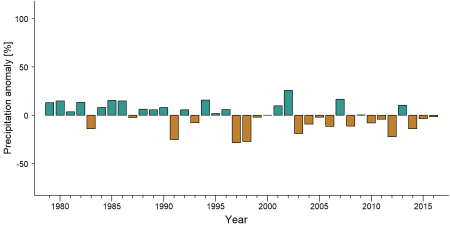
Precipitation anomaly in Malebo -
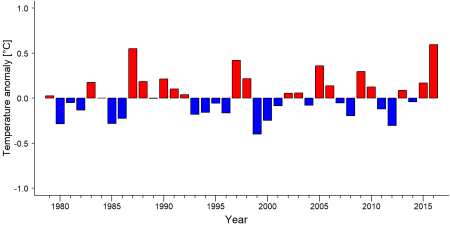
Temperature anomaly in Malebo


External links
References
Inogwabini, B., Mbende, L., Bakanza, A., & Bokika, J. (2013). Crop damage done by elephants in Malebo Region, Democratic Republic of Congo. Pachyderm, 54, 59-65. doi:10.69649/pachyderm.v54i.340
Inogwabini, B., Matungila, B., Mbende, L., Abokome, M., & Tshimanga, T. w. (2007). Great apes in the Lake Tumba landscape, Democratic Republic of Congo: newly described populations. Oryx, 41(4), 532-538. doi:10.1017/s0030605307414120
Serckx, A., Huynen, M., Bastin, J., Hambuckers, A., Beudels-Jamar, R. C., Vimond, M., …, & Kühl, H. S. (2014). Nest Grouping Patterns of Bonobos (Pan paniscus) in Relation to Fruit Availability in a Forest-Savannah Mosaic. PLoS ONE, 9(4), e93742. doi:10.1371/journal.pone.0093742
WWF. (2017).DRC: Malebo site managed by WWF in the top 100 sustainable tourism destinations of 2017 in the World. Online: https://wwf.panda.org/wwf_news/?314614/DRC%2DMalebo%2Dsite%2Dmanaged%2Dby%2DWWF%2Din%2Dthe%2Dtop%2D100%2Dsustainable%2Dtourism%2Ddestinations%2Dof%2D2017%2Din%2Dthe%2DWorld
Kiribou, R., Tehoda, P., Chukwu, O., Bempah, G., Kühl, H. S., Ferreira, J., …, & Heinicke, S. (2024). Exposure of African ape sites to climate change impacts. PLOS Climate, 3(2), e0000345. doi:10.1371/journal.pclm.0000345
SynchronicityEarth. https://www.synchronicityearth.org/partner/mbou-mon-tour/
Page created by: APES Atlas Team Date: 2021-10-29