
Mbam et Djerem National Park: Difference between revisions
No edit summary |
No edit summary Tag: Manual revert |
||
| (9 intermediate revisions by the same user not shown) | |||
| Line 13: | Line 13: | ||
* Key threats to chimpanzees are poaching, transhumance, uncontrolled fires, and gathering terrestrial plants. | * Key threats to chimpanzees are poaching, transhumance, uncontrolled fires, and gathering terrestrial plants. | ||
* Conservation activities are not documented. | * Conservation activities are not documented. | ||
= Site characteristics = | = Site characteristics = | ||
Mbam et Djerem National Park was established in 2000. The park is situated in central Cameroon, within the Guinea-Congolia/Sudania regional transition zone, between the Sudanian regional center of endemism in the north, and the Guinea-Congolian forest block in the south. The vegetation at Mbam et Djerem National Park grades from savanna in the northwest to forest-savanna mosaic, to the closed-canopy humid forest in the southwest. It is the most biologically diverse protected area in the country due to its exceptional habitat diversity ([https://cameroon.wcs.org/Wild-Places/Mbam-Djerem-National-Park1.aspx WCS]). Mbam et Djerem National Park is home to two subspecies of chimpanzees, (central and Nigeria-Cameroon chimpanzees), De Brazza's monkeys, elephants, buffalos, hippopotamus, leopards, and over 65 reptile and 365 bird species (BirdLife International 2020, [https://cameroon.wcs.org/Wild-Places/Mbam-Djerem-National-Park1.aspx WCS]). | Mbam et Djerem National Park was established in 2000. The park is situated in central Cameroon, within the Guinea-Congolia/Sudania regional transition zone, between the Sudanian regional center of endemism in the north, and the Guinea-Congolian forest block in the south. The vegetation at Mbam et Djerem National Park grades from savanna in the northwest to forest-savanna mosaic, to the closed-canopy humid forest in the southwest. It is the most biologically diverse protected area in the country due to its exceptional habitat diversity ([https://cameroon.wcs.org/Wild-Places/Mbam-Djerem-National-Park1.aspx WCS]). Mbam et Djerem National Park is home to two subspecies of chimpanzees, (central and Nigeria-Cameroon chimpanzees), De Brazza's monkeys, elephants, buffalos, hippopotamus, leopards, and over 65 reptile and 365 bird species ([[#R01197|BirdLife International 2020]], [https://cameroon.wcs.org/Wild-Places/Mbam-Djerem-National-Park1.aspx WCS]). | ||
'''Table 1. Basic site information for Mbam et Djerem National Park''' | '''Table 1. Basic site information for Mbam et Djerem National Park''' | ||
| Line 68: | Line 64: | ||
|2016 | |2016 | ||
| | | | ||
|1.77 | |||
|0.33 (0.12-0.86 | |||
| | | | ||
| | |Core area (1,662.34 km²) | ||
|Line transects | |||
| | |||
| | | | ||
|Kamgang et al. 2018 | |[[#R01199|Kamgang et al. 2018]] | ||
| | | | ||
| | | | ||
| Line 82: | Line 78: | ||
| | | | ||
| | | | ||
|0. | |0.59 (0.19-1.76) | ||
| | |449 (150-1,343) | ||
|Mbam et Djerem National Park, | |Mbam et Djerem National Park, forest-savanna mosaic area (900.84 km²) | ||
|Full count | |Full count | ||
| | | | ||
|Kamgang et al. 2018 | |[[#R01199|Kamgang et al. 2018]] | ||
| | | | ||
| | | | ||
| Line 94: | Line 90: | ||
|2016 | |2016 | ||
| | | | ||
| | | | ||
| | |0.88 (0.55-1.41) | ||
| | |795 (496-1,272) | ||
|Mbam et Djerem National Park, dense forest area (761.5 km²) | |||
|Full count | |||
| | | | ||
|Kamgang et al. 2018 | |[[#R01199|Kamgang et al. 2018]] | ||
| | | | ||
| | | | ||
| Line 122: | Line 118: | ||
|2.3 Livestock farming & ranching | |2.3 Livestock farming & ranching | ||
|Medium (30-70% of population affected) | |Medium (30-70% of population affected) | ||
|Transhumance (Dadem, Tchamba & Tsi 2018). | |Transhumance ([[#R01198|Dadem, Tchamba & Tsi 2018]]). | ||
|Ongoing (2018) | |Ongoing (2018) | ||
|- | |- | ||
| Line 128: | Line 124: | ||
|5.1 Hunting & collecting terrestrial animals | |5.1 Hunting & collecting terrestrial animals | ||
|High (more than 70% of population affected) | |High (more than 70% of population affected) | ||
|Poaching is the main threat to wildlife at the site (Dadem, Tchamba & Tsi 2018). | |Poaching is the main threat to wildlife at the site ([[#R01198|Dadem, Tchamba & Tsi 2018]]). | ||
|Ongoing (2018) | |Ongoing (2018) | ||
|- | |- | ||
| Line 134: | Line 130: | ||
|5.2 Gathering terrestrial plants | |5.2 Gathering terrestrial plants | ||
|Low (up to 30% of population affected) | |Low (up to 30% of population affected) | ||
|Bark collection and plant gathering (Dadem, Tchamba & Tsi 2018). | |Bark collection and plant gathering ([[#R01198|Dadem, Tchamba & Tsi 2018]]). | ||
|Ongoing (2018) | |Ongoing (2018) | ||
|- | |- | ||
| Line 140: | Line 136: | ||
|7.1 Fire & fire suppression | |7.1 Fire & fire suppression | ||
|Low (up to 30% of population affected) | |Low (up to 30% of population affected) | ||
|Uncontrolled bushfires (Dadem, Tchamba & Tsi 2018). | |Uncontrolled bushfires ([[#R01198|Dadem, Tchamba & Tsi 2018]]). | ||
|Ongoing (2018) | |Ongoing (2018) | ||
|} | |} | ||
| Line 162: | Line 158: | ||
!Year(s) | !Year(s) | ||
|- | |- | ||
| | |2 Resources and capacity | ||
| | |2.1 Lack of capacity/training | ||
|[https://cameroon.wcs.org/Wild-Places/Mbam-Djerem-National-Park1.aspx WCS] | |[https://cameroon.wcs.org/Wild-Places/Mbam-Djerem-National-Park1.aspx WCS] | ||
| | | | ||
|- | |- | ||
| | |4 Institutional support | ||
| | |4.1 Lack of law enforcement | ||
|[https://cameroon.wcs.org/Wild-Places/Mbam-Djerem-National-Park1.aspx WCS] | |[https://cameroon.wcs.org/Wild-Places/Mbam-Djerem-National-Park1.aspx WCS] | ||
| | | | ||
| Line 255: | Line 251: | ||
= Exposure to climate change impacts = | = Exposure to climate change impacts = | ||
As part of a study on the exposure of African great ape sites to climate change impacts, Kiribou et al. | As part of a study on the exposure of African great ape sites to climate change impacts, [[#R02260|Kiribou et al. (2024)]] extracted climate data and data on projected extreme climate impact events for the site. Climatological characteristics were derived from observation-based climate data provided by the Inter-Sectoral Impact Model Intercomparison Project (ISIMIP, www.isimip.org). Parameters were calculated as the average across each 30-year period. For 1981-2010, the EWEMBI dataset from ISIMIP2a was used. For the two future periods (2021-2050 and 2071-2099) ISIMIP2b climate data based on four CMIP5 global climate models were used. For future projections, two Representative Concentration Pathways (RCP) were used. RCP 2.6 is a scenario with strong mitigation measures in which global temperatures would likely rise below 2C. RCP 6.0 is a scenario with medium emissions in which global temperatures would likely rise up to 3C by 2100. For the number of days with heavy precipitation events, the 98th percentile of all precipitation days (>1mm/d) was calculated for the 1979-2013 reference period as a threshold for a heavy precipitation event. Then, for each year, the number of days above that threshold was derived. The figures on temperature and precipitation anomaly show the deviation from the mean temperature and mean precipitation for the 1979-2013 reference period. | ||
The estimated exposure to future extreme climate impact events (crop failure, drought, river flood, wildfire, tropical cyclone, and heatwave) is based on a published dataset by Lange et al. 2020 derived from ISIMIP2b data. The same global climate models and RCPs as described above were used. Within each 30-year period, the number of years with an extreme event and the average proportion of the site affected were calculated ( | The estimated exposure to future extreme climate impact events (crop failure, drought, river flood, wildfire, tropical cyclone, and heatwave) is based on a published dataset by Lange et al. 2020 derived from ISIMIP2b data. The same global climate models and RCPs as described above were used. Within each 30-year period, the number of years with an extreme event and the average proportion of the site affected were calculated ([[#R02260|Kiribou et al. 2024]]). | ||
'''Table 8. Estimated past and projected climatological characteristics in Mbam et Djerem National Park''' | '''Table 8. Estimated past and projected climatological characteristics in Mbam et Djerem National Park''' | ||
| Line 372: | Line 368: | ||
<div><ul><li style="display: inline-block; vertical-align: top;"> [[File:PrecipAnomaly_Mbam_et_Djerem_NP.png| 450px | thumb| none | Precipitation anomaly | <div><ul><li style="display: inline-block; vertical-align: top;"> [[File:PrecipAnomaly_Mbam_et_Djerem_NP.png| 450px | thumb| none | Precipitation anomaly in Mbam et Djerem National Park]] </li><li style="display: inline-block; vertical-align: top;"> [[File:TempAnomaly_Mbam_et_Djerem_NP.png | 450px | thumb| none | Temperature anomaly in Mbam et Djerem National Park]] </li></ul></div> | ||
= External links = | = External links = | ||
| Line 380: | Line 376: | ||
= References = | = References = | ||
<span id="R01197"></span>BirdLife International. (2020). Important Bird Areas factsheet: Mbam Djerem National Park. Retrieved November 27, 2020, from http://www.birdlife.org | |||
<span id="R01198"></span>Dadem, G. C., Tchamba, N. M., & Tsi, E. A. (2018). Impacts of anthropogenic pressures on wildlife in the northern sector of the National Park of Mbam and Djerem, Adamaoua, Cameroon. International Journal of Biodiversity and Conservation, 10(3), 145–153. [https://doi.org/10.5897/ijbc2015.0827 doi:10.5897/ijbc2015.0827] | |||
<span id="R01199"></span>Kamgang, S. A., Bobo, K. S., Maisels, F., Ambahe, R. D. D., Ambassa Ongono, D. E., Gonder, M. K., …, & Sinsin, B. (2018). The relationship between the abundance of the Nigeria-Cameroon chimpanzee (Pan troglodytes ellioti) and its habitat: a conservation concern in Mbam-Djerem National Park, Cameroon. ''BMC Ecology'', 18(1). [https://doi.org/10.1186/s12898-018-0199-3 doi:10.1186/s12898-018-0199-3] | |||
<span id="R02260"></span>Kiribou, R., Tehoda, P., Chukwu, O., Bempah, G., Kühl, H. S., Ferreira, J., …, & Heinicke, S. (2024). Exposure of African ape sites to climate change impacts. ''PLOS Climate'', 3(2), e0000345. [https://doi.org/10.1371/journal.pclm.0000345 doi:10.1371/journal.pclm.0000345] | |||
'''Page created by: '''Serge Kamgang & APES Atlas Team''' Date:''' 2021-01-14 | '''Page created by: '''Serge Kamgang & APES Atlas Team''' Date:''' 2021-01-14 | ||
Latest revision as of 17:53, 15 October 2026
Central Africa > Cameroon > Mbam et Djerem National Park
Français | Português | Español | Bahasa Indonesia | Melayu
Summary
- Nigeria-Cameroon chimpanzees (Pan troglodytes ellioti) & central chimpanzees (Pan troglodytes troglodytes) are present in Mbam et Djerem National Park.
- It has been estimated that at least 1,244 Nigeria-Cameroon chimpanzees occur in the site.
- The Nigeria-Cameroon chimpanzee population trend is stable.
- The site has a total size of 4,165.2 km².
- Key threats to chimpanzees are poaching, transhumance, uncontrolled fires, and gathering terrestrial plants.
- Conservation activities are not documented.
Site characteristics
Mbam et Djerem National Park was established in 2000. The park is situated in central Cameroon, within the Guinea-Congolia/Sudania regional transition zone, between the Sudanian regional center of endemism in the north, and the Guinea-Congolian forest block in the south. The vegetation at Mbam et Djerem National Park grades from savanna in the northwest to forest-savanna mosaic, to the closed-canopy humid forest in the southwest. It is the most biologically diverse protected area in the country due to its exceptional habitat diversity (WCS). Mbam et Djerem National Park is home to two subspecies of chimpanzees, (central and Nigeria-Cameroon chimpanzees), De Brazza's monkeys, elephants, buffalos, hippopotamus, leopards, and over 65 reptile and 365 bird species (BirdLife International 2020, WCS).
Table 1. Basic site information for Mbam et Djerem National Park
| Species | Pan troglodytes ellioti |
| Area | 4,165.2 km² |
| Coordinates | Lat: 5.858082 , Lon: 12.773937 |
| Type of site | Protected area (National Park) |
| Habitat types | Subtropical/tropical dry forest, Savanna |
| Type of governance |
Types of sites Governance types Habitat types
Ape status
Table 2. Ape population estimates reported for Mbam et Djerem National Park
| Species | Year | Occurrence | Encounter or vistation rate (nests/km; ind/day) | Density estimate [ind./ km²] (95% CI) | Abundance estimate (95% CI) | Survey area | Sampling method | Analytical framework | Source | Comments | A.P.E.S. database ID |
|---|---|---|---|---|---|---|---|---|---|---|---|
| Pan troglodytes ellioti | 2016 | 1.77 | 0.33 (0.12-0.86 | Core area (1,662.34 km²) | Line transects | Kamgang et al. 2018 | |||||
| Pan troglodytes ellioti | 2016 | 0.59 (0.19-1.76) | 449 (150-1,343) | Mbam et Djerem National Park, forest-savanna mosaic area (900.84 km²) | Full count | Kamgang et al. 2018 | |||||
| Pan troglodytes ellioti | 2016 | 0.88 (0.55-1.41) | 795 (496-1,272) | Mbam et Djerem National Park, dense forest area (761.5 km²) | Full count | Kamgang et al. 2018 |
Sampling methods Analytical frameworks
Threats
Table 3. Threats to apes reported for Mbam et Djerem National Park
| Category | Specific threats | Threat level | Description | Year of threat |
|---|---|---|---|---|
| 2 Agriculture & aquaculture | 2.3 Livestock farming & ranching | Medium (30-70% of population affected) | Transhumance (Dadem, Tchamba & Tsi 2018). | Ongoing (2018) |
| 5 Biological resource use | 5.1 Hunting & collecting terrestrial animals | High (more than 70% of population affected) | Poaching is the main threat to wildlife at the site (Dadem, Tchamba & Tsi 2018). | Ongoing (2018) |
| 5 Biological resource use | 5.2 Gathering terrestrial plants | Low (up to 30% of population affected) | Bark collection and plant gathering (Dadem, Tchamba & Tsi 2018). | Ongoing (2018) |
| 7 Natural system modifications | 7.1 Fire & fire suppression | Low (up to 30% of population affected) | Uncontrolled bushfires (Dadem, Tchamba & Tsi 2018). | Ongoing (2018) |
Conservation activities
WCS has been responsible for the management of the site since 2003.
Challenges
Lack of connectivity, lack of community and private sector awareness and conservation constituencies (WCS).
Table 5. Challenges reported for Mbam et Djerem National Park
| Challenges | Specific challenges | Source | Year(s) |
|---|---|---|---|
| 2 Resources and capacity | 2.1 Lack of capacity/training | WCS | |
| 4 Institutional support | 4.1 Lack of law enforcement | WCS |
Enablers
Table 6. Enablers reported for Mbam et Djerem National Park
| Enablers | Specific enablers | Source | Year(s) |
|---|---|---|---|
| 1 Site management | |||
| 2 Resources and capacity | |||
| 3 Engaged community | |||
| 4 Institutional support | |||
| 5 Ecological context | |||
| 6 Safety and stability |
Research activities
Documented behaviours
Table 7. Behaviours documented for Mbam et Djerem National Park
| Category | Behavior | Observation type | Prevalence | Observation dates | Source | Habituation | Species | Comment |
|---|---|---|---|---|---|---|---|---|
| Not reported |
Exposure to climate change impacts
As part of a study on the exposure of African great ape sites to climate change impacts, Kiribou et al. (2024) extracted climate data and data on projected extreme climate impact events for the site. Climatological characteristics were derived from observation-based climate data provided by the Inter-Sectoral Impact Model Intercomparison Project (ISIMIP, www.isimip.org). Parameters were calculated as the average across each 30-year period. For 1981-2010, the EWEMBI dataset from ISIMIP2a was used. For the two future periods (2021-2050 and 2071-2099) ISIMIP2b climate data based on four CMIP5 global climate models were used. For future projections, two Representative Concentration Pathways (RCP) were used. RCP 2.6 is a scenario with strong mitigation measures in which global temperatures would likely rise below 2C. RCP 6.0 is a scenario with medium emissions in which global temperatures would likely rise up to 3C by 2100. For the number of days with heavy precipitation events, the 98th percentile of all precipitation days (>1mm/d) was calculated for the 1979-2013 reference period as a threshold for a heavy precipitation event. Then, for each year, the number of days above that threshold was derived. The figures on temperature and precipitation anomaly show the deviation from the mean temperature and mean precipitation for the 1979-2013 reference period.
The estimated exposure to future extreme climate impact events (crop failure, drought, river flood, wildfire, tropical cyclone, and heatwave) is based on a published dataset by Lange et al. 2020 derived from ISIMIP2b data. The same global climate models and RCPs as described above were used. Within each 30-year period, the number of years with an extreme event and the average proportion of the site affected were calculated (Kiribou et al. 2024).
Table 8. Estimated past and projected climatological characteristics in Mbam et Djerem National Park
| Value | 1981-2010 | 2021-2050, RCP 2.6 | 2021-2050, RCP 6.0 | 2071-2099, RCP 2.6 | 2071-2099, RCP 6.0 |
|---|---|---|---|---|---|
| Mean temperature [C] | 24.2 | 25.4 | 25.2 | 25.6 | 26.7 |
| Annual precipitation [mm] | 1563 | 1606 | 1615 | 1610 | 1657 |
| Max no. consecutive dry days (per year) | 54.1 | 50.5 | 53.1 | 49 | 54.6 |
| No. days with heavy precipitation (per year) | 5.5 | 5.7 | 6.5 | 5.6 | 8.1 |
Table 9. Projected exposure of apes to extreme climate impact events in Mbam et Djerem National Park
| Type | No. of years with event (2021-2050, RCP 2.6) | % of site exposed (2021-2050, RCP 2.6) | No. of years with event (2021-2050, RCP 6.0) | % of site exposed (2021-2050, RCP 6.0) | No. of years with event (2070-2099, RCP 2.6) | % of site exposed (2070-2099, RCP 2.6) | No. of years with event (2070-2099, RCP 6.0) | % of site exposed (2070-2099, RCP 6.0) |
|---|---|---|---|---|---|---|---|---|
| Crop failure | 5 | 0.02 | 4 | 0.02 | 6.5 | 0.01 | 13 | 0.02 |
| Drought | 0 | 0 | 0 | 0 | 0 | 0 | 0 | 0 |
| Heatwave | 1 | 50 | 0.5 | 50 | 0.5 | 50 | 2 | 100 |
| River flood | 1.75 | 1.55 | 1 | 1.14 | 1 | 0.22 | 2.75 | 2.48 |
| Tropical cyclone | 0 | 0 | 0 | 0 | 0 | 0 | 0 | 0 |
| Wildfire | 30 | 0.86 | 30 | 0.88 | 29 | 0.88 | 29 | 0.85 |
-
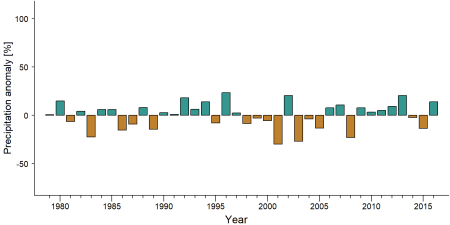
Precipitation anomaly in Mbam et Djerem National Park -
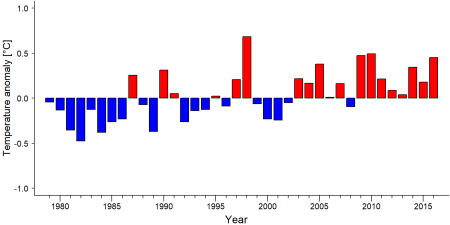
Temperature anomaly in Mbam et Djerem National Park


External links
References
BirdLife International. (2020). Important Bird Areas factsheet: Mbam Djerem National Park. Retrieved November 27, 2020, from http://www.birdlife.org
Dadem, G. C., Tchamba, N. M., & Tsi, E. A. (2018). Impacts of anthropogenic pressures on wildlife in the northern sector of the National Park of Mbam and Djerem, Adamaoua, Cameroon. International Journal of Biodiversity and Conservation, 10(3), 145–153. doi:10.5897/ijbc2015.0827
Kamgang, S. A., Bobo, K. S., Maisels, F., Ambahe, R. D. D., Ambassa Ongono, D. E., Gonder, M. K., …, & Sinsin, B. (2018). The relationship between the abundance of the Nigeria-Cameroon chimpanzee (Pan troglodytes ellioti) and its habitat: a conservation concern in Mbam-Djerem National Park, Cameroon. BMC Ecology, 18(1). doi:10.1186/s12898-018-0199-3
Kiribou, R., Tehoda, P., Chukwu, O., Bempah, G., Kühl, H. S., Ferreira, J., …, & Heinicke, S. (2024). Exposure of African ape sites to climate change impacts. PLOS Climate, 3(2), e0000345. doi:10.1371/journal.pclm.0000345
Page created by: Serge Kamgang & APES Atlas Team Date: 2021-01-14