
Mpem & Djim National Park: Difference between revisions
No edit summary |
No edit summary Tag: Manual revert |
||
| (2 intermediate revisions by the same user not shown) | |||
| Line 17: | Line 17: | ||
= Site characteristics = | = Site characteristics = | ||
Established in 2004, Mpem & Djim National Park spans 974.8 km², with its boundaries defined by the loop created by the Mpem and Djim rivers (Fotsing et al. 2024a). The park's animal and plant diversity is diverse. The vegetation consists of open savannah, woodland savannah, and grassland savannah, along with old secondary forests, permanently inundated swamp forests, young mixed secondary forests, mosaic forest-savannah, and gallery forests (Fotsing et al. 2024a, 2024b). Various ethnic groups and followers of different faiths reside in villages surrounding the park. Regardless of ethnic or religious background, most residents rely on subsistence agriculture and livestock farming as their main sources of income; consequently, these cultural and economic differences may influence local perspectives and attitudes toward chimpanzees and their conservation in the park (Fotsing et al. 2024a). | Established in 2004, Mpem & Djim National Park spans 974.8 km², with its boundaries defined by the loop created by the Mpem and Djim rivers ([[#R01342|Fotsing et al. 2024a]]). The park's animal and plant diversity is diverse. The vegetation consists of open savannah, woodland savannah, and grassland savannah, along with old secondary forests, permanently inundated swamp forests, young mixed secondary forests, mosaic forest-savannah, and gallery forests ([[#R01342|Fotsing et al. 2024a]], 2024b). Various ethnic groups and followers of different faiths reside in villages surrounding the park. Regardless of ethnic or religious background, most residents rely on subsistence agriculture and livestock farming as their main sources of income; consequently, these cultural and economic differences may influence local perspectives and attitudes toward chimpanzees and their conservation in the park ([[#R01342|Fotsing et al. 2024a]]). | ||
'''Table 1. Basic site information for Mpem & Djim National Park''' | '''Table 1. Basic site information for Mpem & Djim National Park''' | ||
| Line 70: | Line 70: | ||
|Camera trap, Line transects & recces | |Camera trap, Line transects & recces | ||
| | | | ||
|Fotsing et al. 2025 | |[[#R01341|Fotsing et al. 2025]] | ||
|The study was carried in the Western part of Mpem and Djim National Park, in the dry season. | |The study was carried in the Western part of Mpem and Djim National Park, in the dry season. | ||
| | | | ||
| Line 83: | Line 83: | ||
|Unknown | |Unknown | ||
| | | | ||
|Mbamba Mbamba 2013 | |[[#R01343|Mbamba Mbamba 2013]] | ||
| | | | ||
| | | | ||
| Line 92: | Line 92: | ||
= Threats = | = Threats = | ||
The primary threats to chimpanzees in Mpem and Djim National Park include poaching and the expansion of agriculture, which leads to habitat loss. Local residents have reported a significant decline in chimpanzee sightings since 2016, a trend that aligns with observed decreases in chimpanzee abundance within the park. While poaching is considered a major factor, some community members also attribute the decline to agricultural expansion encroaching upon chimpanzee habitats. Notably, there have been no reported conflicts between humans and chimpanzees in this area (Fotsing et al. 2024a). | The primary threats to chimpanzees in Mpem and Djim National Park include poaching and the expansion of agriculture, which leads to habitat loss. Local residents have reported a significant decline in chimpanzee sightings since 2016, a trend that aligns with observed decreases in chimpanzee abundance within the park. While poaching is considered a major factor, some community members also attribute the decline to agricultural expansion encroaching upon chimpanzee habitats. Notably, there have been no reported conflicts between humans and chimpanzees in this area ([[#R01342|Fotsing et al. 2024a]]). | ||
'''Table 3. Threats to apes reported for Mpem & Djim National Park''' | '''Table 3. Threats to apes reported for Mpem & Djim National Park''' | ||
| Line 105: | Line 105: | ||
|2.1.2 Small-holder farming | |2.1.2 Small-holder farming | ||
|High (more than 70% of population affected) | |High (more than 70% of population affected) | ||
|The main source of income is subsistence agriculture and livestock farming, reducing the available habitat for chimpanzees (Fotsing et al. 2024a, Fotsing et al. 2025). Large cocoa farms are expanding into the park's borders (Mbamba Mbamba 2013). | |The main source of income is subsistence agriculture and livestock farming, reducing the available habitat for chimpanzees ([[#R01342|Fotsing et al. 2024a]], [[#R01341|Fotsing et al. 2025]]). Large cocoa farms are expanding into the park's borders ([[#R01343|Mbamba Mbamba 2013]]). | ||
|2013-Ongoing (2025) | |2013-Ongoing (2025) | ||
|- | |- | ||
| Line 111: | Line 111: | ||
|2.3 Livestock farming & ranching | |2.3 Livestock farming & ranching | ||
|High (more than 70% of population affected) | |High (more than 70% of population affected) | ||
|Herds and bush fires set by Bororo pastoralists threaten habitats (Mbamba Mbamba 2013). Habitat encroachment due to livestock farming is present (Fotsing 2024a, Fotsing et al. 2025). | |Herds and bush fires set by Bororo pastoralists threaten habitats ([[#R01343|Mbamba Mbamba 2013]]). Habitat encroachment due to livestock farming is present ([[#R01342|Fotsing 2024a]], [[#R01341|Fotsing et al. 2025]]). | ||
|2013-Ongoing (2025) | |2013-Ongoing (2025) | ||
|- | |- | ||
| Line 117: | Line 117: | ||
|5.1 Hunting & collecting terrestrial animals | |5.1 Hunting & collecting terrestrial animals | ||
|High (more than 70% of population affected) | |High (more than 70% of population affected) | ||
|Poaching present in the site (Mbamba Mbamba 2013). During a survey around the area, a relatively high proportion of respondents (19.3% (N = 46) reported involvement in chimpanzee hunting, eating chimpanzee meat or using of body part in traditional medicine (Fotsing et al. 2024a). Bushmeat hunting and poaching have been consistently identified as major threats (Fotsing et al. 2025). In addition, wire snares and traps were observed during recce and line transects walks (Fotsing et al. 2025). | |Poaching present in the site ([[#R01343|Mbamba Mbamba 2013]]). During a survey around the area, a relatively high proportion of respondents (19.3% (N = 46) reported involvement in chimpanzee hunting, eating chimpanzee meat or using of body part in traditional medicine ([[#R01342|Fotsing et al. 2024a]]). Bushmeat hunting and poaching have been consistently identified as major threats ([[#R01341|Fotsing et al. 2025]]). In addition, wire snares and traps were observed during recce and line transects walks ([[#R01341|Fotsing et al. 2025]]). | ||
|2013-Ongoing (2025) | |2013-Ongoing (2025) | ||
|- | |- | ||
| Line 123: | Line 123: | ||
|5.3 Logging & wood harvesting | |5.3 Logging & wood harvesting | ||
|High (more than 70% of population affected) | |High (more than 70% of population affected) | ||
|Smuggling of rare timber continues from within the park (Mbamba Mbamba 2013). Deforestation activities are reported as among the main contributors to habitat degradation and the reduction of species richness (Fotsing et al. 2025). | |Smuggling of rare timber continues from within the park ([[#R01343|Mbamba Mbamba 2013]]). Deforestation activities are reported as among the main contributors to habitat degradation and the reduction of species richness ([[#R01341|Fotsing et al. 2025]]). | ||
|2013-Ongoing (2025) | |2013-Ongoing (2025) | ||
|} | |} | ||
| Line 143: | Line 143: | ||
|2 Counter-wildlife crime | |2 Counter-wildlife crime | ||
|2.3 Conduct regular anti-poaching patrols | |2.3 Conduct regular anti-poaching patrols | ||
|Anti-poaching patrols are conducted by park rangers (Mbamba Mbamba 2013, Fotsing et al. 2025). | |Anti-poaching patrols are conducted by park rangers ([[#R01343|Mbamba Mbamba 2013]], [[#R01341|Fotsing et al. 2025]]). | ||
|Ministère des Forêts et de la Faune (MINFOF) | |Ministère des Forêts et de la Faune (MINFOF) | ||
|2012-Ongoing (2025) | |2012-Ongoing (2025) | ||
| Line 149: | Line 149: | ||
|4 Education & awareness | |4 Education & awareness | ||
|4.2 Involve local community in ape research and conservation management | |4.2 Involve local community in ape research and conservation management | ||
|Local communities are engaged in conservation awareness. In addition, research-based monitoring is conducted to inform conservation planning and adaptive management (Fotsing et al. 2025). | |Local communities are engaged in conservation awareness. In addition, research-based monitoring is conducted to inform conservation planning and adaptive management ([[#R01341|Fotsing et al. 2025]]). | ||
|Ministry of Forestry and Wildlife (Cameroon), Supported by Aspire Grant Program, Idea Wild Foundation, Primate Action Fund, Primate Conservation Incorporated Grant (PCI), Society for Conservation Biology. | |Ministry of Forestry and Wildlife (Cameroon), Supported by Aspire Grant Program, Idea Wild Foundation, Primate Action Fund, Primate Conservation Incorporated Grant (PCI), Society for Conservation Biology. | ||
|2021-Ongoing (2025) | |2021-Ongoing (2025) | ||
| Line 175: | Line 175: | ||
|2 Resources and capacity | |2 Resources and capacity | ||
|2.2 Lack of staff | |2.2 Lack of staff | ||
|Mbamba Mbamba 2013 | |[[#R01343|Mbamba Mbamba 2013]] | ||
|Ongoing (2013) | |Ongoing (2013) | ||
|- | |- | ||
|2 Resources and capacity | |2 Resources and capacity | ||
|2.3 General lack of funding | |2.3 General lack of funding | ||
|Mbamba Mbamba 2013 | |[[#R01343|Mbamba Mbamba 2013]] | ||
|Ongoing (2013) | |Ongoing (2013) | ||
|- | |- | ||
|2 Resources and capacity | |2 Resources and capacity | ||
|2.5 Lack of equipment/transportation | |2.5 Lack of equipment/transportation | ||
|Mbamba Mbamba 2013, Fotsing et al. 2025 | |[[#R01343|Mbamba Mbamba 2013]], [[#R01341|Fotsing et al. 2025]] | ||
|2013-Ongoing (2025) | |2013-Ongoing (2025) | ||
|- | |- | ||
|2 Resources and capacity | |2 Resources and capacity | ||
|2.6 Lack of biomonitoring/survey data | |2.6 Lack of biomonitoring/survey data | ||
|Fotsing et al. 2025 | |[[#R01341|Fotsing et al. 2025]] | ||
|2004-Ongoing (2025) | |2004-Ongoing (2025) | ||
|- | |- | ||
|2 Resources and capacity | |2 Resources and capacity | ||
|2.7 Lack of infrastructure | |2.7 Lack of infrastructure | ||
|Mbamba Mbamba 2013 | |[[#R01343|Mbamba Mbamba 2013]] | ||
|Ongoing (2013) | |Ongoing (2013) | ||
|- | |- | ||
|5 Ecological context | |5 Ecological context | ||
|5.1 Ecological constraints (e.g., susceptibility to climate change, difficult terrain) | |5.1 Ecological constraints (e.g., susceptibility to climate change, difficult terrain) | ||
|Mbamba Mbamba 2013, Fotsing et al. 2025 | |[[#R01343|Mbamba Mbamba 2013]], [[#R01341|Fotsing et al. 2025]] | ||
|2013-Ongoing (2025) | |2013-Ongoing (2025) | ||
|} | |} | ||
| Line 219: | Line 219: | ||
|1 Site management | |1 Site management | ||
|1.2 Effective coordination | |1.2 Effective coordination | ||
|Mbamba Mbamba 2013 | |[[#R01343|Mbamba Mbamba 2013]] | ||
|Ongoing (2013) | |Ongoing (2013) | ||
|- | |- | ||
|2 Resources and capacity | |2 Resources and capacity | ||
|2.4 Adequate data to inform and evaluate conservation actions | |2.4 Adequate data to inform and evaluate conservation actions | ||
|Mbamba Mbamba 2013 | |[[#R01343|Mbamba Mbamba 2013]] | ||
|Ongoing (2013) | |Ongoing (2013) | ||
|- | |- | ||
|2 Resources and capacity | |2 Resources and capacity | ||
|2.6 External partnerships that add expertise or resources | |2.6 External partnerships that add expertise or resources | ||
|Mbamba Mbamba 2013, Fotsing et al. 2025 | |[[#R01343|Mbamba Mbamba 2013]], [[#R01341|Fotsing et al. 2025]] | ||
|2013-Ongoing (2025) | |2013-Ongoing (2025) | ||
|- | |- | ||
|4 Institutional support | |4 Institutional support | ||
|4.2 Strong government support | |4.2 Strong government support | ||
|Fotsing et al. 2025 | |[[#R01341|Fotsing et al. 2025]] | ||
|Ongoing (2025) | |Ongoing (2025) | ||
|} | |} | ||
| Line 252: | Line 252: | ||
= Exposure to climate change impacts = | = Exposure to climate change impacts = | ||
As part of a study on the exposure of African great ape sites to climate change impacts, Kiribou et al. (2024) extracted climate data and data on projected extreme climate impact events for the site. Climatological characteristics were derived from observation-based climate data provided by the Inter-Sectoral Impact Model Intercomparison Project (ISIMIP, www.isimip.org). Parameters were calculated as the average across each 30-year period. For 1981-2010, the EWEMBI dataset from ISIMIP2a was used. For the two future periods (2021-2050 and 2071-2099) ISIMIP2b climate data based on four CMIP5 global climate models were used. For future projections, two Representative Concentration Pathways (RCP) were used. RCP 2.6 is a scenario with strong mitigation measures in which global temperatures would likely rise below 2C. RCP 6.0 is a scenario with medium emissions in which global temperatures would likely rise up to 3C by 2100. For the number of days with heavy precipitation events, the 98th percentile of all precipitation days (>1mm/d) was calculated for the 1979-2013 reference period as a threshold for a heavy precipitation event. Then, for each year, the number of days above that threshold was derived. The figures on temperature and precipitation anomaly show the deviation from the mean temperature and mean precipitation for the 1979-2013 reference period. | As part of a study on the exposure of African great ape sites to climate change impacts, [[#R02277|Kiribou et al. (2024)]] extracted climate data and data on projected extreme climate impact events for the site. Climatological characteristics were derived from observation-based climate data provided by the Inter-Sectoral Impact Model Intercomparison Project (ISIMIP, www.isimip.org). Parameters were calculated as the average across each 30-year period. For 1981-2010, the EWEMBI dataset from ISIMIP2a was used. For the two future periods (2021-2050 and 2071-2099) ISIMIP2b climate data based on four CMIP5 global climate models were used. For future projections, two Representative Concentration Pathways (RCP) were used. RCP 2.6 is a scenario with strong mitigation measures in which global temperatures would likely rise below 2C. RCP 6.0 is a scenario with medium emissions in which global temperatures would likely rise up to 3C by 2100. For the number of days with heavy precipitation events, the 98th percentile of all precipitation days (>1mm/d) was calculated for the 1979-2013 reference period as a threshold for a heavy precipitation event. Then, for each year, the number of days above that threshold was derived. The figures on temperature and precipitation anomaly show the deviation from the mean temperature and mean precipitation for the 1979-2013 reference period. | ||
The estimated exposure to future extreme climate impact events (crop failure, drought, river flood, wildfire, tropical cyclone, and heatwave) is based on a published dataset by Lange et al. 2020 derived from ISIMIP2b data. The same global climate models and RCPs as described above were used. Within each 30-year period, the number of years with an extreme event and the average proportion of the site affected were calculated (Kiribou et al. 2024). | The estimated exposure to future extreme climate impact events (crop failure, drought, river flood, wildfire, tropical cyclone, and heatwave) is based on a published dataset by Lange et al. 2020 derived from ISIMIP2b data. The same global climate models and RCPs as described above were used. Within each 30-year period, the number of years with an extreme event and the average proportion of the site affected were calculated ([[#R02277|Kiribou et al. 2024]]). | ||
'''Table 8. Estimated past and projected climatological characteristics in Mpem & Djim National Park''' | '''Table 8. Estimated past and projected climatological characteristics in Mpem & Djim National Park''' | ||
| Line 377: | Line 377: | ||
= References = | = References = | ||
Fotsing, E. D. B., & Kamkeng, M. M. F. (2025). A | <span id="R01339"></span>Fotsing, E. D. B., & Kamkeng, M. M. F. (2025). A Multi‐Species Occupancy Modelling Approach to Access the Impacts of Ecological Covariates on Terrestrial Vertebrates in a Tropical Hotspot in Central, Cameroon. ''African Journal of Ecology'', 63(3). [https://doi.org/10.1111/aje.70048 doi:10.1111/aje.70048] | ||
Fotsing, E. D., Kamkeng, M. M., Marcel Senge, S., & Zinner, D. (2024b). Diversity, habitat and activity patterns of mesocarnivore assemblages in an Afrotropical protected forest–savannah mosaic of central Cameroon. African Journal of Ecology, 62(3), e13283. | <span id="R01340"></span>Fotsing, E. D., Kamkeng, M. M., Marcel Senge, S., & Zinner, D. (2024b). Diversity, habitat and activity patterns of mesocarnivore assemblages in an Afrotropical protected forest–savannah mosaic of central Cameroon. African Journal of Ecology, 62(3), e13283. [https://doi.org/10.1111/aje.13283 doi:10.1111/aje.13283] | ||
Fotsing, E. D., Kamkeng, M. M., & Salah Senge, M. (2025). Camera | <span id="R01341"></span>Fotsing, E. D. B., Kamkeng, M. M. F., & Salah Senge, M. (2025). Camera Trapping to Assess Diversity, Habitat Use and Activity Patterns of Mammals in a Tropical Hotspot Area. ''African Journal of Ecology'', 63(1). [https://doi.org/10.1111/aje.70004 doi:10.1111/aje.70004] | ||
Fotsing, E. D., Kamkeng, M. M., & Zinner, D. (2024a). Opinions, attitudes and perceptions of local people towards the conservation of Nigeria-Cameroon chimpanzees in Mpem-Djim National Park, central Cameroon. People and Nature, 6(2), 865–881. | <span id="R01342"></span>Fotsing, E. D., Kamkeng, M. M., & Zinner, D. (2024a). Opinions, attitudes and perceptions of local people towards the conservation of Nigeria-Cameroon chimpanzees in Mpem-Djim National Park, central Cameroon. People and Nature, 6(2), 865–881. [https://doi.org/10.1002/pan3.10621 doi:10.1002/pan3.10621] | ||
Mbamba Mbamba, J. P. K. (2013, January). État des lieux du Parc National de Mpem et Djim [Unpublished internal report]. Centre Régional de la Délégation des Forêts et de la Faune du Centre, Ministère des Forêts et de la Faune, Cameroun. < | <span id="R01343"></span>Mbamba Mbamba, J. P. K. (2013, January). État des lieux du Parc National de Mpem et Djim [Unpublished internal report]. Centre Régional de la Délégation des Forêts et de la Faune du Centre, Ministère des Forêts et de la Faune, Cameroun. | ||
<span id="R02277"></span>Kiribou, R., Tehoda, P., Chukwu, O., Bempah, G., Kühl, H. S., Ferreira, J., …, & Heinicke, S. (2024). Exposure of African ape sites to climate change impacts. ''PLOS Climate'', 3(2), e0000345. [https://doi.org/10.1371/journal.pclm.0000345 doi:10.1371/journal.pclm.0000345] | |||
Latest revision as of 17:54, 15 October 2026
Central Africa > Cameroon > Mpem & Djim National Park
Français | Português | Español | Bahasa Indonesia | Melayu
Summary
- Nigeria-Cameroon chimpanzees (Pan troglodytes ellioti) are present in Mpem & Djim National Park.
- The population sizes are unknown.
- The population trend is unknown.
- The total surface area of the park is 974.8 km².
- The major threats include agricultural encroachment, pastoral pressure, poaching, and illegal logging (Mbamba Mbamba 2013).
Site characteristics
Established in 2004, Mpem & Djim National Park spans 974.8 km², with its boundaries defined by the loop created by the Mpem and Djim rivers (Fotsing et al. 2024a). The park's animal and plant diversity is diverse. The vegetation consists of open savannah, woodland savannah, and grassland savannah, along with old secondary forests, permanently inundated swamp forests, young mixed secondary forests, mosaic forest-savannah, and gallery forests (Fotsing et al. 2024a, 2024b). Various ethnic groups and followers of different faiths reside in villages surrounding the park. Regardless of ethnic or religious background, most residents rely on subsistence agriculture and livestock farming as their main sources of income; consequently, these cultural and economic differences may influence local perspectives and attitudes toward chimpanzees and their conservation in the park (Fotsing et al. 2024a).
Table 1. Basic site information for Mpem & Djim National Park
| Species | Pan troglodytes ellioti |
| Area | 974.8 km² |
| Coordinates | Lat: 5.17468 , Lon: 11.75192 |
| Type of site | Protected area (National Park) |
| Habitat types | Subtropical/tropical moist lowland forest, Subtropical/tropical swamp forest, Savanna, Grassland, Wetlands (lakes, rivers, streams, bogs, marshes) |
| Type of governance | Governance by government |
Types of sites Governance types Habitat types
Ape status
Table 2. Ape population estimates reported for Mpem & Djim National Park
| Species | Year | Occurrence | Encounter or vistation rate (nests/km; ind/day) | Density estimate [ind./ km²] (95% CI) | Abundance estimate (95% CI) | Survey area | Sampling method | Analytical framework | Source | Comments | A.P.E.S. database ID |
|---|---|---|---|---|---|---|---|---|---|---|---|
| Pan troglodytes ellioti | 2021 | Present | 1.13 | Mpem & Djim National Park | Camera trap, Line transects & recces | Fotsing et al. 2025 | The study was carried in the Western part of Mpem and Djim National Park, in the dry season. | ||||
| Pan troglodytes ellioti | 2013 | Present | Mpem & Djim National Park | Unknown | Mbamba Mbamba 2013 |
Sampling methods Analytical frameworks
Threats
The primary threats to chimpanzees in Mpem and Djim National Park include poaching and the expansion of agriculture, which leads to habitat loss. Local residents have reported a significant decline in chimpanzee sightings since 2016, a trend that aligns with observed decreases in chimpanzee abundance within the park. While poaching is considered a major factor, some community members also attribute the decline to agricultural expansion encroaching upon chimpanzee habitats. Notably, there have been no reported conflicts between humans and chimpanzees in this area (Fotsing et al. 2024a).
Table 3. Threats to apes reported for Mpem & Djim National Park
| Category | Specific threats | Threat level | Description | Year of threat |
|---|---|---|---|---|
| 2 Agriculture & aquaculture | 2.1.2 Small-holder farming | High (more than 70% of population affected) | The main source of income is subsistence agriculture and livestock farming, reducing the available habitat for chimpanzees (Fotsing et al. 2024a, Fotsing et al. 2025). Large cocoa farms are expanding into the park's borders (Mbamba Mbamba 2013). | 2013-Ongoing (2025) |
| 2 Agriculture & aquaculture | 2.3 Livestock farming & ranching | High (more than 70% of population affected) | Herds and bush fires set by Bororo pastoralists threaten habitats (Mbamba Mbamba 2013). Habitat encroachment due to livestock farming is present (Fotsing 2024a, Fotsing et al. 2025). | 2013-Ongoing (2025) |
| 5 Biological resource use | 5.1 Hunting & collecting terrestrial animals | High (more than 70% of population affected) | Poaching present in the site (Mbamba Mbamba 2013). During a survey around the area, a relatively high proportion of respondents (19.3% (N = 46) reported involvement in chimpanzee hunting, eating chimpanzee meat or using of body part in traditional medicine (Fotsing et al. 2024a). Bushmeat hunting and poaching have been consistently identified as major threats (Fotsing et al. 2025). In addition, wire snares and traps were observed during recce and line transects walks (Fotsing et al. 2025). | 2013-Ongoing (2025) |
| 5 Biological resource use | 5.3 Logging & wood harvesting | High (more than 70% of population affected) | Smuggling of rare timber continues from within the park (Mbamba Mbamba 2013). Deforestation activities are reported as among the main contributors to habitat degradation and the reduction of species richness (Fotsing et al. 2025). | 2013-Ongoing (2025) |
Conservation activities
Table 4. Conservation activities reported for Mpem & Djim National Park
| Category | Specific activity | Description | Implementing organization(s) | Year of activity |
|---|---|---|---|---|
| 2 Counter-wildlife crime | 2.3 Conduct regular anti-poaching patrols | Anti-poaching patrols are conducted by park rangers (Mbamba Mbamba 2013, Fotsing et al. 2025). | Ministère des Forêts et de la Faune (MINFOF) | 2012-Ongoing (2025) |
| 4 Education & awareness | 4.2 Involve local community in ape research and conservation management | Local communities are engaged in conservation awareness. In addition, research-based monitoring is conducted to inform conservation planning and adaptive management (Fotsing et al. 2025). | Ministry of Forestry and Wildlife (Cameroon), Supported by Aspire Grant Program, Idea Wild Foundation, Primate Action Fund, Primate Conservation Incorporated Grant (PCI), Society for Conservation Biology. | 2021-Ongoing (2025) |
| 5 Protection & restoration | 5.2 Legally protect ape habitat | The park was established in 2004 (Law No. 2004/0886/PM). | 2004-Ongoing (2026) |
Challenges
Table 5. Challenges reported for Mpem & Djim National Park
| Challenges | Specific challenges | Source | Year(s) |
|---|---|---|---|
| 2 Resources and capacity | 2.2 Lack of staff | Mbamba Mbamba 2013 | Ongoing (2013) |
| 2 Resources and capacity | 2.3 General lack of funding | Mbamba Mbamba 2013 | Ongoing (2013) |
| 2 Resources and capacity | 2.5 Lack of equipment/transportation | Mbamba Mbamba 2013, Fotsing et al. 2025 | 2013-Ongoing (2025) |
| 2 Resources and capacity | 2.6 Lack of biomonitoring/survey data | Fotsing et al. 2025 | 2004-Ongoing (2025) |
| 2 Resources and capacity | 2.7 Lack of infrastructure | Mbamba Mbamba 2013 | Ongoing (2013) |
| 5 Ecological context | 5.1 Ecological constraints (e.g., susceptibility to climate change, difficult terrain) | Mbamba Mbamba 2013, Fotsing et al. 2025 | 2013-Ongoing (2025) |
Enablers
Table 6. Enablers reported for Mpem & Djim National Park
| Enablers | Specific enablers | Source | Year(s) |
|---|---|---|---|
| 1 Site management | 1.2 Effective coordination | Mbamba Mbamba 2013 | Ongoing (2013) |
| 2 Resources and capacity | 2.4 Adequate data to inform and evaluate conservation actions | Mbamba Mbamba 2013 | Ongoing (2013) |
| 2 Resources and capacity | 2.6 External partnerships that add expertise or resources | Mbamba Mbamba 2013, Fotsing et al. 2025 | 2013-Ongoing (2025) |
| 4 Institutional support | 4.2 Strong government support | Fotsing et al. 2025 | Ongoing (2025) |
Research activities
Documented behaviours
Exposure to climate change impacts
As part of a study on the exposure of African great ape sites to climate change impacts, Kiribou et al. (2024) extracted climate data and data on projected extreme climate impact events for the site. Climatological characteristics were derived from observation-based climate data provided by the Inter-Sectoral Impact Model Intercomparison Project (ISIMIP, www.isimip.org). Parameters were calculated as the average across each 30-year period. For 1981-2010, the EWEMBI dataset from ISIMIP2a was used. For the two future periods (2021-2050 and 2071-2099) ISIMIP2b climate data based on four CMIP5 global climate models were used. For future projections, two Representative Concentration Pathways (RCP) were used. RCP 2.6 is a scenario with strong mitigation measures in which global temperatures would likely rise below 2C. RCP 6.0 is a scenario with medium emissions in which global temperatures would likely rise up to 3C by 2100. For the number of days with heavy precipitation events, the 98th percentile of all precipitation days (>1mm/d) was calculated for the 1979-2013 reference period as a threshold for a heavy precipitation event. Then, for each year, the number of days above that threshold was derived. The figures on temperature and precipitation anomaly show the deviation from the mean temperature and mean precipitation for the 1979-2013 reference period.
The estimated exposure to future extreme climate impact events (crop failure, drought, river flood, wildfire, tropical cyclone, and heatwave) is based on a published dataset by Lange et al. 2020 derived from ISIMIP2b data. The same global climate models and RCPs as described above were used. Within each 30-year period, the number of years with an extreme event and the average proportion of the site affected were calculated (Kiribou et al. 2024).
Table 8. Estimated past and projected climatological characteristics in Mpem & Djim National Park
| Value | 1981-2010 | 2021-2050, RCP 2.6 | 2021-2050, RCP 6.0 | 2071-2099, RCP 2.6 | 2071-2099, RCP 6.0 |
|---|---|---|---|---|---|
| Mean temperature [C] | 24.6 | 25.7 | 25.6 | 25.9 | 27 |
| Annual precipitation [mm] | 1536 | 1652 | 1634 | 1663 | 1711 |
| Max no. consecutive dry days (per year) | 50.5 | 42.7 | 44.5 | 41.9 | 45.6 |
| No. days with heavy precipitation (per year) | 5.5 | 6.1 | 5.6 | 6.3 | 6.9 |
Table 9. Projected exposure of apes to extreme climate impact events in Mpem & Djim National Park
| Type | No. of years with event (2021-2050, RCP 2.6) | % of site exposed (2021-2050, RCP 2.6) | No. of years with event (2021-2050, RCP 6.0) | % of site exposed (2021-2050, RCP 6.0) | No. of years with event (2070-2099, RCP 2.6) | % of site exposed (2070-2099, RCP 2.6) | No. of years with event (2070-2099, RCP 6.0) | % of site exposed (2070-2099, RCP 6.0) |
|---|---|---|---|---|---|---|---|---|
| Crop failure | 5 | 0.57 | 4.5 | 0.57 | 4.5 | 0.38 | 8 | 0.53 |
| Drought | 0 | 0 | 0 | 0 | 0 | 0 | 0 | 0 |
| Heatwave | 3 | 100 | 2.5 | 100 | 4.5 | 100 | 4.5 | 100 |
| River flood | 1.5 | 4 | 2.5 | 1.46 | 2 | 2.16 | 3 | 1.66 |
| Tropical cyclone | 0 | 0 | 0 | 0 | 0 | 0 | 0 | 0 |
| Wildfire | 30 | 0.69 | 30 | 0.7 | 29 | 0.71 | 29 | 0.7 |
-
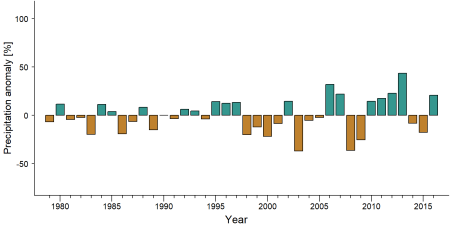
Precipitation anomaly in Mpem & Djim National Park -
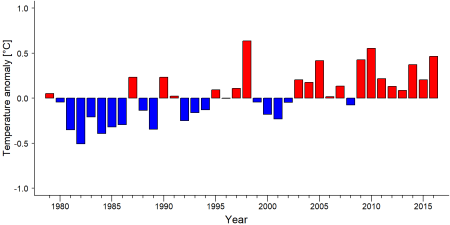
Temperature anomaly in Mpem & Djim National Park


External links
References
Fotsing, E. D. B., & Kamkeng, M. M. F. (2025). A Multi‐Species Occupancy Modelling Approach to Access the Impacts of Ecological Covariates on Terrestrial Vertebrates in a Tropical Hotspot in Central, Cameroon. African Journal of Ecology, 63(3). doi:10.1111/aje.70048
Fotsing, E. D., Kamkeng, M. M., Marcel Senge, S., & Zinner, D. (2024b). Diversity, habitat and activity patterns of mesocarnivore assemblages in an Afrotropical protected forest–savannah mosaic of central Cameroon. African Journal of Ecology, 62(3), e13283. doi:10.1111/aje.13283
Fotsing, E. D. B., Kamkeng, M. M. F., & Salah Senge, M. (2025). Camera Trapping to Assess Diversity, Habitat Use and Activity Patterns of Mammals in a Tropical Hotspot Area. African Journal of Ecology, 63(1). doi:10.1111/aje.70004
Fotsing, E. D., Kamkeng, M. M., & Zinner, D. (2024a). Opinions, attitudes and perceptions of local people towards the conservation of Nigeria-Cameroon chimpanzees in Mpem-Djim National Park, central Cameroon. People and Nature, 6(2), 865–881. doi:10.1002/pan3.10621
Mbamba Mbamba, J. P. K. (2013, January). État des lieux du Parc National de Mpem et Djim [Unpublished internal report]. Centre Régional de la Délégation des Forêts et de la Faune du Centre, Ministère des Forêts et de la Faune, Cameroun.
Kiribou, R., Tehoda, P., Chukwu, O., Bempah, G., Kühl, H. S., Ferreira, J., …, & Heinicke, S. (2024). Exposure of African ape sites to climate change impacts. PLOS Climate, 3(2), e0000345. doi:10.1371/journal.pclm.0000345
Page created by: Steven Joel Basiibye Date: 2024-12-12
Page updated by: Aime Mizero Date: 2026-01-07