
Ngoyla Wildlife Reserve: Difference between revisions
No edit summary |
No edit summary |
||
| (4 intermediate revisions by the same user not shown) | |||
| Line 12: | Line 12: | ||
* The site has a total size of 1,566.72 km². | * The site has a total size of 1,566.72 km². | ||
* Key threats to great apes are logging, hunting, mining, and clearing forest for agriculture. | * Key threats to great apes are logging, hunting, mining, and clearing forest for agriculture. | ||
* Conservation activities | * Conservation activities reported include anti-poaching patrols, ecological monitoring, awareness-raising in local communities, and the promotion of ecotourism activities. | ||
= Site characteristics = | = Site characteristics = | ||
The Ngoyla Wildlife Reserve is situated in southeastern Cameroon. Located between [[Nki National Park]] and Dja Biosphere Reserve, the site is also part of the TRIDOM conservation landscape ([https://www.wwf-congobasin.org/where_we_work/cameroon/ngoyla_mintom_/ WWF]). In 2014, the government of Cameroon, in collaboration with WWF and the World Bank, created the reserve. Along with the reserve, five new forestry concessions were created, covering nearly 500,000 ha in the same forest block (Ngoyla Mintom forest block), on the lands belonging to the indigenous Baka and Bantu peoples (FPP 2019). Mammal species inhabiting the site include forest elephants, gorillas, chimpanzees, mandrills, buffalos, bongos, sitatungas, panthers, duikers, water chevrotains; more than 280 bird species and 230 fish species are also found at the site ([https://www.wwf-congobasin.org/where_we_work/cameroon/ngoyla_mintom_/ WWF]). | The Ngoyla Wildlife Reserve is situated in southeastern Cameroon. Located between [[Nki National Park]] and Dja Biosphere Reserve, the site is also part of the TRIDOM conservation landscape ([https://www.wwf-congobasin.org/where_we_work/cameroon/ngoyla_mintom_/ WWF]). In 2014, the government of Cameroon, in collaboration with WWF and the World Bank, created the reserve. Along with the reserve, five new forestry concessions were created, covering nearly 500,000 ha in the same forest block (Ngoyla Mintom forest block), on the lands belonging to the indigenous Baka and Bantu peoples ([[#R01364|FPP 2019]]). Mammal species inhabiting the site include forest elephants, gorillas, chimpanzees, mandrills, buffalos, bongos, sitatungas, panthers, duikers, water chevrotains; more than 280 bird species and 230 fish species are also found at the site ([https://www.wwf-congobasin.org/where_we_work/cameroon/ngoyla_mintom_/ WWF]). | ||
'''Table 1. Basic site information for Ngoyla Wildlife Reserve''' | '''Table 1. Basic site information for Ngoyla Wildlife Reserve''' | ||
| Line 44: | Line 44: | ||
= Ape status = | = Ape status = | ||
Great ape abundance declined between 2011 and 2015 (N'Goran 2017). | Great ape abundance declined between 2011 and 2015 ([[#R01366|N'Goran 2017]]). | ||
'''Table 2. Ape population estimates reported for Ngoyla Wildlife Reserve''' | '''Table 2. Ape population estimates reported for Ngoyla Wildlife Reserve''' | ||
| Line 62: | Line 62: | ||
|- | |- | ||
|''Pan troglodytes troglodytes'' & ''Gorilla gorilla gorilla'' | |''Pan troglodytes troglodytes'' & ''Gorilla gorilla gorilla'' | ||
| | |2015 | ||
| | | | ||
| | | | ||
| | | | ||
| | |11345.0 | ||
|Ngoyla Mintom forests | |Ngoyla Mintom forests | ||
|Line transects | |Line transects | ||
| | | | ||
|N'Goran 2017 | |[[#R01366|N'Goran 2017]] | ||
| | | | ||
| | | | ||
|- | |- | ||
|''Pan troglodytes troglodytes'' & ''Gorilla gorilla gorilla'' | |''Pan troglodytes troglodytes'' & ''Gorilla gorilla gorilla'' | ||
| | |2011 | ||
| | | | ||
| | | | ||
| | | | ||
| | |20076.0 | ||
|Ngoyla Mintom forests | |Ngoyla Mintom forests | ||
|Line transects | |Line transects | ||
| | | | ||
|N'Goran 2017 | |[[#R01366|N'Goran 2017]] | ||
| | | | ||
| | | | ||
| Line 105: | Line 105: | ||
|2.1 Annual & perennial non-timber crops | |2.1 Annual & perennial non-timber crops | ||
|Present (unknown severity) | |Present (unknown severity) | ||
|Expansion of slash and burn agriculture (WWF n.d.). | |Expansion of slash and burn agriculture ([[#R01367|WWF n.d]].). | ||
|Ongoing (2021) | |Ongoing (2021) | ||
|- | |- | ||
| Line 111: | Line 111: | ||
|3.2 Mining & quarrying | |3.2 Mining & quarrying | ||
|Present (unknown severity) | |Present (unknown severity) | ||
|Industrial and artisanal mining (WWF n.d.). | |Industrial and artisanal mining ([[#R01367|WWF n.d]].). The Mbalam Iron mining project was reported active on site (APES Atlas Team pers.comm. 2026). | ||
|Ongoing ( | |2021-Ongoing (2026) | ||
|- | |- | ||
|4 Transportation & service corridors | |4 Transportation & service corridors | ||
|4.1 Roads & railroads | |4.1 Roads & railroads | ||
|Present (unknown severity) | |Present (unknown severity) | ||
|Logging roads facilitate access to the forest and illegal hunting and bushmeat trade (Mbom & Akana 2017). | |Logging roads facilitate access to the forest and illegal hunting and bushmeat trade ([[#R01365|Mbom & Akana 2017]]). | ||
|Ongoing (2017) | |Ongoing (2017) | ||
|- | |- | ||
| Line 123: | Line 123: | ||
|5.1 Hunting & collecting terrestrial animals | |5.1 Hunting & collecting terrestrial animals | ||
|High (more than 70% of population affected) | |High (more than 70% of population affected) | ||
|Bushmeat poaching (N'Goran 2017, WWF n.d.). | |Bushmeat poaching ([[#R01366|N'Goran 2017]], [[#R01367|WWF n.d]].). In 2026, Poaching activities continued to be reported (APES Atlas Team pers.comm. 2026). | ||
|Ongoing ( | |2017-Ongoing (2026) | ||
|- | |- | ||
|5 Biological resource use | |5 Biological resource use | ||
|5.3 Logging & wood harvesting | |5.3 Logging & wood harvesting | ||
|Present (unknown severity) | |Present (unknown severity) | ||
|Industrial timber exploitation and illegal small scale logging (WWF n.d.). | |Industrial timber exploitation and illegal small scale logging ([[#R01367|WWF n.d]].). Illegal forest exploitation and deforestation activities continued to be reported in 2026 (APES Atlas Team pers. comm. 2026). | ||
|Ongoing ( | |2017-Ongoing (2026) | ||
|} | |} | ||
| Line 155: | Line 155: | ||
|7 Economic & other incentives | |7 Economic & other incentives | ||
|7.1 Provide monetary benefits to local communities for sustainably managing their forest and its wildlife (e.g., REDD, alternative income, employment) | |7.1 Provide monetary benefits to local communities for sustainably managing their forest and its wildlife (e.g., REDD, alternative income, employment) | ||
|Promotion of Payment for Ecosystem Services (PES) and REDD + initiatives (WWF n.d.). | |Promotion of Payment for Ecosystem Services (PES) and REDD + initiatives ([[#R01367|WWF n.d]].). | ||
| | | | ||
|Unknown | |Unknown | ||
|- | |||
|2 Counter-wildlife crime | |||
|2.3 Conduct regular anti-poaching patrols | |||
|Anti-poaching patrols activities reported (APES Atlas Team pers.comm. 2026). | |||
|Ministère des Forêts et de la Faune (MINFOF) | |||
|Ongoing (2026) | |||
|- | |||
|2 Counter-wildlife crime | |||
|2.11 Implement monitoring surveillance strategies (e.g., SMART) or use monitoring data to improve effectiveness of patrols | |||
|MINFOF implements ecological monitoring of flora and fauna, in technical collaboration with conservation partners such as WWF (APES Atla Team pers.comm. 2026). | |||
|Ministère des Forêts et de la Faune (MINFOF), World Wide Fund for Nature (WWF) | |||
|2016-Ongoing (2026) | |||
|- | |||
|4 Education & awareness | |||
|4.1 Educate local communities about apes and sustainable use | |||
|Community outreach and awareness-raising in villages around the reserve (APES Atlas Team pers.comm. 2026). | |||
|Ministère des Forêts et de la Faune (MINFOF) | |||
|Ongoing (2026) | |||
|- | |||
|7 Economic & other incentives | |||
|7.2 Provide non-monetary benefits to local communities for sustainably managing their forest and its wildlife (e.g., better education, infrastructure development) | |||
|Introduction of ecotourism activities (APES Atlas Team pers.comm. 2026). | |||
| | |||
|Ongoing (2026) | |||
|} | |} | ||
| Line 173: | Line 197: | ||
!Year(s) | !Year(s) | ||
|- | |- | ||
| | |1 Site management | ||
| | |1.2 Need for improved coordination | ||
| | |APES Atlas Team pers.comm. 2026 | ||
| | |Ongoing (2026) | ||
|- | |||
|2 Resources and capacity | |||
|2.7 Lack of infrastructure | |||
|APES Atlas Team pers.comm. 2026 | |||
|Ongoing (2026) | |||
|- | |||
|2 Resources and capacity | |||
|2.3 General lack of funding | |||
|APES Atlas Team pers.comm. 2026 | |||
|Ongoing (2026) | |||
|- | |||
|2 Resources and capacity | |||
|2.5 Lack of equipment/transportation | |||
|APES Atlas Team pers.comm. 2026 | |||
|Ongoing (2026) | |||
|} | |} | ||
| Line 193: | Line 232: | ||
|- | |- | ||
|1 Site management | |1 Site management | ||
| | |1.1 Effective leadership | ||
| | |APES Atlas Team pers.comm. 2026 | ||
| | |Ongoing (2026) | ||
|- | |||
|1 Site management | |||
|1.3 Adaptive management practices | |||
|APES Atlas Team pers.comm. 2026 | |||
|Ongoing (2026) | |||
|- | |- | ||
|2 Resources and capacity | |2 Resources and capacity | ||
| | |2.6 External partnerships that add expertise or resources | ||
| | |APES Atlas Team pers.comm. 2026 | ||
| | |Ongoing (2026) | ||
|- | |- | ||
| | |2 Resources and capacity | ||
|2.5 Sufficient capacity/expertise to advise, design, or implement actions | |||
|APES Atlas Team pers.comm. 2026 | |||
|Ongoing (2026) | |||
|5 | |||
| | |||
| | |||
|} | |} | ||
| Line 227: | Line 256: | ||
= Research activities = | = Research activities = | ||
The most recent biological studies were submitted by the Zoological Society of London in 2021. However, these studies have not yet been approved by MINFOF. Consequently, WWF had also conducted its own studies at the sites back in 2016 (APES Atlas Team pers.comm. 2026). | |||
| Line 261: | Line 290: | ||
= Exposure to climate change impacts = | = Exposure to climate change impacts = | ||
As part of a study on the exposure of African great ape sites to climate change impacts, Kiribou et al. | As part of a study on the exposure of African great ape sites to climate change impacts, [[#R02281|Kiribou et al. (2024)]] extracted climate data and data on projected extreme climate impact events for the site. Climatological characteristics were derived from observation-based climate data provided by the Inter-Sectoral Impact Model Intercomparison Project (ISIMIP, www.isimip.org). Parameters were calculated as the average across each 30-year period. For 1981-2010, the EWEMBI dataset from ISIMIP2a was used. For the two future periods (2021-2050 and 2071-2099) ISIMIP2b climate data based on four CMIP5 global climate models were used. For future projections, two Representative Concentration Pathways (RCP) were used. RCP 2.6 is a scenario with strong mitigation measures in which global temperatures would likely rise below 2C. RCP 6.0 is a scenario with medium emissions in which global temperatures would likely rise up to 3C by 2100. For the number of days with heavy precipitation events, the 98th percentile of all precipitation days (>1mm/d) was calculated for the 1979-2013 reference period as a threshold for a heavy precipitation event. Then, for each year, the number of days above that threshold was derived. The figures on temperature and precipitation anomaly show the deviation from the mean temperature and mean precipitation for the 1979-2013 reference period. | ||
The estimated exposure to future extreme climate impact events (crop failure, drought, river flood, wildfire, tropical cyclone, and heatwave) is based on a published dataset by Lange et al. 2020 derived from ISIMIP2b data. The same global climate models and RCPs as described above were used. Within each 30-year period, the number of years with an extreme event and the average proportion of the site affected were calculated ( | The estimated exposure to future extreme climate impact events (crop failure, drought, river flood, wildfire, tropical cyclone, and heatwave) is based on a published dataset by Lange et al. 2020 derived from ISIMIP2b data. The same global climate models and RCPs as described above were used. Within each 30-year period, the number of years with an extreme event and the average proportion of the site affected were calculated ([[#R02281|Kiribou et al. 2024]]). | ||
'''Table 8. Estimated past and projected climatological characteristics in Ngoyla Wildlife Reserve''' | '''Table 8. Estimated past and projected climatological characteristics in Ngoyla Wildlife Reserve''' | ||
| Line 386: | Line 415: | ||
= References = | = References = | ||
<span id="R01364"></span>FPP. (2019). There’s a long, long way to go: The story of FPIC in Cameroon’s Ngoyla Wildlife Reserve. | |||
<span id="R01365"></span>Mbom, S., & Akana, D. (2017). The road to destruction? https://infocongo.org/en/the-road-to-destruction/ | |||
<span id="R01366"></span>N’Goran, K. P. (2017). Summary report on WWF biomonitoring activities from 2014 to 2016: Status of forest elephant and great apes in Central Africa priority sites. | |||
<span id="R01367"></span>WWF. (n.d.). Ngoyla-Mintom Project. https://www.wwf-congobasin.org/where_we_work/cameroon/ngoyla_mintom_/ [https://web.archive.org/web/20220517114521/https://www.wwf-congobasin.org/where_we_work/cameroon/ngoyla_mintom_/ link] | |||
<span id="R02281"></span>Kiribou, R., Tehoda, P., Chukwu, O., Bempah, G., Kühl, H. S., Ferreira, J., …, & Heinicke, S. (2024). Exposure of African ape sites to climate change impacts. ''PLOS Climate'', 3(2), e0000345. [https://doi.org/10.1371/journal.pclm.0000345 doi:10.1371/journal.pclm.0000345] | |||
'''Page created by: '''APES Atlas Team''' Date:''' 2021-11-14 | '''Page created by: '''APES Atlas Team''' Date:''' 2021-11-14 | ||
'''Page updated by: '''APES Atlas Team''' Date:''' 2026-10-12 | |||
Latest revision as of 17:54, 15 October 2026
Central Africa > Cameroon > Ngoyla Wildlife Reserve
Français | Português | Español | Bahasa Indonesia | Melayu
Summary
- Central chimpanzees (Pan troglodytes troglodytes) & western lowland gorillas (Gorilla gorilla gorilla) are present in Ngoyla Wildlife Reserve.
- It has been estimated that 11,345 individuals occur in the site.
- The great ape population trend is decreasing.
- The site has a total size of 1,566.72 km².
- Key threats to great apes are logging, hunting, mining, and clearing forest for agriculture.
- Conservation activities reported include anti-poaching patrols, ecological monitoring, awareness-raising in local communities, and the promotion of ecotourism activities.
Site characteristics
The Ngoyla Wildlife Reserve is situated in southeastern Cameroon. Located between Nki National Park and Dja Biosphere Reserve, the site is also part of the TRIDOM conservation landscape (WWF). In 2014, the government of Cameroon, in collaboration with WWF and the World Bank, created the reserve. Along with the reserve, five new forestry concessions were created, covering nearly 500,000 ha in the same forest block (Ngoyla Mintom forest block), on the lands belonging to the indigenous Baka and Bantu peoples (FPP 2019). Mammal species inhabiting the site include forest elephants, gorillas, chimpanzees, mandrills, buffalos, bongos, sitatungas, panthers, duikers, water chevrotains; more than 280 bird species and 230 fish species are also found at the site (WWF).
Table 1. Basic site information for Ngoyla Wildlife Reserve
| Species | Pan troglodytes troglodytes, Gorilla gorilla gorilla |
| Area | 1,566.72 km² |
| Coordinates | Lat: 2.657628 , Lon: 13.788269 |
| Type of site | Protected area (Wildlife Reserve) |
| Habitat types | Subtropical/tropical moist lowland forest, Subtropical/tropical swamp forest |
| Type of governance |
Types of sites Governance types Habitat types
Ape status
Great ape abundance declined between 2011 and 2015 (N'Goran 2017).
Table 2. Ape population estimates reported for Ngoyla Wildlife Reserve
| Species | Year | Occurrence | Encounter or vistation rate (nests/km; ind/day) | Density estimate [ind./ km²] (95% CI) | Abundance estimate (95% CI) | Survey area | Sampling method | Analytical framework | Source | Comments | A.P.E.S. database ID |
|---|---|---|---|---|---|---|---|---|---|---|---|
| Pan troglodytes troglodytes & Gorilla gorilla gorilla | 2015 | 11345.0 | Ngoyla Mintom forests | Line transects | N'Goran 2017 | ||||||
| Pan troglodytes troglodytes & Gorilla gorilla gorilla | 2011 | 20076.0 | Ngoyla Mintom forests | Line transects | N'Goran 2017 |
Sampling methods Analytical frameworks
Threats
Table 3. Threats to apes reported for Ngoyla Wildlife Reserve
| Category | Specific threats | Threat level | Description | Year of threat |
|---|---|---|---|---|
| 2 Agriculture & aquaculture | 2.1 Annual & perennial non-timber crops | Present (unknown severity) | Expansion of slash and burn agriculture (WWF n.d.). | Ongoing (2021) |
| 3 Energy production & mining | 3.2 Mining & quarrying | Present (unknown severity) | Industrial and artisanal mining (WWF n.d.). The Mbalam Iron mining project was reported active on site (APES Atlas Team pers.comm. 2026). | 2021-Ongoing (2026) |
| 4 Transportation & service corridors | 4.1 Roads & railroads | Present (unknown severity) | Logging roads facilitate access to the forest and illegal hunting and bushmeat trade (Mbom & Akana 2017). | Ongoing (2017) |
| 5 Biological resource use | 5.1 Hunting & collecting terrestrial animals | High (more than 70% of population affected) | Bushmeat poaching (N'Goran 2017, WWF n.d.). In 2026, Poaching activities continued to be reported (APES Atlas Team pers.comm. 2026). | 2017-Ongoing (2026) |
| 5 Biological resource use | 5.3 Logging & wood harvesting | Present (unknown severity) | Industrial timber exploitation and illegal small scale logging (WWF n.d.). Illegal forest exploitation and deforestation activities continued to be reported in 2026 (APES Atlas Team pers. comm. 2026). | 2017-Ongoing (2026) |
Conservation activities
Table 4. Conservation activities reported for Ngoyla Wildlife Reserve
| Category | Specific activity | Description | Implementing organization(s) | Year of activity |
|---|---|---|---|---|
| 5 Protection & restoration | 5.2 Legally protect ape habitat | The reserve was established in 2014. | 2014-Ongoing (2026) | |
| 7 Economic & other incentives | 7.1 Provide monetary benefits to local communities for sustainably managing their forest and its wildlife (e.g., REDD, alternative income, employment) | Promotion of Payment for Ecosystem Services (PES) and REDD + initiatives (WWF n.d.). | Unknown | |
| 2 Counter-wildlife crime | 2.3 Conduct regular anti-poaching patrols | Anti-poaching patrols activities reported (APES Atlas Team pers.comm. 2026). | Ministère des Forêts et de la Faune (MINFOF) | Ongoing (2026) |
| 2 Counter-wildlife crime | 2.11 Implement monitoring surveillance strategies (e.g., SMART) or use monitoring data to improve effectiveness of patrols | MINFOF implements ecological monitoring of flora and fauna, in technical collaboration with conservation partners such as WWF (APES Atla Team pers.comm. 2026). | Ministère des Forêts et de la Faune (MINFOF), World Wide Fund for Nature (WWF) | 2016-Ongoing (2026) |
| 4 Education & awareness | 4.1 Educate local communities about apes and sustainable use | Community outreach and awareness-raising in villages around the reserve (APES Atlas Team pers.comm. 2026). | Ministère des Forêts et de la Faune (MINFOF) | Ongoing (2026) |
| 7 Economic & other incentives | 7.2 Provide non-monetary benefits to local communities for sustainably managing their forest and its wildlife (e.g., better education, infrastructure development) | Introduction of ecotourism activities (APES Atlas Team pers.comm. 2026). | Ongoing (2026) |
Challenges
Table 5. Challenges reported for Ngoyla Wildlife Reserve
| Challenges | Specific challenges | Source | Year(s) |
|---|---|---|---|
| 1 Site management | 1.2 Need for improved coordination | APES Atlas Team pers.comm. 2026 | Ongoing (2026) |
| 2 Resources and capacity | 2.7 Lack of infrastructure | APES Atlas Team pers.comm. 2026 | Ongoing (2026) |
| 2 Resources and capacity | 2.3 General lack of funding | APES Atlas Team pers.comm. 2026 | Ongoing (2026) |
| 2 Resources and capacity | 2.5 Lack of equipment/transportation | APES Atlas Team pers.comm. 2026 | Ongoing (2026) |
Enablers
Table 6. Enablers reported for Ngoyla Wildlife Reserve
| Enablers | Specific enablers | Source | Year(s) |
|---|---|---|---|
| 1 Site management | 1.1 Effective leadership | APES Atlas Team pers.comm. 2026 | Ongoing (2026) |
| 1 Site management | 1.3 Adaptive management practices | APES Atlas Team pers.comm. 2026 | Ongoing (2026) |
| 2 Resources and capacity | 2.6 External partnerships that add expertise or resources | APES Atlas Team pers.comm. 2026 | Ongoing (2026) |
| 2 Resources and capacity | 2.5 Sufficient capacity/expertise to advise, design, or implement actions | APES Atlas Team pers.comm. 2026 | Ongoing (2026) |
Research activities
The most recent biological studies were submitted by the Zoological Society of London in 2021. However, these studies have not yet been approved by MINFOF. Consequently, WWF had also conducted its own studies at the sites back in 2016 (APES Atlas Team pers.comm. 2026).
Documented behaviours
Table 7. Behaviours documented for Ngoyla Wildlife Reserve
| Category | Behavior | Observation type | Prevalence | Observation dates | Source | Habituation | Species | Comment |
|---|---|---|---|---|---|---|---|---|
| Not reported |
Exposure to climate change impacts
As part of a study on the exposure of African great ape sites to climate change impacts, Kiribou et al. (2024) extracted climate data and data on projected extreme climate impact events for the site. Climatological characteristics were derived from observation-based climate data provided by the Inter-Sectoral Impact Model Intercomparison Project (ISIMIP, www.isimip.org). Parameters were calculated as the average across each 30-year period. For 1981-2010, the EWEMBI dataset from ISIMIP2a was used. For the two future periods (2021-2050 and 2071-2099) ISIMIP2b climate data based on four CMIP5 global climate models were used. For future projections, two Representative Concentration Pathways (RCP) were used. RCP 2.6 is a scenario with strong mitigation measures in which global temperatures would likely rise below 2C. RCP 6.0 is a scenario with medium emissions in which global temperatures would likely rise up to 3C by 2100. For the number of days with heavy precipitation events, the 98th percentile of all precipitation days (>1mm/d) was calculated for the 1979-2013 reference period as a threshold for a heavy precipitation event. Then, for each year, the number of days above that threshold was derived. The figures on temperature and precipitation anomaly show the deviation from the mean temperature and mean precipitation for the 1979-2013 reference period.
The estimated exposure to future extreme climate impact events (crop failure, drought, river flood, wildfire, tropical cyclone, and heatwave) is based on a published dataset by Lange et al. 2020 derived from ISIMIP2b data. The same global climate models and RCPs as described above were used. Within each 30-year period, the number of years with an extreme event and the average proportion of the site affected were calculated (Kiribou et al. 2024).
Table 8. Estimated past and projected climatological characteristics in Ngoyla Wildlife Reserve
| Value | 1981-2010 | 2021-2050, RCP 2.6 | 2021-2050, RCP 6.0 | 2071-2099, RCP 2.6 | 2071-2099, RCP 6.0 |
|---|---|---|---|---|---|
| Mean temperature [C] | 23.9 | 25.3 | 25.1 | 25.4 | 26.5 |
| Annual precipitation [mm] | 2176 | 2226 | 2218 | 2233 | 2235 |
| Max no. consecutive dry days (per year) | 19.1 | 14.9 | 16.9 | 13.1 | 15.2 |
| No. days with heavy precipitation (per year) | 7 | 7.3 | 7.5 | 7.2 | 8.5 |
Table 9. Projected exposure of apes to extreme climate impact events in Ngoyla Wildlife Reserve
| Type | No. of years with event (2021-2050, RCP 2.6) | % of site exposed (2021-2050, RCP 2.6) | No. of years with event (2021-2050, RCP 6.0) | % of site exposed (2021-2050, RCP 6.0) | No. of years with event (2070-2099, RCP 2.6) | % of site exposed (2070-2099, RCP 2.6) | No. of years with event (2070-2099, RCP 6.0) | % of site exposed (2070-2099, RCP 6.0) |
|---|---|---|---|---|---|---|---|---|
| Crop failure | 7 | 0.01 | 5.5 | 0.01 | 8.5 | 0.01 | 20 | 0.01 |
| Drought | 0 | 0 | 0 | 0 | 0 | 0 | 0 | 0 |
| Heatwave | 1.5 | 100 | 2.5 | 50 | 4 | 100 | 7.5 | 100 |
| River flood | 0 | 0 | 0.25 | 0.03 | 1 | 0.42 | 1 | 0.33 |
| Tropical cyclone | 0 | 0 | 0 | 0 | 0 | 0 | 0 | 0 |
| Wildfire | 29.75 | 0.37 | 30 | 0.43 | 28.75 | 0.39 | 29 | 0.45 |
-
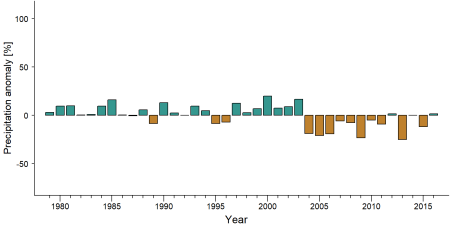
Precipitation anomaly in Ngoyla Wildlife Reserve -
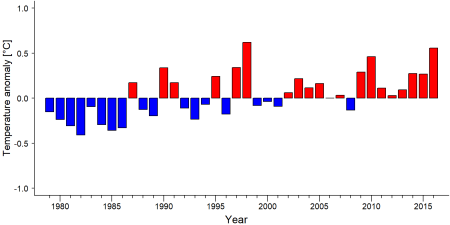
Temperature anomaly in Ngoyla Wildlife Reserve


External links
References
FPP. (2019). There’s a long, long way to go: The story of FPIC in Cameroon’s Ngoyla Wildlife Reserve.
Mbom, S., & Akana, D. (2017). The road to destruction? https://infocongo.org/en/the-road-to-destruction/
N’Goran, K. P. (2017). Summary report on WWF biomonitoring activities from 2014 to 2016: Status of forest elephant and great apes in Central Africa priority sites.
WWF. (n.d.). Ngoyla-Mintom Project. https://www.wwf-congobasin.org/where_we_work/cameroon/ngoyla_mintom_/ link
Kiribou, R., Tehoda, P., Chukwu, O., Bempah, G., Kühl, H. S., Ferreira, J., …, & Heinicke, S. (2024). Exposure of African ape sites to climate change impacts. PLOS Climate, 3(2), e0000345. doi:10.1371/journal.pclm.0000345
Page created by: APES Atlas Team Date: 2021-11-14
Page updated by: APES Atlas Team Date: 2026-10-12