
Oluwa Forest Reserve: Difference between revisions
No edit summary |
No edit summary Tag: Manual revert |
||
| (6 intermediate revisions by the same user not shown) | |||
| Line 13: | Line 13: | ||
* Key threats to chimpanzees are hunting, logging, and expansion of land for agriculture. | * Key threats to chimpanzees are hunting, logging, and expansion of land for agriculture. | ||
* The site is part of the Omo-Shasha-Oluwa project, implemented by the Nigerian Conservation Foundation, which aims to connect three forest reserves and manage them as a wildlife sanctuary. | * The site is part of the Omo-Shasha-Oluwa project, implemented by the Nigerian Conservation Foundation, which aims to connect three forest reserves and manage them as a wildlife sanctuary. | ||
| Line 48: | Line 44: | ||
= Ape status = | = Ape status = | ||
In 2006, chimpanzees and signs of chimpanzees (nests and vocalizations) were observed by the Owena river in the core area of the reserve (Greengrass 2006). Similarly, in 2012 the distribution of chimpanzees was confined to the core area of the reserve (segment OA2), encompassing approximately 39.22 km², or 5.78% of the total forest reserve (Ogunjemite & Olaniyi 2012). The population trend is unknown. | In 2006, chimpanzees and signs of chimpanzees (nests and vocalizations) were observed by the Owena river in the core area of the reserve ([[#R01471|Greengrass 2006]]). Similarly, in 2012 the distribution of chimpanzees was confined to the core area of the reserve (segment OA2), encompassing approximately 39.22 km², or 5.78% of the total forest reserve ([[#R01472|Ogunjemite & Olaniyi 2012]]). The population trend is unknown. | ||
'''Table 2. Ape population estimates reported for Oluwa Forest Reserve''' | '''Table 2. Ape population estimates reported for Oluwa Forest Reserve''' | ||
| Line 66: | Line 62: | ||
|- | |- | ||
|''Pan troglodytes ellioti'' | |''Pan troglodytes ellioti'' | ||
| | |2011-2012 | ||
|Present | |Present | ||
| | | | ||
| Line 74: | Line 70: | ||
|Reconnaissance walk | |Reconnaissance walk | ||
| | | | ||
| | |[[#R01472|Ogunjemite & Olaniyi 2012]] | ||
|Reconnaissance walk. | |Reconnaissance walk. The study recorded 9.50 ± 1.55 individuals and 13 nests. Vocalizations and footprints were also documented. | ||
| | | | ||
|- | |- | ||
|''Pan troglodytes ellioti'' | |''Pan troglodytes ellioti'' | ||
| | |2006 | ||
|Present | |Present | ||
| | | | ||
| Line 87: | Line 83: | ||
|Reconnaissance walk | |Reconnaissance walk | ||
| | | | ||
| | |[[#R01471|Greengrass 2006]] | ||
|Reconnaissance walk. | |Reconnaissance walk. Nests and individuals were seen in the core area of the reserve.Vocalizations and nests also observed. | ||
| | | | ||
|} | |} | ||
| Line 109: | Line 105: | ||
|2.1 Annual & perennial non-timber crops | |2.1 Annual & perennial non-timber crops | ||
|High (more than 70% of population affected) | |High (more than 70% of population affected) | ||
|Cultivation began from the outer edges of the reserve; only the core area has some natural forest left (Greengrass 2006, Ogunjemite & Olayimi 2012). | |Cultivation began from the outer edges of the reserve; only the core area has some natural forest left ([[#R01471|Greengrass 2006]], [[#R01472|Ogunjemite & Olayimi 2012]]). | ||
|2006-Ongoing (2012) | |2006-Ongoing (2012) | ||
|- | |- | ||
| Line 115: | Line 111: | ||
|5.1 Hunting & collecting terrestrial animals | |5.1 Hunting & collecting terrestrial animals | ||
|High (more than 70% of population affected) | |High (more than 70% of population affected) | ||
|Hunting is a major threat in the area; several gunshots were heard during a survey in 2006 (Greengrass 2006, Ogunjemite & Olayimi 2012). | |Hunting is a major threat in the area; several gunshots were heard during a survey in 2006 ([[#R01471|Greengrass 2006]], [[#R01472|Ogunjemite & Olayimi 2012]]). | ||
|Ongoing (2012) | |Ongoing (2012) | ||
|- | |- | ||
| Line 121: | Line 117: | ||
|5.3 Logging & wood harvesting | |5.3 Logging & wood harvesting | ||
|High (more than 70% of population affected) | |High (more than 70% of population affected) | ||
|Logging activity on the eastern side of the Owena River, where chimpanzees were observed (Greengrass 2006). | |Logging activity on the eastern side of the Owena River, where chimpanzees were observed ([[#R01471|Greengrass 2006]]). | ||
|Ongoing (2012) | |Ongoing (2012) | ||
|} | |} | ||
| Line 129: | Line 125: | ||
= Conservation activities = | = Conservation activities = | ||
Together with Omo and Shasha forest reserves, Oluwa is part of the Omo-Shasha-Oluwa project, implemented by the Nigerian Conservation Foundation, which aims to connect the three areas (PNI 2011). Although Omo and Shasha reserves are connected, Oluwa forest is isolated. The plan is to manage the Omo-Shasha-Oluwa areas as a wildlife sanctuary and permit human use where it is compatible with forest conservation. Other conservation activities included in the plan are the re-gazettement of forest reserve areas, community development, environmental education, research, eco-tourism, and long-term financing through REDD carbon credits (PNI 2011). Further information on the advancement of these activities has not been reported. | Together with Omo and Shasha forest reserves, Oluwa is part of the Omo-Shasha-Oluwa project, implemented by the Nigerian Conservation Foundation, which aims to connect the three areas ([[#R01473|PNI 2011]]). Although Omo and Shasha reserves are connected, Oluwa forest is isolated. The plan is to manage the Omo-Shasha-Oluwa areas as a wildlife sanctuary and permit human use where it is compatible with forest conservation. Other conservation activities included in the plan are the re-gazettement of forest reserve areas, community development, environmental education, research, eco-tourism, and long-term financing through REDD carbon credits ([[#R01473|PNI 2011]]). Further information on the advancement of these activities has not been reported. | ||
| Line 197: | Line 193: | ||
= Research activities = | = Research activities = | ||
A new nesting behavior was observed in the Oluwa Forest Reserve chimpanzee population during a survey in 2011-2012 (Ogunjemite & Olaniyi 2012). The majority of nests were built on rock platforms, perhaps due to the absence of tree species that are usually used for nesting (Ogunjemite & Olaniyi 2012). | A new nesting behavior was observed in the Oluwa Forest Reserve chimpanzee population during a survey in 2011-2012 ([[#R01472|Ogunjemite & Olaniyi 2012]]). The majority of nests were built on rock platforms, perhaps due to the absence of tree species that are usually used for nesting ([[#R01472|Ogunjemite & Olaniyi 2012]]). | ||
| Line 221: | Line 217: | ||
| | | | ||
| | | | ||
|Ogunjemite & Olaniyi 2012 | |[[#R01472|Ogunjemite & Olaniyi 2012]] | ||
| | | | ||
| | | | ||
| Line 231: | Line 227: | ||
= Exposure to climate change impacts = | = Exposure to climate change impacts = | ||
As part of a study on the exposure of African great ape sites to climate change impacts, Kiribou et al. | As part of a study on the exposure of African great ape sites to climate change impacts, [[#R02297|Kiribou et al. (2024)]] extracted climate data and data on projected extreme climate impact events for the site. Climatological characteristics were derived from observation-based climate data provided by the Inter-Sectoral Impact Model Intercomparison Project (ISIMIP, www.isimip.org). Parameters were calculated as the average across each 30-year period. For 1981-2010, the EWEMBI dataset from ISIMIP2a was used. For the two future periods (2021-2050 and 2071-2099) ISIMIP2b climate data based on four CMIP5 global climate models were used. For future projections, two Representative Concentration Pathways (RCP) were used. RCP 2.6 is a scenario with strong mitigation measures in which global temperatures would likely rise below 2C. RCP 6.0 is a scenario with medium emissions in which global temperatures would likely rise up to 3C by 2100. For the number of days with heavy precipitation events, the 98th percentile of all precipitation days (>1mm/d) was calculated for the 1979-2013 reference period as a threshold for a heavy precipitation event. Then, for each year, the number of days above that threshold was derived. The figures on temperature and precipitation anomaly show the deviation from the mean temperature and mean precipitation for the 1979-2013 reference period. | ||
The estimated exposure to future extreme climate impact events (crop failure, drought, river flood, wildfire, tropical cyclone, and heatwave) is based on a published dataset by Lange et al. 2020 derived from ISIMIP2b data. The same global climate models and RCPs as described above were used. Within each 30-year period, the number of years with an extreme event and the average proportion of the site affected were calculated ( | The estimated exposure to future extreme climate impact events (crop failure, drought, river flood, wildfire, tropical cyclone, and heatwave) is based on a published dataset by Lange et al. 2020 derived from ISIMIP2b data. The same global climate models and RCPs as described above were used. Within each 30-year period, the number of years with an extreme event and the average proportion of the site affected were calculated ([[#R02297|Kiribou et al. 2024]]). | ||
'''Table 8. Estimated past and projected climatological characteristics in Oluwa Forest Reserve''' | '''Table 8. Estimated past and projected climatological characteristics in Oluwa Forest Reserve''' | ||
| Line 348: | Line 344: | ||
<div><ul><li style="display: inline-block; vertical-align: top;"> [[File:PrecipAnomaly_Oluwa.png| 450px | thumb| none | Precipitation anomaly | <div><ul><li style="display: inline-block; vertical-align: top;"> [[File:PrecipAnomaly_Oluwa.png| 450px | thumb| none | Precipitation anomaly in Oluwa Forest Reserve]] </li><li style="display: inline-block; vertical-align: top;"> [[File:TempAnomaly_Oluwa.png | 450px | thumb| none | Temperature anomaly in Oluwa Forest Reserve]] </li></ul></div> | ||
= External links = | = External links = | ||
| Line 356: | Line 352: | ||
= References = | = References = | ||
Greengrass, E.J. (2006). A survey of chimpanzees in south-west Nigeria. Report to the NCF-WCS Biodiversity Research Programme. | <span id="R01471"></span>Greengrass, E.J. (2006). A survey of chimpanzees in south-west Nigeria. Report to the NCF-WCS Biodiversity Research Programme. [http://cameroun-foret.com/system/files/18_13_132.pdf link] | ||
<span id="R01472"></span>Ogunjemite, B.G. and Olaniyi, O.E. (2012), “The chimpanzees of Oluwa Forest | |||
<span id="R01473"></span>Pro-Natura International. (2011), Project Progress Report for the International Elephant Foundation January 2010 – May 2011. | |||
Reserve, southwest Nigeria”, International Journal of Development and Sustainability, Vol. 1 No. 3, pp. | <span id="R01474"></span>Reserve, southwest Nigeria”, International Journal of Development and Sustainability, Vol. 1 No. 3, pp. | ||
<span id="R02297"></span>Kiribou, R., Tehoda, P., Chukwu, O., Bempah, G., Kühl, H. S., Ferreira, J., …, & Heinicke, S. (2024). Exposure of African ape sites to climate change impacts. ''PLOS Climate'', 3(2), e0000345. [https://doi.org/10.1371/journal.pclm.0000345 doi:10.1371/journal.pclm.0000345] | |||
'''Page created by: '''APES Atlas Team''' Date:''' 2020-11-19 | '''Page created by: '''APES Atlas Team''' Date:''' 2020-11-19 | ||
Latest revision as of 17:54, 15 October 2026
West Africa > Nigeria > Oluwa Forest Reserve
Français | Português | Español | Bahasa Indonesia | Melayu
Summary
- Nigeria-Cameroon chimpanzees (Pan troglodytes ellioti) are present in Oluwa Forest Reserve.
- The population size is unknown.
- The chimpanzee population trend is unknown.
- The site has a total size of 678 km².
- Key threats to chimpanzees are hunting, logging, and expansion of land for agriculture.
- The site is part of the Omo-Shasha-Oluwa project, implemented by the Nigerian Conservation Foundation, which aims to connect three forest reserves and manage them as a wildlife sanctuary.
Site characteristics
Table 1. Basic site information for Oluwa Forest Reserve
| Species | Pan troglodytes ellioti |
| Area | 678 km² |
| Coordinates | Lat: 6.823 , Lon: 4.674 |
| Type of site | Protected area (Forest Reserve) |
| Habitat types | Subtropical/tropical moist lowland forest, Agricultural land |
| Type of governance |
Types of sites Governance types Habitat types
Ape status
In 2006, chimpanzees and signs of chimpanzees (nests and vocalizations) were observed by the Owena river in the core area of the reserve (Greengrass 2006). Similarly, in 2012 the distribution of chimpanzees was confined to the core area of the reserve (segment OA2), encompassing approximately 39.22 km², or 5.78% of the total forest reserve (Ogunjemite & Olaniyi 2012). The population trend is unknown.
Table 2. Ape population estimates reported for Oluwa Forest Reserve
| Species | Year | Occurrence | Encounter or vistation rate (nests/km; ind/day) | Density estimate [ind./ km²] (95% CI) | Abundance estimate (95% CI) | Survey area | Sampling method | Analytical framework | Source | Comments | A.P.E.S. database ID |
|---|---|---|---|---|---|---|---|---|---|---|---|
| Pan troglodytes ellioti | 2011-2012 | Present | Oluwa Forest Reserve | Reconnaissance walk | Ogunjemite & Olaniyi 2012 | Reconnaissance walk. The study recorded 9.50 ± 1.55 individuals and 13 nests. Vocalizations and footprints were also documented. | |||||
| Pan troglodytes ellioti | 2006 | Present | Oluwa Forest Reserve | Reconnaissance walk | Greengrass 2006 | Reconnaissance walk. Nests and individuals were seen in the core area of the reserve.Vocalizations and nests also observed. |
Sampling methods Analytical frameworks
Threats
Table 3. Threats to apes reported for Oluwa Forest Reserve
| Category | Specific threats | Threat level | Description | Year of threat |
|---|---|---|---|---|
| 2 Agriculture & aquaculture | 2.1 Annual & perennial non-timber crops | High (more than 70% of population affected) | Cultivation began from the outer edges of the reserve; only the core area has some natural forest left (Greengrass 2006, Ogunjemite & Olayimi 2012). | 2006-Ongoing (2012) |
| 5 Biological resource use | 5.1 Hunting & collecting terrestrial animals | High (more than 70% of population affected) | Hunting is a major threat in the area; several gunshots were heard during a survey in 2006 (Greengrass 2006, Ogunjemite & Olayimi 2012). | Ongoing (2012) |
| 5 Biological resource use | 5.3 Logging & wood harvesting | High (more than 70% of population affected) | Logging activity on the eastern side of the Owena River, where chimpanzees were observed (Greengrass 2006). | Ongoing (2012) |
Conservation activities
Together with Omo and Shasha forest reserves, Oluwa is part of the Omo-Shasha-Oluwa project, implemented by the Nigerian Conservation Foundation, which aims to connect the three areas (PNI 2011). Although Omo and Shasha reserves are connected, Oluwa forest is isolated. The plan is to manage the Omo-Shasha-Oluwa areas as a wildlife sanctuary and permit human use where it is compatible with forest conservation. Other conservation activities included in the plan are the re-gazettement of forest reserve areas, community development, environmental education, research, eco-tourism, and long-term financing through REDD carbon credits (PNI 2011). Further information on the advancement of these activities has not been reported.
Challenges
Table 5. Challenges reported for Oluwa Forest Reserve
| Challenges | Specific challenges | Source | Year(s) |
|---|---|---|---|
| Not reported |
Enablers
Table 6. Enablers reported for Oluwa Forest Reserve
| Enablers | Specific enablers | Source | Year(s) |
|---|---|---|---|
| 1 Site management | |||
| 2 Resources and capacity | |||
| 3 Engaged community | |||
| 4 Institutional support | |||
| 5 Ecological context | |||
| 6 Safety and stability |
Research activities
A new nesting behavior was observed in the Oluwa Forest Reserve chimpanzee population during a survey in 2011-2012 (Ogunjemite & Olaniyi 2012). The majority of nests were built on rock platforms, perhaps due to the absence of tree species that are usually used for nesting (Ogunjemite & Olaniyi 2012).
Documented behaviours
Table 7. Behaviours documented for Oluwa Forest Reserve
| Category | Behavior | Observation type | Prevalence | Observation dates | Source | Habituation | Species | Comment |
|---|---|---|---|---|---|---|---|---|
| Making ground nests | Ogunjemite & Olaniyi 2012 |
Exposure to climate change impacts
As part of a study on the exposure of African great ape sites to climate change impacts, Kiribou et al. (2024) extracted climate data and data on projected extreme climate impact events for the site. Climatological characteristics were derived from observation-based climate data provided by the Inter-Sectoral Impact Model Intercomparison Project (ISIMIP, www.isimip.org). Parameters were calculated as the average across each 30-year period. For 1981-2010, the EWEMBI dataset from ISIMIP2a was used. For the two future periods (2021-2050 and 2071-2099) ISIMIP2b climate data based on four CMIP5 global climate models were used. For future projections, two Representative Concentration Pathways (RCP) were used. RCP 2.6 is a scenario with strong mitigation measures in which global temperatures would likely rise below 2C. RCP 6.0 is a scenario with medium emissions in which global temperatures would likely rise up to 3C by 2100. For the number of days with heavy precipitation events, the 98th percentile of all precipitation days (>1mm/d) was calculated for the 1979-2013 reference period as a threshold for a heavy precipitation event. Then, for each year, the number of days above that threshold was derived. The figures on temperature and precipitation anomaly show the deviation from the mean temperature and mean precipitation for the 1979-2013 reference period.
The estimated exposure to future extreme climate impact events (crop failure, drought, river flood, wildfire, tropical cyclone, and heatwave) is based on a published dataset by Lange et al. 2020 derived from ISIMIP2b data. The same global climate models and RCPs as described above were used. Within each 30-year period, the number of years with an extreme event and the average proportion of the site affected were calculated (Kiribou et al. 2024).
Table 8. Estimated past and projected climatological characteristics in Oluwa Forest Reserve
| Value | 1981-2010 | 2021-2050, RCP 2.6 | 2021-2050, RCP 6.0 | 2071-2099, RCP 2.6 | 2071-2099, RCP 6.0 |
|---|---|---|---|---|---|
| Mean temperature [C] | 27.2 | 28.3 | 28.1 | 28.4 | 29.5 |
| Annual precipitation [mm] | 1833 | 1851 | 1890 | 1873 | 1907 |
| Max no. consecutive dry days (per year) | 40.4 | 39.2 | 37 | 37.4 | 41.9 |
| No. days with heavy precipitation (per year) | 6.1 | 9.6 | 10.2 | 10.2 | 11.3 |
Table 9. Projected exposure of apes to extreme climate impact events in Oluwa Forest Reserve
| Type | No. of years with event (2021-2050, RCP 2.6) | % of site exposed (2021-2050, RCP 2.6) | No. of years with event (2021-2050, RCP 6.0) | % of site exposed (2021-2050, RCP 6.0) | No. of years with event (2070-2099, RCP 2.6) | % of site exposed (2070-2099, RCP 2.6) | No. of years with event (2070-2099, RCP 6.0) | % of site exposed (2070-2099, RCP 6.0) |
|---|---|---|---|---|---|---|---|---|
| Crop failure | 3 | 2.84 | 1 | 0.73 | 1 | 2.93 | 3.5 | 2.93 |
| Drought | 0 | 0 | 0 | 0 | 0 | 0 | 0 | 0 |
| Heatwave | 10 | 100 | 11 | 100 | 10 | 100 | 13 | 100 |
| River flood | 0.5 | 0.54 | 0.5 | 0.18 | 0.5 | 0.4 | 2.5 | 0.99 |
| Tropical cyclone | 0 | 0 | 0 | 0 | 0 | 0 | 0.5 | 0.03 |
| Wildfire | 30 | 0.44 | 30 | 0.47 | 29 | 0.44 | 29 | 0.46 |
-
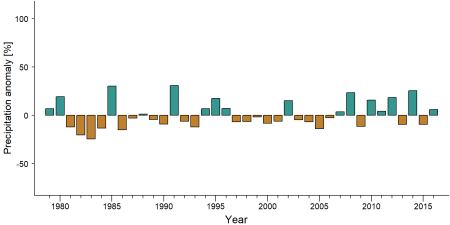
Precipitation anomaly in Oluwa Forest Reserve -
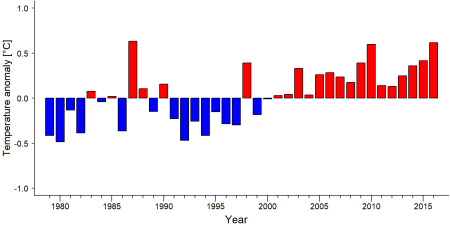
Temperature anomaly in Oluwa Forest Reserve


External links
References
Greengrass, E.J. (2006). A survey of chimpanzees in south-west Nigeria. Report to the NCF-WCS Biodiversity Research Programme. link
Ogunjemite, B.G. and Olaniyi, O.E. (2012), “The chimpanzees of Oluwa Forest
Pro-Natura International. (2011), Project Progress Report for the International Elephant Foundation January 2010 – May 2011.
Reserve, southwest Nigeria”, International Journal of Development and Sustainability, Vol. 1 No. 3, pp.
Kiribou, R., Tehoda, P., Chukwu, O., Bempah, G., Kühl, H. S., Ferreira, J., …, & Heinicke, S. (2024). Exposure of African ape sites to climate change impacts. PLOS Climate, 3(2), e0000345. doi:10.1371/journal.pclm.0000345
Page created by: APES Atlas Team Date: 2020-11-19