
SINFOCAM concessions: Difference between revisions
No edit summary |
No edit summary Tag: Manual revert |
||
| (5 intermediate revisions by the same user not shown) | |||
| Line 17: | Line 17: | ||
= Site characteristics = | = Site characteristics = | ||
The SINFOCAM concessions are logging concessions located in the southwestern corner of the Central African Republic (CAR). The concessions are found within the Dzanga-Sangha Protected Area (DSPA). The DSPA is known for its remarkable biodiversity and is the largest intact forest block remaining in the country (WWF n.d.). DSPA is part of the Sangha Tri-National World Heritage Site. SINFOCAM, a subsidiary of Vicwood Group, obtained a logging permit in 2014 (Global Witness 2015). | The SINFOCAM concessions are logging concessions located in the southwestern corner of the Central African Republic (CAR). The concessions are found within the Dzanga-Sangha Protected Area (DSPA). The DSPA is known for its remarkable biodiversity and is the largest intact forest block remaining in the country ([[#R01708|WWF n.d]].). DSPA is part of the Sangha Tri-National World Heritage Site. SINFOCAM, a subsidiary of Vicwood Group, obtained a logging permit in 2014 (Global [[#R01707|Witness 2015]]). | ||
'''Table 1. Basic site information for SINFOCAM concessions''' | '''Table 1. Basic site information for SINFOCAM concessions''' | ||
| Line 70: | Line 70: | ||
|Line transects | |Line transects | ||
| | | | ||
|N'Goran, Ndomba & Beukou 2016 | |[[#R01706|N'Goran, Ndomba & Beukou 2016]] | ||
| | | | ||
|CAF0012, CAF0016<div class="mw-collapsible mw-collapsed" data-expandtext="+7 more" data-collapsetext="less">CAF0020, CAF0025, CAF0028, CAF0030, CAF0033, CAF0034, CAF0037</div> | |||
|- | |- | ||
|''Gorilla gorilla gorilla'' | |''Gorilla gorilla gorilla'' | ||
| Line 83: | Line 83: | ||
|Line transects | |Line transects | ||
| | | | ||
|N'Goran, Ndomba & Beukou 2016 | |[[#R01706|N'Goran, Ndomba & Beukou 2016]] | ||
| | | | ||
|CAF0012, CAF0016<div class="mw-collapsible mw-collapsed" data-expandtext="+7 more" data-collapsetext="less">CAF0020, CAF0025, CAF0028, CAF0030, CAF0033, CAF0034, CAF0037</div> | |||
|- | |- | ||
|''Pan troglodytes troglodytes'' & ''Gorilla gorilla gorilla'' | |''Pan troglodytes troglodytes'' & ''Gorilla gorilla gorilla'' | ||
| Line 96: | Line 96: | ||
|Line transects | |Line transects | ||
| | | | ||
|N'Goran, Ndomba & Beukou 2016 | |[[#R01706|N'Goran, Ndomba & Beukou 2016]] | ||
| | | | ||
|CAF0012, CAF0016<div class="mw-collapsible mw-collapsed" data-expandtext="+7 more" data-collapsetext="less">CAF0020, CAF0025, CAF0028, CAF0030, CAF0033, CAF0034, CAF0037</div> | |||
|} | |} | ||
| Line 105: | Line 105: | ||
= Threats = | = Threats = | ||
Exploitation of the SINFOCAM logging concessions was predicted to have negative impacts on the remaining wildlife populations, and contributing to increased human pressures in the nearby protected areas (N'Goran, Ndomba & Beukou 2016). | Exploitation of the SINFOCAM logging concessions was predicted to have negative impacts on the remaining wildlife populations, and contributing to increased human pressures in the nearby protected areas ([[#R01706|N'Goran, Ndomba & Beukou 2016]]). | ||
'''Table 3. Threats to apes reported for SINFOCAM concessions''' | '''Table 3. Threats to apes reported for SINFOCAM concessions''' | ||
| Line 118: | Line 118: | ||
|3.2 Mining & quarrying | |3.2 Mining & quarrying | ||
|Present (unknown severity) | |Present (unknown severity) | ||
|Artisanal mining (WWF n.d.). | |Artisanal mining ([[#R01708|WWF n.d]].). | ||
|Unknown | |Unknown | ||
|- | |- | ||
| Line 124: | Line 124: | ||
|5.1 Hunting & collecting terrestrial animals | |5.1 Hunting & collecting terrestrial animals | ||
|High (more than 70% of population affected) | |High (more than 70% of population affected) | ||
|Poaching (subsistence and commercial; WWF n.d., Global Witness 2015). | |Poaching (subsistence and commercial; [[#R01708|WWF n.d.]], Global [[#R01707|Witness 2015]]). | ||
|Ongoing (2015) | |Ongoing (2015) | ||
|- | |- | ||
| Line 130: | Line 130: | ||
|5.3 Logging & wood harvesting | |5.3 Logging & wood harvesting | ||
|High (more than 70% of population affected) | |High (more than 70% of population affected) | ||
|Industrial scale logging is a threat, as logging roads accelerate deforestation and facilitate access to poachers (Global Witness 2015). | |Industrial scale logging is a threat, as logging roads accelerate deforestation and facilitate access to poachers (Global [[#R01707|Witness 2015]]). | ||
|Ongoing (2015) | |Ongoing (2015) | ||
|} | |} | ||
| Line 138: | Line 138: | ||
= Conservation activities = | = Conservation activities = | ||
WWF played an important role in the gazetting of the DSPA, where the site is located. WWF works alongside the CAR government to conserve this area, which is of exceptional regional and international importance (WWF n.d.) | WWF played an important role in the gazetting of the DSPA, where the site is located. WWF works alongside the CAR government to conserve this area, which is of exceptional regional and international importance ([[#R01708|WWF n.d]].) | ||
'''Table 4. Conservation activities reported for SINFOCAM concessions''' | '''Table 4. Conservation activities reported for SINFOCAM concessions''' | ||
| Line 150: | Line 150: | ||
|2 Counter-wildlife crime | |2 Counter-wildlife crime | ||
|2.3 Conduct regular anti-poaching patrols | |2.3 Conduct regular anti-poaching patrols | ||
|Anti-poaching patrols (WWF n.d.). | |Anti-poaching patrols ([[#R01708|WWF n.d]].). | ||
| | | | ||
|Unknown | |Unknown | ||
| Line 256: | Line 256: | ||
= Exposure to climate change impacts = | = Exposure to climate change impacts = | ||
As part of a study on the exposure of African great ape sites to climate change impacts, Kiribou et al. | As part of a study on the exposure of African great ape sites to climate change impacts, [[#R02316|Kiribou et al. (2024)]] extracted climate data and data on projected extreme climate impact events for the site. Climatological characteristics were derived from observation-based climate data provided by the Inter-Sectoral Impact Model Intercomparison Project (ISIMIP, www.isimip.org). Parameters were calculated as the average across each 30-year period. For 1981-2010, the EWEMBI dataset from ISIMIP2a was used. For the two future periods (2021-2050 and 2071-2099) ISIMIP2b climate data based on four CMIP5 global climate models were used. For future projections, two Representative Concentration Pathways (RCP) were used. RCP 2.6 is a scenario with strong mitigation measures in which global temperatures would likely rise below 2C. RCP 6.0 is a scenario with medium emissions in which global temperatures would likely rise up to 3C by 2100. For the number of days with heavy precipitation events, the 98th percentile of all precipitation days (>1mm/d) was calculated for the 1979-2013 reference period as a threshold for a heavy precipitation event. Then, for each year, the number of days above that threshold was derived. The figures on temperature and precipitation anomaly show the deviation from the mean temperature and mean precipitation for the 1979-2013 reference period. | ||
The estimated exposure to future extreme climate impact events (crop failure, drought, river flood, wildfire, tropical cyclone, and heatwave) is based on a published dataset by Lange et al. 2020 derived from ISIMIP2b data. The same global climate models and RCPs as described above were used. Within each 30-year period, the number of years with an extreme event and the average proportion of the site affected were calculated ( | The estimated exposure to future extreme climate impact events (crop failure, drought, river flood, wildfire, tropical cyclone, and heatwave) is based on a published dataset by Lange et al. 2020 derived from ISIMIP2b data. The same global climate models and RCPs as described above were used. Within each 30-year period, the number of years with an extreme event and the average proportion of the site affected were calculated ([[#R02316|Kiribou et al. 2024]]). | ||
'''Table 8. Estimated past and projected climatological characteristics in SINFOCAM concessions''' | '''Table 8. Estimated past and projected climatological characteristics in SINFOCAM concessions''' | ||
| Line 381: | Line 381: | ||
= References = | = References = | ||
N’Goran K.P., Ndomba D.L. and Beukou G.B. (2016). Rapport de l’inventaire des grands et moyens mamifères dans le segment RCA du paysage trinational de la Sangha. Bayanga, Central African Republic: WWF. Unpublished Report. | <span id="R01706"></span>N’Goran K.P., Ndomba D.L. and Beukou G.B. (2016). Rapport de l’inventaire des grands et moyens mamifères dans le segment RCA du paysage trinational de la Sangha. Bayanga, Central African Republic: WWF. Unpublished Report. | ||
<span id="R01707"></span>Witness, G. (2015). Blood timber: how Europe helped fund war in the Central African Republic: a report. | |||
<span id="R01708"></span>WWF (n.d.).WWF in the Dzanga - Sangha Protected Area (DSPA). Online: https://www.wwf-congobasin.org/where_we_work/central_africa_republic/dzanga_sangha_protected_area/ [https://web.archive.org/web/20220517102441/https://www.wwf-congobasin.org/where_we_work/central_africa_republic/dzanga_sangha_protected_area/ link] | |||
<span id="R02316"></span>Kiribou, R., Tehoda, P., Chukwu, O., Bempah, G., Kühl, H. S., Ferreira, J., …, & Heinicke, S. (2024). Exposure of African ape sites to climate change impacts. ''PLOS Climate'', 3(2), e0000345. [https://doi.org/10.1371/journal.pclm.0000345 doi:10.1371/journal.pclm.0000345] | |||
'''Page created by: '''APES Atlas Team''' Date:''' 2021-12-18 | '''Page created by: '''APES Atlas Team''' Date:''' 2021-12-18 | ||
Latest revision as of 17:54, 15 October 2026
Central Africa > Central African Republic > SINFOCAM concessions
Français | Português | Español | Bahasa Indonesia | Melayu
Summary
- Central chimpanzees (Pan troglodytes troglodytes) and western lowland gorillas (Gorilla gorilla gorilla) are present in SINFOCAM concessions.
- It has been estimated that 535 (CI: 287-999) individuals occur in the site.
- The great ape population trend is unknown.
- The site has a total size of 2,346.46 km².
- Key threats to great apes are logging and poaching.
- Conservation activities have focused on anti-poaching patrols.
Site characteristics
The SINFOCAM concessions are logging concessions located in the southwestern corner of the Central African Republic (CAR). The concessions are found within the Dzanga-Sangha Protected Area (DSPA). The DSPA is known for its remarkable biodiversity and is the largest intact forest block remaining in the country (WWF n.d.). DSPA is part of the Sangha Tri-National World Heritage Site. SINFOCAM, a subsidiary of Vicwood Group, obtained a logging permit in 2014 (Global Witness 2015).
Table 1. Basic site information for SINFOCAM concessions
| Species | Pan troglodytes troglodytes, Gorilla gorilla gorilla |
| Area | 2,346.46 km² |
| Coordinates | Lat: 2.786886 , Lon: 16.247316 |
| Type of site | Logging concession |
| Habitat types | Subtropical/tropical moist lowland forest, Savanna |
| Type of governance |
Types of sites Governance types Habitat types
Ape status
Table 2. Ape population estimates reported for SINFOCAM concessions
| Species | Year | Occurrence | Encounter or vistation rate (nests/km; ind/day) | Density estimate [ind./ km²] (95% CI) | Abundance estimate (95% CI) | Survey area | Sampling method | Analytical framework | Source | Comments | A.P.E.S. database ID |
|---|---|---|---|---|---|---|---|---|---|---|---|
| Pan troglodytes troglodytes | 2015-2016 | 0.03 (0.01-0.08) | 82 (33-203) | SINFOCAM concessions | Line transects | N'Goran, Ndomba & Beukou 2016 | CAF0012, CAF0016 CAF0020, CAF0025, CAF0028, CAF0030, CAF0033, CAF0034, CAF0037
| ||||
| Gorilla gorilla gorilla | 2015-2016 | 0.21 (0.11-0.40) | 502 (260-970) | SINFOCAM concessions | Line transects | N'Goran, Ndomba & Beukou 2016 | CAF0012, CAF0016 CAF0020, CAF0025, CAF0028, CAF0030, CAF0033, CAF0034, CAF0037
| ||||
| Pan troglodytes troglodytes & Gorilla gorilla gorilla | 2015-2016 | 0.22 (0.12-0.41) | 535 (287-999) | SINFOCAM concessions | Line transects | N'Goran, Ndomba & Beukou 2016 | CAF0012, CAF0016 CAF0020, CAF0025, CAF0028, CAF0030, CAF0033, CAF0034, CAF0037
|
Sampling methods Analytical frameworks
Threats
Exploitation of the SINFOCAM logging concessions was predicted to have negative impacts on the remaining wildlife populations, and contributing to increased human pressures in the nearby protected areas (N'Goran, Ndomba & Beukou 2016).
Table 3. Threats to apes reported for SINFOCAM concessions
| Category | Specific threats | Threat level | Description | Year of threat |
|---|---|---|---|---|
| 3 Energy production & mining | 3.2 Mining & quarrying | Present (unknown severity) | Artisanal mining (WWF n.d.). | Unknown |
| 5 Biological resource use | 5.1 Hunting & collecting terrestrial animals | High (more than 70% of population affected) | Poaching (subsistence and commercial; WWF n.d., Global Witness 2015). | Ongoing (2015) |
| 5 Biological resource use | 5.3 Logging & wood harvesting | High (more than 70% of population affected) | Industrial scale logging is a threat, as logging roads accelerate deforestation and facilitate access to poachers (Global Witness 2015). | Ongoing (2015) |
Conservation activities
WWF played an important role in the gazetting of the DSPA, where the site is located. WWF works alongside the CAR government to conserve this area, which is of exceptional regional and international importance (WWF n.d.)
Table 4. Conservation activities reported for SINFOCAM concessions
| Category | Specific activity | Description | Implementing organization(s) | Year of activity |
|---|---|---|---|---|
| 2 Counter-wildlife crime | 2.3 Conduct regular anti-poaching patrols | Anti-poaching patrols (WWF n.d.). | Unknown |
Challenges
Table 5. Challenges reported for SINFOCAM concessions
| Challenges | Specific challenges | Source | Year(s) |
|---|---|---|---|
| Not reported |
Enablers
Table 6. Enablers reported for SINFOCAM concessions
| Enablers | Specific enablers | Source | Year(s) |
|---|---|---|---|
| 1 Site management | |||
| 2 Resources and capacity | |||
| 3 Engaged community | |||
| 4 Institutional support | |||
| 5 Ecological context | |||
| 6 Safety and stability |
Research activities
Documented behaviours
Table 7. Behaviours documented for SINFOCAM concessions
| Category | Behavior | Observation type | Prevalence | Observation dates | Source | Habituation | Species | Comment |
|---|---|---|---|---|---|---|---|---|
| Not reported |
Exposure to climate change impacts
As part of a study on the exposure of African great ape sites to climate change impacts, Kiribou et al. (2024) extracted climate data and data on projected extreme climate impact events for the site. Climatological characteristics were derived from observation-based climate data provided by the Inter-Sectoral Impact Model Intercomparison Project (ISIMIP, www.isimip.org). Parameters were calculated as the average across each 30-year period. For 1981-2010, the EWEMBI dataset from ISIMIP2a was used. For the two future periods (2021-2050 and 2071-2099) ISIMIP2b climate data based on four CMIP5 global climate models were used. For future projections, two Representative Concentration Pathways (RCP) were used. RCP 2.6 is a scenario with strong mitigation measures in which global temperatures would likely rise below 2C. RCP 6.0 is a scenario with medium emissions in which global temperatures would likely rise up to 3C by 2100. For the number of days with heavy precipitation events, the 98th percentile of all precipitation days (>1mm/d) was calculated for the 1979-2013 reference period as a threshold for a heavy precipitation event. Then, for each year, the number of days above that threshold was derived. The figures on temperature and precipitation anomaly show the deviation from the mean temperature and mean precipitation for the 1979-2013 reference period.
The estimated exposure to future extreme climate impact events (crop failure, drought, river flood, wildfire, tropical cyclone, and heatwave) is based on a published dataset by Lange et al. 2020 derived from ISIMIP2b data. The same global climate models and RCPs as described above were used. Within each 30-year period, the number of years with an extreme event and the average proportion of the site affected were calculated (Kiribou et al. 2024).
Table 8. Estimated past and projected climatological characteristics in SINFOCAM concessions
| Value | 1981-2010 | 2021-2050, RCP 2.6 | 2021-2050, RCP 6.0 | 2071-2099, RCP 2.6 | 2071-2099, RCP 6.0 |
|---|---|---|---|---|---|
| Mean temperature [C] | 24.1 | 25.3 | 25.3 | 25.7 | 26.6 |
| Annual precipitation [mm] | 1549 | 1542 | 1599 | 1618 | 1594 |
| Max no. consecutive dry days (per year) | 25.5 | 25.9 | 25.2 | 23.4 | 28.1 |
| No. days with heavy precipitation (per year) | 6.6 | 10.5 | 11.6 | 12.3 | 12.3 |
Table 9. Projected exposure of apes to extreme climate impact events in SINFOCAM concessions
| Type | No. of years with event (2021-2050, RCP 2.6) | % of site exposed (2021-2050, RCP 2.6) | No. of years with event (2021-2050, RCP 6.0) | % of site exposed (2021-2050, RCP 6.0) | No. of years with event (2070-2099, RCP 2.6) | % of site exposed (2070-2099, RCP 2.6) | No. of years with event (2070-2099, RCP 6.0) | % of site exposed (2070-2099, RCP 6.0) |
|---|---|---|---|---|---|---|---|---|
| Crop failure | 5.5 | 0.21 | 4 | 0.19 | 5.5 | 0.24 | 11.5 | 0.19 |
| Drought | 0 | 0 | 0 | 0 | 0 | 0 | 0 | 0 |
| Heatwave | 1.5 | 35 | 1 | 62.5 | 2 | 66.67 | 5 | 83.33 |
| River flood | 0 | 0 | 1.5 | 0.33 | 0.5 | 0.01 | 1 | 1.24 |
| Tropical cyclone | 0 | 0 | 0 | 0 | 0 | 0 | 0 | 0 |
| Wildfire | 30 | 0.95 | 30 | 0.93 | 29 | 0.89 | 29 | 0.96 |
-
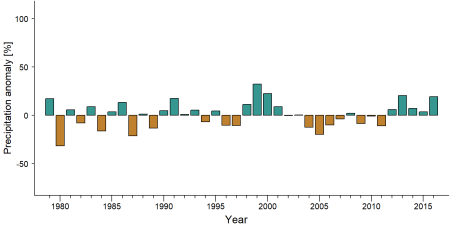
Precipitation anomaly in SINFOCAM concessions -
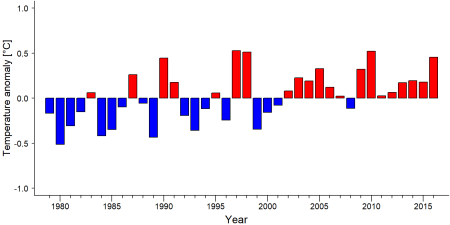
Temperature anomaly in SINFOCAM concessions


External links
References
N’Goran K.P., Ndomba D.L. and Beukou G.B. (2016). Rapport de l’inventaire des grands et moyens mamifères dans le segment RCA du paysage trinational de la Sangha. Bayanga, Central African Republic: WWF. Unpublished Report.
Witness, G. (2015). Blood timber: how Europe helped fund war in the Central African Republic: a report.
WWF (n.d.).WWF in the Dzanga - Sangha Protected Area (DSPA). Online: https://www.wwf-congobasin.org/where_we_work/central_africa_republic/dzanga_sangha_protected_area/ link
Kiribou, R., Tehoda, P., Chukwu, O., Bempah, G., Kühl, H. S., Ferreira, J., …, & Heinicke, S. (2024). Exposure of African ape sites to climate change impacts. PLOS Climate, 3(2), e0000345. doi:10.1371/journal.pclm.0000345
Page created by: APES Atlas Team Date: 2021-12-18