
Takamanda Biosphere Reserve: Difference between revisions
No edit summary |
No edit summary Tag: Manual revert |
| (One intermediate revision by the same user not shown) | |
(No difference)
| |
Latest revision as of 17:54, 15 October 2026
Central Africa > Cameroon > Takamanda Biosphere Reserve
Français | Português | Español | Bahasa Indonesia | Melayu
Summary
- Nigeria-Cameroon chimpanzees (Pan troglodytes ellioti) & Cross river gorillas (Gorilla gorilla diehli) are present in Takamanda Biosphere Reserve.
- The population sizes are unknown.
- The great ape population trend is unknown.
- The site has a total size of 3,071.15 km².
- Key threats to great apes are poaching, logging, and increasing accessibility by roads.
- Conservation activities have focused on involving local communities in conservation and sustainable resource use, monitoring wildlife and law enforcement.
Site characteristics
Located in northeastern Cameroon, the site was first established as Takamanda Forest Reserve in 1934 to protect watersheds and conserve the area for timber production (Dunn et al. 2014). In 2008 it was upgraded to national park to protect the gorillas, as well as for its biological and transboundary importance (Dunn et al. 2014). The site and the neighbouring Okwangwo region in Nigeria are important areas for many large mammals; these include- in addition to the Cross River Gorilla and Nigeria-Cameroon chimpanzee- drills, Preuss's guenon, forest elephants, an buffalos (Sunderland-Groves & Maisels 2003). In 2026, UNESCO designated Takamanda National Park as one of 14 new biosphere reserves across 14 countries. It is now officially designated the Takamanda-Cross River Gorilla Biosphere Reserve (UNESCO 2026a).
Table 1. Basic site information for Takamanda Biosphere Reserve
| Species | Gorilla gorilla diehli, Pan troglodytes ellioti |
| Area | 3,071.15 km² |
| Coordinates | Lat: 6.177757 , Lon: 9.340774 |
| Type of site | Protected area (Biosphere Reserve) |
| Habitat types | Subtropical/tropical moist lowland forest, Subtropical/tropical moist montane forest, Subtropical/tropical heavily degraded former forest |
| Type of governance | Governance by government |
Types of sites Governance types Habitat types
-
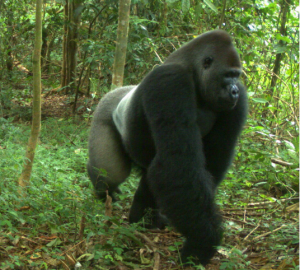
Cross River Gorilla © UNESCO & WCS Cameroon -
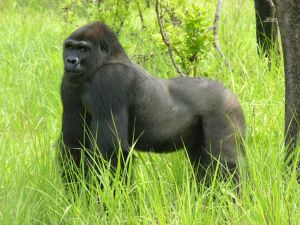
Cross River Gorilla © UNESCO & WCS Cameroon


Ape status
Gorillas are concentrated in three localities of the park. The first one consists of 25 sq.km in the east of the park, in the hills north of Kekpane. The second one covers only about 15 sq.km in an extremely steep and rocky area in the northeast of the park. The third site lies north of the Obonyi villages and extends across the Nigeria-Cameroon border into Okwangwo (Dunn et al. 2014).
Table 2. Ape population estimates reported for Takamanda Biosphere Reserve
| Species | Year | Occurrence | Encounter or vistation rate (nests/km; ind/day) | Density estimate [ind./ km²] (95% CI) | Abundance estimate (95% CI) | Survey area | Sampling method | Analytical framework | Source | Comments | A.P.E.S. database ID |
|---|---|---|---|---|---|---|---|---|---|---|---|
| Gorilla gorilla diehli | 2001 | 100 | Takamanda Forest Reserve | Informed guess | Sunderland-Groves, Maisels & Ekinde 2003 | CMR0103, CMR0104 CMR0105
| |||||
| Gorilla gorilla diehli | Unknown | 45,881 | Takamanda National Park East (Kekpane area) | Reconnaissance walk | WCS surveys as cited by Dunn et al. 2014 | ||||||
| Gorilla gorilla diehli | Unknown | 45,945 | Takamanda National Park-North (Atolo area) | Reconnaissance walk | WCS surveys as cited by Dunn et al. 2014 |
Sampling methods Analytical frameworks
Threats
Bushmeat is still an important source of income and protein for villages at the site. Although traditional hunting rights were given to local communities and the use of firearms has been prohibited since 1934, firearm hunting is widespread throughout the area (Sunderland-Groves & Maisels 2003).
Table 3. Threats to apes reported for Takamanda Biosphere Reserve
| Category | Specific threats | Threat level | Description | Year of threat |
|---|---|---|---|---|
| 4 Transportation & service corridors | 4.1 Roads & railroads | High (more than 70% of population affected) | Increasing accessibility by roads (Dunn et al. 2014). Road between the Takamanda forest and the Mone and Mbulu forests, allows access to the forests and, subsequently, increased export of agricultural and forest products, including bushmeat (Sunderland-Groves, Maisels & Ekinde 2003). | 2003-Ongoing (2014) |
| 5 Biological resource use | 5.1 Hunting & collecting terrestrial animals | High (more than 70% of population affected) | Trafficking of bushmeat across the border with Nigeria and other parts of Cameroon. Gorilla meat is eaten, their bones are used in traditional medicine and as fetishes, and infants have been sold as pets (Dunn et al. 2014). | Ongoing (2014) |
| 5 Biological resource use | 5.2 Gathering terrestrial plants | Present (unknown severity) | Unsustainable harvesting of NFTPs (Dunn et al. 2014). | Ongoing (2014) |
| 5 Biological resource use | 5.3 Logging & wood harvesting | Present (unknown severity) | Illegal logging (Dunn et al. 2014). | Ongoing (2014) |
Conservation activities
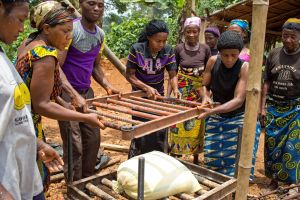
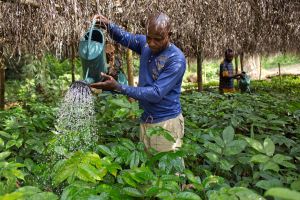
Transboundary cooperation between Okwangwo and Takamanda has been strongly promoted through activities such as regular joint anti-poaching patrols, an annual transboundary workshop, exchange visits and information sharing to capture poachers (Dunn et al. 2014). The landscape is characterized by a rich cultural heritage and long-standing traditions of coexistence with the natural environment. Bantu-speaking communities, including the Anyang, Becheve, Basho, and others together with Mbororo pastoralists, continue to maintain sacred forests, observe totemic taboos, and apply customary land-use practices that have historically contributed to local conservation. Livelihood activities across the region include the sustainable harvesting of non-timber forest products, such as bush mango, njangsang, and wild honey, often undertaken through women-led cooperatives. In addition, younger generations are increasingly engaged in conservation and nature-based livelihoods as gorilla guardians, ecotourism guides, and advocates for the sustainable development of their communities and environment (UNESCO 2026b).
Table 4. Conservation activities reported for Takamanda Biosphere Reserve
| Category | Specific activity | Description | Implementing organization(s) | Year of activity |
|---|---|---|---|---|
| 2 Counter-wildlife crime | 2.11 Implement monitoring surveillance strategies (e.g., SMART) or use monitoring data to improve effectiveness of patrols | The CyberTracker system has been implemented for wildlife and law enforcement monitoring at the site. It has also been used for data collection during wildlife surveys (Dunn et al. 2014). | Ongoing (2014) | |
| 5 Protection & restoration | 5.2 Legally protect ape habitat | The site has been a National Park since 2008. In 2026, UNESCO designated the site as a Biosphere Reserve (UNESCO 2026a). | 2008-Ongoing (2026) | |
| 4 Education & awareness | 4.1 Educate local communities about apes and sustainable use | The Takamanda landscape is shaped by Bantu-speaking communities and Mbororo pastoralists who maintain traditions like sacred groves, species taboos, and community-based conservation mechanisms. In addition, youth are increasingly active as gorilla guardians, ecotourism guides, and advocates for environmental education UNESCO 2026b). | Local communities | Ongoing (2026) |
| 4 Education & awareness | 4.2 Involve local community in ape research and conservation management | Women’s cooperatives sustainably harvest forest products like bush mango, njangsang, and honey, while youth are increasingly active as gorilla guardians, ecotourism guides, and advocates for protecting both nature and community well-being (UNESCO 2026b). | Local communities | Ongoing (2026) |
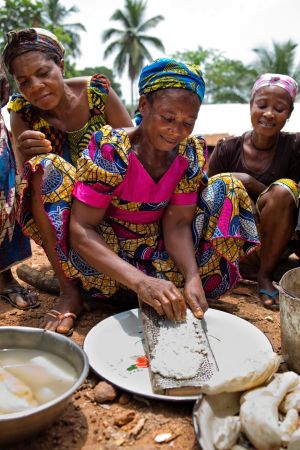
© UNESCO & A-Schuecke -
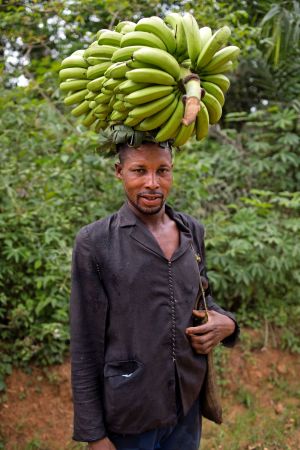
© UNESCO & A-Schuecke -
© UNESCO & A-Schuecke -
© UNESCO & A-Schuecke


Challenges
Table 5. Challenges reported for Takamanda Biosphere Reserve
| Challenges | Specific challenges | Source | Year(s) |
|---|---|---|---|
| Not reported |
Enablers
Table 6. Enablers reported for Takamanda Biosphere Reserve
| Enablers | Specific enablers | Source | Year(s) |
|---|---|---|---|
| 1 Site management | |||
| 2 Resources and capacity | |||
| 3 Engaged community | 3.2 Local taboos in favor of conservation | UNESCO 2026b | Ongoing (2026) |
| 3 Engaged community | 3.6 Local community engagement and support | UNESCO 2026b | Ongoing (2026) |
| 4 Institutional support | |||
| 5 Ecological context | |||
| 6 Safety and stability |
Research activities
Documented behaviours
Table 7. Behaviours documented for Takamanda Biosphere Reserve
| Category | Behavior | Observation type | Prevalence | Observation dates | Source | Habituation | Species | Comment |
|---|---|---|---|---|---|---|---|---|
| Not reported |
Exposure to climate change impacts
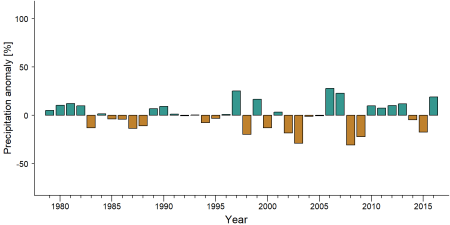
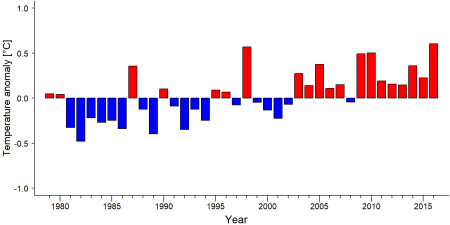
As part of a study on the exposure of African great ape sites to climate change impacts, Kiribou et al. (2024) extracted climate data and data on projected extreme climate impact events for the site. Climatological characteristics were derived from observation-based climate data provided by the Inter-Sectoral Impact Model Intercomparison Project (ISIMIP, www.isimip.org). Parameters were calculated as the average across each 30-year period. For 1981-2010, the EWEMBI dataset from ISIMIP2a was used. For the two future periods (2021-2050 and 2071-2099) ISIMIP2b climate data based on four CMIP5 global climate models were used. For future projections, two Representative Concentration Pathways (RCP) were used. RCP 2.6 is a scenario with strong mitigation measures in which global temperatures would likely rise below 2C. RCP 6.0 is a scenario with medium emissions in which global temperatures would likely rise up to 3C by 2100. For the number of days with heavy precipitation events, the 98th percentile of all precipitation days (>1mm/d) was calculated for the 1979-2013 reference period as a threshold for a heavy precipitation event. Then, for each year, the number of days above that threshold was derived. The figures on temperature and precipitation anomaly show the deviation from the mean temperature and mean precipitation for the 1979-2013 reference period.
The estimated exposure to future extreme climate impact events (crop failure, drought, river flood, wildfire, tropical cyclone, and heatwave) is based on a published dataset by Lange et al. 2020 derived from ISIMIP2b data. The same global climate models and RCPs as described above were used. Within each 30-year period, the number of years with an extreme event and the average proportion of the site affected were calculated (Kiribou et al. 2024).
Table 8. Estimated past and projected climatological characteristics in Takamanda Biosphere Reserve
| Value | 1981-2010 | 2021-2050, RCP 2.6 | 2021-2050, RCP 6.0 | 2071-2099, RCP 2.6 | 2071-2099, RCP 6.0 |
|---|---|---|---|---|---|
| Mean temperature [C] | 25.3 | 26.4 | 26.2 | 26.5 | 27.6 |
| Annual precipitation [mm] | 2359 | 2468 | 2490 | 2470 | 2441 |
| Max no. consecutive dry days (per year) | 40.6 | 40 | 42 | 40.6 | 45.4 |
| No. days with heavy precipitation (per year) | 4.8 | 4.7 | 4.9 | 4.8 | 5.9 |
Table 9. Projected exposure of apes to extreme climate impact events in Takamanda Biosphere Reserve
| Type | No. of years with event (2021-2050, RCP 2.6) | % of site exposed (2021-2050, RCP 2.6) | No. of years with event (2021-2050, RCP 6.0) | % of site exposed (2021-2050, RCP 6.0) | No. of years with event (2070-2099, RCP 2.6) | % of site exposed (2070-2099, RCP 2.6) | No. of years with event (2070-2099, RCP 6.0) | % of site exposed (2070-2099, RCP 6.0) |
|---|---|---|---|---|---|---|---|---|
| Crop failure | 5.5 | 0.18 | 6 | 0.31 | 3.5 | 0.23 | 7.5 | 0.23 |
| Drought | 0 | 0 | 0 | 0 | 0 | 0 | 0 | 0 |
| Heatwave | 3 | 100 | 5 | 100 | 3 | 100 | 5 | 100 |
| River flood | 1.5 | 0.17 | 1 | 1.87 | 1.5 | 1.15 | 2.5 | 1.23 |
| Tropical cyclone | 0 | 0 | 0 | 0 | 0 | 0 | 0 | 0 |
| Wildfire | 30 | 0.74 | 30 | 0.74 | 29 | 0.74 | 29 | 0.74 |
-
Precipitation anomaly in Takamanda National Park -
Temperature anomaly in Takamanda National Park


External links
UNESCO designates 14 new biosphere reserves on World Environment Day
References
Dunn, A., Berg, R., Byler, D., Eben-Ebai, S., Etiendem, D. N., Fotso, R., …, & Williamson, E. A. (2014). Revised Regional Action Plan for the Conservation of the Cross River Gorilla (Gorilla gorilla diehli) 2014–2019. New York: IUCN/SSC Primate Specialist Group and Wildlife Conservation Society. link
Sunderland-Groves, J. L., Maisels, F., & Ekinde, A. (2003). Surveys of the Cross River gorilla and chimpanzee populations in Takamanda Forest Reserve, Cameroon. Takamanda: the biodiversity of an African rainforest, 8, 129-140. link
Sunderland-Groves, J. L., & Maisels, F. (2003). Large mammals of Takamanda Forest Reserve, Cameroon. Takamanda. The Biodiversity of an African Rainforest, 111-127.
Kiribou, R., Tehoda, P., Chukwu, O., Bempah, G., Kühl, H. S., Ferreira, J., …, & Heinicke, S. (2024). Exposure of African ape sites to climate change impacts. PLOS Climate, 3(2), e0000345. doi:10.1371/journal.pclm.0000345
UNESCO 2026a. https://www.unesco.org/en/articles/unesco-designates-14-new-biosphere-reserves-world-environment-day
UNESCO 2026b. https://www.unesco.org/en/mab/takamanda-cross-river-gorilla
Page created by: APES Atlas Team Date: 2021-11-29