
Tingi Hills Non-hunting Forest Reserve: Difference between revisions
No edit summary |
No edit summary Tag: Manual revert |
||
| (5 intermediate revisions by the same user not shown) | |||
| Line 14: | Line 14: | ||
* There is a lack of information on conservation interventions implemented at the site. | * There is a lack of information on conservation interventions implemented at the site. | ||
* The remote area is renowned for its batholiths. | * The remote area is renowned for its batholiths. | ||
= Site characteristics = | = Site characteristics = | ||
The site is located in eastern Sierra Leone, close to the border with Guinea. It is characterized by steep forested hills, which include the second highest peak in Sierra Leone, the Sankan Biriwa, at 1860 m (Brncic et al. 2010, BirdLife International 2019). The site is an Important Bird Area ([http://datazone.birdlife.org/site/factsheet/tingi-hills-non-hunting-forest-reserve-iba-sierra-leone IBA]); more than 200 bird species have been recorded at the site, six of which are of global conservation concern, including the white-necked picarthes (BirdLife International 2019). Other species inhabiting the reserve include forest elephant (''Loxodonta cyclotis''), pygmy hippopotamus (''Choeropsis liberiensis''), sooty mangabey (''Cercocebus atys'', BirdLife International 2019), and the endemic toad species ''Amietophrynus cristiglans'', commonly known as the Tingi Hills toad (EPA 2017). | The site is located in eastern Sierra Leone, close to the border with Guinea. It is characterized by steep forested hills, which include the second highest peak in Sierra Leone, the Sankan Biriwa, at 1860 m ([[#R01812|Brncic et al. 2010]], [[#R01811|BirdLife International 2019]]). The site is an Important Bird Area ([http://datazone.birdlife.org/site/factsheet/tingi-hills-non-hunting-forest-reserve-iba-sierra-leone IBA]); more than 200 bird species have been recorded at the site, six of which are of global conservation concern, including the white-necked picarthes ([[#R01811|BirdLife International 2019]]). Other species inhabiting the reserve include forest elephant (''Loxodonta cyclotis''), pygmy hippopotamus (''Choeropsis liberiensis''), sooty mangabey (''Cercocebus atys'', [[#R01811|BirdLife International 2019]]), and the endemic toad species ''Amietophrynus cristiglans'', commonly known as the Tingi Hills toad ([[#R01813|EPA 2017]]). | ||
'''Table 1. Basic site information for Tingi Hills Non-hunting Forest Reserve''' | '''Table 1. Basic site information for Tingi Hills Non-hunting Forest Reserve''' | ||
| Line 48: | Line 44: | ||
= Ape status = | = Ape status = | ||
In 1979-1980, Teleki and Baldwin conducted a nationwide survey and reported high densities in Tingi Hills (Brncic et al. 2010). Decades later, in 2010, a line transect survey was conducted in Tingi Hills Non-hunting Forest Reserve, which estimated approximately 70 individuals in the area; however, a higher survey effort would be needed to reduce uncertainty in this population estimate (Brncic et al. 2010). | In 1979-1980, Teleki and Baldwin conducted a nationwide survey and reported high densities in Tingi Hills ([[#R01812|Brncic et al. 2010]]). Decades later, in 2010, a line transect survey was conducted in Tingi Hills Non-hunting Forest Reserve, which estimated approximately 70 individuals in the area; however, a higher survey effort would be needed to reduce uncertainty in this population estimate ([[#R01812|Brncic et al. 2010]]). | ||
'''Table 2. Ape population estimates reported for Tingi Hills Non-hunting Forest Reserve''' | '''Table 2. Ape population estimates reported for Tingi Hills Non-hunting Forest Reserve''' | ||
| Line 74: | Line 70: | ||
|Line transects | |Line transects | ||
| | | | ||
|Brncic et al. 2010 | |[[#R01812|Brncic et al. 2010]] | ||
|Total survey effort: 24.55 km | |Total survey effort: 24.55 km | ||
| | |SLE0002, SLE0003<div class="mw-collapsible mw-collapsed" data-expandtext="+13 more" data-collapsetext="less">SLE0004, SLE0014, SLE0015, SLE0017, SLE0018, SLE0021, SLE0024, SLE0025, SLE0026, SLE0029, SLE0032, SLE0036, SLE0037</div> | ||
|} | |} | ||
| Line 83: | Line 79: | ||
= Threats = | = Threats = | ||
Footpaths are present throughout the reserve, and hunting signs were frequently encountered during the chimpanzee survey in 2010 (Brncic et al. 2010). Bush fires are also a main concern, as they cause severe damage to the forest cover (BirdLife International 2019). The steep terrain offers protection to chimpanzees in the interior of the reserve, but the high demand for agricultural land means that farming is slowly reaching the steeper areas (Brncic et al. 2010). | Footpaths are present throughout the reserve, and hunting signs were frequently encountered during the chimpanzee survey in 2010 ([[#R01812|Brncic et al. 2010]]). Bush fires are also a main concern, as they cause severe damage to the forest cover ([[#R01811|BirdLife International 2019]]). The steep terrain offers protection to chimpanzees in the interior of the reserve, but the high demand for agricultural land means that farming is slowly reaching the steeper areas ([[#R01812|Brncic et al. 2010]]). | ||
'''Table 3. Threats to apes reported for Tingi Hills Non-hunting Forest Reserve''' | '''Table 3. Threats to apes reported for Tingi Hills Non-hunting Forest Reserve''' | ||
| Line 96: | Line 92: | ||
|2.1 Annual & perennial non-timber crops | |2.1 Annual & perennial non-timber crops | ||
|High (more than 70% of population affected) | |High (more than 70% of population affected) | ||
|Agricultural practices are a main threat in the reserve, causing forest clearance and erosion of the soil (Brncic et al. 2010). | |Agricultural practices are a main threat in the reserve, causing forest clearance and erosion of the soil ([[#R01812|Brncic et al. 2010]]). | ||
|Ongoing (2010) | |Ongoing (2010) | ||
|- | |||
|3 Energy production & mining | |||
|3.2 Mining & quarrying | |||
|Low (up to 30% of population affected) | |||
|Mining is a potential long-term threat and takes places along the river in the south of the reserve ([[#R01811|BirdLife International 2019]]). | |||
|Ongoing (2019) | |||
|- | |- | ||
|4 Transportation & service corridors | |4 Transportation & service corridors | ||
|4.1 Roads & railroads | |4.1 Roads & railroads | ||
|High (more than 70% of population affected) | |High (more than 70% of population affected) | ||
|Footpaths present (Brncic et al. 2010). | |Footpaths present ([[#R01812|Brncic et al. 2010]]). | ||
|Ongoing (2010) | |Ongoing (2010) | ||
|- | |- | ||
| Line 108: | Line 110: | ||
|5.1 Hunting & collecting terrestrial animals | |5.1 Hunting & collecting terrestrial animals | ||
|High (more than 70% of population affected) | |High (more than 70% of population affected) | ||
|Hunting signs present in the reserve (Brncic et al. 2010). | |Hunting signs present in the reserve ([[#R01812|Brncic et al. 2010]]). | ||
|Ongoing (2010) | |Ongoing (2010) | ||
|- | |- | ||
|7 Natural system modifications | |7 Natural system modifications | ||
|7.1 Fire & fire suppression | |7.1 Fire & fire suppression | ||
|High (more than 70% of population affected) | |High (more than 70% of population affected) | ||
|Bush fires occasionally cause severe damage to forest cover (BirdLife International 2019). | |Bush fires occasionally cause severe damage to forest cover ([[#R01811|BirdLife International 2019]]). | ||
|Ongoing (2019) | |Ongoing (2019) | ||
|} | |} | ||
| Line 128: | Line 124: | ||
= Conservation activities = | = Conservation activities = | ||
In 2010, it was reported that seven forest guards were undergoing training for deployment in the site (Brncic et al. 2010). However, further information on conservation activities has been reported; in fact, there may be no management plan for the area or immediate development plans (BirdLife International 2019). | In 2010, it was reported that seven forest guards were undergoing training for deployment in the site ([[#R01812|Brncic et al. 2010]]). However, further information on conservation activities has been reported; in fact, there may be no management plan for the area or immediate development plans ([[#R01811|BirdLife International 2019]]). | ||
'''Table 4. Conservation activities reported for Tingi Hills Non-hunting Forest Reserve''' | '''Table 4. Conservation activities reported for Tingi Hills Non-hunting Forest Reserve''' | ||
| Line 140: | Line 136: | ||
|5 Protection & restoration | |5 Protection & restoration | ||
|5.2 Legally protect ape habitat | |5.2 Legally protect ape habitat | ||
|The site was designated a Forest Reserve in 1947 and Non-hunting Forest Reserve in 1973 (BirdLife International 2019) | |The site was designated a Forest Reserve in 1947 and Non-hunting Forest Reserve in 1973 ([[#R01811|BirdLife International 2019]]) | ||
| | | | ||
|1947-Ongoing (2026) | |1947-Ongoing (2026) | ||
| Line 246: | Line 242: | ||
= Exposure to climate change impacts = | = Exposure to climate change impacts = | ||
As part of a study on the exposure of African great ape sites to climate change impacts, Kiribou et al. | As part of a study on the exposure of African great ape sites to climate change impacts, [[#R02325|Kiribou et al. (2024)]] extracted climate data and data on projected extreme climate impact events for the site. Climatological characteristics were derived from observation-based climate data provided by the Inter-Sectoral Impact Model Intercomparison Project (ISIMIP, www.isimip.org). Parameters were calculated as the average across each 30-year period. For 1981-2010, the EWEMBI dataset from ISIMIP2a was used. For the two future periods (2021-2050 and 2071-2099) ISIMIP2b climate data based on four CMIP5 global climate models were used. For future projections, two Representative Concentration Pathways (RCP) were used. RCP 2.6 is a scenario with strong mitigation measures in which global temperatures would likely rise below 2C. RCP 6.0 is a scenario with medium emissions in which global temperatures would likely rise up to 3C by 2100. For the number of days with heavy precipitation events, the 98th percentile of all precipitation days (>1mm/d) was calculated for the 1979-2013 reference period as a threshold for a heavy precipitation event. Then, for each year, the number of days above that threshold was derived. The figures on temperature and precipitation anomaly show the deviation from the mean temperature and mean precipitation for the 1979-2013 reference period. | ||
The estimated exposure to future extreme climate impact events (crop failure, drought, river flood, wildfire, tropical cyclone, and heatwave) is based on a published dataset by Lange et al. 2020 derived from ISIMIP2b data. The same global climate models and RCPs as described above were used. Within each 30-year period, the number of years with an extreme event and the average proportion of the site affected were calculated ( | The estimated exposure to future extreme climate impact events (crop failure, drought, river flood, wildfire, tropical cyclone, and heatwave) is based on a published dataset by Lange et al. 2020 derived from ISIMIP2b data. The same global climate models and RCPs as described above were used. Within each 30-year period, the number of years with an extreme event and the average proportion of the site affected were calculated ([[#R02325|Kiribou et al. 2024]]). | ||
'''Table 8. Estimated past and projected climatological characteristics in Tingi Hills Non-hunting Forest Reserve''' | '''Table 8. Estimated past and projected climatological characteristics in Tingi Hills Non-hunting Forest Reserve''' | ||
| Line 371: | Line 367: | ||
= References = | = References = | ||
BirdLife International. 2019. Important Bird Areas factsheet: Tingi Hills Non-hunting Forest Reserve. Downloaded from http://www.birdlife.org on 19/09/2019. | <span id="R01811"></span>BirdLife International. 2019. Important Bird Areas factsheet: Tingi Hills Non-hunting Forest Reserve. Downloaded from http://www.birdlife.org on 19/09/2019. | ||
<span id="R01812"></span>Brncic, T.M., Amarasekaran,B. & McKenna,A. (2010) Final Report of the Sierra Leone National Chimpanzee Census Project. Tacugama Chimpanzee Sanctuary, Freetown, Sierra Leone. [https://web.archive.org/web/20160308223613/http://tacugama.com/census.html link] | |||
<span id="R01813"></span>Environment Protection Agency (EPA). 2017. Sierra Leone’s Second National Biodiversity Strategy and Action Plan 2017-2026. | |||
<span id="R02325"></span>Kiribou, R., Tehoda, P., Chukwu, O., Bempah, G., Kühl, H. S., Ferreira, J., …, & Heinicke, S. (2024). Exposure of African ape sites to climate change impacts. ''PLOS Climate'', 3(2), e0000345. [https://doi.org/10.1371/journal.pclm.0000345 doi:10.1371/journal.pclm.0000345] | |||
'''Page created by: '''APES Atlas Team''' Date:''' 2019-09-20 | '''Page created by: '''APES Atlas Team''' Date:''' 2019-09-20 | ||
Latest revision as of 17:54, 15 October 2026
West Africa > Sierra Leone > Tingi Hills Non-hunting Forest Reserve
Français | Português | Español | Bahasa Indonesia | Melayu
Summary
- Western chimpanzees (Pan troglodytes verus) are present in Tingi Hills Non-hunting Forest Reserve.
- It has been estimated that 70 (CI: 22-213) individuals occur at the site.
- The chimpanzee population trend is unknown.
- This site has a total size of 118.85 km².
- Key threats to chimpanzees are hunting and slash-and-burn agriculture.
- There is a lack of information on conservation interventions implemented at the site.
- The remote area is renowned for its batholiths.
Site characteristics
The site is located in eastern Sierra Leone, close to the border with Guinea. It is characterized by steep forested hills, which include the second highest peak in Sierra Leone, the Sankan Biriwa, at 1860 m (Brncic et al. 2010, BirdLife International 2019). The site is an Important Bird Area (IBA); more than 200 bird species have been recorded at the site, six of which are of global conservation concern, including the white-necked picarthes (BirdLife International 2019). Other species inhabiting the reserve include forest elephant (Loxodonta cyclotis), pygmy hippopotamus (Choeropsis liberiensis), sooty mangabey (Cercocebus atys, BirdLife International 2019), and the endemic toad species Amietophrynus cristiglans, commonly known as the Tingi Hills toad (EPA 2017).
Table 1. Basic site information for Tingi Hills Non-hunting Forest Reserve
| Species | Pan troglodytes verus |
| Area | 118.85 km² |
| Coordinates | Lat: 8.92 , Lon: -10.79 |
| Type of site | Protected area (Forest Reserve) |
| Habitat types | Subtropical/tropical moist montane forest, Shrubland, Grassland, Savanna, Rocky areas (inland cliffs, mountain peaks), Agricultural land |
| Type of governance |
Types of sites Governance types Habitat types
Ape status
In 1979-1980, Teleki and Baldwin conducted a nationwide survey and reported high densities in Tingi Hills (Brncic et al. 2010). Decades later, in 2010, a line transect survey was conducted in Tingi Hills Non-hunting Forest Reserve, which estimated approximately 70 individuals in the area; however, a higher survey effort would be needed to reduce uncertainty in this population estimate (Brncic et al. 2010).
Table 2. Ape population estimates reported for Tingi Hills Non-hunting Forest Reserve
| Species | Year | Occurrence | Encounter or vistation rate (nests/km; ind/day) | Density estimate [ind./ km²] (95% CI) | Abundance estimate (95% CI) | Survey area | Sampling method | Analytical framework | Source | Comments | A.P.E.S. database ID |
|---|---|---|---|---|---|---|---|---|---|---|---|
| Pan troglodytes verus | 2010 | 1.91 | 0.59 (0.19-1.84) | 70 (22-213) | Tingi Hills Non-hunting Forest Reserve | Line transects | Brncic et al. 2010 | Total survey effort: 24.55 km | SLE0002, SLE0003 SLE0004, SLE0014, SLE0015, SLE0017, SLE0018, SLE0021, SLE0024, SLE0025, SLE0026, SLE0029, SLE0032, SLE0036, SLE0037
|
Sampling methods Analytical frameworks
Threats
Footpaths are present throughout the reserve, and hunting signs were frequently encountered during the chimpanzee survey in 2010 (Brncic et al. 2010). Bush fires are also a main concern, as they cause severe damage to the forest cover (BirdLife International 2019). The steep terrain offers protection to chimpanzees in the interior of the reserve, but the high demand for agricultural land means that farming is slowly reaching the steeper areas (Brncic et al. 2010).
Table 3. Threats to apes reported for Tingi Hills Non-hunting Forest Reserve
| Category | Specific threats | Threat level | Description | Year of threat |
|---|---|---|---|---|
| 2 Agriculture & aquaculture | 2.1 Annual & perennial non-timber crops | High (more than 70% of population affected) | Agricultural practices are a main threat in the reserve, causing forest clearance and erosion of the soil (Brncic et al. 2010). | Ongoing (2010) |
| 3 Energy production & mining | 3.2 Mining & quarrying | Low (up to 30% of population affected) | Mining is a potential long-term threat and takes places along the river in the south of the reserve (BirdLife International 2019). | Ongoing (2019) |
| 4 Transportation & service corridors | 4.1 Roads & railroads | High (more than 70% of population affected) | Footpaths present (Brncic et al. 2010). | Ongoing (2010) |
| 5 Biological resource use | 5.1 Hunting & collecting terrestrial animals | High (more than 70% of population affected) | Hunting signs present in the reserve (Brncic et al. 2010). | Ongoing (2010) |
| 7 Natural system modifications | 7.1 Fire & fire suppression | High (more than 70% of population affected) | Bush fires occasionally cause severe damage to forest cover (BirdLife International 2019). | Ongoing (2019) |
Conservation activities
In 2010, it was reported that seven forest guards were undergoing training for deployment in the site (Brncic et al. 2010). However, further information on conservation activities has been reported; in fact, there may be no management plan for the area or immediate development plans (BirdLife International 2019).
Table 4. Conservation activities reported for Tingi Hills Non-hunting Forest Reserve
| Category | Specific activity | Description | Implementing organization(s) | Year of activity |
|---|---|---|---|---|
| 5 Protection & restoration | 5.2 Legally protect ape habitat | The site was designated a Forest Reserve in 1947 and Non-hunting Forest Reserve in 1973 (BirdLife International 2019) | 1947-Ongoing (2026) |
Challenges
Table 5. Challenges reported for Tingi Hills Non-hunting Forest Reserve
| Challenges | Specific challenges | Source | Year(s) |
|---|---|---|---|
| Not reported |
Enablers
Table 6. Enablers reported for Tingi Hills Non-hunting Forest Reserve
| Enablers | Specific enablers | Source | Year(s) |
|---|---|---|---|
| 1 Site management | |||
| 2 Resources and capacity | |||
| 3 Engaged community | |||
| 4 Institutional support | |||
| 5 Ecological context | |||
| 6 Safety and stability |
Research activities
No information on research activities has been documented.
Documented behaviours
Table 7. Behaviours documented for Tingi Hills Non-hunting Forest Reserve
| Category | Behavior | Observation type | Prevalence | Observation dates | Source | Habituation | Species | Comment |
|---|---|---|---|---|---|---|---|---|
| Not reported |
Exposure to climate change impacts
As part of a study on the exposure of African great ape sites to climate change impacts, Kiribou et al. (2024) extracted climate data and data on projected extreme climate impact events for the site. Climatological characteristics were derived from observation-based climate data provided by the Inter-Sectoral Impact Model Intercomparison Project (ISIMIP, www.isimip.org). Parameters were calculated as the average across each 30-year period. For 1981-2010, the EWEMBI dataset from ISIMIP2a was used. For the two future periods (2021-2050 and 2071-2099) ISIMIP2b climate data based on four CMIP5 global climate models were used. For future projections, two Representative Concentration Pathways (RCP) were used. RCP 2.6 is a scenario with strong mitigation measures in which global temperatures would likely rise below 2C. RCP 6.0 is a scenario with medium emissions in which global temperatures would likely rise up to 3C by 2100. For the number of days with heavy precipitation events, the 98th percentile of all precipitation days (>1mm/d) was calculated for the 1979-2013 reference period as a threshold for a heavy precipitation event. Then, for each year, the number of days above that threshold was derived. The figures on temperature and precipitation anomaly show the deviation from the mean temperature and mean precipitation for the 1979-2013 reference period.
The estimated exposure to future extreme climate impact events (crop failure, drought, river flood, wildfire, tropical cyclone, and heatwave) is based on a published dataset by Lange et al. 2020 derived from ISIMIP2b data. The same global climate models and RCPs as described above were used. Within each 30-year period, the number of years with an extreme event and the average proportion of the site affected were calculated (Kiribou et al. 2024).
Table 8. Estimated past and projected climatological characteristics in Tingi Hills Non-hunting Forest Reserve
| Value | 1981-2010 | 2021-2050, RCP 2.6 | 2021-2050, RCP 6.0 | 2071-2099, RCP 2.6 | 2071-2099, RCP 6.0 |
|---|---|---|---|---|---|
| Mean temperature [C] | 25.3 | 26.4 | 26.3 | 26.5 | 27.6 |
| Annual precipitation [mm] | 2213 | 2158 | 2227 | 2216 | 2284 |
| Max no. consecutive dry days (per year) | 35.2 | 37 | 37.5 | 39.7 | 41.8 |
| No. days with heavy precipitation (per year) | 5.7 | 6.8 | 6.9 | 7.3 | 8.7 |
Table 9. Projected exposure of apes to extreme climate impact events in Tingi Hills Non-hunting Forest Reserve
| Type | No. of years with event (2021-2050, RCP 2.6) | % of site exposed (2021-2050, RCP 2.6) | No. of years with event (2021-2050, RCP 6.0) | % of site exposed (2021-2050, RCP 6.0) | No. of years with event (2070-2099, RCP 2.6) | % of site exposed (2070-2099, RCP 2.6) | No. of years with event (2070-2099, RCP 6.0) | % of site exposed (2070-2099, RCP 6.0) |
|---|---|---|---|---|---|---|---|---|
| Crop failure | 4.5 | 0.11 | 3.5 | 0.11 | 3.5 | 0.11 | 7.5 | 0.11 |
| Drought | 0 | 0 | 0 | 0 | 0 | 0 | 0 | 0 |
| Heatwave | 8.5 | 100 | 7.5 | 100 | 10.5 | 100 | 9.5 | 100 |
| River flood | 0 | 0 | 0.5 | 1.4 | 0.5 | 2.07 | 2 | 2.19 |
| Tropical cyclone | 0 | 0 | 0 | 0 | 0.5 | 0.43 | 0 | 0 |
| Wildfire | 30 | 0.56 | 30 | 0.57 | 29 | 0.58 | 29 | 0.59 |
-
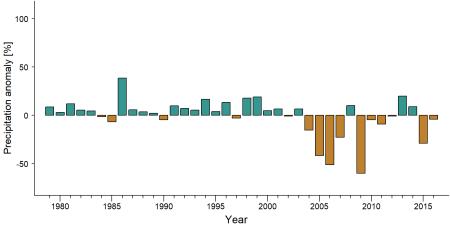
Precipitation anomaly in Tingi Hills Non-hunting Forest Reserve -
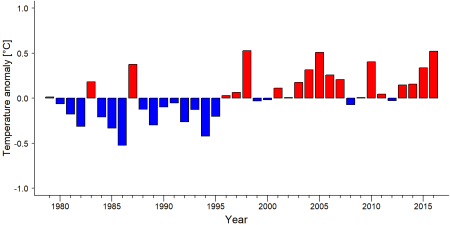
Temperature anomaly in Tingi Hills Non-hunting Forest Reserve


External links
References
BirdLife International. 2019. Important Bird Areas factsheet: Tingi Hills Non-hunting Forest Reserve. Downloaded from http://www.birdlife.org on 19/09/2019.
Brncic, T.M., Amarasekaran,B. & McKenna,A. (2010) Final Report of the Sierra Leone National Chimpanzee Census Project. Tacugama Chimpanzee Sanctuary, Freetown, Sierra Leone. link
Environment Protection Agency (EPA). 2017. Sierra Leone’s Second National Biodiversity Strategy and Action Plan 2017-2026.
Kiribou, R., Tehoda, P., Chukwu, O., Bempah, G., Kühl, H. S., Ferreira, J., …, & Heinicke, S. (2024). Exposure of African ape sites to climate change impacts. PLOS Climate, 3(2), e0000345. doi:10.1371/journal.pclm.0000345
Page created by: APES Atlas Team Date: 2019-09-20