
UFA 10-063 ZICGC3: Difference between revisions
No edit summary Tag: Reverted |
No edit summary Tag: Manual revert |
||
| Line 385: | Line 385: | ||
<span id="R01848"></span>Beukou, B., Sombambo, M., Nzooh, Z., N'Goran, K. P., Hessana, D., Sebogo, L., & Mengamenya, A. (2019). Dynamique des populations de grands et moyens mammiferes dans le segment Cameroun du paysage Tri-National dela Sangha. WWF Report and MINFOP. | <span id="R01848"></span>Beukou, B., Sombambo, M., Nzooh, Z., N'Goran, K. P., Hessana, D., Sebogo, L., & Mengamenya, A. (2019). Dynamique des populations de grands et moyens mammiferes dans le segment Cameroun du paysage Tri-National dela Sangha. WWF Report and MINFOP. | ||
<span id="R02331"></span>Kiribou, R., Tehoda, P., Chukwu, O., Bempah, G., Kühl, H. S., Ferreira, J., …, & Heinicke, S. (2024). Exposure of African ape sites to climate change impacts. ''PLOS Climate'', 3(2), | <span id="R02331"></span>Kiribou, R., Tehoda, P., Chukwu, O., Bempah, G., Kühl, H. S., Ferreira, J., …, & Heinicke, S. (2024). Exposure of African ape sites to climate change impacts. ''PLOS Climate'', 3(2), e0000345. [https://doi.org/10.1371/journal.pclm.0000345 doi:10.1371/journal.pclm.0000345] | ||
'''Page created by: '''Onella Mundi''' Date:''' 2024-11-25 10:07:00 | '''Page created by: '''Onella Mundi''' Date:''' 2024-11-25 10:07:00 | ||
Latest revision as of 17:55, 15 October 2026
Central Africa > Cameroon > UFA 10-063_ZICGC3
Français | Português | Español | Bahasa Indonesia | Melayu
Summary
- Central chimpanzees (Pan troglodytes troglodytes) & western lowland gorillas (Gorilla gorilla gorilla) are present in UFA 10-063_ZICGC3 (Forest Management Unit).
- In 2018, the great ape population was estimated at 2,546 (1,626-3,985) individuals.
- The population trends are unknown.
Site characteristics
The site exhibits notable ecological dynamics, particularly concerning elephant populations and primate species. Over time, elephant densities have increased between 2015 and 2018. The site supports diverse wildlife, including chimpanzees, gorillas, and various duiker species. However, the distribution of elephants and other species has shifted over time, due to anthropogenic pressures such as hunting and habitat modification. The habitat consists of primary and secondary forests, swamps, and human-altered landscapes, making it a crucial area for conservation. Human activities have influenced species movement, emphasizing the need for targeted conservation efforts to mitigate habitat fragmentation and ensure sustainable wildlife populations (Beukou et al. 2019).
Table 1. Basic site information for UFA 10-063_ZICGC3
| Species | Pan troglodytes troglodytes, Gorilla gorilla gorilla |
| Area | 838.18 km² |
| Coordinates | Lat: 2.235082 , Lon: 15.614917 |
| Type of site | Logging concession and community managed hunting interest zone |
| Habitat types | Subtropical/tropical moist lowland forest, Subtropical/tropical swamp forest |
| Type of governance |
Types of sites Governance types Habitat types
Ape status
Table 2. Ape population estimates reported for UFA 10-063_ZICGC3
| Species | Year | Occurrence | Encounter or vistation rate (nests/km; ind/day) | Density estimate [ind./ km²] (95% CI) | Abundance estimate (95% CI) | Survey area | Sampling method | Analytical framework | Source | Comments | A.P.E.S. database ID |
|---|---|---|---|---|---|---|---|---|---|---|---|
| Gorilla gorilla gorilla | 2018 | 1.50 (0.92-2.43) | 1,254 (772-2,038) | UFA 10-063_ZICGC3 (83.21 km²) | Line transects | Distance sampling with adopted decay time | Beukou et al. 2019, WWF Cameroon | CMR0058, CMR0128 CMR0132, CMR0135, CMR0138, CMR0150, CMR0153
| |||
| Pan troglodytes troglodytes & Gorilla gorilla gorilla | 2015 | 1.66 (1.06-2.60) | 1,387 (885-2,175) | UFA 10-063_ZICGC3 (83.21 km²) | Line transects | Distance sampling with adopted decay time | Beukou et al. 2019, WWF Cameroon | CMR0058, CMR0128 CMR0132, CMR0135, CMR0138, CMR0150, CMR0153
| |||
| Gorilla gorilla gorilla | 2015 | 2.10 (1.39-3.21) | 2,444 (1,607-3716) | UFA 10-063_ZICGC3 (83.21 km²) | Line transects | Distance sampling with adopted decay time | Beukou et al. 2019, WWF Cameroon | CMR0058, CMR0128 CMR0132, CMR0135, CMR0138, CMR0150, CMR0153
| |||
| Pan troglodytes troglodytes & Gorilla gorilla gorilla | 2018 | 3.03 (1.94-4.75) | 2,546 (1,626-3,985) | UFA 10-063_ZICGC3 (83.21 km²) | Line transects | Distance sampling with adopted decay time | Beukou et al. 2019, WWF Cameroon | CMR0058, CMR0128 CMR0132, CMR0135, CMR0138, CMR0150, CMR0153
|
Sampling methods Analytical frameworks
Threats
Table 3. Threats to apes reported for UFA 10-063_ZICGC3
| Category | Specific threats | Threat level | Description | Year of threat |
|---|---|---|---|---|
| 3 Energy production & mining | 3.2 Mining & quarrying | High (more than 70% of population affected) | Mining on the periphery of the park destroys or disturbs the natural wildlife habitats (Beukou et al. 2019). | 2002-Ongoing (2018) |
| 4 Transportation & service corridors | 4.1 Roads & railroads | Present (unknown severity) | Presence of roads and railroads around the periphery zone (UFA10-063_ZICGC3) of the Lobeke NP (Beukou et al. 2019). | Ongoing (2018) |
| 5 Biological resource use | 5.1 Hunting & collecting terrestrial animals | Medium (30-70% of population affected) | Hunting is present in the area (Beukou et al. 2019). Presence of sport hunting on the periphery of the park does not respect sustainable management principles (Beukou et al. 2019). | 2002-Ongoing (2018) |
| 5 Biological resource use | 5.3 Logging & wood harvesting | High (more than 70% of population affected) | The presence of human activities, such as logging, threatens the integrity of forest habitats of the Lobeke landscape (Beukou et al. 2019). | 2015-Ongoing (2018) |
| 6 Human intrusions & disturbance | 6.3 Other human disturbances | High (more than 70% of population affected) | The illegal circulation of war weapons in the TNS landscape intensifies the high poaching of elephants for ivory trade as well as gorilla and chimpanzees although elephants remain the main target during this survey years. More over, traps, cartridge cases, camp sites are present pose threats to this site (Beukou et al. 2019). | 2002-Ongoing (2018) |
Conservation activities
Table 4. Conservation activities reported for UFA 10-063_ZICGC3
| Category | Specific activity | Description | Implementing organization(s) | Year of activity |
|---|---|---|---|---|
| 2 Counter-wildlife crime | 2.3 Conduct regular anti-poaching patrols | During data collection, teams led by eco-guards assisted by military personnel consistently covered the study area. resulting in the seizure of 14 weapons (13 12-gauge & 01 AK47), 211 rounds of AKA 47 ammunition and more than 2,500 steel wire booby traps dismantled. Although the principal objectif was not to combat poaching. A significant number of seizures of poaching materials were also recorded during the reconnaissance walks carried out in 2016 in Lobeke NP and its peripheral zone (UFA10-063_ZICGC3) in 2015. | WWF Cameroon Country Program and Lobeke National Park Conservation Office | 2015-Ongoing (2018) |
Challenges
Table 5. Challenges reported for UFA 10-063_ZICGC3
| Challenges | Specific challenges | Source | Year(s) |
|---|---|---|---|
| 2 Resources and capacity | 2.2 Lack of staff | Beukou et al. 2019 | 2015-Ongoing (2018) |
| 2 Resources and capacity | 2.6 Lack of biomonitoring/survey data | Beukou et al. 2019 | 2000-Ongoing (2018) |
| 3 Engaged community | 3.1 General lack of community engagement or support | Beukou et al. 2019 | 2015-Ongoing (2018) |
| 3 Engaged community | 3.2 Lack of youth engagement | Beukou et al. 2019 | 2015-Ongoing (2018) |
| 6 Safety and stability | 6.2 Insecurity | Beukou et al. 2019 | 2015-Ongoing (2018) |
Enablers
Table 6. Enablers reported for UFA 10-063_ZICGC3
| Enablers | Specific enablers | Source | Year(s) |
|---|---|---|---|
| 1 Site management | 1.3 Adaptive management practices | Beukou et al. 2019 | 2015-Ongoing (2018) |
| 2 Resources and capacity | 2.6 External partnerships that add expertise or resources | Beukou et al. 2019 | 2015-Ongoing (2018) |
Research activities
Research activities in UFA 10-063/ZICGC 3 have focused primarily on the abundance, distribution, and habitat usage of great apes, including gorillas and chimpanzees, in the context of human impact and conservation strategies. Data collected through transects have recorded signs of human activities affecting species distribution, with notable declines in density compared to nearby protected areas like Lobeke National Park (Beukou et al. 2019).
Documented behaviours
Exposure to climate change impacts
As part of a study on the exposure of African great ape sites to climate change impacts, Kiribou et al. (2024) extracted climate data and data on projected extreme climate impact events for the site. Climatological characteristics were derived from observation-based climate data provided by the Inter-Sectoral Impact Model Intercomparison Project (ISIMIP, www.isimip.org). Parameters were calculated as the average across each 30-year period. For 1981-2010, the EWEMBI dataset from ISIMIP2a was used. For the two future periods (2021-2050 and 2071-2099) ISIMIP2b climate data based on four CMIP5 global climate models were used. For future projections, two Representative Concentration Pathways (RCP) were used. RCP 2.6 is a scenario with strong mitigation measures in which global temperatures would likely rise below 2C. RCP 6.0 is a scenario with medium emissions in which global temperatures would likely rise up to 3C by 2100. For the number of days with heavy precipitation events, the 98th percentile of all precipitation days (>1mm/d) was calculated for the 1979-2013 reference period as a threshold for a heavy precipitation event. Then, for each year, the number of days above that threshold was derived. The figures on temperature and precipitation anomaly show the deviation from the mean temperature and mean precipitation for the 1979-2013 reference period.
The estimated exposure to future extreme climate impact events (crop failure, drought, river flood, wildfire, tropical cyclone, and heatwave) is based on a published dataset by Lange et al. 2020 derived from ISIMIP2b data. The same global climate models and RCPs as described above were used. Within each 30-year period, the number of years with an extreme event and the average proportion of the site affected were calculated (Kiribou et al. 2024).
Table 8. Estimated past and projected climatological characteristics in UFA 10-063_ZICGC3
| Value | 1981-2010 | 2021-2050, RCP 2.6 | 2021-2050, RCP 6.0 | 2071-2099, RCP 2.6 | 2071-2099, RCP 6.0 |
|---|---|---|---|---|---|
| Mean temperature [C] | 24.3 | 25.7 | 25.6 | 26 | 27 |
| Annual precipitation [mm] | 1434 | 1451 | 1477 | 1505 | 1486 |
| Max no. consecutive dry days (per year) | 24.9 | 19.6 | 21.9 | 17.4 | 20.5 |
| No. days with heavy precipitation (per year) | 6.5 | 7.7 | 8.9 | 7.9 | 9.7 |
Table 9. Projected exposure of apes to extreme climate impact events in UFA 10-063_ZICGC3
| Type | No. of years with event (2021-2050, RCP 2.6) | % of site exposed (2021-2050, RCP 2.6) | No. of years with event (2021-2050, RCP 6.0) | % of site exposed (2021-2050, RCP 6.0) | No. of years with event (2070-2099, RCP 2.6) | % of site exposed (2070-2099, RCP 2.6) | No. of years with event (2070-2099, RCP 6.0) | % of site exposed (2070-2099, RCP 6.0) |
|---|---|---|---|---|---|---|---|---|
| Crop failure | 5.5 | 0 | 4 | 0 | 7.5 | 0 | 13.5 | 0 |
| Drought | 0 | 0 | 0 | 0 | 0 | 0 | 0 | 0 |
| Heatwave | 3 | 50 | 2.5 | 100 | 4 | 100 | 10.5 | 100 |
| River flood | 0 | 0 | 1.25 | 0.41 | 0.5 | 0.13 | 1 | 0.35 |
| Tropical cyclone | 0 | 0 | 0 | 0 | 0 | 0 | 0 | 0 |
| Wildfire | 30 | 0.67 | 30 | 0.67 | 29 | 0.44 | 29 | 0.62 |
-
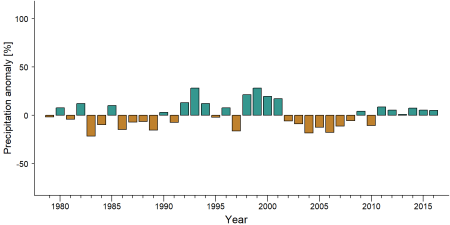
Precipitation anomaly in UFA 10-063_ZICGC3 -
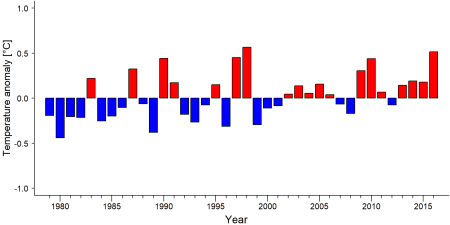
Temperature anomaly in UFA 10-063_ZICGC3


External links
References
Beukou, B., Sombambo, M., Nzooh, Z., N'Goran, K. P., Hessana, D., Sebogo, L., & Mengamenya, A. (2019). Dynamique des populations de grands et moyens mammiferes dans le segment Cameroun du paysage Tri-National dela Sangha. WWF Report and MINFOP.
Kiribou, R., Tehoda, P., Chukwu, O., Bempah, G., Kühl, H. S., Ferreira, J., …, & Heinicke, S. (2024). Exposure of African ape sites to climate change impacts. PLOS Climate, 3(2), e0000345. doi:10.1371/journal.pclm.0000345
Page created by: Onella Mundi Date: 2024-11-25 10:07:00