
Gola Rainforest National Park: Difference between revisions
No edit summary |
No edit summary Tag: Manual revert |
||
| (9 intermediate revisions by the same user not shown) | |||
| Line 13: | Line 13: | ||
* Key threats to chimpanzees are poaching and habitat destruction due to logging and shifting agriculture. | * Key threats to chimpanzees are poaching and habitat destruction due to logging and shifting agriculture. | ||
* A REDD+ project is being developed and implemented at the site with the support of the Royal Society for the Protection of Birds, which aims to ensure funds for the continuation of conservation work in the park and improve the management of natural resources. | * A REDD+ project is being developed and implemented at the site with the support of the Royal Society for the Protection of Birds, which aims to ensure funds for the continuation of conservation work in the park and improve the management of natural resources. | ||
= Site characteristics = | = Site characteristics = | ||
The [https://www.golarainforest.org/the-forest site] consists of three forest blocks (Gola North, Central, and South) situated in southeast Sierra Leone, which are linked to Liberia’s Gola National Park, forming a [https://www.africa-eu-partnership.org/en/success-stories/trans-boundary-peace-park-sierra-leone-and-liberia transboundary peace park]. The forests in Gola Rainforest National Park are a catchment for the Moro, Mahoi, Mano and Moa rivers, providing an important water source for nearby villages (Barca et al. 2018). The area forms part of the Upper Guinean forest ecosystem, a biodiversity hotspot with a large number of endemic species. Close to 1,000 plant species have been identified in [https://www.golarainforest.org/the-forest Gola Rainforest National Park], half of which are endemic to the Upper Guinea forest ecosystem. In addition to the western chimpanzee (''Pan troglodytes verus''), other [https://www.golarainforest.org/wildlife threatened species] inhabit the area, including pygmy hippos (''Choeropsis liberiensis''), pangolins, red colobus (''Piliocolobus badius''), and Jentink’s duiker (''Cephalophus jentinki''). Gola Rainforest National Park is also classified as an Important Bird Area (BirdLife International 2019a) and has been included in the tentative list of [https://whc.unesco.org/en/tentativelists/5747/ World Heritage Sites]. | The [https://www.golarainforest.org/the-forest site] consists of three forest blocks (Gola North, Central, and South) situated in southeast Sierra Leone, which are linked to Liberia’s Gola National Park, forming a [https://www.africa-eu-partnership.org/en/success-stories/trans-boundary-peace-park-sierra-leone-and-liberia transboundary peace park]. The forests in Gola Rainforest National Park are a catchment for the Moro, Mahoi, Mano and Moa rivers, providing an important water source for nearby villages ([[#R00634|Barca et al. 2018]]). The area forms part of the Upper Guinean forest ecosystem, a biodiversity hotspot with a large number of endemic species. Close to 1,000 plant species have been identified in [https://www.golarainforest.org/the-forest Gola Rainforest National Park], half of which are endemic to the Upper Guinea forest ecosystem. In addition to the western chimpanzee (''Pan troglodytes verus''), other [https://www.golarainforest.org/wildlife threatened species] inhabit the area, including pygmy hippos (''Choeropsis liberiensis''), pangolins, red colobus (''Piliocolobus badius''), and Jentink’s duiker (''Cephalophus jentinki''). Gola Rainforest National Park is also classified as an Important Bird Area ([[#R00636|BirdLife International 2019a]]) and has been included in the tentative list of [https://whc.unesco.org/en/tentativelists/5747/ World Heritage Sites]. | ||
'''Table 1. Basic site information for Gola Rainforest National Park''' | '''Table 1. Basic site information for Gola Rainforest National Park''' | ||
| Line 48: | Line 44: | ||
= Ape status = | = Ape status = | ||
The chimpanzee population in Gola Rainforest National Park is estimated to be 270 individuals, which is equivalent to almost 5% of Sierra Leone’s estimated population (Brncic et al. 2010). The population trend is unknown. | The chimpanzee population in Gola Rainforest National Park is estimated to be 270 individuals, which is equivalent to almost 5% of Sierra Leone’s estimated population ([[#R00638|Brncic et al. 2010]]). The population trend is unknown. | ||
'''Table 2. Ape population estimates reported for Gola Rainforest National Park''' | '''Table 2. Ape population estimates reported for Gola Rainforest National Park''' | ||
| Line 66: | Line 62: | ||
|- | |- | ||
|''Pan troglodytes verus'' | |''Pan troglodytes verus'' | ||
| | |2015-2016 | ||
| | | | ||
|0. | |0.6 | ||
| | | | ||
| | | | ||
|Gola | |Gola Rainforest National Park | ||
|Line transects | |Line transects | ||
| | | | ||
| | |[[#R00634|Barca et al. 2018]] | ||
| | |96 chimpanzee nests were recorded | ||
| | |SLE0012 | ||
|- | |- | ||
|''Pan troglodytes verus'' | |''Pan troglodytes verus'' | ||
|2009 | |2009 | ||
| | | | ||
| | |0.76 | ||
|0. | |0.25 (0.14-0.43) | ||
| | |270 (159-468) | ||
|Gola forest reserves and potential corridors | |Gola forest reserves and potential corridors | ||
|Line transects | |Line transects | ||
| | | | ||
| | |[[#R00638|Brncic et al. 2010]] | ||
| | |Population estimate based on a re-analysis of data presented in Ganas 2009 | ||
| | |SLE0002, SLE0003<div class="mw-collapsible mw-collapsed" data-expandtext="+13 more" data-collapsetext="less">SLE0004, SLE0014, SLE0015, SLE0017, SLE0018, SLE0021, SLE0024, SLE0025, SLE0026, SLE0029, SLE0032, SLE0036, SLE0037</div> | ||
|- | |- | ||
|''Pan troglodytes verus'' | |''Pan troglodytes verus'' | ||
|2009 | |2009 | ||
| | | | ||
| | | | ||
|0. | |0.27 (0.18-0.42) | ||
| | |305 (203-458) | ||
|Gola forest reserves and potential corridors | |Gola forest reserves and potential corridors | ||
|Line transects | |Line transects | ||
| | | | ||
|Brncic et al. 2010 | |Ganas 2009 as cited in [[#R00638|Brncic et al. 2010]] | ||
| | |Survey effort: 173 km | ||
|SLE0002, SLE0003<div class="mw-collapsible mw-collapsed" data-expandtext="+13 more" data-collapsetext="less">SLE0004, SLE0014, SLE0015, SLE0017, SLE0018, SLE0021, SLE0024, SLE0025, SLE0026, SLE0029, SLE0032, SLE0036, SLE0037</div> | |||
|- | |- | ||
|''Pan troglodytes verus'' | |''Pan troglodytes verus'' | ||
| | |2006-2007 | ||
| | | | ||
|0. | |0.102 | ||
| | | | ||
| | | | ||
|Gola | |Gola West, East, North, and an extension of Gola North | ||
|Line transects | |Line transects | ||
| | | | ||
| | |[[#R00642|Klop et al. 2008]] | ||
| | |Survey effort: 245.28 km. No evidence of chimpanzees found in Gola West | ||
| | | | ||
|} | |} | ||
| Line 122: | Line 118: | ||
= Threats = | = Threats = | ||
Approximately 28% of Gola Forest has been subject to logging (Klop et al. 2008). Large-scale logging operations in Gola started in the 1960s and continued until the late 1980s (Klop et al. 2008). Forestry Industries Corporation (FIC) and the Sierra Leone Timber Industry and Plantation Company (Sileti) were the two main companies responsible for the exploitation of timber in Gola (Klop et al. 2008). The resulting impacts from these logging operations include an extensive road network in Gola North, and a large clearing in Gola East. During the 1991-2001 civil war in Sierra Leone, the Revolutionary United Front set up camps near Gola forest; however, a survey that compared wildlife abundances before and after the war found no evidence of serious negative impacts from the war (Lindsell et al. 2011). [https://www.birdlife.org/worldwide/projects/forests-hope-site-gola-rainforest-national-park-sierra-leone Current threats] in the area include small-scale logging, bushmeat hunting, and shifting agriculture. | Approximately 28% of Gola Forest has been subject to logging ([[#R00642|Klop et al. 2008]]). Large-scale logging operations in Gola started in the 1960s and continued until the late 1980s ([[#R00642|Klop et al. 2008]]). Forestry Industries Corporation (FIC) and the Sierra Leone Timber Industry and Plantation Company (Sileti) were the two main companies responsible for the exploitation of timber in Gola ([[#R00642|Klop et al. 2008]]). The resulting impacts from these logging operations include an extensive road network in Gola North, and a large clearing in Gola East. During the 1991-2001 civil war in Sierra Leone, the Revolutionary United Front set up camps near Gola forest; however, a survey that compared wildlife abundances before and after the war found no evidence of serious negative impacts from the war ([[#R00643|Lindsell et al. 2011]]). [https://www.birdlife.org/worldwide/projects/forests-hope-site-gola-rainforest-national-park-sierra-leone Current threats] in the area include small-scale logging, bushmeat hunting, and shifting agriculture. | ||
'''Table 3. Threats to apes reported for Gola Rainforest National Park''' | '''Table 3. Threats to apes reported for Gola Rainforest National Park''' | ||
| Line 132: | Line 128: | ||
!Year of threat | !Year of threat | ||
|- | |- | ||
| | |2 Agriculture & aquaculture | ||
| | |2.1 Annual & perennial non-timber crops | ||
| | |Present (unknown severity) | ||
| | |Shifting agriculture due to increasing population growth around the area and scarcity of fertile land ([[#R00637|BirdLife International 2019b]]) | ||
| | |Ongoing (2019) | ||
|- | |- | ||
|4 Transportation & service corridors | |4 Transportation & service corridors | ||
|4.1 Roads & railroads | |4.1 Roads & railroads | ||
|High (more than 70% of population affected) | |High (more than 70% of population affected) | ||
|Extensive road network in Gola North as a result of large-scale logging activities (Klop et al. 2008), which facilitates access to the forest. | |Extensive road network in Gola North as a result of large-scale logging activities ([[#R00642|Klop et al. 2008]]), which facilitates access to the forest. | ||
|Ongoing (2008) | |Ongoing (2008) | ||
|- | |- | ||
| | |5 Biological resource use | ||
| | |5.3 Logging & wood harvesting | ||
| | |High (more than 70% of population affected) | ||
| | |Large-scale logging operations between 1960s and 1980s ([[#R00642|Klop et al. 2008]]), Small-scale logging by local communities ([[#R00636|BirdLife International 2019a]]) | ||
| | |1960-1989 | ||
|} | |} | ||
| Line 155: | Line 151: | ||
= Conservation activities = | = Conservation activities = | ||
A conservation program began in 1990 by the Forestry Division of the government of Sierra Leone and the Conservation Society for Sierra Leone (CSSL). Since then, the Royal Society for the Protection of Birds (RSPB) became a supporter of the conservation projects in Gola, and the site is part of RSPB’s [http://www.birdlife.org/worldwide/programmes/forests-hope Forests of Hope Programme]. Conservation activities were interrupted by the civil war but resumed after the return of peace in 2002 (Lindsell et al. 2011). | A conservation program began in 1990 by the Forestry Division of the government of Sierra Leone and the Conservation Society for Sierra Leone (CSSL). Since then, the Royal Society for the Protection of Birds (RSPB) became a supporter of the conservation projects in Gola, and the site is part of RSPB’s [http://www.birdlife.org/worldwide/programmes/forests-hope Forests of Hope Programme]. Conservation activities were interrupted by the civil war but resumed after the return of peace in 2002 ([[#R00643|Lindsell et al. 2011]]). | ||
A [https://www.rspb.org.uk/our-work/conservation/projects/gola-rainforest-sierra-leones-first-rainforest-national-park/ REDD+ project] is currently under development at the site. The project will use funds obtained from the sale of carbon credits to improve the management of the park, fund long-term conservation work, develop sustainable farming practices, and the establishment of a research station in the park. | A [https://www.rspb.org.uk/our-work/conservation/projects/gola-rainforest-sierra-leones-first-rainforest-national-park/ REDD+ project] is currently under development at the site. The project will use funds obtained from the sale of carbon credits to improve the management of the park, fund long-term conservation work, develop sustainable farming practices, and the establishment of a research station in the park. | ||
| Line 169: | Line 165: | ||
!Year of activity | !Year of activity | ||
|- | |- | ||
| | |1 Development impact mitigation | ||
| | |1.4 Farm more intensively and effectively in selected areas and spare more natural land | ||
| | |Develop sustainable farming practices ([[#R00637|BirdLife International 2019b]]) | ||
| | | | ||
| | |Ongoing (2019) | ||
|- | |- | ||
|1 Development impact mitigation | |1 Development impact mitigation | ||
|1.8 Use set-aside areas of natural habitat (e.g., mining, logging, agricultural areas) | |1.8 Use set-aside areas of natural habitat (e.g., mining, logging, agricultural areas) | ||
|Bordering the site, cocoa trees are strategically planted alongside tree and plant species that increase soil fertility and attract birds (BirdLife International 2018) | |Bordering the site, cocoa trees are strategically planted alongside tree and plant species that increase soil fertility and attract birds ([[#R00635|BirdLife International 2018]]) | ||
| | | | ||
|Ongoing (2018) | |Ongoing (2018) | ||
|- | |- | ||
|2 Counter-wildlife crime | |2 Counter-wildlife crime | ||
|2.3 Conduct regular anti-poaching patrols | |2.3 Conduct regular anti-poaching patrols | ||
|Forest guards patrol and monitor the forest (Gola Rainforest National Park 2019a) | |Forest guards patrol and monitor the forest ([[#R00640|Gola Rainforest National Park 2019a]]) | ||
| | | | ||
|Ongoing (2019) | |Ongoing (2019) | ||
| Line 195: | Line 185: | ||
|4 Education & awareness | |4 Education & awareness | ||
|4.1 Educate local communities about apes and sustainable use | |4.1 Educate local communities about apes and sustainable use | ||
|The Gola Rainforest Conservation Center offers environmental education and conservation awareness to school classes and local communities (Gola Rainforest National Park 2019a) | |The Gola Rainforest Conservation Center offers environmental education and conservation awareness to school classes and local communities ([[#R00640|Gola Rainforest National Park 2019a]]) | ||
| | | | ||
|Ongoing (2019) | |Ongoing (2019) | ||
|- | |||
|5 Protection & restoration | |||
|5.2 Legally protect ape habitat | |||
|The site was designated as National Park in 2010 ([[#R00641|Gola Rainforest National Park 2019b]]) | |||
| | |||
|2010-Ongoing (2026) | |||
|- | |- | ||
|7 Economic & other incentives | |7 Economic & other incentives | ||
|7.2 Provide non-monetary benefits to local communities for sustainably managing their forest and its wildlife (e.g., better education, infrastructure development) | |7.2 Provide non-monetary benefits to local communities for sustainably managing their forest and its wildlife (e.g., better education, infrastructure development) | ||
|RSPB is developing a REDD+ project which aims to provide funds for the long-term management of the site and support local people in the sustainable management of resources (RSPB 2019) | |RSPB is developing a REDD+ project which aims to provide funds for the long-term management of the site and support local people in the sustainable management of resources ([[#R00644|RSPB 2019]]) | ||
| | | | ||
|Ongoing (2019) | |Ongoing (2019) | ||
| Line 221: | Line 217: | ||
|2 Resources and capacity | |2 Resources and capacity | ||
|2.5 Lack of equipment/transportation | |2.5 Lack of equipment/transportation | ||
|Brncic et al. 2010 | |[[#R00638|Brncic et al. 2010]] | ||
| | | | ||
|} | |} | ||
| Line 273: | Line 269: | ||
= Research activities = | = Research activities = | ||
Several surveys have been done at the site to monitor wildlife and estimate species abundances (e.g., Brncic et al. 2010, Klop et al. 2008, Davies et al. 2008), and the nest ecology of chimpanzees has also been studied at the site (Barca et al. 2018). | Several surveys have been done at the site to monitor wildlife and estimate species abundances (e.g., [[#R00638|Brncic et al. 2010]], [[#R00642|Klop et al. 2008]], [[#R00639|Davies et al. 2008]]), and the nest ecology of chimpanzees has also been studied at the site ([[#R00634|Barca et al. 2018]]). | ||
| Line 307: | Line 303: | ||
= Exposure to climate change impacts = | = Exposure to climate change impacts = | ||
As part of a study on the exposure of African great ape sites to climate change impacts, Kiribou et al. | As part of a study on the exposure of African great ape sites to climate change impacts, [[#R02204|Kiribou et al. (2024)]] extracted climate data and data on projected extreme climate impact events for the site. Climatological characteristics were derived from observation-based climate data provided by the Inter-Sectoral Impact Model Intercomparison Project (ISIMIP, www.isimip.org). Parameters were calculated as the average across each 30-year period. For 1981-2010, the EWEMBI dataset from ISIMIP2a was used. For the two future periods (2021-2050 and 2071-2099) ISIMIP2b climate data based on four CMIP5 global climate models were used. For future projections, two Representative Concentration Pathways (RCP) were used. RCP 2.6 is a scenario with strong mitigation measures in which global temperatures would likely rise below 2C. RCP 6.0 is a scenario with medium emissions in which global temperatures would likely rise up to 3C by 2100. For the number of days with heavy precipitation events, the 98th percentile of all precipitation days (>1mm/d) was calculated for the 1979-2013 reference period as a threshold for a heavy precipitation event. Then, for each year, the number of days above that threshold was derived. The figures on temperature and precipitation anomaly show the deviation from the mean temperature and mean precipitation for the 1979-2013 reference period. | ||
The estimated exposure to future extreme climate impact events (crop failure, drought, river flood, wildfire, tropical cyclone, and heatwave) is based on a published dataset by Lange et al. 2020 derived from ISIMIP2b data. The same global climate models and RCPs as described above were used. Within each 30-year period, the number of years with an extreme event and the average proportion of the site affected were calculated ( | The estimated exposure to future extreme climate impact events (crop failure, drought, river flood, wildfire, tropical cyclone, and heatwave) is based on a published dataset by Lange et al. 2020 derived from ISIMIP2b data. The same global climate models and RCPs as described above were used. Within each 30-year period, the number of years with an extreme event and the average proportion of the site affected were calculated ([[#R02204|Kiribou et al. 2024]]). | ||
'''Table 8. Estimated past and projected climatological characteristics in Gola Rainforest National Park''' | '''Table 8. Estimated past and projected climatological characteristics in Gola Rainforest National Park''' | ||
| Line 432: | Line 428: | ||
= References = | = References = | ||
Barca, B., Turay, B.S., Kanneh, B.A., Tayleur, C. 2018. Nest ecology and conservation of Western Chimpanzees (Pan troglodytes verus) in Gola Rainforest National Park, Sierra Leone. Primate Conservation (32): 133-139. | <span id="R00634"></span>Barca, B., Turay, B.S., Kanneh, B.A., Tayleur, C. 2018. Nest ecology and conservation of Western Chimpanzees (Pan troglodytes verus) in Gola Rainforest National Park, Sierra Leone. Primate Conservation (32): 133-139. [http://www.primate-sg.org/primate-conservation-32/ link] | ||
<span id="R00635"></span>BirdLife International. 2018. Eat chocolate, save a rainforest - the Gola Cocoa Project tells you how. Online: https://www.birdlife.org/worldwide/news/eat-chocolate-save-rainforest-gola-cocoa-project-tells-you-how | |||
BirdLife International. | <span id="R00636"></span>BirdLife International. 2019a. Important Bird Areas factsheet: Gola Forests. Downloaded from [http://datazone.birdlife.org/site/factsheet/gola-forests-iba-sierra-leone datazone.birdlife.org ] on 05/07/2019. | ||
BirdLife International. | <span id="R00637"></span>BirdLife International. 2019b. Forests of Hope site - Gola Rainforest National Park, Sierra Leone. Online: [https://www.birdlife.org/worldwide/projects/forests-hope-site-gola-rainforest-national-park-sierra-leone www.birdlife.org] | ||
<span id="R00638"></span>Brncic, T.M., Amarasekaran,B. & McKenna,A. 2010. Final Report of the Sierra Leone National Chimpanzee Census Project. Tacugama Chimpanzee Sanctuary, Freetown, Sierra Leone. [https://web.archive.org/web/20160308223613/http://tacugama.com/census.html link] | |||
<span id="R00639"></span>Davies, Glyn & Schulte-Herbruggen, Bjorn & Kümpel, Noëlle & Mendelson, Samantha. (2008). Hunting and Trapping in Gola Forests, South-Eastern Sierra Leone: Bushmeat from Farm, Fallow and Forest. 10.1002/9780470692592.ch1. | |||
<span id="R00640"></span>Gola Rainforest National Park. 2019a The Gola Rainforest Conservation Centre (GRCC). Online: https://www.golarainforest.org/conservation-center [https://web.archive.org/web/20220122143832/https://golarainforest.org/conservation-center link] | |||
Gola Rainforest National Park. | <span id="R00641"></span>Gola Rainforest National Park. 2019b. Online: https://www.golarainforest.org/about [https://web.archive.org/web/20190722035626/https://www.golarainforest.org/about link] | ||
Gola | <span id="R00642"></span>Klop, E., Lindsell, J.A. & Siaka, A. 2008. Biodiversity of Gola Forest, Sierra Leone. Unpublished Report. Royal Society for the Protection of Birds, Sandy, UK, and Conservation Society of Sierra Leone, Freetown, Sierra Leone. [https://web.archive.org/web/20260825215338/https://golarainforest.org/ link] | ||
<span id="R00643"></span>Lindsell, J. A., Klop, E., & Siaka, A. M. (2011). The impact of civil war on forest wildlife in West Africa: mammals in Gola Forest, Sierra Leone. ''Oryx'', 45(1), 69-77. [https://doi.org/10.1017/s0030605310000347 doi:10.1017/s0030605310000347] | |||
<span id="R00644"></span>RSPB. 2019. The Gola Rainforest: Sierra Leone's first rainforest national park. Online: https://www.rspb.org.uk/our-work/conservation/projects/gola-rainforest-sierra-leones-first-rainforest-national-park/ | |||
<span id="R00645"></span>UNESCO. Gola Rainforest National Park. Online: https://whc.unesco.org/en/tentativelists/5747/ | |||
<span id="R02204"></span>Kiribou, R., Tehoda, P., Chukwu, O., Bempah, G., Kühl, H. S., Ferreira, J., …, & Heinicke, S. (2024). Exposure of African ape sites to climate change impacts. ''PLOS Climate'', 3(2), e0000345. [https://doi.org/10.1371/journal.pclm.0000345 doi:10.1371/journal.pclm.0000345] | |||
'''Page created by: '''APES Atlas Team''' Date:''' 2019-09-02 | '''Page created by: '''APES Atlas Team''' Date:''' 2019-09-02 | ||
Latest revision as of 17:53, 15 October 2026
West Africa > Sierra Leone > Gola Rainforest National Park
Français | Português | Español | Bahasa Indonesia | Melayu
Summary
- Western chimpanzees (Pan troglodytes verus) are present in Gola Rainforest National Park.
- It has been estimated that 270 (CI: 159-468) individuals occur at the site.
- The chimpanzee population trend is unknown.
- This site has a total size of 710 km².
- Key threats to chimpanzees are poaching and habitat destruction due to logging and shifting agriculture.
- A REDD+ project is being developed and implemented at the site with the support of the Royal Society for the Protection of Birds, which aims to ensure funds for the continuation of conservation work in the park and improve the management of natural resources.
Site characteristics
The site consists of three forest blocks (Gola North, Central, and South) situated in southeast Sierra Leone, which are linked to Liberia’s Gola National Park, forming a transboundary peace park. The forests in Gola Rainforest National Park are a catchment for the Moro, Mahoi, Mano and Moa rivers, providing an important water source for nearby villages (Barca et al. 2018). The area forms part of the Upper Guinean forest ecosystem, a biodiversity hotspot with a large number of endemic species. Close to 1,000 plant species have been identified in Gola Rainforest National Park, half of which are endemic to the Upper Guinea forest ecosystem. In addition to the western chimpanzee (Pan troglodytes verus), other threatened species inhabit the area, including pygmy hippos (Choeropsis liberiensis), pangolins, red colobus (Piliocolobus badius), and Jentink’s duiker (Cephalophus jentinki). Gola Rainforest National Park is also classified as an Important Bird Area (BirdLife International 2019a) and has been included in the tentative list of World Heritage Sites.
Table 1. Basic site information for Gola Rainforest National Park
| Species | Pan troglodytes verus |
| Area | 710 km² |
| Coordinates | Lat: 7.60 , Lon: -10.92 |
| Type of site | Protected area (National Park) |
| Habitat types | Subtropical/tropical moist lowland forest |
| Type of governance |
Types of sites Governance types Habitat types
Ape status
The chimpanzee population in Gola Rainforest National Park is estimated to be 270 individuals, which is equivalent to almost 5% of Sierra Leone’s estimated population (Brncic et al. 2010). The population trend is unknown.
Table 2. Ape population estimates reported for Gola Rainforest National Park
| Species | Year | Occurrence | Encounter or vistation rate (nests/km; ind/day) | Density estimate [ind./ km²] (95% CI) | Abundance estimate (95% CI) | Survey area | Sampling method | Analytical framework | Source | Comments | A.P.E.S. database ID |
|---|---|---|---|---|---|---|---|---|---|---|---|
| Pan troglodytes verus | 2015-2016 | 0.6 | Gola Rainforest National Park | Line transects | Barca et al. 2018 | 96 chimpanzee nests were recorded | SLE0012 | ||||
| Pan troglodytes verus | 2009 | 0.76 | 0.25 (0.14-0.43) | 270 (159-468) | Gola forest reserves and potential corridors | Line transects | Brncic et al. 2010 | Population estimate based on a re-analysis of data presented in Ganas 2009 | SLE0002, SLE0003 SLE0004, SLE0014, SLE0015, SLE0017, SLE0018, SLE0021, SLE0024, SLE0025, SLE0026, SLE0029, SLE0032, SLE0036, SLE0037
| ||
| Pan troglodytes verus | 2009 | 0.27 (0.18-0.42) | 305 (203-458) | Gola forest reserves and potential corridors | Line transects | Ganas 2009 as cited in Brncic et al. 2010 | Survey effort: 173 km | SLE0002, SLE0003 SLE0004, SLE0014, SLE0015, SLE0017, SLE0018, SLE0021, SLE0024, SLE0025, SLE0026, SLE0029, SLE0032, SLE0036, SLE0037
| |||
| Pan troglodytes verus | 2006-2007 | 0.102 | Gola West, East, North, and an extension of Gola North | Line transects | Klop et al. 2008 | Survey effort: 245.28 km. No evidence of chimpanzees found in Gola West |
Sampling methods Analytical frameworks
Threats
Approximately 28% of Gola Forest has been subject to logging (Klop et al. 2008). Large-scale logging operations in Gola started in the 1960s and continued until the late 1980s (Klop et al. 2008). Forestry Industries Corporation (FIC) and the Sierra Leone Timber Industry and Plantation Company (Sileti) were the two main companies responsible for the exploitation of timber in Gola (Klop et al. 2008). The resulting impacts from these logging operations include an extensive road network in Gola North, and a large clearing in Gola East. During the 1991-2001 civil war in Sierra Leone, the Revolutionary United Front set up camps near Gola forest; however, a survey that compared wildlife abundances before and after the war found no evidence of serious negative impacts from the war (Lindsell et al. 2011). Current threats in the area include small-scale logging, bushmeat hunting, and shifting agriculture.
Table 3. Threats to apes reported for Gola Rainforest National Park
| Category | Specific threats | Threat level | Description | Year of threat |
|---|---|---|---|---|
| 2 Agriculture & aquaculture | 2.1 Annual & perennial non-timber crops | Present (unknown severity) | Shifting agriculture due to increasing population growth around the area and scarcity of fertile land (BirdLife International 2019b) | Ongoing (2019) |
| 4 Transportation & service corridors | 4.1 Roads & railroads | High (more than 70% of population affected) | Extensive road network in Gola North as a result of large-scale logging activities (Klop et al. 2008), which facilitates access to the forest. | Ongoing (2008) |
| 5 Biological resource use | 5.3 Logging & wood harvesting | High (more than 70% of population affected) | Large-scale logging operations between 1960s and 1980s (Klop et al. 2008), Small-scale logging by local communities (BirdLife International 2019a) | 1960-1989 |
Conservation activities
A conservation program began in 1990 by the Forestry Division of the government of Sierra Leone and the Conservation Society for Sierra Leone (CSSL). Since then, the Royal Society for the Protection of Birds (RSPB) became a supporter of the conservation projects in Gola, and the site is part of RSPB’s Forests of Hope Programme. Conservation activities were interrupted by the civil war but resumed after the return of peace in 2002 (Lindsell et al. 2011).
A REDD+ project is currently under development at the site. The project will use funds obtained from the sale of carbon credits to improve the management of the park, fund long-term conservation work, develop sustainable farming practices, and the establishment of a research station in the park.
Gola Rainforest National Park also has its own conservation center, the Gola Rainforest Conservation Center (GRCC), which hosts visitors and researchers. The GRCC also offers capacity building and environmental education activities to the staff of the park, students, and local communities.
Table 4. Conservation activities reported for Gola Rainforest National Park
| Category | Specific activity | Description | Implementing organization(s) | Year of activity |
|---|---|---|---|---|
| 1 Development impact mitigation | 1.4 Farm more intensively and effectively in selected areas and spare more natural land | Develop sustainable farming practices (BirdLife International 2019b) | Ongoing (2019) | |
| 1 Development impact mitigation | 1.8 Use set-aside areas of natural habitat (e.g., mining, logging, agricultural areas) | Bordering the site, cocoa trees are strategically planted alongside tree and plant species that increase soil fertility and attract birds (BirdLife International 2018) | Ongoing (2018) | |
| 2 Counter-wildlife crime | 2.3 Conduct regular anti-poaching patrols | Forest guards patrol and monitor the forest (Gola Rainforest National Park 2019a) | Ongoing (2019) | |
| 4 Education & awareness | 4.1 Educate local communities about apes and sustainable use | The Gola Rainforest Conservation Center offers environmental education and conservation awareness to school classes and local communities (Gola Rainforest National Park 2019a) | Ongoing (2019) | |
| 5 Protection & restoration | 5.2 Legally protect ape habitat | The site was designated as National Park in 2010 (Gola Rainforest National Park 2019b) | 2010-Ongoing (2026) | |
| 7 Economic & other incentives | 7.2 Provide non-monetary benefits to local communities for sustainably managing their forest and its wildlife (e.g., better education, infrastructure development) | RSPB is developing a REDD+ project which aims to provide funds for the long-term management of the site and support local people in the sustainable management of resources (RSPB 2019) | Ongoing (2019) |
Challenges
Table 5. Challenges reported for Gola Rainforest National Park
| Challenges | Specific challenges | Source | Year(s) |
|---|---|---|---|
| 2 Resources and capacity | 2.5 Lack of equipment/transportation | Brncic et al. 2010 |
Enablers
Table 6. Enablers reported for Gola Rainforest National Park
| Enablers | Specific enablers | Source | Year(s) |
|---|---|---|---|
| 1 Site management | |||
| 2 Resources and capacity | |||
| 3 Engaged community | |||
| 4 Institutional support | |||
| 5 Ecological context | |||
| 6 Safety and stability |
Research activities
Several surveys have been done at the site to monitor wildlife and estimate species abundances (e.g., Brncic et al. 2010, Klop et al. 2008, Davies et al. 2008), and the nest ecology of chimpanzees has also been studied at the site (Barca et al. 2018).
Documented behaviours
Table 7. Behaviours documented for Gola Rainforest National Park
| Category | Behavior | Observation type | Prevalence | Observation dates | Source | Habituation | Species | Comment |
|---|---|---|---|---|---|---|---|---|
| Not reported |
Exposure to climate change impacts
As part of a study on the exposure of African great ape sites to climate change impacts, Kiribou et al. (2024) extracted climate data and data on projected extreme climate impact events for the site. Climatological characteristics were derived from observation-based climate data provided by the Inter-Sectoral Impact Model Intercomparison Project (ISIMIP, www.isimip.org). Parameters were calculated as the average across each 30-year period. For 1981-2010, the EWEMBI dataset from ISIMIP2a was used. For the two future periods (2021-2050 and 2071-2099) ISIMIP2b climate data based on four CMIP5 global climate models were used. For future projections, two Representative Concentration Pathways (RCP) were used. RCP 2.6 is a scenario with strong mitigation measures in which global temperatures would likely rise below 2C. RCP 6.0 is a scenario with medium emissions in which global temperatures would likely rise up to 3C by 2100. For the number of days with heavy precipitation events, the 98th percentile of all precipitation days (>1mm/d) was calculated for the 1979-2013 reference period as a threshold for a heavy precipitation event. Then, for each year, the number of days above that threshold was derived. The figures on temperature and precipitation anomaly show the deviation from the mean temperature and mean precipitation for the 1979-2013 reference period.
The estimated exposure to future extreme climate impact events (crop failure, drought, river flood, wildfire, tropical cyclone, and heatwave) is based on a published dataset by Lange et al. 2020 derived from ISIMIP2b data. The same global climate models and RCPs as described above were used. Within each 30-year period, the number of years with an extreme event and the average proportion of the site affected were calculated (Kiribou et al. 2024).
Table 8. Estimated past and projected climatological characteristics in Gola Rainforest National Park
| Value | 1981-2010 | 2021-2050, RCP 2.6 | 2021-2050, RCP 6.0 | 2071-2099, RCP 2.6 | 2071-2099, RCP 6.0 |
|---|---|---|---|---|---|
| Mean temperature [C] | 26 | 27.1 | 27.1 | 27.2 | 28.3 |
| Annual precipitation [mm] | 2286 | 2245 | 2316 | 2290 | 2324 |
| Max no. consecutive dry days (per year) | 38.7 | 35.5 | 30.9 | 30.5 | 35.5 |
| No. days with heavy precipitation (per year) | 6.3 | 6.8 | 6.7 | 6.9 | 8.5 |
Table 9. Projected exposure of apes to extreme climate impact events in Gola Rainforest National Park
| Type | No. of years with event (2021-2050, RCP 2.6) | % of site exposed (2021-2050, RCP 2.6) | No. of years with event (2021-2050, RCP 6.0) | % of site exposed (2021-2050, RCP 6.0) | No. of years with event (2070-2099, RCP 2.6) | % of site exposed (2070-2099, RCP 2.6) | No. of years with event (2070-2099, RCP 6.0) | % of site exposed (2070-2099, RCP 6.0) |
|---|---|---|---|---|---|---|---|---|
| Crop failure | 7 | 0.12 | 8 | 0.08 | 7 | 0.09 | 14 | 0.08 |
| Drought | 0 | 0 | 0 | 0 | 0.5 | 12.5 | 0.5 | 12.5 |
| Heatwave | 9.5 | 67.71 | 10.5 | 77.78 | 10.5 | 83.62 | 19 | 86.31 |
| River flood | 1 | 2.09 | 1.5 | 2 | 2 | 2.19 | 5.5 | 3.18 |
| Tropical cyclone | 0 | 0 | 0 | 0 | 0.5 | 0.14 | 0.5 | 3.57 |
| Wildfire | 30 | 0.5 | 30 | 0.48 | 29 | 0.5 | 29 | 0.49 |
-
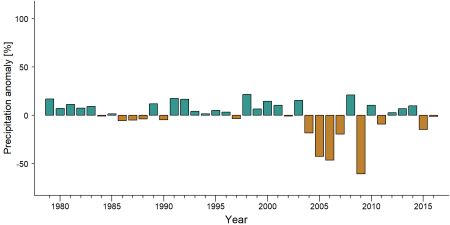
Precipitation anomaly in Gola Rainforest National Park -
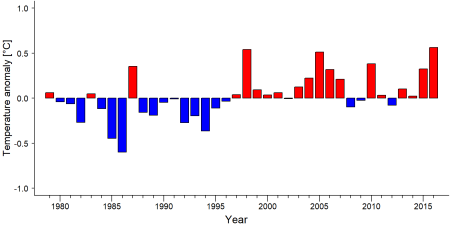
Temperature anomaly in Gola Rainforest National Park


External links
References
Barca, B., Turay, B.S., Kanneh, B.A., Tayleur, C. 2018. Nest ecology and conservation of Western Chimpanzees (Pan troglodytes verus) in Gola Rainforest National Park, Sierra Leone. Primate Conservation (32): 133-139. link
BirdLife International. 2018. Eat chocolate, save a rainforest - the Gola Cocoa Project tells you how. Online: https://www.birdlife.org/worldwide/news/eat-chocolate-save-rainforest-gola-cocoa-project-tells-you-how
BirdLife International. 2019a. Important Bird Areas factsheet: Gola Forests. Downloaded from datazone.birdlife.org on 05/07/2019.
BirdLife International. 2019b. Forests of Hope site - Gola Rainforest National Park, Sierra Leone. Online: www.birdlife.org
Brncic, T.M., Amarasekaran,B. & McKenna,A. 2010. Final Report of the Sierra Leone National Chimpanzee Census Project. Tacugama Chimpanzee Sanctuary, Freetown, Sierra Leone. link
Davies, Glyn & Schulte-Herbruggen, Bjorn & Kümpel, Noëlle & Mendelson, Samantha. (2008). Hunting and Trapping in Gola Forests, South-Eastern Sierra Leone: Bushmeat from Farm, Fallow and Forest. 10.1002/9780470692592.ch1.
Gola Rainforest National Park. 2019a The Gola Rainforest Conservation Centre (GRCC). Online: https://www.golarainforest.org/conservation-center link
Gola Rainforest National Park. 2019b. Online: https://www.golarainforest.org/about link
Klop, E., Lindsell, J.A. & Siaka, A. 2008. Biodiversity of Gola Forest, Sierra Leone. Unpublished Report. Royal Society for the Protection of Birds, Sandy, UK, and Conservation Society of Sierra Leone, Freetown, Sierra Leone. link
Lindsell, J. A., Klop, E., & Siaka, A. M. (2011). The impact of civil war on forest wildlife in West Africa: mammals in Gola Forest, Sierra Leone. Oryx, 45(1), 69-77. doi:10.1017/s0030605310000347
RSPB. 2019. The Gola Rainforest: Sierra Leone's first rainforest national park. Online: https://www.rspb.org.uk/our-work/conservation/projects/gola-rainforest-sierra-leones-first-rainforest-national-park/
UNESCO. Gola Rainforest National Park. Online: https://whc.unesco.org/en/tentativelists/5747/
Kiribou, R., Tehoda, P., Chukwu, O., Bempah, G., Kühl, H. S., Ferreira, J., …, & Heinicke, S. (2024). Exposure of African ape sites to climate change impacts. PLOS Climate, 3(2), e0000345. doi:10.1371/journal.pclm.0000345
Page created by: APES Atlas Team Date: 2019-09-02