
Western Area Peninsula National Park: Difference between revisions
No edit summary |
No edit summary Tag: Manual revert |
||
| (9 intermediate revisions by the same user not shown) | |||
| Line 13: | Line 13: | ||
* Key threats to chimpanzees include logging, farming, hunting, and human encroachment. | * Key threats to chimpanzees include logging, farming, hunting, and human encroachment. | ||
* Awareness raising, tree planting, law enforcement activities, and support for alternative livelihoods are the main conservation interventions that have been implemented at the site. | * Awareness raising, tree planting, law enforcement activities, and support for alternative livelihoods are the main conservation interventions that have been implemented at the site. | ||
= Site characteristics = | = Site characteristics = | ||
The Western Area Peninsula National Park (WAPNP) is located in the Freetown peninsula, west of Sierra Leone (BirdLife International 2019). The site covers a narrow chain of hills, reaching up to 900 m, and holds the western-most remnant of Upper Guinea forest ecosystem (Brncic et al. 2010). With 314 bird species, including five species of global conservation concern (e.g., white-necked rockfowl ''Picathartes gymnocephalus''), WAPNP was designated as an Important Bird Area ([http://datazone.birdlife.org/site/factsheet/western-area-peninsula-non-hunting-forest-reserve-iba-sierra-leone IBA]) in 2001 (BirdLife International 2019). The site is also of high importance to the surrounding populations, as it protects the watershed of two dams, which supply water to Freetown and nearby settlements (Brncic et al. 2010; EPA 2017). In addition to the western chimpanzee, other vulnerable species inhabiting the area include Diana monkey (''Cercopithecus diana''), Jentink’s duiker (''Cephalopus jentinki''), and the endemic frog ''Cardioglossa aureole'' (BirdLife International 2019). | The Western Area Peninsula National Park (WAPNP) is located in the Freetown peninsula, west of Sierra Leone ([[#R01932|BirdLife International 2019]]). The site covers a narrow chain of hills, reaching up to 900 m, and holds the western-most remnant of Upper Guinea forest ecosystem ([[#R01933|Brncic et al. 2010]]). With 314 bird species, including five species of global conservation concern (e.g., white-necked rockfowl ''Picathartes gymnocephalus''), WAPNP was designated as an Important Bird Area ([http://datazone.birdlife.org/site/factsheet/western-area-peninsula-non-hunting-forest-reserve-iba-sierra-leone IBA]) in 2001 ([[#R01932|BirdLife International 2019]]). The site is also of high importance to the surrounding populations, as it protects the watershed of two dams, which supply water to Freetown and nearby settlements ([[#R01933|Brncic et al. 2010]]; [[#R01934|EPA 2017]]). In addition to the western chimpanzee, other vulnerable species inhabiting the area include Diana monkey (''Cercopithecus diana''), Jentink’s duiker (''Cephalopus jentinki''), and the endemic frog ''Cardioglossa aureole'' ([[#R01932|BirdLife International 2019]]). | ||
'''Table 1. Basic site information for Western Area Peninsula National Park''' | '''Table 1. Basic site information for Western Area Peninsula National Park''' | ||
| Line 48: | Line 44: | ||
= Ape status = | = Ape status = | ||
Based on a line transect survey in 2010, there may be three chimpanzee communities in the area (Brncic et al. 2010). The size of the population was estimated at 55 individuals, which is the most recent population estimate currently available (Brncic et al. 2010). | Based on a line transect survey in 2010, there may be three chimpanzee communities in the area ([[#R01933|Brncic et al. 2010]]). The size of the population was estimated at 55 individuals, which is the most recent population estimate currently available ([[#R01933|Brncic et al. 2010]]). | ||
'''Table 2. Ape population estimates reported for Western Area Peninsula National Park''' | '''Table 2. Ape population estimates reported for Western Area Peninsula National Park''' | ||
| Line 87: | Line 83: | ||
|Line transects & recces | |Line transects & recces | ||
| | | | ||
|Brncic et al. 2010 | |[[#R01933|Brncic et al. 2010]] | ||
|Total survey effort: 26.97 km | |Total survey effort: 26.97 km | ||
| | |SLE0002, SLE0003<div class="mw-collapsible mw-collapsed" data-expandtext="+13 more" data-collapsetext="less">SLE0004, SLE0014, SLE0015, SLE0017, SLE0018, SLE0021, SLE0024, SLE0025, SLE0026, SLE0029, SLE0032, SLE0036, SLE0037</div> | ||
|} | |} | ||
| Line 96: | Line 92: | ||
= Threats = | = Threats = | ||
The park is highly accessible to humans through trails (Brncic et al. 2010). Hunting is a key threat in the area, with several hunting camps and hunting signs present at the site (Brncic et al. 2010). In addition, multiple large-scale marijuana farms have been discovered in the park, as well as signs of logging and charcoal production (Brncic et al. 2010). Due to the urban expansion and close proximity to the capital, Freetown, WAPNP faces a lot of pressure, as the demands for fuelwood, farmland, and bushmeat continue to rise (Brncic et al. 2010, BirdLife International 2017). In 2017, following heavy rainfall, a mudslide in the area resulted in the deaths of hundreds of people; the mudslide has been linked to extensive deforestation and erosion of the soil (BirdLife International 2017). | The park is highly accessible to humans through trails ([[#R01933|Brncic et al. 2010]]). Hunting is a key threat in the area, with several hunting camps and hunting signs present at the site ([[#R01933|Brncic et al. 2010]]). In addition, multiple large-scale marijuana farms have been discovered in the park, as well as signs of logging and charcoal production ([[#R01933|Brncic et al. 2010]]). Due to the urban expansion and close proximity to the capital, Freetown, WAPNP faces a lot of pressure, as the demands for fuelwood, farmland, and bushmeat continue to rise ([[#R01933|Brncic et al. 2010]], [[#R01931|BirdLife International 2017]]). In 2017, following heavy rainfall, a mudslide in the area resulted in the deaths of hundreds of people; the mudslide has been linked to extensive deforestation and erosion of the soil ([[#R01931|BirdLife International 2017]]). | ||
'''Table 3. Threats to apes reported for Western Area Peninsula National Park''' | '''Table 3. Threats to apes reported for Western Area Peninsula National Park''' | ||
| Line 105: | Line 101: | ||
!Description | !Description | ||
!Year of threat | !Year of threat | ||
|- | |||
|1 Residential & commercial development | |||
|1.1 Residential areas | |||
|Present (unknown severity) | |||
|Human encroachment and housing development within the park ([[#R01931|BirdLife International 2017]]). Urban encrochment is ongoing (Lahai Keifala pers. comm. 2025). | |||
|2017-Ongoing (2025) | |||
|- | |- | ||
|2 Agriculture & aquaculture | |2 Agriculture & aquaculture | ||
|2.1 Annual & perennial non-timber crops | |2.1 Annual & perennial non-timber crops | ||
|High (more than 70% of population affected) | |High (more than 70% of population affected) | ||
|Several marijuana farms were found during a survey in 2010 (Brncic et al. 2010). Local communities also seek land for farming (BirdLife International 2017). | |Several marijuana farms were found during a survey in 2010 ([[#R01933|Brncic et al. 2010]]). Local communities also seek land for farming ([[#R01931|BirdLife International 2017]]). | ||
|2010-Ongoing (2017) | |2010-Ongoing (2017) | ||
|- | |- | ||
| | |3 Energy production & mining | ||
|3.2 Mining & quarrying | |||
| | |||
|Present (unknown severity) | |Present (unknown severity) | ||
| | |Stone mining ([[#R01931|BirdLife International 2017]]). | ||
| | |Ongoing (2017) | ||
|- | |- | ||
|4 Transportation & service corridors | |4 Transportation & service corridors | ||
|4.1 Roads & railroads | |4.1 Roads & railroads | ||
|Present (unknown severity) | |Present (unknown severity) | ||
|The presence of trails allows for accessibility to humans (Brncic et al. 2010). | |The presence of trails allows for accessibility to humans ([[#R01933|Brncic et al. 2010]]). | ||
|Ongoing (2010) | |Ongoing (2010) | ||
|- | |- | ||
| Line 133: | Line 129: | ||
|5.1 Hunting & collecting terrestrial animals | |5.1 Hunting & collecting terrestrial animals | ||
|High (more than 70% of population affected) | |High (more than 70% of population affected) | ||
|Hunting camps, shotgun shells, and snares were frequently encountered during a survey (Brncic et al. 2010). | |Hunting camps, shotgun shells, and snares were frequently encountered during a survey ([[#R01933|Brncic et al. 2010]]). | ||
|Ongoing (2010) | |Ongoing (2010) | ||
|- | |||
|5 Biological resource use | |||
|5.3 Logging & wood harvesting | |||
|High (more than 70% of population affected) | |||
|Tree cuts were frequently found within the park during a survey ([[#R01933|Brncic et al. 2010]]). Deforestation is ongoing in 2025 (Lahai Keifala pers. comm. 2025). | |||
|2010-Ongoing (2025) | |||
|- | |- | ||
|7 Natural system modifications | |7 Natural system modifications | ||
|7.2 Dams & water management/use | |7.2 Dams & water management/use | ||
|Present (unknown severity) | |Present (unknown severity) | ||
|Two dams are present in the site (Guma Valley Dam and Congo Dam) (Brncic et al. 2010). | |Two dams are present in the site (Guma Valley Dam and Congo Dam) ([[#R01933|Brncic et al. 2010]]). | ||
|Ongoing (2010) | |Ongoing (2010) | ||
|} | |} | ||
| Line 153: | Line 149: | ||
= Conservation activities = | = Conservation activities = | ||
Sierra Leone’s Forestry Division and the Conservation Society of Sierra Leone are the main organizations responsible for the management of the site and the implementation of conservation activities. The EU funded an intervention to decelerate deforestation at the site, which was implemented by Welthungerhilfe (WHH) and the Environmental Forum for Action (ENFORAC) from 2009-2014 (EPA 2017). This intervention focused on awareness raising, especially among potential encroachers, and proving support to local people with alternative livelihood options (Hempel 2013). | Sierra Leone’s Forestry Division and the Conservation Society of Sierra Leone are the main organizations responsible for the management of the site and the implementation of conservation activities. The EU funded an intervention to decelerate deforestation at the site, which was implemented by Welthungerhilfe (WHH) and the Environmental Forum for Action (ENFORAC) from 2009-2014 ([[#R01934|EPA 2017]]). This intervention focused on awareness raising, especially among potential encroachers, and proving support to local people with alternative livelihood options ([[#R01935|Hempel 2013]]). | ||
In 1995, the [https://www.tacugama.com Tacugama Chimpanzee Sanctuary] was established. The sanctuary rescues, rehabilitates and cares for orphaned chimpanzees. Since 2011, Tacugama works with rural communities as part of its Tacugama Community Outreach Programme to promote the sustainable use of natural resources, improve agricultural practices (seed distribution), promote alternative livelihoods (e.g., fruit tree planting, livestock farms, community woodlots), improve health and hygiene in rural communities to decrease the risk of disease transmission, and environmental education activities for rural communities and children to increase awareness of the need to protect chimpanzees (Tacugama Chimpanzee Sanctuary 2020). Tacugama also runs an eco-lodge with the proceeds going to its conservation programmes (Tacugama Chimpanzee Sanctuary 2020). | In 1995, the [https://www.tacugama.com Tacugama Chimpanzee Sanctuary] was established. The sanctuary rescues, rehabilitates and cares for orphaned chimpanzees. Since 2011, Tacugama works with rural communities as part of its Tacugama Community Outreach Programme to promote the sustainable use of natural resources, improve agricultural practices (seed distribution), promote alternative livelihoods (e.g., fruit tree planting, livestock farms, community woodlots), improve health and hygiene in rural communities to decrease the risk of disease transmission, and environmental education activities for rural communities and children to increase awareness of the need to protect chimpanzees ([[#R01936|Tacugama Chimpanzee Sanctuary 2020]]). Tacugama also runs an eco-lodge with the proceeds going to its conservation programmes ([[#R01936|Tacugama Chimpanzee Sanctuary 2020]]). | ||
'''Table 4. Conservation activities reported for Western Area Peninsula National Park''' | '''Table 4. Conservation activities reported for Western Area Peninsula National Park''' | ||
| Line 164: | Line 160: | ||
!Implementing organization(s) | !Implementing organization(s) | ||
!Year of activity | !Year of activity | ||
|- | |- | ||
|1 Development impact mitigation | |1 Development impact mitigation | ||
|1.4 Farm more intensively and effectively in selected areas and spare more natural land | |1.4 Farm more intensively and effectively in selected areas and spare more natural land | ||
|Tacugama Community Outreach Programme promotes improved agricultural practices and distributes seeds (Tacugama Chimpanzee Sanctuary 2020). | |Tacugama Community Outreach Programme promotes improved agricultural practices and distributes seeds ([[#R01936|Tacugama Chimpanzee Sanctuary 2020]]). | ||
| | | | ||
|2011-Ongoing (2020) | |2011-Ongoing (2020) | ||
| Line 191: | Line 169: | ||
|2 Counter-wildlife crime | |2 Counter-wildlife crime | ||
|2.13 Provide sustainable alternative livelihoods; establish fish- or domestic meat farms | |2.13 Provide sustainable alternative livelihoods; establish fish- or domestic meat farms | ||
|Tacugama Community Outreach Programme promotes alternative livelihoods, e.g., fruit tree planting, livestock farms, community woodlots (Tacugama Chimpanzee Sanctuary 2020). | |Tacugama Community Outreach Programme promotes alternative livelihoods, e.g., fruit tree planting, livestock farms, community woodlots ([[#R01936|Tacugama Chimpanzee Sanctuary 2020]]). | ||
| | | | ||
|2011-Ongoing (2020) | |2011-Ongoing (2020) | ||
| Line 197: | Line 175: | ||
|3 Species health | |3 Species health | ||
|3.13 Implement a health programme for local communities | |3.13 Implement a health programme for local communities | ||
|Tacugama Community Outreach Programme constructs latrines in rural communities to improve hygiene and minimize bush defecation (Tacugama Chimpanzee Sanctuary 2020). | |Tacugama Community Outreach Programme constructs latrines in rural communities to improve hygiene and minimize bush defecation ([[#R01936|Tacugama Chimpanzee Sanctuary 2020]]). | ||
| | | | ||
|2011-Ongoing (2020) | |2011-Ongoing (2020) | ||
|- | |- | ||
| | |4 Education & awareness | ||
| | |4.1 Educate local communities about apes and sustainable use | ||
| | |Awareness raising to create an understanding of the importance of conservation, forest ecosystem and function, and chimpanzees ([[#R01935|Hempel 2013]], [[#R01936|Tacugama Chimpanzee Sanctuary 2020]], Lahai Keifala pers. comm. 2025). | ||
| | | | ||
| | |2009-Ongoing (2025) | ||
|- | |- | ||
|5 Protection & restoration | |5 Protection & restoration | ||
|5.2 Legally protect ape habitat | |5.2 Legally protect ape habitat | ||
|The site was designated a National Park in 2012 (EPA 2017). | |The site was designated a National Park in 2012 ([[#R01934|EPA 2017]]). | ||
| | | | ||
|2012-Ongoing ( | |2012-Ongoing (2026) | ||
|- | |- | ||
|5 Protection & restoration | |5 Protection & restoration | ||
| Line 218: | Line 196: | ||
|Ministry of Environment and Climate Change | |Ministry of Environment and Climate Change | ||
|2024 | |2024 | ||
|- | |||
|6 Species management | |||
|6.9 Rehabilitate injured/orphaned apes | |||
|Tacugama Chimpanzee Sanctuary takes care of and rehabilitates orphaned chimpanzees ([[#R01936|Tacugama Chimpanzee Sanctuary 2020]]). | |||
| | |||
|1995-Ongoing (2020) | |||
|- | |||
|7 Economic & other incentives | |||
|7.2 Provide non-monetary benefits to local communities for sustainably managing their forest and its wildlife (e.g., better education, infrastructure development) | |||
|Tacugama Community Outreach Programme provides infrastructure as part of its alternative livelihoods programme and supports communities in establishing sustainable sources of income ([[#R01936|Tacugama Chimpanzee Sanctuary 2020]]). | |||
| | |||
|2011-Ongoing (2020) | |||
|- | |||
|8 Permanent presence | |||
|8.2 Run tourist projects and ensure permanent human presence at site | |||
|Small-scale community-based tourism was promoted between 2009-2014 ([[#R01935|Hempel 2013]]), Tacugama runs an eco-lodge ([[#R01936|Tacugama Chimpanzee Sanctuary 2020]]). | |||
| | |||
|Ongoing (2009) | |||
|- | |||
|8 Permanent presence | |||
|8.3 Permanent presence of staff/manager | |||
|Tacugama Chimpanzee Sanctuary has a permanent presence of staff ([[#R01936|Tacugama Chimpanzee Sanctuary 2020]]). | |||
| | |||
|1995-Ongoing (2020) | |||
|- | |- | ||
|5 Protection & restoration | |5 Protection & restoration | ||
| Line 224: | Line 226: | ||
|Ministry of Environment and Climate Change, National Protected Area Authority | |Ministry of Environment and Climate Change, National Protected Area Authority | ||
|2025 | |2025 | ||
|} | |} | ||
| Line 309: | Line 305: | ||
= Research activities = | = Research activities = | ||
Since 2012, Tacugama Chimpanzee Sanctuary is conducting chimpanzee monitoring programmes across Sierra Leone. The sanctuary is also implementing annual biodiversity surveys using camera traps in the Western Area Peninsula National Park (Tacugama Chimpanzee Sanctuary 2020). | Since 2012, Tacugama Chimpanzee Sanctuary is conducting chimpanzee monitoring programmes across Sierra Leone. The sanctuary is also implementing annual biodiversity surveys using camera traps in the Western Area Peninsula National Park ([[#R01936|Tacugama Chimpanzee Sanctuary 2020]]). | ||
| Line 343: | Line 339: | ||
= Exposure to climate change impacts = | = Exposure to climate change impacts = | ||
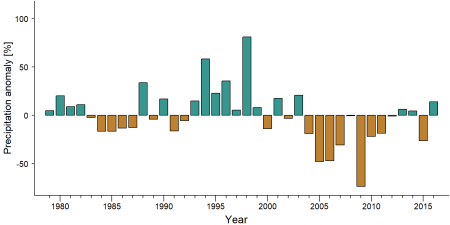
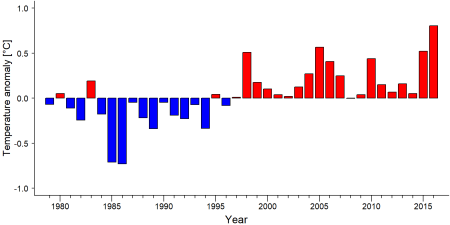
As part of a study on the exposure of African great ape sites to climate change impacts, Kiribou et al. | As part of a study on the exposure of African great ape sites to climate change impacts, [[#R02339|Kiribou et al. (2024)]] extracted climate data and data on projected extreme climate impact events for the site. Climatological characteristics were derived from observation-based climate data provided by the Inter-Sectoral Impact Model Intercomparison Project (ISIMIP, www.isimip.org). Parameters were calculated as the average across each 30-year period. For 1981-2010, the EWEMBI dataset from ISIMIP2a was used. For the two future periods (2021-2050 and 2071-2099) ISIMIP2b climate data based on four CMIP5 global climate models were used. For future projections, two Representative Concentration Pathways (RCP) were used. RCP 2.6 is a scenario with strong mitigation measures in which global temperatures would likely rise below 2C. RCP 6.0 is a scenario with medium emissions in which global temperatures would likely rise up to 3C by 2100. For the number of days with heavy precipitation events, the 98th percentile of all precipitation days (>1mm/d) was calculated for the 1979-2013 reference period as a threshold for a heavy precipitation event. Then, for each year, the number of days above that threshold was derived. The figures on temperature and precipitation anomaly show the deviation from the mean temperature and mean precipitation for the 1979-2013 reference period. | ||
The estimated exposure to future extreme climate impact events (crop failure, drought, river flood, wildfire, tropical cyclone, and heatwave) is based on a published dataset by Lange et al. 2020 derived from ISIMIP2b data. The same global climate models and RCPs as described above were used. Within each 30-year period, the number of years with an extreme event and the average proportion of the site affected were calculated ( | The estimated exposure to future extreme climate impact events (crop failure, drought, river flood, wildfire, tropical cyclone, and heatwave) is based on a published dataset by Lange et al. 2020 derived from ISIMIP2b data. The same global climate models and RCPs as described above were used. Within each 30-year period, the number of years with an extreme event and the average proportion of the site affected were calculated ([[#R02339|Kiribou et al. 2024]]). | ||
'''Table 8. Estimated past and projected climatological characteristics in Western Area Peninsula National Park''' | '''Table 8. Estimated past and projected climatological characteristics in Western Area Peninsula National Park''' | ||
| Line 468: | Line 464: | ||
= References = | = References = | ||
BirdLife International. 2017. [https://www.birdlife.org/africa/news/did-sierra-leones-mudslide-uncover-forgotten-conservation-promise www.birdlife.org] | <span id="R01931"></span>BirdLife International. 2017. [https://www.birdlife.org/africa/news/did-sierra-leones-mudslide-uncover-forgotten-conservation-promise www.birdlife.org] [https://web.archive.org/web/20210927194642/https://www.birdlife.org/africa/news/did-sierra-leones-mudslide-uncover-forgotten-conservation-promise link] | ||
<span id="R01932"></span>BirdLife International. 2019. Important Bird Areas factsheet: Western Area Peninsula Non-hunting Forest Reserve. Downloaded from http://www.birdlife.org on 17/09/2019. | |||
<span id="R01933"></span>Brncic, T.M., Amarasekaran,B. & McKenna,A. (2010) Final Report of the Sierra Leone National Chimpanzee Census Project. Tacugama Chimpanzee Sanctuary, Freetown, Sierra Leone. [https://web.archive.org/web/20160308223613/http://tacugama.com/census.html link] | |||
<span id="R01934"></span>Environment Protection Agency (EPA). 2017. Sierra Leone’s Second National Biodiversity Strategy and Action Plan 2017-2026. | |||
<span id="R01935"></span>Hempel, H. 2013. Final evaluation report of the Western Area Peninsula Forest Reserve protection project. Welthungerhilfe, Bonn. | |||
<span id="R01936"></span>Tacugama Chimpanzee Sanctuary. 2020. Online: [https://www.tacugama.com Tacugama Chimpanzee Sanctuary] | |||
<span id="R02339"></span>Kiribou, R., Tehoda, P., Chukwu, O., Bempah, G., Kühl, H. S., Ferreira, J., …, & Heinicke, S. (2024). Exposure of African ape sites to climate change impacts. ''PLOS Climate'', 3(2), e0000345. [https://doi.org/10.1371/journal.pclm.0000345 doi:10.1371/journal.pclm.0000345] | |||
Latest revision as of 17:55, 15 October 2026
West Africa > Sierra Leone > Western Area Peninsula National Park
Français | Português | Español | Bahasa Indonesia | Melayu
Summary
- Western chimpanzees (Pan troglodytes verus) are present in Western Area Peninsula National Park.
- It has been estimated that 36 individuals occur in the site in 2019.
- The chimpanzee population trend is unknown.
- This site has a total size of 183.37 km².
- Key threats to chimpanzees include logging, farming, hunting, and human encroachment.
- Awareness raising, tree planting, law enforcement activities, and support for alternative livelihoods are the main conservation interventions that have been implemented at the site.
Site characteristics
The Western Area Peninsula National Park (WAPNP) is located in the Freetown peninsula, west of Sierra Leone (BirdLife International 2019). The site covers a narrow chain of hills, reaching up to 900 m, and holds the western-most remnant of Upper Guinea forest ecosystem (Brncic et al. 2010). With 314 bird species, including five species of global conservation concern (e.g., white-necked rockfowl Picathartes gymnocephalus), WAPNP was designated as an Important Bird Area (IBA) in 2001 (BirdLife International 2019). The site is also of high importance to the surrounding populations, as it protects the watershed of two dams, which supply water to Freetown and nearby settlements (Brncic et al. 2010; EPA 2017). In addition to the western chimpanzee, other vulnerable species inhabiting the area include Diana monkey (Cercopithecus diana), Jentink’s duiker (Cephalopus jentinki), and the endemic frog Cardioglossa aureole (BirdLife International 2019).
Table 1. Basic site information for Western Area Peninsula National Park
| Species | Pan troglodytes verus |
| Area | 183.37 km² |
| Coordinates | Lat: 8.32 , Lon: -13.15 |
| Type of site | Protected area (National Park) |
| Habitat types | Subtropical/tropical dry forest |
| Type of governance | Governance by government |
Types of sites Governance types Habitat types
Ape status
Based on a line transect survey in 2010, there may be three chimpanzee communities in the area (Brncic et al. 2010). The size of the population was estimated at 55 individuals, which is the most recent population estimate currently available (Brncic et al. 2010).
Table 2. Ape population estimates reported for Western Area Peninsula National Park
| Species | Year | Occurrence | Encounter or vistation rate (nests/km; ind/day) | Density estimate [ind./ km²] (95% CI) | Abundance estimate (95% CI) | Survey area | Sampling method | Analytical framework | Source | Comments | A.P.E.S. database ID |
|---|---|---|---|---|---|---|---|---|---|---|---|
| Pan troglodytes verus | 2019 | 36.0 | 100 acres and buffer zone along TCS axis | Camera trap, Reconnaissance walk | Distance sampling | TCS unpublished data 2019, Lahai Keifala pers. comm. 2025 | Not a systematic survey | ||||
| Pan troglodytes verus | 2010 | 1.08 (0.30-3.90) | 0.36 (0.10-1.32) | 55 (15-209) | Western Area Peninsular Forest Reserve (158 km²) | Line transects & recces | Brncic et al. 2010 | Total survey effort: 26.97 km | SLE0002, SLE0003 SLE0004, SLE0014, SLE0015, SLE0017, SLE0018, SLE0021, SLE0024, SLE0025, SLE0026, SLE0029, SLE0032, SLE0036, SLE0037
|
Sampling methods Analytical frameworks
Threats
The park is highly accessible to humans through trails (Brncic et al. 2010). Hunting is a key threat in the area, with several hunting camps and hunting signs present at the site (Brncic et al. 2010). In addition, multiple large-scale marijuana farms have been discovered in the park, as well as signs of logging and charcoal production (Brncic et al. 2010). Due to the urban expansion and close proximity to the capital, Freetown, WAPNP faces a lot of pressure, as the demands for fuelwood, farmland, and bushmeat continue to rise (Brncic et al. 2010, BirdLife International 2017). In 2017, following heavy rainfall, a mudslide in the area resulted in the deaths of hundreds of people; the mudslide has been linked to extensive deforestation and erosion of the soil (BirdLife International 2017).
Table 3. Threats to apes reported for Western Area Peninsula National Park
| Category | Specific threats | Threat level | Description | Year of threat |
|---|---|---|---|---|
| 1 Residential & commercial development | 1.1 Residential areas | Present (unknown severity) | Human encroachment and housing development within the park (BirdLife International 2017). Urban encrochment is ongoing (Lahai Keifala pers. comm. 2025). | 2017-Ongoing (2025) |
| 2 Agriculture & aquaculture | 2.1 Annual & perennial non-timber crops | High (more than 70% of population affected) | Several marijuana farms were found during a survey in 2010 (Brncic et al. 2010). Local communities also seek land for farming (BirdLife International 2017). | 2010-Ongoing (2017) |
| 3 Energy production & mining | 3.2 Mining & quarrying | Present (unknown severity) | Stone mining (BirdLife International 2017). | Ongoing (2017) |
| 4 Transportation & service corridors | 4.1 Roads & railroads | Present (unknown severity) | The presence of trails allows for accessibility to humans (Brncic et al. 2010). | Ongoing (2010) |
| 5 Biological resource use | 5.1 Hunting & collecting terrestrial animals | High (more than 70% of population affected) | Hunting camps, shotgun shells, and snares were frequently encountered during a survey (Brncic et al. 2010). | Ongoing (2010) |
| 5 Biological resource use | 5.3 Logging & wood harvesting | High (more than 70% of population affected) | Tree cuts were frequently found within the park during a survey (Brncic et al. 2010). Deforestation is ongoing in 2025 (Lahai Keifala pers. comm. 2025). | 2010-Ongoing (2025) |
| 7 Natural system modifications | 7.2 Dams & water management/use | Present (unknown severity) | Two dams are present in the site (Guma Valley Dam and Congo Dam) (Brncic et al. 2010). | Ongoing (2010) |
Conservation activities
Sierra Leone’s Forestry Division and the Conservation Society of Sierra Leone are the main organizations responsible for the management of the site and the implementation of conservation activities. The EU funded an intervention to decelerate deforestation at the site, which was implemented by Welthungerhilfe (WHH) and the Environmental Forum for Action (ENFORAC) from 2009-2014 (EPA 2017). This intervention focused on awareness raising, especially among potential encroachers, and proving support to local people with alternative livelihood options (Hempel 2013).
In 1995, the Tacugama Chimpanzee Sanctuary was established. The sanctuary rescues, rehabilitates and cares for orphaned chimpanzees. Since 2011, Tacugama works with rural communities as part of its Tacugama Community Outreach Programme to promote the sustainable use of natural resources, improve agricultural practices (seed distribution), promote alternative livelihoods (e.g., fruit tree planting, livestock farms, community woodlots), improve health and hygiene in rural communities to decrease the risk of disease transmission, and environmental education activities for rural communities and children to increase awareness of the need to protect chimpanzees (Tacugama Chimpanzee Sanctuary 2020). Tacugama also runs an eco-lodge with the proceeds going to its conservation programmes (Tacugama Chimpanzee Sanctuary 2020).
Table 4. Conservation activities reported for Western Area Peninsula National Park
| Category | Specific activity | Description | Implementing organization(s) | Year of activity |
|---|---|---|---|---|
| 1 Development impact mitigation | 1.4 Farm more intensively and effectively in selected areas and spare more natural land | Tacugama Community Outreach Programme promotes improved agricultural practices and distributes seeds (Tacugama Chimpanzee Sanctuary 2020). | 2011-Ongoing (2020) | |
| 2 Counter-wildlife crime | 2.13 Provide sustainable alternative livelihoods; establish fish- or domestic meat farms | Tacugama Community Outreach Programme promotes alternative livelihoods, e.g., fruit tree planting, livestock farms, community woodlots (Tacugama Chimpanzee Sanctuary 2020). | 2011-Ongoing (2020) | |
| 3 Species health | 3.13 Implement a health programme for local communities | Tacugama Community Outreach Programme constructs latrines in rural communities to improve hygiene and minimize bush defecation (Tacugama Chimpanzee Sanctuary 2020). | 2011-Ongoing (2020) | |
| 4 Education & awareness | 4.1 Educate local communities about apes and sustainable use | Awareness raising to create an understanding of the importance of conservation, forest ecosystem and function, and chimpanzees (Hempel 2013, Tacugama Chimpanzee Sanctuary 2020, Lahai Keifala pers. comm. 2025). | 2009-Ongoing (2025) | |
| 5 Protection & restoration | 5.2 Legally protect ape habitat | The site was designated a National Park in 2012 (EPA 2017). | 2012-Ongoing (2026) | |
| 5 Protection & restoration | 5.6 Habitat restoration | Sierra Leone Launches Tree Planting Initiative in Western Area Peninsula National Park with GEF Support (Lahai Keifala pers. comm. 2025). | Ministry of Environment and Climate Change | 2024 |
| 6 Species management | 6.9 Rehabilitate injured/orphaned apes | Tacugama Chimpanzee Sanctuary takes care of and rehabilitates orphaned chimpanzees (Tacugama Chimpanzee Sanctuary 2020). | 1995-Ongoing (2020) | |
| 7 Economic & other incentives | 7.2 Provide non-monetary benefits to local communities for sustainably managing their forest and its wildlife (e.g., better education, infrastructure development) | Tacugama Community Outreach Programme provides infrastructure as part of its alternative livelihoods programme and supports communities in establishing sustainable sources of income (Tacugama Chimpanzee Sanctuary 2020). | 2011-Ongoing (2020) | |
| 8 Permanent presence | 8.2 Run tourist projects and ensure permanent human presence at site | Small-scale community-based tourism was promoted between 2009-2014 (Hempel 2013), Tacugama runs an eco-lodge (Tacugama Chimpanzee Sanctuary 2020). | Ongoing (2009) | |
| 8 Permanent presence | 8.3 Permanent presence of staff/manager | Tacugama Chimpanzee Sanctuary has a permanent presence of staff (Tacugama Chimpanzee Sanctuary 2020). | 1995-Ongoing (2020) | |
| 5 Protection & restoration | Other | Authorities have committed to demolishing illegal structures and prosecuting violators to protect the park's integrity (Lahai Keifala pers. comm. 2025). | Ministry of Environment and Climate Change, National Protected Area Authority | 2025 |
Challenges
Table 5. Challenges reported for Western Area Peninsula National Park
| Challenges | Specific challenges | Source | Year(s) |
|---|---|---|---|
| 1 Site management | 1.3 Corruption | Lahai Keifala pers. comm. 2025 | 2024 |
| 4 Institutional support | 4.1 Lack of law enforcement | Lahai Keifala pers. comm. 2025 | 2024 |
| Other (Urbanization and poor planning) | Lahai Keifala pers. comm. 2025 | 2024 |
Enablers
Table 6. Enablers reported for Western Area Peninsula National Park
| Enablers | Specific enablers | Source | Year(s) |
|---|---|---|---|
| 2 Resources and capacity | 2.6 External partnerships that add expertise or resources | Lahai Keifala pers. comm. 2025 | 2025 |
| 3 Engaged community | 3.6 Local community engagement and support | Lahai Keifala pers. comm. 2025 | 2023 |
| 4 Institutional support | 4.2 Strong government support | Lahai Keifala pers. comm. 2025 | 2024 |
| 1 Site management | |||
| 5 Ecological context | |||
| 6 Safety and stability |
Research activities
Since 2012, Tacugama Chimpanzee Sanctuary is conducting chimpanzee monitoring programmes across Sierra Leone. The sanctuary is also implementing annual biodiversity surveys using camera traps in the Western Area Peninsula National Park (Tacugama Chimpanzee Sanctuary 2020).
Documented behaviours
Table 7. Behaviours documented for Western Area Peninsula National Park
| Category | Behavior | Observation type | Prevalence | Observation dates | Source | Habituation | Species | Comment |
|---|---|---|---|---|---|---|---|---|
| Not reported |
Exposure to climate change impacts
As part of a study on the exposure of African great ape sites to climate change impacts, Kiribou et al. (2024) extracted climate data and data on projected extreme climate impact events for the site. Climatological characteristics were derived from observation-based climate data provided by the Inter-Sectoral Impact Model Intercomparison Project (ISIMIP, www.isimip.org). Parameters were calculated as the average across each 30-year period. For 1981-2010, the EWEMBI dataset from ISIMIP2a was used. For the two future periods (2021-2050 and 2071-2099) ISIMIP2b climate data based on four CMIP5 global climate models were used. For future projections, two Representative Concentration Pathways (RCP) were used. RCP 2.6 is a scenario with strong mitigation measures in which global temperatures would likely rise below 2C. RCP 6.0 is a scenario with medium emissions in which global temperatures would likely rise up to 3C by 2100. For the number of days with heavy precipitation events, the 98th percentile of all precipitation days (>1mm/d) was calculated for the 1979-2013 reference period as a threshold for a heavy precipitation event. Then, for each year, the number of days above that threshold was derived. The figures on temperature and precipitation anomaly show the deviation from the mean temperature and mean precipitation for the 1979-2013 reference period.
The estimated exposure to future extreme climate impact events (crop failure, drought, river flood, wildfire, tropical cyclone, and heatwave) is based on a published dataset by Lange et al. 2020 derived from ISIMIP2b data. The same global climate models and RCPs as described above were used. Within each 30-year period, the number of years with an extreme event and the average proportion of the site affected were calculated (Kiribou et al. 2024).
Table 8. Estimated past and projected climatological characteristics in Western Area Peninsula National Park
| Value | 1981-2010 | 2021-2050, RCP 2.6 | 2021-2050, RCP 6.0 | 2071-2099, RCP 2.6 | 2071-2099, RCP 6.0 |
|---|---|---|---|---|---|
| Mean temperature [C] | 25.6 | 26.6 | 26.6 | 26.7 | 27.7 |
| Annual precipitation [mm] | 3043 | 2911 | 3014 | 2980 | 2977 |
| Max no. consecutive dry days (per year) | 56 | 50.3 | 52.8 | 52.8 | 53.6 |
| No. days with heavy precipitation (per year) | 5.8 | 6.1 | 6.4 | 7.3 | 6.9 |
Table 9. Projected exposure of apes to extreme climate impact events in Western Area Peninsula National Park
| Type | No. of years with event (2021-2050, RCP 2.6) | % of site exposed (2021-2050, RCP 2.6) | No. of years with event (2021-2050, RCP 6.0) | % of site exposed (2021-2050, RCP 6.0) | No. of years with event (2070-2099, RCP 2.6) | % of site exposed (2070-2099, RCP 2.6) | No. of years with event (2070-2099, RCP 6.0) | % of site exposed (2070-2099, RCP 6.0) |
|---|---|---|---|---|---|---|---|---|
| Crop failure | 3 | 0.02 | 4 | 0.02 | 4 | 0.02 | 5.5 | 0.02 |
| Drought | 0 | 0 | 0 | 0 | 0 | 0 | 0 | 0 |
| Heatwave | 1 | 100 | 2 | 100 | 3 | 100 | 6 | 100 |
| River flood | 0 | 0 | 1 | 0.42 | 1.5 | 0.83 | 0.75 | 0.62 |
| Tropical cyclone | 0 | 0 | 1 | 5.46 | 0.5 | 4.86 | 0 | 0 |
| Wildfire | 30 | 0.14 | 29.5 | 0.13 | 29 | 0.23 | 29 | 0.15 |
-
Precipitation anomaly in Western Area Peninsula National Park -
Temperature anomaly in Western Area Peninsula National Park


External links
References
BirdLife International. 2017. www.birdlife.org link
BirdLife International. 2019. Important Bird Areas factsheet: Western Area Peninsula Non-hunting Forest Reserve. Downloaded from http://www.birdlife.org on 17/09/2019.
Brncic, T.M., Amarasekaran,B. & McKenna,A. (2010) Final Report of the Sierra Leone National Chimpanzee Census Project. Tacugama Chimpanzee Sanctuary, Freetown, Sierra Leone. link
Environment Protection Agency (EPA). 2017. Sierra Leone’s Second National Biodiversity Strategy and Action Plan 2017-2026.
Hempel, H. 2013. Final evaluation report of the Western Area Peninsula Forest Reserve protection project. Welthungerhilfe, Bonn.
Tacugama Chimpanzee Sanctuary. 2020. Online: Tacugama Chimpanzee Sanctuary
Kiribou, R., Tehoda, P., Chukwu, O., Bempah, G., Kühl, H. S., Ferreira, J., …, & Heinicke, S. (2024). Exposure of African ape sites to climate change impacts. PLOS Climate, 3(2), e0000345. doi:10.1371/journal.pclm.0000345
Page created by: APES Atlas Team Date: 2019-09-18
Page updated by: Lahai Keifala Date: 2025-04-23