
Dja Biosphere (or Faunal) Reserve: Difference between revisions
No edit summary |
No edit summary Tag: Manual revert |
||
| (9 intermediate revisions by the same user not shown) | |||
| Line 14: | Line 14: | ||
* Conservation activities have focused on poaching patrols, law enforcement, and programs that support local communities . | * Conservation activities have focused on poaching patrols, law enforcement, and programs that support local communities . | ||
* The site was declared a UNESCO World Heritage Site in 1987. It is one of the largest and best protected African rainforests, with approximately 90% of its area remaining undisturbed. | * The site was declared a UNESCO World Heritage Site in 1987. It is one of the largest and best protected African rainforests, with approximately 90% of its area remaining undisturbed. | ||
= Site characteristics = | = Site characteristics = | ||
The Dja Biosphere Reserve includes the formal Dja Faunal Reserve and its buffer zone, which comprise logging concessions (also known in Cameroon as Forestry Management Units - FMUs), settlements, and community forests. Rubber plantations and a hydroelectric dam with a reservoir on the Dja River in the western buffer zone are also present (Bruce et al. 2018). Approximately 80% of the reserve is surrounded by the Dja River, providing a natural barrier and some limited protection to the reserve (Nguiffo 2001). | The Dja Biosphere Reserve includes the formal Dja Faunal Reserve and its buffer zone, which comprise logging concessions (also known in Cameroon as Forestry Management Units - FMUs), settlements, and community forests. Rubber plantations and a hydroelectric dam with a reservoir on the Dja River in the western buffer zone are also present ([[#R00495|Bruce et al. 2018]]). Approximately 80% of the reserve is surrounded by the Dja River, providing a natural barrier and some limited protection to the reserve (Nguiffo 2001). | ||
The reserve is a relatively flat plateau of round-topped hills (UNESCO 2015). The topography is mainly shallow valleys on either side of a ridgeline that cuts through the reserve east to west (MINFOF & IUCN 2015). In the floors of the valleys, swamp habitat becomes more common and tributaries throughout the reserve flow into the Dja River (UNESCO 2010, MINFOF & IUCN 2015). The three major types of forest in the reserve are mixed-species forest terra firma, monodominant forest where ''Gilbertiodendron dewevrei'' is the most abundant species, and periodically flooded forest (Djuikouo et al. 2010). | The reserve is a relatively flat plateau of round-topped hills ([[#R00501|UNESCO 2015]]). The topography is mainly shallow valleys on either side of a ridgeline that cuts through the reserve east to west ([[#R00500|MINFOF & IUCN 2015]]). In the floors of the valleys, swamp habitat becomes more common and tributaries throughout the reserve flow into the Dja River ([[#R00501|UNESCO 2010, MINFOF & IUCN 2015]]). The three major types of forest in the reserve are mixed-species forest terra firma, monodominant forest where ''Gilbertiodendron dewevrei'' is the most abundant species, and periodically flooded forest ([[#R00497|Djuikouo et al. 2010]]). | ||
The area comprises mainly dense evergreen Congo rainforest and is known to have a wide range of primate species. As the exploitation of timber resources increases, the Dja forest remains an important refuge for many plants and animal species, such as the moabi tree, ''Baillonella toxisperma'' (UNESCO 2015). | The area comprises mainly dense evergreen Congo rainforest and is known to have a wide range of primate species. As the exploitation of timber resources increases, the Dja forest remains an important refuge for many plants and animal species, such as the moabi tree, ''Baillonella toxisperma'' ([[#R00501|UNESCO 2015]]). | ||
The Dja Biosphere Reserve is home Western lowland gorilla, Central chimpanzee, Bongo (''Tragelaphus eurycerus''), giant pangolin (''Manis gigantea''), elephant (''Loxodonta Africana cyclotis''), mantled guereza (''Colobus guereza''), leopard (''Panthera pardus''), and many other species of wildlife (UNESCO 2015, Bruce et al. 2018). The reserve hosts a rich diversity of fauna including 109 mammal species, 360 bird species, and 61 fish species. It is also home to the world’s most important colony of grey-necked rockfowl (''Picathartes oreas'') with 50 active nests on the same rocky cliff (UNESCO 2015). | The Dja Biosphere Reserve is home Western lowland gorilla, Central chimpanzee, Bongo (''Tragelaphus eurycerus''), giant pangolin (''Manis gigantea''), elephant (''Loxodonta Africana cyclotis''), mantled guereza (''Colobus guereza''), leopard (''Panthera pardus''), and many other species of wildlife ([[#R00501|UNESCO 2015]], [[#R00495|Bruce et al. 2018]]). The reserve hosts a rich diversity of fauna including 109 mammal species, 360 bird species, and 61 fish species. It is also home to the world’s most important colony of grey-necked rockfowl (''Picathartes oreas'') with 50 active nests on the same rocky cliff ([[#R00501|UNESCO 2015]]). | ||
More than 4,000 and 40,000 inhabitants live in the core and the surrounding areas of the Biosphere, respectively. Main ethnic groups in the area include the Badjoué, Boulou, Fang, Nzimé, Kakas, and the Baka pygmies. The two latter groups are semi-nomad. The Baka group are free to hunt within the reserve using traditional methods (UNESCO 2015). | More than 4,000 and 40,000 inhabitants live in the core and the surrounding areas of the Biosphere, respectively. Main ethnic groups in the area include the Badjoué, Boulou, Fang, Nzimé, Kakas, and the Baka pygmies. The two latter groups are semi-nomad. The Baka group are free to hunt within the reserve using traditional methods ([[#R00501|UNESCO 2015]]). | ||
'''Table 1. Basic site information for Dja Biosphere (or Faunal) Reserve''' | '''Table 1. Basic site information for Dja Biosphere (or Faunal) Reserve''' | ||
| Line 56: | Line 52: | ||
= Ape status = | = Ape status = | ||
Between 1995 and 2018, there was a declining trend in estimates of density for forest elephants and great apes. Western lowland gorillas showed a roughly five-fold decrease in estimated densities between the two surveys. However, methodological differences in survey practice and analysis may be magnifying these apparent sharp declines between the 2015 and 2018 inventories. This is supported by the fact that great ape and forest elephant population estimates from surveys completed prior to the 2015 inventory are more in line with a more gradual decline in numbers for great apes and forest elephants (for example, N’Goran et al. 2017). | Between 1995 and 2018, there was a declining trend in estimates of density for forest elephants and great apes. Western lowland gorillas showed a roughly five-fold decrease in estimated densities between the two surveys. However, methodological differences in survey practice and analysis may be magnifying these apparent sharp declines between the 2015 and 2018 inventories. This is supported by the fact that great ape and forest elephant population estimates from surveys completed prior to the 2015 inventory are more in line with a more gradual decline in numbers for great apes and forest elephants (for example, [[#R02183|N’Goran et al. 2017]]). | ||
Using the DFR western lowland gorilla densities estimated by Williamson and Usongo (1995), we can estimate 8,971 gorillas in 1995. The 2018 population estimate for western lowland gorillas in the DFR is 1,371, suggesting a decline of approximately 83% in numbers since 1995. However, both Williamson and Usongo (1995) and Latour (2010) population estimates were based only on the north-east sector of the reserve. For central chimpanzees, the 1995 estimate would be 4,155 individuals with a decline of roughly 30% in 2018. | Using the DFR western lowland gorilla densities estimated by [[#R00503|Williamson and Usongo (1995)]], we can estimate 8,971 gorillas in 1995. The 2018 population estimate for western lowland gorillas in the DFR is 1,371, suggesting a decline of approximately 83% in numbers since 1995. However, both [[#R00503|Williamson and Usongo (1995)]] and [[#R00499|Latour (2010)]] population estimates were based only on the north-east sector of the reserve. For central chimpanzees, the 1995 estimate would be 4,155 individuals with a decline of roughly 30% in 2018. | ||
'''Table 2. Ape population estimates reported for Dja Biosphere (or Faunal) Reserve''' | '''Table 2. Ape population estimates reported for Dja Biosphere (or Faunal) Reserve''' | ||
| Line 75: | Line 71: | ||
!A.P.E.S. database ID | !A.P.E.S. database ID | ||
|- | |- | ||
|'' | |''Gorilla gorilla gorilla'' | ||
| | |2018 | ||
| | | | ||
| | |0.413 | ||
|0. | |0.24 | ||
| | |1,258 (779-2,031) | ||
| | |Entire site (5260 km²) | ||
|Line transects | |Line transects | ||
| | | | ||
| | |[[#R00495|Bruce et al. 2018]] | ||
| | |283 transects covered 298.2 km. Distance covered in recces: 1681.38 km. | ||
| | | | ||
|- | |- | ||
|'' | |''Pan troglodytes troglodytes'' | ||
| | |2018 | ||
| | | | ||
| | |0.472 | ||
| | |0.43 | ||
| | |2,313 (1,568-3,411) | ||
| | |Entire site (5260 km²) | ||
|Line transects | |Line transects | ||
| | | | ||
| | |[[#R00495|Bruce et al. 2018]] | ||
| | |283 transects covered 298.2 km. Distance covered in recces: 1681.38 km. | ||
| | | | ||
|- | |- | ||
| Line 110: | Line 106: | ||
|Line transects | |Line transects | ||
| | | | ||
|Latour (2010) | |[[#R00499|Latour (2010)]] | ||
|Abundance estimate is an extrapolation to the whole surface of the site. Williamson & Usongo (1995) only estimated population densities for the north-east sector of the reserve. 34 transects were walked in an area of 620 km², totaling 43.4 km. | |Abundance estimate is an extrapolation to the whole surface of the site. Williamson & Usongo (1995) only estimated population densities for the north-east sector of the reserve. 34 transects were walked in an area of 620 km², totaling 43.4 km. | ||
| | | | ||
| Line 123: | Line 119: | ||
|Line transects | |Line transects | ||
| | | | ||
|Latour (2010) | |[[#R00499|Latour (2010)]] | ||
|Abundance estimate is an extrapolation to the whole surface of the site. Williamson & Usongo (1995) only estimated population densities for the north-east sector of the reserve. 34 transects were walked in an area of 620 km², totaling 43.4 km. | |Abundance estimate is an extrapolation to the whole surface of the site. Williamson & Usongo (1995) only estimated population densities for the north-east sector of the reserve. 34 transects were walked in an area of 620 km², totaling 43.4 km. | ||
| | | | ||
|- | |- | ||
|''Pan troglodytes troglodytes'' | |''Pan troglodytes troglodytes'' | ||
| | |1995 | ||
| | |||
| | | | ||
|0. | |0.79 | ||
|0 | |4155.0 | ||
|620 km² | |||
| | |||
|Line transects | |Line transects | ||
| | | | ||
| | |[[#R00503|Willamson & Usongo (1995)]] | ||
| | |17 transects totaling 94.7km were walked twice at intervals of 5-7 months. Abundance estimate is an extrapolation to the whole surface of the park. Latour (2010) only estimated population densities for the north-east sector of the reserve. | ||
| | | | ||
|- | |- | ||
|''Gorilla gorilla gorilla'' | |''Gorilla gorilla gorilla'' | ||
| | |1995 | ||
| | |||
| | | | ||
| | |1.71 | ||
|0 | |8995.0 | ||
|620 km² | |||
| | |||
|Line transects | |Line transects | ||
| | | | ||
| | |[[#R00503|Willamson & Usongo (1995)]] | ||
| | |17 transects totaling 94.7km were walked twice at intervals of 5-7 months. Abundance estimate is an extrapolation to the whole surface of the park. Latour (2010) only estimated population densities for the north-east sector of the reserve. | ||
| | | | ||
|} | |} | ||
| Line 158: | Line 154: | ||
= Threats = | = Threats = | ||
Dja’s unique ecosystem and wildlife are in crisis due to high levels of poaching, the expansion of extractive industries, and a lack of capacity and support for the Cameroonian Government’s Conservation Service, which manages the Reserve ([https://www.zsl.org/conservation/regions/africa/dja-conservation-complex ZSL]). Commercial logging, mining, agriculture, and infrastructure development contribute to habitat loss and fragmentation in Dja (Kubania 2019). Recent human population growth has increased deforestation and exacerbated the impacts of poaching and the illegal bushmeat trade. The populations of forest elephant, western lowland gorilla, and central chimpanzee within the Dja Faunal Reserve are relatively low compared to what the landscape and habitat could theoretically support. These populations are declining compared to prior surveys. Hunting for the illegal wildlife trade and bushmeat are likely the primary driver of the declines (Bruce et al. 2018). | Dja’s unique ecosystem and wildlife are in crisis due to high levels of poaching, the expansion of extractive industries, and a lack of capacity and support for the Cameroonian Government’s Conservation Service, which manages the Reserve ([https://www.zsl.org/conservation/regions/africa/dja-conservation-complex ZSL]). Commercial logging, mining, agriculture, and infrastructure development contribute to habitat loss and fragmentation in Dja ([[#R00498|Kubania 2019]]). Recent human population growth has increased deforestation and exacerbated the impacts of poaching and the illegal bushmeat trade. The populations of forest elephant, western lowland gorilla, and central chimpanzee within the Dja Faunal Reserve are relatively low compared to what the landscape and habitat could theoretically support. These populations are declining compared to prior surveys. Hunting for the illegal wildlife trade and bushmeat are likely the primary driver of the declines ([[#R00495|Bruce et al. 2018]]). | ||
Indicators of human activity within the reserve are highest in the north-west and lowest in the southern sector towards the centre. The most frequently encountered sign of human activity were trails, machete cuts, and signs of human passage. Areas within the reserve that have few signs of human activity are uncommon (Bruce et al. 2018). | Indicators of human activity within the reserve are highest in the north-west and lowest in the southern sector towards the centre. The most frequently encountered sign of human activity were trails, machete cuts, and signs of human passage. Areas within the reserve that have few signs of human activity are uncommon ([[#R00495|Bruce et al. 2018]]). | ||
Most human signs were recorded in the north-west of the reserve. The low encounter rates of wildlife in this area other than around Bouamir Research Station suggest that human activity continues to impact wildlife within the reserve. The wildlife hotspots were (1) the area around Bouamir Research Station (a hotspot for the elephant population), (2) the north-east corner of the reserve where great apes were most frequently encountered, and (3) the habitat around the Bali Bai and the east of the Southern Sector that has lower levels of human sign and where disturbance-sensitive species, such as leopard, golden cat and white-bellied duiker, most commonly occur (Bruce et al. 2018). | Most human signs were recorded in the north-west of the reserve. The low encounter rates of wildlife in this area other than around Bouamir Research Station suggest that human activity continues to impact wildlife within the reserve. The wildlife hotspots were (1) the area around Bouamir Research Station (a hotspot for the elephant population), (2) the north-east corner of the reserve where great apes were most frequently encountered, and (3) the habitat around the Bali Bai and the east of the Southern Sector that has lower levels of human sign and where disturbance-sensitive species, such as leopard, golden cat and white-bellied duiker, most commonly occur ([[#R00495|Bruce et al. 2018]]). | ||
'''Table 3. Threats to apes reported for Dja Biosphere (or Faunal) Reserve''' | '''Table 3. Threats to apes reported for Dja Biosphere (or Faunal) Reserve''' | ||
| Line 177: | Line 173: | ||
| | | | ||
|Ongoing (2018) | |Ongoing (2018) | ||
|- | |||
|2 Agriculture & aquaculture | |||
|2.1 Annual & perennial non-timber crops | |||
|Present (unknown severity) | |||
|Expansion of land for agriculture ([[#R00502|UNESCO 2021]]). | |||
|Ongoing (2021) | |||
|- | |||
|3 Energy production & mining | |||
|3.2 Mining & quarrying | |||
|Present (unknown severity) | |||
|Mining activities in the periphery ([[#R00502|UNESCO 2021]]). | |||
|Ongoing (2021) | |||
|- | |- | ||
|5 Biological resource use | |5 Biological resource use | ||
|5.1 Hunting & collecting terrestrial animals | |5.1 Hunting & collecting terrestrial animals | ||
|High (more than 70% of population affected) | |High (more than 70% of population affected) | ||
|Intensity of signs of human activity in the northwest area of the reserve and low encounter rates of great ape nests and forest elephant dung in this area (apart from around Bouamir Research Station), suggests that human perturbation continues to influence the distribution of wildlife within the DFR (Bruce et al. 2018). | |Intensity of signs of human activity in the northwest area of the reserve and low encounter rates of great ape nests and forest elephant dung in this area (apart from around Bouamir Research Station), suggests that human perturbation continues to influence the distribution of wildlife within the DFR ([[#R00495|Bruce et al. 2018]]). | ||
|Ongoing (2018) | |Ongoing (2018) | ||
|- | |- | ||
| Line 187: | Line 195: | ||
|5.1.3 Commercial bushmeat trade | |5.1.3 Commercial bushmeat trade | ||
|High (more than 70% of population affected) | |High (more than 70% of population affected) | ||
|Bushmeat hunting is reported amon the main threats ([ | |Bushmeat hunting is reported amon the main threats ([[#R00496|Born Free 2025]]). | ||
|2022-Ongoing (2025) | |||
|- | |||
|5 Biological resource use | |||
|5.1.5 Persecution/human wildlife conflict | |||
|High (more than 70% of population affected) | |||
|Illegal wildlife trade reported ([[#R00496|Born Free 2025]]). | |||
|2022-Ongoing (2025) | |2022-Ongoing (2025) | ||
|- | |- | ||
| Line 193: | Line 207: | ||
|5.3 Logging & wood harvesting | |5.3 Logging & wood harvesting | ||
|Present (unknown severity) | |Present (unknown severity) | ||
|Around the Dja Faunal Reserve other significant threats include mining, logging, agricultural clearance, rubber plantations and the associated demands for bushmeat, and the ecological impacts of existing and planned hydroelectric dams (MINFOF & IUCN 2015). | |Around the Dja Faunal Reserve other significant threats include mining, logging, agricultural clearance, rubber plantations and the associated demands for bushmeat, and the ecological impacts of existing and planned hydroelectric dams ([[#R00500|MINFOF & IUCN 2015]]). | ||
|Ongoing (2018) | |Ongoing (2018) | ||
|- | |- | ||
| | |7 Natural system modifications | ||
| | |7.1 Fire & fire suppression | ||
|Present (unknown severity) | |Present (unknown severity) | ||
| | |Habitat loss via slash-and-burn farming was also reported ([[#R00496|Born Free 2025]]). | ||
| | |2022-Ongoing (2025) | ||
|- | |- | ||
|7 Natural system modifications | |7 Natural system modifications | ||
|7.2 Dams & water management/use | |7.2 Dams & water management/use | ||
|Present (unknown severity) | |Present (unknown severity) | ||
|Water infrastructure and Mekin hydroelectric dam ([ | |Water infrastructure and Mekin hydroelectric dam ([[#R00502|UNESCO 2021]]). | ||
|Ongoing (2021) | |Ongoing (2021) | ||
|} | |} | ||
| Line 231: | Line 227: | ||
= Conservation activities = | = Conservation activities = | ||
Conservation activities including the monitoring of biodiversity through wildlife surveys, improving law enforcement to combat wildlife crimes, anti-poaching patrols, and empowerment of local communities in and around the Dja Biosphere Reserve are conducted in the DBR by the Cameroon Ministry of Forest and Wildlife, the Zoological Society of London ([https://www.zsl.org/ ZSL]) and the African Wildlife Foundation ([https://www.awf.org/ AWF]). During 2018, ZSL supported MINFOF eco-guards to carry out patrols throughout all four sectors of the Dja Biosphere Reserve using the Spatial Monitoring and Reporting Tool (SMART) approach. A total of 68 patrols were completed in all sectors of the Dja covering a distance of 7,769km and 93% of the Reserve. During these patrols, 14 arms were seized, along with 131 pieces of ammunition, and a total of 9 people were arrested on charges of poaching (ZSL 2018). Between January and December 2017, the AWF anti-poaching units conducted 559 patrols and destroyed 52 active hunting camps, seizing 82 kg of pangolin scale, as well as traditional guns, ammunition, and motorbikes. They also removed 264 traps and snares. <br> | Conservation activities including the monitoring of biodiversity through wildlife surveys, improving law enforcement to combat wildlife crimes, anti-poaching patrols, and empowerment of local communities in and around the Dja Biosphere Reserve are conducted in the DBR by the Cameroon Ministry of Forest and Wildlife, the Zoological Society of London ([https://www.zsl.org/ ZSL]) and the African Wildlife Foundation ([https://www.awf.org/ AWF]). During 2018, ZSL supported MINFOF eco-guards to carry out patrols throughout all four sectors of the Dja Biosphere Reserve using the Spatial Monitoring and Reporting Tool (SMART) approach. A total of 68 patrols were completed in all sectors of the Dja covering a distance of 7,769km and 93% of the Reserve. During these patrols, 14 arms were seized, along with 131 pieces of ammunition, and a total of 9 people were arrested on charges of poaching ([[#R00504|ZSL 2018]]). Between January and December 2017, the AWF anti-poaching units conducted 559 patrols and destroyed 52 active hunting camps, seizing 82 kg of pangolin scale, as well as traditional guns, ammunition, and motorbikes. They also removed 264 traps and snares. <br> | ||
In addition, the Guardians of the Dja Programme was established in 2022. Through this programme, Born Free aims to increase the abundance of rare chimpanzees and gorillas in a great ape conservation priority area of the Dja Biosphere Reserve, and to foster sustainable coexistence between local communities and wildlife ([https://www.bornfree.org.uk/field-conservation/guardians-of-dja/ Guardians of Dja - Born Free 2025]). | In addition, the Guardians of the Dja Programme was established in 2022. Through this programme, Born Free aims to increase the abundance of rare chimpanzees and gorillas in a great ape conservation priority area of the Dja Biosphere Reserve, and to foster sustainable coexistence between local communities and wildlife ([https://www.bornfree.org.uk/field-conservation/guardians-of-dja/ Guardians of Dja - Born Free 2025]). | ||
| Line 241: | Line 237: | ||
!Implementing organization(s) | !Implementing organization(s) | ||
!Year of activity | !Year of activity | ||
|- | |- | ||
|2 Counter-wildlife crime | |2 Counter-wildlife crime | ||
| Line 265: | Line 243: | ||
| | | | ||
|Ongoing (2018) | |Ongoing (2018) | ||
|- | |||
|2 Counter-wildlife crime | |||
|2.12 Implement community control of patrolling, banning hunting and removing snares | |||
|The Great Ape Guardians initiative, established by BFF, recruited and trained twelve local men and women in conservation to assist with patrols, collect information, raise awareness, and serve as an essential bridge between Born Free and surrounding communities. Through their efforts, we have established and supported an informer network that works with local authorities to ensure rapid information sharing on poaching activities ([[#R00496|Born Free 2025]]). | |||
|Born Free Foundation, Association de la Protection de Grands Singes (APGS), Services of Conservation of Dja Biosphere Reserve, Ministry of Forests & Wildlife, local communities. | |||
|2022-Ongoing (2025) | |||
|- | |- | ||
|2 Counter-wildlife crime | |2 Counter-wildlife crime | ||
| Line 274: | Line 258: | ||
|2 Counter-wildlife crime | |2 Counter-wildlife crime | ||
|2.3 Conduct regular anti-poaching patrols | |2.3 Conduct regular anti-poaching patrols | ||
|To safeguard great apes and other wildlife from ongoing poaching, BFF works alongside the wildlife authority to support regular anti-poaching patrols across the landscape, an area that presents significant challenges ([ | |To safeguard great apes and other wildlife from ongoing poaching, BFF works alongside the wildlife authority to support regular anti-poaching patrols across the landscape, an area that presents significant challenges ([[#R00496|Born Free 2025]]). | ||
|Born Free Foundation, Association de la Protection de Grands Singes (APGS), Services of Conservation of Dja Biosphere Reserve, Ministry of Forests & Wildlife, local communities. | |Born Free Foundation, Association de la Protection de Grands Singes (APGS), Services of Conservation of Dja Biosphere Reserve, Ministry of Forests & Wildlife, local communities. | ||
|2022-Ongoing (2022) | |2022-Ongoing (2022) | ||
| Line 283: | Line 267: | ||
| | | | ||
|Ongoing (2018) | |Ongoing (2018) | ||
|- | |- | ||
|4 Education & awareness | |4 Education & awareness | ||
|4.1 Educate local communities about apes and sustainable use | |4.1 Educate local communities about apes and sustainable use | ||
|As part of our community outreach, regular events and sessions to raise awareness of wildlife and conservation issues are held. These events include movies, shows, competitions, football tournaments, handball games, and debates, all of which are very popular with young people ([ | |As part of our community outreach, regular events and sessions to raise awareness of wildlife and conservation issues are held. These events include movies, shows, competitions, football tournaments, handball games, and debates, all of which are very popular with young people ([[#R00496|Born Free 2025]]). | ||
|Born Free Foundation, Association de la Protection de Grands Singes (APGS), Services of Conservation of Dja Biosphere Reserve, Ministry of Forests & Wildlife, local communities. | |Born Free Foundation, Association de la Protection de Grands Singes (APGS), Services of Conservation of Dja Biosphere Reserve, Ministry of Forests & Wildlife, local communities. | ||
|2022-Ongoing (2025) | |2022-Ongoing (2025) | ||
|- | |- | ||
| | |4 Education & awareness | ||
|2 | |4.2 Involve local community in ape research and conservation management | ||
| | |Community surveillance networks that allow forest community members to collect and report information on illegal activities such as poaching, illegal mining and logging, as well as monitor law enforcement activities (in partnership with the University College of London’s Extreme Citizen Science (ExCiteS) programme). | ||
| | | | ||
| | |Ongoing (2016) | ||
|- | |||
|5 Protection & restoration | |||
|5.2 Legally protect ape habitat | |||
|The reserve was created in 1950 and in 1987 became a UNESCO World Heritage Site. | |||
| | |||
|1950-Ongoing (2026) | |||
|- | |- | ||
|5 Protection & restoration | |5 Protection & restoration | ||
|5.6 Habitat restoration | |5.6 Habitat restoration | ||
|Different measures are carried out to restore the landscape and natural habitats by encouraging local farmers to adopt sustainable agricultural practices, such as using compost to improve soil health and fertility. This reduces the need to cut down pristine, biodiverse forests([ | |Different measures are carried out to restore the landscape and natural habitats by encouraging local farmers to adopt sustainable agricultural practices, such as using compost to improve soil health and fertility. This reduces the need to cut down pristine, biodiverse forests([[#R00496|Born Free 2025]]). | ||
|Born Free Foundation, Association de la Protection de Grands Singes (APGS), Services of Conservation of Dja Biosphere Reserve, Ministry of Forests & Wildlife, local communities. | |Born Free Foundation, Association de la Protection de Grands Singes (APGS), Services of Conservation of Dja Biosphere Reserve, Ministry of Forests & Wildlife, local communities. | ||
|2022-Ongoing (2025) | |2022-Ongoing (2025) | ||
|- | |||
|7 Economic & other incentives | |||
|7.1 Provide monetary benefits to local communities for sustainably managing their forest and its wildlife (e.g., REDD, alternative income, employment) | |||
|Village Savings and Loans Associations (VSLA) were established to help individuals from partner communities save and access small amounts of money for sustainable livelihood initiatives developed by the communities themselves ([[#R02027|ZSL]]). | |||
| | |||
|Ongoing (2016) | |||
|- | |||
|7 Economic & other incentives | |||
|7.2 Provide non-monetary benefits to local communities for sustainably managing their forest and its wildlife (e.g., better education, infrastructure development) | |||
|ZSL supports community members and women in particular, to derive better and more sustainable revenue from Non-Timber Forest Products (NTFPs) such as Ndjangsang, Bush mango and Ebaye ([[#R02027|ZSL]]). AWF supports communities by helping improve cocoa crop cultivation techniques. In exchange, the farmers sign a Reciprocal Environmental Agreement to refrain from participating in poaching, illegal wildlife trade, and illegal logging; with the added boost in income, they no longer rely on money from poaching and logging ([[#R00498|Kubania 2019]]). <br> | |||
Born Free supports skills training, through our established Agroforestry Training Centre, to equip staff to run three-year programs in sustainable agroforestry for young men and women who have completed primary school (ages 12–25). In addition to that, tailored one-year courses for experienced cocoa farmers, designed to strengthen their skills and support them in managing and restoring their farms. These initiatives give young people the tools and guidance to begin livelihood activities that ease pressure on both wildlife and the environment ([[#R00496|Born Free 2025]]). | |||
|Born Free Foundation, Association de la Protection de Grands Singes (APGS), Services of Conservation of Dja Biosphere Reserve, Ministry of Forests & Wildlife, local communities. | |||
|2019, 2022-Ongoing (2025) | |||
|} | |} | ||
| Line 349: | Line 345: | ||
|2 Resources and capacity | |2 Resources and capacity | ||
|2.6 External partnerships that add expertise or resources | |2.6 External partnerships that add expertise or resources | ||
|[ | |[[#R00496|Born Free 2025]] | ||
|2022-Ongoing (2025) | |2022-Ongoing (2025) | ||
|- | |- | ||
| Line 411: | Line 407: | ||
= Exposure to climate change impacts = | = Exposure to climate change impacts = | ||
As part of a study on the exposure of African great ape sites to climate change impacts, Kiribou et al. | As part of a study on the exposure of African great ape sites to climate change impacts, [[#R02184|Kiribou et al. (2024)]] extracted climate data and data on projected extreme climate impact events for the site. Climatological characteristics were derived from observation-based climate data provided by the Inter-Sectoral Impact Model Intercomparison Project (ISIMIP, www.isimip.org). Parameters were calculated as the average across each 30-year period. For 1981-2010, the EWEMBI dataset from ISIMIP2a was used. For the two future periods (2021-2050 and 2071-2099) ISIMIP2b climate data based on four CMIP5 global climate models were used. For future projections, two Representative Concentration Pathways (RCP) were used. RCP 2.6 is a scenario with strong mitigation measures in which global temperatures would likely rise below 2C. RCP 6.0 is a scenario with medium emissions in which global temperatures would likely rise up to 3C by 2100. For the number of days with heavy precipitation events, the 98th percentile of all precipitation days (>1mm/d) was calculated for the 1979-2013 reference period as a threshold for a heavy precipitation event. Then, for each year, the number of days above that threshold was derived. The figures on temperature and precipitation anomaly show the deviation from the mean temperature and mean precipitation for the 1979-2013 reference period. | ||
The estimated exposure to future extreme climate impact events (crop failure, drought, river flood, wildfire, tropical cyclone, and heatwave) is based on a published dataset by Lange et al. 2020 derived from ISIMIP2b data. The same global climate models and RCPs as described above were used. Within each 30-year period, the number of years with an extreme event and the average proportion of the site affected were calculated ( | The estimated exposure to future extreme climate impact events (crop failure, drought, river flood, wildfire, tropical cyclone, and heatwave) is based on a published dataset by Lange et al. 2020 derived from ISIMIP2b data. The same global climate models and RCPs as described above were used. Within each 30-year period, the number of years with an extreme event and the average proportion of the site affected were calculated ([[#R02184|Kiribou et al. 2024]]). | ||
'''Table 8. Estimated past and projected climatological characteristics in Dja Biosphere (or Faunal) Reserve''' | '''Table 8. Estimated past and projected climatological characteristics in Dja Biosphere (or Faunal) Reserve''' | ||
| Line 537: | Line 533: | ||
= References = | = References = | ||
Djuikouo, M.N.K., Doucet, J | <span id="R00495"></span>Bruce, T., Ndjassi, C., Fowler, A., Ndimbe, M., Fankem, O., Tabue Mbobda, R. B., Kobla, A. S., Wabo Puemo, F. A., Amin, R., Wacher, T., Grange-Chamfray, S., & Olson, D. (2018). Faunal inventory of the Dja Faunal Reserve, Cameroon – 2018. Ministry of Forests and Wildlife (MINFOF), Zoological Society of London – Cameroon Country Programme, African Wildlife Foundation, Yaoundé, Cameroon. | ||
<span id="R00496"></span>Born Free Foundation. (2025). Guardians of Dja. Retrieved December 2025, from https://www.bornfree.org.uk/field-conservation/guardians-of-dja/ | |||
<span id="R00497"></span>Djuikouo, M. N. K., Doucet, J., Nguembou, C. K., Lewis, S. L., & Sonké, B. (2010). Diversity and aboveground biomass in three tropical forest types in the Dja Biosphere Reserve, Cameroon. ''African Journal of Ecology'', 48(4), 1053-1063. [https://doi.org/10.1111/j.1365-2028.2010.01212.x doi:10.1111/j.1365-2028.2010.01212.x] | |||
<span id="R00498"></span>Kubania, J. (2019). Sustainable cocoa turns Cameroon’s farmers into conservation champions. African Wildlife Foundation. https://www.awf.org/blog/sustainable-cocoa-turns-cameroons-farmers-conservation-champions | |||
<span id="R00499"></span>Latour, S. (2010). Reserve de Faune du Dja: Evaluation du Statut de grands singes. Rapport de BRL Ingenierie, GFA Consulting, et DFS. | |||
MINFOF | <span id="R00500"></span>MINFOF/UICN (2015). Caractérisation de la population de grands et moyens mammifères dans la Reserve de Faune du Dja: Potentiel et menaces, Yaoundé, Cameroun: 54 pages + Annexes. | ||
<span id="R00501"></span>UNESCO. (2015). http://www.unesco.org/new/fileadmin/MULTIMEDIA/HQ/SC/pdf/sc_mab_BR_Dja_EN.pdf (Accessed on 18.01.2021). [https://web.archive.org/web/20220403201742/http://www.unesco.org/new/fileadmin/MULTIMEDIA/HQ/SC/pdf/sc_mab_BR_Dja_EN.pdf link] | |||
<span id="R00502"></span>UNESCO. (2021). State of conservation, Dja Faunal Reserve. Retrieved September 27, 2021, from https://whc.unesco.org/en/soc/4202 | |||
<span id="R00503"></span>Williamson, E., & Usongo, L. (1995). Réserve de faune du Dja: Recensement des populations de primates et inventaire des grands mammifères. ECOFAC, Bruxelles. | |||
<span id="R00504"></span>ZSL. (2018). ZSL Cameroon annual report 2018. https://admin.zsl.org/sites/default/files/Cameroon%20Annual%20Report%202018.pdf [https://web.archive.org/web/20240511110350/https://admin.zsl.org/sites/default/files/Cameroon%20Annual%20Report%202018.pdf link] | |||
<span id="R02112"></span>IUCN. 2015. How a single Pygmy Hippo photo gave rise to the Wonegizi Proposed Protected Area Project. Online: https://www.iucn.org/content/how-single-pygmy-hippo-photo-gave-rise-wonegizi-proposed-protected-area-project | |||
<span id="R02183"></span>N’Goran, K. P. (2017). Summary report on WWF biomonitoring activities from 2014 to 2016: Status of forest elephant and great apes in Central Africa priority sites. https://www.wwf.de/fileadmin/fm-wwf/Publikationen-PDF/WWF_CA_Biomonitoring_Report.pdf | |||
<span id="R02184"></span>Kiribou, R., Tehoda, P., Chukwu, O., Bempah, G., Kühl, H. S., Ferreira, J., …, & Heinicke, S. (2024). Exposure of African ape sites to climate change impacts. ''PLOS Climate'', 3(2), e0000345. [https://doi.org/10.1371/journal.pclm.0000345 doi:10.1371/journal.pclm.0000345] | |||
<span id="R02027"></span>ZSL. https://www.zsl.org/conservation/regions/africa/dja-conservation-complex | |||
Latest revision as of 17:52, 15 October 2026
Central Africa > Cameroon > Dja Biosphere (or Faunal) Reserve
Français | Português | Español | Bahasa Indonesia | Melayu
Summary
- Central chimpanzees (Pan troglodytes troglodytes) and western lowland gorillas (Gorilla gorilla gorilla) are present in Dja Biosphere Reserve.
- It has been estimated that 1,258 (95% CI: 779–2,031) gorillas and 2,313 (95% CI: 1,568–3,411) chimpanzees inhabit the site.
- The great ape population trend is decreasing.
- The site has a total size of 5,260 km².
- Key threats to great apes are poaching, livestock farming, land conversion, forestry and mining activities.
- Conservation activities have focused on poaching patrols, law enforcement, and programs that support local communities .
- The site was declared a UNESCO World Heritage Site in 1987. It is one of the largest and best protected African rainforests, with approximately 90% of its area remaining undisturbed.
Site characteristics
The Dja Biosphere Reserve includes the formal Dja Faunal Reserve and its buffer zone, which comprise logging concessions (also known in Cameroon as Forestry Management Units - FMUs), settlements, and community forests. Rubber plantations and a hydroelectric dam with a reservoir on the Dja River in the western buffer zone are also present (Bruce et al. 2018). Approximately 80% of the reserve is surrounded by the Dja River, providing a natural barrier and some limited protection to the reserve (Nguiffo 2001).
The reserve is a relatively flat plateau of round-topped hills (UNESCO 2015). The topography is mainly shallow valleys on either side of a ridgeline that cuts through the reserve east to west (MINFOF & IUCN 2015). In the floors of the valleys, swamp habitat becomes more common and tributaries throughout the reserve flow into the Dja River (UNESCO 2010, MINFOF & IUCN 2015). The three major types of forest in the reserve are mixed-species forest terra firma, monodominant forest where Gilbertiodendron dewevrei is the most abundant species, and periodically flooded forest (Djuikouo et al. 2010).
The area comprises mainly dense evergreen Congo rainforest and is known to have a wide range of primate species. As the exploitation of timber resources increases, the Dja forest remains an important refuge for many plants and animal species, such as the moabi tree, Baillonella toxisperma (UNESCO 2015).
The Dja Biosphere Reserve is home Western lowland gorilla, Central chimpanzee, Bongo (Tragelaphus eurycerus), giant pangolin (Manis gigantea), elephant (Loxodonta Africana cyclotis), mantled guereza (Colobus guereza), leopard (Panthera pardus), and many other species of wildlife (UNESCO 2015, Bruce et al. 2018). The reserve hosts a rich diversity of fauna including 109 mammal species, 360 bird species, and 61 fish species. It is also home to the world’s most important colony of grey-necked rockfowl (Picathartes oreas) with 50 active nests on the same rocky cliff (UNESCO 2015).
More than 4,000 and 40,000 inhabitants live in the core and the surrounding areas of the Biosphere, respectively. Main ethnic groups in the area include the Badjoué, Boulou, Fang, Nzimé, Kakas, and the Baka pygmies. The two latter groups are semi-nomad. The Baka group are free to hunt within the reserve using traditional methods (UNESCO 2015).
Table 1. Basic site information for Dja Biosphere (or Faunal) Reserve
| Species | Pan troglodytes troglodytes, Gorilla gorilla gorilla |
| Area | 5,260 km² |
| Coordinates | Lat: 3.145201 , Lon: 13.038452 |
| Type of site | Protected area |
| Habitat types | Subtropical/tropical dry forest, Subtropical/tropical moist lowland forest, Subtropical/tropical swamp forest |
| Type of governance | Governance by government |
Types of sites Governance types Habitat types
Ape status
Between 1995 and 2018, there was a declining trend in estimates of density for forest elephants and great apes. Western lowland gorillas showed a roughly five-fold decrease in estimated densities between the two surveys. However, methodological differences in survey practice and analysis may be magnifying these apparent sharp declines between the 2015 and 2018 inventories. This is supported by the fact that great ape and forest elephant population estimates from surveys completed prior to the 2015 inventory are more in line with a more gradual decline in numbers for great apes and forest elephants (for example, N’Goran et al. 2017).
Using the DFR western lowland gorilla densities estimated by Williamson and Usongo (1995), we can estimate 8,971 gorillas in 1995. The 2018 population estimate for western lowland gorillas in the DFR is 1,371, suggesting a decline of approximately 83% in numbers since 1995. However, both Williamson and Usongo (1995) and Latour (2010) population estimates were based only on the north-east sector of the reserve. For central chimpanzees, the 1995 estimate would be 4,155 individuals with a decline of roughly 30% in 2018.
Table 2. Ape population estimates reported for Dja Biosphere (or Faunal) Reserve
| Species | Year | Occurrence | Encounter or vistation rate (nests/km; ind/day) | Density estimate [ind./ km²] (95% CI) | Abundance estimate (95% CI) | Survey area | Sampling method | Analytical framework | Source | Comments | A.P.E.S. database ID |
|---|---|---|---|---|---|---|---|---|---|---|---|
| Gorilla gorilla gorilla | 2018 | 0.413 | 0.24 | 1,258 (779-2,031) | Entire site (5260 km²) | Line transects | Bruce et al. 2018 | 283 transects covered 298.2 km. Distance covered in recces: 1681.38 km. | |||
| Pan troglodytes troglodytes | 2018 | 0.472 | 0.43 | 2,313 (1,568-3,411) | Entire site (5260 km²) | Line transects | Bruce et al. 2018 | 283 transects covered 298.2 km. Distance covered in recces: 1681.38 km. | |||
| Pan troglodytes troglodytes | 2010 | 0.48 | 0.67 | 3524.0 | 620 km² | Line transects | Latour (2010) | Abundance estimate is an extrapolation to the whole surface of the site. Williamson & Usongo (1995) only estimated population densities for the north-east sector of the reserve. 34 transects were walked in an area of 620 km², totaling 43.4 km. | |||
| Gorilla gorilla gorilla | 2010 | 1.18 | 1.78 | 9362.8 | 620 km² | Line transects | Latour (2010) | Abundance estimate is an extrapolation to the whole surface of the site. Williamson & Usongo (1995) only estimated population densities for the north-east sector of the reserve. 34 transects were walked in an area of 620 km², totaling 43.4 km. | |||
| Pan troglodytes troglodytes | 1995 | 0.79 | 4155.0 | 620 km² | Line transects | Willamson & Usongo (1995) | 17 transects totaling 94.7km were walked twice at intervals of 5-7 months. Abundance estimate is an extrapolation to the whole surface of the park. Latour (2010) only estimated population densities for the north-east sector of the reserve. | ||||
| Gorilla gorilla gorilla | 1995 | 1.71 | 8995.0 | 620 km² | Line transects | Willamson & Usongo (1995) | 17 transects totaling 94.7km were walked twice at intervals of 5-7 months. Abundance estimate is an extrapolation to the whole surface of the park. Latour (2010) only estimated population densities for the north-east sector of the reserve. |
Sampling methods Analytical frameworks
Threats
Dja’s unique ecosystem and wildlife are in crisis due to high levels of poaching, the expansion of extractive industries, and a lack of capacity and support for the Cameroonian Government’s Conservation Service, which manages the Reserve (ZSL). Commercial logging, mining, agriculture, and infrastructure development contribute to habitat loss and fragmentation in Dja (Kubania 2019). Recent human population growth has increased deforestation and exacerbated the impacts of poaching and the illegal bushmeat trade. The populations of forest elephant, western lowland gorilla, and central chimpanzee within the Dja Faunal Reserve are relatively low compared to what the landscape and habitat could theoretically support. These populations are declining compared to prior surveys. Hunting for the illegal wildlife trade and bushmeat are likely the primary driver of the declines (Bruce et al. 2018).
Indicators of human activity within the reserve are highest in the north-west and lowest in the southern sector towards the centre. The most frequently encountered sign of human activity were trails, machete cuts, and signs of human passage. Areas within the reserve that have few signs of human activity are uncommon (Bruce et al. 2018).
Most human signs were recorded in the north-west of the reserve. The low encounter rates of wildlife in this area other than around Bouamir Research Station suggest that human activity continues to impact wildlife within the reserve. The wildlife hotspots were (1) the area around Bouamir Research Station (a hotspot for the elephant population), (2) the north-east corner of the reserve where great apes were most frequently encountered, and (3) the habitat around the Bali Bai and the east of the Southern Sector that has lower levels of human sign and where disturbance-sensitive species, such as leopard, golden cat and white-bellied duiker, most commonly occur (Bruce et al. 2018).
Table 3. Threats to apes reported for Dja Biosphere (or Faunal) Reserve
| Category | Specific threats | Threat level | Description | Year of threat |
|---|---|---|---|---|
| 1 Residential & commercial development | 1.2 Commercial & industrial areas | Present (unknown severity) | Ongoing (2018) | |
| 2 Agriculture & aquaculture | 2.1 Annual & perennial non-timber crops | Present (unknown severity) | Expansion of land for agriculture (UNESCO 2021). | Ongoing (2021) |
| 3 Energy production & mining | 3.2 Mining & quarrying | Present (unknown severity) | Mining activities in the periphery (UNESCO 2021). | Ongoing (2021) |
| 5 Biological resource use | 5.1 Hunting & collecting terrestrial animals | High (more than 70% of population affected) | Intensity of signs of human activity in the northwest area of the reserve and low encounter rates of great ape nests and forest elephant dung in this area (apart from around Bouamir Research Station), suggests that human perturbation continues to influence the distribution of wildlife within the DFR (Bruce et al. 2018). | Ongoing (2018) |
| 5 Biological resource use | 5.1.3 Commercial bushmeat trade | High (more than 70% of population affected) | Bushmeat hunting is reported amon the main threats (Born Free 2025). | 2022-Ongoing (2025) |
| 5 Biological resource use | 5.1.5 Persecution/human wildlife conflict | High (more than 70% of population affected) | Illegal wildlife trade reported (Born Free 2025). | 2022-Ongoing (2025) |
| 5 Biological resource use | 5.3 Logging & wood harvesting | Present (unknown severity) | Around the Dja Faunal Reserve other significant threats include mining, logging, agricultural clearance, rubber plantations and the associated demands for bushmeat, and the ecological impacts of existing and planned hydroelectric dams (MINFOF & IUCN 2015). | Ongoing (2018) |
| 7 Natural system modifications | 7.1 Fire & fire suppression | Present (unknown severity) | Habitat loss via slash-and-burn farming was also reported (Born Free 2025). | 2022-Ongoing (2025) |
| 7 Natural system modifications | 7.2 Dams & water management/use | Present (unknown severity) | Water infrastructure and Mekin hydroelectric dam (UNESCO 2021). | Ongoing (2021) |
Conservation activities
Conservation activities including the monitoring of biodiversity through wildlife surveys, improving law enforcement to combat wildlife crimes, anti-poaching patrols, and empowerment of local communities in and around the Dja Biosphere Reserve are conducted in the DBR by the Cameroon Ministry of Forest and Wildlife, the Zoological Society of London (ZSL) and the African Wildlife Foundation (AWF). During 2018, ZSL supported MINFOF eco-guards to carry out patrols throughout all four sectors of the Dja Biosphere Reserve using the Spatial Monitoring and Reporting Tool (SMART) approach. A total of 68 patrols were completed in all sectors of the Dja covering a distance of 7,769km and 93% of the Reserve. During these patrols, 14 arms were seized, along with 131 pieces of ammunition, and a total of 9 people were arrested on charges of poaching (ZSL 2018). Between January and December 2017, the AWF anti-poaching units conducted 559 patrols and destroyed 52 active hunting camps, seizing 82 kg of pangolin scale, as well as traditional guns, ammunition, and motorbikes. They also removed 264 traps and snares.
In addition, the Guardians of the Dja Programme was established in 2022. Through this programme, Born Free aims to increase the abundance of rare chimpanzees and gorillas in a great ape conservation priority area of the Dja Biosphere Reserve, and to foster sustainable coexistence between local communities and wildlife (Guardians of Dja - Born Free 2025).
Table 4. Conservation activities reported for Dja Biosphere (or Faunal) Reserve
| Category | Specific activity | Description | Implementing organization(s) | Year of activity |
|---|---|---|---|---|
| 2 Counter-wildlife crime | 2.11 Implement monitoring surveillance strategies (e.g., SMART) or use monitoring data to improve effectiveness of patrols | Ongoing (2018) | ||
| 2 Counter-wildlife crime | 2.12 Implement community control of patrolling, banning hunting and removing snares | The Great Ape Guardians initiative, established by BFF, recruited and trained twelve local men and women in conservation to assist with patrols, collect information, raise awareness, and serve as an essential bridge between Born Free and surrounding communities. Through their efforts, we have established and supported an informer network that works with local authorities to ensure rapid information sharing on poaching activities (Born Free 2025). | Born Free Foundation, Association de la Protection de Grands Singes (APGS), Services of Conservation of Dja Biosphere Reserve, Ministry of Forests & Wildlife, local communities. | 2022-Ongoing (2025) |
| 2 Counter-wildlife crime | 2.13 Provide sustainable alternative livelihoods; establish fish- or domestic meat farms | Ongoing (2018) | ||
| 2 Counter-wildlife crime | 2.3 Conduct regular anti-poaching patrols | To safeguard great apes and other wildlife from ongoing poaching, BFF works alongside the wildlife authority to support regular anti-poaching patrols across the landscape, an area that presents significant challenges (Born Free 2025). | Born Free Foundation, Association de la Protection de Grands Singes (APGS), Services of Conservation of Dja Biosphere Reserve, Ministry of Forests & Wildlife, local communities. | 2022-Ongoing (2022) |
| 2 Counter-wildlife crime | 2.6 Regularly de-activate/remove ground snares | Ongoing (2018) | ||
| 4 Education & awareness | 4.1 Educate local communities about apes and sustainable use | As part of our community outreach, regular events and sessions to raise awareness of wildlife and conservation issues are held. These events include movies, shows, competitions, football tournaments, handball games, and debates, all of which are very popular with young people (Born Free 2025). | Born Free Foundation, Association de la Protection de Grands Singes (APGS), Services of Conservation of Dja Biosphere Reserve, Ministry of Forests & Wildlife, local communities. | 2022-Ongoing (2025) |
| 4 Education & awareness | 4.2 Involve local community in ape research and conservation management | Community surveillance networks that allow forest community members to collect and report information on illegal activities such as poaching, illegal mining and logging, as well as monitor law enforcement activities (in partnership with the University College of London’s Extreme Citizen Science (ExCiteS) programme). | Ongoing (2016) | |
| 5 Protection & restoration | 5.2 Legally protect ape habitat | The reserve was created in 1950 and in 1987 became a UNESCO World Heritage Site. | 1950-Ongoing (2026) | |
| 5 Protection & restoration | 5.6 Habitat restoration | Different measures are carried out to restore the landscape and natural habitats by encouraging local farmers to adopt sustainable agricultural practices, such as using compost to improve soil health and fertility. This reduces the need to cut down pristine, biodiverse forests(Born Free 2025). | Born Free Foundation, Association de la Protection de Grands Singes (APGS), Services of Conservation of Dja Biosphere Reserve, Ministry of Forests & Wildlife, local communities. | 2022-Ongoing (2025) |
| 7 Economic & other incentives | 7.1 Provide monetary benefits to local communities for sustainably managing their forest and its wildlife (e.g., REDD, alternative income, employment) | Village Savings and Loans Associations (VSLA) were established to help individuals from partner communities save and access small amounts of money for sustainable livelihood initiatives developed by the communities themselves (ZSL). | Ongoing (2016) | |
| 7 Economic & other incentives | 7.2 Provide non-monetary benefits to local communities for sustainably managing their forest and its wildlife (e.g., better education, infrastructure development) | ZSL supports community members and women in particular, to derive better and more sustainable revenue from Non-Timber Forest Products (NTFPs) such as Ndjangsang, Bush mango and Ebaye (ZSL). AWF supports communities by helping improve cocoa crop cultivation techniques. In exchange, the farmers sign a Reciprocal Environmental Agreement to refrain from participating in poaching, illegal wildlife trade, and illegal logging; with the added boost in income, they no longer rely on money from poaching and logging (Kubania 2019). Born Free supports skills training, through our established Agroforestry Training Centre, to equip staff to run three-year programs in sustainable agroforestry for young men and women who have completed primary school (ages 12–25). In addition to that, tailored one-year courses for experienced cocoa farmers, designed to strengthen their skills and support them in managing and restoring their farms. These initiatives give young people the tools and guidance to begin livelihood activities that ease pressure on both wildlife and the environment (Born Free 2025). |
Born Free Foundation, Association de la Protection de Grands Singes (APGS), Services of Conservation of Dja Biosphere Reserve, Ministry of Forests & Wildlife, local communities. | 2019, 2022-Ongoing (2025) |
Challenges
Table 5. Challenges reported for Dja Biosphere (or Faunal) Reserve
| Challenges | Specific challenges | Source | Year(s) |
|---|---|---|---|
| Not reported |
Enablers
Table 6. Enablers reported for Dja Biosphere (or Faunal) Reserve
| Enablers | Specific enablers | Source | Year(s) |
|---|---|---|---|
| 1 Site management | |||
| 2 Resources and capacity | 2.6 External partnerships that add expertise or resources | Born Free 2025 | 2022-Ongoing (2025) |
| 3 Engaged community | |||
| 4 Institutional support | |||
| 5 Ecological context | |||
| 6 Safety and stability |
Research activities
Documented behaviours
Table 7. Behaviours documented for Dja Biosphere (or Faunal) Reserve
| Category | Behavior | Observation type | Prevalence | Observation dates | Source | Habituation | Species | Comment |
|---|---|---|---|---|---|---|---|---|
| Not reported |
Exposure to climate change impacts
As part of a study on the exposure of African great ape sites to climate change impacts, Kiribou et al. (2024) extracted climate data and data on projected extreme climate impact events for the site. Climatological characteristics were derived from observation-based climate data provided by the Inter-Sectoral Impact Model Intercomparison Project (ISIMIP, www.isimip.org). Parameters were calculated as the average across each 30-year period. For 1981-2010, the EWEMBI dataset from ISIMIP2a was used. For the two future periods (2021-2050 and 2071-2099) ISIMIP2b climate data based on four CMIP5 global climate models were used. For future projections, two Representative Concentration Pathways (RCP) were used. RCP 2.6 is a scenario with strong mitigation measures in which global temperatures would likely rise below 2C. RCP 6.0 is a scenario with medium emissions in which global temperatures would likely rise up to 3C by 2100. For the number of days with heavy precipitation events, the 98th percentile of all precipitation days (>1mm/d) was calculated for the 1979-2013 reference period as a threshold for a heavy precipitation event. Then, for each year, the number of days above that threshold was derived. The figures on temperature and precipitation anomaly show the deviation from the mean temperature and mean precipitation for the 1979-2013 reference period.
The estimated exposure to future extreme climate impact events (crop failure, drought, river flood, wildfire, tropical cyclone, and heatwave) is based on a published dataset by Lange et al. 2020 derived from ISIMIP2b data. The same global climate models and RCPs as described above were used. Within each 30-year period, the number of years with an extreme event and the average proportion of the site affected were calculated (Kiribou et al. 2024).
Table 8. Estimated past and projected climatological characteristics in Dja Biosphere (or Faunal) Reserve
| Value | 1981-2010 | 2021-2050, RCP 2.6 | 2021-2050, RCP 6.0 | 2071-2099, RCP 2.6 | 2071-2099, RCP 6.0 |
|---|---|---|---|---|---|
| Mean temperature [C] | 24 | 25.3 | 25.2 | 25.5 | 26.5 |
| Annual precipitation [mm] | 1785 | 1823 | 1834 | 1861 | 1847 |
| Max no. consecutive dry days (per year) | 30.4 | 22.5 | 25.6 | 20.2 | 25.4 |
| No. days with heavy precipitation (per year) | 6.7 | 9.9 | 10.8 | 9.8 | 11.5 |
Table 9. Projected exposure of apes to extreme climate impact events in Dja Biosphere (or Faunal) Reserve
| Type | No. of years with event (2021-2050, RCP 2.6) | % of site exposed (2021-2050, RCP 2.6) | No. of years with event (2021-2050, RCP 6.0) | % of site exposed (2021-2050, RCP 6.0) | No. of years with event (2070-2099, RCP 2.6) | % of site exposed (2070-2099, RCP 2.6) | No. of years with event (2070-2099, RCP 6.0) | % of site exposed (2070-2099, RCP 6.0) |
|---|---|---|---|---|---|---|---|---|
| Crop failure | 6.5 | 0.06 | 5.5 | 0.05 | 9.5 | 0.03 | 17 | 0.05 |
| Drought | 0 | 0 | 0 | 0 | 0 | 0 | 0 | 0 |
| Heatwave | 2.5 | 79.17 | 1.5 | 75 | 3.5 | 69.32 | 5 | 86.03 |
| River flood | 0.25 | 0.09 | 1.25 | 0.41 | 1 | 0.37 | 2.75 | 0.98 |
| Tropical cyclone | 0 | 0 | 0 | 0 | 0 | 0 | 0 | 0 |
| Wildfire | 30 | 0.66 | 30 | 0.69 | 29 | 0.63 | 29 | 0.67 |
-
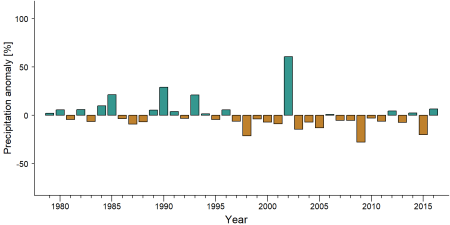
Precipitation anomaly in Dja Biosphere (or Faunal) Reserve -
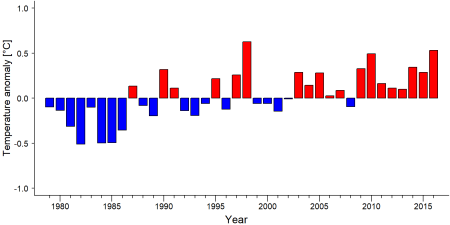
Temperature anomaly in Dja Biosphere (or Faunal) Reserve


External links
UNESCO Dja Biosphere Reserve
Guardians of Dja - Born Free
References
Bruce, T., Ndjassi, C., Fowler, A., Ndimbe, M., Fankem, O., Tabue Mbobda, R. B., Kobla, A. S., Wabo Puemo, F. A., Amin, R., Wacher, T., Grange-Chamfray, S., & Olson, D. (2018). Faunal inventory of the Dja Faunal Reserve, Cameroon – 2018. Ministry of Forests and Wildlife (MINFOF), Zoological Society of London – Cameroon Country Programme, African Wildlife Foundation, Yaoundé, Cameroon.
Born Free Foundation. (2025). Guardians of Dja. Retrieved December 2025, from https://www.bornfree.org.uk/field-conservation/guardians-of-dja/
Djuikouo, M. N. K., Doucet, J., Nguembou, C. K., Lewis, S. L., & Sonké, B. (2010). Diversity and aboveground biomass in three tropical forest types in the Dja Biosphere Reserve, Cameroon. African Journal of Ecology, 48(4), 1053-1063. doi:10.1111/j.1365-2028.2010.01212.x
Kubania, J. (2019). Sustainable cocoa turns Cameroon’s farmers into conservation champions. African Wildlife Foundation. https://www.awf.org/blog/sustainable-cocoa-turns-cameroons-farmers-conservation-champions
Latour, S. (2010). Reserve de Faune du Dja: Evaluation du Statut de grands singes. Rapport de BRL Ingenierie, GFA Consulting, et DFS.
MINFOF/UICN (2015). Caractérisation de la population de grands et moyens mammifères dans la Reserve de Faune du Dja: Potentiel et menaces, Yaoundé, Cameroun: 54 pages + Annexes.
UNESCO. (2015). http://www.unesco.org/new/fileadmin/MULTIMEDIA/HQ/SC/pdf/sc_mab_BR_Dja_EN.pdf (Accessed on 18.01.2021). link
UNESCO. (2021). State of conservation, Dja Faunal Reserve. Retrieved September 27, 2021, from https://whc.unesco.org/en/soc/4202
Williamson, E., & Usongo, L. (1995). Réserve de faune du Dja: Recensement des populations de primates et inventaire des grands mammifères. ECOFAC, Bruxelles.
ZSL. (2018). ZSL Cameroon annual report 2018. https://admin.zsl.org/sites/default/files/Cameroon%20Annual%20Report%202018.pdf link
IUCN. 2015. How a single Pygmy Hippo photo gave rise to the Wonegizi Proposed Protected Area Project. Online: https://www.iucn.org/content/how-single-pygmy-hippo-photo-gave-rise-wonegizi-proposed-protected-area-project
N’Goran, K. P. (2017). Summary report on WWF biomonitoring activities from 2014 to 2016: Status of forest elephant and great apes in Central Africa priority sites. https://www.wwf.de/fileadmin/fm-wwf/Publikationen-PDF/WWF_CA_Biomonitoring_Report.pdf
Kiribou, R., Tehoda, P., Chukwu, O., Bempah, G., Kühl, H. S., Ferreira, J., …, & Heinicke, S. (2024). Exposure of African ape sites to climate change impacts. PLOS Climate, 3(2), e0000345. doi:10.1371/journal.pclm.0000345
ZSL. https://www.zsl.org/conservation/regions/africa/dja-conservation-complex
Page created by: Tene Sop & APES Atlas Team Date: 2021-09-27
Page updated by: Aime Mizero Date: 2025-12-16