
Bia Conservation Area: Difference between revisions
No edit summary |
No edit summary |
||
| (2 intermediate revisions by the same user not shown) | |||
| Line 15: | Line 15: | ||
* Illegal hunting is the main threat. | * Illegal hunting is the main threat. | ||
* Conservation activities have focused on anti-poaching patrols. | * Conservation activities have focused on anti-poaching patrols. | ||
| Line 96: | Line 92: | ||
!Description | !Description | ||
!Year of threat | !Year of threat | ||
|- | |||
|2 Agriculture & aquaculture | |||
|2.1 Annual & perennial non-timber crops | |||
|Low (up to 30% of population affected) | |||
|Habitat encroachment due to agriculture (Quansah P. K., pers. comm. 2023). | |||
|1974-Ongoing (2023) | |||
|- | |- | ||
|5 Biological resource use | |5 Biological resource use | ||
| Line 102: | Line 104: | ||
|Cartridge cases and wire snares (Danquah, E. pers. comm. 2022). Poaching of wildlife which includes illegal entry with guns to kill wildlife and setting of traps like wire snares (Quansah P. K., pers. comm. 2023). | |Cartridge cases and wire snares (Danquah, E. pers. comm. 2022). Poaching of wildlife which includes illegal entry with guns to kill wildlife and setting of traps like wire snares (Quansah P. K., pers. comm. 2023). | ||
|1935-Ongoing (2023) | |1935-Ongoing (2023) | ||
|- | |||
|5 Biological resource use | |||
|5.1.5 Persecution/human wildlife conflict | |||
|Low (up to 30% of population affected) | |||
|Farm raids by wildlife resulting in human-wildlife conflict, mostly with elephants, but chimpanzees are also involved (Quansah pers. comm. 2023). | |||
|Ongoing (2023) | |||
|- | |- | ||
|7 Natural system modifications | |7 Natural system modifications | ||
| Line 108: | Line 116: | ||
|Hunting for tree Hyrax with the use of fires, resulting sometimes in bushfires (Quansah P. K., pers. comm. 2023). | |Hunting for tree Hyrax with the use of fires, resulting sometimes in bushfires (Quansah P. K., pers. comm. 2023). | ||
|1935-Ongoing (2023) | |1935-Ongoing (2023) | ||
|} | |} | ||
| Line 160: | Line 156: | ||
| | | | ||
| | | | ||
|1935-Ongoing ( | |1935-Ongoing (2026) | ||
|- | |- | ||
|5 Protection & restoration | |5 Protection & restoration | ||
| Line 206: | Line 202: | ||
|- | |- | ||
|2 Resources and capacity | |2 Resources and capacity | ||
|2. | |2.2 Lack of staff | ||
|Quansah P. K., pers. comm. 2023 | |Quansah P. K., pers. comm. 2023 | ||
| | | | ||
|- | |- | ||
|2 Resources and capacity | |2 Resources and capacity | ||
|2. | |2.3 General lack of funding | ||
|Quansah P. K., pers. comm. 2023 | |Quansah P. K., pers. comm. 2023 | ||
| | | | ||
|- | |- | ||
|2 Resources and capacity | |2 Resources and capacity | ||
|2. | |2.6 Lack of biomonitoring/survey data | ||
|Quansah P. K., pers. comm. 2023 | |Quansah P. K., pers. comm. 2023 | ||
| | | | ||
|- | |- | ||
|2 Resources and capacity | |2 Resources and capacity | ||
|2. | |2.7 Lack of infrastructure | ||
|Quansah P. K., pers. comm. 2023 | |Quansah P. K., pers. comm. 2023 | ||
| | | | ||
|- | |- | ||
|2 Resources and capacity | |2 Resources and capacity | ||
|2. | |2.7 Lack of infrastructure | ||
|Quansah P. K., pers. comm. 2023 | |Quansah P. K., pers. comm. 2023 | ||
| | | | ||
|- | |- | ||
|2 Resources and capacity | |2 Resources and capacity | ||
|2. | |2.8 Lack of evidence of conservation effectiveness | ||
|Quansah P. K., pers. comm. 2023 | |Quansah P. K., pers. comm. 2023 | ||
| | | | ||
Latest revision as of 05:25, 21 April 2026
West Africa > Ghana > Bia Conservation Area
Cite as: Danquah, E., Ofori-Amanfo, R. & Papa Kwaw Quansah (2023) Bia Conservation Area. A.P.E.S. Wiki. Retrieved Month Day, Year, from https://wiki.iucnapesportal.org/index.php/Bia_Conservation_Area
Français | Português | Español | Bahasa Indonesia | Melayu
Summary
- Western chimpanzees (Pan troglodytes verus) are present in the Bia Conservation Area.
- The population size is estimated at 34 weaned individuals.
- The chimpanzee population trend is decreasing.
- The site has a total size of 306 km².
- Illegal hunting is the main threat.
- Conservation activities have focused on anti-poaching patrols.
Site characteristics
The Bia Conservation Area (BCA) forms a 306km2 block in the moist evergreen and moist semi-deciduous forest zones of western Ghana, between the Bia River and the border with Côte d’Ivoire. BCA encompasses Bia National Park and Bia Resource Reserve; Bia National Park is 78 km2 and Bia Resource Reserve is 228 km2. The BCA was originally part of a larger (about 1500km2) ecosystem for forest elephants known as the Bia Group of Forest Reserves. However, the Bia elephant range has reduced over time due to clearance for cocoa cultivation, and is now an isolated population in an ecological island of forest with hard boundaries and no transitional zone to farmland (PADP 2001). It is planned for the entire area to be upgraded to national park status (Quansah P. K., pers. comm. 2023).
Table 1. Basic site information for Bia Conservation Area
| Species | Pan troglodytes verus |
| Area | 306 km² |
| Coordinates | Lat: 6.481132 , Lon: -3.112847 |
| Type of site | Conservation area |
| Habitat types | Subtropical/tropical moist lowland forest |
| Type of governance |
Types of sites Governance types Habitat types

Ape status
Wildlife patrol team encounters with chimpanzee signs indicate a decreasing trend (Danquah, E., pers. comm. 2022).
Table 2. Ape population estimates reported for Bia Conservation Area
| Species | Year | Occurrence | Encounter or vistation rate (nests/km; ind/day) | Density estimate [ind./ km²] (95% CI) | Abundance estimate (95% CI) | Survey area | Sampling method | Analytical framework | Source | Comments | A.P.E.S. database ID |
|---|---|---|---|---|---|---|---|---|---|---|---|
| Pan troglodytes verus | 2019-2020 | 34.0 | Bia Conservation Area | Line transects | Ofori-Amanfo, R. pers comm. 2023 | Estimate for weaned individuals |
Sampling methods Analytical frameworks

Threats
A total of 3,721 illegal human signs which are threats to the subspecies were recorded in 2021 and provided an overall encounter rate of 5.69 human signs per a kilometre walk. Three major threats among these were cartridge case (45.9%), wire snare (29.4%) and illegal logging (14.2%) (Danquah, E., pers. comm. 2022). Poachers still hunt in the park and set snares that also affect chimpanzees. Although poaching is not very frequent, it is a main threat because of the site’s low chimpanzee population abundance. Farm raids by wildlife resulting in human-wildlife conflict with elephants the most but chimpanzees are also involved. And with chimpanzees being low in numbers compared to elephants, it means a major threat to the chimpanzee population (Quansah P. K., pers. comm. 2023).
Table 3. Threats to apes reported for Bia Conservation Area
| Category | Specific threats | Threat level | Description | Year of threat |
|---|---|---|---|---|
| 2 Agriculture & aquaculture | 2.1 Annual & perennial non-timber crops | Low (up to 30% of population affected) | Habitat encroachment due to agriculture (Quansah P. K., pers. comm. 2023). | 1974-Ongoing (2023) |
| 5 Biological resource use | 5.1 Hunting & collecting terrestrial animals | Medium (30-70% of population affected) | Cartridge cases and wire snares (Danquah, E. pers. comm. 2022). Poaching of wildlife which includes illegal entry with guns to kill wildlife and setting of traps like wire snares (Quansah P. K., pers. comm. 2023). | 1935-Ongoing (2023) |
| 5 Biological resource use | 5.1.5 Persecution/human wildlife conflict | Low (up to 30% of population affected) | Farm raids by wildlife resulting in human-wildlife conflict, mostly with elephants, but chimpanzees are also involved (Quansah pers. comm. 2023). | Ongoing (2023) |
| 7 Natural system modifications | 7.1 Fire & fire suppression | Low (up to 30% of population affected) | Hunting for tree Hyrax with the use of fires, resulting sometimes in bushfires (Quansah P. K., pers. comm. 2023). | 1935-Ongoing (2023) |
Conservation activities
Bia Conservation Area is a protected area so there are dedicated staff who patrol inside the Park to protect the resources including the chimpanzees. There is also a community outreach team that goes to the communities to educate them about the need to conserve natural resources including the chimpanzees. Ghana's Wildlife Division is responsible for maintaining law and order within the protected area.
Between February and September 2023, the park conducted a programme, with funding from the Africa Elephant Fund (AEF), in 11 human wildlife hotspot communities where wildlife (with emphasis on elephants) invade community farms and livelihoods resulting in human wildlife conflict situations sometimes resulting in reprisal killings of wildlife. These communities were sensitised and educated on ways to mitigate human wildlife conflicts. Community Volunteer Squads were then formed, trained and given implements and the necessary tools and education to prevent wildlife raids on farms which results in human wildlife conflicts (Quansah P. K., pers. comm. 2023).
Table 4. Conservation activities reported for Bia Conservation Area
| Category | Specific activity | Description | Implementing organization(s) | Year of activity |
|---|---|---|---|---|
| 2 Counter-wildlife crime | 2.3 Conduct regular anti-poaching patrols | Wildlife patrol teams regularly conduct law enforcement duties within and around the protected area (Danquah, E., 2022). Anti-poaching operations (day, night and long patrols) (Ofori-Amanfo pers. obs. 2023). | 1974-Ongoing (2023) | |
| 4 Education & awareness | 4.1 Educate local communities about apes and sustainable use | Conservation education and outreach programmes in communities around the Park (Ofori-Amanfo pers. obs. 2023). | 2000-Ongoing (2023) | |
| 4 Education & awareness | 4.2 Involve local community in ape research and conservation management | Communities around the park are aggregated into 10 Community Resource Management Areas (CREMAs) where they have a constitution and management plans backed by the local government to regulate the use of their natural resources and also help protect the protected area from human entering (Quansah P. K., pers. comm. 2023). | 1974-Ongoing (2023) | |
| 5 Protection & restoration | 5.2 Legally protect ape habitat | 1935-Ongoing (2026) | ||
| 5 Protection & restoration | 5.5 Demarcate and enforce boundaries of protected areas | Fifty (50) missing, broken and defaced boundary pillars replaced (out of a total of 115 boundary pillar points identified) to properly demarcate and delineate the park from fringe farms and prevent encroachment into the park (Quansah P. K., pers. comm. 2023). | 2020 | |
| 7 Economic & other incentives | 7.1 Provide monetary benefits to local communities for sustainably managing their forest and its wildlife (e.g., REDD, alternative income, employment) | The park has been employing community people around the park as staff since the park was established in 1974 up till now. In the last 5 years the park has employed about 10 people in communities surrounding the park (Quansah P. K., pers. comm. 2023). | 1974-Ongoing (2023) | |
| 7 Economic & other incentives | 7.2 Provide non-monetary benefits to local communities for sustainably managing their forest and its wildlife (e.g., better education, infrastructure development) | Provision of school and other infrastructural development (Quansah P. K., pers. comm. 2023). | 1974-Ongoing (2023) | |
| 7 Economic & other incentives | 7.2 Provide non-monetary benefits to local communities for sustainably managing their forest and its wildlife (e.g., better education, infrastructure development) | Tropenbos Ghana, UNESCO, NCRC, and SNV Ghana support income generating activities such as beekeeping and honey processing, palm oil processing, soap production, snail farming, and mushroom cultivation (Quansah P. K., pers. comm. 2023). | 1993-Ongoing (2023) |
Challenges
The Ghana Wildlife Division has few staff and resources to conduct effective and regular anti-poaching activities within and around the protected area. Inadequate staff, field equipment, vehicles etc. hinder effective protection of the chimpanzees.
Table 5. Challenges reported for Bia Conservation Area
| Challenges | Specific challenges | Source | Year(s) |
|---|---|---|---|
| 1 Site management | 1.2 Need for improved coordination | Danquah, E. pers. observation 2022 | |
| 2 Resources and capacity | 2.2 Lack of staff | Quansah P. K., pers. comm. 2023 | |
| 2 Resources and capacity | 2.3 General lack of funding | Quansah P. K., pers. comm. 2023 | |
| 2 Resources and capacity | 2.6 Lack of biomonitoring/survey data | Quansah P. K., pers. comm. 2023 | |
| 2 Resources and capacity | 2.7 Lack of infrastructure | Quansah P. K., pers. comm. 2023 | |
| 2 Resources and capacity | 2.7 Lack of infrastructure | Quansah P. K., pers. comm. 2023 | |
| 2 Resources and capacity | 2.8 Lack of evidence of conservation effectiveness | Quansah P. K., pers. comm. 2023 |
Enablers
Table 6. Enablers reported for Bia Conservation Area
| Enablers | Specific enablers | Source | Year(s) |
|---|---|---|---|
| 1 Site management | |||
| 2 Resources and capacity | |||
| 3 Engaged community | |||
| 4 Institutional support | |||
| 5 Ecological context | |||
| 6 Safety and stability |
Research activities
Bia Conservation Area is part of the Pan African Programme: The Cultured Chimpanzee (PanAf).
Documented behaviours
Table 7. Behaviours documented for Bia Conservation Area
| Category | Behavior | Observation type | Prevalence | Observation dates | Source | Habituation | Species | Comment |
|---|---|---|---|---|---|---|---|---|
| Not reported |
Exposure to climate change impacts
-
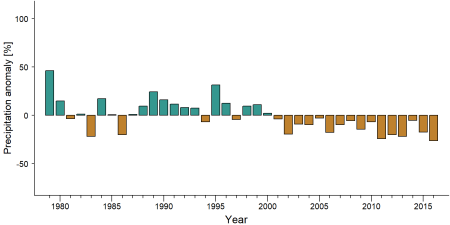
Precipitation anomaly in Bia Conservation Area -
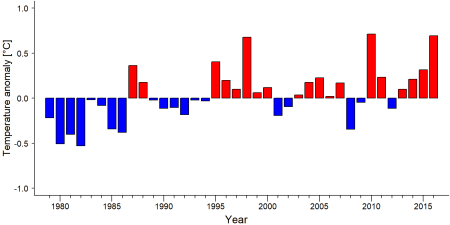
Temperature anomaly in Bia Conservation Area


External links
References
Page created by: Emmanuel Danquah, Richard Ofori-Amanfo & Papa Kwaw Quansah Date: 2023-11-17