
Marahoué National Park: Difference between revisions
No edit summary |
No edit summary Tag: Manual revert |
||
| (7 intermediate revisions by the same user not shown) | |||
| Line 17: | Line 17: | ||
= Site characteristics = | = Site characteristics = | ||
Marahoué National Park (IUCN category: II) was established in 1968 (UNEP-WCMC and IUCN 2019). It covers an area of 1010 km2 and is located in the central Côte d´Ivoire in the Bouafle region near Lake Kossou. Marahoué NP is 275 km (170 miles) northwest of Abidjan. Marahoué NP is managed by the Office Ivoirien des Parcs et Réserves (OIPR). The park consists of two ecological zones: close forest in the south-west of the park and savanna in the north-eastern part. In a survey in 2007 signs of different mammal and bird species were found, including forest elephant (''Loxodonta africana''), pygmy hippopotamus (''Choeropsis liberiensis''), African buffalo (''Syncerus caffer''), and bushbuck (''Tragelaphus scriptus''). However, the park is strongly affected by illegal activities, especially forest clearing for cocoa plantations and poaching, and the current status of the biodiversity is unknown (Campbell et al. 2008, N’Goran et al. 2006, N’Goran et al. 2007, WCF 2012). | Marahoué National Park (IUCN category: II) was established in 1968 ([[#R01174|UNEP-WCMC and IUCN 2019]]). It covers an area of 1010 km2 and is located in the central Côte d´Ivoire in the Bouafle region near Lake Kossou. Marahoué NP is 275 km (170 miles) northwest of Abidjan. Marahoué NP is managed by the Office Ivoirien des Parcs et Réserves (OIPR). The park consists of two ecological zones: close forest in the south-west of the park and savanna in the north-eastern part. In a survey in 2007 signs of different mammal and bird species were found, including forest elephant (''Loxodonta africana''), pygmy hippopotamus (''Choeropsis liberiensis''), African buffalo (''Syncerus caffer''), and bushbuck (''Tragelaphus scriptus''). However, the park is strongly affected by illegal activities, especially forest clearing for cocoa plantations and poaching, and the current status of the biodiversity is unknown ([[#R01168|Campbell et al. 2008]], [[#R01171|N’Goran et al. 2006, N’Goran et al. 2007]], [[#R01175|WCF 2012]]). | ||
'''Table 1. Basic site information for Marahoué National Park''' | '''Table 1. Basic site information for Marahoué National Park''' | ||
| Line 44: | Line 44: | ||
= Ape status = | = Ape status = | ||
The chimpanzee (''Pan troglodytes verus'') population in Marahoué National Park was first estimated at 1407 individuals by Marchesi et al. (1995). However, due to the relatively small number of transects surveyed, large uncertainties are associated with this estimate. In 2007, a survey that covered 167.5 km of systematically located transects across the entire park yielded a conservative population estimate of fewer than 50 individuals (N´Goran et al. 2007). In 2012, a rapid assessment was conducted by the Wild Chimpanzee Foundation [https://www.wildchimps.org WCF] in collaboration with Afrique Nature, and no signs of chimpanzees were found. | The chimpanzee (''Pan troglodytes verus'') population in Marahoué National Park was first estimated at 1407 individuals by [[#R01170|Marchesi et al. (1995)]]. However, due to the relatively small number of transects surveyed, large uncertainties are associated with this estimate. In 2007, a survey that covered 167.5 km of systematically located transects across the entire park yielded a conservative population estimate of fewer than 50 individuals (N´Goran et al. 2007). In 2012, a rapid assessment was conducted by the Wild Chimpanzee Foundation [https://www.wildchimps.org WCF] in collaboration with Afrique Nature, and no signs of chimpanzees were found. | ||
'''Table 2. Ape population estimates reported for Marahoué National Park''' | '''Table 2. Ape population estimates reported for Marahoué National Park''' | ||
| Line 62: | Line 62: | ||
|- | |- | ||
|''Pan troglodytes verus'' | |''Pan troglodytes verus'' | ||
| | |2012 | ||
| | |||
|0 | |||
| | | | ||
| | |0.0 | ||
|Marahoué National Park | |Marahoué National Park | ||
|Line transects | |Line transects | ||
| | | | ||
| | |[[#R01175|WCF 2012]] | ||
|Total survey effort: | |Total survey effort: 36.9 km | ||
| | | | ||
|- | |- | ||
|''Pan troglodytes verus'' | |''Pan troglodytes verus'' | ||
| | |2007 | ||
| | |||
|0.03 | |||
| | | | ||
| | | | ||
|Marahoué National Park | |Marahoué National Park | ||
|Line transects | |Line transects | ||
| | | | ||
|N’Goran et al. | |[[#R01171|N’Goran et al. 2007]], [[#R01168|Campbell et al. 2008]] | ||
|Total survey effort: | |Total survey effort: 167.5 km, abundance estimate is a maximum | ||
| | |CIV0008, CIV0016<div class="mw-collapsible mw-collapsed" data-expandtext="+15 more" data-collapsetext="less">CIV0024, CIV0027, CIV0028, CIV0030, CIV0033, CIV0034, CIV0037, CIV0048, CIV0050, CIV0057, CIV0058, CIV0059, CIV0060, CIV0063, CIV0069</div> | ||
|- | |- | ||
|''Pan troglodytes verus'' | |''Pan troglodytes verus'' | ||
| | |2006 | ||
| | | | ||
|0.01 | |||
| | | | ||
|50.0 | |||
|Marahoué National Park | |Marahoué National Park | ||
|Line transects | |Line transects | ||
| | | | ||
|N’Goran et al. | |N’Goran et al. 2006 | ||
|Total survey effort: | |Total survey effort: 154.5 km, abundance estimate is a maximum | ||
| | |CIV0033 | ||
|- | |- | ||
|''Pan troglodytes verus'' | |''Pan troglodytes verus'' | ||
| | |1990 | ||
| | | | ||
| | |15.6 | ||
| | |1.64 | ||
| | |1407.0 | ||
|Marahoué National Park | |Marahoué National Park | ||
|Line transects | |Line transects | ||
| | | | ||
| | |[[#R01170|Marchesi et al. 1995]] | ||
|Total survey effort: | |Total survey effort: 15 km, abundance estimate for weaned individuals | ||
| | |CIV0061 | ||
|} | |} | ||
| Line 118: | Line 118: | ||
= Threats = | = Threats = | ||
Marahoué National Park has lost 93% of its forest cover between 2002 and 2008, which may be directly linked to the civil unrest prevailing in the country since 2002 (Campbell et al. 2008). Deforestation was many driven clearing land for agriculture using fires, especially for cocoa plantations, and illegal logging (Campbell et al. 2008, N’Goran et al. 2006, N’Goran et al. 2007, WCF 2012). In addition, the presence of people in the park and illegal hunting of chimpanzees likely caused the extinction of chimpanzees in Marahoué NP (Struhsaker and Bakarr 1999, Denis 2015). | Marahoué National Park has lost 93% of its forest cover between 2002 and 2008, which may be directly linked to the civil unrest prevailing in the country since 2002 ([[#R01168|Campbell et al. 2008]]). Deforestation was many driven clearing land for agriculture using fires, especially for cocoa plantations, and illegal logging ([[#R01168|Campbell et al. 2008]], [[#R01171|N’Goran et al. 2006, N’Goran et al. 2007]], [[#R01175|WCF 2012]]). In addition, the presence of people in the park and illegal hunting of chimpanzees likely caused the extinction of chimpanzees in Marahoué NP ([[#R01173|Struhsaker and Bakarr 1999]], [[#R01169|Denis 2015]]). | ||
'''Table 3. Threats to apes reported for Marahoué National Park''' | '''Table 3. Threats to apes reported for Marahoué National Park''' | ||
| Line 131: | Line 131: | ||
|1.1 Residential areas | |1.1 Residential areas | ||
|High (more than 70% of population affected) | |High (more than 70% of population affected) | ||
|Presence of people in the park, campsites and small villages (WCF 2012). | |Presence of people in the park, campsites and small villages ([[#R01175|WCF 2012]]). | ||
|Ongoing (2012) | |Ongoing (2012) | ||
|- | |- | ||
| Line 137: | Line 137: | ||
|2.1 Annual & perennial non-timber crops | |2.1 Annual & perennial non-timber crops | ||
|High (more than 70% of population affected) | |High (more than 70% of population affected) | ||
|Especially cocoa plantations (WCF 2012). | |Especially cocoa plantations ([[#R01175|WCF 2012]]). | ||
|Ongoing (2012) | |Ongoing (2012) | ||
|- | |- | ||
| Line 143: | Line 143: | ||
|2.3 Livestock farming & ranching | |2.3 Livestock farming & ranching | ||
|Low (up to 30% of population affected) | |Low (up to 30% of population affected) | ||
|Signs of cattle grazing (WCF 2012). | |Signs of cattle grazing ([[#R01175|WCF 2012]]). | ||
|Ongoing (2012) | |Ongoing (2012) | ||
|- | |- | ||
| Line 149: | Line 149: | ||
|4.1 Roads & railroads | |4.1 Roads & railroads | ||
|Medium (30-70% of population affected) | |Medium (30-70% of population affected) | ||
|Presence of illegal paths, roads and vehicles (WCF 2012). | |Presence of illegal paths, roads and vehicles ([[#R01175|WCF 2012]]). | ||
|Ongoing (2012) | |Ongoing (2012) | ||
|- | |- | ||
| Line 155: | Line 155: | ||
|5.1 Hunting & collecting terrestrial animals | |5.1 Hunting & collecting terrestrial animals | ||
|High (more than 70% of population affected) | |High (more than 70% of population affected) | ||
|Poaching widespread (WCF 2012). | |Poaching widespread ([[#R01175|WCF 2012]]). | ||
|Ongoing (2012) | |Ongoing (2012) | ||
|- | |- | ||
|5 Biological resource use | |5 Biological resource use | ||
|5.1.2 Unintentional effects | |5.1.2 Unintentional effects | ||
|Present (unknown severity) | |Present (unknown severity) | ||
|Great apes getting injured by traps likely intended for other animals (Kouadio R. pers. comm. 2025). | |Great apes getting injured by traps likely intended for other animals (Kouadio R. pers. comm. 2025). | ||
| Line 226: | Line 226: | ||
= Challenges = | = Challenges = | ||
Denis (2015) conducted a comprehensive study into why Marahoué National Park degraded. The study was based on interviews with different stakeholders in Marahoué National Park and pointed out that already since its creation in 1968 farmers were present in the park and in 1990 13% of the park was occupied by people, and this percentage has grown steadily since (Denis 2015). Government support for maintaining the protective status of Marahoué was weak and inconsistent. There is also widespread corruption and a lack of technical means as well as human resources to ensure law enforcement (Denis 2015). | [[#R01169|Denis (2015)]] conducted a comprehensive study into why Marahoué National Park degraded. The study was based on interviews with different stakeholders in Marahoué National Park and pointed out that already since its creation in 1968 farmers were present in the park and in 1990 13% of the park was occupied by people, and this percentage has grown steadily since ([[#R01169|Denis 2015]]). Government support for maintaining the protective status of Marahoué was weak and inconsistent. There is also widespread corruption and a lack of technical means as well as human resources to ensure law enforcement ([[#R01169|Denis 2015]]). | ||
'''Table 5. Challenges reported for Marahoué National Park''' | '''Table 5. Challenges reported for Marahoué National Park''' | ||
| Line 237: | Line 237: | ||
|1 Site management | |1 Site management | ||
|1.3 Corruption | |1.3 Corruption | ||
|Denis 2015 | |[[#R01169|Denis 2015]] | ||
| | | | ||
|- | |- | ||
| | |2 Resources and capacity | ||
| | |2.1 Lack of capacity/training | ||
| | |Kouadio R. pers. comm. 2025 | ||
| | |Ongoing (2025) | ||
|- | |- | ||
|2 Resources and capacity | |2 Resources and capacity | ||
|2.2 Lack of staff | |2.2 Lack of staff | ||
|Denis 2015 | |[[#R01169|Denis 2015]] | ||
|2015-Ongoing (2025) | |2015-Ongoing (2025) | ||
|- | |- | ||
| Line 261: | Line 261: | ||
|- | |- | ||
|2 Resources and capacity | |2 Resources and capacity | ||
|2. | |2.5 Lack of equipment/transportation | ||
| | |[[#R01169|Denis 2015]] | ||
| | | | ||
|- | |- | ||
|4 Institutional support | |4 Institutional support | ||
|4.1 Lack of law enforcement | |4.1 Lack of law enforcement | ||
|Denis 2015 | |[[#R01169|Denis 2015]] | ||
| | | | ||
|- | |- | ||
| | |4 Institutional support | ||
|2 | |4.2 Lack of government support | ||
|Denis 2015 | |[[#R01169|Denis 2015]] | ||
| | | | ||
|} | |} | ||
| Line 358: | Line 358: | ||
= Exposure to climate change impacts = | = Exposure to climate change impacts = | ||
As part of a study on the exposure of African great ape sites to climate change impacts, Kiribou et al. | As part of a study on the exposure of African great ape sites to climate change impacts, [[#R02258|Kiribou et al. (2024)]] extracted climate data and data on projected extreme climate impact events for the site. Climatological characteristics were derived from observation-based climate data provided by the Inter-Sectoral Impact Model Intercomparison Project (ISIMIP, www.isimip.org). Parameters were calculated as the average across each 30-year period. For 1981-2010, the EWEMBI dataset from ISIMIP2a was used. For the two future periods (2021-2050 and 2071-2099) ISIMIP2b climate data based on four CMIP5 global climate models were used. For future projections, two Representative Concentration Pathways (RCP) were used. RCP 2.6 is a scenario with strong mitigation measures in which global temperatures would likely rise below 2C. RCP 6.0 is a scenario with medium emissions in which global temperatures would likely rise up to 3C by 2100. For the number of days with heavy precipitation events, the 98th percentile of all precipitation days (>1mm/d) was calculated for the 1979-2013 reference period as a threshold for a heavy precipitation event. Then, for each year, the number of days above that threshold was derived. The figures on temperature and precipitation anomaly show the deviation from the mean temperature and mean precipitation for the 1979-2013 reference period. | ||
The estimated exposure to future extreme climate impact events (crop failure, drought, river flood, wildfire, tropical cyclone, and heatwave) is based on a published dataset by Lange et al. 2020 derived from ISIMIP2b data. The same global climate models and RCPs as described above were used. Within each 30-year period, the number of years with an extreme event and the average proportion of the site affected were calculated ( | The estimated exposure to future extreme climate impact events (crop failure, drought, river flood, wildfire, tropical cyclone, and heatwave) is based on a published dataset by Lange et al. 2020 derived from ISIMIP2b data. The same global climate models and RCPs as described above were used. Within each 30-year period, the number of years with an extreme event and the average proportion of the site affected were calculated ([[#R02258|Kiribou et al. 2024]]). | ||
'''Table 8. Estimated past and projected climatological characteristics in Marahoué National Park''' | '''Table 8. Estimated past and projected climatological characteristics in Marahoué National Park''' | ||
| Line 483: | Line 483: | ||
= References = | = References = | ||
Denis G. 2015. Le parc de la Marahoué : | <span id="R01168"></span>Campbell, G., Kuehl, H., N'Goran Kouamé, P., & Boesch, C. (2008). Alarming decline of West African chimpanzees in Côte d'Ivoire. ''Current Biology'', 18(19), R903-R904. [https://doi.org/10.1016/j.cub.2008.08.015 doi:10.1016/j.cub.2008.08.015] | ||
<span id="R01169"></span>Denis, G. (2015). Le parc de la Marahoué : De la logique de conservation à la logique de prédation. European Scientific Journal, 11(8), 1857–7881. [https://www.semanticscholar.org/paper/aa34ecf010cb49119a44fb49ffb9e9337a6f07a0 link] | |||
<span id="R01170"></span>Marchesi, P., Marchesi, N., Fruth, B., & Boesch, C. (1995). Census and distribution of chimpanzees in Côte D’Ivoire. ''Primates'', 36(4), 591-607. [https://doi.org/10.1007/bf02382880 doi:10.1007/bf02382880] | |||
<span id="R01171"></span>N’Goran, K. P., et al. (2007). Résultats de la première phase du biomonitoring au Parc National de Marahoué (mai 2006 – décembre 2006). Unpublished report. WCF/OIPR. Online: https://www.wildchimps.org/reports/reports.html | |||
<span id="R01172"></span>N'Goran, P. (2008). Résultats importants des activités de biomonitoring au Parc National de la Marahoué (mai 2007 – novembre 2007). WCF/CSRS/Universite d'Abobo-Adjame. | |||
<span id="R01173"></span>Struhsaker, T. T., & Bakarr, M. I. (1999). A rapid survey of primates and other large mammals in Parc National de la Marahoué, Côte d'Ivoire. In Schulenberg, T. S., Short, C. A., & Stephenson, P. J. (Eds.), ''A Biological Assessment of Parc National de la Marahoué, Côte d'Ivoire. RAP Working Papers 13'' (pp. 50-53). Washington, DC: Conservation International. | |||
<span id="R01174"></span>UNEP-WCMC, & IUCN. (2019). Protected Planet: The World Database on Protected Areas (WDPA). Cambridge, UK: UNEP-WCMC and IUCN. Online: https://www.protectedplanet.net/722 [https://web.archive.org/web/20200930170440/https://www.protectedplanet.net/country/GN link] | |||
<span id="R01175"></span>WCF. (2012). Annual report 2012 – Activities of the Wild Chimpanzee Foundation for improved conservation of chimpanzees and their habitat in West Africa. Online: https://www.wildchimps.org/reports/reports.html [https://web.archive.org/web/20241112052804/https://www.wildchimps.org/reports/reports.html link] | |||
<span id="R02258"></span>Kiribou, R., Tehoda, P., Chukwu, O., Bempah, G., Kühl, H. S., Ferreira, J., …, & Heinicke, S. (2024). Exposure of African ape sites to climate change impacts. ''PLOS Climate'', 3(2), e0000345. [https://doi.org/10.1371/journal.pclm.0000345 doi:10.1371/journal.pclm.0000345] | |||
Latest revision as of 17:53, 15 October 2026
West Africa > Côte d'Ivoire > Marahoué National Park
Français | Português | Español | Bahasa Indonesia | Melayu
Summary
- Western chimpanzees (Pan troglodytes verus) might be extirpated in Marahoué National Park.
- This site has a total size of 1,010 km².
- Chimpanzees are extirpated due to hunting and large-scale deforestation driven by the expansion of agricultural areas.
Site characteristics
Marahoué National Park (IUCN category: II) was established in 1968 (UNEP-WCMC and IUCN 2019). It covers an area of 1010 km2 and is located in the central Côte d´Ivoire in the Bouafle region near Lake Kossou. Marahoué NP is 275 km (170 miles) northwest of Abidjan. Marahoué NP is managed by the Office Ivoirien des Parcs et Réserves (OIPR). The park consists of two ecological zones: close forest in the south-west of the park and savanna in the north-eastern part. In a survey in 2007 signs of different mammal and bird species were found, including forest elephant (Loxodonta africana), pygmy hippopotamus (Choeropsis liberiensis), African buffalo (Syncerus caffer), and bushbuck (Tragelaphus scriptus). However, the park is strongly affected by illegal activities, especially forest clearing for cocoa plantations and poaching, and the current status of the biodiversity is unknown (Campbell et al. 2008, N’Goran et al. 2006, N’Goran et al. 2007, WCF 2012).
Table 1. Basic site information for Marahoué National Park
| Species | Pan troglodytes verus |
| Area | 1,010 km² |
| Coordinates | Lat: 7.11 , Lon: -6.02 |
| Type of site | Protected area (National Park) |
| Habitat types | Subtropical/tropical moist lowland forest, Savanna, Agricultural land |
| Type of governance | Governance by government |
Types of sites Governance types Habitat types
Ape status
The chimpanzee (Pan troglodytes verus) population in Marahoué National Park was first estimated at 1407 individuals by Marchesi et al. (1995). However, due to the relatively small number of transects surveyed, large uncertainties are associated with this estimate. In 2007, a survey that covered 167.5 km of systematically located transects across the entire park yielded a conservative population estimate of fewer than 50 individuals (N´Goran et al. 2007). In 2012, a rapid assessment was conducted by the Wild Chimpanzee Foundation WCF in collaboration with Afrique Nature, and no signs of chimpanzees were found.
Table 2. Ape population estimates reported for Marahoué National Park
| Species | Year | Occurrence | Encounter or vistation rate (nests/km; ind/day) | Density estimate [ind./ km²] (95% CI) | Abundance estimate (95% CI) | Survey area | Sampling method | Analytical framework | Source | Comments | A.P.E.S. database ID |
|---|---|---|---|---|---|---|---|---|---|---|---|
| Pan troglodytes verus | 2012 | 0 | 0.0 | Marahoué National Park | Line transects | WCF 2012 | Total survey effort: 36.9 km | ||||
| Pan troglodytes verus | 2007 | 0.03 | Marahoué National Park | Line transects | N’Goran et al. 2007, Campbell et al. 2008 | Total survey effort: 167.5 km, abundance estimate is a maximum | CIV0008, CIV0016 CIV0024, CIV0027, CIV0028, CIV0030, CIV0033, CIV0034, CIV0037, CIV0048, CIV0050, CIV0057, CIV0058, CIV0059, CIV0060, CIV0063, CIV0069
| ||||
| Pan troglodytes verus | 2006 | 0.01 | 50.0 | Marahoué National Park | Line transects | N’Goran et al. 2006 | Total survey effort: 154.5 km, abundance estimate is a maximum | CIV0033 | |||
| Pan troglodytes verus | 1990 | 15.6 | 1.64 | 1407.0 | Marahoué National Park | Line transects | Marchesi et al. 1995 | Total survey effort: 15 km, abundance estimate for weaned individuals | CIV0061 |
Sampling methods Analytical frameworks
Threats
Marahoué National Park has lost 93% of its forest cover between 2002 and 2008, which may be directly linked to the civil unrest prevailing in the country since 2002 (Campbell et al. 2008). Deforestation was many driven clearing land for agriculture using fires, especially for cocoa plantations, and illegal logging (Campbell et al. 2008, N’Goran et al. 2006, N’Goran et al. 2007, WCF 2012). In addition, the presence of people in the park and illegal hunting of chimpanzees likely caused the extinction of chimpanzees in Marahoué NP (Struhsaker and Bakarr 1999, Denis 2015).
Table 3. Threats to apes reported for Marahoué National Park
| Category | Specific threats | Threat level | Description | Year of threat |
|---|---|---|---|---|
| 1 Residential & commercial development | 1.1 Residential areas | High (more than 70% of population affected) | Presence of people in the park, campsites and small villages (WCF 2012). | Ongoing (2012) |
| 2 Agriculture & aquaculture | 2.1 Annual & perennial non-timber crops | High (more than 70% of population affected) | Especially cocoa plantations (WCF 2012). | Ongoing (2012) |
| 2 Agriculture & aquaculture | 2.3 Livestock farming & ranching | Low (up to 30% of population affected) | Signs of cattle grazing (WCF 2012). | Ongoing (2012) |
| 4 Transportation & service corridors | 4.1 Roads & railroads | Medium (30-70% of population affected) | Presence of illegal paths, roads and vehicles (WCF 2012). | Ongoing (2012) |
| 5 Biological resource use | 5.1 Hunting & collecting terrestrial animals | High (more than 70% of population affected) | Poaching widespread (WCF 2012). | Ongoing (2012) |
| 5 Biological resource use | 5.1.2 Unintentional effects | Present (unknown severity) | Great apes getting injured by traps likely intended for other animals (Kouadio R. pers. comm. 2025). | Ongoing (2025) |
| 5 Biological resource use | 5.1.5 Persecution/human wildlife conflict | Present (unknown severity) | Human wildlife conflict has been reported, involving people and great apes sharing water sources and wild natural resources such as forest fruits, encountering each other on paths or trails, and, in some cases, people killing great apes for trade or cultural reasons (Kouadio R. pers. comm. 2025). | Ongoing (2025) |
| 8 Invasive & other problematic species, genes & diseases | 8.4 Pathogens | Present (unknown severity) | The potential risk of diseases trasmission between people and apes, or apes and people is reported (Kouadio R. pers. comm. 2025). | Ongoing (2025) |
Conservation activities
Table 4. Conservation activities reported for Marahoué National Park
| Category | Specific activity | Description | Implementing organization(s) | Year of activity |
|---|---|---|---|---|
| 2 Counter-wildlife crime | 2.3 Conduct regular anti-poaching patrols | Patrols and law enforcement actvities are conducted (Kouadio R. pers. comm. 2025). | Ongoing (2025) | |
| 4 Education & awareness | 4.1 Educate local communities about apes and sustainable use | Awareness raising and educating local people about great apes (Kouadio R. pers. comm. 2025). | Ongoing (2025) | |
| 4 Education & awareness | 4.2 Involve local community in ape research and conservation management | Local communities are involved in conservation programs (Kouadio R. pers. comm. 2025). | Ongoing (2025) | |
| 5 Protection & restoration | 5.6 Habitat restoration | Forest rehabilitation and protection activities are reported (Kouadio R. pers. comm. 2025). | Ongoing (2025) | |
| 7 Economic & other incentives | 7.2 Provide non-monetary benefits to local communities for sustainably managing their forest and its wildlife (e.g., better education, infrastructure development) | Ecotourism ventures and initiatives are being supported and developed, as well as other new income sources like selling local products (Kouadio R. pers. comm. 2025). | Ongoing (2025) |
Challenges
Denis (2015) conducted a comprehensive study into why Marahoué National Park degraded. The study was based on interviews with different stakeholders in Marahoué National Park and pointed out that already since its creation in 1968 farmers were present in the park and in 1990 13% of the park was occupied by people, and this percentage has grown steadily since (Denis 2015). Government support for maintaining the protective status of Marahoué was weak and inconsistent. There is also widespread corruption and a lack of technical means as well as human resources to ensure law enforcement (Denis 2015).
Table 5. Challenges reported for Marahoué National Park
| Challenges | Specific challenges | Source | Year(s) |
|---|---|---|---|
| 1 Site management | 1.3 Corruption | Denis 2015 | |
| 2 Resources and capacity | 2.1 Lack of capacity/training | Kouadio R. pers. comm. 2025 | Ongoing (2025) |
| 2 Resources and capacity | 2.2 Lack of staff | Denis 2015 | 2015-Ongoing (2025) |
| 2 Resources and capacity | 2.3 General lack of funding | Kouadio R. pers. comm. 2025 | Ongoing (2025) |
| 2 Resources and capacity | 2.4 Lack of continuous/long-term funding | Kouadio R. pers. comm. 2025 | Ongoing (2025) |
| 2 Resources and capacity | 2.5 Lack of equipment/transportation | Denis 2015 | |
| 4 Institutional support | 4.1 Lack of law enforcement | Denis 2015 | |
| 4 Institutional support | 4.2 Lack of government support | Denis 2015 |
Enablers
Table 6. Enablers reported for Marahoué National Park
| Enablers | Specific enablers | Source | Year(s) |
|---|---|---|---|
| 3 Engaged community | 3.6 Local community engagement and support | Kouadio R. pers. comm. 2025 | Ongoing (2025) |
| 1 Site management | |||
| 2 Resources and capacity | |||
| 4 Institutional support | |||
| 5 Ecological context | |||
| 6 Safety and stability |
Research activities
As chimpanzees might be extirpated from Marahoué National Park no research is conducted on chimpanzees.
Documented behaviours
Table 7. Behaviours documented for Marahoué National Park
| Category | Behavior | Observation type | Prevalence | Observation dates | Source | Habituation | Species | Comment |
|---|---|---|---|---|---|---|---|---|
| Not reported |
Exposure to climate change impacts
As part of a study on the exposure of African great ape sites to climate change impacts, Kiribou et al. (2024) extracted climate data and data on projected extreme climate impact events for the site. Climatological characteristics were derived from observation-based climate data provided by the Inter-Sectoral Impact Model Intercomparison Project (ISIMIP, www.isimip.org). Parameters were calculated as the average across each 30-year period. For 1981-2010, the EWEMBI dataset from ISIMIP2a was used. For the two future periods (2021-2050 and 2071-2099) ISIMIP2b climate data based on four CMIP5 global climate models were used. For future projections, two Representative Concentration Pathways (RCP) were used. RCP 2.6 is a scenario with strong mitigation measures in which global temperatures would likely rise below 2C. RCP 6.0 is a scenario with medium emissions in which global temperatures would likely rise up to 3C by 2100. For the number of days with heavy precipitation events, the 98th percentile of all precipitation days (>1mm/d) was calculated for the 1979-2013 reference period as a threshold for a heavy precipitation event. Then, for each year, the number of days above that threshold was derived. The figures on temperature and precipitation anomaly show the deviation from the mean temperature and mean precipitation for the 1979-2013 reference period.
The estimated exposure to future extreme climate impact events (crop failure, drought, river flood, wildfire, tropical cyclone, and heatwave) is based on a published dataset by Lange et al. 2020 derived from ISIMIP2b data. The same global climate models and RCPs as described above were used. Within each 30-year period, the number of years with an extreme event and the average proportion of the site affected were calculated (Kiribou et al. 2024).
Table 8. Estimated past and projected climatological characteristics in Marahoué National Park
| Value | 1981-2010 | 2021-2050, RCP 2.6 | 2021-2050, RCP 6.0 | 2071-2099, RCP 2.6 | 2071-2099, RCP 6.0 |
|---|---|---|---|---|---|
| Mean temperature [C] | 26.4 | 27.6 | 27.6 | 27.7 | 28.9 |
| Annual precipitation [mm] | 1251 | 1266 | 1321 | 1271 | 1343 |
| Max no. consecutive dry days (per year) | 35.6 | 34.8 | 36 | 35.1 | 33.7 |
| No. days with heavy precipitation (per year) | 5 | 6.4 | 6.4 | 6.7 | 8.1 |
Table 9. Projected exposure of apes to extreme climate impact events in Marahoué National Park
| Type | No. of years with event (2021-2050, RCP 2.6) | % of site exposed (2021-2050, RCP 2.6) | No. of years with event (2021-2050, RCP 6.0) | % of site exposed (2021-2050, RCP 6.0) | No. of years with event (2070-2099, RCP 2.6) | % of site exposed (2070-2099, RCP 2.6) | No. of years with event (2070-2099, RCP 6.0) | % of site exposed (2070-2099, RCP 6.0) |
|---|---|---|---|---|---|---|---|---|
| Crop failure | 4 | 2.98 | 2 | 2.98 | 4 | 2.98 | 5.5 | 2.98 |
| Drought | 0.25 | 25 | 0 | 0 | 0 | 0 | 0 | 0 |
| Heatwave | 4.5 | 100 | 5.5 | 100 | 3 | 100 | 6.5 | 100 |
| River flood | 1 | 0.14 | 1.5 | 1.61 | 2.25 | 2.97 | 4 | 2.23 |
| Tropical cyclone | 0 | 0 | 0 | 0 | 0 | 0 | 0 | 0 |
| Wildfire | 30 | 0.61 | 30 | 0.61 | 29 | 0.63 | 29 | 0.6 |
-
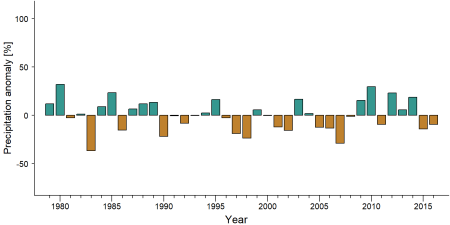
Precipitation anomaly in Marahoué National Park -
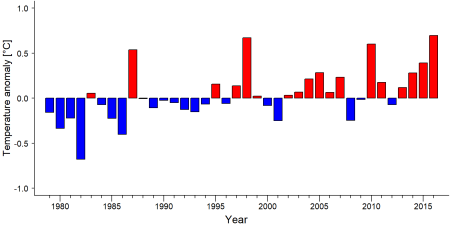
Temperature anomaly in Marahoué National Park


External links
References
Campbell, G., Kuehl, H., N'Goran Kouamé, P., & Boesch, C. (2008). Alarming decline of West African chimpanzees in Côte d'Ivoire. Current Biology, 18(19), R903-R904. doi:10.1016/j.cub.2008.08.015
Denis, G. (2015). Le parc de la Marahoué : De la logique de conservation à la logique de prédation. European Scientific Journal, 11(8), 1857–7881. link
Marchesi, P., Marchesi, N., Fruth, B., & Boesch, C. (1995). Census and distribution of chimpanzees in Côte D’Ivoire. Primates, 36(4), 591-607. doi:10.1007/bf02382880
N’Goran, K. P., et al. (2007). Résultats de la première phase du biomonitoring au Parc National de Marahoué (mai 2006 – décembre 2006). Unpublished report. WCF/OIPR. Online: https://www.wildchimps.org/reports/reports.html
N'Goran, P. (2008). Résultats importants des activités de biomonitoring au Parc National de la Marahoué (mai 2007 – novembre 2007). WCF/CSRS/Universite d'Abobo-Adjame.
Struhsaker, T. T., & Bakarr, M. I. (1999). A rapid survey of primates and other large mammals in Parc National de la Marahoué, Côte d'Ivoire. In Schulenberg, T. S., Short, C. A., & Stephenson, P. J. (Eds.), A Biological Assessment of Parc National de la Marahoué, Côte d'Ivoire. RAP Working Papers 13 (pp. 50-53). Washington, DC: Conservation International.
UNEP-WCMC, & IUCN. (2019). Protected Planet: The World Database on Protected Areas (WDPA). Cambridge, UK: UNEP-WCMC and IUCN. Online: https://www.protectedplanet.net/722 link
WCF. (2012). Annual report 2012 – Activities of the Wild Chimpanzee Foundation for improved conservation of chimpanzees and their habitat in West Africa. Online: https://www.wildchimps.org/reports/reports.html link
Kiribou, R., Tehoda, P., Chukwu, O., Bempah, G., Kühl, H. S., Ferreira, J., …, & Heinicke, S. (2024). Exposure of African ape sites to climate change impacts. PLOS Climate, 3(2), e0000345. doi:10.1371/journal.pclm.0000345
Page created by: APES Atlas Team Date: 2019-10-16
Page updated by: KOUADIO KOUASSI REMY Date: 2025-08-15