
Okomu National Park: Difference between revisions
No edit summary |
No edit summary Tag: Manual revert |
||
| (6 intermediate revisions by the same user not shown) | |||
| Line 7: | Line 7: | ||
<div style='float: right'>{{#display_map: height=190px | width=300px | scrollzoom=off | zoom=5 | layers=OpenStreetMap,OpenTopoMap|6.252, 5.268~[[Okomu National Park]]~''Pan troglodytes ellioti''}}</div> | <div style='float: right'>{{#display_map: height=190px | width=300px | scrollzoom=off | zoom=5 | layers=OpenStreetMap,OpenTopoMap|6.252, 5.268~[[Okomu National Park]]~''Pan troglodytes ellioti''}}</div> | ||
* Nigeria-Cameroon | * Nigeria-Cameroon chimpanzees (''Pan troglodytes ellioti'') are likely absent in Okomu National Park. | ||
* The population has likely been extirpated. | * The population has likely been extirpated. | ||
* The site has a total size of 224 km². | * The site has a total size of 224 km². | ||
| Line 14: | Line 14: | ||
<div><ul> <li style="display: inline-block;">[[File: photo_2026-06-12_15-40-58.jpg | 300px | thumb| none | © ANI Foundation & Jack Devlin]]<li style="display: inline-block;"> [[File: photo_2026-06-12_15-41-03.jpg | 300px | thumb| none | © ANI Foundation & Jack Devlin]]<li style="display: inline-block;"> [[File: photo_2026-06-12_15-41-06.jpg | 300px | thumb| none | © ANI Foundation & Jack Devlin]]<li style="display: inline-block;"> [[File: photo_2026-06-12_15-41-15.jpg | 300px | thumb| none | © ANI Foundation & Jack Devlin]]<li style="display: inline-block;"> [[File: photo_2026-06-12_15-41-25.jpg | 300px | thumb| none | © ANI Foundation & Jack Devlin]]<li style="display: inline-block;"> [[File: photo_2026-06-12_15-41-30.jpg | 300px | thumb| none | © ANI Foundation & Jack Devlin]]</ul></div> | |||
= Site characteristics = | |||
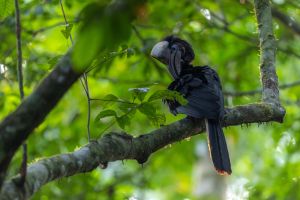
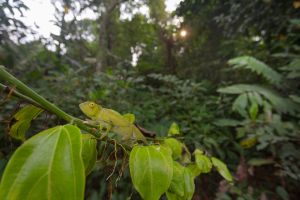
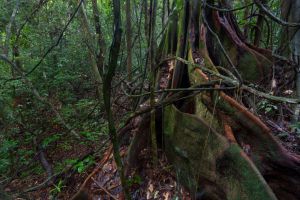
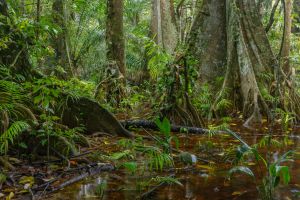
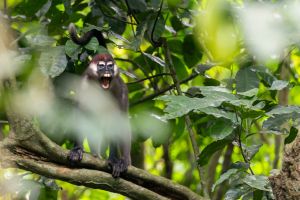
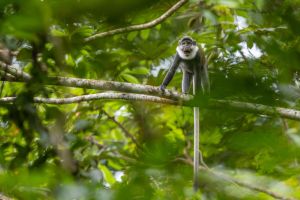
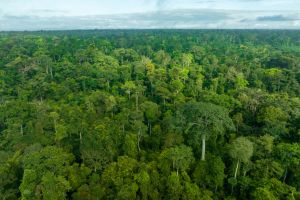
Located in southwestern Nigeria, the site was upgraded from wildlife sanctuary to national park in 1999 ([[#R01469|Nwankwo & Halilu 2016]]). . The vegetation of Okomu National Park is mostly lowland rainforest and supports a rich diversity of species including one of Nigeria’s last populations of critically endangered forest elephant, white-bellied pangolin, leopard, and forest buffalo. Chimpanzees have not been detected in the park for over 20 years. Other important species include the white-throated guenon monkey, red-capped mangabey monkey, yellow-crested hornbill, and West Africa’s largest population of African grey parrots. However, the park has been plagued by illegal logging, unsustainable slash-and-burn agriculture, and insecurity in the park’s riverine southern areas bordering the Niger Delta. Other threats include expanding oil palm, rubber, and cocoa plantations, and bushmeat poaching. ANI Foundation signed a 30-year Partnership Agreement with the National Park Service (NPS) to co-manage Okomu National Park in 2022 ([[#R01468|ANI 2025]]). | |||
'''Table 1. Basic site information for Okomu National Park''' | '''Table 1. Basic site information for Okomu National Park''' | ||
| Line 62: | Line 63: | ||
|- | |- | ||
|''Pan troglodytes ellioti'' | |''Pan troglodytes ellioti'' | ||
| | |2026 | ||
|Absent | |Absent | ||
| | | | ||
| Line 75: | Line 76: | ||
|- | |- | ||
|''Pan troglodytes ellioti'' | |''Pan troglodytes ellioti'' | ||
| | |2025 | ||
|Absent | |Absent | ||
| | | | ||
| Line 88: | Line 89: | ||
|- | |- | ||
|''Pan troglodytes ellioti'' | |''Pan troglodytes ellioti'' | ||
| | |2024 | ||
|Absent | |Absent | ||
| | | | ||
| Line 101: | Line 102: | ||
|- | |- | ||
|''Pan troglodytes ellioti'' | |''Pan troglodytes ellioti'' | ||
| | |2023 | ||
|Absent | |Absent | ||
| | | | ||
| Line 131: | Line 132: | ||
|2.1.1 Shifting agriculture | |2.1.1 Shifting agriculture | ||
|Medium (30-70% of population affected) | |Medium (30-70% of population affected) | ||
| | |[[#R01468|ANI 2025]] | ||
|Ongoing (2026) | |2022-Ongoing (2026) | ||
|- | |- | ||
|4 Transportation & service corridors | |4 Transportation & service corridors | ||
|4.1 Roads & railroads | |4.1 Roads & railroads | ||
|Low (up to 30% of population affected) | |Low (up to 30% of population affected) | ||
| | |[[#R01468|ANI 2025]] | ||
|Ongoing (2026) | |2022-Ongoing (2026) | ||
|- | |- | ||
|5 Biological resource use | |5 Biological resource use | ||
|5.1.1 Subsistence bushmeat hunting | |5.1.1 Subsistence bushmeat hunting | ||
|High (more than 70% of population affected) | |High (more than 70% of population affected) | ||
| | |[[#R01468|ANI 2025]] | ||
|2022-Ongoing (2026) | |2022-Ongoing (2026) | ||
|- | |- | ||
| Line 149: | Line 150: | ||
|5.1.3 Commercial bushmeat trade | |5.1.3 Commercial bushmeat trade | ||
|High (more than 70% of population affected) | |High (more than 70% of population affected) | ||
|Driven by commerce (Morakinyo pers. comm. 2026). | |Driven by commerce ([[#R01468|ANI 2025]], Morakinyo pers. comm. 2026). | ||
|Ongoing (2026) | |2022-Ongoing (2026) | ||
|- | |- | ||
|5 Biological resource use | |5 Biological resource use | ||
|5.3.1 Subsistence logging | |5.3.1 Subsistence logging | ||
|High (more than 70% of population affected) | |High (more than 70% of population affected) | ||
|Driven by commerce, not large-scale operations (Morakinyo pers. comm. 2026). | |Driven by commerce, not large-scale operations ([[#R01468|ANI 2025]], Morakinyo pers. comm. 2026). | ||
|Ongoing (2026) | |2022-Ongoing (2026) | ||
|- | |- | ||
|6 Human intrusions & disturbance | |6 Human intrusions & disturbance | ||
|6.2 War, civil unrest & military exercises | |6.2 War, civil unrest & military exercises | ||
|Medium (30-70% of population affected) | |Medium (30-70% of population affected) | ||
|Threat to rangers conducting patrols ( | |Threat to rangers conducting patrols ([[#R01468|ANI 2025]]). | ||
|Ongoing (2026) | |2022-Ongoing (2026) | ||
|- | |- | ||
|8 Invasive & other problematic species, genes & diseases | |8 Invasive & other problematic species, genes & diseases | ||
|8.1 Invasive non-native/alien species | |8.1 Invasive non-native/alien species | ||
|Low (up to 30% of population affected) | |Low (up to 30% of population affected) | ||
| | |[[#R01468|ANI 2025]] | ||
|Ongoing (2026) | |2022-Ongoing (2026) | ||
|} | |} | ||
| Line 175: | Line 176: | ||
= Conservation activities = | = Conservation activities = | ||
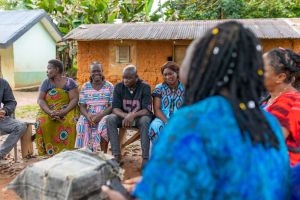
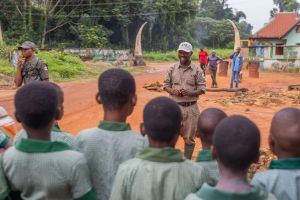
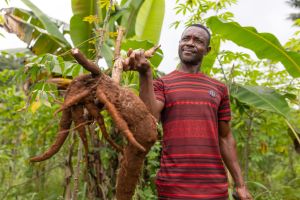
Conservation activities implemented under the National Park Service-ANI Foundation co-management agreement includes ranger patrols to counter illegal activities, as well as habitat protection and restoration, education, and livelihoods incentive programmes for local communities. | |||
'''Table 4. Conservation activities reported for Okomu National Park''' | '''Table 4. Conservation activities reported for Okomu National Park''' | ||
| Line 187: | Line 188: | ||
|2 Counter-wildlife crime | |2 Counter-wildlife crime | ||
|2.3 Conduct regular anti-poaching patrols | |2.3 Conduct regular anti-poaching patrols | ||
| | |[[#R01468|ANI 2025]] | ||
|Africa Nature Investors (ANI), National Park Service | |Africa Nature Investors (ANI), National Park Service | ||
|Ongoing (2026) | |2022-Ongoing (2026) | ||
|- | |- | ||
|2 Counter-wildlife crime | |2 Counter-wildlife crime | ||
|2.6 Regularly de-activate/remove ground snares | |2.6 Regularly de-activate/remove ground snares | ||
| | |[[#R01468|ANI 2025]] | ||
|Africa Nature Investors (ANI), National Park Service | |Africa Nature Investors (ANI), National Park Service | ||
|Ongoing (2026) | |2022-Ongoing (2026) | ||
|- | |- | ||
|2 Counter-wildlife crime | |2 Counter-wildlife crime | ||
|2.7 Provide better equipment (e.g., guns) to anti-poaching ranger patrols | |2.7 Provide better equipment (e.g., guns) to anti-poaching ranger patrols | ||
| | |[[#R01468|ANI 2025]] | ||
|Africa Nature Investors (ANI), National Park Service | |Africa Nature Investors (ANI), National Park Service | ||
|2022-Ongoing (2026) | |2022-Ongoing (2026) | ||
| Line 205: | Line 206: | ||
|2 Counter-wildlife crime | |2 Counter-wildlife crime | ||
|2.8 Provide training to anti-poaching ranger patrols | |2.8 Provide training to anti-poaching ranger patrols | ||
| | |[[#R01468|ANI 2025]] | ||
|Africa Nature Investors (ANI), National Park Service | |Africa Nature Investors (ANI), National Park Service | ||
|Ongoing (2026) | |2022-Ongoing (2026) | ||
|- | |- | ||
|2 Counter-wildlife crime | |2 Counter-wildlife crime | ||
|2.11 Implement monitoring surveillance strategies (e.g., SMART) or use monitoring data to improve effectiveness of wildlife law enforcement patrols | |2.11 Implement monitoring surveillance strategies (e.g., SMART) or use monitoring data to improve effectiveness of wildlife law enforcement patrols | ||
| | |[[#R01468|ANI 2025]] | ||
|Africa Nature Investors (ANI), National Park Service | |Africa Nature Investors (ANI), National Park Service | ||
|Ongoing (2026) | |2022-Ongoing (2026) | ||
|- | |- | ||
|2 Counter-wildlife crime | |2 Counter-wildlife crime | ||
|2.12 Implement community control of patrolling, banning hunting and removing snares | |2.12 Implement community control of patrolling, banning hunting and removing snares | ||
| | |[[#R01468|ANI 2025]] | ||
|Africa Nature Investors (ANI), National Park Service | |Africa Nature Investors (ANI), National Park Service | ||
|Ongoing (2026) | |2022-Ongoing (2026) | ||
|- | |- | ||
|2 Counter-wildlife crime | |2 Counter-wildlife crime | ||
|2.13 Provide sustainable alternative livelihoods; establish fish- or domestic meat farms | |2.13 Provide sustainable alternative livelihoods; establish fish- or domestic meat farms | ||
| | |[[#R01468|ANI 2025]] | ||
|Africa Nature Investors (ANI), National Park Service | |Africa Nature Investors (ANI), National Park Service | ||
|Ongoing (2026) | |2022-Ongoing (2026) | ||
|- | |- | ||
|2 Counter-wildlife crime | |2 Counter-wildlife crime | ||
|2.14 Employ hunters in the conservation sector to reduce their impact | |2.14 Employ hunters in the conservation sector to reduce their impact | ||
| | |[[#R01468|ANI 2025]] | ||
|Africa Nature Investors (ANI), National Park Service | |Africa Nature Investors (ANI), National Park Service | ||
|Ongoing (2026) | |2022-Ongoing (2026) | ||
|- | |- | ||
|4 Education & awareness | |4 Education & awareness | ||
|4.1 Educate local communities about apes and sustainable use | |4.1 Educate local communities about apes and sustainable use | ||
| | |[[#R01468|ANI 2025]] | ||
|Africa Nature Investors (ANI), National Park Service | |Africa Nature Investors (ANI), National Park Service | ||
|Ongoing (2026) | |2022-Ongoing (2026) | ||
|- | |- | ||
|4 Education & awareness | |4 Education & awareness | ||
|4.2 Involve local community in ape research and conservation management | |4.2 Involve local community in ape research and conservation management | ||
| | |[[#R01468|ANI 2025]] | ||
|Africa Nature Investors (ANI), National Park Service | |Africa Nature Investors (ANI), National Park Service | ||
|Ongoing (2026) | |2022-Ongoing (2026) | ||
|- | |- | ||
|4 Education & awareness | |4 Education & awareness | ||
|4.4 Regularly play TV & radio announcements to raise ape conservation awareness | |4.4 Regularly play TV & radio announcements to raise ape conservation awareness | ||
| | |[[#R01468|ANI 2025]] | ||
|Africa Nature Investors (ANI), National Park Service | |Africa Nature Investors (ANI), National Park Service | ||
|Ongoing (2026) | |2022-Ongoing (2026) | ||
|- | |- | ||
|4 Education & awareness | |4 Education & awareness | ||
|4.5 Implement multimedia campaigns using theatre, film, print media, discussions | |4.5 Implement multimedia campaigns using theatre, film, print media, discussions | ||
| | |[[#R01468|ANI 2025]] | ||
|Africa Nature Investors (ANI), National Park Service | |Africa Nature Investors (ANI), National Park Service | ||
|Ongoing (2026) | |2022-Ongoing (2026) | ||
|- | |- | ||
|4 Education & awareness | |4 Education & awareness | ||
|4.6 Integrate religion/local taboos into conservation education | |4.6 Integrate religion/local taboos into conservation education | ||
|Morakinyo pers. comm. 2026 | |Implemented through environmental education outreach activities in local schools (Morakinyo pers. comm. 2026, [[#R01468|ANI 2025]]). | ||
|Africa Nature Investors (ANI), National Park Service | |Africa Nature Investors (ANI), National Park Service | ||
|Ongoing (2026) | |2022-Ongoing (2026) | ||
|- | |- | ||
|5 Protection & restoration | |5 Protection & restoration | ||
|5.1 Create buffer zones around protected ape habitat | |5.1 Create buffer zones around protected ape habitat | ||
| | |[[#R01468|ANI 2025]] | ||
|Africa Nature Investors (ANI), National Park Service | |Africa Nature Investors (ANI), National Park Service | ||
|Ongoing (2026) | |2022-Ongoing (2026) | ||
|- | |- | ||
|5 Protection & restoration | |5 Protection & restoration | ||
|5.2 Legally protect ape habitat | |5.2 Legally protect ape habitat | ||
| | |[[#R01468|ANI 2025]] | ||
|Africa Nature Investors (ANI), National Park Service | |Africa Nature Investors (ANI), National Park Service | ||
|1999-Ongoing (2026) | |1999-Ongoing (2026) | ||
| Line 277: | Line 278: | ||
|5 Protection & restoration | |5 Protection & restoration | ||
|5.5 Demarcate and enforce boundaries of protected areas | |5.5 Demarcate and enforce boundaries of protected areas | ||
| | |[[#R01468|ANI 2025]] | ||
|Africa Nature Investors (ANI), National Park Service | |Africa Nature Investors (ANI), National Park Service | ||
|Ongoing (2026) | |2022-Ongoing (2026) | ||
|- | |- | ||
|5 Protection & restoration | |5 Protection & restoration | ||
|5.6 Habitat restoration | |5.6 Habitat restoration | ||
| | |[[#R01468|ANI 2025]] | ||
|Africa Nature Investors (ANI), National Park Service | |Africa Nature Investors (ANI), National Park Service | ||
|Ongoing (2026) | |2022-Ongoing (2026) | ||
|- | |- | ||
|5 Protection & restoration | |5 Protection & restoration | ||
|5.8 Restrict number of people that are allowed access to site | |5.8 Restrict number of people that are allowed access to site | ||
| | |[[#R01468|ANI 2025]] | ||
|Africa Nature Investors (ANI), National Park Service | |Africa Nature Investors (ANI), National Park Service | ||
|Ongoing (2026) | |2022-Ongoing (2026) | ||
|- | |- | ||
|5 Protection & restoration | |5 Protection & restoration | ||
|5.9 Resettle illegal human communities (i.e., in a protected area) to another location | |5.9 Resettle illegal human communities (i.e., in a protected area) to another location | ||
| | |[[#R01468|ANI 2025]] | ||
|Africa Nature Investors (ANI), National Park Service | |Africa Nature Investors (ANI), National Park Service | ||
|Ongoing (2026) | |2022-Ongoing (2026) | ||
|- | |- | ||
|7 Economic & other incentives | |7 Economic & other incentives | ||
|7.1 Provide monetary benefits to local communities for sustainably managing their forest and its wildlife (e.g., REDD, alternative income, employment) | |7.1 Provide monetary benefits to local communities for sustainably managing their forest and its wildlife (e.g., REDD, alternative income, employment) | ||
| | |[[#R01468|ANI 2025]] | ||
|Africa Nature Investors (ANI), National Park Service | |Africa Nature Investors (ANI), National Park Service | ||
|Ongoing (2026) | |2022-Ongoing (2026) | ||
|- | |- | ||
|7 Economic & other incentives | |7 Economic & other incentives | ||
|7.2 Provide non-monetary benefits to local communities for sustainably managing their forest and its wildlife (e.g., better education, infrastructure development) | |7.2 Provide non-monetary benefits to local communities for sustainably managing their forest and its wildlife (e.g., better education, infrastructure development) | ||
| | |[[#R01468|ANI 2025]] | ||
|Africa Nature Investors (ANI), National Park Service | |Africa Nature Investors (ANI), National Park Service | ||
|Ongoing (2026) | |2022-Ongoing (2026) | ||
|} | |} | ||
[[Conservation activities]] | [[Conservation activities]] | ||
<div><ul> <li style="display: inline-block;">[[File: photo_2026-06-12_15-41-11.jpg | 300px | thumb| none | © ANI Foundation & Jack Devlin]]<li style="display: inline-block;"> [[File: photo_2026-06-12_15-41-18.jpg | 300px | thumb| none | © ANI Foundation & Jack Devlin]]<li style="display: inline-block;"> [[File: photo_2026-06-12_15-41-22.jpg | 300px | thumb| none | © ANI Foundation & Jack Devlin]]<li style="display: inline-block;"> [[File: photo_2026-06-12_15-41-34.jpg | 300px | thumb| none | © ANI Foundation & Jack Devlin]]</ul></div> | |||
= Challenges = | = Challenges = | ||
| Line 327: | Line 328: | ||
|1 Site management | |1 Site management | ||
|1.1 Need for improved leadership | |1.1 Need for improved leadership | ||
| | |[[#R01468|ANI 2025]] | ||
|Ongoing (2026) | |Ongoing (2026) | ||
|- | |- | ||
|1 Site management | |1 Site management | ||
|1.2 Need for improved coordination | |1.2 Need for improved coordination | ||
| | |[[#R01468|ANI 2025]] | ||
|Ongoing (2026) | |Ongoing (2026) | ||
|- | |- | ||
|1 Site management | |1 Site management | ||
|1.3 Corruption | |1.3 Corruption | ||
| | |[[#R01468|ANI 2025]] | ||
|Ongoing (2026) | |Ongoing (2026) | ||
|- | |- | ||
|1 Site management | |1 Site management | ||
|1.4 Conflict on land tenure | |1.4 Conflict on land tenure | ||
| | |[[#R01468|ANI 2025]] | ||
|Ongoing (2026) | |Ongoing (2026) | ||
|- | |- | ||
|2 Resources and capacity | |2 Resources and capacity | ||
|2.1 Lack of capacity/training | |2.1 Lack of capacity/training | ||
| | |[[#R01468|ANI 2025]] | ||
|Ongoing (2026) | |Ongoing (2026) | ||
|- | |- | ||
|2 Resources and capacity | |2 Resources and capacity | ||
|2.2 Lack of staff | |2.2 Lack of staff | ||
| | |[[#R01468|ANI 2025]] | ||
|Ongoing (2026) | |Ongoing (2026) | ||
|- | |- | ||
|2 Resources and capacity | |2 Resources and capacity | ||
|2.3 General lack of funding | |2.3 General lack of funding | ||
| | |[[#R01468|ANI 2025]] | ||
|Ongoing (2026) | |Ongoing (2026) | ||
|- | |- | ||
|2 Resources and capacity | |2 Resources and capacity | ||
|2.4 Lack of continuous/long-term funding | |2.4 Lack of continuous/long-term funding | ||
| | |[[#R01468|ANI 2025]] | ||
|Ongoing (2026) | |Ongoing (2026) | ||
|- | |- | ||
|2 Resources and capacity | |2 Resources and capacity | ||
|2.5 Lack of equipment | |2.5 Lack of equipment | ||
| | |[[#R01468|ANI 2025]] | ||
|Ongoing (2026) | |Ongoing (2026) | ||
|- | |- | ||
|2 Resources and capacity | |2 Resources and capacity | ||
|2.6 Lack of biomonitoring/survey data | |2.6 Lack of biomonitoring/survey data | ||
| | |[[#R01468|ANI 2025]] | ||
|Ongoing (2026) | |Ongoing (2026) | ||
|- | |- | ||
|2 Resources and capacity | |2 Resources and capacity | ||
|2.7 Lack of infrastructure | |2.7 Lack of infrastructure | ||
| | |[[#R01468|ANI 2025]] | ||
|Ongoing (2026) | |Ongoing (2026) | ||
|- | |- | ||
|2 Resources and capacity | |2 Resources and capacity | ||
|2.8 Lack of evidence of conservation effectiveness | |2.8 Lack of evidence of conservation effectiveness | ||
| | |[[#R01468|ANI 2025]] | ||
|Ongoing (2026) | |Ongoing (2026) | ||
|- | |- | ||
|3 Engaged community | |3 Engaged community | ||
|3.1 General lack of community engagement or support | |3.1 General lack of community engagement or support | ||
| | |[[#R01468|ANI 2025]] | ||
|Ongoing (2026) | |Ongoing (2026) | ||
|- | |- | ||
|3 Engaged community | |3 Engaged community | ||
|3.2 Lack of youth engagement | |3.2 Lack of youth engagement | ||
| | |[[#R01468|ANI 2025]] | ||
|Ongoing (2026) | |Ongoing (2026) | ||
|- | |- | ||
|3 Engaged community | |3 Engaged community | ||
|3.3 Lack of volunteers | |3.3 Lack of volunteers | ||
| | |[[#R01468|ANI 2025]] | ||
|Ongoing (2026) | |Ongoing (2026) | ||
|- | |- | ||
|3 Engaged community | |3 Engaged community | ||
|3.4 Eroding taboos in favor of conservation | |3.4 Eroding taboos in favor of conservation | ||
| | |[[#R01468|ANI 2025]] | ||
|Ongoing (2026) | |Ongoing (2026) | ||
|- | |- | ||
|3 Engaged community | |3 Engaged community | ||
|3.5 Anticipated disadvantages/costs created by conservation activities (e.g., restricted access/ resource use) | |3.5 Anticipated disadvantages/costs created by conservation activities (e.g., restricted access/ resource use) | ||
| | |[[#R01468|ANI 2025]] | ||
|Ongoing (2026) | |Ongoing (2026) | ||
|- | |- | ||
|4 Institutional support | |4 Institutional support | ||
|4.1 Lack of law enforcement | |4.1 Lack of law enforcement | ||
| | |[[#R01468|ANI 2025]] | ||
|Ongoing (2026) | |Ongoing (2026) | ||
|- | |- | ||
|4 Institutional support | |4 Institutional support | ||
|4.2 Lack of government support | |4.2 Lack of government support | ||
| | |[[#R01468|ANI 2025]] | ||
|Ongoing (2026) | |Ongoing (2026) | ||
|- | |- | ||
|4 Institutional support | |4 Institutional support | ||
|4.4 Lack of transboundary cooperation | |4.4 Lack of transboundary cooperation | ||
| | |[[#R01468|ANI 2025]] | ||
|Ongoing (2026) | |Ongoing (2026) | ||
|- | |- | ||
|5 Ecological context | |5 Ecological context | ||
|5.1 Ecological constraints (e.g., susceptibility to climate change, difficult terrain) | |5.1 Ecological constraints (e.g., susceptibility to climate change, difficult terrain) | ||
| | |[[#R01468|ANI 2025]] | ||
|Ongoing (2026) | |Ongoing (2026) | ||
|- | |- | ||
|6 Safety and stability | |6 Safety and stability | ||
|6.1 Political/economic | |6.1 Political/economic instability | ||
| | |[[#R01468|ANI 2025]] | ||
|Ongoing (2026) | |Ongoing (2026) | ||
|- | |- | ||
|6 Safety and stability | |6 Safety and stability | ||
|6.2 Insecurity | |6.2 Insecurity | ||
| | |[[#R01468|ANI 2025]] | ||
|Ongoing (2026) | |Ongoing (2026) | ||
|} | |} | ||
| Line 528: | Line 524: | ||
= Exposure to climate change impacts = | = Exposure to climate change impacts = | ||
As part of a study on the exposure of African great ape sites to climate change impacts, Kiribou et al. | As part of a study on the exposure of African great ape sites to climate change impacts, [[#R02295|Kiribou et al. (2024)]] extracted climate data and data on projected extreme climate impact events for the site. Climatological characteristics were derived from observation-based climate data provided by the Inter-Sectoral Impact Model Intercomparison Project (ISIMIP, www.isimip.org). Parameters were calculated as the average across each 30-year period. For 1981-2010, the EWEMBI dataset from ISIMIP2a was used. For the two future periods (2021-2050 and 2071-2099) ISIMIP2b climate data based on four CMIP5 global climate models were used. For future projections, two Representative Concentration Pathways (RCP) were used. RCP 2.6 is a scenario with strong mitigation measures in which global temperatures would likely rise below 2C. RCP 6.0 is a scenario with medium emissions in which global temperatures would likely rise up to 3C by 2100. For the number of days with heavy precipitation events, the 98th percentile of all precipitation days (>1mm/d) was calculated for the 1979-2013 reference period as a threshold for a heavy precipitation event. Then, for each year, the number of days above that threshold was derived. The figures on temperature and precipitation anomaly show the deviation from the mean temperature and mean precipitation for the 1979-2013 reference period. | ||
The estimated exposure to future extreme climate impact events (crop failure, drought, river flood, wildfire, tropical cyclone, and heatwave) is based on a published dataset by Lange et al. 2020 derived from ISIMIP2b data. The same global climate models and RCPs as described above were used. Within each 30-year period, the number of years with an extreme event and the average proportion of the site affected were calculated ( | The estimated exposure to future extreme climate impact events (crop failure, drought, river flood, wildfire, tropical cyclone, and heatwave) is based on a published dataset by Lange et al. 2020 derived from ISIMIP2b data. The same global climate models and RCPs as described above were used. Within each 30-year period, the number of years with an extreme event and the average proportion of the site affected were calculated ([[#R02295|Kiribou et al. 2024]]). | ||
'''Table 8. Estimated past and projected climatological characteristics in Okomu National Park''' | '''Table 8. Estimated past and projected climatological characteristics in Okomu National Park''' | ||
| Line 653: | Line 649: | ||
= References = | = References = | ||
Nwankwo, E. A. (2016). Sustainable Wildlife Conservation at Okomu National Park. Ottoman Journal of Tourism and Management Research, 1(1), 101-118. https://doi.org/10.26465/ojtmr.2016132258 | <span id="R01468"></span>ANI (2025). ANI Annual report. Online: https://www.africanatureinvestors.org/resources | ||
<span id="R01469"></span>Nwankwo, E. A. (2016). Sustainable Wildlife Conservation at Okomu National Park. ''Ottoman Journal of Tourism and Management Research'', 1(1), 101-118. [https://doi.org/10.26465/ojtmr.2016132258 doi:10.26465/ojtmr.2016132258] | |||
<span id="R02295"></span>Kiribou, R., Tehoda, P., Chukwu, O., Bempah, G., Kühl, H. S., Ferreira, J., …, & Heinicke, S. (2024). Exposure of African ape sites to climate change impacts. ''PLOS Climate'', 3(2), e0000345. [https://doi.org/10.1371/journal.pclm.0000345 doi:10.1371/journal.pclm.0000345] | |||
| Line 659: | Line 659: | ||
'''Page created by: '''APES Atlas Team''' Date:''' 2020-12-02 | '''Page created by: '''APES Atlas Team''' Date:''' 2020-12-02 | ||
'''Page updated by: '''Tunde Morakinyo''' Date:''' 2026- | '''Page updated by: '''Tunde Morakinyo''' Date:''' 2026-06-08 | ||
Latest revision as of 17:54, 15 October 2026
West Africa > Nigeria > Okomu National Park
Français | Português | Español | Bahasa Indonesia | Melayu
Summary
- Nigeria-Cameroon chimpanzees (Pan troglodytes ellioti) are likely absent in Okomu National Park.
- The population has likely been extirpated.
- The site has a total size of 224 km².
- Key threats to chimpanzees are poaching and habitat loss due to logging and agriculture.
- Conservation activities at the site include patrols, habitat protection and education in local communities.
© ANI Foundation & Jack Devlin -
© ANI Foundation & Jack Devlin -
© ANI Foundation & Jack Devlin -
© ANI Foundation & Jack Devlin -
© ANI Foundation & Jack Devlin -
© ANI Foundation & Jack Devlin


Site characteristics
Located in southwestern Nigeria, the site was upgraded from wildlife sanctuary to national park in 1999 (Nwankwo & Halilu 2016). . The vegetation of Okomu National Park is mostly lowland rainforest and supports a rich diversity of species including one of Nigeria’s last populations of critically endangered forest elephant, white-bellied pangolin, leopard, and forest buffalo. Chimpanzees have not been detected in the park for over 20 years. Other important species include the white-throated guenon monkey, red-capped mangabey monkey, yellow-crested hornbill, and West Africa’s largest population of African grey parrots. However, the park has been plagued by illegal logging, unsustainable slash-and-burn agriculture, and insecurity in the park’s riverine southern areas bordering the Niger Delta. Other threats include expanding oil palm, rubber, and cocoa plantations, and bushmeat poaching. ANI Foundation signed a 30-year Partnership Agreement with the National Park Service (NPS) to co-manage Okomu National Park in 2022 (ANI 2025).
Table 1. Basic site information for Okomu National Park
| Species | Pan troglodytes ellioti |
| Area | 224 km² |
| Coordinates | Lat: 6.252 , Lon: 5.268 |
| Type of site | Protected area (National Park) |
| Habitat types | Subtropical/tropical moist lowland forest, Subtropical/tropical heavily degraded former forest |
| Type of governance | Shared governance |
Types of sites Governance types Habitat types
Ape status
Chimpanzees have no been seen at the site in the last few decades. Annual camera trap surveys conducted by ANI since 2023 have not captured chimpanzees (Morakinyo pers. comm. 2026).
Table 2. Ape population estimates reported for Okomu National Park
| Species | Year | Occurrence | Encounter or vistation rate (nests/km; ind/day) | Density estimate [ind./ km²] (95% CI) | Abundance estimate (95% CI) | Survey area | Sampling method | Analytical framework | Source | Comments | A.P.E.S. database ID |
|---|---|---|---|---|---|---|---|---|---|---|---|
| Pan troglodytes ellioti | 2026 | Absent | Okomu National Park | Camera trap | Morakinyo pers. comm. 2026 | ||||||
| Pan troglodytes ellioti | 2025 | Absent | Okomu National Park | Camera trap | Morakinyo pers. comm. 2026 | ||||||
| Pan troglodytes ellioti | 2024 | Absent | Okomu National Park | Camera trap | Morakinyo pers. comm. 2026 | ||||||
| Pan troglodytes ellioti | 2023 | Absent | Okomu National Park | Camera trap | Morakinyo pers. comm. 2026 |
Sampling methods Analytical frameworks
Threats
Table 3. Threats to apes reported for Okomu National Park
| Category | Specific threats | Threat level | Description | Year of threat |
|---|---|---|---|---|
| 2 Agriculture & aquaculture | 2.1.1 Shifting agriculture | Medium (30-70% of population affected) | ANI 2025 | 2022-Ongoing (2026) |
| 4 Transportation & service corridors | 4.1 Roads & railroads | Low (up to 30% of population affected) | ANI 2025 | 2022-Ongoing (2026) |
| 5 Biological resource use | 5.1.1 Subsistence bushmeat hunting | High (more than 70% of population affected) | ANI 2025 | 2022-Ongoing (2026) |
| 5 Biological resource use | 5.1.3 Commercial bushmeat trade | High (more than 70% of population affected) | Driven by commerce (ANI 2025, Morakinyo pers. comm. 2026). | 2022-Ongoing (2026) |
| 5 Biological resource use | 5.3.1 Subsistence logging | High (more than 70% of population affected) | Driven by commerce, not large-scale operations (ANI 2025, Morakinyo pers. comm. 2026). | 2022-Ongoing (2026) |
| 6 Human intrusions & disturbance | 6.2 War, civil unrest & military exercises | Medium (30-70% of population affected) | Threat to rangers conducting patrols (ANI 2025). | 2022-Ongoing (2026) |
| 8 Invasive & other problematic species, genes & diseases | 8.1 Invasive non-native/alien species | Low (up to 30% of population affected) | ANI 2025 | 2022-Ongoing (2026) |
Conservation activities
Conservation activities implemented under the National Park Service-ANI Foundation co-management agreement includes ranger patrols to counter illegal activities, as well as habitat protection and restoration, education, and livelihoods incentive programmes for local communities.
Table 4. Conservation activities reported for Okomu National Park
| Category | Specific activity | Description | Implementing organization(s) | Year of activity |
|---|---|---|---|---|
| 2 Counter-wildlife crime | 2.3 Conduct regular anti-poaching patrols | ANI 2025 | Africa Nature Investors (ANI), National Park Service | 2022-Ongoing (2026) |
| 2 Counter-wildlife crime | 2.6 Regularly de-activate/remove ground snares | ANI 2025 | Africa Nature Investors (ANI), National Park Service | 2022-Ongoing (2026) |
| 2 Counter-wildlife crime | 2.7 Provide better equipment (e.g., guns) to anti-poaching ranger patrols | ANI 2025 | Africa Nature Investors (ANI), National Park Service | 2022-Ongoing (2026) |
| 2 Counter-wildlife crime | 2.8 Provide training to anti-poaching ranger patrols | ANI 2025 | Africa Nature Investors (ANI), National Park Service | 2022-Ongoing (2026) |
| 2 Counter-wildlife crime | 2.11 Implement monitoring surveillance strategies (e.g., SMART) or use monitoring data to improve effectiveness of wildlife law enforcement patrols | ANI 2025 | Africa Nature Investors (ANI), National Park Service | 2022-Ongoing (2026) |
| 2 Counter-wildlife crime | 2.12 Implement community control of patrolling, banning hunting and removing snares | ANI 2025 | Africa Nature Investors (ANI), National Park Service | 2022-Ongoing (2026) |
| 2 Counter-wildlife crime | 2.13 Provide sustainable alternative livelihoods; establish fish- or domestic meat farms | ANI 2025 | Africa Nature Investors (ANI), National Park Service | 2022-Ongoing (2026) |
| 2 Counter-wildlife crime | 2.14 Employ hunters in the conservation sector to reduce their impact | ANI 2025 | Africa Nature Investors (ANI), National Park Service | 2022-Ongoing (2026) |
| 4 Education & awareness | 4.1 Educate local communities about apes and sustainable use | ANI 2025 | Africa Nature Investors (ANI), National Park Service | 2022-Ongoing (2026) |
| 4 Education & awareness | 4.2 Involve local community in ape research and conservation management | ANI 2025 | Africa Nature Investors (ANI), National Park Service | 2022-Ongoing (2026) |
| 4 Education & awareness | 4.4 Regularly play TV & radio announcements to raise ape conservation awareness | ANI 2025 | Africa Nature Investors (ANI), National Park Service | 2022-Ongoing (2026) |
| 4 Education & awareness | 4.5 Implement multimedia campaigns using theatre, film, print media, discussions | ANI 2025 | Africa Nature Investors (ANI), National Park Service | 2022-Ongoing (2026) |
| 4 Education & awareness | 4.6 Integrate religion/local taboos into conservation education | Implemented through environmental education outreach activities in local schools (Morakinyo pers. comm. 2026, ANI 2025). | Africa Nature Investors (ANI), National Park Service | 2022-Ongoing (2026) |
| 5 Protection & restoration | 5.1 Create buffer zones around protected ape habitat | ANI 2025 | Africa Nature Investors (ANI), National Park Service | 2022-Ongoing (2026) |
| 5 Protection & restoration | 5.2 Legally protect ape habitat | ANI 2025 | Africa Nature Investors (ANI), National Park Service | 1999-Ongoing (2026) |
| 5 Protection & restoration | 5.5 Demarcate and enforce boundaries of protected areas | ANI 2025 | Africa Nature Investors (ANI), National Park Service | 2022-Ongoing (2026) |
| 5 Protection & restoration | 5.6 Habitat restoration | ANI 2025 | Africa Nature Investors (ANI), National Park Service | 2022-Ongoing (2026) |
| 5 Protection & restoration | 5.8 Restrict number of people that are allowed access to site | ANI 2025 | Africa Nature Investors (ANI), National Park Service | 2022-Ongoing (2026) |
| 5 Protection & restoration | 5.9 Resettle illegal human communities (i.e., in a protected area) to another location | ANI 2025 | Africa Nature Investors (ANI), National Park Service | 2022-Ongoing (2026) |
| 7 Economic & other incentives | 7.1 Provide monetary benefits to local communities for sustainably managing their forest and its wildlife (e.g., REDD, alternative income, employment) | ANI 2025 | Africa Nature Investors (ANI), National Park Service | 2022-Ongoing (2026) |
| 7 Economic & other incentives | 7.2 Provide non-monetary benefits to local communities for sustainably managing their forest and its wildlife (e.g., better education, infrastructure development) | ANI 2025 | Africa Nature Investors (ANI), National Park Service | 2022-Ongoing (2026) |
© ANI Foundation & Jack Devlin -
© ANI Foundation & Jack Devlin -
© ANI Foundation & Jack Devlin -
© ANI Foundation & Jack Devlin


Challenges
Table 5. Challenges reported for Okomu National Park
| Challenges | Specific challenges | Source | Year(s) |
|---|---|---|---|
| 1 Site management | 1.1 Need for improved leadership | ANI 2025 | Ongoing (2026) |
| 1 Site management | 1.2 Need for improved coordination | ANI 2025 | Ongoing (2026) |
| 1 Site management | 1.3 Corruption | ANI 2025 | Ongoing (2026) |
| 1 Site management | 1.4 Conflict on land tenure | ANI 2025 | Ongoing (2026) |
| 2 Resources and capacity | 2.1 Lack of capacity/training | ANI 2025 | Ongoing (2026) |
| 2 Resources and capacity | 2.2 Lack of staff | ANI 2025 | Ongoing (2026) |
| 2 Resources and capacity | 2.3 General lack of funding | ANI 2025 | Ongoing (2026) |
| 2 Resources and capacity | 2.4 Lack of continuous/long-term funding | ANI 2025 | Ongoing (2026) |
| 2 Resources and capacity | 2.5 Lack of equipment | ANI 2025 | Ongoing (2026) |
| 2 Resources and capacity | 2.6 Lack of biomonitoring/survey data | ANI 2025 | Ongoing (2026) |
| 2 Resources and capacity | 2.7 Lack of infrastructure | ANI 2025 | Ongoing (2026) |
| 2 Resources and capacity | 2.8 Lack of evidence of conservation effectiveness | ANI 2025 | Ongoing (2026) |
| 3 Engaged community | 3.1 General lack of community engagement or support | ANI 2025 | Ongoing (2026) |
| 3 Engaged community | 3.2 Lack of youth engagement | ANI 2025 | Ongoing (2026) |
| 3 Engaged community | 3.3 Lack of volunteers | ANI 2025 | Ongoing (2026) |
| 3 Engaged community | 3.4 Eroding taboos in favor of conservation | ANI 2025 | Ongoing (2026) |
| 3 Engaged community | 3.5 Anticipated disadvantages/costs created by conservation activities (e.g., restricted access/ resource use) | ANI 2025 | Ongoing (2026) |
| 4 Institutional support | 4.1 Lack of law enforcement | ANI 2025 | Ongoing (2026) |
| 4 Institutional support | 4.2 Lack of government support | ANI 2025 | Ongoing (2026) |
| 4 Institutional support | 4.4 Lack of transboundary cooperation | ANI 2025 | Ongoing (2026) |
| 5 Ecological context | 5.1 Ecological constraints (e.g., susceptibility to climate change, difficult terrain) | ANI 2025 | Ongoing (2026) |
| 6 Safety and stability | 6.1 Political/economic instability | ANI 2025 | Ongoing (2026) |
| 6 Safety and stability | 6.2 Insecurity | ANI 2025 | Ongoing (2026) |
Enablers
Table 6. Enablers reported for Okomu National Park
| Enablers | Specific enablers | Source | Year(s) |
|---|---|---|---|
| 1 Site management | |||
| 2 Resources and capacity | |||
| 3 Engaged community | |||
| 4 Institutional support | |||
| 5 Ecological context | |||
| 6 Safety and stability |
Research activities
Documented behaviours
Table 7. Behaviours documented for Okomu National Park
| Category | Behavior | Observation type | Prevalence | Observation dates | Source | Habituation | Species | Comment |
|---|---|---|---|---|---|---|---|---|
| Not reported |
Exposure to climate change impacts
As part of a study on the exposure of African great ape sites to climate change impacts, Kiribou et al. (2024) extracted climate data and data on projected extreme climate impact events for the site. Climatological characteristics were derived from observation-based climate data provided by the Inter-Sectoral Impact Model Intercomparison Project (ISIMIP, www.isimip.org). Parameters were calculated as the average across each 30-year period. For 1981-2010, the EWEMBI dataset from ISIMIP2a was used. For the two future periods (2021-2050 and 2071-2099) ISIMIP2b climate data based on four CMIP5 global climate models were used. For future projections, two Representative Concentration Pathways (RCP) were used. RCP 2.6 is a scenario with strong mitigation measures in which global temperatures would likely rise below 2C. RCP 6.0 is a scenario with medium emissions in which global temperatures would likely rise up to 3C by 2100. For the number of days with heavy precipitation events, the 98th percentile of all precipitation days (>1mm/d) was calculated for the 1979-2013 reference period as a threshold for a heavy precipitation event. Then, for each year, the number of days above that threshold was derived. The figures on temperature and precipitation anomaly show the deviation from the mean temperature and mean precipitation for the 1979-2013 reference period.
The estimated exposure to future extreme climate impact events (crop failure, drought, river flood, wildfire, tropical cyclone, and heatwave) is based on a published dataset by Lange et al. 2020 derived from ISIMIP2b data. The same global climate models and RCPs as described above were used. Within each 30-year period, the number of years with an extreme event and the average proportion of the site affected were calculated (Kiribou et al. 2024).
Table 8. Estimated past and projected climatological characteristics in Okomu National Park
| Value | 1981-2010 | 2021-2050, RCP 2.6 | 2021-2050, RCP 6.0 | 2071-2099, RCP 2.6 | 2071-2099, RCP 6.0 |
|---|---|---|---|---|---|
| Mean temperature [C] | 27.2 | 28.3 | 28.1 | 28.5 | 29.5 |
| Annual precipitation [mm] | 2338 | 2398 | 2415 | 2382 | 2440 |
| Max no. consecutive dry days (per year) | 31.2 | 34.9 | 34.8 | 34.9 | 38.1 |
| No. days with heavy precipitation (per year) | 6 | 9.8 | 9.4 | 9.9 | 11.7 |
Table 9. Projected exposure of apes to extreme climate impact events in Okomu National Park
| Type | No. of years with event (2021-2050, RCP 2.6) | % of site exposed (2021-2050, RCP 2.6) | No. of years with event (2021-2050, RCP 6.0) | % of site exposed (2021-2050, RCP 6.0) | No. of years with event (2070-2099, RCP 2.6) | % of site exposed (2070-2099, RCP 2.6) | No. of years with event (2070-2099, RCP 6.0) | % of site exposed (2070-2099, RCP 6.0) |
|---|---|---|---|---|---|---|---|---|
| Crop failure | 4 | 2.07 | 1.5 | 1.57 | 2 | 2.07 | 7.5 | 2.07 |
| Drought | 0 | 0 | 0 | 0 | 0 | 0 | 0.25 | 25 |
| Heatwave | 10 | 100 | 10.5 | 100 | 10.5 | 100 | 12.5 | 100 |
| River flood | 2 | 2.92 | 2.25 | 1.43 | 2.25 | 3.06 | 4 | 6.32 |
| Tropical cyclone | 0 | 0 | 0 | 0 | 0 | 0 | 0.5 | 1.21 |
| Wildfire | 30 | 0.44 | 30 | 0.44 | 29 | 0.44 | 29 | 0.47 |
-
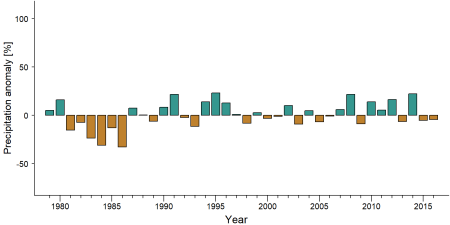
Precipitation anomaly in Okomu National Park -
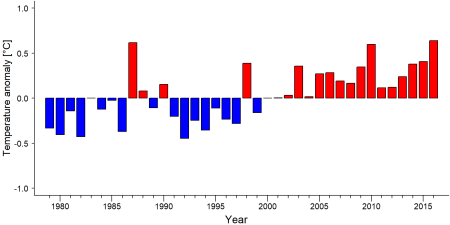
Temperature anomaly in Okomu National Park


External links
References
ANI (2025). ANI Annual report. Online: https://www.africanatureinvestors.org/resources
Nwankwo, E. A. (2016). Sustainable Wildlife Conservation at Okomu National Park. Ottoman Journal of Tourism and Management Research, 1(1), 101-118. doi:10.26465/ojtmr.2016132258
Kiribou, R., Tehoda, P., Chukwu, O., Bempah, G., Kühl, H. S., Ferreira, J., …, & Heinicke, S. (2024). Exposure of African ape sites to climate change impacts. PLOS Climate, 3(2), e0000345. doi:10.1371/journal.pclm.0000345
Page created by: APES Atlas Team Date: 2020-12-02
Page updated by: Tunde Morakinyo Date: 2026-06-08