
Greater Mahale Ecosystem: Difference between revisions
No edit summary |
No edit summary |
||
| (6 intermediate revisions by the same user not shown) | |||
| Line 62: | Line 62: | ||
|- | |- | ||
|''Pan troglodytes schweinfurthii'' | |''Pan troglodytes schweinfurthii'' | ||
| | |2010-2020 | ||
|Present | |||
| | | | ||
|0.86 | |||
| | | | ||
|Greater Mahale Ecosystem | |Greater Mahale Ecosystem | ||
| | |Line transects | ||
| | | | ||
|[[#R00661|Carvalho et al. 2022]] | |||
|The research utilized nest survey data collected from 2010 to 2020, excluding 2016 when no surveys took place, and applied line-transect distance sampling along with generalized additive models (GAMs). In addition, the density estimates were reported as varying spatially and temporally (numerical values provided per stratum in article tables). | |||
| | | | ||
|- | |- | ||
|''Pan troglodytes schweinfurthii'' | |''Pan troglodytes schweinfurthii'' | ||
| | |2005 | ||
| | | | ||
| | | | ||
| | | | ||
|2600.0 | |||
|Greater Mahale Ecosystem | |Greater Mahale Ecosystem | ||
| | |Survey data | ||
| | |||
|[[#R00665|Plumptre et al. 2010]] | |||
| | | | ||
| | | | ||
|} | |} | ||
| Line 92: | Line 92: | ||
= Threats = | = Threats = | ||
In Tanzania, 90% of the country’s chimpanzees are found in the Greater Mahale Ecosystem, where suitable habitat is being lost and fragmented by the expansion of human settlements, conversion of land for agriculture, logging, and cattle herding (Chitayat et al. 2021). Chimpanzees in savanna-woodland mosaics, such as in the Greater Mahale Ecosystem, already live at relatively low densities, highlighting the need to identify and protect areas critical for chimpanzee conservation (Chitayat et al. 2021). | In Tanzania, 90% of the country’s chimpanzees are found in the Greater Mahale Ecosystem, where suitable habitat is being lost and fragmented by the expansion of human settlements, conversion of land for agriculture, logging, and cattle herding ([[#R00662|Chitayat et al. 2021]]). Chimpanzees in savanna-woodland mosaics, such as in the Greater Mahale Ecosystem, already live at relatively low densities, highlighting the need to identify and protect areas critical for chimpanzee conservation ([[#R00662|Chitayat et al. 2021]]). | ||
'''Table 3. Threats to apes reported for Greater Mahale Ecosystem''' | '''Table 3. Threats to apes reported for Greater Mahale Ecosystem''' | ||
| Line 105: | Line 105: | ||
|1.1 Residential areas | |1.1 Residential areas | ||
|Present (unknown severity) | |Present (unknown severity) | ||
|People settling in the area tend to locate near water sources. As a result, small riverine strips of forest, critical for chimpanzees and the endemic Kungwe apalis, are disappearing (WCS n.d.). Expansion of settlements and land use influencing chimpanzee density (Carvalho et al. 2022) | |People settling in the area tend to locate near water sources. As a result, small riverine strips of forest, critical for chimpanzees and the endemic Kungwe apalis, are disappearing ([[#R00666|WCS n.d]].). Expansion of settlements and land use influencing chimpanzee density ([[#R00661|Carvalho et al. 2022]]) | ||
|2018-Ongoing (2022) | |2018-Ongoing (2022) | ||
|- | |- | ||
| Line 111: | Line 111: | ||
|2.1 Annual & perennial non-timber crops | |2.1 Annual & perennial non-timber crops | ||
|High (more than 70% of population affected) | |High (more than 70% of population affected) | ||
|Conversion of chimpanzee habitat into agricultural land (GMERC n.d., Carvalho et al. 2022). | |Conversion of chimpanzee habitat into agricultural land ([[#R00663|GMERC n.d.]], [[#R00661|Carvalho et al. 2022]]). | ||
|2018-Ongoing (2022) | |2018-Ongoing (2022) | ||
|- | |- | ||
| Line 117: | Line 117: | ||
|2.3 Livestock farming & ranching | |2.3 Livestock farming & ranching | ||
|High (more than 70% of population affected) | |High (more than 70% of population affected) | ||
|Cattle herding (Chitayat et al. 2021, Carvalho et al. 2022). | |Cattle herding ([[#R00662|Chitayat et al. 2021]], [[#R00661|Carvalho et al. 2022]]). | ||
|2018-Ongoing (2022) | |2018-Ongoing (2022) | ||
|- | |- | ||
| Line 123: | Line 123: | ||
|5.1 Hunting & collecting terrestrial animals | |5.1 Hunting & collecting terrestrial animals | ||
|Present (unknown severity) | |Present (unknown severity) | ||
|Injuries caused by snares ([ | |Injuries caused by snares ([[#R00663|GMERC]]). | ||
|Ongoing (2021) | |Ongoing (2021) | ||
|- | |- | ||
| Line 141: | Line 141: | ||
|5.3 Logging & wood harvesting | |5.3 Logging & wood harvesting | ||
|High (more than 70% of population affected) | |High (more than 70% of population affected) | ||
|Clearing the forest for charcoal production ([ | |Clearing the forest for charcoal production ([[#R00663|GMERC]]). Conversion of woodland and forest due to human activities ([[#R00661|Carvalho et al. 2022]]). | ||
|2018-Ongoing (2022) | |2018-Ongoing (2022) | ||
|- | |- | ||
| Line 147: | Line 147: | ||
|7.1 Fire & fire suppression | |7.1 Fire & fire suppression | ||
|High (more than 70% of population affected) | |High (more than 70% of population affected) | ||
|Fires ignited by humans, contributing to habitat loss (WCS n.d., GMERC n.d.). | |Fires ignited by humans, contributing to habitat loss ([[#R00666|WCS n.d.]], [[#R00663|GMERC n.d]].). | ||
|Ongoing (2021) | |Ongoing (2021) | ||
|- | |- | ||
| Line 161: | Line 161: | ||
= Conservation activities = | = Conservation activities = | ||
Government-led patrols are conducted in partnership with the Jane Goodall Institute to fight illegal activities, such as poaching and herding (GMERC n.d.). | Government-led patrols are conducted in partnership with the Jane Goodall Institute to fight illegal activities, such as poaching and herding ([[#R00663|GMERC]] n.d.). | ||
'''Table 4. Conservation activities reported for Greater Mahale Ecosystem''' | '''Table 4. Conservation activities reported for Greater Mahale Ecosystem''' | ||
| Line 173: | Line 173: | ||
|2 Counter-wildlife crime | |2 Counter-wildlife crime | ||
|2.3 Conduct regular anti-poaching patrols | |2.3 Conduct regular anti-poaching patrols | ||
|[ | |[[#R00663|GMERC]] organise and sponsor patrols to combat illegal activities since 2009. | ||
| | | | ||
|2009-Ongoing (2021) | |2009-Ongoing (2021) | ||
| Line 185: | Line 185: | ||
|4 Education & awareness | |4 Education & awareness | ||
|4.2 Involve local community in ape research and conservation management | |4.2 Involve local community in ape research and conservation management | ||
|Community-led conservation projects and land-use planning (Jane Goodall Institute, since 1994) (Pintea & Bean, 2022). Local communities are involved in conservation programs through the provision of conservation extension services, participation in Village Natural Resources Committees, and the recruitment and training of village forest scouts to support patrols and manage great ape habitats and their ecological connectivity within their respective areas (Naiman M. pers. comm. 2025). | |Community-led conservation projects and land-use planning (Jane Goodall Institute, since 1994) ([[#R00664|Pintea & Bean, 2022]]). Local communities are involved in conservation programs through the provision of conservation extension services, participation in Village Natural Resources Committees, and the recruitment and training of village forest scouts to support patrols and manage great ape habitats and their ecological connectivity within their respective areas (Naiman M. pers. comm. 2025). | ||
|Jane Goodall Institute | |Jane Goodall Institute | ||
|1994-Ongoing (2025) | |1994-Ongoing (2025) | ||
| Line 197: | Line 197: | ||
|7 Economic & other incentives | |7 Economic & other incentives | ||
|7.1 Provide monetary benefits to local communities for sustainably managing their forest and its wildlife (e.g., REDD, alternative income, employment) | |7.1 Provide monetary benefits to local communities for sustainably managing their forest and its wildlife (e.g., REDD, alternative income, employment) | ||
|REDD+ initiatives REDD+ carbon projects by Carbon Tanzania, Ntakata Forest (Carvalho et al. 2022). Local people are employed to work in conservation projects (Naiman M. pers. comm. 2025). | |REDD+ initiatives REDD+ carbon projects by Carbon Tanzania, Ntakata Forest ([[#R00661|Carvalho et al. 2022]]). Local people are employed to work in conservation projects (Naiman M. pers. comm. 2025). | ||
| | | | ||
|Ongoing (2025) | |Ongoing (2025) | ||
| Line 203: | Line 203: | ||
|7 Economic & other incentives | |7 Economic & other incentives | ||
|7.2 Provide non-monetary benefits to local communities for sustainably managing their forest and its wildlife (e.g., better education, infrastructure development) | |7.2 Provide non-monetary benefits to local communities for sustainably managing their forest and its wildlife (e.g., better education, infrastructure development) | ||
|Providing fuel efficient ovens [ | |Providing fuel efficient ovens [[#R00663|GMERC]]. | ||
| | | | ||
|Ongoing (2021) | |Ongoing (2021) | ||
| Line 209: | Line 209: | ||
|8 Permanent presence | |8 Permanent presence | ||
|8.1 Run research project and ensure permanent human presence at site | |8.1 Run research project and ensure permanent human presence at site | ||
|Research is regularly conducted at the site [ | |Research is regularly conducted at the site [[#R00663|GMERC]]. | ||
| | | | ||
|Ongoing (2021) | |Ongoing (2021) | ||
| Line 244: | Line 244: | ||
|4 Institutional support | |4 Institutional support | ||
|4.3 Lack of protected area status | |4.3 Lack of protected area status | ||
|Carvalho et al. 2022 | |[[#R00661|Carvalho et al. 2022]] | ||
|Ongoing (2022) | |Ongoing (2022) | ||
|} | |} | ||
| Line 301: | Line 301: | ||
= Research activities = | = Research activities = | ||
The Greater Mahale Ecosystem Research and Conservation group cover several topics in their research, such as chimpanzee behavioral ecology, bioacoustics, environmental and biodiversity monitoring, as well as research on yellow baboons and red-tailed monkeys (GMERC n.d.). | The Greater Mahale Ecosystem Research and Conservation group cover several topics in their research, such as chimpanzee behavioral ecology, bioacoustics, environmental and biodiversity monitoring, as well as research on yellow baboons and red-tailed monkeys ([[#R00663|GMERC]] n.d.). | ||
| Line 335: | Line 335: | ||
= Exposure to climate change impacts = | = Exposure to climate change impacts = | ||
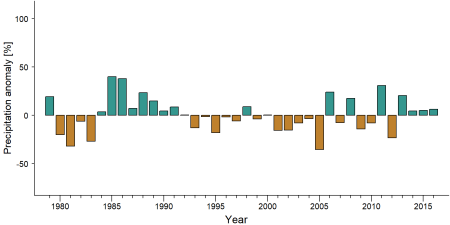
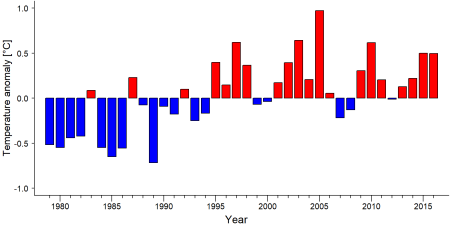
As part of a study on the exposure of African great ape sites to climate change impacts, Kiribou et al. | As part of a study on the exposure of African great ape sites to climate change impacts, [[#R02207|Kiribou et al. (2024)]] extracted climate data and data on projected extreme climate impact events for the site. Climatological characteristics were derived from observation-based climate data provided by the Inter-Sectoral Impact Model Intercomparison Project (ISIMIP, www.isimip.org). Parameters were calculated as the average across each 30-year period. For 1981-2010, the EWEMBI dataset from ISIMIP2a was used. For the two future periods (2021-2050 and 2071-2099) ISIMIP2b climate data based on four CMIP5 global climate models were used. For future projections, two Representative Concentration Pathways (RCP) were used. RCP 2.6 is a scenario with strong mitigation measures in which global temperatures would likely rise below 2C. RCP 6.0 is a scenario with medium emissions in which global temperatures would likely rise up to 3C by 2100. For the number of days with heavy precipitation events, the 98th percentile of all precipitation days (>1mm/d) was calculated for the 1979-2013 reference period as a threshold for a heavy precipitation event. Then, for each year, the number of days above that threshold was derived. The figures on temperature and precipitation anomaly show the deviation from the mean temperature and mean precipitation for the 1979-2013 reference period. | ||
The estimated exposure to future extreme climate impact events (crop failure, drought, river flood, wildfire, tropical cyclone, and heatwave) is based on a published dataset by Lange et al. 2020 derived from ISIMIP2b data. The same global climate models and RCPs as described above were used. Within each 30-year period, the number of years with an extreme event and the average proportion of the site affected were calculated ( | The estimated exposure to future extreme climate impact events (crop failure, drought, river flood, wildfire, tropical cyclone, and heatwave) is based on a published dataset by Lange et al. 2020 derived from ISIMIP2b data. The same global climate models and RCPs as described above were used. Within each 30-year period, the number of years with an extreme event and the average proportion of the site affected were calculated ([[#R02207|Kiribou et al. 2024]]). | ||
'''Table 8. Estimated past and projected climatological characteristics in Greater Mahale Ecosystem''' | '''Table 8. Estimated past and projected climatological characteristics in Greater Mahale Ecosystem''' | ||
| Line 464: | Line 464: | ||
= References = | = References = | ||
Carvalho, J. S., Stewart, F. | <span id="R00661"></span>Carvalho, J. S., Stewart, F. A., Marques, T. A., Bonnin, N., Pintea, L., Chitayat, A., …, & Piel, A. K. (2022). Spatio‐temporal changes in chimpanzee density and abundance in the Greater Mahale Ecosystem, Tanzania. ''Ecological Applications'', 32(8), e2715. [https://doi.org/10.1002/eap.2715 doi:10.1002/eap.2715] | ||
<span id="R00662"></span>Chitayat, A. B., Wich, S. A., Lewis, M., Stewart, F. A., & Piel, A. K. (2021). Ecological correlates of chimpanzee (Pan troglodytes schweinfurthii) density in Mahale Mountains National Park, Tanzania. ''PLOS ONE'', 16(2), e0246628. [https://doi.org/10.1371/journal.pone.0246628 doi:10.1371/journal.pone.0246628] | |||
<span id="R00663"></span>GMERC (n.d.). Conservation. https://www.gmerc.org/conservation | |||
<span id="R00664"></span>Pintea, L., and A. Bean. 2022. Local Voices, Local Choices: The Tacare Approach to Community-Led Conservation. Redlands, CA: The Jane Goodall Institute, Esri Press. | |||
<span id="R00665"></span>Plumptre AJ, Rose R, Nangendo G, Williamson E a., Didier K, Hart J, et al. Eastern Chimpanzee (Pan troglodytes schweinfurthii) Status Survey and Conservation Action Plan 2010–2020. Gland, Switzerland; 2010. [http://www.primate-sg.org/PDF/ECCAP.pdf link] | |||
<span id="R00666"></span>WCS. (n.d.). Greater Mahale Ecosystem. https://albertinerift.wcs.org/Wild-Places/Greater-Mahale-Ecosystem.aspx [https://web.archive.org/web/20220926060516/https://albertinerift.wcs.org/Wild-Places/Greater-Mahale-Ecosystem.aspx link] | |||
<span id="R02207"></span>Kiribou, R., Tehoda, P., Chukwu, O., Bempah, G., Kühl, H. S., Ferreira, J., …, & Heinicke, S. (2024). Exposure of African ape sites to climate change impacts. ''PLOS Climate'', 3(2), e0000345. [https://doi.org/10.1371/journal.pclm.0000345 doi:10.1371/journal.pclm.0000345] | |||
Latest revision as of 17:53, 15 October 2026
East Africa > Tanzania > Greater Mahale Ecosystem
Français | Português | Español | Bahasa Indonesia | Melayu
Summary
- Eastern chimpanzees (Pan troglodytes schweinfurthii) are present in the Greater Mahale Ecosystem.
- It has been estimated that 2,600 individuals occur in the site.
- The chimpanzee population trend is decreasing.
- The site has a total size of 20,000 km².
- Key threats to chimpanzees include human settlements in important habitat, logging and charcoal production, fires, expansion of agriculture and herding, and poaching.
- Conservation activities have focused on anti-poaching patrols and presence of researchers, and providing fuel-efficient ovens.
- The site holds approximately 90% of the chimpanzee population in Tanzania.
Site characteristics
Located in western Tanzania, the Greater Mahale Ecosystem includes the Mahale Mountains National Park and its surrounding natural habitat. In addition to the eastern chimpanzee, other species of conservation concern that occur in the area include red colobus monkeys, elephants, lions, sables, and the endemic bird Kungwe apalis (WCS). A total of 1,939 mammal, bird, reptile, amphibian and plant species have been recorded at the site, of which 15 species are endemic to the Albertine Rift and 28 species are threatened (CR, EN, VU) under the IUCN Red List (WCS).
Table 1. Basic site information for Greater Mahale Ecosystem
| Species | Pan troglodytes schweinfurthii |
| Area | 20,000 km² |
| Coordinates | Lat: -5.861672 , Lon: 30.357929 |
| Type of site | Non-protected area |
| Habitat types | Subtropical/tropical montane forest, Grassland |
| Type of governance | Governance by government |
Types of sites Governance types Habitat types
Ape status
The WCS Albertine Rift Program conducted surveys of the Greater Mahale Ecosystem in the mid 2000s with Jane Goodall Institute (JGI), to estimate chimpanzee numbers for the area and assess other biodiversity WCS).
Table 2. Ape population estimates reported for Greater Mahale Ecosystem
| Species | Year | Occurrence | Encounter or vistation rate (nests/km; ind/day) | Density estimate [ind./ km²] (95% CI) | Abundance estimate (95% CI) | Survey area | Sampling method | Analytical framework | Source | Comments | A.P.E.S. database ID |
|---|---|---|---|---|---|---|---|---|---|---|---|
| Pan troglodytes schweinfurthii | 2010-2020 | Present | 0.86 | Greater Mahale Ecosystem | Line transects | Carvalho et al. 2022 | The research utilized nest survey data collected from 2010 to 2020, excluding 2016 when no surveys took place, and applied line-transect distance sampling along with generalized additive models (GAMs). In addition, the density estimates were reported as varying spatially and temporally (numerical values provided per stratum in article tables). | ||||
| Pan troglodytes schweinfurthii | 2005 | 2600.0 | Greater Mahale Ecosystem | Survey data | Plumptre et al. 2010 |
Sampling methods Analytical frameworks
Threats
In Tanzania, 90% of the country’s chimpanzees are found in the Greater Mahale Ecosystem, where suitable habitat is being lost and fragmented by the expansion of human settlements, conversion of land for agriculture, logging, and cattle herding (Chitayat et al. 2021). Chimpanzees in savanna-woodland mosaics, such as in the Greater Mahale Ecosystem, already live at relatively low densities, highlighting the need to identify and protect areas critical for chimpanzee conservation (Chitayat et al. 2021).
Table 3. Threats to apes reported for Greater Mahale Ecosystem
| Category | Specific threats | Threat level | Description | Year of threat |
|---|---|---|---|---|
| 1 Residential & commercial development | 1.1 Residential areas | Present (unknown severity) | People settling in the area tend to locate near water sources. As a result, small riverine strips of forest, critical for chimpanzees and the endemic Kungwe apalis, are disappearing (WCS n.d.). Expansion of settlements and land use influencing chimpanzee density (Carvalho et al. 2022) | 2018-Ongoing (2022) |
| 2 Agriculture & aquaculture | 2.1 Annual & perennial non-timber crops | High (more than 70% of population affected) | Conversion of chimpanzee habitat into agricultural land (GMERC n.d., Carvalho et al. 2022). | 2018-Ongoing (2022) |
| 2 Agriculture & aquaculture | 2.3 Livestock farming & ranching | High (more than 70% of population affected) | Cattle herding (Chitayat et al. 2021, Carvalho et al. 2022). | 2018-Ongoing (2022) |
| 5 Biological resource use | 5.1 Hunting & collecting terrestrial animals | Present (unknown severity) | Injuries caused by snares (GMERC). | Ongoing (2021) |
| 5 Biological resource use | 5.1.2 Unintentional effects | Present (unknown severity) | Great apes getting injured by traps likely intended for other animals (Naiman M. pers. comm. 2025). | Ongoing (2025) |
| 5 Biological resource use | 5.1.5 Persecution/human wildlife conflict | Present (unknown severity) | Humans and great apes often share natural spaces drawing water from the same sources, foraging the same wild resources like forest fruits, and occasionally crossing paths on trails all of which can lead to increased interaction and potential health or conservation challenges and conflict (Naiman M. pers. comm. 2025). | Ongoing (2025) |
| 5 Biological resource use | 5.3 Logging & wood harvesting | High (more than 70% of population affected) | Clearing the forest for charcoal production (GMERC). Conversion of woodland and forest due to human activities (Carvalho et al. 2022). | 2018-Ongoing (2022) |
| 7 Natural system modifications | 7.1 Fire & fire suppression | High (more than 70% of population affected) | Fires ignited by humans, contributing to habitat loss (WCS n.d., GMERC n.d.). | Ongoing (2021) |
| 8 Invasive & other problematic species, genes & diseases | 8.4 Pathogens | Present (unknown severity) | The potential risk of diseases trasmission between people and apes, or apes and people is reported (Naiman M. pers. comm. 2025). | Ongoing (2025) |
Conservation activities
Government-led patrols are conducted in partnership with the Jane Goodall Institute to fight illegal activities, such as poaching and herding (GMERC n.d.).
Table 4. Conservation activities reported for Greater Mahale Ecosystem
| Category | Specific activity | Description | Implementing organization(s) | Year of activity |
|---|---|---|---|---|
| 2 Counter-wildlife crime | 2.3 Conduct regular anti-poaching patrols | GMERC organise and sponsor patrols to combat illegal activities since 2009. | 2009-Ongoing (2021) | |
| 4 Education & awareness | 4.1 Educate local communities about apes and sustainable use | Educational activities about great apes are being conducted (Naiman M. pers. comm. 2025). | Ongoing (2025) | |
| 4 Education & awareness | 4.2 Involve local community in ape research and conservation management | Community-led conservation projects and land-use planning (Jane Goodall Institute, since 1994) (Pintea & Bean, 2022). Local communities are involved in conservation programs through the provision of conservation extension services, participation in Village Natural Resources Committees, and the recruitment and training of village forest scouts to support patrols and manage great ape habitats and their ecological connectivity within their respective areas (Naiman M. pers. comm. 2025). | Jane Goodall Institute | 1994-Ongoing (2025) |
| 5 Protection & restoration | 5.6 Habitat restoration | Forest rehabilitation and protection activities are reported (Naiman pers. comm. 2025). | Ongoing (2025) | |
| 7 Economic & other incentives | 7.1 Provide monetary benefits to local communities for sustainably managing their forest and its wildlife (e.g., REDD, alternative income, employment) | REDD+ initiatives REDD+ carbon projects by Carbon Tanzania, Ntakata Forest (Carvalho et al. 2022). Local people are employed to work in conservation projects (Naiman M. pers. comm. 2025). | Ongoing (2025) | |
| 7 Economic & other incentives | 7.2 Provide non-monetary benefits to local communities for sustainably managing their forest and its wildlife (e.g., better education, infrastructure development) | Providing fuel efficient ovens GMERC. | Ongoing (2021) | |
| 8 Permanent presence | 8.1 Run research project and ensure permanent human presence at site | Research is regularly conducted at the site GMERC. | Ongoing (2021) |
Challenges
Table 5. Challenges reported for Greater Mahale Ecosystem
| Challenges | Specific challenges | Source | Year(s) |
|---|---|---|---|
| 2 Resources and capacity | 2.2 Lack of staff | Naiman M. pers. comm. 2025 | Ongoing (2025) |
| 2 Resources and capacity | 2.3 General lack of funding | Naiman M. pers. comm. 2025 | Ongoing (2025) |
| 2 Resources and capacity | 2.4 Lack of continuous/long-term funding | Naiman M. pers. comm. 2025 | Ongoing (2025) |
| 4 Institutional support | 4.3 Lack of protected area status | Carvalho et al. 2022 | Ongoing (2022) |
Enablers
Table 6. Enablers reported for Greater Mahale Ecosystem
| Enablers | Specific enablers | Source | Year(s) |
|---|---|---|---|
| 2 Resources and capacity | 2.5 Sufficient capacity/expertise to advise, design, or implement actions | Naiman M. pers. comm. 2025 | 2025 |
| 2 Resources and capacity | 2.6 External partnerships that add expertise or resources | Naiman M. pers. comm. 2025 | 2025 |
| 1 Site management | |||
| 3 Engaged community | |||
| 4 Institutional support | |||
| 5 Ecological context | |||
| 6 Safety and stability |
Research activities
The Greater Mahale Ecosystem Research and Conservation group cover several topics in their research, such as chimpanzee behavioral ecology, bioacoustics, environmental and biodiversity monitoring, as well as research on yellow baboons and red-tailed monkeys (GMERC n.d.).
Documented behaviours
Table 7. Behaviours documented for Greater Mahale Ecosystem
| Category | Behavior | Observation type | Prevalence | Observation dates | Source | Habituation | Species | Comment |
|---|---|---|---|---|---|---|---|---|
| Not reported |
Exposure to climate change impacts
As part of a study on the exposure of African great ape sites to climate change impacts, Kiribou et al. (2024) extracted climate data and data on projected extreme climate impact events for the site. Climatological characteristics were derived from observation-based climate data provided by the Inter-Sectoral Impact Model Intercomparison Project (ISIMIP, www.isimip.org). Parameters were calculated as the average across each 30-year period. For 1981-2010, the EWEMBI dataset from ISIMIP2a was used. For the two future periods (2021-2050 and 2071-2099) ISIMIP2b climate data based on four CMIP5 global climate models were used. For future projections, two Representative Concentration Pathways (RCP) were used. RCP 2.6 is a scenario with strong mitigation measures in which global temperatures would likely rise below 2C. RCP 6.0 is a scenario with medium emissions in which global temperatures would likely rise up to 3C by 2100. For the number of days with heavy precipitation events, the 98th percentile of all precipitation days (>1mm/d) was calculated for the 1979-2013 reference period as a threshold for a heavy precipitation event. Then, for each year, the number of days above that threshold was derived. The figures on temperature and precipitation anomaly show the deviation from the mean temperature and mean precipitation for the 1979-2013 reference period.
The estimated exposure to future extreme climate impact events (crop failure, drought, river flood, wildfire, tropical cyclone, and heatwave) is based on a published dataset by Lange et al. 2020 derived from ISIMIP2b data. The same global climate models and RCPs as described above were used. Within each 30-year period, the number of years with an extreme event and the average proportion of the site affected were calculated (Kiribou et al. 2024).
Table 8. Estimated past and projected climatological characteristics in Greater Mahale Ecosystem
| Value | 1981-2010 | 2021-2050, RCP 2.6 | 2021-2050, RCP 6.0 | 2071-2099, RCP 2.6 | 2071-2099, RCP 6.0 |
|---|---|---|---|---|---|
| Mean temperature [C] | 22.8 | 23.9 | 23.9 | 24 | 25.5 |
| Annual precipitation [mm] | 1049 | 1026 | 1088 | 1027 | 1080 |
| Max no. consecutive dry days (per year) | 104.9 | 121.8 | 112.1 | 122.2 | 123 |
| No. days with heavy precipitation (per year) | 4.5 | 2.7 | 3.7 | 2.9 | 4.7 |
Table 9. Projected exposure of apes to extreme climate impact events in Greater Mahale Ecosystem
| Type | No. of years with event (2021-2050, RCP 2.6) | % of site exposed (2021-2050, RCP 2.6) | No. of years with event (2021-2050, RCP 6.0) | % of site exposed (2021-2050, RCP 6.0) | No. of years with event (2070-2099, RCP 2.6) | % of site exposed (2070-2099, RCP 2.6) | No. of years with event (2070-2099, RCP 6.0) | % of site exposed (2070-2099, RCP 6.0) |
|---|---|---|---|---|---|---|---|---|
| Crop failure | 2.5 | 0.01 | 1 | 0 | 2.5 | 0 | 3.5 | 0 |
| Drought | 0 | 0 | 0.25 | 25 | 0 | 0 | 0 | 0 |
| Heatwave | 0 | 0 | 0 | 0 | 0 | 0 | 0 | 0 |
| River flood | 1.5 | 13.66 | 2 | 17.73 | 1.5 | 13.38 | 3 | 9.58 |
| Tropical cyclone | 0 | 0 | 0 | 0 | 0 | 0 | 0 | 0 |
| Wildfire | 30 | 2.28 | 30 | 2.31 | 29 | 2.33 | 29 | 2.73 |
-
Precipitation anomaly in Greater Mahale Ecosystem -
Temperature anomaly in Greater Mahale Ecosystem


External links
Greater Mahale Ecosystem Research and Conservation
Greater Mahale Ecosystem Frankfurt Zoological Society
References
Carvalho, J. S., Stewart, F. A., Marques, T. A., Bonnin, N., Pintea, L., Chitayat, A., …, & Piel, A. K. (2022). Spatio‐temporal changes in chimpanzee density and abundance in the Greater Mahale Ecosystem, Tanzania. Ecological Applications, 32(8), e2715. doi:10.1002/eap.2715
Chitayat, A. B., Wich, S. A., Lewis, M., Stewart, F. A., & Piel, A. K. (2021). Ecological correlates of chimpanzee (Pan troglodytes schweinfurthii) density in Mahale Mountains National Park, Tanzania. PLOS ONE, 16(2), e0246628. doi:10.1371/journal.pone.0246628
GMERC (n.d.). Conservation. https://www.gmerc.org/conservation
Pintea, L., and A. Bean. 2022. Local Voices, Local Choices: The Tacare Approach to Community-Led Conservation. Redlands, CA: The Jane Goodall Institute, Esri Press.
Plumptre AJ, Rose R, Nangendo G, Williamson E a., Didier K, Hart J, et al. Eastern Chimpanzee (Pan troglodytes schweinfurthii) Status Survey and Conservation Action Plan 2010–2020. Gland, Switzerland; 2010. link
WCS. (n.d.). Greater Mahale Ecosystem. https://albertinerift.wcs.org/Wild-Places/Greater-Mahale-Ecosystem.aspx link
Kiribou, R., Tehoda, P., Chukwu, O., Bempah, G., Kühl, H. S., Ferreira, J., …, & Heinicke, S. (2024). Exposure of African ape sites to climate change impacts. PLOS Climate, 3(2), e0000345. doi:10.1371/journal.pclm.0000345
Page created by: APES Atlas Team Date: 2021-10-14
Page updated by: Naiman Martin Mollel, Aime Mizero Date: 2025-01-12