
Goin-Débé Classified Forest: Difference between revisions
No edit summary |
No edit summary |
||
| (2 intermediate revisions by the same user not shown) | |||
| Line 17: | Line 17: | ||
= Site characteristics = | = Site characteristics = | ||
Goin-Débé is a Classified Forest in southwestern Côte d’Ivoire directly neighboring Cavally Classified Forest. In the past ten years the forest has been almost entirely degraded and has been replaced by cocoa plantations. Biodiversity surveys in 2007 and 2009/2010 confirmed the presence of ungulates such as bongo (''Tragelaphus eurycerus'') and bushbuck (''Tragelaphus scriptus''), birds, including hornbills (''Buceros sp.'') and turacos (''Tauraco sp.''), red river hog (''Potamochoerus porcus''), pygmy hippopotamus (''Choeropsis liberiensis''), and primates, such as Campbell’s monkey (''Cercopithecus campbelli''), sooty mangabey (''Cercocebus atys''), Diana monkey (''Cercopithecus diana'', Normand 2010). With the recent forest destruction, the current state of biodiversity and western chimpanzees specifically is unknown. Because of the presence of the endangered bird species Gola malimbe (''Malimbus ballmanni'') Cavally and Goin-Débé are designated as Important Bird Areas (BirdLife International 2019). Goin-Débé is listed as “Classified Forest Name Unknown (CIV) No.58” in the World Database of Protected Areas (UNEP-WCMC and IUCN 2019). | Goin-Débé is a Classified Forest in southwestern Côte d’Ivoire directly neighboring Cavally Classified Forest. In the past ten years the forest has been almost entirely degraded and has been replaced by cocoa plantations. Biodiversity surveys in 2007 and 2009/2010 confirmed the presence of ungulates such as bongo (''Tragelaphus eurycerus'') and bushbuck (''Tragelaphus scriptus''), birds, including hornbills (''Buceros sp.'') and turacos (''Tauraco sp.''), red river hog (''Potamochoerus porcus''), pygmy hippopotamus (''Choeropsis liberiensis''), and primates, such as Campbell’s monkey (''Cercopithecus campbelli''), sooty mangabey (''Cercocebus atys''), Diana monkey (''Cercopithecus diana'', [[#R00619|Normand 2010]]). With the recent forest destruction, the current state of biodiversity and western chimpanzees specifically is unknown. Because of the presence of the endangered bird species Gola malimbe (''Malimbus ballmanni'') Cavally and Goin-Débé are designated as Important Bird Areas (BirdLife International 2019). Goin-Débé is listed as “Classified Forest Name Unknown (CIV) No.58” in the World Database of Protected Areas ([[#R00620|UNEP-WCMC and IUCN 2019]]). | ||
'''Table 1. Basic site information for Goin-Débé Classified Forest''' | '''Table 1. Basic site information for Goin-Débé Classified Forest''' | ||
| Line 44: | Line 44: | ||
= Ape status = | = Ape status = | ||
A survey by the Wild Chimpanzee Foundation (WCF) found a strong decline in western chimpanzee numbers between 2007 and 2010 mainly driven by large-scale deforestation (Normand 2010). While high chimpanzee densities were found in the first survey, with densities even higher than in Taï National Park, it was estimated that the chimpanzee population declined from more than 200 individuals to less than 40 individuals (Normand 2010). An analysis by Kühl et al. 2017 also found a significant population decline. For several years this forest has suffered significant degradation across its entire area and no inventory has been carried out since 2012 due to armed conflicts at the local level. This suggests that there are no longer any chimpanzees in this forest (Normand, personal observation, 2025). | A survey by the Wild Chimpanzee Foundation (WCF) found a strong decline in western chimpanzee numbers between 2007 and 2010 mainly driven by large-scale deforestation ([[#R00619|Normand 2010]]). While high chimpanzee densities were found in the first survey, with densities even higher than in Taï National Park, it was estimated that the chimpanzee population declined from more than 200 individuals to less than 40 individuals ([[#R00619|Normand 2010]]). An analysis by [[#R00617|Kühl et al. 2017]] also found a significant population decline. For several years this forest has suffered significant degradation across its entire area and no inventory has been carried out since 2012 due to armed conflicts at the local level. This suggests that there are no longer any chimpanzees in this forest (Normand, personal observation, 2025). | ||
'''Table 2. Ape population estimates reported for Goin-Débé Classified Forest''' | '''Table 2. Ape population estimates reported for Goin-Débé Classified Forest''' | ||
| Line 70: | Line 70: | ||
|Line transects | |Line transects | ||
| | | | ||
|Normand 2010 | |[[#R00619|Normand 2010]] | ||
|Total survey effort: 197 km | |Total survey effort: 197 km | ||
| | | | ||
| Line 83: | Line 83: | ||
|Line transects | |Line transects | ||
| | | | ||
|Normand 2010 | |[[#R00619|Normand 2010]] | ||
|Total survey effort: 197 km | |Total survey effort: 197 km | ||
| | | | ||
| Line 96: | Line 96: | ||
|Line transects | |Line transects | ||
| | | | ||
|Normand 2010 | |[[#R00619|Normand 2010]] | ||
|Total survey effort: 197 km | |Total survey effort: 197 km | ||
| | | | ||
| Line 109: | Line 109: | ||
|Line transects | |Line transects | ||
| | | | ||
|Normand 2010 | |[[#R00619|Normand 2010]] | ||
|Total survey effort: 165 km | |Total survey effort: 165 km | ||
| | | | ||
| Line 122: | Line 122: | ||
|Line transects | |Line transects | ||
| | | | ||
|Normand 2010 | |[[#R00619|Normand 2010]] | ||
|Total survey effort: 165 km | |Total survey effort: 165 km | ||
| | | | ||
| Line 135: | Line 135: | ||
|Line transects | |Line transects | ||
| | | | ||
|Normand 2010 | |[[#R00619|Normand 2010]] | ||
|Total survey effort: 165 km | |Total survey effort: 165 km | ||
| | | | ||
| Line 144: | Line 144: | ||
= Threats = | = Threats = | ||
The monitoring surveys conducted by the WCF encountered mostly plantations in the eastern and western part of Goin-Débé in 2007 (Normand 2010). During that survey the central part was still forested and hardly any agricultural activities were encountered. However, prevalence of agricultural activities strongly increased since the dry season 2008/2009 (Normand 2010). Signs of hunting were recorded across the entire area (Normand 2010). While deforestation was the most prevalent anthropogenic pressure encountered during 2007 survey, agricultural activities were the most prevalent activity recorded in the 2010 survey, most of them cocoa plantations. This highlights the dynamic of deforestation being followed by expansion of agricultural areas. The WCF concluded that the entire forest is now degraded (WCF 2016), while SODEFOR (Society for the Forest Development, the government agency managing classified forests) in a recent survey of the area concluded that 80% of the forest are severely degraded (IDH 2018). | The monitoring surveys conducted by the WCF encountered mostly plantations in the eastern and western part of Goin-Débé in 2007 ([[#R00619|Normand 2010]]). During that survey the central part was still forested and hardly any agricultural activities were encountered. However, prevalence of agricultural activities strongly increased since the dry season 2008/2009 ([[#R00619|Normand 2010]]). Signs of hunting were recorded across the entire area ([[#R00619|Normand 2010]]). While deforestation was the most prevalent anthropogenic pressure encountered during 2007 survey, agricultural activities were the most prevalent activity recorded in the 2010 survey, most of them cocoa plantations. This highlights the dynamic of deforestation being followed by expansion of agricultural areas. The WCF concluded that the entire forest is now degraded ([[#R00623|WCF 2016]]), while SODEFOR (Society for the Forest Development, the government agency managing classified forests) in a recent survey of the area concluded that 80% of the forest are severely degraded ([[#R00616|IDH 2018]]). | ||
'''Table 3. Threats to apes reported for Goin-Débé Classified Forest''' | '''Table 3. Threats to apes reported for Goin-Débé Classified Forest''' | ||
| Line 157: | Line 157: | ||
|2.1 Annual & perennial non-timber crops | |2.1 Annual & perennial non-timber crops | ||
|High (more than 70% of population affected) | |High (more than 70% of population affected) | ||
|Agricultural activities widespread (Normand 2010). Cocoa plantation is tolerated by SODEFOR (WCF 2023). | |Agricultural activities widespread ([[#R00619|Normand 2010]]). Cocoa plantation is tolerated by SODEFOR ([[#R00624|WCF 2023]]). | ||
|2008-Ongoing (2023) | |2008-Ongoing (2023) | ||
|- | |- | ||
| Line 163: | Line 163: | ||
|3.2 Mining & quarrying | |3.2 Mining & quarrying | ||
|Low (up to 30% of population affected) | |Low (up to 30% of population affected) | ||
|Signs of artisanal mining for gold during 2007 survey (Normand 2010) | |Signs of artisanal mining for gold during 2007 survey ([[#R00619|Normand 2010]]) | ||
|2007 | |2007 | ||
|- | |- | ||
| Line 169: | Line 169: | ||
|4.1 Roads & railroads | |4.1 Roads & railroads | ||
|Medium (30-70% of population affected) | |Medium (30-70% of population affected) | ||
|Roads used to access plantations but also for wood extraction (Normand 2010). | |Roads used to access plantations but also for wood extraction ([[#R00619|Normand 2010]]). | ||
|2008-Ongoing (2023) | |2008-Ongoing (2023) | ||
|- | |- | ||
| Line 175: | Line 175: | ||
|5.1 Hunting & collecting terrestrial animals | |5.1 Hunting & collecting terrestrial animals | ||
|High (more than 70% of population affected) | |High (more than 70% of population affected) | ||
|Normand 2010 | |[[#R00619|Normand 2010]] | ||
|Ongoing (2010) | |Ongoing (2010) | ||
|- | |- | ||
| Line 181: | Line 181: | ||
|5.3 Logging & wood harvesting | |5.3 Logging & wood harvesting | ||
|High (more than 70% of population affected) | |High (more than 70% of population affected) | ||
|Especially high prevalence in 2007 survey (Normand 2010). | |Especially high prevalence in 2007 survey ([[#R00619|Normand 2010]]). | ||
|2007-Ongoing (2010) | |2007-Ongoing (2010) | ||
|- | |- | ||
| Line 187: | Line 187: | ||
|6.3 Other human disturbances | |6.3 Other human disturbances | ||
|High (more than 70% of population affected) | |High (more than 70% of population affected) | ||
|Populations have infiltrated since 1960 and have degraded the forest, particularly during the post-election crisis of 2011 that the country suffered (WCF 2023). | |Populations have infiltrated since 1960 and have degraded the forest, particularly during the post-election crisis of 2011 that the country suffered ([[#R00624|WCF 2023]]). | ||
|1960-Ongoing (2023) | |1960-Ongoing (2023) | ||
|} | |} | ||
| Line 195: | Line 195: | ||
= Conservation activities = | = Conservation activities = | ||
Since 2005 the WCF cooperated with SODEFOR (Society for the Forest Development, the government agency managing classified forests) and OIPR (Office for Reserves and National Parks) to establish and monitor sustainable logging practices in the classified forests of Goin-Débé and Cavally (Normand 2007). The WCF implemented monitoring activities and with its presence wanted to deter illegal agricultural activities (Normand 2007, WCF 2011). With the lack of law enforcement during the post-election crisis 2010/2011 deforestation pressure increased strongly and the WCF seems to have now ceased its conservation activities due to the large-scale degradation of the forest (WCF 2016). In 2018, SODEFOR implemented a survey of Goin-Débé forest and conducted sensitization events of the local population and illegal farmers (IDH 2018). | Since 2005 the WCF cooperated with SODEFOR (Society for the Forest Development, the government agency managing classified forests) and OIPR (Office for Reserves and National Parks) to establish and monitor sustainable logging practices in the classified forests of Goin-Débé and Cavally ([[#R00618|Normand 2007]]). The WCF implemented monitoring activities and with its presence wanted to deter illegal agricultural activities ([[#R00618|Normand 2007]], [[#R00621|WCF 2011]]). With the lack of law enforcement during the post-election crisis 2010/2011 deforestation pressure increased strongly and the WCF seems to have now ceased its conservation activities due to the large-scale degradation of the forest ([[#R00623|WCF 2016]]). In 2018, SODEFOR implemented a survey of Goin-Débé forest and conducted sensitization events of the local population and illegal farmers ([[#R00616|IDH 2018]]). | ||
'''Table 4. Conservation activities reported for Goin-Débé Classified Forest''' | '''Table 4. Conservation activities reported for Goin-Débé Classified Forest''' | ||
| Line 207: | Line 207: | ||
|1 Development impact mitigation | |1 Development impact mitigation | ||
|1.15 Certify products from agriculture, mining or logging and market them as ape friendly | |1.15 Certify products from agriculture, mining or logging and market them as ape friendly | ||
|WCF cooperates with SODEFOR and OIPR to establish and monitor sustainable logging practices (Normand 2007, WCF 2012) | |WCF cooperates with SODEFOR and OIPR to establish and monitor sustainable logging practices ([[#R00618|Normand 2007]], [[#R00622|WCF 2012]]) | ||
| | | | ||
|2005-2012 | |2005-2012 | ||
| Line 213: | Line 213: | ||
|4 Education & awareness | |4 Education & awareness | ||
|4.1 Educate local communities about apes and sustainable use | |4.1 Educate local communities about apes and sustainable use | ||
|SODEFOR conducted sensitization events with local population and illegal farmers (IDH 2018) | |SODEFOR conducted sensitization events with local population and illegal farmers ([[#R00616|IDH 2018]]) | ||
| | | | ||
|2018 | |2018 | ||
| Line 219: | Line 219: | ||
|5 Protection & restoration | |5 Protection & restoration | ||
|5.2 Legally protect ape habitat | |5.2 Legally protect ape habitat | ||
|Designated as classified forest (Normand 2007, 2010). | |Designated as classified forest ([[#R00618|Normand 2007]], 2010). | ||
| | | | ||
|1978-Ongoing (2025) | |1978-Ongoing (2025) | ||
| Line 228: | Line 228: | ||
= Challenges = | = Challenges = | ||
As part of their work to establish and monitor sustainable logging practices the WCF noted that civil unrest and the lack of law enforcement impeded conservation activities (WCF 2012). | As part of their work to establish and monitor sustainable logging practices the WCF noted that civil unrest and the lack of law enforcement impeded conservation activities ([[#R00622|WCF 2012]]). | ||
'''Table 5. Challenges reported for Goin-Débé Classified Forest''' | '''Table 5. Challenges reported for Goin-Débé Classified Forest''' | ||
| Line 239: | Line 239: | ||
|4 Institutional support | |4 Institutional support | ||
|4.1 Lack of law enforcement | |4.1 Lack of law enforcement | ||
|WCF 2012 | |[[#R00622|WCF 2012]] | ||
| | | | ||
|- | |- | ||
|6 Safety and stability | |6 Safety and stability | ||
|6.3 Civil unrest/war | |6.3 Civil unrest/war | ||
|WCF 2012 | |[[#R00622|WCF 2012]] | ||
| | | | ||
|} | |} | ||
| Line 330: | Line 330: | ||
= Exposure to climate change impacts = | = Exposure to climate change impacts = | ||
As part of a study on the exposure of African great ape sites to climate change impacts, Kiribou et al. (2024) extracted climate data and data on projected extreme climate impact events for the site. Climatological characteristics were derived from observation-based climate data provided by the Inter-Sectoral Impact Model Intercomparison Project (ISIMIP, www.isimip.org). Parameters were calculated as the average across each 30-year period. For 1981-2010, the EWEMBI dataset from ISIMIP2a was used. For the two future periods (2021-2050 and 2071-2099) ISIMIP2b climate data based on four CMIP5 global climate models were used. For future projections, two Representative Concentration Pathways (RCP) were used. RCP 2.6 is a scenario with strong mitigation measures in which global temperatures would likely rise below 2C. RCP 6.0 is a scenario with medium emissions in which global temperatures would likely rise up to 3C by 2100. For the number of days with heavy precipitation events, the 98th percentile of all precipitation days (>1mm/d) was calculated for the 1979-2013 reference period as a threshold for a heavy precipitation event. Then, for each year, the number of days above that threshold was derived. The figures on temperature and precipitation anomaly show the deviation from the mean temperature and mean precipitation for the 1979-2013 reference period. | As part of a study on the exposure of African great ape sites to climate change impacts, [[#R02202|Kiribou et al. (2024)]] extracted climate data and data on projected extreme climate impact events for the site. Climatological characteristics were derived from observation-based climate data provided by the Inter-Sectoral Impact Model Intercomparison Project (ISIMIP, www.isimip.org). Parameters were calculated as the average across each 30-year period. For 1981-2010, the EWEMBI dataset from ISIMIP2a was used. For the two future periods (2021-2050 and 2071-2099) ISIMIP2b climate data based on four CMIP5 global climate models were used. For future projections, two Representative Concentration Pathways (RCP) were used. RCP 2.6 is a scenario with strong mitigation measures in which global temperatures would likely rise below 2C. RCP 6.0 is a scenario with medium emissions in which global temperatures would likely rise up to 3C by 2100. For the number of days with heavy precipitation events, the 98th percentile of all precipitation days (>1mm/d) was calculated for the 1979-2013 reference period as a threshold for a heavy precipitation event. Then, for each year, the number of days above that threshold was derived. The figures on temperature and precipitation anomaly show the deviation from the mean temperature and mean precipitation for the 1979-2013 reference period. | ||
The estimated exposure to future extreme climate impact events (crop failure, drought, river flood, wildfire, tropical cyclone, and heatwave) is based on a published dataset by Lange et al. 2020 derived from ISIMIP2b data. The same global climate models and RCPs as described above were used. Within each 30-year period, the number of years with an extreme event and the average proportion of the site affected were calculated (Kiribou et al. 2024). | The estimated exposure to future extreme climate impact events (crop failure, drought, river flood, wildfire, tropical cyclone, and heatwave) is based on a published dataset by Lange et al. 2020 derived from ISIMIP2b data. The same global climate models and RCPs as described above were used. Within each 30-year period, the number of years with an extreme event and the average proportion of the site affected were calculated ([[#R02202|Kiribou et al. 2024]]). | ||
'''Table 8. Estimated past and projected climatological characteristics in Goin-Débé Classified Forest''' | '''Table 8. Estimated past and projected climatological characteristics in Goin-Débé Classified Forest''' | ||
| Line 455: | Line 455: | ||
= References = | = References = | ||
IDH. (2018). SODEFOR half-way the full census of the Goin-Débé forest reserve. IDH Sustainable Trade Initiative. Retrieved from https://www.idhsustainabletrade.com | <span id="R00616"></span>IDH. (2018). SODEFOR half-way the full census of the Goin-Débé forest reserve. IDH Sustainable Trade Initiative. Retrieved from https://www.idhsustainabletrade.com | ||
Kühl, H. S., Sop, T., Williamson, E. A., Mundry, R., Brugière, D., Campbell, G., … Boesch, C. (2017). The | <span id="R00617"></span>Kühl, H. S., Sop, T., Williamson, E. A., Mundry, R., Brugière, D., Campbell, G., …, & Boesch, C. (2017). The Critically Endangered western chimpanzee declines by 80%. ''American Journal of Primatology'', 79(9), e22681. [https://doi.org/10.1002/ajp.22681 doi:10.1002/ajp.22681] | ||
Normand, E. (2007). Protection of two high priority classified forests in Côte d’Ivoire (Cavally and Goin-Débé): Improved management plan and bio-monitoring of logging operations. Unpublished report, Wild Chimpanzee Foundation. | <span id="R00618"></span>Normand, E. (2007). Protection of two high priority classified forests in Côte d’Ivoire (Cavally and Goin-Débé): Improved management plan and bio-monitoring of logging operations. Unpublished report, Wild Chimpanzee Foundation. | ||
Normand, E. (2010). Rapport de suivi écologique dans les forêts de Goin-Débé et de Cavally (2007–2010). Unpublished report, Wild Chimpanzee Foundation. | <span id="R00619"></span>Normand, E. (2010). Rapport de suivi écologique dans les forêts de Goin-Débé et de Cavally (2007–2010). Unpublished report, Wild Chimpanzee Foundation. | ||
UNEP-WCMC, & IUCN. (2019). Protected Planet: The World Database on Protected Areas (WDPA). Cambridge, UK: UNEP-WCMC and IUCN. Retrieved from https://www.protectedplanet.net | <span id="R00620"></span>UNEP-WCMC, & IUCN. (2019). Protected Planet: The World Database on Protected Areas (WDPA). Cambridge, UK: UNEP-WCMC and IUCN. Retrieved from https://www.protectedplanet.net [https://web.archive.org/web/20200930170440/https://www.protectedplanet.net/country/GN link] | ||
Wild Chimpanzee Foundation | <span id="R00621"></span>Wild Chimpanzee Foundation (2011). Annual report of the activities undertaken by the Wild Chimpanzee Foundation to improve the protection of wild chimpanzees and their habitat in West Africa: Year 2011. Wild Chimpanzee Foundation. | ||
Wild Chimpanzee Foundation (WCF). (2012). Annual report 2012 – Activities of the Wild Chimpanzee Foundation for improved conservation of chimpanzees and their habitat in West Africa. Wild Chimpanzee Foundation. | <span id="R00622"></span>Wild Chimpanzee Foundation (WCF). (2012). Annual report 2012 – Activities of the Wild Chimpanzee Foundation for improved conservation of chimpanzees and their habitat in West Africa. Wild Chimpanzee Foundation. | ||
Wild Chimpanzee Foundation (WCF). (2016). Annual report 2016 – Activities of the Wild Chimpanzee Foundation for improved conservation of chimpanzees and their habitat in West Africa. Wild Chimpanzee Foundation. | <span id="R00623"></span>Wild Chimpanzee Foundation (WCF). (2016). Annual report 2016 – Activities of the Wild Chimpanzee Foundation for improved conservation of chimpanzees and their habitat in West Africa. Wild Chimpanzee Foundation. | ||
Wild Chimpanzee Foundation (WCF). (2023). Rapport d'observation indépendante externe : cas de recel de cacao en provenance de forêts classées. Online: https://www.wildchimps.org/fileadmin/content_files/pdfs/reports/WCF__RAPPORT_final_OI_11-2023.pdf | <span id="R00624"></span>Wild Chimpanzee Foundation (WCF). (2023). Rapport d'observation indépendante externe : cas de recel de cacao en provenance de forêts classées. Online: https://www.wildchimps.org/fileadmin/content_files/pdfs/reports/WCF__RAPPORT_final_OI_11-2023.pdf [https://web.archive.org/web/20240229091659/https://www.wildchimps.org/fileadmin/content_files/pdfs/reports/WCF__RAPPORT_final_OI_11-2023.pdf link] | ||
<span id="R02202"></span>Kiribou, R., Tehoda, P., Chukwu, O., Bempah, G., Kühl, H. S., Ferreira, J., …, & Heinicke, S. (2024). Exposure of African ape sites to climate change impacts. ''PLOS Climate'', 3(2), e0000345. [https://doi.org/10.1371/journal.pclm.0000345 doi:10.1371/journal.pclm.0000345] | |||
Latest revision as of 17:53, 15 October 2026
West Africa > Côte d'Ivoire > Goin-Débé Classified Forest
Français | Português | Español | Bahasa Indonesia | Melayu
Summary
- Western chimpanzees (Pan troglodytes verus) are likely absent in Goin-Débé Classified Forest.
- The population was estimates at 27 (CI: 13-57) individuals in 2010.
- The chimpanzee population trend is decreasing.
- This site has a total size of 1,366 km².
- Key threats to chimpanzees are deforestation and illegal bushmeat hunting.
- The following conservation activities were conducted: certifying for sustainable logging.
- Goin-Débé forest is now completely degraded.
Site characteristics
Goin-Débé is a Classified Forest in southwestern Côte d’Ivoire directly neighboring Cavally Classified Forest. In the past ten years the forest has been almost entirely degraded and has been replaced by cocoa plantations. Biodiversity surveys in 2007 and 2009/2010 confirmed the presence of ungulates such as bongo (Tragelaphus eurycerus) and bushbuck (Tragelaphus scriptus), birds, including hornbills (Buceros sp.) and turacos (Tauraco sp.), red river hog (Potamochoerus porcus), pygmy hippopotamus (Choeropsis liberiensis), and primates, such as Campbell’s monkey (Cercopithecus campbelli), sooty mangabey (Cercocebus atys), Diana monkey (Cercopithecus diana, Normand 2010). With the recent forest destruction, the current state of biodiversity and western chimpanzees specifically is unknown. Because of the presence of the endangered bird species Gola malimbe (Malimbus ballmanni) Cavally and Goin-Débé are designated as Important Bird Areas (BirdLife International 2019). Goin-Débé is listed as “Classified Forest Name Unknown (CIV) No.58” in the World Database of Protected Areas (UNEP-WCMC and IUCN 2019).
Table 1. Basic site information for Goin-Débé Classified Forest
| Species | Pan troglodytes verus |
| Area | 1,366 km² |
| Coordinates | Lat: 6.29 , Lon: -7.74 |
| Type of site | Protected area (Classified Forest) |
| Habitat types | Agricultural land, Subtropical/tropical moist lowland forest |
| Type of governance | Governance by government |
Types of sites Governance types Habitat types
Ape status
A survey by the Wild Chimpanzee Foundation (WCF) found a strong decline in western chimpanzee numbers between 2007 and 2010 mainly driven by large-scale deforestation (Normand 2010). While high chimpanzee densities were found in the first survey, with densities even higher than in Taï National Park, it was estimated that the chimpanzee population declined from more than 200 individuals to less than 40 individuals (Normand 2010). An analysis by Kühl et al. 2017 also found a significant population decline. For several years this forest has suffered significant degradation across its entire area and no inventory has been carried out since 2012 due to armed conflicts at the local level. This suggests that there are no longer any chimpanzees in this forest (Normand, personal observation, 2025).
Table 2. Ape population estimates reported for Goin-Débé Classified Forest
| Species | Year | Occurrence | Encounter or vistation rate (nests/km; ind/day) | Density estimate [ind./ km²] (95% CI) | Abundance estimate (95% CI) | Survey area | Sampling method | Analytical framework | Source | Comments | A.P.E.S. database ID |
|---|---|---|---|---|---|---|---|---|---|---|---|
| Pan troglodytes verus | 2009-2010 | 0.103 | Western part | Line transects | Normand 2010 | Total survey effort: 197 km | |||||
| Pan troglodytes verus | 2009-2010 | 0.109 | Central part | Line transects | Normand 2010 | Total survey effort: 197 km | |||||
| Pan troglodytes verus | 2009-2010 | 0.026 (0.013-0.055) | 27 (13-57) | Western and central part of Goin-Débé | Line transects | Normand 2010 | Total survey effort: 197 km | ||||
| Pan troglodytes verus | 2007 | 0.235 (0.095-0.580) | 213 (86-525) | Eastern and central part of Goin-Débé | Line transects | Normand 2010 | Total survey effort: 165 km | ||||
| Pan troglodytes verus | 2007 | 0.179 | Eastern part | Line transects | Normand 2010 | Total survey effort: 165 km | |||||
| Pan troglodytes verus | 2007 | 0.872 | Central part | Line transects | Normand 2010 | Total survey effort: 165 km |
Sampling methods Analytical frameworks
Threats
The monitoring surveys conducted by the WCF encountered mostly plantations in the eastern and western part of Goin-Débé in 2007 (Normand 2010). During that survey the central part was still forested and hardly any agricultural activities were encountered. However, prevalence of agricultural activities strongly increased since the dry season 2008/2009 (Normand 2010). Signs of hunting were recorded across the entire area (Normand 2010). While deforestation was the most prevalent anthropogenic pressure encountered during 2007 survey, agricultural activities were the most prevalent activity recorded in the 2010 survey, most of them cocoa plantations. This highlights the dynamic of deforestation being followed by expansion of agricultural areas. The WCF concluded that the entire forest is now degraded (WCF 2016), while SODEFOR (Society for the Forest Development, the government agency managing classified forests) in a recent survey of the area concluded that 80% of the forest are severely degraded (IDH 2018).
Table 3. Threats to apes reported for Goin-Débé Classified Forest
| Category | Specific threats | Threat level | Description | Year of threat |
|---|---|---|---|---|
| 2 Agriculture & aquaculture | 2.1 Annual & perennial non-timber crops | High (more than 70% of population affected) | Agricultural activities widespread (Normand 2010). Cocoa plantation is tolerated by SODEFOR (WCF 2023). | 2008-Ongoing (2023) |
| 3 Energy production & mining | 3.2 Mining & quarrying | Low (up to 30% of population affected) | Signs of artisanal mining for gold during 2007 survey (Normand 2010) | 2007 |
| 4 Transportation & service corridors | 4.1 Roads & railroads | Medium (30-70% of population affected) | Roads used to access plantations but also for wood extraction (Normand 2010). | 2008-Ongoing (2023) |
| 5 Biological resource use | 5.1 Hunting & collecting terrestrial animals | High (more than 70% of population affected) | Normand 2010 | Ongoing (2010) |
| 5 Biological resource use | 5.3 Logging & wood harvesting | High (more than 70% of population affected) | Especially high prevalence in 2007 survey (Normand 2010). | 2007-Ongoing (2010) |
| 6 Human intrusions & disturbance | 6.3 Other human disturbances | High (more than 70% of population affected) | Populations have infiltrated since 1960 and have degraded the forest, particularly during the post-election crisis of 2011 that the country suffered (WCF 2023). | 1960-Ongoing (2023) |
Conservation activities
Since 2005 the WCF cooperated with SODEFOR (Society for the Forest Development, the government agency managing classified forests) and OIPR (Office for Reserves and National Parks) to establish and monitor sustainable logging practices in the classified forests of Goin-Débé and Cavally (Normand 2007). The WCF implemented monitoring activities and with its presence wanted to deter illegal agricultural activities (Normand 2007, WCF 2011). With the lack of law enforcement during the post-election crisis 2010/2011 deforestation pressure increased strongly and the WCF seems to have now ceased its conservation activities due to the large-scale degradation of the forest (WCF 2016). In 2018, SODEFOR implemented a survey of Goin-Débé forest and conducted sensitization events of the local population and illegal farmers (IDH 2018).
Table 4. Conservation activities reported for Goin-Débé Classified Forest
| Category | Specific activity | Description | Implementing organization(s) | Year of activity |
|---|---|---|---|---|
| 1 Development impact mitigation | 1.15 Certify products from agriculture, mining or logging and market them as ape friendly | WCF cooperates with SODEFOR and OIPR to establish and monitor sustainable logging practices (Normand 2007, WCF 2012) | 2005-2012 | |
| 4 Education & awareness | 4.1 Educate local communities about apes and sustainable use | SODEFOR conducted sensitization events with local population and illegal farmers (IDH 2018) | 2018 | |
| 5 Protection & restoration | 5.2 Legally protect ape habitat | Designated as classified forest (Normand 2007, 2010). | 1978-Ongoing (2025) |
Challenges
As part of their work to establish and monitor sustainable logging practices the WCF noted that civil unrest and the lack of law enforcement impeded conservation activities (WCF 2012).
Table 5. Challenges reported for Goin-Débé Classified Forest
| Challenges | Specific challenges | Source | Year(s) |
|---|---|---|---|
| 4 Institutional support | 4.1 Lack of law enforcement | WCF 2012 | |
| 6 Safety and stability | 6.3 Civil unrest/war | WCF 2012 |
Enablers
Table 6. Enablers reported for Goin-Débé Classified Forest
| Enablers | Specific enablers | Source | Year(s) |
|---|---|---|---|
| 1 Site management | |||
| 2 Resources and capacity | |||
| 3 Engaged community | |||
| 4 Institutional support | |||
| 5 Ecological context | |||
| 6 Safety and stability |
Research activities
Beyond the monitoring activities mentioned in the section ‘Ape Status’ no further research activities have been reported.
Documented behaviours
Table 7. Behaviours documented for Goin-Débé Classified Forest
| Category | Behavior | Observation type | Prevalence | Observation dates | Source | Habituation | Species | Comment |
|---|---|---|---|---|---|---|---|---|
| Not reported |
Exposure to climate change impacts
As part of a study on the exposure of African great ape sites to climate change impacts, Kiribou et al. (2024) extracted climate data and data on projected extreme climate impact events for the site. Climatological characteristics were derived from observation-based climate data provided by the Inter-Sectoral Impact Model Intercomparison Project (ISIMIP, www.isimip.org). Parameters were calculated as the average across each 30-year period. For 1981-2010, the EWEMBI dataset from ISIMIP2a was used. For the two future periods (2021-2050 and 2071-2099) ISIMIP2b climate data based on four CMIP5 global climate models were used. For future projections, two Representative Concentration Pathways (RCP) were used. RCP 2.6 is a scenario with strong mitigation measures in which global temperatures would likely rise below 2C. RCP 6.0 is a scenario with medium emissions in which global temperatures would likely rise up to 3C by 2100. For the number of days with heavy precipitation events, the 98th percentile of all precipitation days (>1mm/d) was calculated for the 1979-2013 reference period as a threshold for a heavy precipitation event. Then, for each year, the number of days above that threshold was derived. The figures on temperature and precipitation anomaly show the deviation from the mean temperature and mean precipitation for the 1979-2013 reference period.
The estimated exposure to future extreme climate impact events (crop failure, drought, river flood, wildfire, tropical cyclone, and heatwave) is based on a published dataset by Lange et al. 2020 derived from ISIMIP2b data. The same global climate models and RCPs as described above were used. Within each 30-year period, the number of years with an extreme event and the average proportion of the site affected were calculated (Kiribou et al. 2024).
Table 8. Estimated past and projected climatological characteristics in Goin-Débé Classified Forest
| Value | 1981-2010 | 2021-2050, RCP 2.6 | 2021-2050, RCP 6.0 | 2071-2099, RCP 2.6 | 2071-2099, RCP 6.0 |
|---|---|---|---|---|---|
| Mean temperature [C] | 25.5 | 26.6 | 26.6 | 26.7 | 27.8 |
| Annual precipitation [mm] | 1834 | 1849 | 1905 | 1885 | 1962 |
| Max no. consecutive dry days (per year) | 23.2 | 25.7 | 24.5 | 27.9 | 26.9 |
| No. days with heavy precipitation (per year) | 6.4 | 8 | 7.7 | 8.2 | 10.8 |
Table 9. Projected exposure of apes to extreme climate impact events in Goin-Débé Classified Forest
| Type | No. of years with event (2021-2050, RCP 2.6) | % of site exposed (2021-2050, RCP 2.6) | No. of years with event (2021-2050, RCP 6.0) | % of site exposed (2021-2050, RCP 6.0) | No. of years with event (2070-2099, RCP 2.6) | % of site exposed (2070-2099, RCP 2.6) | No. of years with event (2070-2099, RCP 6.0) | % of site exposed (2070-2099, RCP 6.0) |
|---|---|---|---|---|---|---|---|---|
| Crop failure | 2 | 1.79 | 4.5 | 1.36 | 6 | 1.15 | 6.5 | 1.61 |
| Drought | 0 | 0 | 0 | 0 | 0 | 0 | 0 | 0 |
| Heatwave | 10 | 100 | 9 | 100 | 15 | 100 | 17 | 100 |
| River flood | 0.5 | 0.23 | 2 | 4.11 | 2.5 | 1.91 | 2.75 | 2.94 |
| Tropical cyclone | 0 | 0 | 0 | 0 | 0 | 0 | 0 | 0 |
| Wildfire | 30 | 0.51 | 30 | 0.49 | 29 | 0.52 | 29 | 0.56 |
-
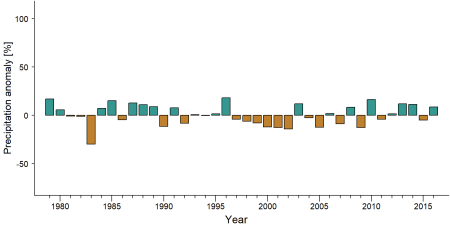
Precipitation anomaly in Goin-Débé Classified Forest -
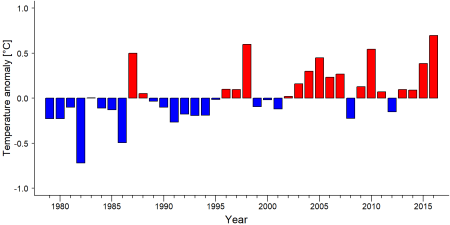
Temperature anomaly in Goin-Débé Classified Forest


External links
References
IDH. (2018). SODEFOR half-way the full census of the Goin-Débé forest reserve. IDH Sustainable Trade Initiative. Retrieved from https://www.idhsustainabletrade.com
Kühl, H. S., Sop, T., Williamson, E. A., Mundry, R., Brugière, D., Campbell, G., …, & Boesch, C. (2017). The Critically Endangered western chimpanzee declines by 80%. American Journal of Primatology, 79(9), e22681. doi:10.1002/ajp.22681
Normand, E. (2007). Protection of two high priority classified forests in Côte d’Ivoire (Cavally and Goin-Débé): Improved management plan and bio-monitoring of logging operations. Unpublished report, Wild Chimpanzee Foundation.
Normand, E. (2010). Rapport de suivi écologique dans les forêts de Goin-Débé et de Cavally (2007–2010). Unpublished report, Wild Chimpanzee Foundation.
UNEP-WCMC, & IUCN. (2019). Protected Planet: The World Database on Protected Areas (WDPA). Cambridge, UK: UNEP-WCMC and IUCN. Retrieved from https://www.protectedplanet.net link
Wild Chimpanzee Foundation (2011). Annual report of the activities undertaken by the Wild Chimpanzee Foundation to improve the protection of wild chimpanzees and their habitat in West Africa: Year 2011. Wild Chimpanzee Foundation.
Wild Chimpanzee Foundation (WCF). (2012). Annual report 2012 – Activities of the Wild Chimpanzee Foundation for improved conservation of chimpanzees and their habitat in West Africa. Wild Chimpanzee Foundation.
Wild Chimpanzee Foundation (WCF). (2016). Annual report 2016 – Activities of the Wild Chimpanzee Foundation for improved conservation of chimpanzees and their habitat in West Africa. Wild Chimpanzee Foundation.
Wild Chimpanzee Foundation (WCF). (2023). Rapport d'observation indépendante externe : cas de recel de cacao en provenance de forêts classées. Online: https://www.wildchimps.org/fileadmin/content_files/pdfs/reports/WCF__RAPPORT_final_OI_11-2023.pdf link
Kiribou, R., Tehoda, P., Chukwu, O., Bempah, G., Kühl, H. S., Ferreira, J., …, & Heinicke, S. (2024). Exposure of African ape sites to climate change impacts. PLOS Climate, 3(2), e0000345. doi:10.1371/journal.pclm.0000345
Page created by: APES Atlas Team & Julia Riedel Date: 2019-11-22
Page updated by: Diorne Zausa Date: 2025-10-10