
Korup National Park: Difference between revisions
No edit summary |
No edit summary Tag: Manual revert |
||
| (3 intermediate revisions by the same user not shown) | |||
| Line 17: | Line 17: | ||
= Site characteristics = | = Site characteristics = | ||
Korup National Park is located in western Cameroon, bordering Cross River National Park in southeast Nigeria (BirdLife International 2021). The site was established as a forest reserve in 1962 and upgraded to a national park in 1986 (Morgan et al. 2011, BirdLife International 2021). Altitudes range from just above sea-level to over 1,000 m but the terrain is generally flat, with hills and escarpments found only in the northern section of the park; the highest peak (Mount Yuhan) is situated in the centre of the park. The forests of Korup are floristically diverse and the annual average rainfall is approximately 5,460 mm (Chuyong et al. 2004). The diversity of birds is relatively well known, with some 320 species recorded in and on the margins of the site, including a large number of species of the Guinea–Congo Forests biome (BirdLife International 2021). Mammals of conservation concern found at the site include mandrills (''Mandrillus leucophaeus''), and forest elephant (''Loxodonta cyclotis''). The occurrence of Preuss's red colobus, ''Piliocolobus preussi'', is of special importance (Morgan et al. 2011, BirdLife International. 2021). | Korup National Park is located in western Cameroon, bordering Cross River National Park in southeast Nigeria ([[#R00909|BirdLife International 2021]]). The site was established as a forest reserve in 1962 and upgraded to a national park in 1986 ([[#R00922|Morgan et al. 2011]], [[#R00909|BirdLife International 2021]]). Altitudes range from just above sea-level to over 1,000 m but the terrain is generally flat, with hills and escarpments found only in the northern section of the park; the highest peak (Mount Yuhan) is situated in the centre of the park. The forests of Korup are floristically diverse and the annual average rainfall is approximately 5,460 mm ([[#R00911|Chuyong et al. 2004]]). The diversity of birds is relatively well known, with some 320 species recorded in and on the margins of the site, including a large number of species of the Guinea–Congo Forests biome ([[#R00909|BirdLife International 2021]]). Mammals of conservation concern found at the site include mandrills (''Mandrillus leucophaeus''), and forest elephant (''Loxodonta cyclotis''). The occurrence of Preuss's red colobus, ''Piliocolobus preussi'', is of special importance ([[#R00922|Morgan et al. 2011]], BirdLife International. 2021). | ||
'''Table 1. Basic site information for Korup National Park''' | '''Table 1. Basic site information for Korup National Park''' | ||
| Line 44: | Line 44: | ||
= Ape status = | = Ape status = | ||
Two surveys were conducted in logged and unlogged sites in the Korup Project Area, which consists of the Korup National Park and the surrounding Support Zone (5,357 sq.km), where two logging concessions had been active between 1996-1998 (Waltert et al. 2002). The results of the survey showed that between 1999-2000 and 2000-2001, chimpanzee (as well as other primate) density decreased in the logged sites (Waltert et al. 2002). | Two surveys were conducted in logged and unlogged sites in the Korup Project Area, which consists of the Korup National Park and the surrounding Support Zone (5,357 sq.km), where two logging concessions had been active between 1996-1998 ([[#R00927|Waltert et al. 2002]]). The results of the survey showed that between 1999-2000 and 2000-2001, chimpanzee (as well as other primate) density decreased in the logged sites ([[#R00927|Waltert et al. 2002]]). | ||
'''Table 2. Ape population estimates reported for Korup National Park''' | '''Table 2. Ape population estimates reported for Korup National Park''' | ||
| Line 70: | Line 70: | ||
|Reconnaissance walk | |Reconnaissance walk | ||
| | | | ||
|Kupsch et al. n.d. | |[[#R00919|Kupsch et al. n.d]]. | ||
|Community-based, survey effort 140.2 hours, July-October; 0.00 nest cluster enc/hour (presence confirmed) | |Community-based, survey effort 140.2 hours, July-October; 0.00 nest cluster enc/hour (presence confirmed) | ||
| | | | ||
| Line 83: | Line 83: | ||
|Reconnaissance walk | |Reconnaissance walk | ||
| | | | ||
|Kupsch et al. 2024 | |[[#R00918|Kupsch et al. 2024]] | ||
|Survey effort 71.5 km; 0.00 nest cluster enc/km (presence confirmed) | |Survey effort 71.5 km; 0.00 nest cluster enc/km (presence confirmed) | ||
| | | | ||
| Line 96: | Line 96: | ||
|Camera trap | |Camera trap | ||
| | | | ||
|Kupsch et al. n.d. | |[[#R00919|Kupsch et al. n.d]]. | ||
|Survey effort 1,809 camera days, July-October; 0.3 camera rec/100d +/- 0.1 (SE) | |Survey effort 1,809 camera days, July-October; 0.3 camera rec/100d +/- 0.1 (SE) | ||
| | | | ||
| Line 109: | Line 109: | ||
|Camera trap | |Camera trap | ||
| | | | ||
|Kupsch et al. 2024 | |[[#R00918|Kupsch et al. 2024]] | ||
|Survey effort 462 camera days; 1.09 camera rec/100d +/- 1.09 (SE) | |Survey effort 462 camera days; 1.09 camera rec/100d +/- 1.09 (SE) | ||
| | | | ||
| Line 122: | Line 122: | ||
|Reconnaissance walk | |Reconnaissance walk | ||
| | | | ||
|Kupsch & Tamo 2023 | |[[#R00916|Kupsch & Tamo 2023]] | ||
|Community-based, survey effort 140.2 hours, July-December; 0.03 nest cluster enc/hour +/- 0.02 (SE) | |Community-based, survey effort 140.2 hours, July-December; 0.03 nest cluster enc/hour +/- 0.02 (SE) | ||
| Line 137: | Line 137: | ||
|Camera trap | |Camera trap | ||
| | | | ||
|Kupsch & Tamo 2023 | |[[#R00916|Kupsch & Tamo 2023]] | ||
|Survey effort 1,463 camera days, July-October; 1.1 camera rec/100d +/- 1 (SE) | |Survey effort 1,463 camera days, July-October; 1.1 camera rec/100d +/- 1 (SE) | ||
| | | | ||
| Line 150: | Line 150: | ||
|Reconnaissance walk | |Reconnaissance walk | ||
| | | | ||
|Kupsch et al. 2024 | |[[#R00918|Kupsch et al. 2024]] | ||
|Survey effort 86.8 km; 0.01 nest cluster enc/km +/- 0.01 (SE) | |Survey effort 86.8 km; 0.01 nest cluster enc/km +/- 0.01 (SE) | ||
| | | | ||
| Line 163: | Line 163: | ||
|Camera trap | |Camera trap | ||
| | | | ||
|Boekee & Robinson 2018 | |[[#R00910|Boekee & Robinson 2018]] | ||
|90 TEAM Network protocol sites | |90 TEAM Network protocol sites | ||
| | | | ||
| Line 176: | Line 176: | ||
|Line transects | |Line transects | ||
| | | | ||
|Hofner et al. 2020 | |[[#R00912|Hofner et al. 2020]] | ||
|Acoustic and visual encounters. | |Acoustic and visual encounters. | ||
| | | | ||
| Line 189: | Line 189: | ||
|Line transects | |Line transects | ||
| | | | ||
|Kupsch 2020, Kupsch & Bobo 2024 | |[[#R00914|Kupsch 2020]], [[#R00915|Kupsch & Bobo 2024]] | ||
|Survey effort 176 km; 0.085 nest cluster enc/km +/- 0.026 (SE) | |Survey effort 176 km; 0.085 nest cluster enc/km +/- 0.026 (SE) | ||
| | | | ||
| Line 202: | Line 202: | ||
|Line transects | |Line transects | ||
| | | | ||
|Kupsch 2020, Kupsch & Bobo 2024 | |[[#R00914|Kupsch 2020]], [[#R00915|Kupsch & Bobo 2024]] | ||
|Survey effort 154.7 km; 0.121 nest cluster enc/km +/- 0.04 (SE) | |Survey effort 154.7 km; 0.121 nest cluster enc/km +/- 0.04 (SE) | ||
| | | | ||
| Line 215: | Line 215: | ||
|Line transects | |Line transects | ||
| | | | ||
|Waltert et al. 2002 | |[[#R00927|Waltert et al. 2002]] | ||
|Survey effort 86 km. 0.16 groups/km² (0.02–1.21). 0.08 group sightings/km (95% CI 0.01–0.63) | |Survey effort 86 km. 0.16 groups/km² (0.02–1.21). 0.08 group sightings/km (95% CI 0.01–0.63) | ||
| | | | ||
| Line 228: | Line 228: | ||
|Line transects | |Line transects | ||
| | | | ||
|Usongo 1997 | |[[#R00926|Usongo 1997]] | ||
|Survey effort 72.5 km; 0.14 nest cluster enc/km | |Survey effort 72.5 km; 0.14 nest cluster enc/km | ||
| | | | ||
| Line 237: | Line 237: | ||
= Threats = | = Threats = | ||
Hunting is a major threat to chimpanzees and other mammals in Korup National Park (Morgan et al. 2011, Hofner et al. 2020). Pressure on the park's wildlife is high due to the dependence of locals on bushmeat, and the demand for bushmeat in neighbouring Nigeria (Robinson 2014). Since 2017, the wildlife and habitats of Korup National Park have been affected by a civil war as rebel groups in the forests have prevented access for government personnel, such as ecoguards, allowing local people and Nigerians to remove resources unhindered (Kupsch & Tamo 2023, Kupsch et al. 2024). | Hunting is a major threat to chimpanzees and other mammals in Korup National Park ([[#R00922|Morgan et al. 2011]], [[#R00912|Hofner et al. 2020]]). Pressure on the park's wildlife is high due to the dependence of locals on bushmeat, and the demand for bushmeat in neighbouring Nigeria ([[#R00924|Robinson 2014]]). Since 2017, the wildlife and habitats of Korup National Park have been affected by a civil war as rebel groups in the forests have prevented access for government personnel, such as ecoguards, allowing local people and Nigerians to remove resources unhindered ([[#R00916|Kupsch & Tamo 2023]], [[#R00918|Kupsch et al. 2024]]). | ||
'''Table 3. Threats to apes reported for Korup National Park''' | '''Table 3. Threats to apes reported for Korup National Park''' | ||
| Line 250: | Line 250: | ||
|1.1 Residential areas | |1.1 Residential areas | ||
|Present (unknown severity) | |Present (unknown severity) | ||
|There are settlements inside the park which are officially illegal and linked to farms in the site (MINEF 2002). Two out of five communities were granted the legal status of a permanent use zone with management regulations in 2015 (Spey et al. 2019). | |There are settlements inside the park which are officially illegal and linked to farms in the site ([[#R00921|MINEF 2002]]). Two out of five communities were granted the legal status of a permanent use zone with management regulations in 2015 ([[#R00925|Spey et al. 2019]]). | ||
|1986-Ongoing (2024) | |1986-Ongoing (2024) | ||
|- | |- | ||
| Line 256: | Line 256: | ||
|2.1 Annual & perennial non-timber crops | |2.1 Annual & perennial non-timber crops | ||
|Present (unknown severity) | |Present (unknown severity) | ||
|Agricultural encroachment from industrial plantations and villages situated inside the park (BirdLife International 2021). | |Agricultural encroachment from industrial plantations and villages situated inside the park ([[#R00909|BirdLife International 2021]]). | ||
|Ongoing (2021) | |Ongoing (2021) | ||
|- | |- | ||
| Line 262: | Line 262: | ||
|4.1 Roads & railroads | |4.1 Roads & railroads | ||
|Present (unknown severity) | |Present (unknown severity) | ||
|Motorbike road construction by the ministry to two settlements in the southwest and north of the park (Spey et al. 2019). | |Motorbike road construction by the ministry to two settlements in the southwest and north of the park ([[#R00925|Spey et al. 2019]]). | ||
|Ongoing (2019) | |Ongoing (2019) | ||
|- | |- | ||
| Line 268: | Line 268: | ||
|5.1 Hunting & collecting terrestrial animals | |5.1 Hunting & collecting terrestrial animals | ||
|High (more than 70% of population affected) | |High (more than 70% of population affected) | ||
|Illegal wildlife hunting for bushmeat is a serious threat (Morgan et al. 2011, Hofner et al. 2020). 39,053 annually estimated animals extracted by gun-hunting (Astaras et al. 2017); hunting sign rate in southern sector 0.75 enc/h ± 0.16 (SE) in 2014 and 0.77 enc/h ± 0.21 (SE) in 2022 (Kupsch & Tamo 2023); 33.2% of household income in the Korup villages in 2014/15 was generated from hunting (Kupsch et al. 2023). | |Illegal wildlife hunting for bushmeat is a serious threat ([[#R00922|Morgan et al. 2011]], [[#R00912|Hofner et al. 2020]]). 39,053 annually estimated animals extracted by gun-hunting ([[#R00908|Astaras et al. 2017]]); hunting sign rate in southern sector 0.75 enc/h ± 0.16 (SE) in 2014 and 0.77 enc/h ± 0.21 (SE) in 2022 ([[#R00916|Kupsch & Tamo 2023]]); 33.2% of household income in the Korup villages in 2014/15 was generated from hunting ([[#R00917|Kupsch et al. 2023]]). | ||
|1986-Ongoing (2024) | |1986-Ongoing (2024) | ||
|- | |- | ||
| Line 274: | Line 274: | ||
|5.3 Logging & wood harvesting | |5.3 Logging & wood harvesting | ||
|Medium (30-70% of population affected) | |Medium (30-70% of population affected) | ||
|Illegal logging with clearings in the extreme south of the park (Kupsch et al. 2024). | |Illegal logging with clearings in the extreme south of the park ([[#R00918|Kupsch et al. 2024]]). | ||
|2018-Ongoing (2024) | |2018-Ongoing (2024) | ||
|- | |- | ||
| Line 280: | Line 280: | ||
|6.2 War, civil unrest & military exercises | |6.2 War, civil unrest & military exercises | ||
|Present (unknown severity) | |Present (unknown severity) | ||
|Military-political crisis in the entire region with ranging rebel groups in and around Korup National Park (Kupsch & Tamo 2023). | |Military-political crisis in the entire region with ranging rebel groups in and around Korup National Park ([[#R00916|Kupsch & Tamo 2023]]). | ||
|2017-Ongoing (2024) | |2017-Ongoing (2024) | ||
|} | |} | ||
| Line 288: | Line 288: | ||
= Conservation activities = | = Conservation activities = | ||
Korup National Park is under the administration of the Cameroonian Ministry of Forestry and Wildlife (MINFOF), which is supported by the PSMNR-SWR development program and follows a collaborative management approach (PSMNR-SWR n.d.). In addition to support for infrastructure, households, education and training, this also includes protection activities such as demarcation and patrolling, as well as bio-monitoring (Kupsch & Tamo 2023). In addition to communities and their members, community-based organizations are also involved in management. Some of them also carry out independent projects, such as the Korup Rainforest Conservation Society (KRCS), which is a community based organisation in Southwest Cameroon that was created in 2009. KRCS supports and implements various conservation activities, especially related to wildlife research and livelihood improvement initiatives such as donating farming equipment and community infrastructural development (KRCS). | Korup National Park is under the administration of the Cameroonian Ministry of Forestry and Wildlife (MINFOF), which is supported by the PSMNR-SWR development program and follows a collaborative management approach ([[#R00923|PSMNR-SWR n.d.]]). In addition to support for infrastructure, households, education and training, this also includes protection activities such as demarcation and patrolling, as well as bio-monitoring ([[#R00916|Kupsch & Tamo 2023]]). In addition to communities and their members, community-based organizations are also involved in management. Some of them also carry out independent projects, such as the Korup Rainforest Conservation Society (KRCS), which is a community based organisation in Southwest Cameroon that was created in 2009. KRCS supports and implements various conservation activities, especially related to wildlife research and livelihood improvement initiatives such as donating farming equipment and community infrastructural development (KRCS). | ||
'''Table 4. Conservation activities reported for Korup National Park''' | '''Table 4. Conservation activities reported for Korup National Park''' | ||
| Line 300: | Line 300: | ||
|1 Development impact mitigation | |1 Development impact mitigation | ||
|1.10 Reduce road widths | |1.10 Reduce road widths | ||
|New roads inside the park are limited in size to only allow moto-bikes to pass (Spey et al. 2019). | |New roads inside the park are limited in size to only allow moto-bikes to pass ([[#R00925|Spey et al. 2019]]). | ||
| | | | ||
|2014-2015 | |2014-2015 | ||
| Line 306: | Line 306: | ||
|2 Counter-wildlife crime | |2 Counter-wildlife crime | ||
|2.1 Implement road blocks to inspect cars for illegal ape bushmeat | |2.1 Implement road blocks to inspect cars for illegal ape bushmeat | ||
|Officially always, but actually during the height of the military-political crisis, to search for bushmeat hunted with guns and identify the owners (Kupsch & Tamo 2023) | |Officially always, but actually during the height of the military-political crisis, to search for bushmeat hunted with guns and identify the owners ([[#R00916|Kupsch & Tamo 2023]]) | ||
| | | | ||
|2018-2022 | |2018-2022 | ||
| Line 312: | Line 312: | ||
|2 Counter-wildlife crime | |2 Counter-wildlife crime | ||
|2.11 Implement monitoring surveillance strategies (e.g., SMART) or use monitoring data to improve effectiveness of patrols | |2.11 Implement monitoring surveillance strategies (e.g., SMART) or use monitoring data to improve effectiveness of patrols | ||
|GPS, GIS and bio-monitoring training for community members (Kupsch & Tamo 2023), park staff (PSMNR-SWR n.d., Kupsch & Tamo 2023) and KRCS members (KRCS n.d.). | |GPS, GIS and bio-monitoring training for community members ([[#R00916|Kupsch & Tamo 2023]]), park staff ([[#R00923|PSMNR-SWR n.d.]], [[#R00916|Kupsch & Tamo 2023]]) and KRCS members ([[#R00913|KRCS n.d]].). | ||
| | | | ||
|2006-2018 | |2006-2018 | ||
| Line 324: | Line 324: | ||
|2 Counter-wildlife crime | |2 Counter-wildlife crime | ||
|2.14 Employ hunters in the conservation sector to reduce their impact | |2.14 Employ hunters in the conservation sector to reduce their impact | ||
|Hunters work as research assistants (KRCS n.d.) and as surveyors in community-based wildlife monitoring (Kupsch & Tamo 2023). | |Hunters work as research assistants ([[#R00913|KRCS n.d]].) and as surveyors in community-based wildlife monitoring ([[#R00916|Kupsch & Tamo 2023]]). | ||
| | | | ||
|2009-2023 | |2009-2023 | ||
| Line 330: | Line 330: | ||
|2 Counter-wildlife crime | |2 Counter-wildlife crime | ||
|2.3 Conduct regular anti-poaching patrols | |2.3 Conduct regular anti-poaching patrols | ||
|Anti-poaching patrols evaluation and design (PSMNR-SWR n.d., KRCS n.d.). | |Anti-poaching patrols evaluation and design ([[#R00923|PSMNR-SWR n.d.]], [[#R00913|KRCS n.d]].). | ||
| | | | ||
|1986-2018 | |1986-2018 | ||
| Line 336: | Line 336: | ||
|2 Counter-wildlife crime | |2 Counter-wildlife crime | ||
|2.6 Regularly de-activate/remove ground snares | |2.6 Regularly de-activate/remove ground snares | ||
|Joint activities of community members and park-staff (PSMNR-SWR n.d.) | |Joint activities of community members and park-staff ([[#R00923|PSMNR-SWR n.d]].) | ||
| | | | ||
|2022-2023 | |2022-2023 | ||
| Line 342: | Line 342: | ||
|4 Education & awareness | |4 Education & awareness | ||
|4.1 Educate local communities about apes and sustainable use | |4.1 Educate local communities about apes and sustainable use | ||
|Video shows on conservation, nature excursions for kids, school scholarships with environmental mentoring (KRCS n.d.). | |Video shows on conservation, nature excursions for kids, school scholarships with environmental mentoring ([[#R00913|KRCS n.d]].). | ||
| | | | ||
|2009-Ongoing (2024) | |2009-Ongoing (2024) | ||
| Line 348: | Line 348: | ||
|4 Education & awareness | |4 Education & awareness | ||
|4.2 Involve local community in ape research and conservation management | |4.2 Involve local community in ape research and conservation management | ||
|Involvement in primate research, biomonitoring, and training in conservation project management (KRCS n.d.). | |Involvement in primate research, biomonitoring, and training in conservation project management ([[#R00913|KRCS n.d]].). | ||
| | | | ||
|2009-Ongoing (2024) | |2009-Ongoing (2024) | ||
| Line 360: | Line 360: | ||
|5 Protection & restoration | |5 Protection & restoration | ||
|5.5 Demarcate and enforce boundaries of protected areas | |5.5 Demarcate and enforce boundaries of protected areas | ||
|Boundary demarcation activities of park staff and communities (PSMNR-SWR n.d.) | |Boundary demarcation activities of park staff and communities ([[#R00923|PSMNR-SWR n.d]].) | ||
| | | | ||
|2006-2023 | |2006-2023 | ||
| Line 366: | Line 366: | ||
|5 Protection & restoration | |5 Protection & restoration | ||
|5.9 Resettle illegal human communities (i.e., in a protected area) to another location | |5.9 Resettle illegal human communities (i.e., in a protected area) to another location | ||
|Resettlement of the Korup village Ekundukundu I from inside the park to Fabe road (MINEF 2002). | |Resettlement of the Korup village Ekundukundu I from inside the park to Fabe road ([[#R00921|MINEF 2002]]). | ||
| | | | ||
|2000 | |2000 | ||
| Line 372: | Line 372: | ||
|7 Economic & other incentives | |7 Economic & other incentives | ||
|7.2 Provide non-monetary benefits to local communities for sustainably managing their forest and its wildlife (e.g., better education, infrastructure development) | |7.2 Provide non-monetary benefits to local communities for sustainably managing their forest and its wildlife (e.g., better education, infrastructure development) | ||
|Farming equipment, scholarships, community infrastructure development, green initiatives e.g. bee farming, small scale poultry and non-timber products value chain improvement (PSMNR-SWR n.d., KRCS n.d.). | |Farming equipment, scholarships, community infrastructure development, green initiatives e.g. bee farming, small scale poultry and non-timber products value chain improvement ([[#R00923|PSMNR-SWR n.d.]], [[#R00913|KRCS n.d]].). | ||
| | | | ||
|2006-Ongoing (2024) | |2006-Ongoing (2024) | ||
| Line 381: | Line 381: | ||
= Challenges = | = Challenges = | ||
Conflicts between park staff and local communities due to inadequate flow of information (Robinson 2014). Since 2017, there has been a military-political crisis with a very poor security situation in the Anglophone regions of Cameroon, which has made law enforcement impossible, particularly in Korup National Park. Eco-guards and researchers cannot enter the national park and most of the villages within and adjacent to it (Kupsch & Tamo 2023). | Conflicts between park staff and local communities due to inadequate flow of information ([[#R00924|Robinson 2014]]). Since 2017, there has been a military-political crisis with a very poor security situation in the Anglophone regions of Cameroon, which has made law enforcement impossible, particularly in Korup National Park. Eco-guards and researchers cannot enter the national park and most of the villages within and adjacent to it ([[#R00916|Kupsch & Tamo 2023]]). | ||
'''Table 5. Challenges reported for Korup National Park''' | '''Table 5. Challenges reported for Korup National Park''' | ||
| Line 392: | Line 392: | ||
|3 Engaged community | |3 Engaged community | ||
|3.1 General lack of community engagement or support | |3.1 General lack of community engagement or support | ||
|Robinson 2014 | |[[#R00924|Robinson 2014]] | ||
|Ongoing (2014) | |Ongoing (2014) | ||
|- | |- | ||
|4 Institutional support | |4 Institutional support | ||
|4.1 Lack of law enforcement | |4.1 Lack of law enforcement | ||
|Kupsch & Tamo 2023 | |[[#R00916|Kupsch & Tamo 2023]] | ||
|Ongoing (2024) | |Ongoing (2024) | ||
|- | |- | ||
|6 Safety and stability | |6 Safety and stability | ||
|6.2 Insecurity | |6.2 Insecurity | ||
|Kupsch & Tamo 2023 | |[[#R00916|Kupsch & Tamo 2023]] | ||
|Ongoing (2024) | |Ongoing (2024) | ||
|- | |- | ||
|6 Safety and stability | |6 Safety and stability | ||
|6.3 Civil unrest/war | |6.3 Civil unrest/war | ||
|Kupsch & Tamo 2023 | |[[#R00916|Kupsch & Tamo 2023]] | ||
|Ongoing (2024) | |Ongoing (2024) | ||
|} | |} | ||
| Line 459: | Line 459: | ||
= Research activities = | = Research activities = | ||
Due to the proximity to the Korup National Park headquarters in Mundemba and the establishment of good research and tourism infrastructure, e.g. chimpanzee camp, the wildlife populations of the southern part of the park are the best studied (e.g. Astaras et al. 2017, Boekee & Robinson 2018, Kupsch & Tamo 2023). There is also good access via Mamfe in the northeast of the park, making it a local focus for wildlife research. (Waltert et al. 2002, Hofner 2020). The remaining parts of the park were surveyed in 2007 and 2014 by a park-wide, transect-based wildlife monitoring program (see Kupsch & Bobo 2024), funded by the development program PSMNR-SWR (PSMNR-SWR n.d.). The community-based organization KRCS supports international researchers and the national park administration in the implementation of conservation research activities, which mainly focus on biomonitoring, socio-economic surveys, and primate research, and also carries out own projects (KRCS n.d.). | Due to the proximity to the Korup National Park headquarters in Mundemba and the establishment of good research and tourism infrastructure, e.g. chimpanzee camp, the wildlife populations of the southern part of the park are the best studied (e.g. [[#R00908|Astaras et al. 2017]], [[#R00910|Boekee & Robinson 2018]], [[#R00916|Kupsch & Tamo 2023]]). There is also good access via Mamfe in the northeast of the park, making it a local focus for wildlife research. ([[#R00927|Waltert et al. 2002]], [[#R00912|Hofner 2020]]). The remaining parts of the park were surveyed in 2007 and 2014 by a park-wide, transect-based wildlife monitoring program (see [[#R00915|Kupsch & Bobo 2024]]), funded by the development program PSMNR-SWR ([[#R00923|PSMNR-SWR n.d.]]). The community-based organization KRCS supports international researchers and the national park administration in the implementation of conservation research activities, which mainly focus on biomonitoring, socio-economic surveys, and primate research, and also carries out own projects ([[#R00913|KRCS n.d]].). | ||
However, due to the ongoing military-political crisis and the high level of insecurity in the Anglophone regions, all research activities in the park were suspended in 2017. In 2022 and 2023, PSMNR-SWR successfully introduced low-risk community-based wildlife monitoring by training community members as surveyors under the guidance of the local organization KRCS (Kupsch & Tamo 2023). In 2023, PSMNR-SWR conducted its first own surveys in the south of the park in collaboration with KRCS (Kupsch et al. 2024). However, due to the worsening crisis situation since the end of 2023, all monitoring activities have been put on hold for the time being. | However, due to the ongoing military-political crisis and the high level of insecurity in the Anglophone regions, all research activities in the park were suspended in 2017. In 2022 and 2023, PSMNR-SWR successfully introduced low-risk community-based wildlife monitoring by training community members as surveyors under the guidance of the local organization KRCS ([[#R00916|Kupsch & Tamo 2023]]). In 2023, PSMNR-SWR conducted its first own surveys in the south of the park in collaboration with KRCS ([[#R00918|Kupsch et al. 2024]]). However, due to the worsening crisis situation since the end of 2023, all monitoring activities have been put on hold for the time being. | ||
| Line 495: | Line 495: | ||
= Exposure to climate change impacts = | = Exposure to climate change impacts = | ||
As part of a study on the exposure of African great ape sites to climate change impacts, Kiribou et al. (2024) extracted climate data and data on projected extreme climate impact events for the site. Climatological characteristics were derived from observation-based climate data provided by the Inter-Sectoral Impact Model Intercomparison Project (ISIMIP, www.isimip.org). Parameters were calculated as the average across each 30-year period. For 1981-2010, the EWEMBI dataset from ISIMIP2a was used. For the two future periods (2021-2050 and 2071-2099) ISIMIP2b climate data based on four CMIP5 global climate models were used. For future projections, two Representative Concentration Pathways (RCP) were used. RCP 2.6 is a scenario with strong mitigation measures in which global temperatures would likely rise below 2C. RCP 6.0 is a scenario with medium emissions in which global temperatures would likely rise up to 3C by 2100. For the number of days with heavy precipitation events, the 98th percentile of all precipitation days (>1mm/d) was calculated for the 1979-2013 reference period as a threshold for a heavy precipitation event. Then, for each year, the number of days above that threshold was derived. The figures on temperature and precipitation anomaly show the deviation from the mean temperature and mean precipitation for the 1979-2013 reference period. | As part of a study on the exposure of African great ape sites to climate change impacts, [[#R02231|Kiribou et al. (2024)]] extracted climate data and data on projected extreme climate impact events for the site. Climatological characteristics were derived from observation-based climate data provided by the Inter-Sectoral Impact Model Intercomparison Project (ISIMIP, www.isimip.org). Parameters were calculated as the average across each 30-year period. For 1981-2010, the EWEMBI dataset from ISIMIP2a was used. For the two future periods (2021-2050 and 2071-2099) ISIMIP2b climate data based on four CMIP5 global climate models were used. For future projections, two Representative Concentration Pathways (RCP) were used. RCP 2.6 is a scenario with strong mitigation measures in which global temperatures would likely rise below 2C. RCP 6.0 is a scenario with medium emissions in which global temperatures would likely rise up to 3C by 2100. For the number of days with heavy precipitation events, the 98th percentile of all precipitation days (>1mm/d) was calculated for the 1979-2013 reference period as a threshold for a heavy precipitation event. Then, for each year, the number of days above that threshold was derived. The figures on temperature and precipitation anomaly show the deviation from the mean temperature and mean precipitation for the 1979-2013 reference period. | ||
The estimated exposure to future extreme climate impact events (crop failure, drought, river flood, wildfire, tropical cyclone, and heatwave) is based on a published dataset by Lange et al. 2020 derived from ISIMIP2b data. The same global climate models and RCPs as described above were used. Within each 30-year period, the number of years with an extreme event and the average proportion of the site affected were calculated (Kiribou et al. 2024). | The estimated exposure to future extreme climate impact events (crop failure, drought, river flood, wildfire, tropical cyclone, and heatwave) is based on a published dataset by Lange et al. 2020 derived from ISIMIP2b data. The same global climate models and RCPs as described above were used. Within each 30-year period, the number of years with an extreme event and the average proportion of the site affected were calculated ([[#R02231|Kiribou et al. 2024]]). | ||
'''Table 8. Estimated past and projected climatological characteristics in Korup National Park''' | '''Table 8. Estimated past and projected climatological characteristics in Korup National Park''' | ||
| Line 622: | Line 622: | ||
= References = | = References = | ||
Astaras, C., Linder, J. M., Wrege, P., | <span id="R00908"></span>Astaras, C., Linder, J. M., Wrege, P., Orume, R. D., & Macdonald, D. W. (2017). Passive acoustic monitoring as a law enforcement tool for Afrotropical rainforests. ''Frontiers in Ecology and the Environment'', 15(5), 233-234. [https://doi.org/10.1002/fee.1495 doi:10.1002/fee.1495] | ||
BirdLife International. (2021). Important Bird Areas factsheet: Korup National Park. Downloaded from http://www.birdlife.org on 24/10/2021. | <span id="R00909"></span>BirdLife International. (2021). Important Bird Areas factsheet: Korup National Park. Downloaded from http://www.birdlife.org on 24/10/2021. | ||
Boekee, K., & Robinson, D. O. (2018). Camera Trap Monitoring Report Korup National Park 2011–2018. Project report. PSMNR-SWR, Buea, Cameroon. 126p. | <span id="R00910"></span>Boekee, K., & Robinson, D. O. (2018). Camera Trap Monitoring Report Korup National Park 2011–2018. Project report. PSMNR-SWR, Buea, Cameroon. 126p. | ||
Chuyong, G. B., Condit, R., Kenfack, D., Losos, E. C., Moses, S. N., Songwe, N. C., & Thomas, D. W. (2004). Korup forest dynamics plot, Cameroon. In E. C. Losos & E. G. Leigh Jr. (Eds.), Tropical Forest Diversity and Dynamism: Findings From a Large-Scale Plot Network (pp. 506–516). University of Chicago Press, Illinois. | <span id="R00911"></span>Chuyong, G. B., Condit, R., Kenfack, D., Losos, E. C., Moses, S. N., Songwe, N. C., & Thomas, D. W. (2004). Korup forest dynamics plot, Cameroon. In E. C. Losos & E. G. Leigh Jr. (Eds.), Tropical Forest Diversity and Dynamism: Findings From a Large-Scale Plot Network (pp. 506–516). University of Chicago Press, Illinois. | ||
Hofner, A. N., Jost Robinson, C. A., Hall, E. S., Capel, T., Astaras, C., & Linder, J. M. (2020). Surveying primates in northeastern Korup National Park, Cameroon: A longitudinal comparison. African Primates, 14, 35–44. | <span id="R00912"></span>Hofner, A. N., Jost Robinson, C. A., Hall, E. S., Capel, T., Astaras, C., & Linder, J. M. (2020). Surveying primates in northeastern Korup National Park, Cameroon: A longitudinal comparison. African Primates, 14, 35–44. [http://static1.1.sqspcdn.com/static/f/1200343/28385232/1608487218667/AP+Vol+14+-+Hofner+et+al.pdf?token=yIMlYLBQ8hB3tQqMjV7t9Ua8caY%3D link] | ||
KRCS. (n.d.). Activities. https://www.korup-conservation.org/activities/ | <span id="R00913"></span>KRCS. (n.d.). Activities. https://www.korup-conservation.org/activities/ [https://web.archive.org/web/20250324004932/https://www.korup-conservation.org/activities/ link] | ||
Kupsch, D. (2020). Ecological and socio-economic effects of industrial oil palm plantations in Southwest Cameroon (PhD thesis). University of Göttingen, Germany. 199p. http://hdl.handle.net/21.11130/00-1735-0000-0005-139A-8 | <span id="R00914"></span>Kupsch, D. (2020). Ecological and socio-economic effects of industrial oil palm plantations in Southwest Cameroon (PhD thesis). University of Göttingen, Germany. 199p. http://hdl.handle.net/21.11130/00-1735-0000-0005-139A-8 [https://doi.org/10.53846/goediss-7974 doi:10.53846/goediss-7974] | ||
Kupsch, D., & Bobo, K. S. (2024). Distribution parameters of large mammals and conservation management in an Afrotropical forest landscape and biodiversity hotspot. African Journal of Ecology, 62 | <span id="R00915"></span>Kupsch, D., & Bobo, K. S. (2024). Distribution parameters of large mammals and conservation management in an Afrotropical forest landscape and biodiversity hotspot. ''African Journal of Ecology'', 62(2). [https://doi.org/10.1111/aje.13254 doi:10.1111/aje.13254] | ||
Kupsch, D., & Tamo, A. (2023). Community-based wildlife monitoring pilot phase 2022 in Mount Cameroon National Park and Korup National Park. Project report. PSMNR-SWR, Buea. 60p. | <span id="R00916"></span>Kupsch, D., & Tamo, A. (2023). Community-based wildlife monitoring pilot phase 2022 in Mount Cameroon National Park and Korup National Park. Project report. PSMNR-SWR, Buea. 60p. | ||
Kupsch, D., Knobloch, L., Bobo, K. S., Motombi, F. N., & Waltert, M. (2023). Rural livelihoods and biodiversity in Afrotropical agroforestry systems and oil palm plantations. In C. F. Dormann, P. Batáry, I. Grass, A.-M. Klein, J. Loos, C. Scherber, S. Steffan-Dewenter, & T. C. Wanger (Eds.), Defining Agroecology – A Festschrift for Teja Tscharntke (pp. 223–240). Tredition, Hamburg, Germany. https://doi.org/10.5281/zenodo.10019829 | <span id="R00917"></span>Kupsch, D., Knobloch, L., Bobo, K. S., Motombi, F. N., & Waltert, M. (2023). Rural livelihoods and biodiversity in Afrotropical agroforestry systems and oil palm plantations. In C. F. Dormann, P. Batáry, I. Grass, A.-M. Klein, J. Loos, C. Scherber, S. Steffan-Dewenter, & T. C. Wanger (Eds.), Defining Agroecology – A Festschrift for Teja Tscharntke (pp. 223–240). Tredition, Hamburg, Germany. https://doi.org/10.5281/zenodo.10019829 | ||
Kupsch, D., Namolongo, E., & Sumbede, A. (2024a). Status of large mammals and human activities in the Extreme South hotspot of Korup National Park. PSMNR-SWR bio-monitoring report. Buea, Cameroon. 29p. | <span id="R00918"></span>Kupsch, D., Namolongo, E., & Sumbede, A. (2024a). Status of large mammals and human activities in the Extreme South hotspot of Korup National Park. PSMNR-SWR bio-monitoring report. Buea, Cameroon. 29p. | ||
Kupsch, D., Namolongo, E., & Sumbede, A. (in preparation). Community-based wildlife monitoring outcomes in 2023 in the Extreme South hotspot in Korup National Park. PSMNR-SWR bio-monitoring report. Buea, Cameroon. | <span id="R00919"></span>Kupsch, D., Namolongo, E., & Sumbede, A. (in preparation). Community-based wildlife monitoring outcomes in 2023 in the Extreme South hotspot in Korup National Park. PSMNR-SWR bio-monitoring report. Buea, Cameroon. | ||
Kupsch, D., Serge, B. K., Waltert, M., Chia, N. B., Brice, B. C. G., Abdoulaye, D., & Kalagan, D. (2014). Biodiversity, carbon stock and market value assessment for the SGSOC project area, Southwest region, Cameroon. World Wide Fund for Nature, Germany, and Greenpeace International. | <span id="R00920"></span>Kupsch, D., Serge, B. K., Waltert, M., Chia, N. B., Brice, B. C. G., Abdoulaye, D., & Kalagan, D. (2014). Biodiversity, carbon stock and market value assessment for the SGSOC project area, Southwest region, Cameroon. World Wide Fund for Nature, Germany, and Greenpeace International. | ||
MINEF. (2002). A management plan for Korup National Park and its peripheral zone 2002–2007. Ministry of the Environment and Forestry. Mundemba, Cameroon. 190p. | <span id="R00921"></span>MINEF. (2002). A management plan for Korup National Park and its peripheral zone 2002–2007. Ministry of the Environment and Forestry. Mundemba, Cameroon. 190p. | ||
Morgan, B | <span id="R00922"></span>Morgan, B., Adeleke, A., Bassey, T., Bergl, R., Dunn, A., Fotso, R., …, & Williamson, E. (2011). Regional Action Plan for the Conservation of the Nigeria-Cameroon chimpanzee (Pan troglodytes ellioti). IUCN/SSC Primate Specialist Group and Zoological Society of San Diego. [https://portals.iucn.org/library/sites/library/files/documents/2011-123-Fr.pdf link] | ||
PSMNR-SWR. (n.d.). About PSMNR-SWR. https://psmnrswr.org/about-psmnr-swr/ | <span id="R00923"></span>PSMNR-SWR. (n.d.). About PSMNR-SWR. https://psmnrswr.org/about-psmnr-swr/ | ||
Robinson, D. O. (2014). Action for primate conservation in Korup National Park, Cameroon. https://www.conservationleadershipprogramme.org/project/primate-conservation-korup-national-park-cameroon/ | <span id="R00924"></span>Robinson, D. O. (2014). Action for primate conservation in Korup National Park, Cameroon. https://www.conservationleadershipprogramme.org/project/primate-conservation-korup-national-park-cameroon/ | ||
Spey, I | <span id="R00925"></span>Spey, I., Kupsch, D., Bobo, K. S., Waltert, M., & Schwarze, S. (2019). The Effects of Road Access on Income Generation. Evidence from An Integrated Conservation and Development Project in Cameroon. ''Sustainability'', 11(12), 3368. [https://doi.org/10.3390/su11123368 doi:10.3390/su11123368] | ||
Usongo, L. (1997). Zoological inventory of Korup National Park, Cameroon. Report submitted to the Korup Project. Mundemba, Cameroon. 63p. | <span id="R00926"></span>Usongo, L. (1997). Zoological inventory of Korup National Park, Cameroon. Report submitted to the Korup Project. Mundemba, Cameroon. 63p. | ||
Waltert, M., Faber, K., & Mühlenberg, M. (2002). Further declines of threatened primates in the Korup Project Area, south-west Cameroon. Oryx, 36(3), | <span id="R00927"></span>Waltert, M., Lien, Faber, K., & Mühlenberg, M. (2002). Further declines of threatened primates in the Korup Project Area, south-west Cameroon. ''Oryx'', 36(3), 257-265. [https://doi.org/10.1017/s0030605302000479 doi:10.1017/s0030605302000479] | ||
<span id="R02231"></span>Kiribou, R., Tehoda, P., Chukwu, O., Bempah, G., Kühl, H. S., Ferreira, J., …, & Heinicke, S. (2024). Exposure of African ape sites to climate change impacts. ''PLOS Climate'', 3(2), e0000345. [https://doi.org/10.1371/journal.pclm.0000345 doi:10.1371/journal.pclm.0000345] | |||
Latest revision as of 17:53, 15 October 2026
Central Africa > Cameroon > Korup National Park
Français | Português | Español | Bahasa Indonesia | Melayu
Summary
- Nigeria-Cameroon chimpanzees (Pan troglodytes ellioti) are present in Korup National Park.
- It has been estimated that 69 (CI: 36-132) individuals occurred in the site in 2014.
- The chimpanzee population trend is decreasing.
- The site has a total size of 1,260 km².
- Hunting is the main threat to chimpanzees.
- Conservation activities have focused on wildlife research and livelihood improvement initiatives.
Site characteristics
Korup National Park is located in western Cameroon, bordering Cross River National Park in southeast Nigeria (BirdLife International 2021). The site was established as a forest reserve in 1962 and upgraded to a national park in 1986 (Morgan et al. 2011, BirdLife International 2021). Altitudes range from just above sea-level to over 1,000 m but the terrain is generally flat, with hills and escarpments found only in the northern section of the park; the highest peak (Mount Yuhan) is situated in the centre of the park. The forests of Korup are floristically diverse and the annual average rainfall is approximately 5,460 mm (Chuyong et al. 2004). The diversity of birds is relatively well known, with some 320 species recorded in and on the margins of the site, including a large number of species of the Guinea–Congo Forests biome (BirdLife International 2021). Mammals of conservation concern found at the site include mandrills (Mandrillus leucophaeus), and forest elephant (Loxodonta cyclotis). The occurrence of Preuss's red colobus, Piliocolobus preussi, is of special importance (Morgan et al. 2011, BirdLife International. 2021).
Table 1. Basic site information for Korup National Park
| Species | Pan troglodytes ellioti |
| Area | 1,260 km² |
| Coordinates | Lat: 5.354790 , Lon: 8.977458 |
| Type of site | Protected area (National Park) |
| Habitat types | Subtropical/tropical moist lowland forest |
| Type of governance |
Types of sites Governance types Habitat types
Ape status
Two surveys were conducted in logged and unlogged sites in the Korup Project Area, which consists of the Korup National Park and the surrounding Support Zone (5,357 sq.km), where two logging concessions had been active between 1996-1998 (Waltert et al. 2002). The results of the survey showed that between 1999-2000 and 2000-2001, chimpanzee (as well as other primate) density decreased in the logged sites (Waltert et al. 2002).
Table 2. Ape population estimates reported for Korup National Park
| Species | Year | Occurrence | Encounter or vistation rate (nests/km; ind/day) | Density estimate [ind./ km²] (95% CI) | Abundance estimate (95% CI) | Survey area | Sampling method | Analytical framework | Source | Comments | A.P.E.S. database ID |
|---|---|---|---|---|---|---|---|---|---|---|---|
| Pan troglodytes ellioti | 2023 | Present | Korup National Park (southern section 170 km², Mt. Yuhan, Cross-mountain, Mana) | Reconnaissance walk | Kupsch et al. n.d. | Community-based, survey effort 140.2 hours, July-October; 0.00 nest cluster enc/hour (presence confirmed) | |||||
| Pan troglodytes ellioti | 2023 | Present | Korup National Park (extreme south, 24 km²) | Reconnaissance walk | Kupsch et al. 2024 | Survey effort 71.5 km; 0.00 nest cluster enc/km (presence confirmed) | |||||
| Pan troglodytes ellioti | 2023 | Present | Korup National Park (southern section 170 km², Mt. Yuhan, Cross-mountain, Mana) | Camera trap | Kupsch et al. n.d. | Survey effort 1,809 camera days, July-October; 0.3 camera rec/100d +/- 0.1 (SE) | |||||
| Pan troglodytes ellioti | 2023 | Present | Korup National Park (extreme south, 21 km²) | Camera trap | Kupsch et al. 2024 | Survey effort 462 camera days; 1.09 camera rec/100d +/- 1.09 (SE) | |||||
| Pan troglodytes ellioti | 2022 | Present | Korup National Park (southern section 170 km², Mt. Yuhan, Cross-mountain, Mana) | Reconnaissance walk | Kupsch & Tamo 2023 | Community-based, survey effort 140.2 hours, July-December; 0.03 nest cluster enc/hour +/- 0.02 (SE)
|
|||||
| Pan troglodytes ellioti | 2022 | Present | Korup National Park (southern section 105 km², Mt. Yuhan, Cross-mountain) | Camera trap | Kupsch & Tamo 2023 | Survey effort 1,463 camera days, July-October; 1.1 camera rec/100d +/- 1 (SE) | |||||
| Pan troglodytes ellioti | 2017 | Present | Korup National Park (extreme south, 24 km²) | Reconnaissance walk | Kupsch et al. 2024 | Survey effort 86.8 km; 0.01 nest cluster enc/km +/- 0.01 (SE) | |||||
| Pan troglodytes ellioti | 2012, 2014-2017 | Present | Korup National Park (southern section, 360 km²) | Camera trap | Boekee & Robinson 2018 | 90 TEAM Network protocol sites | |||||
| Pan troglodytes ellioti | 2016 | Present | Korup National Park (northeastern section, Ikenge) | Line transects | Hofner et al. 2020 | Acoustic and visual encounters. | |||||
| Pan troglodytes ellioti | 2014 | 0.06 (0.03-0.11) | 69 (36-132) | Korup National Park (1,260 km²) | Line transects | Kupsch 2020, Kupsch & Bobo 2024 | Survey effort 176 km; 0.085 nest cluster enc/km +/- 0.026 (SE) | ||||
| Pan troglodytes ellioti | 2007 | Korup National Park (1,260 km²) | Line transects | Kupsch 2020, Kupsch & Bobo 2024 | Survey effort 154.7 km; 0.121 nest cluster enc/km +/- 0.04 (SE) | ||||||
| Pan troglodytes ellioti | 2000-2001 | 0.15 (0.08-0.29) | 188 (96-369) | Northern peripheral zone of Korup National Park (8 km²) | Line transects | Waltert et al. 2002 | Survey effort 86 km. 0.16 groups/km² (0.02–1.21). 0.08 group sightings/km (95% CI 0.01–0.63) | ||||
| Pan troglodytes ellioti | 1997 | Korup National Park (1,260 km²) | Line transects | Usongo 1997 | Survey effort 72.5 km; 0.14 nest cluster enc/km |
Sampling methods Analytical frameworks
Threats
Hunting is a major threat to chimpanzees and other mammals in Korup National Park (Morgan et al. 2011, Hofner et al. 2020). Pressure on the park's wildlife is high due to the dependence of locals on bushmeat, and the demand for bushmeat in neighbouring Nigeria (Robinson 2014). Since 2017, the wildlife and habitats of Korup National Park have been affected by a civil war as rebel groups in the forests have prevented access for government personnel, such as ecoguards, allowing local people and Nigerians to remove resources unhindered (Kupsch & Tamo 2023, Kupsch et al. 2024).
Table 3. Threats to apes reported for Korup National Park
| Category | Specific threats | Threat level | Description | Year of threat |
|---|---|---|---|---|
| 1 Residential & commercial development | 1.1 Residential areas | Present (unknown severity) | There are settlements inside the park which are officially illegal and linked to farms in the site (MINEF 2002). Two out of five communities were granted the legal status of a permanent use zone with management regulations in 2015 (Spey et al. 2019). | 1986-Ongoing (2024) |
| 2 Agriculture & aquaculture | 2.1 Annual & perennial non-timber crops | Present (unknown severity) | Agricultural encroachment from industrial plantations and villages situated inside the park (BirdLife International 2021). | Ongoing (2021) |
| 4 Transportation & service corridors | 4.1 Roads & railroads | Present (unknown severity) | Motorbike road construction by the ministry to two settlements in the southwest and north of the park (Spey et al. 2019). | Ongoing (2019) |
| 5 Biological resource use | 5.1 Hunting & collecting terrestrial animals | High (more than 70% of population affected) | Illegal wildlife hunting for bushmeat is a serious threat (Morgan et al. 2011, Hofner et al. 2020). 39,053 annually estimated animals extracted by gun-hunting (Astaras et al. 2017); hunting sign rate in southern sector 0.75 enc/h ± 0.16 (SE) in 2014 and 0.77 enc/h ± 0.21 (SE) in 2022 (Kupsch & Tamo 2023); 33.2% of household income in the Korup villages in 2014/15 was generated from hunting (Kupsch et al. 2023). | 1986-Ongoing (2024) |
| 5 Biological resource use | 5.3 Logging & wood harvesting | Medium (30-70% of population affected) | Illegal logging with clearings in the extreme south of the park (Kupsch et al. 2024). | 2018-Ongoing (2024) |
| 6 Human intrusions & disturbance | 6.2 War, civil unrest & military exercises | Present (unknown severity) | Military-political crisis in the entire region with ranging rebel groups in and around Korup National Park (Kupsch & Tamo 2023). | 2017-Ongoing (2024) |
Conservation activities
Korup National Park is under the administration of the Cameroonian Ministry of Forestry and Wildlife (MINFOF), which is supported by the PSMNR-SWR development program and follows a collaborative management approach (PSMNR-SWR n.d.). In addition to support for infrastructure, households, education and training, this also includes protection activities such as demarcation and patrolling, as well as bio-monitoring (Kupsch & Tamo 2023). In addition to communities and their members, community-based organizations are also involved in management. Some of them also carry out independent projects, such as the Korup Rainforest Conservation Society (KRCS), which is a community based organisation in Southwest Cameroon that was created in 2009. KRCS supports and implements various conservation activities, especially related to wildlife research and livelihood improvement initiatives such as donating farming equipment and community infrastructural development (KRCS).
Table 4. Conservation activities reported for Korup National Park
| Category | Specific activity | Description | Implementing organization(s) | Year of activity |
|---|---|---|---|---|
| 1 Development impact mitigation | 1.10 Reduce road widths | New roads inside the park are limited in size to only allow moto-bikes to pass (Spey et al. 2019). | 2014-2015 | |
| 2 Counter-wildlife crime | 2.1 Implement road blocks to inspect cars for illegal ape bushmeat | Officially always, but actually during the height of the military-political crisis, to search for bushmeat hunted with guns and identify the owners (Kupsch & Tamo 2023) | 2018-2022 | |
| 2 Counter-wildlife crime | 2.11 Implement monitoring surveillance strategies (e.g., SMART) or use monitoring data to improve effectiveness of patrols | GPS, GIS and bio-monitoring training for community members (Kupsch & Tamo 2023), park staff (PSMNR-SWR n.d., Kupsch & Tamo 2023) and KRCS members (KRCS n.d.). | 2006-2018 | |
| 2 Counter-wildlife crime | 2.13 Provide sustainable alternative livelihoods; establish fish- or domestic meat farms | Various activities in 40+ target communities under PSMNR-SWR (n.d.), e.g. farmers training, vocational training, tree nurseries, piggeries, bee keeping, cassava mills (Kupsch pers. comm. 2024). | 2006-Ongoing (2024) | |
| 2 Counter-wildlife crime | 2.14 Employ hunters in the conservation sector to reduce their impact | Hunters work as research assistants (KRCS n.d.) and as surveyors in community-based wildlife monitoring (Kupsch & Tamo 2023). | 2009-2023 | |
| 2 Counter-wildlife crime | 2.3 Conduct regular anti-poaching patrols | Anti-poaching patrols evaluation and design (PSMNR-SWR n.d., KRCS n.d.). | 1986-2018 | |
| 2 Counter-wildlife crime | 2.6 Regularly de-activate/remove ground snares | Joint activities of community members and park-staff (PSMNR-SWR n.d.) | 2022-2023 | |
| 4 Education & awareness | 4.1 Educate local communities about apes and sustainable use | Video shows on conservation, nature excursions for kids, school scholarships with environmental mentoring (KRCS n.d.). | 2009-Ongoing (2024) | |
| 4 Education & awareness | 4.2 Involve local community in ape research and conservation management | Involvement in primate research, biomonitoring, and training in conservation project management (KRCS n.d.). | 2009-Ongoing (2024) | |
| 5 Protection & restoration | 5.2 Legally protect ape habitat | The site is a National Park. | 1986-Ongoing (2026) | |
| 5 Protection & restoration | 5.5 Demarcate and enforce boundaries of protected areas | Boundary demarcation activities of park staff and communities (PSMNR-SWR n.d.) | 2006-2023 | |
| 5 Protection & restoration | 5.9 Resettle illegal human communities (i.e., in a protected area) to another location | Resettlement of the Korup village Ekundukundu I from inside the park to Fabe road (MINEF 2002). | 2000 | |
| 7 Economic & other incentives | 7.2 Provide non-monetary benefits to local communities for sustainably managing their forest and its wildlife (e.g., better education, infrastructure development) | Farming equipment, scholarships, community infrastructure development, green initiatives e.g. bee farming, small scale poultry and non-timber products value chain improvement (PSMNR-SWR n.d., KRCS n.d.). | 2006-Ongoing (2024) |
Challenges
Conflicts between park staff and local communities due to inadequate flow of information (Robinson 2014). Since 2017, there has been a military-political crisis with a very poor security situation in the Anglophone regions of Cameroon, which has made law enforcement impossible, particularly in Korup National Park. Eco-guards and researchers cannot enter the national park and most of the villages within and adjacent to it (Kupsch & Tamo 2023).
Table 5. Challenges reported for Korup National Park
| Challenges | Specific challenges | Source | Year(s) |
|---|---|---|---|
| 3 Engaged community | 3.1 General lack of community engagement or support | Robinson 2014 | Ongoing (2014) |
| 4 Institutional support | 4.1 Lack of law enforcement | Kupsch & Tamo 2023 | Ongoing (2024) |
| 6 Safety and stability | 6.2 Insecurity | Kupsch & Tamo 2023 | Ongoing (2024) |
| 6 Safety and stability | 6.3 Civil unrest/war | Kupsch & Tamo 2023 | Ongoing (2024) |
Enablers
Table 6. Enablers reported for Korup National Park
| Enablers | Specific enablers | Source | Year(s) |
|---|---|---|---|
| 1 Site management | |||
| 2 Resources and capacity | |||
| 3 Engaged community | |||
| 4 Institutional support | |||
| 5 Ecological context | |||
| 6 Safety and stability |
Research activities
Due to the proximity to the Korup National Park headquarters in Mundemba and the establishment of good research and tourism infrastructure, e.g. chimpanzee camp, the wildlife populations of the southern part of the park are the best studied (e.g. Astaras et al. 2017, Boekee & Robinson 2018, Kupsch & Tamo 2023). There is also good access via Mamfe in the northeast of the park, making it a local focus for wildlife research. (Waltert et al. 2002, Hofner 2020). The remaining parts of the park were surveyed in 2007 and 2014 by a park-wide, transect-based wildlife monitoring program (see Kupsch & Bobo 2024), funded by the development program PSMNR-SWR (PSMNR-SWR n.d.). The community-based organization KRCS supports international researchers and the national park administration in the implementation of conservation research activities, which mainly focus on biomonitoring, socio-economic surveys, and primate research, and also carries out own projects (KRCS n.d.). However, due to the ongoing military-political crisis and the high level of insecurity in the Anglophone regions, all research activities in the park were suspended in 2017. In 2022 and 2023, PSMNR-SWR successfully introduced low-risk community-based wildlife monitoring by training community members as surveyors under the guidance of the local organization KRCS (Kupsch & Tamo 2023). In 2023, PSMNR-SWR conducted its first own surveys in the south of the park in collaboration with KRCS (Kupsch et al. 2024). However, due to the worsening crisis situation since the end of 2023, all monitoring activities have been put on hold for the time being.
Documented behaviours
Table 7. Behaviours documented for Korup National Park
| Category | Behavior | Observation type | Prevalence | Observation dates | Source | Habituation | Species | Comment |
|---|---|---|---|---|---|---|---|---|
| Not reported |
Exposure to climate change impacts
As part of a study on the exposure of African great ape sites to climate change impacts, Kiribou et al. (2024) extracted climate data and data on projected extreme climate impact events for the site. Climatological characteristics were derived from observation-based climate data provided by the Inter-Sectoral Impact Model Intercomparison Project (ISIMIP, www.isimip.org). Parameters were calculated as the average across each 30-year period. For 1981-2010, the EWEMBI dataset from ISIMIP2a was used. For the two future periods (2021-2050 and 2071-2099) ISIMIP2b climate data based on four CMIP5 global climate models were used. For future projections, two Representative Concentration Pathways (RCP) were used. RCP 2.6 is a scenario with strong mitigation measures in which global temperatures would likely rise below 2C. RCP 6.0 is a scenario with medium emissions in which global temperatures would likely rise up to 3C by 2100. For the number of days with heavy precipitation events, the 98th percentile of all precipitation days (>1mm/d) was calculated for the 1979-2013 reference period as a threshold for a heavy precipitation event. Then, for each year, the number of days above that threshold was derived. The figures on temperature and precipitation anomaly show the deviation from the mean temperature and mean precipitation for the 1979-2013 reference period.
The estimated exposure to future extreme climate impact events (crop failure, drought, river flood, wildfire, tropical cyclone, and heatwave) is based on a published dataset by Lange et al. 2020 derived from ISIMIP2b data. The same global climate models and RCPs as described above were used. Within each 30-year period, the number of years with an extreme event and the average proportion of the site affected were calculated (Kiribou et al. 2024).
Table 8. Estimated past and projected climatological characteristics in Korup National Park
| Value | 1981-2010 | 2021-2050, RCP 2.6 | 2021-2050, RCP 6.0 | 2071-2099, RCP 2.6 | 2071-2099, RCP 6.0 |
|---|---|---|---|---|---|
| Mean temperature [C] | 25.6 | 26.7 | 26.7 | 26.8 | 27.9 |
| Annual precipitation [mm] | 2732 | 2783 | 2853 | 2864 | 2834 |
| Max no. consecutive dry days (per year) | 32.6 | 26.4 | 27 | 24.8 | 28.8 |
| No. days with heavy precipitation (per year) | 5.8 | 5.7 | 6.3 | 6.8 | 6.6 |
Table 9. Projected exposure of apes to extreme climate impact events in Korup National Park
| Type | No. of years with event (2021-2050, RCP 2.6) | % of site exposed (2021-2050, RCP 2.6) | No. of years with event (2021-2050, RCP 6.0) | % of site exposed (2021-2050, RCP 6.0) | No. of years with event (2070-2099, RCP 2.6) | % of site exposed (2070-2099, RCP 2.6) | No. of years with event (2070-2099, RCP 6.0) | % of site exposed (2070-2099, RCP 6.0) |
|---|---|---|---|---|---|---|---|---|
| Crop failure | 6.5 | 0.1 | 5.5 | 0.14 | 2.5 | 0.12 | 15 | 0.15 |
| Drought | 0 | 0 | 0 | 0 | 0 | 0 | 0 | 0 |
| Heatwave | 10.5 | 100 | 11 | 100 | 10.5 | 100 | 14.5 | 100 |
| River flood | 1.5 | 0.44 | 0 | 0 | 1.5 | 1.73 | 1.5 | 1.3 |
| Tropical cyclone | 0 | 0 | 0 | 0 | 0 | 0 | 0 | 0 |
| Wildfire | 30 | 0.66 | 30 | 0.68 | 29 | 0.67 | 29 | 0.71 |
-
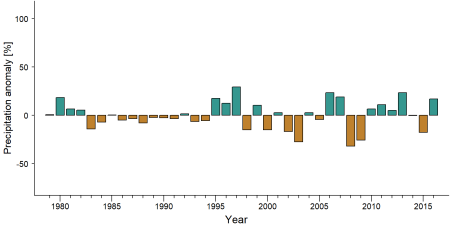
Precipitation anomaly in Korup National Park -
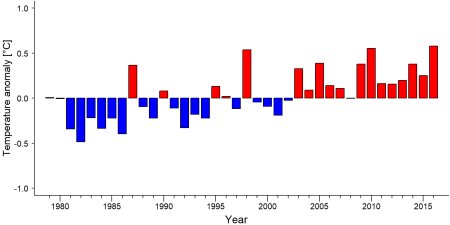
Temperature anomaly in Korup National Park


External links
[psmnrswr.org Programme for the Sustainable Management of Natural Resources – Southwest Cameroon]
References
Astaras, C., Linder, J. M., Wrege, P., Orume, R. D., & Macdonald, D. W. (2017). Passive acoustic monitoring as a law enforcement tool for Afrotropical rainforests. Frontiers in Ecology and the Environment, 15(5), 233-234. doi:10.1002/fee.1495
BirdLife International. (2021). Important Bird Areas factsheet: Korup National Park. Downloaded from http://www.birdlife.org on 24/10/2021.
Boekee, K., & Robinson, D. O. (2018). Camera Trap Monitoring Report Korup National Park 2011–2018. Project report. PSMNR-SWR, Buea, Cameroon. 126p.
Chuyong, G. B., Condit, R., Kenfack, D., Losos, E. C., Moses, S. N., Songwe, N. C., & Thomas, D. W. (2004). Korup forest dynamics plot, Cameroon. In E. C. Losos & E. G. Leigh Jr. (Eds.), Tropical Forest Diversity and Dynamism: Findings From a Large-Scale Plot Network (pp. 506–516). University of Chicago Press, Illinois.
Hofner, A. N., Jost Robinson, C. A., Hall, E. S., Capel, T., Astaras, C., & Linder, J. M. (2020). Surveying primates in northeastern Korup National Park, Cameroon: A longitudinal comparison. African Primates, 14, 35–44. link
KRCS. (n.d.). Activities. https://www.korup-conservation.org/activities/ link
Kupsch, D. (2020). Ecological and socio-economic effects of industrial oil palm plantations in Southwest Cameroon (PhD thesis). University of Göttingen, Germany. 199p. http://hdl.handle.net/21.11130/00-1735-0000-0005-139A-8 doi:10.53846/goediss-7974
Kupsch, D., & Bobo, K. S. (2024). Distribution parameters of large mammals and conservation management in an Afrotropical forest landscape and biodiversity hotspot. African Journal of Ecology, 62(2). doi:10.1111/aje.13254
Kupsch, D., & Tamo, A. (2023). Community-based wildlife monitoring pilot phase 2022 in Mount Cameroon National Park and Korup National Park. Project report. PSMNR-SWR, Buea. 60p.
Kupsch, D., Knobloch, L., Bobo, K. S., Motombi, F. N., & Waltert, M. (2023). Rural livelihoods and biodiversity in Afrotropical agroforestry systems and oil palm plantations. In C. F. Dormann, P. Batáry, I. Grass, A.-M. Klein, J. Loos, C. Scherber, S. Steffan-Dewenter, & T. C. Wanger (Eds.), Defining Agroecology – A Festschrift for Teja Tscharntke (pp. 223–240). Tredition, Hamburg, Germany. https://doi.org/10.5281/zenodo.10019829
Kupsch, D., Namolongo, E., & Sumbede, A. (2024a). Status of large mammals and human activities in the Extreme South hotspot of Korup National Park. PSMNR-SWR bio-monitoring report. Buea, Cameroon. 29p.
Kupsch, D., Namolongo, E., & Sumbede, A. (in preparation). Community-based wildlife monitoring outcomes in 2023 in the Extreme South hotspot in Korup National Park. PSMNR-SWR bio-monitoring report. Buea, Cameroon.
Kupsch, D., Serge, B. K., Waltert, M., Chia, N. B., Brice, B. C. G., Abdoulaye, D., & Kalagan, D. (2014). Biodiversity, carbon stock and market value assessment for the SGSOC project area, Southwest region, Cameroon. World Wide Fund for Nature, Germany, and Greenpeace International.
MINEF. (2002). A management plan for Korup National Park and its peripheral zone 2002–2007. Ministry of the Environment and Forestry. Mundemba, Cameroon. 190p.
Morgan, B., Adeleke, A., Bassey, T., Bergl, R., Dunn, A., Fotso, R., …, & Williamson, E. (2011). Regional Action Plan for the Conservation of the Nigeria-Cameroon chimpanzee (Pan troglodytes ellioti). IUCN/SSC Primate Specialist Group and Zoological Society of San Diego. link
PSMNR-SWR. (n.d.). About PSMNR-SWR. https://psmnrswr.org/about-psmnr-swr/
Robinson, D. O. (2014). Action for primate conservation in Korup National Park, Cameroon. https://www.conservationleadershipprogramme.org/project/primate-conservation-korup-national-park-cameroon/
Spey, I., Kupsch, D., Bobo, K. S., Waltert, M., & Schwarze, S. (2019). The Effects of Road Access on Income Generation. Evidence from An Integrated Conservation and Development Project in Cameroon. Sustainability, 11(12), 3368. doi:10.3390/su11123368
Usongo, L. (1997). Zoological inventory of Korup National Park, Cameroon. Report submitted to the Korup Project. Mundemba, Cameroon. 63p.
Waltert, M., Lien, Faber, K., & Mühlenberg, M. (2002). Further declines of threatened primates in the Korup Project Area, south-west Cameroon. Oryx, 36(3), 257-265. doi:10.1017/s0030605302000479
Kiribou, R., Tehoda, P., Chukwu, O., Bempah, G., Kühl, H. S., Ferreira, J., …, & Heinicke, S. (2024). Exposure of African ape sites to climate change impacts. PLOS Climate, 3(2), e0000345. doi:10.1371/journal.pclm.0000345
Page created by: Denish Kupsch & Anthoine Sumbede Date: 2021-10-25
Page updated by: Denish Kupsch & Anthoine Sumbede Date: 2025-04-29