
Kibira National Park: Difference between revisions
No edit summary |
No edit summary Tag: Manual revert |
| (One intermediate revision by the same user not shown) | |
(No difference)
| |
Latest revision as of 17:53, 15 October 2026
East Africa > Burundi > Kibira National Park
Français | Português | Español | Bahasa Indonesia | Melayu
Summary
- Eastern chimpanzees (Pan troglodytes schweinfurthii) are present in Kibira National Park.
- It has been estimated that 204 (CI: 122 – 339) individuals occur in the site.
- The chimpanzee population trend is unknown.
- The site has a total size of 400 km².
- Key threats to chimpanzees are hunting and logging.
- Conservation activities have focused on running tourist projects and involving local communities.
- The park is adjacent to Nyungwe National Park in Rwanda.
Site characteristics
Located in northwestern Burundi, Kibira National Park is contiguous with Nyungwe National Park in Rwanda; together they form a 130,000 ha montane forest block (BirdLife International 2020). The site lies from 1,600 to 2,666 m of altitude. Until 1933, Kibira was a royal hunting reserve (FAO). Historically, parts of the forest in Kibira have been very important to local people, who consider it sacred and possessing magical qualities (FAO). Between 1933 and 1980 Kibira was classified as the Congo-Nile Ridge Forest Reserve, under Belgian rule and after Burundian Independence in 1962 (FAO). From 1980, active conservation efforts began at the site; in the same year, it was declared a National Park (Hakizimana et al. 2015). In addition to Eastern chimpanzees (Pan troglodytes), other primate species found at the site include Ruwenzori colobus (Colobus angolensis ruwenzorii), golden monkey (Cercopithecus mitis kandti), and L'Hoest's monkey (Cercopithecus l’hoesti). The park is also home to many of the Albertine Rift endemic bird species, and is a designated Important Bird Area (BirdLife International 2020).
Table 1. Basic site information for Kibira National Park
| Species | Pan troglodytes schweinfurthii |
| Area | 400 km² |
| Coordinates | Lat: -3.001130 , Lon: 29.495718 |
| Type of site | Protected area (National Park) |
| Habitat types | Subtropical/tropical montane forest |
| Type of governance |
Types of sites Governance types Habitat types
Ape status
Table 2. Ape population estimates reported for Kibira National Park
| Species | Year | Occurrence | Encounter or vistation rate (nests/km; ind/day) | Density estimate [ind./ km²] (95% CI) | Abundance estimate (95% CI) | Survey area | Sampling method | Analytical framework | Source | Comments | A.P.E.S. database ID |
|---|---|---|---|---|---|---|---|---|---|---|---|
| Pan troglodytes schweinfurthii | 2011-2013 | 0.509 (0.305 - 0.847) | 204 (122 - 339) | Kibira National Park | Line transects | Hakizimana & Huynen 2013 | Survey effort: 864 km |
Sampling methods Analytical frameworks
Threats
Kibira forest originally covered about 900 km², but this was reduced to 400 km² as a result of a tea plantation extension program implemented by the government in the 1970s. As the land surrounding Kibira National Park was particularly suitable for tea cultivation, a large area was deforested for the program (Hakizimana et al. 2015). Rebels who occupied the forest during several years of civil conflict, between 1994 and 2007, logged and extensively hunted large mammals (Hakizimana et al. 2015).
Table 3. Threats to apes reported for Kibira National Park
| Category | Specific threats | Threat level | Description | Year of threat |
|---|---|---|---|---|
| 2 Agriculture & aquaculture | 2.1 Annual & perennial non-timber crops | High (more than 70% of population affected) | Deforestation as a result of agricultural expansion in the 1970s (Hakizimana et al. 2015). | 1970-1979 |
| 5 Biological resource use | 5.1 Hunting & collecting terrestrial animals | Present (unknown severity) | Hunting by rebels who occupied the forest (Hakizimana et al. 2015). | Ongoing (2015) |
| 5 Biological resource use | 5.3 Logging & wood harvesting | Present (unknown severity) | Logging by rebels who occupied the forest for several years (Hakizimana et al. 2015). | Ongoing (2015) |
Conservation activities
BirdLife International - Kibira National Park
Table 4. Conservation activities reported for Kibira National Park
| Category | Specific activity | Description | Implementing organization(s) | Year of activity |
|---|---|---|---|---|
| 5 Protection & restoration | 5.2 Legally protect ape habitat | The site is a National Park. | 2000-Ongoing (2026) | |
| 8 Permanent presence | 8.2 Run tourist projects and ensure permanent human presence at site | Chimpanzee tracking, bird watching, safaris, and other activities offered (Kibira National Park). | Ongoing (2021) |
Challenges
Table 5. Challenges reported for Kibira National Park
| Challenges | Specific challenges | Source | Year(s) |
|---|---|---|---|
| Not reported |
Enablers
Table 6. Enablers reported for Kibira National Park
| Enablers | Specific enablers | Source | Year(s) |
|---|---|---|---|
| 1 Site management | |||
| 2 Resources and capacity | |||
| 3 Engaged community | |||
| 4 Institutional support | |||
| 5 Ecological context | |||
| 6 Safety and stability |
Research activities
A study found that chimpanzees in Kibira National Park are selective in the choice of nest trees, preferring to nest in Parinari excelsa trees, which occur in low densities at the park. On the other hand, the more abundant Macaranga kilimandscharica trees were less used (Hakizimana et al. 2015).
Documented behaviours
Table 7. Behaviours documented for Kibira National Park
| Category | Behavior | Observation type | Prevalence | Observation dates | Source | Habituation | Species | Comment |
|---|---|---|---|---|---|---|---|---|
| Not reported |
Exposure to climate change impacts
As part of a study on the exposure of African great ape sites to climate change impacts, Kiribou et al. (2024) extracted climate data and data on projected extreme climate impact events for the site. Climatological characteristics were derived from observation-based climate data provided by the Inter-Sectoral Impact Model Intercomparison Project (ISIMIP, www.isimip.org). Parameters were calculated as the average across each 30-year period. For 1981-2010, the EWEMBI dataset from ISIMIP2a was used. For the two future periods (2021-2050 and 2071-2099) ISIMIP2b climate data based on four CMIP5 global climate models were used. For future projections, two Representative Concentration Pathways (RCP) were used. RCP 2.6 is a scenario with strong mitigation measures in which global temperatures would likely rise below 2C. RCP 6.0 is a scenario with medium emissions in which global temperatures would likely rise up to 3C by 2100. For the number of days with heavy precipitation events, the 98th percentile of all precipitation days (>1mm/d) was calculated for the 1979-2013 reference period as a threshold for a heavy precipitation event. Then, for each year, the number of days above that threshold was derived. The figures on temperature and precipitation anomaly show the deviation from the mean temperature and mean precipitation for the 1979-2013 reference period.
The estimated exposure to future extreme climate impact events (crop failure, drought, river flood, wildfire, tropical cyclone, and heatwave) is based on a published dataset by Lange et al. 2020 derived from ISIMIP2b data. The same global climate models and RCPs as described above were used. Within each 30-year period, the number of years with an extreme event and the average proportion of the site affected were calculated (Kiribou et al. 2024).
Table 8. Estimated past and projected climatological characteristics in Kibira National Park
| Value | 1981-2010 | 2021-2050, RCP 2.6 | 2021-2050, RCP 6.0 | 2071-2099, RCP 2.6 | 2071-2099, RCP 6.0 |
|---|---|---|---|---|---|
| Mean temperature [C] | 21.2 | 22.4 | 22.1 | 22.5 | 23.8 |
| Annual precipitation [mm] | 1135 | 1153 | 1209 | 1128 | 1166 |
| Max no. consecutive dry days (per year) | 51.4 | 61.1 | 57.5 | 68.7 | 58.5 |
| No. days with heavy precipitation (per year) | 5.1 | 4.4 | 5.1 | 4.8 | 6.2 |
Table 9. Projected exposure of apes to extreme climate impact events in Kibira National Park
| Type | No. of years with event (2021-2050, RCP 2.6) | % of site exposed (2021-2050, RCP 2.6) | No. of years with event (2021-2050, RCP 6.0) | % of site exposed (2021-2050, RCP 6.0) | No. of years with event (2070-2099, RCP 2.6) | % of site exposed (2070-2099, RCP 2.6) | No. of years with event (2070-2099, RCP 6.0) | % of site exposed (2070-2099, RCP 6.0) |
|---|---|---|---|---|---|---|---|---|
| Crop failure | 9.5 | 0.58 | 9.5 | 0.57 | 9.5 | 1.3 | 18.5 | 0.51 |
| Drought | 0 | 0 | 0 | 0 | 0 | 0 | 0 | 0 |
| Heatwave | 0 | 0 | 0 | 0 | 0 | 0 | 0 | 0 |
| River flood | 2.75 | 1.03 | 4 | 2.67 | 2 | 1.94 | 7.25 | 5.76 |
| Tropical cyclone | 0 | 0 | 0 | 0 | 0 | 0 | 0 | 0 |
| Wildfire | 30 | 0.81 | 30 | 0.66 | 29 | 0.86 | 29 | 0.87 |
-
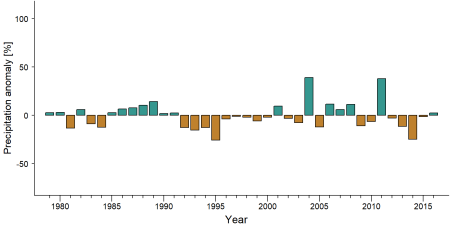
Precipitation anomaly in Kibira National Park -
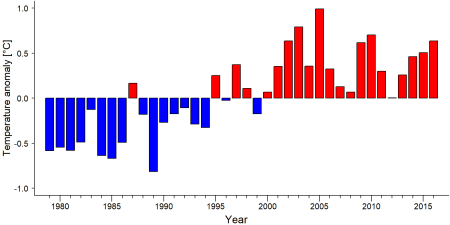
Temperature anomaly in Kibira National Park


External links
References
BirdLife International. (2020). Important Bird Areas factsheet: Kibira National Park. Downloaded from http://www.birdlife.org on 08/12/2020. link
Hakizimana, D., Hambuckers, A., & Brotcorne, F. (2015). Characterization of nest sites of chimpanzees (Pan troglodytes schweinfurthii) in Kibira National Park, Burundi.African Primates, 10,1–12. link
Hakizimana, D., & Huynen, M. (2013). Chimpanzee (Pan troglodytes schweinfurthii) Population Density and Abundance in Kibira National Park, Burundi. Pan Africa News, 20(2), 16-19. doi:10.5134/180553
Kiribou, R., Tehoda, P., Chukwu, O., Bempah, G., Kühl, H. S., Ferreira, J., …, & Heinicke, S. (2024). Exposure of African ape sites to climate change impacts. PLOS Climate, 3(2), e0000345. doi:10.1371/journal.pclm.0000345
Kibira National Park. https://www.kibiranationalparkburundi.com/
Page created by: APES Atlas Team Date: 2021-01-14