
Sangaredi: Difference between revisions
No edit summary |
No edit summary |
||
| Line 588: | Line 588: | ||
<span id="R02140"></span>WCF. (2009). Rapport sur le recensement des chimpanzés dans le Parc National de la Comoé, Côte d’Ivoire. Wild Chimpanzee Foundation. https://www.wildchimps.org/reports/reports.html | <span id="R02140"></span>WCF. (2009). Rapport sur le recensement des chimpanzés dans le Parc National de la Comoé, Côte d’Ivoire. Wild Chimpanzee Foundation. https://www.wildchimps.org/reports/reports.html | ||
<span id="R02311"></span>Kiribou, R., Tehoda, P., Chukwu, O., Bempah, G., Kühl, H. S., Ferreira, J., …, & Heinicke, S. (2024). Exposure of African ape sites to climate change impacts. ''PLOS Climate'', 3(2), | <span id="R02311"></span>Kiribou, R., Tehoda, P., Chukwu, O., Bempah, G., Kühl, H. S., Ferreira, J., …, & Heinicke, S. (2024). Exposure of African ape sites to climate change impacts. ''PLOS Climate'', 3(2), e0000345. [https://doi.org/10.1371/journal.pclm.0000345 doi:10.1371/journal.pclm.0000345] | ||
'''Page created by: '''APES Atlas Team & Julia Riedel''' Date:''' 2019-11-25 | '''Page created by: '''APES Atlas Team & Julia Riedel''' Date:''' 2019-11-25 | ||
Latest revision as of 17:54, 15 October 2026
West Africa > Republic of Guinea > Sangaredi
Français | Português | Español | Bahasa Indonesia | Melayu
Summary
- Western chimpanzees (Pan troglodytes verus) are present in Sangaredi.
- It has been estimated that more than 200 individuals occurred in two neighboring bauxite mining concessions prior to mining exploitations.
- The chimpanzee population trend is very likely declining due to mining activities.
- This site has a total size of 1542 km².
- Key threats to chimpanzees are mining and logging.
- The following conservation activities were implemented by the Wild Chimpanzee Foundation (WCF): environmental education (Club P.A.N. and theater plays) and forest regeneration.
- Sangaredi is a mining town and mining operations have been ongoing for several decades.
Site characteristics
Sangaredi is a mining town in the prefecture Boké in Guinea. Mining exploitation for bauxite began in 1973 and a railway connects the mining site to the port of Kamsar for the ore to be shipped overseas. Mining concessions around Sangaredi are owned by different mining companies, including the Bauxite Company of Guinea (CBG, owned by the Government of Guinea), Guinea Alumina Corporation (GAC) and Halco, with the latter two being consortia owned by transnational mining companies with changing ownership over the years.
Sangaredi is characterized by moist savanna with gallery forests along rivers. However, decades of mining and intense anthropogenic influence, including agriculture, logging and hunting, led to large-scale degradation of ecosystems. Still, biodiversity surveys by Conservation International and the Wild Chimpanzee Foundation confirmed the presence of different primate species including western chimpanzee (Pan troglodytes verus), Temminck’s red colobus (Piliocolobus temminckii), green monkey (Chlorocebus sabaeus), sooty mangabey (Cercocebus atys), patas monkey (Erythrocebus patas), Campbell’s monkey (Cercopithecus campbelli) and galago (Galagoides sp. ,Eriksson & Kpoghomou 2006, WCF 2015). In addition, 5 reptile, 17 amphibian, 140 bird and 16 non-primate mammal species were recorded during the Rapid Biological Assessment in 2005 at the site (Wright et al. 2006).
Table 1. Basic site information for Sangaredi
| Species | Pan troglodytes verus |
| Area | 1,542 km² |
| Coordinates | Lat: 11.10 , Lon: -13.79 |
| Type of site | Non-protected area |
| Habitat types | Subtropical/tropical heavily degraded former forest, Agricultural land, Savanna, Subtropical/tropical moist lowland forest, Wetlands (lakes, rivers, streams, bogs, marshes) |
| Type of governance |
Types of sites Governance types Habitat types
Ape status
Sugiyama and Soumah (1988) and Ham (1998) confirmed the presence of western chimpanzees throughout Boké prefecture. As part of a rapid biological assessment in 2005 in Boulléré just to the west of Sangaredi the presence of western chimpanzees was established by Eriksson and Kpoghomou (2006). The Wild Chimpanzee Foundation corporates with Guinea Alumina Corporation (GAC) since 2008 to assess the impact of mining on chimpanzees in their mining concession, and suggested mitigation measures (offset) as part of a comprehensive management plan (WCF 2011, WCF 2015). In 2015 WCF started working with the Bauxite Company of Guinea (CBG) on a concession neighboring the GAC concession (CBG Halco concession). As part of these collaborations, the WCF monitored the local chimpanzee population across several years and estimated a total chimpanzee abundance of more than 200 individuals around Sangaredi. A population trend assessment showed stable population from 2008 until 2014 in the GAC concession (Kühl et al. 2017). Nevertheless, with starting mining exploitation in these concessions and the ensuing habitat destruction and increase in anthropogenic pressures, the chimpanzee population is now very likely declining (WCF 2015).
Table 2. Ape population estimates reported for Sangaredi
| Species | Year | Occurrence | Encounter or vistation rate (nests/km; ind/day) | Density estimate [ind./ km²] (95% CI) | Abundance estimate (95% CI) | Survey area | Sampling method | Analytical framework | Source | Comments | A.P.E.S. database ID |
|---|---|---|---|---|---|---|---|---|---|---|---|
| Pan troglodytes verus | 2015 | 0.1 | 62 (33-118) | CBG Halco concession (530 km²) | Line transects | WCF 2015 | Total survey effort: 139 km | ||||
| Pan troglodytes verus | 2015 | 0.33 | 252 (147-423) | GAC concession | Line transects | WCF 2015 | Total survey effort: 254 km | ||||
| Pan troglodytes verus | 2014 | 0.25 | 174.0 | GAC concession | Line transects | WCF 2014 | Total survey effort: 254 km | ||||
| Pan troglodytes verus | 2012 | 0.14 | 142.0 | GAC concession | Line transects | WCF 2012 | Total survey effort: 348 km | ||||
| Pan troglodytes verus | 2011 | 0.25 | 266.0 | GAC concession | Line transects | WCF 2012 | Total survey effort: 339 km | ||||
| Pan troglodytes verus | 2010 | 0.18 | 190.0 | GAC concession | Line transects | WCF 2012 | Total survey effort: 347 km | ||||
| Pan troglodytes verus | 2009 | 0.11 | 119.0 | GAC concession (685 km²) | Line transects | WCF 2012 | Total survey effort: 537 km | ||||
| Pan troglodytes verus | 2005 | Present | Boulléré | Reconnaissance walk | Eriksson & Kpoghomou 2006 | Total survey effort: 37.8 km; walking existing trail system | |||||
| Pan troglodytes verus | 1997 | Present | Boké prefecture | Interviews | Ham 1998 | Questionnaire survey | GIN0019, GIN0021 | ||||
| Pan troglodytes verus | 1988 | Present | Boké prefecture | Interviews | Sugiyama & Soumah 1988 | Questionnaire survey |
Sampling methods Analytical frameworks
Threats
As mining operations have been ongoing since 1973 the ecosystem is strongly impacted by anthropogenic pressures, especially logging and charring, agriculture, mining, the construction of roads, the presence of settlements, as well as hunting and fishing, and livestock keeping (WCF 2014, WCF 2015). Mining exploitation was planned to start by 2016 in the GAC concession, but the current status is unclear. However, chimpanzee habitat has already been destroyed in the mining concession (WCF 2015). In connection with the mining project, concerns have been raised in relation to social issues (e.g., work insecurity, loss of livelihoods, displacement, and corruption), environmental damage by pollution (air, soil, and water), crop damage and changes in the hydrology (Environmental Justice Atlas 2019).
Table 3. Threats to apes reported for Sangaredi
| Category | Specific threats | Threat level | Description | Year of threat |
|---|---|---|---|---|
| 1 Residential & commercial development | 1.1 Residential areas | Medium (30-70% of population affected) | Mining town of Sangaredi newly established (Environmental Justice Atlas 2019). | 1973-Ongoing (2019) |
| 2 Agriculture & aquaculture | 2.1 Annual & perennial non-timber crops | Medium (30-70% of population affected) | Slash and burn agriculture and rice fields (WCF 2015, Wright et al. 2006). | Ongoing (2015) |
| 2 Agriculture & aquaculture | 2.3 Livestock farming & ranching | Low (up to 30% of population affected) | Detection of livestock on camera traps (WCF 2015). | Ongoing (2015) |
| 3 Energy production & mining | 3.2 Mining & quarrying | High (more than 70% of population affected) | Mining exploitation since 1973 (Environmental Justice Atlas 2019). | 1973-Ongoing (2019) |
| 4 Transportation & service corridors | 4.1 Roads & railroads | Medium (30-70% of population affected) | Road development for mining activities (Environmental Justice Atlas 2019). | 1973-Ongoing (2019) |
| 5 Biological resource use | 5.1 Hunting & collecting terrestrial animals | Medium (30-70% of population affected) | Bushmeat study confirmed hunting of primates (WCF 2014). | Ongoing (2014) |
| 5 Biological resource use | 5.3 Logging & wood harvesting | High (more than 70% of population affected) | Wood-cutting mainly for charcoal (WCF 2015). | Ongoing (2015) |
| 7 Natural system modifications | 7.1 Fire & fire suppression | Present (unknown severity) | Fires are set for clearing areas for agricultural use (WCF 2014, Wright et al. 2006). | Ongoing (2014) |
| 9 Pollution | 9.2 Industrial & military effluents | Medium (30-70% of population affected) | Contamination of air, water and soil (Environmental Justice Atlas 2019). | 1973-Ongoing (2019) |
Conservation activities
Since 2008, the Wild Chimpanzee Foundation collaborates with the Guinea Alumina Project (GAP) to develop and implement a management plan to first minimize negative impacts on chimpanzees and offset any damage (WCF 2011). In 2011, the WCF proposed a management plan that was informed by the annual monitoring surveys that WCF conducted since 2009 (see above). When the ownership of the mining company changed, the area proposed for exploitation changed to the southwestern part of the concession and a new management plan was proposed by the WCF (WCF 2015). It is not clear which part of the management plan is or was implemented. As part of their engagement, the WCF conducted different environmental education activities: an extracurricular environmental education program at schools (Club P.A.N. program), theater tour, environmental newsletter, and chimpanzee film screenings (WCF 2011, WCF 2012, WCF 2014, WCF 2015). Community consultations revealed that water is key for local agricultural activities, and in collaboration with local communities the WCF started a program to protect three water sources in the area by protecting the habitat around the water sources – but it is not clear whether protection was implemented (WCF 2014, 2015). In 2015, the WCF established a plant nursery with 25,000 plants to be replanted around three water sources (WCF 2015).
Table 4. Conservation activities reported for Sangaredi
| Category | Specific activity | Description | Implementing organization(s) | Year of activity |
|---|---|---|---|---|
| 4 Education & awareness | 4.1 Educate local communities about apes and sustainable use | Activities at schools (Club P.A.N. program) and villages (theater, film) (WCF 2011, 2012, 2014, 2015) | 2010-2015 | |
| 4 Education & awareness | 4.5 Implement multimedia campaigns using theatre, film, print media, discussions | Environmental awareness raising activities include theater, film and newsletters (WCF 2011, 2012, 2014, 2015) | 2010-2015 | |
| 5 Protection & restoration | 5.6 Habitat restoration | Plant nursery with 25,000 plants (WCF 2015) | 2015 |
Challenges
Changing ownership of mining companies and volatility of markets for minerals impedes continuous implementation of management plan to mitigate negative impacts of mining operations on chimpanzees (WCF 2015).
Table 5. Challenges reported for Sangaredi
| Challenges | Specific challenges | Source | Year(s) |
|---|---|---|---|
| 2 Resources and capacity | 2.3 General lack of funding | WCF 2015 |
Enablers
Table 6. Enablers reported for Sangaredi
| Enablers | Specific enablers | Source | Year(s) |
|---|---|---|---|
| 1 Site management | |||
| 2 Resources and capacity | |||
| 3 Engaged community | |||
| 4 Institutional support | |||
| 5 Ecological context | |||
| 6 Safety and stability |
Research activities
As detailed above several surveys on chimpanzees have been implemented in Sangaredi (Eriksson & Kpoghomou 2006, Wright et al. 2006, WCF 2012, WCF 2014, WCF 2015). The Pan African Programme (PanAf) ‘The Cultured Chimpanzee’ established a temporary research site in Sangaredi with the aim to record ecological conditions of chimpanzees living in the area and to document chimpanzee behavior (Kühl et al. 2016, Kühl et al. 2019).
Documented behaviours
Table 7. Behaviours documented for Sangaredi
| Category | Behavior | Observation type | Prevalence | Observation dates | Source | Habituation | Species | Comment |
|---|---|---|---|---|---|---|---|---|
| Accumulative stone throwing | Kühl et al. 2016 | |||||||
| Algae fishing | Kühl et al. 2019 | |||||||
| Ant dipping | Kühl et al. 2019 | |||||||
| Ant eating | Kühl et al. 2019 | |||||||
| Making ground nests | Kühl et al. 2019 |
Exposure to climate change impacts
As part of a study on the exposure of African great ape sites to climate change impacts, Kiribou et al. (2024) extracted climate data and data on projected extreme climate impact events for the site. Climatological characteristics were derived from observation-based climate data provided by the Inter-Sectoral Impact Model Intercomparison Project (ISIMIP, www.isimip.org). Parameters were calculated as the average across each 30-year period. For 1981-2010, the EWEMBI dataset from ISIMIP2a was used. For the two future periods (2021-2050 and 2071-2099) ISIMIP2b climate data based on four CMIP5 global climate models were used. For future projections, two Representative Concentration Pathways (RCP) were used. RCP 2.6 is a scenario with strong mitigation measures in which global temperatures would likely rise below 2C. RCP 6.0 is a scenario with medium emissions in which global temperatures would likely rise up to 3C by 2100. For the number of days with heavy precipitation events, the 98th percentile of all precipitation days (>1mm/d) was calculated for the 1979-2013 reference period as a threshold for a heavy precipitation event. Then, for each year, the number of days above that threshold was derived. The figures on temperature and precipitation anomaly show the deviation from the mean temperature and mean precipitation for the 1979-2013 reference period.
The estimated exposure to future extreme climate impact events (crop failure, drought, river flood, wildfire, tropical cyclone, and heatwave) is based on a published dataset by Lange et al. 2020 derived from ISIMIP2b data. The same global climate models and RCPs as described above were used. Within each 30-year period, the number of years with an extreme event and the average proportion of the site affected were calculated (Kiribou et al. 2024).
Table 8. Estimated past and projected climatological characteristics in Sangaredi
| Value | 1981-2010 | 2021-2050, RCP 2.6 | 2021-2050, RCP 6.0 | 2071-2099, RCP 2.6 | 2071-2099, RCP 6.0 |
|---|---|---|---|---|---|
| Mean temperature [C] | 26.6 | 27.6 | 27.5 | 27.9 | 29 |
| Annual precipitation [mm] | 1931 | 1804 | 1763 | 1844 | 1569 |
| Max no. consecutive dry days (per year) | 125.7 | 120.8 | 117.4 | 118.6 | 120.4 |
| No. days with heavy precipitation (per year) | 3.6 | 4.7 | 4.5 | 4.9 | 3.2 |
Table 9. Projected exposure of apes to extreme climate impact events in Sangaredi
| Type | No. of years with event (2021-2050, RCP 2.6) | % of site exposed (2021-2050, RCP 2.6) | No. of years with event (2021-2050, RCP 6.0) | % of site exposed (2021-2050, RCP 6.0) | No. of years with event (2070-2099, RCP 2.6) | % of site exposed (2070-2099, RCP 2.6) | No. of years with event (2070-2099, RCP 6.0) | % of site exposed (2070-2099, RCP 6.0) |
|---|---|---|---|---|---|---|---|---|
| Crop failure | 6 | 0.45 | 4.5 | 0.45 | 6.5 | 0.45 | 12 | 0.45 |
| Drought | 1.25 | 50 | 0.75 | 75 | 1 | 50 | 4.25 | 100 |
| Heatwave | 2.5 | 100 | 1.5 | 50 | 2 | 100 | 6.5 | 100 |
| River flood | 0 | 0 | 0.5 | 0.03 | 1 | 1.86 | 1 | 1.3 |
| Tropical cyclone | 0.5 | 1.59 | 0.5 | 3 | 1.5 | 1.62 | 0.5 | 0.93 |
| Wildfire | 30 | 2.02 | 30 | 2.01 | 29 | 2.14 | 29 | 3.39 |
-
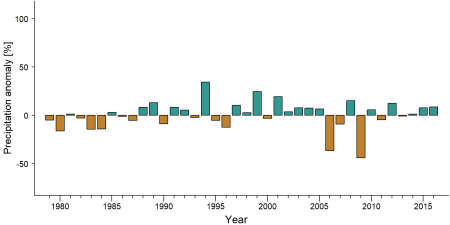
Precipitation anomaly in Sangaredi -
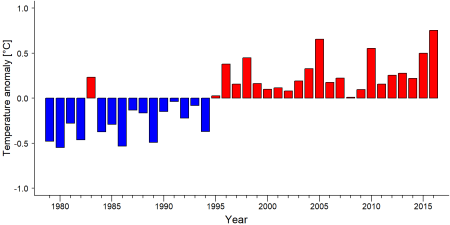
Temperature anomaly in Sangaredi


External links
References
Environmental Justice Atlas. 2019. Iron Mine on Simandou Mountain Range, Mine de Fer, Guinée, ejatlas.org link
Eriksson, J., & Kpoghoumou, E. (2006). A Rapid Survey of the Primates of Boké Préfecture, Northwestern Guinea. In A Rapid Biological Assessment of Boké Préfecture, Northwestern Guinea 145. Conservation International. 41. doi:10.1896/054.041.0114
Ham R. 1998 Nationwide chimpanzee census and large mammal survey Republic of Guinea. Projet de conservation des chimpanzés en Guineée. Report to the European Union.
Kühl, H. S., Kalan, A. K., Arandjelovic, M., Aubert, F., D’Auvergne, L., Goedmakers, A., …, & Boesch, C. (2016). Chimpanzee accumulative stone throwing. Scientific Reports, 6(1). doi:10.1038/srep22219
Kühl, H. S., Sop, T., Williamson, E. A., Mundry, R., Brugière, D., Campbell, G., …, & Boesch, C. (2017). The Critically Endangered western chimpanzee declines by 80%. American Journal of Primatology, 79(9), e22681. doi:10.1002/ajp.22681
Kühl, H. S., Boesch, C., Kulik, L., Haas, F., Arandjelovic, M., Dieguez, P., …, & Kalan, A. K. (2019). Human impact erodes chimpanzee behavioral diversity. Science, 363(6434), 1453-1455. doi:10.1126/science.aau4532
Sugiyama, Y., & Soumah, A. G. (1988). Preliminary survey of the distribution and population of chimpanzees in the Republic of Guinea. Primates, 29(4), 569-574. doi:10.1007/bf02381144
WCF. 2011. Annual report of the activities undertaken by the Wild Chimpanzee Foundation to improve the protection of wild chimpanzees and their habitat in West Africa – Year 2011. Online: Wild Chimpanzee Foundation link
WCF. 2012. Annual report 2012 – activities of the Wild Chimpanzee Foundation for improved conservation of chimpanzees and their habitat in West Africa. Online: Wild Chimpanzee Foundation link
WCF. 2014. Annual report 2014 – activities of the Wild Chimpanzee Foundation for improved conservation of chimpanzees and their habitat in West Africa. Online: Wild Chimpanzee Foundation link
WCF. 2015. Annual report 2015 – activities of the Wild Chimpanzee Foundation for improved conservation of chimpanzees and their habitat in West Africa. Online: Wild Chimpanzee Foundation link
Wright HE et al. 2006. A Rapid Biological Assessment of Boké Préfecture, Northwestern Guinea. RAP Bulletin of Biological Assessment 41. Conservation International, Washington, DC.
WCF. (2009). Rapport sur le recensement des chimpanzés dans le Parc National de la Comoé, Côte d’Ivoire. Wild Chimpanzee Foundation. https://www.wildchimps.org/reports/reports.html
Kiribou, R., Tehoda, P., Chukwu, O., Bempah, G., Kühl, H. S., Ferreira, J., …, & Heinicke, S. (2024). Exposure of African ape sites to climate change impacts. PLOS Climate, 3(2), e0000345. doi:10.1371/journal.pclm.0000345
Page created by: APES Atlas Team & Julia Riedel Date: 2019-11-25