
Cape Three Points Forest Reserve: Difference between revisions
No edit summary |
No edit summary |
||
| Line 347: | Line 347: | ||
<div><ul><li style="display: inline-block; vertical-align: top;"> [[File:PrecipAnomaly_Cape_Three_Points_FR.png| 450px | thumb| none | Precipitation anomaly | <div><ul><li style="display: inline-block; vertical-align: top;"> [[File:PrecipAnomaly_Cape_Three_Points_FR.png| 450px | thumb| none | Precipitation anomaly in Cape Three Points Forest Reserve]] </li><li style="display: inline-block; vertical-align: top;"> [[File:TempAnomaly_Cape_Three_Points_FR.png | 450px | thumb| none | Temperature anomaly in Cape Three Points Forest Reserve]] </li></ul></div> | ||
= External links = | = External links = | ||
Revision as of 03:05, 6 November 2025
West Africa > Ghana > Cape Three Points Forest Reserve
Français | Português | Español | Bahasa Indonesia | Melayu
Summary
- Western chimpanzees (Pan troglodytes verus) may be present in Cape Three Points Forest Reserve.
- No chimpanzees were recorded in the last survey.
- The chimpanzee population trend is decreasing.
- The site has a total size of 51 km².
- Key threats to chimpanzees are hunting, logging, and forest loss due to agricultural expansion.
- Conservation activities are not documented.
Site characteristics
Cape Three Points Forest Reserve (CTP) is a small forest fragment in southern Ghana, representing one of the few patches of Atlantic forest remaining along the coast (Gatti 2009). Despite its small size, the reserve holds a rich diversity of plants, which led to its designation as a GSBA (Gatti 2009). The site was also declared as an Important Bird Area in 2001, as the site supports an interesting avifauna, including the Yellow-casqued hornbill (BirdLife International 2022).
Table 1. Basic site information for Cape Three Points Forest Reserve
| Species | Pan troglodytes verus |
| Area | 51 km² |
| Coordinates | Lat: 4.846039 , Lon: -2.041636 |
| Type of site | Protected area (Forest Reserve) |
| Habitat types | Subtropical/tropical moist lowland forest |
| Type of governance |
Types of sites Governance types Habitat types
Ape status
A rapid survey was conducted at the site in 2009 in the context of the Wildlife Wood Project in Ghana, which aims to assist logging companies in improving wildlife management in concession areas (Gatti 2009). No signs of chimpanzees were recorded.
Table 2. Ape population estimates reported for Cape Three Points Forest Reserve
| Species | Year | Occurrence | Encounter or vistation rate (nests/km; ind/day) | Density estimate [ind./ km²] (95% CI) | Abundance estimate (95% CI) | Survey area | Sampling method | Analytical framework | Source | Comments | A.P.E.S. database ID |
|---|---|---|---|---|---|---|---|---|---|---|---|
| Pan troglodytes verus | 2009 | 0 | Cape Three Points Forest Reserve | Reconnaissance walk | Gatti 2009 | survey effort: 16.55 km |
Sampling methods Analytical frameworks
Threats
The reserve is surrounded by rural settlements and extensive rubber plantations of the GREL (Ghana Rubber Estates Limited Company) (Gatti 2009). Wildlife resources are under severe threat from the surrounding human population (BirdLife International 2022).
Table 3. Threats to apes reported for Cape Three Points Forest Reserve
| Category | Specific threats | Threat level | Description | Year of threat |
|---|---|---|---|---|
| 1 Residential & commercial development | 1.1 Residential areas | High (more than 70% of population affected) | The reserve is surrounded by rural settlements and is under significant pressure from the surrounding populations (Gatti 2009). | Ongoing (2009) |
| 2 Agriculture & aquaculture | 2.1 Annual & perennial non-timber crops | High (more than 70% of population affected) | Seven admitted farms within the reserve boundaries. In the absence of clear demarcation, the farms have slowly extended, causing forest loss (Gatti 2009). | Ongoing (2009) |
| 5 Biological resource use | 5.1 Hunting & collecting terrestrial animals | High (more than 70% of population affected) | High hunting pressure in the reserve (Gatti 2009). | Ongoing (2009) |
| 5 Biological resource use | 5.3 Logging & wood harvesting | Present (unknown severity) | Illegal felling of trees for canoes and wood construction in local fishing villages (Gatti 2009). | Ongoing (2009) |
| 3 Energy production & mining | 3.2 Mining & quarrying | Present (unknown severity) | Evidence of past gold-mining activity, including prospecting pits and small abandoned mines (BirdLife International 2022). | Ongoing (2022) |
Conservation activities
Challenges
Table 5. Challenges reported for Cape Three Points Forest Reserve
| Challenges | Specific challenges | Source | Year(s) |
|---|---|---|---|
| Not reported |
Enablers
Table 6. Enablers reported for Cape Three Points Forest Reserve
| Enablers | Specific enablers | Source | Year(s) |
|---|---|---|---|
| 1 Site management | |||
| 2 Resources and capacity | |||
| 3 Engaged community | |||
| 4 Institutional support | |||
| 5 Ecological context | |||
| 6 Safety and stability |
Research activities
Documented behaviours
Table 7. Behaviours documented for Cape Three Points Forest Reserve
| Category | Behavior | Observation type | Prevalence | Observation dates | Source | Habituation | Species | Comment |
|---|---|---|---|---|---|---|---|---|
| Not reported |
Exposure to climate change impacts
As part of a study on the exposure of African great ape sites to climate change impacts, Kiribou et al. subm. extracted climate data and data on projected extreme climate impact events for the site. Climatological characteristics were derived from observation-based climate data provided by the Inter-Sectoral Impact Model Intercomparison Project (ISIMIP, www.isimip.org). Parameters were calculated as the average across each 30-year period. For 1981-2010, the EWEMBI dataset from ISIMIP2a was used. For the two future periods (2021-2050 and 2071-2099) ISIMIP2b climate data based on four CMIP5 global climate models were used. For future projections, two Representative Concentration Pathways (RCP) were used. RCP 2.6 is a scenario with strong mitigation measures in which global temperatures would likely rise below 2C. RCP 6.0 is a scenario with medium emissions in which global temperatures would likely rise up to 3C by 2100. For the number of days with heavy precipitation events, the 98th percentile of all precipitation days (>1mm/d) was calculated for the 1979-2013 reference period as a threshold for a heavy precipitation event. Then, for each year, the number of days above that threshold was derived. The figures on temperature and precipitation anomaly show the deviation from the mean temperature and mean precipitation for the 1979-2013 reference period.
The estimated exposure to future extreme climate impact events (crop failure, drought, river flood, wildfire, tropical cyclone, and heatwave) is based on a published dataset by Lange et al. 2020 derived from ISIMIP2b data. The same global climate models and RCPs as described above were used. Within each 30-year period, the number of years with an extreme event and the average proportion of the site affected were calculated (see Kiribou et al. subm. for details).
Table 8. Estimated past and projected climatological characteristics in Cape Three Points Forest Reserve
| Value | 1981-2010 | 2021-2050, RCP 2.6 | 2021-2050, RCP 6.0 | 2071-2099, RCP 2.6 | 2071-2099, RCP 6.0 |
|---|---|---|---|---|---|
| Mean temperature [C] | 27 | 28 | 27.7 | 28.1 | 29.1 |
| Annual precipitation [mm] | 1689 | 1624 | 1703 | 1653 | 1723 |
| Max no. consecutive dry days (per year) | 25.9 | 23.3 | 24.2 | 23.6 | 27.1 |
| No. days with heavy precipitation (per year) | 7 | 7.4 | 6.6 | 6.1 | 8.3 |
Table 9. Projected exposure of apes to extreme climate impact events in Cape Three Points Forest Reserve
| Type | No. of years with event (2021-2050, RCP 2.6) | % of site exposed (2021-2050, RCP 2.6) | No. of years with event (2021-2050, RCP 6.0) | % of site exposed (2021-2050, RCP 6.0) | No. of years with event (2070-2099, RCP 2.6) | % of site exposed (2070-2099, RCP 2.6) | No. of years with event (2070-2099, RCP 6.0) | % of site exposed (2070-2099, RCP 6.0) |
|---|---|---|---|---|---|---|---|---|
| Crop failure | 1 | 1.19 | 0.5 | 0.12 | 1 | 0.41 | 0.5 | 0.67 |
| Drought | 0 | 0 | 0 | 0 | 0 | 0 | 0 | 0 |
| Heatwave | 16 | 100 | 15 | 100 | 19.5 | 100 | 17.5 | 100 |
| River flood | 0 | 0 | 0 | 0 | 0 | 0 | 0.5 | 0.06 |
| Tropical cyclone | 0 | 0 | 0 | 0 | 0 | 0 | 0.5 | 9.08 |
| Wildfire | 22 | 0.31 | 22 | 0.26 | 22 | 0.26 | 21.5 | 0.33 |
-
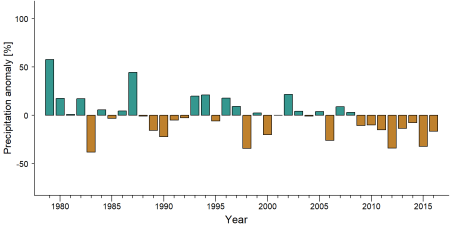
Precipitation anomaly in Cape Three Points Forest Reserve -
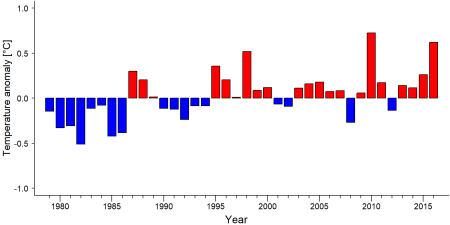
Temperature anomaly in Cape Three Points Forest Reserve


External links
References
BirdLife International (2022) Important Bird Areas factsheet: Cape Three Points Forest Reserve. Downloaded from http://www.birdlife.org on 15/03/2022.
Gatti, S. (2009). Mammal surveys and capacity building for the Wildlife Wood Project - Ghana. Unpublished report to the WWP-Ghana.
Page created by: APES Atlas Team Date: 2022-03-18