
Dimonika Biosphere Reserve: Difference between revisions
No edit summary |
No edit summary |
||
| Line 136: | Line 136: | ||
|The site has been a Biosphere Reserve since 1988. | |The site has been a Biosphere Reserve since 1988. | ||
| | | | ||
|1988-Ongoing ( | |1988-Ongoing (2026) | ||
|} | |} | ||
Revision as of 03:25, 4 February 2026
Central Africa > Republic of the Congo > Dimonika Biosphere Reserve
Français | Português | Español | Bahasa Indonesia | Melayu
Summary
- Central chimpanzees (Pan troglodytes troglodytes) and western lowland gorillas (Gorilla gorilla gorilla) are present in Dimonika Biosphere Reserve.
- The gorilla population at the site has been estimated at 113 nest building individuals.
- The great ape population trend is unknown.
- The site has a total size of 1,360 km².
- Key threats to great apes are hunting and gold mining.
- Conservation activities at the site are not reported.
- The site was declared a UNESCO Biosphere Reserve in 1988.
Site characteristics
The site is located in the central Mayombe mountain chain in the Republic of Congo, about 50 km from the Atlantic coast. It was declared a UNESCO Biosphere Reserve in 1988 (UNESCO). The reserve has a remarkable mountainous terrain dominated by lowland guineo-congolese rainforest and savanna patches. A total of 275 bird species have been recorded at Dimonika, including rare species, such as Bubo shelleyi. In addition to western lowland gorillas and chimpanzees, other species of conservation concern found at the site include forest elephants (Loxodonta cyclotis), African forest buffalo (Syncerus caffer nanus), and mandrills (Mandrillus sphinx) (BirdLife International 2021). The southern edge of the reserve coincides with a road and part of a railway line that connect Brazzaville to Pointe-Noire, along which lie several large settlements. There is also a road that goes into the reserve to the villages of Dimonika and Makaba (BirdLife International 2021).
Table 1. Basic site information for Dimonika Biosphere Reserve
| Species | Gorilla gorilla gorilla |
| Area | 1,360 km² |
| Coordinates | Lat: -4.167361 , Lon: 12.346388 |
| Type of site | Protected area |
| Habitat types | Subtropical/tropical moist montane forest, Savanna |
| Type of governance |
Types of sites Governance types Habitat types
Ape status
With support from the U. S. Fish & Wildlife Service's Great Ape Conservation Fund, in 2009 the Jane Goodall Institute (JGI), in partnership with the Ministère de l'Economie Forestière et de l'Environnement, was able to conduct biodiversity and socio-economic surveys in Dimonika Biosphere Reserve (Pintea, Atencia & Cox 2013). A JGI survey team conducted a series of initial reconnaissance walks within the reserve. A sampling plan was then designed using Distance software that identified 57 one-kilometer line transects. The field teams were able to collect data along 50 line transects with a total length of 44,590 km. Some inaccessible places on very steep slopes still remain quite intact with mature forest (Pintea, Atencia & Cox 2013). The survey confirmed the presence of a population of western lowland gorilla (Gorilla gorilla gorilla), estimated at 113 nest building individuals. Some ape nests could not be identified to the species level and the number of those individuals (chimpanzees or gorillas) were estimated at 163. Furthermore, gorillas were among large mammal species – including chimpanzees, duikers and bush pigs – whose traces (footprints, droppings, tracks, crossings) were the most frequently encountered (Pintea, Atencia & Cox 2013).
Table 2. Ape population estimates reported for Dimonika Biosphere Reserve
| Species | Year | Occurrence | Encounter or vistation rate (nests/km; ind/day) | Density estimate [ind./ km²] (95% CI) | Abundance estimate (95% CI) | Survey area | Sampling method | Analytical framework | Source | Comments | A.P.E.S. database ID |
|---|---|---|---|---|---|---|---|---|---|---|---|
| Gorilla gorilla gorilla | 2009 | 113.0 | Dimonika Biosphere Reserve | Line transects | Pintea, Atencia & Cox 2013 | 113 nest building individals |
Sampling methods Analytical frameworks
Threats
Hunting and mining are the primary threats to great apes at the site (Pintea, Atencia & Cox 2013; BirdLife International 2021). During the 2009 wildlife inventory, hunting signs (animals slaughtered, cartridge cases, hunting trails, signs of passage) and mining signs were frequently observed (Pintea, Atencia & Cox 2013). The main activity in the villages adjacent to the site is hunting, as the villages are located on major roads and constantly have customers. Old logging roads going into the reserve still serve as a network of hunting trails (Pintea, Atencia & Cox 2013). In the village of Dimonika, the hamlets of Voula and Ndéguélé (former secondary mining areas), Vigoureux, and the village of Poung, artisanal gold mining is increasing (Pintea, Atencia & Cox 2013).
Table 3. Threats to apes reported for Dimonika Biosphere Reserve
| Category | Specific threats | Threat level | Description | Year of threat |
|---|---|---|---|---|
| 2 Agriculture & aquaculture | 2.1 Annual & perennial non-timber crops | Present (unknown severity) | Commercial and subsistence farming (Pintea, Atencia & Cox 2013). | Ongoing (2013) |
| 3 Energy production & mining | 3.2 Mining & quarrying | High (more than 70% of population affected) | Commercialized artisanal gold mining (Pintea, Atencia & Cox 2013). | Ongoing (2013) |
| 5 Biological resource use | 5.1 Hunting & collecting terrestrial animals | High (more than 70% of population affected) | Subsistence hunting as well as commercialized bushmeat trade. Hunting tracks starting from the village follow old, established logging tracks (Pintea, Atencia & Cox 2013). | Ongoing (2013) |
| 5 Biological resource use | 5.3 Logging & wood harvesting | Low (up to 30% of population affected) | Old logging sites and tracks were often found during wildlife inventory (Pintea, Atencia & Cox 2013). | Ongoing (2013) |
Conservation activities
Table 4. Conservation activities reported for Dimonika Biosphere Reserve
| Category | Specific activity | Description | Implementing organization(s) | Year of activity |
|---|---|---|---|---|
| 5 Protection & restoration | 5.2 Legally protect ape habitat | The site has been a Biosphere Reserve since 1988. | 1988-Ongoing (2026) |
Challenges
Table 5. Challenges reported for Dimonika Biosphere Reserve
| Challenges | Specific challenges | Source | Year(s) |
|---|---|---|---|
| 1 Site management | 1.2 Need for improved coordination | Pintea, Atencia & Cox 2013 |
Enablers
Table 6. Enablers reported for Dimonika Biosphere Reserve
| Enablers | Specific enablers | Source | Year(s) |
|---|---|---|---|
| 1 Site management | |||
| 2 Resources and capacity | |||
| 3 Engaged community | |||
| 4 Institutional support | |||
| 5 Ecological context | |||
| 6 Safety and stability |
Research activities
Documented behaviours
Table 7. Behaviours documented for Dimonika Biosphere Reserve
| Category | Behavior | Observation type | Prevalence | Observation dates | Source | Habituation | Species | Comment |
|---|---|---|---|---|---|---|---|---|
| Not reported |
Exposure to climate change impacts
As part of a study on the exposure of African great ape sites to climate change impacts, Kiribou et al. subm. extracted climate data and data on projected extreme climate impact events for the site. Climatological characteristics were derived from observation-based climate data provided by the Inter-Sectoral Impact Model Intercomparison Project (ISIMIP, www.isimip.org). Parameters were calculated as the average across each 30-year period. For 1981-2010, the EWEMBI dataset from ISIMIP2a was used. For the two future periods (2021-2050 and 2071-2099) ISIMIP2b climate data based on four CMIP5 global climate models were used. For future projections, two Representative Concentration Pathways (RCP) were used. RCP 2.6 is a scenario with strong mitigation measures in which global temperatures would likely rise below 2C. RCP 6.0 is a scenario with medium emissions in which global temperatures would likely rise up to 3C by 2100. For the number of days with heavy precipitation events, the 98th percentile of all precipitation days (>1mm/d) was calculated for the 1979-2013 reference period as a threshold for a heavy precipitation event. Then, for each year, the number of days above that threshold was derived. The figures on temperature and precipitation anomaly show the deviation from the mean temperature and mean precipitation for the 1979-2013 reference period.
The estimated exposure to future extreme climate impact events (crop failure, drought, river flood, wildfire, tropical cyclone, and heatwave) is based on a published dataset by Lange et al. 2020 derived from ISIMIP2b data. The same global climate models and RCPs as described above were used. Within each 30-year period, the number of years with an extreme event and the average proportion of the site affected were calculated (see Kiribou et al. subm. for details).
Table 8. Estimated past and projected climatological characteristics in Dimonika Biosphere Reserve
| Value | 1981-2010 | 2021-2050, RCP 2.6 | 2021-2050, RCP 6.0 | 2071-2099, RCP 2.6 | 2071-2099, RCP 6.0 |
|---|---|---|---|---|---|
| Mean temperature [C] | 25 | 26 | 25.9 | 26 | 27.1 |
| Annual precipitation [mm] | 1383 | 1442 | 1389 | 1411 | 1467 |
| Max no. consecutive dry days (per year) | 49.6 | 55.3 | 50 | 58.2 | 51.7 |
| No. days with heavy precipitation (per year) | 4.9 | 11.9 | 11.8 | 11.8 | 14 |
Table 9. Projected exposure of apes to extreme climate impact events in Dimonika Biosphere Reserve
| Type | No. of years with event (2021-2050, RCP 2.6) | % of site exposed (2021-2050, RCP 2.6) | No. of years with event (2021-2050, RCP 6.0) | % of site exposed (2021-2050, RCP 6.0) | No. of years with event (2070-2099, RCP 2.6) | % of site exposed (2070-2099, RCP 2.6) | No. of years with event (2070-2099, RCP 6.0) | % of site exposed (2070-2099, RCP 6.0) |
|---|---|---|---|---|---|---|---|---|
| Crop failure | 4.5 | 0.01 | 7 | 0.01 | 4 | 0 | 16 | 0.01 |
| Drought | 0 | 0 | 0.25 | 25 | 0 | 0 | 0.5 | 50 |
| Heatwave | 6.5 | 100 | 5 | 100 | 6 | 100 | 16 | 100 |
| River flood | 1 | 0.69 | 1.75 | 0.76 | 1.75 | 0.91 | 2.5 | 1.4 |
| Tropical cyclone | 0 | 0 | 0 | 0 | 0 | 0 | 0.5 | 2.96 |
| Wildfire | 30 | 0.75 | 30 | 0.72 | 29 | 0.75 | 29 | 0.72 |
-
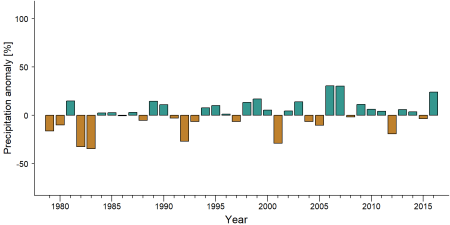
Precipitation anomaly in Dimonika Biosphere Reserve -
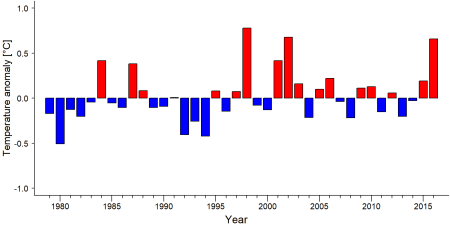
Temperature anomaly in Dimonika Biosphere Reserve


External links
References
BirdLife International. (2021). Important Bird Areas factsheet: Dimonika Biosphere Reserve. Downloaded from http://www.birdlife.org on 14/10/2021.
Pintea, L., Atencia, R., & Cox, D. (2013). Gorillas in the Dimonika Biosphere Reserve. Gorilla Journal 46, 16-19. Online: https://www.berggorilla.org/en/gorillas/species/western-gorillas/articles-western-gorillas/gorillas-in-the-dimonika-biosphere-reserve/
Page created by: APES Atlas Team Date: 2021-10-15