
Dzanga-Sangha Protected Area: Difference between revisions
No edit summary |
No edit summary |
||
| Line 213: | Line 213: | ||
!Source | !Source | ||
!Year(s) | !Year(s) | ||
|- | |- | ||
|2 Resources and capacity | |2 Resources and capacity | ||
| Line 233: | Line 228: | ||
|UNESCO World Heritage Centre 2012 | |UNESCO World Heritage Centre 2012 | ||
|2012-Ongoing (2025) | |2012-Ongoing (2025) | ||
|- | |||
|1 Site management | |||
| | |||
| | |||
| | |||
|- | |- | ||
|5 Ecological context | |5 Ecological context | ||
Revision as of 06:35, 15 December 2025
Central Africa > Central African Republic > Dzanga-Sangha Protected Area
Français | Português | Español | Bahasa Indonesia | Melayu
Summary
- Central chimpanzees (Pan troglodytes troglodytes) and western lowland gorillas (Gorilla gorilla gorilla) are present in the Dzanga-Sangha Protected Area.
- It has been estimated that 2,059 great apes occur in the site.
- The great ape population trend is stable.
- The site has a total size of 6,865 km².
- Key threats to great apes are hunting, logging, and increased risk of disease transmission from humans.
- Conservation activities have focused on anti-poaching patrols, eco-tourism, and supporting community health.
- The site forms part of the Sangha Trinational transboundary conservation complex
Site characteristics
Dzanga-Sangha is located in the southwestern corner of the Central African Republic, bordering Dzanga-Ndoki National Park, also found in the Central African Republic, and Nouabalé-Ndoki National Park in the Republic of the Congo. The site forms part of the Sangha Trinational (TNS) transboundary conservation complex, a UNESCO World Heritage Site. The TNS also encompasses Lobéké National Park in Cameroon, Dzanga-Ndoki National Park in the Central African Republic and Nouabalé-Ndoki National Park in the Republic of Congo. The Dzanga-Sangha Dense Forest Special reserve was established in 1990; in 2007 it was renamed the Dzanga-Sangha Protected Area (DSPA). In 2019, the World Wide Fund for Nature signed a co-management agreement with the government (Dzanga-Sangha). The DSPA is formed by a mosaic of ecosystems, including rivers, marshlands and bais, which support rare and endangered species such as forest elephants, western lowland gorillas, sitatungas and bongos (Dzanga-Sangha).
Table 1. Basic site information for Dzanga-Sangha Protected Area
| Species | Pan troglodytes troglodytes, Gorilla gorilla gorilla |
| Area | 6,865 km² |
| Coordinates | Lat: 3.173628 , Lon: 16.296941 |
| Type of site | Protected area |
| Habitat types | Subtropical/tropical swamp forest, Subtropical/tropical moist lowland forest, Wetlands (lakes, rivers, streams, bogs, marshes) |
| Type of governance | Shared governance |
Types of sites Governance types Habitat types
Ape status
From 2012 to 2016 the great ape population in the DSPA has remained stable (N'Goran 2017).
Table 2. Ape population estimates reported for Dzanga-Sangha Protected Area
| Species | Year | Occurrence | Encounter or vistation rate (nests/km; ind/day) | Density estimate [ind./ km²] (95% CI) | Abundance estimate (95% CI) | Survey area | Sampling method | Analytical framework | Source | Comments | A.P.E.S. database ID |
|---|---|---|---|---|---|---|---|---|---|---|---|
| Pan troglodytes troglodytes & Gorilla gorilla gorilla | 2012 | 2310.0 | Dzanga-Sangha Protected Area | Line transects | N'Goran 2017 | ||||||
| Pan troglodytes troglodytes & Gorilla gorilla gorilla | 2016 | 2059.0 | Dzanga-Sangha Protected Area | Line transects | N'Goran 2017 |
Sampling methods Analytical frameworks
Threats
Table 3. Threats to apes reported for Dzanga-Sangha Protected Area
| Category | Specific threats | Threat level | Description | Year of threat |
|---|---|---|---|---|
| 5 Biological resource use | 5.3 Logging & wood harvesting | Present (unknown severity) | Since 2014, two companies have each been granted a logging and administrative permit. Logging by the two companies will be completed by 2020. At that point, their concession permit can be extended or renewed (Dzanga-Sangha). | 2014-Ongoing (2020) |
| 5 Biological resource use | 5.1 Hunting & collecting terrestrial animals | High (more than 70% of population affected) | Growing demand for bushmeat from distant urban areas (Dzanga-Sangha). Active hunting pressures mapped during participatory ZCC mission; snares, cartridges, camps detected (DSPA Newsletter 2024). | 2020-Ongoing (2024) |
| 8 Invasive & other problematic species, genes & diseases | 8.4 Pathogens | Present (unknown severity) | Increased risk of disease transmission from humans (Dzanga-Sangha). | Ongoing (2020) |
Conservation activities
Table 4. Conservation activities reported for Dzanga-Sangha Protected Area
| Category | Specific activity | Description | Implementing organization(s) | Year of activity |
|---|---|---|---|---|
| 5 Protection & restoration | 5.2 Legally protect ape habitat | The area encompasses Dzanga-Ndoki National Park and Dzanga-Sangha Special Reserve | 1990-Ongoing (2025) | |
| 6 Species management | 6.1 Habituate primates to human presence to reduce stress from tourists/researchers | Visitors have the privilege of tracking gorillas and mangabeys who are used to the presence of humans, thanks to the Primate Habituation Programme (PHP) (Dzanga-Sangha). | 1997-Ongoing (2020) | |
| 2 Counter-wildlife crime | 2.3 Conduct regular anti-poaching patrols | Anti-poaching patrols (Dzanga-Sangha). A total of 41 patrols were carried out with the participation of 86 rangers, amounting to 1,673 ranger-days and covering nearly 2,000 km on foot (DSPA Newsletter 2024). | DSPA Protection & Surveillance Department | 2018-Ongoing (2024) |
| 7 Economic & other incentives | 7.2 Provide non-monetary benefits to local communities for sustainably managing their forest and its wildlife (e.g., better education, infrastructure development) | Support community health through a mobile unit and health care centers; supporting schools with money for teaching materials, teacher salaries, and student fees (Dzanga-Sangha]). School supplies distributed to 1 480 students (32 primary, 2 high schools), maintenance and installation of solar plants at Dzanga and Belemboke (DSPA Newsletter 2024). | DSPA Community Department, CSSS team, EU NaturAfrica initiative, WWF | 2019-Ongoing (2024) |
| 8 Permanent presence | 8.2 Run tourist projects and ensure permanent human presence at site | Eco-tourism project (Dzanga-Sangha). | Ongoing (2020) | |
| 2 Counter-wildlife crime | 2.11 Implement monitoring surveillance strategies (e.g., SMART) or use monitoring data to improve effectiveness of patrols | A monitoring system has been established that not only tracks wildlife species but also examines, for example, how human pressure affects natural resources. In addition, we record the spatial distribution of habitats, monitor changes in forest area, and collect data on timber usage (Dzanga-Sangha Protected Areas 2025). | Ongoing (2025) | |
| 3 Species health | 3.13 Implement a health programme for local communities | zoonotic diseases such as Ebola and anthrax can be transmitted between humans and animals. To protect both people and wildlife, Dzanga-Sangha Protected Area developed an early warning system in collaboration with the Robert Koch Institute, and since 2022, they had been working with the Helmholtz Institute for One Health. They noted that this approach helps prevent deadly outbreaks and supports the health of wildlife populations safeguarding ecotourism as a vital source of income for local communities (Dzanga-Sangha Protected Areas 2025). In addition, Malaria diagnostic tests (Giemsa stain) were introduced (DSPA Newsletter 2024). | Dzanga-Sangha National Protected Area, Helmholtz Institute for One Health | 2022-Ongoing (2025) |
Challenges
Table 5. Challenges reported for Dzanga-Sangha Protected Area
| Challenges | Specific challenges | Source | Year(s) |
|---|---|---|---|
| Not reported |
Enablers
Table 6. Enablers reported for Dzanga-Sangha Protected Area
| Enablers | Specific enablers | Source | Year(s) |
|---|---|---|---|
| 2 Resources and capacity | 2.6 External partnerships that add expertise or resources | DSPA Newsletter 2024 | Ongoing (2024) |
| 3 Engaged community | 3.6 Local community engagement and support | DSPA Newsletter 2024 | Ongoing (2024) |
| 4 Institutional support | 4.3 Strong transboundary cooperation | UNESCO World Heritage Centre 2012 | 2012-Ongoing (2025) |
| 1 Site management | |||
| 5 Ecological context | |||
| 6 Safety and stability |
Research activities
Researchers from around the world come to Dzanga-Sangha to study wildlife and rainforest ecology, with findings guiding park management. Research also helps understand community impacts, human-wildlife conflicts like crop damage by elephants, and disease transmission risks. Their work includes a zoonoses project and a Primate Habituation Programme to support ecotourism (Research in Dzanga-Sangha). A study was also carried out. A deeper investigation into his injuries suggests they were the result of a fight with another male. Silverbacks can engage in physical confrontations during sexual competition, sometimes injuring or even killing their rivals (Potel et al., 2024).
Documented behaviours
Table 7. Behaviours documented for Dzanga-Sangha Protected Area
| Category | Behavior | Observation type | Prevalence | Observation dates | Source | Habituation | Species | Comment |
|---|---|---|---|---|---|---|---|---|
| Not reported |
Exposure to climate change impacts
As part of a study on the exposure of African great ape sites to climate change impacts, Kiribou et al. subm. extracted climate data and data on projected extreme climate impact events for the site. Climatological characteristics were derived from observation-based climate data provided by the Inter-Sectoral Impact Model Intercomparison Project (ISIMIP, www.isimip.org). Parameters were calculated as the average across each 30-year period. For 1981-2010, the EWEMBI dataset from ISIMIP2a was used. For the two future periods (2021-2050 and 2071-2099) ISIMIP2b climate data based on four CMIP5 global climate models were used. For future projections, two Representative Concentration Pathways (RCP) were used. RCP 2.6 is a scenario with strong mitigation measures in which global temperatures would likely rise below 2C. RCP 6.0 is a scenario with medium emissions in which global temperatures would likely rise up to 3C by 2100. For the number of days with heavy precipitation events, the 98th percentile of all precipitation days (>1mm/d) was calculated for the 1979-2013 reference period as a threshold for a heavy precipitation event. Then, for each year, the number of days above that threshold was derived. The figures on temperature and precipitation anomaly show the deviation from the mean temperature and mean precipitation for the 1979-2013 reference period.
The estimated exposure to future extreme climate impact events (crop failure, drought, river flood, wildfire, tropical cyclone, and heatwave) is based on a published dataset by Lange et al. 2020 derived from ISIMIP2b data. The same global climate models and RCPs as described above were used. Within each 30-year period, the number of years with an extreme event and the average proportion of the site affected were calculated (see Kiribou et al. subm. for details).
Table 8. Estimated past and projected climatological characteristics in Dzanga-Sangha Protected Area
| Value | 1981-2010 | 2021-2050, RCP 2.6 | 2021-2050, RCP 6.0 | 2071-2099, RCP 2.6 | 2071-2099, RCP 6.0 |
|---|---|---|---|---|---|
| Mean temperature [C] | 24.4 | 25.7 | 25.6 | 26 | 26.9 |
| Annual precipitation [mm] | 1579 | 1576 | 1632 | 1639 | 1629 |
| Max no. consecutive dry days (per year) | 24.5 | 24.3 | 24.4 | 20.8 | 26.7 |
| No. days with heavy precipitation (per year) | 6.5 | 10.2 | 11.6 | 11 | 11.8 |
Table 9. Projected exposure of apes to extreme climate impact events in Dzanga-Sangha Protected Area
| Type | No. of years with event (2021-2050, RCP 2.6) | % of site exposed (2021-2050, RCP 2.6) | No. of years with event (2021-2050, RCP 6.0) | % of site exposed (2021-2050, RCP 6.0) | No. of years with event (2070-2099, RCP 2.6) | % of site exposed (2070-2099, RCP 2.6) | No. of years with event (2070-2099, RCP 6.0) | % of site exposed (2070-2099, RCP 6.0) |
|---|---|---|---|---|---|---|---|---|
| Crop failure | 11.5 | 0.01 | 5.5 | 0.01 | 9 | 0.01 | 17.5 | 0.02 |
| Drought | 0 | 0 | 0 | 0 | 0 | 0 | 0.5 | 16.07 |
| Heatwave | 3 | 33.33 | 2.5 | 70.83 | 4.5 | 55.56 | 12 | 73.21 |
| River flood | 0 | 0 | 1.5 | 0.34 | 1 | 0.04 | 1 | 0.96 |
| Tropical cyclone | 0 | 0 | 0 | 0 | 0 | 0 | 0 | 0 |
| Wildfire | 30 | 0.87 | 30 | 0.87 | 29 | 0.81 | 29 | 0.78 |
-
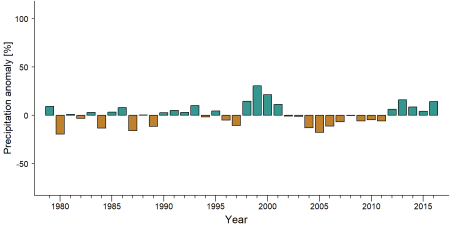
Precipitation anomaly in Dzanga-Sangha Protected Area -
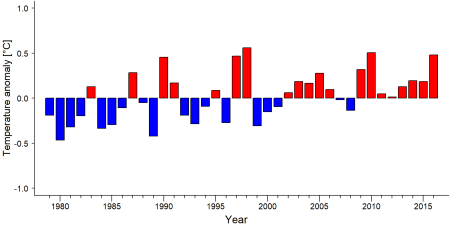
Temperature anomaly in Dzanga-Sangha Protected Area


External links
References
Dzanga-Sangha Protected Areas (2025). Research in Dzanga-Sangha. https://dzanga-sangha.org/research/
Potel, H., [Other authors’ initials & surnames], & [Last author]. (2024). Lethal combats in the forest among wild western gorillas: We show lethal aggressions in western gorillas as predicted by sexual selection. iScience, 27(??), ???. https://doi.org/10.1016/j.isci.2024.00658-8
N'Goran, K.P. (2017). Summary Report on WWF BIOMONITORING activities from 2014 to 2016 Status of Forest Elephant and Great Apes in Central Africa Priority Sites. Available online: https://www.wwf.de/fileadmin/fm-wwf/Publikationen-PDF/WWF_CA_Biomonitoring_Report.pdf
UNESCO World Heritage Centre (2012). Sangha Trinational (Cameroon, Central African Republic, Congo).
Page created by: APES Atlas Team Date: 2020-12-30
Page updated by: Aime Mizero Date: 2025-10-22