
Lac Télé Community Reserve: Difference between revisions
No edit summary |
No edit summary |
||
| Line 541: | Line 541: | ||
|- | |- | ||
|2 Counter-wildlife crime | |2 Counter-wildlife crime | ||
|2. | |2.10 Inform hunters of the dangers (e.g., disease transmission) of handling ape meat | ||
| | |One wildlife health officer in place in reserve staff since 2022. Awareness campaigns on zoonoses risk (Ebola, Mpox) conducted every year. In 2024 : 7 villages/ 330 people reached (Brugiere pers. comm. 2025). | ||
|Wildlife Conservation Society | |Wildlife Conservation Society | ||
| | |Ongoing (2025) | ||
|- | |- | ||
|2 Counter-wildlife crime | |2 Counter-wildlife crime | ||
| Line 551: | Line 551: | ||
|Wildlife Conservation Society | |Wildlife Conservation Society | ||
|2010-Ongoing (2025) | |2010-Ongoing (2025) | ||
|- | |- | ||
|2 Counter-wildlife crime | |2 Counter-wildlife crime | ||
|2. | |2.13 Provide sustainable alternative livelihoods; establish fish- or domestic meat farms | ||
| | |By-laws (developed conjointly by reserve staff and local community) on sustainable fishing activities in place since 2007 (Brugiere pers. comm. 2025). | ||
|Wildlife Conservation Society | |Wildlife Conservation Society | ||
| | |2007-Ongoing (2025) | ||
|- | |- | ||
|2 Counter-wildlife crime | |2 Counter-wildlife crime | ||
| Line 581: | Line 569: | ||
|Wildlife Conservation Society | |Wildlife Conservation Society | ||
|Ongoing (2025) | |Ongoing (2025) | ||
|- | |||
|2 Counter-wildlife crime | |||
|2.5 Inspect bushmeat markets for ape species | |||
|Busmeat markets are inspected regularly at the village level. Last bushmeat survey was carried out in 2023 in five villages over a year (Brugiere pers. comm. 2025) | |||
|Wildlife Conservation Society | |||
|2023-Ongoing (2025) | |||
|- | |- | ||
|2 Counter-wildlife crime | |2 Counter-wildlife crime | ||
| Line 599: | Line 593: | ||
|Wildlife Conservation Society | |Wildlife Conservation Society | ||
|Ongoing (2025) | |Ongoing (2025) | ||
|- | |||
|3 Species health | |||
|3.12 Detect & report dead apes and clinically determine their cause of death to avoid disease transmission | |||
|Detection system in place since 2022 run by wildlife health officer with local communities (see also 2.10). One gorilla carcass reported and analyzed in 2024 (cause of death unknown but not caused by virus infection) (Brugiere pers. comm. 2025). | |||
|Wildlife Conservation Society | |||
|2022-Ongoing (2025) | |||
|- | |- | ||
|4 Education & awareness | |4 Education & awareness | ||
Revision as of 10:29, 23 December 2025
Central Africa > Republic of the Congo > Lac Télé Community Reserve
Français | Português | Español | Bahasa Indonesia | Melayu
Summary
- Central chimpanzees (Pan troglodytes troglodytes) & western lowland gorillas (Gorilla gorilla gorilla) are present in Lac Télé Community Reserve.
- It has been estimated that 3,207 (CI: 1,699-6,052) gorillas and 85 (CI: 21-351) chimpanzees occur in the site.
- The chimpanzee and gorilla population trends are decreasing.
- The site has a total size of 4,380 km².
- Key threats to great apes are hunting and habitat loss due to expected increase in road construction.
- Conservation activities have focused on monitoring with SMART, anti-poaching patrols, and providing alternative forms of income and protein to reduce the bushmeat trade.

Site characteristics
Lac Télé Community Reserve (LTCR) is located in the northeastern Republic of the Congo. Consisting of 70% wetland, Lac Télé Community Reserve is one of the world's largest swamp-forest (WCS).The site is located between the Sangha and Oubangui rivers. The Reserve comprises four main terrestrial ecosystems: (i) permanently flooded forests (also called swamp forests; 50% of the size of the Reserve), (ii) seasonally flooded forests (24%), (iii) terra firma forests (9%), and (iv) seasonally flooded savannas (17%). The Reserve is bisected by the Likouala-aux-Herbes River (a tributary of the Sangha river) and the savannas are found along the river, extending 2-3 km from its banks. There are two rainy seasons: a minor one from May to July, and a major one from September to November (Romani & Ossere 2025a). During the latter, approx. 90% of the LTCR is flooded.
In the centre of the reserve lies an area of firm land, which is an important habitat for gorillas (WCS). The reserve supports one of the densest populations of western lowland gorillas, and it is also home to chimpanzees, elephants, buffaloes, duikers, and hippopotamuses. In total, the primate community includes 11 species, 2 apes and 9 cercopithecidae species (Romani pers. comm. 2025).
The reserve is populated by local communities (approximately 20,000 people live in the reserve, mainly on its borders; WCS; Ramsar). These communities heavily depend on the reserve's natural resources for fish, agriculture, construction materials, canoes, and medicines (WCS; Ramsar).
The reserve was designated a Ramsar site in 1998. In 2017, the Lac Tumba Transboundary Ramsar Site was established, which includes Lac Télé and Grands Affluents in Congo, as well as Ngiri-Tumba-Maindombe in the Democratic Republic of Congo (Ramsar). The Reserve is also a Key Biodiversity Area (KBA) and an Important Bird Area (IBA).
Table 1. Basic site information for Lac Télé Community Reserve
| Species | Pan troglodytes troglodytes, Gorilla gorilla gorilla |
| Area | 4,380 km² |
| Coordinates | Lat: 1.316971 , Lon: 17.223215 |
| Type of site | Non-protected area (Community Forest) |
| Habitat types | Subtropical/tropical swamp forest, Subtropical/tropical moist lowland forest, Wetlands (lakes, rivers, streams, bogs, marshes), Shrubland, Grassland |
| Type of governance |
Types of sites Governance types Habitat types

Ape status
Earlier studies (1990s) found diverse groups of gorillas in the swamps, and no accurate estimations of chimpanzee abundance or densities have been carried out. Surveys conducted between 2002 and 2023 have provided a picture of the status of great apes- western lowland gorillas (Gorilla gorilla gorilla) and central chimpanzees (Pan troglodytes troglodytes)- in the region. These studies, relying on line transect distance sampling and covering various zones such as the main Reserve, the Batanga, and the Tanga reveal both temporal and spatial variations in ape densities.
The first comprehensive estimate, carried out in 2002 by Poulsen & Clark (2004), showed relatively high densities, particularly for gorillas, with an estimated 2.9 individuals/km² and a total population of over 13,000 gorillas in the Reserve. Chimpanzees were less abundant, with densities around 0.7 individuals/km². Subsequent surveys confirmed these trends but also highlighted fluctuations over time.
In 2006, Stokes et al. (2010) observed a decrease in both species, especially chimpanzees, whose density dropped to 0.13 individuals/km², while gorillas maintained moderate levels (2.27 individuals/km²). These differences may reflect changes in survey methodology, nest decay assumptions, or actual population dynamics. Notably, in Batanga in 2007, gorilla density estimates spiked to over 5 individuals/km², suggesting localized areas of high abundance. However, these numbers declined in 2009 and again in 2012, pointing to either a real population decline or variability in detection.
The 2011 survey by Maisels et al. (2012) showed contrasting situations across regions: high gorilla densities (4.3 ind./km²) in Lac Télé north, but much lower densities (0.5 ind./km²) in the southern zones. Chimpanzees remained scarce in most surveys, with densities rarely exceeding 0.2 individuals/km², and sometimes too low for reliable estimation.
By 2017, densities in the Reserve had decreased further, with gorillas estimated at 1.6 individuals/km² and chimpanzees at 0.16 individuals/km² (Brncic et al. 2018). The most recent surveys in 2023 (Estienne et al. 2025) confirmed this declining trend, particularly for chimpanzees, whose densities reached a low of 0.02 individuals/km² in the Reserve and 0.08 individuals/km² in Batanga. Gorillas also showed reduced densities compared to earlier surveys, with values around 0.76-0.91 individuals/km² depending on the site.
In summary, over the last two decades, gorillas have consistently been more abundant than chimpanzees, but both species show signs of population decline in many areas. The highest densities have historically been recorded in swamp and mixed forests, but recent data suggest growing conservation concern, especially for chimpanzees, whose nest encounters have become extremely rare. These findings underscore the importance of continued monitoring and the need to understand the drivers of change in great ape populations across the region (Romani pers. comm. 2025).
Table 2. Ape population estimates reported for Lac Télé Community Reserve
| Species | Year | Occurrence | Encounter or vistation rate (nests/km; ind/day) | Density estimate [ind./ km²] (95% CI) | Abundance estimate (95% CI) | Survey area | Sampling method | Analytical framework | Source | Comments | A.P.E.S. database ID |
|---|---|---|---|---|---|---|---|---|---|---|---|
| Gorilla gorilla gorilla | 1989-1990 | 1.43 | 1.20 | Mboukou zone | Line transects | Distance sampling with adopted decay time | Fay et al. 1990, Fay & Agnagna 1992 | Nest decay rates from Tutin and Fernandez (1984). | |||
| Gorilla gorilla gorilla | 1993 | 2.85 | 2.93 | Botala, Bossela, Liouesso zones | Line transects | Distance sampling with adopted decay time | Blake et al. 1995 | Nest decay rates from Tutin and Fernandez (1984). | |||
| Gorilla gorilla gorilla | 2002 | 3.07 | 2.9 (0.3-5.4) | 13,221 (7,054-25,597) | Lac Télé Community Reserve (4,380 km²) | Line transects | Distance sampling with adopted decay time | Poulsen & Clark 2004 | Highest densities in swamp forest and terra firma mixed forest. Nest decay rates from Tutin et al. (1995). | ||
| Pan troglodytes troglodytes | 2002 | 2.07 | 0.7 (0.1-1.3) | 3,189 (1,741-5,814) | Lac Télé Community Reserve (4,380 km²) | Line transects | Distance sampling with adopted decay time | Poulsen & Clark 2004 | Nest decay rates from Tutin et al. (1995). | ||
| Pan troglodytes troglodytes & Gorilla gorilla gorilla | 2002 | 5.15 | 3.6 (2.0-6.2) | 16,514 (9,171-28,049) | Lac Télé Community Reserve (4,380 km²) | Line transects | Distance sampling with adopted decay time | Poulsen & Clark 2004 | Nest decay rates from Tutin et al. (1995). | ||
| Gorilla gorilla gorilla | 2006 | 4.26 | 2.27 (1.66-3.11) | 8,919 (6,514-12,211) | Lac Télé Community Reserve (4,380 km²) | Line transects | Distance sampling with adopted decay time | Stokes et al. 2010 | Decay rates of nests from Morgan et al. (2006). | ||
| Pan troglodytes troglodytes | 2006 | 0.66 | 0.13 (0.07-0.26) | 509 (257-1,007) | Lac Télé Community Reserve (4,380 km²) | Line transects | Distance sampling with adopted decay time | Stokes et al. 2010 | Decay rates of nests from Morgan et al. (2006). | ||
| Pan troglodytes troglodytes & Gorilla gorilla gorilla | 2006 | 4.92 | 2.08 (1.38-3.12) | Lac Télé Community Reserve (4,380 km²) | Line transects | Distance sampling with adopted decay time | Stokes et al. 2010 | Decay rates of nests from Morgan et al. (2006). | |||
| Gorilla gorilla gorilla | 2007 | 3.33 | 5.25 (2.70-10.19) | 5,402 (2,778-10,486) | Batanga (1,029 km²) | Line transects | Distance sampling with adopted decay time | Rainey et al. 2009 | Decay rates of nests from Morgan et al. (2006). | ||
| Pan troglodytes troglodytes & Gorilla gorilla gorilla | 2007 | 1.97 | 6.81 (3.93-11.84) | 7,647 (4,044-12,183) | Batanga (1,029 km²) | Line transects | Distance sampling with adopted decay time | Rainey et al. 2009 | Decay rates of nests from Morgan et al. (2006). | ||
| Gorilla gorilla gorilla | 2009 | 2.21 | 1.50 (0.82-2.76) | 3,368 (1,841-6,108) | Tanga (2,246 km²) | Line transects | Distance sampling with adopted decay time | Malanda et al. 2009 | Decay rates of nests from Morgan et al. (2006). | ||
| Pan troglodytes troglodytes | 2009 | 0.01 | Tanga (2,246 km²) | Line transects | Distance sampling with adopted decay time | Malanda et al. 2009 | Too few chimpanzee nests to calculate density. | ||||
| Pan troglodytes troglodytes & Gorilla gorilla gorilla | 2009 | 2.36 | 1.63 (0.97-2.51) | 3,660 (2,178-5,637) | Tanga (2,246 km²) | Line transects | Distance sampling with adopted decay time | Malanda et al. 2009 | Decay rates of nests from Morgan et al. (2006). | ||
| Gorilla gorilla gorilla | 2011 | 0.80 | 0.5 (0.3-1.1) | 1,758 (845-3,658) | Bailly south and Lac Tele south (3,299 km²) | Line transects | Distance sampling with adopted decay time | Maisels et al. 2012 | Decay rates of nests from Sanz et al. (2007). | ||
| Pan troglodytes troglodytes | 2011 | 0.55 | 0.14 (0.05-0.37) | 455 (171-1,208) | Bailly south and Lac Tele south (3,299 km²) | Line transects | Distance sampling with adopted decay time | Maisels et al. 2012 | Decay rates of nests from Sanz et al. (2007). | ||
| Pan troglodytes troglodytes & Gorilla gorilla gorilla | 2011 | 1.16 | 0.62 (0.34-1.13) | 2,046 (1,128-3,712) | Bailly south and Lac Tele south (3,299 km²) | Line transects | Distance sampling with adopted decay time | Maisels et al. 2012 | Decay rates of nests from Sanz et al. (2007). | ||
| Gorilla gorilla gorilla | 2011 | 6.44 | 4.3 (2.2-8.4) | 11,859 (6,096-23,072) | Lac Tele north (2,755 km²) | Line transects | Distance sampling with adopted decay time | Maisels et al. 2012 | Decay rates of nests from Sanz et al. (2007). | ||
| Pan troglodytes troglodytes | 2011 | 0.67 | 0.17 (0.07-0.39) | 463 (202-1,064) | Lac Tele north (2,755 km²) | Line transects | Distance sampling with adopted decay time | Maisels et al. 2012 | Decay rates of nests from Sanz et al. (2007). | ||
| Pan troglodytes troglodytes & Gorilla gorilla gorilla | 2011 | 7.09 | 3.79 (2.06-6.97) | 10,437 (5,672-19,204) | Lac Tele north (2,755 km²) | Line transects | Distance sampling with adopted decay time | Maisels et al. 2012 | Decay rates of nests from Sanz et al. (2007). | ||
| Gorilla gorilla gorilla | 2012 | 2.92 (1.7-5.02) | 3,009 (1,749-5,175) | Batanga (1,029 km²) | Line transects | Distance sampling with adopted decay time | Iyenguet et al. 2012 | Decay rates of nests from Morgan et al. (2006). | |||
| Pan troglodytes troglodytes & Gorilla gorilla gorilla | 2012 | 3.03 (1.78-5.17) | 3,124 (1,835-5,318) | Batanga (1,029 km²) | Line transects | Distance sampling with adopted decay time | Iyenguet et al. 2012 | Decay rates of nests from Morgan et al. (2006). Too few chimpanzee nests to calculate density. | |||
| Gorilla gorilla gorilla | 2017 | 4.99 | 1.60 (0.83-3.11) | 6,761 (3,487-13,109) | Lac Télé Community Reserve (4,380 km²) | Line transects | Distance sampling with adopted decay time | Brncic et al. 2018 | Decay rates of nests from Morgan et al. (2016). | ||
| Pan troglodytes troglodytes | 2017 | 0.79 | 0.16 (0.07-0.34) | 669 (309-1,448) | Lac Télé Community Reserve (4,380 km²) | Line transects | Distance sampling with adopted decay time | Brncic et al. 2018 | Decay rates of nests from Morgan et al. (2016). | ||
| Pan troglodytes troglodytes & Gorilla gorilla gorilla | 2017 | 5.78 | 1.93 (1.03-3.63) | 8,158 (4,351-15,297) | Lac Télé Community Reserve (4,380 km²) | Line transects | Distance sampling with adopted decay time | Brncic et al. 2018 | Decay rates of nests from Morgan et al. (2016). | ||
| Gorilla gorilla gorilla | 2023 | 0.76 (0.40-1.44) | 3,207 (1,699 - 6,052) | Lac Télé Community Reserve (4,380 km²) | Line transects | Distance sampling with adopted decay time | Estienne et al. 2025 | Decay rates of nests from Morgan et al. (2016). | |||
| Pan troglodytes troglodytes | 2023 | 0.02 (0.01-0.08) | 85 (21-351) | Lac Télé Community Reserve (4,380 km²) | Line transects | Distance sampling with adopted decay time | Estienne et al. 2025 | Decay rates of nests from Morgan et al. (2016). | |||
| Pan troglodytes troglodytes & Gorilla gorilla gorilla | 2023 | 0.80 (0.43-1.48) | 3,356 (1,807-6,235) | Lac Télé Community Reserve (4,380 km²) | Line transects | Distance sampling with adopted decay time | Estienne et al. 2025 | Decay rates of nests from Morgan et al. (2016). | |||
| Gorilla gorilla gorilla | 2023 | 0.91 (0.50-1.67) | 2,073 (1,133-3,790) | Batanga (2,276 km²) | Line transects | Distance sampling with adopted decay time | Estienne et al. 2025 | Decay rates of nests from Morgan et al. (2016). | |||
| Pan troglodytes troglodytes | 2023 | 0.08 (0.02-0.36) | 170 (35-818) | Batanga (2,276 km²) | Line transects | Distance sampling with adopted decay time | Estienne et al. 2025 | Decay rates of nests from Morgan et al. (2016). | |||
| Pan troglodytes troglodytes & Gorilla gorilla gorilla | 2023 | 1.05 (0.60-1.85) | 2,394 (1,364-4,204) | Batanga (2,276 km²) | Line transects | Distance sampling with adopted decay time | Estienne et al. 2025 | Decay rates of nests from Morgan et al. (2016). |
Sampling methods Analytical frameworks
Threats
As a result of the civil war occurring in the country in the 90s, many war guns are still present in the country. Poaching is widespread in the country, and the laws and regulations of legal hunting do not follow direct scientific criteria.
In the Reserve there are currently no major threats to ape populations. Subsistence hunting by local population is permitted, However monitoring by reserve staff of hunting catches as well as seizure of illegal game at road check point have shown that apes are present but at very low level in the carcasses (1 chimpanzee carcasses out of 2,182 carcasses in five villages monitored in 2023 - Bondeko et al., 2024 ; 7,5 kg of smoked gorilla seized over 4 years out of a total of 5,921 kg seized at road check point - Romani et al., 2025).
The proposed road between Bene (north LTCR) and Epena (east LTCR) would cut the northern area into two pieces, leading to fragmentation and poaching inside an area that is nowadays considered as virgin flooded forest (Trivellini, G. pers. comm. 2022). For this road, authorities have already "posed the first stone"; a trail was manually opened by villagers in early 2024; since that date, no work has been undertaken and the trail is gradually being closed by the vegetation.
Table 3. Threats to apes reported for Lac Télé Community Reserve
| Category | Specific threats | Threat level | Description | Year of threat |
|---|---|---|---|---|
| 1 Residential & commercial development | 1.1 Residential areas | Low (up to 30% of population affected) | 20 000 people live in and around the réserve. Limited land clearing for housing purpose (Brugiere pers. comm. 2025). | Ongoing (2025) |
| 11 Climate change & severe weather | 11.2 Droughts | Present (unknown severity) | Apparent increase in climatic variability translates into increasingly very dry years. Savanna fires (which occur every year) destroy gallery forests along the Likouala river and tend to spread into forests. If frequency of dry years increases, this may change the whole ecology of the area and impact ape populations (Brugiere pers. comm. 2025). | Ongoing (2025) |
| 2 Agriculture & aquaculture | 2.1.2 Small-holder farming | Medium (30-70% of population affected) | Subsistence agriculture around villages based on slash & burn system (Brugiere pers. comm. 2025). | Ongoing (2025) |
| 5 Biological resource use | 5.1 Hunting & collecting terrestrial animals | Medium (30-70% of population affected) | Mammal species hunted for commercial bushmeat markets, not only locally, but also in urban areas further away, e.g., in Kinshasa (WCS). Hunting gorillas in the area seems to be opportunistic (Romani et al., 2025), but some cases of poachers targeting gorillas are known. | Ongoing (2025) |
| 5 Biological resource use | 5.3 Logging & wood harvesting | Low (up to 30% of population affected) | Deforestation concentrated along the rivers and in terra firma forests. Trees are logged mainly for firewood collection and slash-and-burn agriculture. Although at the moment is it small-scale, the threat is expected to increase as road networks expand in the area (WCS). | Ongoing (2025) |
| 4 Transportation & service corridors | 4.1 Roads & railroads | High (more than 70% of population affected) | A road project between Epene and Bene is foreseen and proposed by the State. Future, but public authorities already organised events to publicly announce the project will be done. The road would cut the northern area of the reserve, increasing the access to nowadays inaccessible flooded forest and potentially fragmenting the humid environment (if the road will be built on a stripe of terra firma; Trivellini, G. pers. comm. 2022). | Unknown |
Conservation activities
The reserve is managed by the Ministry of Forest Economy (MEF) in partnership with WCS Congo. The reserve employs 65 staff (2024 figure) (3 MEF, 62 WCS) in five departments: law enforcement, community development, research & monitoring, logistics, human resources & finance. Annual budget is 1,5 USD M (2024) (100% provided by WCS). Law enfocement team comprises 19 staff (2 MEF; 17 WCS). Law enforcement patrols are permanently deployed in the field (2024 figures: 71 patrols and 3,105 man-days of rangers in the field; 9 poachers arrested; 1,161 kg of bushmeat seized). Community-based conservation is constantly implemented, focusing on sustainable use of natural resources (fish), improving living conditions (school, health, etc.) and developing income generating activities (honey, cocoa). Research and ecological biomonitoring in place for several years focusing on large and medium sized mammals. Research and biomonitoring strategy currently being designed for the next 5 years (Brugiere pers. comm. 2025).
Table 4. Conservation activities reported for Lac Télé Community Reserve
| Category | Specific activity | Description | Implementing organization(s) | Year of activity |
|---|---|---|---|---|
| 2 Counter-wildlife crime | 2.1 Implement road blocks to inspect cars for illegal ape bushmeat | One road block in place since 2000. 1,161 Kg of bushmeat seized in 2024 (5, 921 Kg in 2021-2024)(Brugiere pers. comm. 2025). | Wildlife Conservation Society | 2000-Ongoing (2025) |
| 2 Counter-wildlife crime | 2.10 Inform hunters of the dangers (e.g., disease transmission) of handling ape meat | One wildlife health officer in place in reserve staff since 2022. Awareness campaigns on zoonoses risk (Ebola, Mpox) conducted every year. In 2024 : 7 villages/ 330 people reached (Brugiere pers. comm. 2025). | Wildlife Conservation Society | Ongoing (2025) |
| 2 Counter-wildlife crime | 2.11 Implement monitoring surveillance strategies (e.g., SMART) or use monitoring data to improve effectiveness of patrols | SMART system in place since 2010. Earth Ranger in place since 2023 (Brugiere pers. comm. 2025). | Wildlife Conservation Society | 2010-Ongoing (2025) |
| 2 Counter-wildlife crime | 2.13 Provide sustainable alternative livelihoods; establish fish- or domestic meat farms | By-laws (developed conjointly by reserve staff and local community) on sustainable fishing activities in place since 2007 (Brugiere pers. comm. 2025). | Wildlife Conservation Society | 2007-Ongoing (2025) |
| 2 Counter-wildlife crime | 2.14 Employ hunters in the conservation sector to reduce their impact | 80% of reserve rangers come from local villages – so are presumably former hunters (Brugiere pers. comm. 2025). | Wildlife Conservation Society | Ongoing (2025) |
| 2 Counter-wildlife crime | 2.3 Conduct regular anti-poaching patrols | 2024 : 71 patrols and 3,105 man-days of rangers in the field ; 9 poachers arrested; 1,161 kg of bushmed seized (Brugiere pers. comm. 2025). | Wildlife Conservation Society | Ongoing (2025) |
| 2 Counter-wildlife crime | 2.5 Inspect bushmeat markets for ape species | Busmeat markets are inspected regularly at the village level. Last bushmeat survey was carried out in 2023 in five villages over a year (Brugiere pers. comm. 2025) | Wildlife Conservation Society | 2023-Ongoing (2025) |
| 2 Counter-wildlife crime | 2.6 Regularly de-activate/remove ground snares | Conducted during ranger field patrols. Snare poaching is not common in the reserve (Brugiere pers. comm. 2025). | Wildlife Conservation Society | Ongoing (2025) |
| 2 Counter-wildlife crime | 2.7 Provide better equipment (e.g., guns) to anti-poaching ranger patrols | Field equipment for rangers is renewed on regular basis. Rangers receive new equipment every year (Brugiere pers. comm. 2025). | Wildlife Conservation Society | Ongoing (2025) |
| 2 Counter-wildlife crime | 2.8 Provide training to anti-poaching ranger patrols | Every ranger undergoes recycling training session (4 days) every year (Brugiere pers. comm. 2025). | Wildlife Conservation Society | Ongoing (2025) |
| 3 Species health | 3.12 Detect & report dead apes and clinically determine their cause of death to avoid disease transmission | Detection system in place since 2022 run by wildlife health officer with local communities (see also 2.10). One gorilla carcass reported and analyzed in 2024 (cause of death unknown but not caused by virus infection) (Brugiere pers. comm. 2025). | Wildlife Conservation Society | 2022-Ongoing (2025) |
| 4 Education & awareness | 4.1 Educate local communities about apes and sustainable use | Awareness campaigns run in the Reserve village every year by education officer. Subjects include ape conservation. 2024 figures : 2 awareness campaigns carried out in the Reserve’s 27 villages, reaching 762 people. In addition, 11 primary schools targeted reaching 802 pupils (Brugiere pers. comm. 2025). | Wildlife Conservation Society | Ongoing (2025) |
| 4 Education & awareness | 4.2 Involve local community in ape research and conservation management | Any ape research activity (survey, ecological study) involves local community members: field assistant, trackers, porters (Brugiere pers. comm. 2025). | Wildlife Conservation Society | Ongoing (2025) |
| 5 Protection & restoration | 5.10 Use prescribed burning within the context of home range size and use | Awaraness campaign on fire carried out each year in the Reserve; by-laws on fire management in the Reserve under development (Brugiere pers. comm. 2025). | Wildlife Conservation Society | Ongoing (2025) |
| 5 Protection & restoration | 5.5 Demarcate and enforce boundaries of protected areas | 80% of the Reserve boundaries are natural (rivers); 20% artificial boundaries have been demarcated with boards (Brugiere pers. comm. 2025). | Wildlife Conservation Society | Ongoing (2025) |
| 7 Economic & other incentives | 7.2 Provide non-monetary benefits to local communities for sustainably managing their forest and its wildlife (e.g., better education, infrastructure development) | Community conservation activities implented in the reserve focus on three type of activities : i) promote sustainable use of natural resources (fish), improving living conditions (school, health, water etc.) and developing income generating activities (honey, cocoa) (Brugiere pers. comm. 2025). | Wildlife Conservation Society | Ongoing (2025) |
| 8 Permanent presence | 8.1 Run research project and ensure permanent human presence at site | Research projects continuously run in the reserve (WCS staff + external researchers; Brugiere pers. comm. 2025). | Wildlife Conservation Society | Ongoing (2025) |
| 8 Permanent presence | 8.3 Permanent presence of staff/manager | Reserve staff (rangers, officers, assisitants, etc.) always in the field (Brugiere pers. comm. 2025). | Wildlife Conservation Society | Ongoing (2025) |
Challenges
Table 5. Challenges reported for Lac Télé Community Reserve
| Challenges | Specific challenges | Source | Year(s) |
|---|---|---|---|
| 1 Site management | 1.3 Corruption | Trivellini, G. pers. comm. 2022 | Ongoing (2022) |
| 3 Engaged community | 3.1 General lack of community engagement or support | Reserve annual activity reports | Ongoing (2025) |
| Other (Basic services (education, health, justice, security, transport, etc.) not ensured by State local services. Pressures on Reserve to deliver basic services) | Reserve annual activity reports | Ongoing (2025) | |
| 4 Institutional support | 4.2 Lack of government support | Reserve annual activity reports | Ongoing (2025) |
| Other (Reserve located in remote place making any field operation costly) | Reserve annual activity reports | Ongoing (2025) | |
| 5 Ecological context | 5.1 Ecological constraints (e.g., susceptibility to climate change, difficult terrain) | Reserve annual activity reports | Ongoing (2025) |
| 2 Resources and capacity | 2.4 Lack of continuous/long-term funding | Reserve annual activity reports | Ongoing (2025) |
Enablers
Table 6. Enablers reported for Lac Télé Community Reserve
| Enablers | Specific enablers | Source | Year(s) |
|---|---|---|---|
| 1 Site management | |||
| 2 Resources and capacity | |||
| 3 Engaged community | |||
| 4 Institutional support | |||
| 5 Ecological context | |||
| 6 Safety and stability |
Research activities
WCS implements wildlife surveys every 5 years, in order to establish the densities of large and medium sized mammals, including great apes. Two PhD projects related to apes are ongoing i) spatial ecology of the gorillas (K. Meier/ Univ. Yale); ii) Inter group communication of gorillas (A. Michel/ Univ. Davies). One additional PhD study (Hunting patterns by local communities in the Reserve by B. Christin) and a Post Doctoral study (Material culture, nesting behaviour and tool use, of the RCLT chimpanzees by T. Romani) will start in 2025.
Between 2008 and 2010, the first in-depth studies on the feeding and nesting ecology of gorillas were carried out in the Lac Télé Community Reserve. Kalan (2008) conducted one of the earliest investigations focused on the diet and nest-building behavior of Western lowland gorillas (Gorilla gorilla gorilla). This research provided critical insight into the gorillas’ nesting habits and the types of vegetation they relied on for food. Building on these findings, Kalan et al. (2010) produced a preliminary report further exploring the feeding and nesting behavior of swamp-dwelling gorillas, highlighting the species’ remarkable ability to adapt to flooded environments.
After a decade-long pause, the study of great apes in the region experienced a renewed momentum between 2022 and 2024. Meier (2024) led a comprehensive field study on the ecology and conservation of great apes, addressing key themes such as habitat use, human-induced pressures, and the implementation of effective monitoring strategies. Around the same time, Redjali (2024) investigated how chimpanzees navigate and utilize space in a human-altered, seasonally flooded landscape. Her work emphasized the chimpanzees’ ecological flexibility and their capacity to adapt to disturbed habitats.
In 2024, the research landscape became even more dynamic with the introduction of methodological innovations and more targeted ecological studies. Christin (2024) focused on primate density—particularly great apes—within a transitional ecotone zone in northern Congo. His work explored how hunting pressure influences species distribution across these shifting habitats. Caillaud (2024) explored the potential of using fixed-wing drones for surveying great ape populations, a promising avenue for non-invasive monitoring in the flood-prone and logistically challenging environment of the reserve. Michel (2024) tested a novel dual-method approach to track social interactions within gorilla groups, offering new perspectives on group dynamics and social cohesion.
From 2023 to 2024, conservation research in the Lac Télé Reserve has also been informed by broader investigations into hunting pressure and its indirect consequences for great apes. Bondeko et al. (2024) conducted a study on game hunting and the financial dynamics of the bushmeat trade. Although not exclusively focused on great apes, their findings offered crucial context on the indirect threats posed to these species through human exploitation of wildlife. Complementing this work, Romani et al. (2025) analyzed trends in wildlife seizures between 2021 and 2024. While great apes were not always explicitly identified among the confiscated species, the data offered valuable indirect insights into the risks faced by these primates due to illegal hunting activities.
Documented behaviours
Table 7. Behaviours documented for Lac Télé Community Reserve
| Category | Behavior | Observation type | Prevalence | Observation dates | Source | Habituation | Species | Comment |
|---|---|---|---|---|---|---|---|---|
| Not reported |
Exposure to climate change impacts
As part of a study on the exposure of African great ape sites to climate change impacts, Kiribou et al. subm. extracted climate data and data on projected extreme climate impact events for the site. Climatological characteristics were derived from observation-based climate data provided by the Inter-Sectoral Impact Model Intercomparison Project (ISIMIP, www.isimip.org). Parameters were calculated as the average across each 30-year period. For 1981-2010, the EWEMBI dataset from ISIMIP2a was used. For the two future periods (2021-2050 and 2071-2099) ISIMIP2b climate data based on four CMIP5 global climate models were used. For future projections, two Representative Concentration Pathways (RCP) were used. RCP 2.6 is a scenario with strong mitigation measures in which global temperatures would likely rise below 2C. RCP 6.0 is a scenario with medium emissions in which global temperatures would likely rise up to 3C by 2100. For the number of days with heavy precipitation events, the 98th percentile of all precipitation days (>1mm/d) was calculated for the 1979-2013 reference period as a threshold for a heavy precipitation event. Then, for each year, the number of days above that threshold was derived. The figures on temperature and precipitation anomaly show the deviation from the mean temperature and mean precipitation for the 1979-2013 reference period.
The estimated exposure to future extreme climate impact events (crop failure, drought, river flood, wildfire, tropical cyclone, and heatwave) is based on a published dataset by Lange et al. 2020 derived from ISIMIP2b data. The same global climate models and RCPs as described above were used. Within each 30-year period, the number of years with an extreme event and the average proportion of the site affected were calculated (see Kiribou et al. subm. for details).
Table 8. Estimated past and projected climatological characteristics in Lac Télé Community Reserve
| Value | 1981-2010 | 2021-2050, RCP 2.6 | 2021-2050, RCP 6.0 | 2071-2099, RCP 2.6 | 2071-2099, RCP 6.0 |
|---|---|---|---|---|---|
| Mean temperature [C] | 25.1 | 26.4 | 26.2 | 26.7 | 27.7 |
| Annual precipitation [mm] | 1559 | 1630 | 1618 | 1643 | 1617 |
| Max no. consecutive dry days (per year) | 10.4 | 10 | 10.9 | 9.3 | 11.7 |
| No. days with heavy precipitation (per year) | 6.6 | 15 | 14.3 | 14.9 | 15.7 |
Table 9. Projected exposure of apes to extreme climate impact events in Lac Télé Community Reserve
| Type | No. of years with event (2021-2050, RCP 2.6) | % of site exposed (2021-2050, RCP 2.6) | No. of years with event (2021-2050, RCP 6.0) | % of site exposed (2021-2050, RCP 6.0) | No. of years with event (2070-2099, RCP 2.6) | % of site exposed (2070-2099, RCP 2.6) | No. of years with event (2070-2099, RCP 6.0) | % of site exposed (2070-2099, RCP 6.0) |
|---|---|---|---|---|---|---|---|---|
| Crop failure | 16.5 | 0 | 16.5 | 0 | 14 | 0 | 29 | 0 |
| Drought | 0 | 0 | 0 | 0 | 0 | 0 | 0 | 0 |
| Heatwave | 9 | 69.38 | 5 | 79.17 | 8 | 81.89 | 14 | 88.76 |
| River flood | 1 | 0.96 | 0.75 | 0.47 | 1.25 | 0.61 | 1.5 | 2.92 |
| Tropical cyclone | 0 | 0 | 0 | 0 | 0 | 0 | 0 | 0 |
| Wildfire | 30 | 0.36 | 30 | 0.36 | 29 | 0.32 | 29 | 0.33 |
-
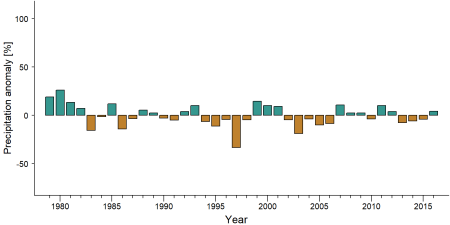
Precipitation anomaly in Lac Télé Community Reserve -
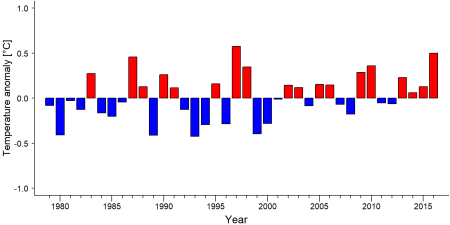
Temperature anomaly in Lac Télé Community Reserve


External links
WCS Lac Télé Community Reserve
References
Blake S., Rogers E., Fay J.M., Ngangoué M. & Ebéké G. (1995) Swamp gorillas in northern Congo. Afr J Ecol 33(3):285–290
Bondeko G., Mobongo R., Mbala O., Molougna L., Silaho R., Romani T. & Brugiere D. (2024) Suivi des prélèvements de gibier et évaluation financière du commerce de viande de brousse dans la Réserve Communautaire du lac Télé. WCS, rapport interne.
Brncic et al 2018. Ndoki Likouala large scale mammal Survey, 2017. WCS Internal report
Caillaud D. (2024) Etude de faisabilité du recensement des grands singes à l’aide d’un drone à aile fixe dans la Réserve Communautaire du Lac Télé. Rapport Université de Davis, USA.
Christin B. (2024) Densité de primates et chasse le long d’un écotone dans le nord de la République du Congo. Rapport Université de Davis, USA.
Estienne et al. (2025) 2022-2023 Large mammal survey of the Ndoki-Likouala landscape. WCS Internal report
Fay J.M., Agnagna M., Moore J. & Oko R. (1990) Gorillas (Gorilla gorilla gorilla) in the Likouala Swamp Forests of North Central Congo: Preliminary Data on Populations and Ecology.International Journal of Primatology. 10(5), 477–486.
Fay J.M. & Agnagna M. (1992) Census of Gorillas in northern Republic of Congo. Am. J. Primatol. 27, 275–284.
Iyenguet F.C., Madzoké B., Twagirashyaka F., Maisels F., Strindberg S., Bomomo V. & Elondza D.E. (2012) Final report to USFWS- Great Ape conservation and monitoring in the Lac Télé landscape. GACF Agreement: 96200-1-G196
Kalan A. (2008) Feeding and nesting ecology of western lowland gorillas (Gorilla gorilla gorilla) at the Lac Tele Community Reserve, Republic of Congo. MSc mémoire, Université de Oxford Brookes, UK.
Kalan A.K., Madzoke B. & Rainey H.J. (2010) A preliminary report on feeding and nesting behavior of swamp gorillas in the Lac Tele Community Reserve. Mammalia 74: 439–442. Doi : 10.1515/MAMM.2010.047
Maisels F. et al. (2012) Final report to USFWS-Ndoki-Likouala landscape: training, monitoring and protection. GACF Agreement: 96200-9-G247
Malanda G.A.F., Iyenguet F.C., Madzoke B. & Twagirashyaka F. (2009) Inventaire et distribution des grands mammifères et activités humaines dans la zone Tanga. WCS Internal report
Meier K. (2024) Travail de terrain sur l’écologie et la conservation des grands singes dans la Réserve Communautaire du Lac Télé 2022-23. Rapport Université de Yale, USA. Rapport Université de Davies, USA.
Michel A. (2024) Nouvelle méthode couplée pour surveiller les interactions en groupes de gorille dans la Réserve Communautaire du Lac Télé. Rapport Université de Davies, USA.
Morgan D., Sanz C., Onononga J.R. & Strindberg S. (2006) Ape abundance and habitat use in the Goualougo Triangle, Republic of Congo. Int J Primatol. 27:147–179.
Morgan D., Sanz C., Onononga J.R. & Strindberg S. (2016). Factors influencing the survival of sympatric gorilla (Gorilla gorilla gorilla) and chimpanzee (Pan troglodytes troglodytes) nests. International Journal of Primatology, 37(6), 718–737. https://doi.org/10.1007/s10764-016-9934-9
Morris A. (2024) Génétique des populations et dispersion des gorilles des plaines de l’Ouest dans un habitat hétérogène. Rapport Université de Davies, USA.
Poulsen J.R. & Clark C.J. (2004) Densities, distributions, and seasonal movements of gorillas and chimpanzees in swamp forest in northern Congo. International Journal of Primatology 25, 285–306. https://doi.org/10.1023/B:IJOP.0000019153.50161.58
Rainey H.J., Iyenguet F.C., Malanda G.A.F., Madzoké B., Santos D.D., Stokes E.J., Maisels F. & Strindberg S. (2009). Survey of Raphia swamp forest, Republic of Congo, indicates high densities of Critically Endangered western lowland gorillas Gorilla gorilla gorilla. Oryx, 44(01), 124. https://doi.org/10.1017/S003060530999010X
Redjali S. (2024) Chimpanzee space use in a human-dominated, seasonally flooded landscape. BSc mémoire Université de Yale, USA.
Romani T., Ekouth D. & Brugiere D. (2025) Evolution de gibier saisi entre 2021 et 2024 à la barrière PK38. WCS internal report.
Sanz C., Morgan D., Strindberg S. & Onononga J. (2007). Distinguishing between the nests of sympatric chimpanzees and gorillas. J. Appl. Ecol. 44, 263–272. doi: 10.1111/j.1365-2664.2007.01278.x
Stokes E.J., Strindberg S., Bakabana P.C., Elkan P.W., Iyenguet F.C., Madzoke B., Malanda G.A.F., Mowawa B.S., Moukoumbou C., Ouakabadio F.K. & Rainey H.J. (2010) Monitoring great ape and elephant abundance at large spatial scales: measuring effectiveness of a conservation landscape. PLoS ONE 5(4): e10294. doi:10.1371/journal.pone.0010294
Tutin C.E.G. & Fernandez M. (1984). Nationwide census of gorilla (Gorilla g. gorilla) and chimpanzee (Pan t. troglodytes) populations in Gabon. Am. J. Primatol. 6: 313–336.
Tutin C.E.G., Parnell R.J., White L.J.T. & Fernandez M. (1995). Nest building by lowland gorillas in the Lope Reserve, Gabon: Environmental influences and implications for censusing. Int. J. Primatol. 16: 53–76.
Page created by: Toni Romani (WCS Research officer, Lac Tele Community Reserve), David Brugiere (WCS Project Director, Lac Tele Community Reserve) & Guido Trivellini Date: 2022-04-08
Page updated by: Toni Romani, David Brugiere Date: 2025-05-28