
Zwedru Proposed Protected Area: Difference between revisions
No edit summary |
No edit summary |
||
| Line 13: | Line 13: | ||
* Key threats to chimpanzees are hunting, large-scale mining and commercial logging. | * Key threats to chimpanzees are hunting, large-scale mining and commercial logging. | ||
* Zwedru Proposed Protected Area has been designated a Key Biodiversity Area (KBA) and an International Bird Area (IBA). | * Zwedru Proposed Protected Area has been designated a Key Biodiversity Area (KBA) and an International Bird Area (IBA). | ||
| Line 93: | Line 89: | ||
!Year of threat | !Year of threat | ||
|- | |- | ||
| | |3 Energy production & mining | ||
| | |3.2 Mining & quarrying | ||
| | |High (more than 70% of population affected) | ||
| | |Mining for gold, diamonds and other minerals, except for iron ore (Johnson 2015). | ||
| | |Ongoing (2015) | ||
|- | |- | ||
|5 Biological resource use | |5 Biological resource use | ||
| Line 105: | Line 101: | ||
|Ongoing (2012) | |Ongoing (2012) | ||
|- | |- | ||
| | |5 Biological resource use | ||
|3 | |5.3 Logging & wood harvesting | ||
| | |Low (up to 30% of population affected) | ||
| | |Area overlapped with Private-Use Permits, which have been withdrawn (Global Witness 2013, Johnson 2015). | ||
| | |2013-2015 | ||
|} | |} | ||
Revision as of 10:50, 25 March 2026
West Africa > Liberia > Zwedru Proposed Protected Area
Français | Português | Español | Bahasa Indonesia | Melayu
Summary
- Western chimpanzees (Pan troglodytes verus) are likely to be present in Zwedru Proposed Protected Area.
- The population size is unknown.
- The chimpanzee population trend is unknown.
- This site has a total size of 637.15 km².
- Key threats to chimpanzees are hunting, large-scale mining and commercial logging.
- Zwedru Proposed Protected Area has been designated a Key Biodiversity Area (KBA) and an International Bird Area (IBA).
Site characteristics
Zwedru Proposed Protected Area is located 20 km west of the town Zwedru – the capital of Grand Gedeh county - on the northern border between Liberia and Côte D’Ivoire. It has been designated an IBA and a KBA, because it is the only known site where the critically endangered Liberian greenbul, Phyllastrephus leucolepis, has been reported (Johnson 2015). No information about other surveys at this site could be found. During the nationwide survey in 2010-2012 (Tweh et al. 2014), the survey teams found fresh and old chimpanzee nests three kilometres from the border of Zwedru Proposed Protected Area, on the north-western boundary of the site (Junker unpubl. data).
Table 1. Basic site information for Zwedru Proposed Protected Area
| Species | Pan troglodytes verus |
| Area | 637.15 km² |
| Coordinates | Lat: 6.32 , Lon: -8.40 |
| Type of site | Proposed protected area |
| Habitat types | Subtropical/tropical moist lowland forest |
| Type of governance |
Types of sites Governance types Habitat types
Ape status
A survey of indicator species was undertaken in 2005 (FFI 2005). This was a collaborative effort of Fauna & Flora International (FFI) the FDA, Environmental Protection Agency of Liberia (EPA) and the Ministry of Planning and Economic Affairs (MPEA). However, no further details on this survey could be found.
Table 2. Ape population estimates reported for Zwedru Proposed Protected Area
| Species | Year | Occurrence | Encounter or vistation rate (nests/km; ind/day) | Density estimate [ind./ km²] (95% CI) | Abundance estimate (95% CI) | Survey area | Sampling method | Analytical framework | Source | Comments | A.P.E.S. database ID |
|---|---|---|---|---|---|---|---|---|---|---|---|
| Pan troglodytes verus | 2010-2012 | Present | Zwedru Proposed Protected Area | Other | Junker et al. 2015 (Fig. 6A, Appendix B) | The site itself was not surveyed, estimate based on a nationwide chimpanzee abundance model |
Sampling methods Analytical frameworks
Threats
The entire proposed protected area is covered by Mineral Exploration Licenses (MEL) for gold, diamonds and other minerals except for iron ore owned by Superior Mineral Resources Inc. (Johnson 2015). MEL’s entail that after a proposed exploration program has been handed to the Minister of Land, Mines, and Energy, the company commences exploration (Wilson et al. 2017). Zwedru Proposed Protected Area overlapped with illegally issued Private-Use Permit (PUP) for commercial logging. Private Use Permits were a type of logging licence designed to allow private land owners to cut trees on their property, but which were reportedly subject to misuse by commercial logging companies. After investigations by Global Witness (Global Witness 2013) much public outcry and extensive media coverage, PUPs have now largely been rescinded (Johnson 2015). Moderate amounts of hunting signs were also recorded on two line transects about 3 km south-west of Zwedru Proposed Protected Area (Junker unpubl. data).
Table 3. Threats to apes reported for Zwedru Proposed Protected Area
| Category | Specific threats | Threat level | Description | Year of threat |
|---|---|---|---|---|
| 3 Energy production & mining | 3.2 Mining & quarrying | High (more than 70% of population affected) | Mining for gold, diamonds and other minerals, except for iron ore (Johnson 2015). | Ongoing (2015) |
| 5 Biological resource use | 5.1 Hunting & collecting terrestrial animals | Medium (30-70% of population affected) | Hunting signs recorded (Junker unpubl. data). | Ongoing (2012) |
| 5 Biological resource use | 5.3 Logging & wood harvesting | Low (up to 30% of population affected) | Area overlapped with Private-Use Permits, which have been withdrawn (Global Witness 2013, Johnson 2015). | 2013-2015 |
Conservation activities
No conservation activities have been reported for the site.
Challenges
Table 5. Challenges reported for Zwedru Proposed Protected Area
| Challenges | Specific challenges | Source | Year(s) |
|---|---|---|---|
| Not reported |
Enablers
Table 6. Enablers reported for Zwedru Proposed Protected Area
| Enablers | Specific enablers | Source | Year(s) |
|---|---|---|---|
| 1 Site management | |||
| 2 Resources and capacity | |||
| 3 Engaged community | |||
| 4 Institutional support | |||
| 5 Ecological context | |||
| 6 Safety and stability |
Research activities
No information on research activities has been documented.
Documented behaviours
Table 7. Behaviours documented for Zwedru Proposed Protected Area
| Category | Behavior | Observation type | Prevalence | Observation dates | Source | Habituation | Species | Comment |
|---|---|---|---|---|---|---|---|---|
| Not reported |
Exposure to climate change impacts
As part of a study on the exposure of African great ape sites to climate change impacts, Kiribou et al. subm. extracted climate data and data on projected extreme climate impact events for the site. Climatological characteristics were derived from observation-based climate data provided by the Inter-Sectoral Impact Model Intercomparison Project (ISIMIP, www.isimip.org). Parameters were calculated as the average across each 30-year period. For 1981-2010, the EWEMBI dataset from ISIMIP2a was used. For the two future periods (2021-2050 and 2071-2099) ISIMIP2b climate data based on four CMIP5 global climate models were used. For future projections, two Representative Concentration Pathways (RCP) were used. RCP 2.6 is a scenario with strong mitigation measures in which global temperatures would likely rise below 2C. RCP 6.0 is a scenario with medium emissions in which global temperatures would likely rise up to 3C by 2100. For the number of days with heavy precipitation events, the 98th percentile of all precipitation days (>1mm/d) was calculated for the 1979-2013 reference period as a threshold for a heavy precipitation event. Then, for each year, the number of days above that threshold was derived. The figures on temperature and precipitation anomaly show the deviation from the mean temperature and mean precipitation for the 1979-2013 reference period.
The estimated exposure to future extreme climate impact events (crop failure, drought, river flood, wildfire, tropical cyclone, and heatwave) is based on a published dataset by Lange et al. 2020 derived from ISIMIP2b data. The same global climate models and RCPs as described above were used. Within each 30-year period, the number of years with an extreme event and the average proportion of the site affected were calculated (see Kiribou et al. subm. for details).
Table 8. Estimated past and projected climatological characteristics in Zwedru Proposed Protected Area
| Value | 1981-2010 | 2021-2050, RCP 2.6 | 2021-2050, RCP 6.0 | 2071-2099, RCP 2.6 | 2071-2099, RCP 6.0 |
|---|---|---|---|---|---|
| Mean temperature [C] | 25.5 | 26.6 | 26.6 | 26.7 | 27.8 |
| Annual precipitation [mm] | 1943 | 1960 | 2017 | 1994 | 2082 |
| Max no. consecutive dry days (per year) | 22.4 | 25.1 | 23.7 | 27 | 24.9 |
| No. days with heavy precipitation (per year) | 6 | 9.5 | 9.1 | 9.6 | 13 |
Table 9. Projected exposure of apes to extreme climate impact events in Zwedru Proposed Protected Area
| Type | No. of years with event (2021-2050, RCP 2.6) | % of site exposed (2021-2050, RCP 2.6) | No. of years with event (2021-2050, RCP 6.0) | % of site exposed (2021-2050, RCP 6.0) | No. of years with event (2070-2099, RCP 2.6) | % of site exposed (2070-2099, RCP 2.6) | No. of years with event (2070-2099, RCP 6.0) | % of site exposed (2070-2099, RCP 6.0) |
|---|---|---|---|---|---|---|---|---|
| Crop failure | 1.5 | 1.14 | 2 | 1.23 | 3 | 1.13 | 9.5 | 1.23 |
| Drought | 0 | 0 | 0 | 0 | 0 | 0 | 0 | 0 |
| Heatwave | 11 | 100 | 9 | 100 | 16 | 100 | 18 | 100 |
| River flood | 1.75 | 0.64 | 3.5 | 4.24 | 3.25 | 4.07 | 5.5 | 3.14 |
| Tropical cyclone | 0 | 0 | 0.5 | 0.09 | 0 | 0 | 0 | 0 |
| Wildfire | 30 | 0.51 | 30 | 0.49 | 29 | 0.51 | 29 | 0.54 |
-
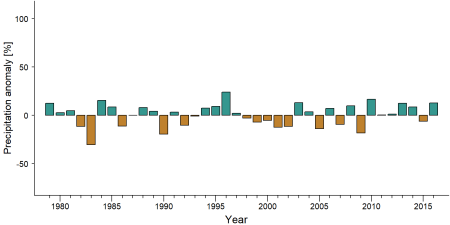
Precipitation anomaly in Zwedru Proposed Protected Area -
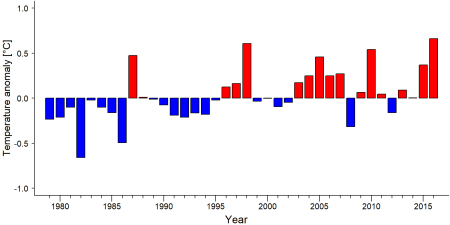
Temperature anomaly in Zwedru Proposed Protected Area


External links
References
Global Witness. (2013). Avoiding the Riptide: Liberia must Enforce its Forest Laws to Prevent a New Wave of Illegal and Destructive Logging Contracts. Global Witness.
Johnson S. 2015. Aggregated Biodiversity Offsets: A Roadmap for Liberia’s Mining Sector. Unpublished report by the World Bank Group (WBG) and Program On Forests (PROFOR).
Junker J, Boesch C, Freeman T, Mundry R, Stephens C, Kühl HS. 2015. Integrating wildlife conservation with conflicting economic land-use goals in a West African biodiversity hotspot. Basic and Applied Ecology: doi:10.1016/j.baae.2015.07.002.
Tweh C, Lormie M, Kouakou CY, Hillers A, Kühl HS, Junker J, et al. 2014. Conservation status of chimpanzees Pan troglodytes verus and other large mammals in Liberia: a nationwide survey. Oryx: http://dx.doi.org/10.1017/S0030605313001191.
Wilson STK, Wang H, Kabenge M, Qi X. 2017. The mining sector of Liberia: current practices and environmental challenges. Environmental Science and Pollution Research 24: 18711–18720.
Page created by: APES Atlas Team Date: 2019-10-28