
Niokolo-Koba National Park: Difference between revisions
No edit summary |
No edit summary |
||
| Line 204: | Line 204: | ||
|Designated a national park in 1954 (UNEP-WCMC & IUCN 2019) | |Designated a national park in 1954 (UNEP-WCMC & IUCN 2019) | ||
| | | | ||
|1954-Ongoing ( | |1954-Ongoing (2026) | ||
|- | |- | ||
|7 Economic & other incentives | |7 Economic & other incentives | ||
Revision as of 03:30, 4 February 2026
West Africa > Senegal > Niokolo-Koba National Park
Français | Português | Español | Bahasa Indonesia | Melayu
Summary
- Western chimpanzees (Pan troglodytes verus) are present in Niokolo-Koba National Park.
- It has been estimated that 23 individuals occur at the site.
- The chimpanzee population trend is estimated to be stable.
- This site has a total size of 9130 km².
- Key threats to chimpanzees are illegal bushmeat hunting and mining activities.
- The park management implements anti-poaching patrols, roadblocks and supports communities around the park.
- Niokolo-Koba National Park is contiguous with Badiar National Park in Guinea.
Site characteristics
The Niokolo-Koba National Park (also called Parc National du Niokolo Koba – PNNK) is located in southeastern Senegal and is contiguous with Badiar National Park in northern Guinea. Niokolo-Koba National Park has been established in 1954 (UNEP-WCMC & IUCN 2019). PNNK is also a World Heritage Site since 1981 and has been listed as a World Heritage site in danger since 2007 (UNESCO 2019a, UNESCO 2019b). It is also an Important Bird Area (BirdLife International 2019).
Most of the park is flat, but there are several hills in its eastern part with Mt Assirik being the highest elevation with 311 m (BirdLife International 2019). PNNK is characterized by savanna with gallery forests, grasslands, bamboo forests, and seasonally inundated flood-plains and marshes (BirdLife International 2019, Lindshield et al. 2019). The river Gambie and several of its tributaries cross the park.
PNNK features a rich biodiversity with more than 70 mammal species, 329 bird species, 36 reptile species reptiles, 20 amphibian species and many species of invertebrates (BirdLife International 2019). Some of the present mammal species include lion (Panthera leo), leopard (Panthera pardus), African civet (Civettictis civetta), spotted hyena (Crocuta crocuta), roan antelope (Hippotragus equinus), African buffalo (Syncerus caffer), and African elephant (Loxodonta africana, Henschel et al. 2014, McGrew et al. 2014, Lindshield et al. 2019). In addition to western chimpanzees (Pan troglodytes verus), the presence of several primate species has been confirmed, including green monkey (Chlorocebus sabaeus), patas monkey (Erythrocebus patas), lesser bushbaby (Galago senegalensis), and Guinea baboon (Papio papio, Lindshield et al. 2019). There are also more than 1500 plant species (BirdLife International 2019).
Table 1. Basic site information for Niokolo-Koba National Park
| Species | Pan troglodytes verus |
| Area | 9,130.0 km² |
| Coordinates | Lat: 13.031594 , Lon: -13.068463 |
| Type of site | Protected area (National Park) |
| Habitat types | Savanna, Shrubland, Grassland, Subtropical/tropical dry forest, Wetlands (lakes, rivers, streams, bogs, marshes) |
| Type of governance |
Types of sites Governance types Habitat types
Ape status
In 1967, De Bournonville confirmed the presence of chimpanzees in Niokolo-Koba National Park (De Bournonville 1967). McGrew et al. (1981) estimated the chimpanzee population size to be around 24 individuals based on studying unhabituated chimpanzees around Mt. Assirik. Similarly, Pruetz et al. (2002) estimated a population size of 23 individuals based on nest count surveys.
Table 2. Ape population estimates reported for Niokolo-Koba National Park
| Species | Year | Occurrence | Encounter or vistation rate (nests/km; ind/day) | Density estimate [ind./ km²] (95% CI) | Abundance estimate (95% CI) | Survey area | Sampling method | Analytical framework | Source | Comments | A.P.E.S. database ID |
|---|---|---|---|---|---|---|---|---|---|---|---|
| Pan troglodytes verus | 1976-1979 | 0.09 | 24.0 | Assirik area | Full count | McGrew et al 1981 | |||||
| Pan troglodytes verus | 1967 | Present | PNNK | Interviews, Reconnaissance walk | De Bournonville 1967 | ||||||
| Pan troglodytes verus | 2000 | 0.13 | 23.0 | Assirik area | Line transects | Pruetz et al. 2002 |
Sampling methods Analytical frameworks
Threats
In 2007, Niokolo-Koba National Park was listed as a World Heritage site in danger because of poaching, livestock grazing, and the Sambangalou dam project (UNESCO 2019b). The park is also negatively affected by drought (UNESCO 2019b). A road bisects the park and a large-scale gold mining operation at the eastern border of PNNK exerts further pressure on the park’s resources (Lindshield et al. 2019). In addition, anthropogenic bushfires have been reported, as well as illegal logging and fishing (BirdLife International 2019, Lindshield et al. 2019).
There are plans to construct a dam 930 km upstream from the mouth of the Gambia River. While contributing to development by providing energy and irrigation opportunities, there are fears of environmental and social risks, especially for downstream wetlands and indirect impacts caused by population resettlement (BirdLife International 2019).
Table 3. Threats to apes reported for Niokolo-Koba National Park
| Category | Specific threats | Threat level | Description | Year of threat |
|---|---|---|---|---|
| 11 Climate change & severe weather | 11.2 Droughts | Medium (30-70% of population affected) | Droughts cause the drying of rivers and reduce flooding of marshes and flood-plains, causing damage also to forests (BirdLife International 2019). | Ongoing (2019) |
| 2 Agriculture & aquaculture | 2.3 Livestock farming & ranching | Medium (30-70% of population affected) | Livestock grazing (BirdLife International 2019, Lindshield et al. 2019, UNESCO 2019b). | Ongoing (2019) |
| 3 Energy production & mining | 3.2 Mining & quarrying | Present (unknown severity) | Artisanal gold mining (BirdLife International 2019, Lindshield et al. 2019, UNESCO 2019b). | Ongoing (2019) |
| 4 Transportation & service corridors | 4.1 Roads & railroads | Medium (30-70% of population affected) | A road bisects the park (BirdLife International 2019, Lindshield et al. 2019, UNESCO 2019b). | Ongoing (2019) |
| 5 Biological resource use | 5.1 Hunting & collecting terrestrial animals | Medium (30-70% of population affected) | Illegal hunting has been reported (BirdLife International 2019, Lindshield et al. 2019, UNESCO 2019b). | Ongoing (2019) |
| 5 Biological resource use | 5.3 Logging & wood harvesting | Present (unknown severity) | Illegal logging has been reported (BirdLife International 2019, Lindshield et al. 2019, UNESCO 2019b). | Ongoing (2019) |
| 5 Biological resource use | 5.3 Logging & wood harvesting | Present (unknown severity) | Illegal fishing (BirdLife International 2019). | Ongoing (2019) |
| 7 Natural system modifications | 7.1 Fire & fire suppression | Present (unknown severity) | Anthropogenic fires (BirdLife International 2019, Lindshield et al. 2019). | Ongoing (2019) |
Conservation activities
Niokolo-Koba National Park is managed by Direction des Parcs Nationaux (DPN). Conservation activities include anti-poaching patrols and road checkpoints (BirdLife International 2019, Lindshield at al. 20019). Park agents also engage with communities living close to the park to discourage illegal behavior, for example by supporting tourist guides, fishermen groups and providing veterinary assistance (BirdLife International 2019, Lindshield at al. 20019). The management plan from 2000 has expired and a request has been submitted to UNESCO to renew the management plan (BirdLife International 2019, UNESCO 2019b).
Table 4. Conservation activities reported for Niokolo-Koba National Park
| Category | Specific activity | Description | Implementing organization(s) | Year of activity |
|---|---|---|---|---|
| 2 Counter-wildlife crime | 2.1 Implement road blocks to inspect cars for illegal ape bushmeat | Road checkpoints on the road bisecting the park (Lindshield at al. 20019) | Ongoing (2019) | |
| 2 Counter-wildlife crime | 2.3 Conduct regular anti-poaching patrols | Park agents regularly conduct anti-poaching patrols (BirdLife International 2019, Lindshield at al. 20019) | Ongoing (2019) | |
| 5 Protection & restoration | 5.2 Legally protect ape habitat | Designated a national park in 1954 (UNEP-WCMC & IUCN 2019) | 1954-Ongoing (2026) | |
| 7 Economic & other incentives | 7.2 Provide non-monetary benefits to local communities for sustainably managing their forest and its wildlife (e.g., better education, infrastructure development) | Communities living close to the park are supported , e.g., tourist guides, fishermen groups and providing veterinary assistance (BirdLife International 2019, Lindshield at al. 20019) | Ongoing (2019) |
Challenges
Table 5. Challenges reported for Niokolo-Koba National Park
| Challenges | Specific challenges | Source | Year(s) |
|---|---|---|---|
| Not reported |
Enablers
Table 6. Enablers reported for Niokolo-Koba National Park
| Enablers | Specific enablers | Source | Year(s) |
|---|---|---|---|
| 1 Site management | |||
| 2 Resources and capacity | |||
| 3 Engaged community | |||
| 4 Institutional support | |||
| 5 Ecological context | |||
| 6 Safety and stability |
Research activities
Research on chimpanzees in Niokolo-Koba National Park has been ongoing intermittently since the 1970s. A research site was established near Mt. Assirik by the Stirling African Primate Project (coordinated by William McGrew and Caroline Tutin) in 1976 to study the local chimpanzee community (Carter et al. 2003). Since then a wide variety of studies has been implemented on the ecology and social organization of chimpanzees, including diet, tool use and nesting behavior.
Documented behaviours
Table 7. Behaviours documented for Niokolo-Koba National Park
| Category | Behavior | Observation type | Prevalence | Observation dates | Source | Habituation | Species | Comment |
|---|---|---|---|---|---|---|---|---|
| Ant dipping | McGrew et al. 2003 | |||||||
| Ant eating | McGrew et al. 2003 | |||||||
| Ant fishing | McGrew et al. 2003 | |||||||
| Cave use | compiled in Kühl et al. 2019 | |||||||
| Fruit cleaving | Marchant & McGrew 2005 | |||||||
| Honey eating | McGrew et al. 2003 | |||||||
| Honey extraction with tool | McGrew et al. 2003 | |||||||
| Making ground nests | Pruetz et al. 2008 | |||||||
| Stone throwing | McGrew et al. 2003 | |||||||
| Termite eating | McGrew et al. 2003 | |||||||
| Termite fishing | McGrew et al. 2003 |
Exposure to climate change impacts
As part of a study on the exposure of African great ape sites to climate change impacts, Kiribou et al. subm. extracted climate data and data on projected extreme climate impact events for the site. Climatological characteristics were derived from observation-based climate data provided by the Inter-Sectoral Impact Model Intercomparison Project (ISIMIP, www.isimip.org). Parameters were calculated as the average across each 30-year period. For 1981-2010, the EWEMBI dataset from ISIMIP2a was used. For the two future periods (2021-2050 and 2071-2099) ISIMIP2b climate data based on four CMIP5 global climate models were used. For future projections, two Representative Concentration Pathways (RCP) were used. RCP 2.6 is a scenario with strong mitigation measures in which global temperatures would likely rise below 2C. RCP 6.0 is a scenario with medium emissions in which global temperatures would likely rise up to 3C by 2100. For the number of days with heavy precipitation events, the 98th percentile of all precipitation days (>1mm/d) was calculated for the 1979-2013 reference period as a threshold for a heavy precipitation event. Then, for each year, the number of days above that threshold was derived. The figures on temperature and precipitation anomaly show the deviation from the mean temperature and mean precipitation for the 1979-2013 reference period.
The estimated exposure to future extreme climate impact events (crop failure, drought, river flood, wildfire, tropical cyclone, and heatwave) is based on a published dataset by Lange et al. 2020 derived from ISIMIP2b data. The same global climate models and RCPs as described above were used. Within each 30-year period, the number of years with an extreme event and the average proportion of the site affected were calculated (see Kiribou et al. subm. for details).
Table 8. Estimated past and projected climatological characteristics in Niokolo-Koba National Park
| Value | 1981-2010 | 2021-2050, RCP 2.6 | 2021-2050, RCP 6.0 | 2071-2099, RCP 2.6 | 2071-2099, RCP 6.0 |
|---|---|---|---|---|---|
| Mean temperature [C] | 28.6 | 29.9 | 29.7 | 30.1 | 31.6 |
| Annual precipitation [mm] | 978 | 975 | 912 | 973 | 855 |
| Max no. consecutive dry days (per year) | 131.9 | 130.4 | 131.1 | 132.2 | 136.2 |
| No. days with heavy precipitation (per year) | 2.9 | 3.4 | 2.7 | 3.4 | 2.7 |
Table 9. Projected exposure of apes to extreme climate impact events in Niokolo-Koba National Park
| Type | No. of years with event (2021-2050, RCP 2.6) | % of site exposed (2021-2050, RCP 2.6) | No. of years with event (2021-2050, RCP 6.0) | % of site exposed (2021-2050, RCP 6.0) | No. of years with event (2070-2099, RCP 2.6) | % of site exposed (2070-2099, RCP 2.6) | No. of years with event (2070-2099, RCP 6.0) | % of site exposed (2070-2099, RCP 6.0) |
|---|---|---|---|---|---|---|---|---|
| Crop failure | 10.5 | 0.17 | 3.5 | 0.16 | 10 | 0.15 | 15.5 | 0.18 |
| Drought | 4.5 | 41.67 | 3.75 | 41.59 | 1.25 | 26.39 | 4.5 | 37.3 |
| Heatwave | 2.5 | 50 | 1.5 | 29.17 | 3 | 43.75 | 4 | 65.56 |
| River flood | 2.75 | 0.71 | 2.75 | 1.14 | 1.5 | 0.94 | 1 | 1.23 |
| Tropical cyclone | 0 | 0 | 0 | 0 | 0 | 0 | 0 | 0 |
| Wildfire | 30 | 1.21 | 30 | 1.09 | 29 | 1.2 | 29 | 2.14 |
-
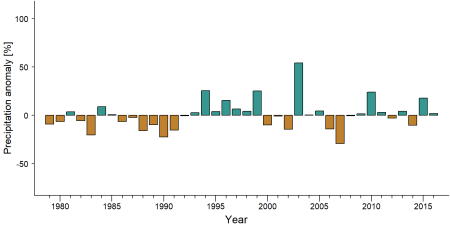
Precipitation anomaly in Niokolo-Koba National Park -
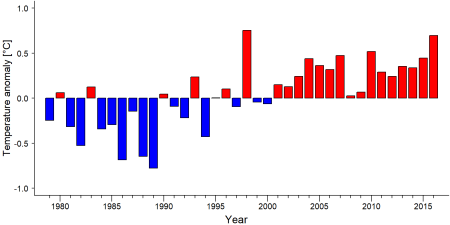
Temperature anomaly in Niokolo-Koba National Park


External links
References
BirdLife International. 2019. Important Bird Areas factsheet: Parc National du Niokolo-Koba. Online: www.birdlife.org
Carter et al. 2003.Senegal. In: Kormos and Boesch (eds) Regional Action Plan for the Conservation of Chimpanzees in West Africa. IUCN/SSC Primate Specialist Group and Conservation International, Washington DC.
De Bournonville D. 1967. Contribution à l’étude du chimpanzé en République de Guinee. Bulletin de l’Institute Fondamental d’Afrique Noire, Serie A 24, 1188–1269.
Henschel P et al. 2014. The lion in West Africa is Critically Endangered, PLoS ONE 9(1): e83500.
Kühl HS et al. 2019. Human impact erodes chimpanzee behavioral diversity. Science. 363, 1453–1455.
Lindshield S et al. 2019. Informing Protection Efforts for Critically Endangered Chimpanzees (Pan troglodytes verus) and Sympatric Mammals amidst Rapid Growth of Extractive Industries in Senegal. Folia Primatologica 90: 124-136.
Marchant LF & McGrew WC. 2005. Percussive technology: chimpanzee baobab smashing and the evolutionary modelling of hominin knapping. In: Roux & Bril (eds) Stone knapping – the necessary conditions for a uniquely hominin behaviour.
McGrew WC et al. 1981. Chimpanzees in a hot, dry and open habitat: Mt. Assirik, Senegal, West Africa. Journal of Human Evolution, 10, 227–244.
McGrew WC et al. 2003. Ethnoarchaeology and elementary technology of unhabituated wild chimpanzees at Assirik, Senegal, West Africa. PaleoAnthropology 5(2):1–20
McGrew WC et al. 2014. Chimpanzees (Pan troglodytes verus) and their mammalian sympatriates: Mt. Assirik, Niokolo-Koba National Park, Senegal. Primates 55: 525–532.
Pruetz JD et al. 2002. Survey of savannah chimpanzees (Pan troglodytes verus) in south-eastern Sénégal. American Journal of Primatology 58: 35–43.
Pruetz et al. 2008. Arboreal nesting as anti-predator adaptation by savanna chimpanzees in southeastern Senegal. American Journal of Primatology 70: 393-401
Pruetz JD et al. 2012. Update on the Assirik chimpanzee (Pan troglodytes verus) population in Niokolo Koba National Park, Senegal. Pan Africa News 19: 8–11.
Tutin CEG et al. 1983. Social organization of savannah-dwelling chimpanzees, Pan troglodytes verus, at Mt. Assirik, Senegal. Primates 24: 154–173.
UNEP-WCMC, IUCN. 2019. Protected Planet: The World Database on Protected Areas (WDPA), Cambridge, UK: UNEP-WCMC and IUCN Online: www.protectedplanet.net
UNESCO. 2019a. Niokolo-Koba National Park. Online: whc.unesco.org
UNESCO. 2019b. State of Conservation - Niokolo-Koba National Park. Online: whc.unesco.org/soc
Page created by: APES Atlas Team Date: 2019-11-21