
Mabi-Yaya Nature Reserve: Difference between revisions
No edit summary |
No edit summary |
||
| Line 297: | Line 297: | ||
= Exposure to climate change impacts = | = Exposure to climate change impacts = | ||
As part of a study on the exposure of African great ape sites to climate change impacts, Kiribou et al. | As part of a study on the exposure of African great ape sites to climate change impacts, Kiribou et al. (2024) extracted climate data and data on projected extreme climate impact events for the site. Climatological characteristics were derived from observation-based climate data provided by the Inter-Sectoral Impact Model Intercomparison Project (ISIMIP, www.isimip.org). Parameters were calculated as the average across each 30-year period. For 1981-2010, the EWEMBI dataset from ISIMIP2a was used. For the two future periods (2021-2050 and 2071-2099) ISIMIP2b climate data based on four CMIP5 global climate models were used. For future projections, two Representative Concentration Pathways (RCP) were used. RCP 2.6 is a scenario with strong mitigation measures in which global temperatures would likely rise below 2C. RCP 6.0 is a scenario with medium emissions in which global temperatures would likely rise up to 3C by 2100. For the number of days with heavy precipitation events, the 98th percentile of all precipitation days (>1mm/d) was calculated for the 1979-2013 reference period as a threshold for a heavy precipitation event. Then, for each year, the number of days above that threshold was derived. The figures on temperature and precipitation anomaly show the deviation from the mean temperature and mean precipitation for the 1979-2013 reference period. | ||
The estimated exposure to future extreme climate impact events (crop failure, drought, river flood, wildfire, tropical cyclone, and heatwave) is based on a published dataset by Lange et al. 2020 derived from ISIMIP2b data. The same global climate models and RCPs as described above were used. Within each 30-year period, the number of years with an extreme event and the average proportion of the site affected were calculated ( | The estimated exposure to future extreme climate impact events (crop failure, drought, river flood, wildfire, tropical cyclone, and heatwave) is based on a published dataset by Lange et al. 2020 derived from ISIMIP2b data. The same global climate models and RCPs as described above were used. Within each 30-year period, the number of years with an extreme event and the average proportion of the site affected were calculated (Kiribou et al. 2024). | ||
'''Table 8. Estimated past and projected climatological characteristics in Mabi-Yaya Nature Reserve''' | '''Table 8. Estimated past and projected climatological characteristics in Mabi-Yaya Nature Reserve''' | ||
Revision as of 08:17, 3 September 2026
West Africa > Côte d'Ivoire > Mabi-Yaya Nature Reserve
Français | Português | Español | Bahasa Indonesia | Melayu
Summary
- Western chimpanzees (Pan troglodytes verus) are present in Mabi-Yaya Nature Reserve.
- Population size is unknown.
- The trend or dynamics of the chimpanzee population is unknown.
- This site has a total surface area of 604.74 km².
- The main threats to chimpanzees are poaching and deforestation.
- OIPR monitors the site and the NGO NITIDAE conducts conservation awareness raising activities.
Site characteristics
The Mabi Yaya Nature Reserve (RNMY) was created from the merging of two forests classified under the management of SODEFOR. These are the former Mabi classified forest with an area of 59,614 ha and the former Yaya classified forest with an area of 23,873 ha. Administratively, the RNMY is located in the Mé Region and is straddling the departments of Alépé (through the sub-prefectures of Aboisso-Comoé, Alépé, Alosso and Danguira) and Yakassé Attobrou by the sub-prefecture of Biéby. It is limited in its northeast ridge by the Sous - prefecture of Bettié. While subject to strong pressure from loggers, poachers and cocoa farmers, initiatives have been carried out since 2016 by the Mé Regional Council and NGOs, such as Nitidae, as part of the Mé REDD+ Project in order to safeguard this national heritage that constitutes these forests.
In 2019, following all these actions and with the support of a large majority of the local population, the government decided by Decree No. 2019-897 of October 30, 2019 to create the Mabi Yaya Nature Reserve with an area of 61,282.559 ha. This decision concretizes the commitment of the Ivorian government to implement its New Strategy for the Preservation, Rehabilitation and Extension of Forests.
It is crossed in its northwest part by the Mabi River and extends along the Comoé River in its eastern part to the Kossan River in the southwest. There are certain large dispersers of forest tree seeds, such as the elephant (Loxodonta africana), the chimpanzee (Pan troglodytes), the monkeys ('Cercopithecus' spp and Colobus spp), hornbills (Ceratoymna spp, Bycanistes spp, Tropicranus albocristatus, Tockus semifasciatus), large forest duikers, bush pig, etc. Among the reptiles, there are Broad-fronted Crocodiles, which are vulnerable according to the IUCN due to poaching and the destruction of ecosystems, as well as pythons and the vipers. In the class of birds, around 170 species are found in the region.
Table 1. Basic site information for Mabi-Yaya Nature Reserve
| Species | Pan troglodytes verus |
| Area | 604.74 km² |
| Coordinates | Lat: 5.670010 , Lon: -3.542367 |
| Type of site | Protected area (Nature Reserve) |
| Habitat types | Subtropical/tropical moist lowland forest, Agricultural land |
| Type of governance | Governance by government |
Types of sites Governance types Habitat types
Ape status
The 2021 national forest wildlife inventory documented 2 chimpanzee vocalizations in the reserve. Observation of chimpanzees on 29/06/2023 by camera trap set by OIPR and the NGO NITIDAE. A total of 4 individuals (an adult female, a juvenile, an adolescent male and an adult male) were observed (Soiret pers. comm. 2023).
Table 2. Ape population estimates reported for Mabi-Yaya Nature Reserve
| Species | Year | Occurrence | Encounter or vistation rate (nests/km; ind/day) | Density estimate [ind./ km²] (95% CI) | Abundance estimate (95% CI) | Survey area | Sampling method | Analytical framework | Source | Comments | A.P.E.S. database ID |
|---|---|---|---|---|---|---|---|---|---|---|---|
| Pan troglodytes verus | 2020 | 0.005 | Mabi-Yaya Nature Reserve (612.82 km²) | Reconnaissance walk | OIPR 2020 | Patrouille ordinaire des agents forestiers de l'OIPR |
Sampling methods Analytical frameworks
Threats
The small chimpanzee population is threatened by deforestation due to the clearing and cultivation that took place when the reserve was created. There is also poaching and the risk of zoonosis due to contact between wildlife and humans (OIPR 2021). In September 2023, 20 people were detained by OIPR agents for hunting illegally in the reserve.
Table 3. Threats to apes reported for Mabi-Yaya Nature Reserve
| Category | Specific threats | Threat level | Description | Year of threat |
|---|---|---|---|---|
| 2 Agriculture & aquaculture | 2.1 Annual & perennial non-timber crops | Medium (30-70% of population affected) | These plantations existed in the former classified forests. Most of them are cocoa plantations (NITIDAE and OIPR pers. comm. 2023). | Ongoing (2023) |
| 5 Biological resource use | 5.1 Hunting & collecting terrestrial animals | Medium (30-70% of population affected) | Poaching with 12-gauge shotguns, snare traps (NITIDAE and OIPR pers. comm. 2023). | Ongoing (2023) |
| 5 Biological resource use | 5.1.5 Persecution/human wildlife conflict | Present (unknown severity) | Human wildlife conflicts that includes cases where great apes have been reported to damage property, people to feel unsafe around great apes, and are sometimes killed for trade or cultural reasons (Toulo A. pers. comm. 2025). | Ongoing (2025) |
Conservation activities
OIPR is responsible for monitoring the site. The site's ecological monitoring protocols and the monitoring operation plan have been drafted and will be validated before the end of 2022. The NGO NITIDAE, with funding from the World Bank, will be responsible for raising awareness. The site management plan is currently being drafted (Soiret pers. obs. 2023).
Table 4. Conservation activities reported for Mabi-Yaya Nature Reserve
| Category | Specific activity | Description | Implementing organization(s) | Year of activity |
|---|---|---|---|---|
| 2 Counter-wildlife crime | 2.6 Regularly de-activate/remove ground snares | Regular patrols by OIPR officers collect shell casings and destroy poachers' traps, shelters and camps (Soiret pers. obs. 2023). | Ongoing (2023) | |
| 4 Education & awareness | 4.1 Educate local communities about apes and sustainable use | OIPR and the NGO NITIDAE are responsible for raising awareness of biological conservation in the villages along the river (NITIDAE and OIPR pers. comm. 2023). | Ongoing (2023) | |
| 4 Education & awareness | 4.2 Involve local community in ape research and conservation management | Local communities are involved in conservation programs through their participation in raising public awareness, development work, monitoring, research, and regional management meetings (Toulo A. pers. comm. 2025). | Ongoing (2025) | |
| 5 Protection & restoration | 5.2 Legally protect ape habitat | The site is a nature reserve. | 2018-Ongoing (2026) | |
| 5 Protection & restoration | 5.6 Habitat restoration | Forest rehabilitation and protection activities reported (Toulo A. pers. comm. 2025). | Ongoing (2025) | |
| 7 Economic & other incentives | 7.1 Provide monetary benefits to local communities for sustainably managing their forest and its wildlife (e.g., REDD, alternative income, employment) | Local people are employed by conservation projects (Toulo A. pers. comm. 2025). | Ongoing (2025) | |
| 7 Economic & other incentives | 7.2 Provide non-monetary benefits to local communities for sustainably managing their forest and its wildlife (e.g., better education, infrastructure development) | Local people are provided with general education and life skills (Toulo A. pers. comm. 2025). | Ongoing (2025) |
Challenges
Table 5. Challenges reported for Mabi-Yaya Nature Reserve
| Challenges | Specific challenges | Source | Year(s) |
|---|---|---|---|
| 2 Resources and capacity | 2.1 Lack of capacity/training | OIPR 2021 | |
| 2 Resources and capacity | 2.2 Lack of staff | Toulo A. pers. comm. 2025 | 2025 |
Enablers
Table 6. Enablers reported for Mabi-Yaya Nature Reserve
| Enablers | Specific enablers | Source | Year(s) |
|---|---|---|---|
| 2 Resources and capacity | 2.2 Sufficient funding | Toulo A. pers. comm. 2025 | Ongoing (2025) |
| 2 Resources and capacity | 2.3 Continuous/long-term funding | Toulo A. pers. comm. 2025 | Ongoing (2025) |
| 2 Resources and capacity | 2.5 Sufficient capacity/expertise to advise, design, or implement actions | Toulo A. pers. comm. 2025 | Ongoing (2025) |
| 2 Resources and capacity | 2.6 External partnerships that add expertise or resources | Toulo A. pers. comm. 2025 | Ongoing (2025) |
| 3 Engaged community | 3.6 Local community engagement and support | Toulo A. pers. comm. 2025 | Ongoing (2025) |
| 1 Site management | |||
| 4 Institutional support | |||
| 5 Ecological context | |||
| 6 Safety and stability |
Research activities
Documented behaviours
Table 7. Behaviours documented for Mabi-Yaya Nature Reserve
| Category | Behavior | Observation type | Prevalence | Observation dates | Source | Habituation | Species | Comment |
|---|---|---|---|---|---|---|---|---|
| Not reported |
Exposure to climate change impacts
As part of a study on the exposure of African great ape sites to climate change impacts, Kiribou et al. (2024) extracted climate data and data on projected extreme climate impact events for the site. Climatological characteristics were derived from observation-based climate data provided by the Inter-Sectoral Impact Model Intercomparison Project (ISIMIP, www.isimip.org). Parameters were calculated as the average across each 30-year period. For 1981-2010, the EWEMBI dataset from ISIMIP2a was used. For the two future periods (2021-2050 and 2071-2099) ISIMIP2b climate data based on four CMIP5 global climate models were used. For future projections, two Representative Concentration Pathways (RCP) were used. RCP 2.6 is a scenario with strong mitigation measures in which global temperatures would likely rise below 2C. RCP 6.0 is a scenario with medium emissions in which global temperatures would likely rise up to 3C by 2100. For the number of days with heavy precipitation events, the 98th percentile of all precipitation days (>1mm/d) was calculated for the 1979-2013 reference period as a threshold for a heavy precipitation event. Then, for each year, the number of days above that threshold was derived. The figures on temperature and precipitation anomaly show the deviation from the mean temperature and mean precipitation for the 1979-2013 reference period.
The estimated exposure to future extreme climate impact events (crop failure, drought, river flood, wildfire, tropical cyclone, and heatwave) is based on a published dataset by Lange et al. 2020 derived from ISIMIP2b data. The same global climate models and RCPs as described above were used. Within each 30-year period, the number of years with an extreme event and the average proportion of the site affected were calculated (Kiribou et al. 2024).
Table 8. Estimated past and projected climatological characteristics in Mabi-Yaya Nature Reserve
| Value | 1981-2010 | 2021-2050, RCP 2.6 | 2021-2050, RCP 6.0 | 2071-2099, RCP 2.6 | 2071-2099, RCP 6.0 |
|---|---|---|---|---|---|
| Mean temperature [C] | 27 | 28.1 | 27.9 | 28.2 | 29.3 |
| Annual precipitation [mm] | 1643 | 1568 | 1631 | 1564 | 1654 |
| Max no. consecutive dry days (per year) | 24.8 | 22.5 | 23.2 | 23.2 | 22.2 |
| No. days with heavy precipitation (per year) | 7.2 | 5.3 | 6.2 | 5.1 | 7.9 |
Table 9. Projected exposure of apes to extreme climate impact events in Mabi-Yaya Nature Reserve
| Type | No. of years with event (2021-2050, RCP 2.6) | % of site exposed (2021-2050, RCP 2.6) | No. of years with event (2021-2050, RCP 6.0) | % of site exposed (2021-2050, RCP 6.0) | No. of years with event (2070-2099, RCP 2.6) | % of site exposed (2070-2099, RCP 2.6) | No. of years with event (2070-2099, RCP 6.0) | % of site exposed (2070-2099, RCP 6.0) |
|---|---|---|---|---|---|---|---|---|
| Crop failure | 3.5 | 1.76 | 1 | 0.44 | 1 | 0.88 | 4 | 1.76 |
| Drought | 2.25 | 100 | 0.5 | 50 | 2 | 50 | 0.75 | 25 |
| Heatwave | 13 | 100 | 10 | 100 | 10.5 | 100 | 7.5 | 100 |
| River flood | 0.75 | 0.41 | 1.25 | 0.32 | 1.5 | 0.87 | 1.25 | 0.91 |
| Tropical cyclone | 0 | 0 | 0 | 0 | 0 | 0 | 0 | 0 |
| Wildfire | 30 | 0.33 | 30 | 0.29 | 29 | 0.34 | 29 | 0.28 |
-
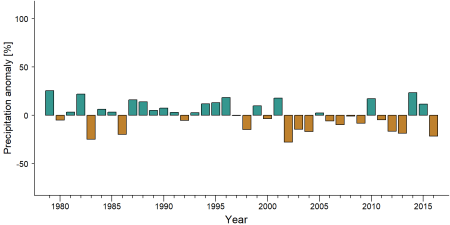
Precipitation anomaly in Mabi-Yaya Nature Reserve -
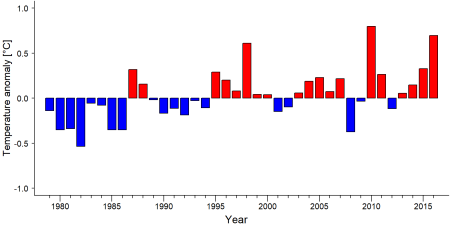
Temperature anomaly in Mabi-Yaya Nature Reserve


External links
References
OIPR. 2021. Guide méthodologique de suivi-écologique de la Réserve naturelle de Mabi Yaya
Page created by: Serge Soiret & Colonel Azani Dede Date: 2023-09-25
Page updated by: TOULO Alain Date: 2025-08-14