
Ulu Sungai Menyang: Difference between revisions
No edit summary |
No edit summary |
||
| Line 62: | Line 62: | ||
|- | |- | ||
|''Pongo pygmaeus pygmaeus'' | |''Pongo pygmaeus pygmaeus'' | ||
| | |2023 | ||
| | | | ||
| | | | ||
| | | | ||
| | |270.0 | ||
|Ulu Sungai Menyang Conservation Area | |||
|Informed guess | |||
| | | | ||
|Manggat Meringai pers. comm. 2023 | |||
|Manggat Meringai is the chief of the Manggat longhouse, located inside the conservation area | |||
| | | | ||
|- | |- | ||
|''Pongo pygmaeus pygmaeus'' | |''Pongo pygmaeus pygmaeus'' | ||
| | |2012-2013 | ||
| | | | ||
| | | | ||
|0.82 (0.41-1.26) | |||
|115 (57-176) | |||
|Ulu Sungai Menyang landscape (140 km²) | |||
|Full count | |||
| | | | ||
| | |Pandong et al. 2018 | ||
| | | | ||
| | | | ||
|} | |} | ||
Revision as of 10:51, 1 September 2026
Asia > Malaysia > Ulu Sungai Menyang
Français | Português | Español | Bahasa Indonesia | Melayu
Summary
- Northwest Bornean orangutans (Pongo pygmaeus pygmaeus) are present in Ulu Sungai Menyang.
- It has been estimated that 200-270 individuals occur in the site.
- The orangutan population trend is unknown.
- The site has a total size of 430 km².
- Key threats to orangutans are hunting and potential habitat loss due to logging.
- Conservation activities have focused on ecotourism, supporting livelihoods through a gaharu tree project, and supporting orangutans by planting fruit trees and palms that they feed on.
- Indigenous Iban longhouse communities are found in the site, where they have lived for centuries; through their knowledge and customs they have protected orangutans and other wildlife in the area.
-
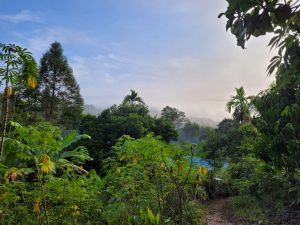
Ulu Sungai Menyang © Isabel Ordaz-Nemeth -
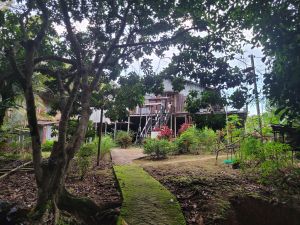
Iban longhouse © Isabel Ordaz-Nemeth -
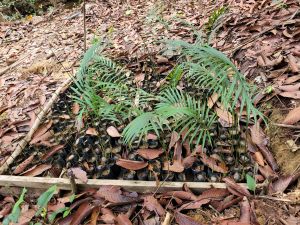
Sago palms for orangutans © Isabel Ordaz-Nemeth


Site characteristics
The site is located in the Malaysian state of Sarawak, Borneo. It is situated between Batang Ai National Park, the border to Indonesia, and the Batang Ai lake, which is an artificial lake that was created as a hydroelectric reservoir. The site, which is now classified as a Conservation Area, was proposed as an extension of Batang Ai National park following a 2013 survey that documented a high density of orangutans in the area (Borneo Adventure 2019, Sarawak Tourism).
Table 1. Basic site information for Ulu Sungai Menyang
| Species | Pongo pygmaeus pygmaeus |
| Area | 430 km² |
| Coordinates | Lat: 1.191402 , Lon: 111.939060 |
| Type of site | Conservation area |
| Habitat types | Subtropical/tropical moist lowland forest, Artificial aquatic (water storage), Agricultural land |
| Type of governance |
Types of sites Governance types Habitat types

Ape status
Table 2. Ape population estimates reported for Ulu Sungai Menyang
| Species | Year | Occurrence | Encounter or vistation rate (nests/km; ind/day) | Density estimate [ind./ km²] (95% CI) | Abundance estimate (95% CI) | Survey area | Sampling method | Analytical framework | Source | Comments | A.P.E.S. database ID |
|---|---|---|---|---|---|---|---|---|---|---|---|
| Pongo pygmaeus pygmaeus | 2023 | 270.0 | Ulu Sungai Menyang Conservation Area | Informed guess | Manggat Meringai pers. comm. 2023 | Manggat Meringai is the chief of the Manggat longhouse, located inside the conservation area | |||||
| Pongo pygmaeus pygmaeus | 2012-2013 | 0.82 (0.41-1.26) | 115 (57-176) | Ulu Sungai Menyang landscape (140 km²) | Full count | Pandong et al. 2018 |
Sampling methods Analytical frameworks
Threats
Logging companies have been stopped by local Iban communities on multiple occasions (Manggat M. pers comm. 2023).
Table 3. Threats to apes reported for Ulu Sungai Menyang
| Category | Specific threats | Threat level | Description | Year of threat |
|---|---|---|---|---|
| 2 Agriculture & aquaculture | 2.1 Annual & perennial non-timber crops | Low (up to 30% of population affected) | Some forest clearing occurs for agriculture, mainly rice cultivation. However, the Iban community allow for the forest to regenerate and the expansion of paddy fields is controlled (Ordaz-Nemeth pers. obs. 2023). | Ongoing (2023) |
| 5 Biological resource use | 5.1 Hunting & collecting terrestrial animals | Present (unknown severity) | Hunters come from outside towns and communities and target different wildlife, including orangutans (Manggat M. pers comm. 2023). | Ongoing (2023) |
Conservation activities
Due to an abundance of feeding trees and protection from the local Iban longhouse communities, the orangutan population in the area is stable. WWF-Malaysia and the Forest Department Sarawak initiated a project in 2014 to support income generation for local communities through the plantation of native gaharu trees in degraded land. Gaharu trees are used for the production of agarwood, but the leaves can also be harvested and used for tea (WWF).
Table 4. Conservation activities reported for Ulu Sungai Menyang
| Category | Specific activity | Description | Implementing organization(s) | Year of activity |
|---|---|---|---|---|
| 2 Counter-wildlife crime | 2.12 Implement community control of patrolling, banning hunting and removing snares | Local Iban communities do not hunt nor consume orangutans (Manggat M. pers comm. 2023). | Ongoing (2023) | |
| 5 Protection & restoration | 5.2 Legally protect ape habitat | The site is designated as a Conservation Area. | Ongoing (2023) |
Challenges
Table 5. Challenges reported for Ulu Sungai Menyang
| Challenges | Specific challenges | Source | Year(s) |
|---|---|---|---|
| Not reported |
Enablers
Table 6. Enablers reported for Ulu Sungai Menyang
| Enablers | Specific enablers | Source | Year(s) |
|---|---|---|---|
| 1 Site management | |||
| 2 Resources and capacity | |||
| 3 Engaged community | |||
| 4 Institutional support | |||
| 5 Ecological context | |||
| 6 Safety and stability |
Research activities
Documented behaviours
Table 7. Behaviours documented for Ulu Sungai Menyang
| Category | Behavior | Observation type | Prevalence | Observation dates | Source | Habituation | Species | Comment |
|---|---|---|---|---|---|---|---|---|
| Not reported |
Exposure to climate change impacts
External links
References
Borneo Adventure (2019). 200 orangutan found living outside Batang Ai National Park. Retrieved 15 Sept 2023. Online: https://borneoadventure.com/blog/2013/04/orangutan-survey-menyang/
WWF (n.d.). Planting a future for orangutans and people. Retrieved 15 Sept 2023.Online: https://www.wwf.org.uk/success-stories/planting-future-orangutans-and-people
Page created by: Isabel Ordaz-Nemeth Date: 2023-09-15