
Dzanga-Ndoki National Park: Difference between revisions
No edit summary |
No edit summary |
||
| Line 373: | Line 373: | ||
= References = | = References = | ||
BirdLife International. (2020). Important Bird Areas factsheet: Dzanga-Ndoki National Park. http://www.birdlife.org <br> | |||
BirdLife International. (2020). Important Bird Areas factsheet: Dzanga-Ndoki National Park. | |||
Blom, A., Almaši, A., Heitkönig, I.M.A., Kpanou, J. | Blom, A., Almaši, A., Heitkönig, I. M. A., Kpanou, J.-B., & Prins, H. H. T. (2008). A survey of the apes in the Dzanga-Ndoki National Park, Central African Republic: A comparison between the census and survey methods of estimating the gorilla (Gorilla gorilla gorilla) and chimpanzee (Pan troglodytes) nest group density. African Journal of Ecology, 39(1), 98–105. <br> | ||
Dzanga Sangha Protected Areas. (2024, March). Newsletter March 2024. | |||
Dzanga Sangha Protected Areas. (2024, March). Newsletter March 2024. https://dzanga-sangha.org/wp-content/uploads/2024/05/DSPA-newsletter-March-2024.pdf <br> | |||
Maxime, N. N. L., Jiwen, G., & Alphonse, N. (2010). Assessment of socioeconomic factors and stakeholders involved in Dzanga Sangha Complex Protected Area, Central African Republic. Journal of Sustainable Development, 3(2), 273. <br> | |||
UNEP-WCMC. (2020). Protected Area Profile for Dzanga-Ndoki from the World Database of Protected Areas, November 2020. Available at: www.protectedplanet.net <br> | |||
Revision as of 10:45, 1 September 2026
Central Africa > Central African Republic > Dzanga-Ndoki National Park
Français | Português | Español | Bahasa Indonesia | Melayu
Summary
- Central chimpanzees (Pan troglodytes troglodytes) & Western lowland gorillas (Gorilla gorilla gorilla) are present in Dzanga-Ndoki National Park.
- The population sizes are unknown.
- The population trends are unknown.
- The site has a total size of 1143.26 km².
Site characteristics
Located in the southwestern extremity of the Central African Republic, Dzanga-Ndoki National Park was established in 1990 (UNEP-WCMC 2020). The park is divided into two parts: the Dzanga sector in the north (49,500 ha) and a southern Ndoki sector (72,500 ha). The two areas are joined by the Dzanga–Sangha Rainforest Reserve, covering 335,900 ha (BirdLife International 2020). The Dzanga sector was selectively logged in the 1980s, and the Ndoki sector is primary forest (BirdLife International 2020). The park is also contiguous with the protected areas of Lobéké in Cameroon, and Nouabalé–Ndoki in Congo.The site has many natural forest clearings along streams, forming marshy areas known as ‘bai’ (BirdLife International 2020). Dzanga-Ndoki is an Important Bird Area, with at least 357 documented bird species, including species of global conservation concern, such as Bradypterus grandis, Batis minima, and Falco naumanni (BirdLife International 2020).
Table 1. Basic site information for Dzanga-Ndoki National Park
| Species | Pan troglodytes troglodytes, Gorilla gorilla gorilla |
| Area | 1,143.26 km² |
| Coordinates | Lat: 2.499285 , Lon: 16.166557 |
| Type of site | Protected area (National Park) |
| Habitat types | Subtropical/tropical moist lowland forest, Wetlands (lakes, rivers, streams, bogs, marshes) |
| Type of governance |
Types of sites Governance types Habitat types
Ape status
Table 2. Ape population estimates reported for Dzanga-Ndoki National Park
| Species | Year | Occurrence | Encounter or vistation rate (nests/km; ind/day) | Density estimate [ind./ km²] (95% CI) | Abundance estimate (95% CI) | Survey area | Sampling method | Analytical framework | Source | Comments | A.P.E.S. database ID |
|---|---|---|---|---|---|---|---|---|---|---|---|
| Pan troglodytes troglodytes | 1996-1997 | 0.16 | Dzanga sector | Strip transect | Blom et al. 2008 | Survey effort: 100 km | |||||
| Gorilla gorilla gorilla | 1996-1997 | 26.7 | 1.6 (1.2-2.1) | Dzanga sector | Line transects | Blom et al. 2008 | Survey effort: 100 km |
Sampling methods Analytical frameworks
Threats
Table 3. Threats to apes reported for Dzanga-Ndoki National Park
| Category | Specific threats | Threat level | Description | Year of threat |
|---|---|---|---|---|
| 5 Biological resource use | 5.1 Hunting & collecting terrestrial animals | Present (unknown severity) | Poaching for meat, ivory, and skins has been a major challenge to conserve wildlife in the park since the 90s. According to local communities, immigrant hunters have a belief that wildlife regenerates in perpetuity, hence the increase in poaching activities (Maxime et al. 2010). | 1996-Ongoing (2010) |
Conservation activities
Table 4. Conservation activities reported for Dzanga-Ndoki National Park
| Category | Specific activity | Description | Implementing organization(s) | Year of activity |
|---|---|---|---|---|
| 2 Counter-wildlife crime | 2.3 Conduct regular anti-poaching patrols | The government is involved in monitoring against poaching, where it manages a team of 32 eco-guards (Maxime et al. 2010). Patrols are ongoing as part of the DSPA patrols (Dzanga Sangha Protected Areas 2024). | 2010-Ongoing (2024) | |
| 4 Education & awareness | 4.1 Educate local communities about apes and sustainable use | Raise awareness on legal hunting and protection of species, also educate the population how they could benefit from conserving the park (Maxime et al. 2010). | ADAC | Ongoing (2010) |
| 5 Protection & restoration | 5.2 Legally protect ape habitat | The site is a national park. | 1990-Ongoing (2026) |
Challenges
Table 5. Challenges reported for Dzanga-Ndoki National Park
| Challenges | Specific challenges | Source | Year(s) |
|---|---|---|---|
| Not reported |
Enablers
Table 6. Enablers reported for Dzanga-Ndoki National Park
| Enablers | Specific enablers | Source | Year(s) |
|---|---|---|---|
| 1 Site management | |||
| 2 Resources and capacity | |||
| 3 Engaged community | |||
| 4 Institutional support | |||
| 5 Ecological context | |||
| 6 Safety and stability |
Research activities
Between 1996 and 1999, research at Dzanga-Ndoki National Park focused on how western lowland gorillas (Gorilla gorilla gorilla) responded to the process of habituation. The study observed their behavior as they gradually became accustomed to human presence, noting changes in vigilance, vocalizations, and tolerance. At the same time, researchers tracked the gorillas’ movements to understand their spatial ecology, looking at home range size, daily travel distances, and habitat use. Together, these findings shed light on how habituation influences gorilla ranging behavior and helped refine protocols for both research and tourism in Central African forests (Cipolletta 2003).
Documented behaviours
Table 7. Behaviours documented for Dzanga-Ndoki National Park
| Category | Behavior | Observation type | Prevalence | Observation dates | Source | Habituation | Species | Comment |
|---|---|---|---|---|---|---|---|---|
| Not reported |
Exposure to climate change impacts
As part of a study on the exposure of African great ape sites to climate change impacts, Kiribou et al. subm. extracted climate data and data on projected extreme climate impact events for the site. Climatological characteristics were derived from observation-based climate data provided by the Inter-Sectoral Impact Model Intercomparison Project (ISIMIP, www.isimip.org). Parameters were calculated as the average across each 30-year period. For 1981-2010, the EWEMBI dataset from ISIMIP2a was used. For the two future periods (2021-2050 and 2071-2099) ISIMIP2b climate data based on four CMIP5 global climate models were used. For future projections, two Representative Concentration Pathways (RCP) were used. RCP 2.6 is a scenario with strong mitigation measures in which global temperatures would likely rise below 2C. RCP 6.0 is a scenario with medium emissions in which global temperatures would likely rise up to 3C by 2100. For the number of days with heavy precipitation events, the 98th percentile of all precipitation days (>1mm/d) was calculated for the 1979-2013 reference period as a threshold for a heavy precipitation event. Then, for each year, the number of days above that threshold was derived. The figures on temperature and precipitation anomaly show the deviation from the mean temperature and mean precipitation for the 1979-2013 reference period.
The estimated exposure to future extreme climate impact events (crop failure, drought, river flood, wildfire, tropical cyclone, and heatwave) is based on a published dataset by Lange et al. 2020 derived from ISIMIP2b data. The same global climate models and RCPs as described above were used. Within each 30-year period, the number of years with an extreme event and the average proportion of the site affected were calculated (see Kiribou et al. subm. for details).
Table 8. Estimated past and projected climatological characteristics in Dzanga-Ndoki National Park
| Value | 1981-2010 | 2021-2050, RCP 2.6 | 2021-2050, RCP 6.0 | 2071-2099, RCP 2.6 | 2071-2099, RCP 6.0 |
|---|---|---|---|---|---|
| Mean temperature [C] | 24.5 | 25.8 | 25.7 | 26.1 | 27.1 |
| Annual precipitation [mm] | 1594 | 1617 | 1643 | 1653 | 1650 |
| Max no. consecutive dry days (per year) | 21.5 | 20.7 | 22.5 | 17.8 | 23.2 |
| No. days with heavy precipitation (per year) | 6.4 | 10 | 11.6 | 10.8 | 12.7 |
Table 9. Projected exposure of apes to extreme climate impact events in Dzanga-Ndoki National Park
| Type | No. of years with event (2021-2050, RCP 2.6) | % of site exposed (2021-2050, RCP 2.6) | No. of years with event (2021-2050, RCP 6.0) | % of site exposed (2021-2050, RCP 6.0) | No. of years with event (2070-2099, RCP 2.6) | % of site exposed (2070-2099, RCP 2.6) | No. of years with event (2070-2099, RCP 6.0) | % of site exposed (2070-2099, RCP 6.0) |
|---|---|---|---|---|---|---|---|---|
| Crop failure | 12.5 | 0 | 11.5 | 0 | 11.5 | 0 | 23.5 | 0 |
| Drought | 0 | 0 | 0 | 0 | 0 | 0 | 0 | 0 |
| Heatwave | 2.5 | 40 | 3 | 85.42 | 4 | 71.43 | 10 | 87.5 |
| River flood | 0 | 0 | 1.75 | 1.08 | 1.25 | 0.35 | 1 | 1.38 |
| Tropical cyclone | 0 | 0 | 0 | 0 | 0 | 0 | 0 | 0 |
| Wildfire | 30 | 0.86 | 30 | 0.85 | 29 | 0.74 | 29 | 0.79 |
-
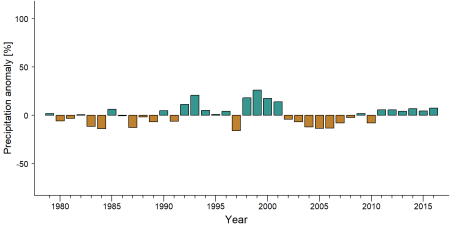
Precipitation anomaly in Dzanga-Ndoki National Park -
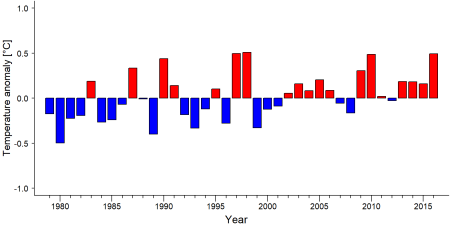
Temperature anomaly in Dzanga-Ndoki National Park


External links
https://link.springer.com/article/10.1023/A:1014969617036
https://link.springer.com/article/10.1023/B:IJOP.0000014649.15973.3a
https://link.springer.com/article/10.1023/B:IJOP.0000005988.52177.45
References
BirdLife International. (2020). Important Bird Areas factsheet: Dzanga-Ndoki National Park. http://www.birdlife.org
Blom, A., Almaši, A., Heitkönig, I. M. A., Kpanou, J.-B., & Prins, H. H. T. (2008). A survey of the apes in the Dzanga-Ndoki National Park, Central African Republic: A comparison between the census and survey methods of estimating the gorilla (Gorilla gorilla gorilla) and chimpanzee (Pan troglodytes) nest group density. African Journal of Ecology, 39(1), 98–105.
Dzanga Sangha Protected Areas. (2024, March). Newsletter March 2024. https://dzanga-sangha.org/wp-content/uploads/2024/05/DSPA-newsletter-March-2024.pdf
Maxime, N. N. L., Jiwen, G., & Alphonse, N. (2010). Assessment of socioeconomic factors and stakeholders involved in Dzanga Sangha Complex Protected Area, Central African Republic. Journal of Sustainable Development, 3(2), 273.
UNEP-WCMC. (2020). Protected Area Profile for Dzanga-Ndoki from the World Database of Protected Areas, November 2020. Available at: www.protectedplanet.net
Page created by: APES Atlas Team Date: 2020-12-05
Page updated by: Priscilla Stanley Shao Date: 2025-10-10