
Batang Ai National Park: Difference between revisions
No edit summary |
No edit summary |
||
| Line 17: | Line 17: | ||
= Site characteristics = | = Site characteristics = | ||
Batang Ai National Park is located in Sarawak, Malaysia, bordering Indonesia to the south. The park was gazetted in 1991, after the construction of the Batang Ai dam (Horowitz 1998). Sarawak's largest ethnic group, the Iban, live in traditional longhouses around Batang Ai (Pandong 2019). Thousands of Ibans were displaced as a result of the construction of the dam and the establishment of the park. Batang Ai National Park is contiguous with the Lanjak-Entimau Wildlife Sanctuary, which also adjoins Bentuang-Karimun National Park in Indonesia; together, these three areas cover almost 10,000 sq. km and form a transboundary conservation area ([https://malaysia.wcs.org/Wildlife/Orang-utan-conservation-in-Sarawak.aspx WCS]). | Batang Ai National Park is located in Sarawak, Malaysia, bordering Indonesia to the south. The park was gazetted in 1991, after the construction of the Batang Ai dam ([[#R00099|Horowitz 1998]]). Sarawak's largest ethnic group, the Iban, live in traditional longhouses around Batang Ai ([[#R00100|Pandong 2019]]). Thousands of Ibans were displaced as a result of the construction of the dam and the establishment of the park. Batang Ai National Park is contiguous with the Lanjak-Entimau Wildlife Sanctuary, which also adjoins Bentuang-Karimun National Park in Indonesia; together, these three areas cover almost 10,000 sq. km and form a transboundary conservation area ([https://malaysia.wcs.org/Wildlife/Orang-utan-conservation-in-Sarawak.aspx WCS]). | ||
'''Table 1. Basic site information for Batang Ai National Park''' | '''Table 1. Basic site information for Batang Ai National Park''' | ||
| Line 44: | Line 44: | ||
= Ape status = | = Ape status = | ||
Between 1999 and 2015 it is estimated that the orangutan population in the region of Sarawak, where the park is located, decreased by 900 individuals (Voigt et al. 2018). | Between 1999 and 2015 it is estimated that the orangutan population in the region of Sarawak, where the park is located, decreased by 900 individuals ([[#R00101|Voigt et al. 2018]]). | ||
'''Table 2. Ape population estimates reported for Batang Ai National Park''' | '''Table 2. Ape population estimates reported for Batang Ai National Park''' | ||
| Line 70: | Line 70: | ||
|Line transects | |Line transects | ||
| | | | ||
|Wich et al. 2008 | |[[#R00104|Wich et al. 2008]] | ||
| | | | ||
| | | | ||
| Line 92: | Line 92: | ||
|2.1 Annual & perennial non-timber crops | |2.1 Annual & perennial non-timber crops | ||
|Present (unknown severity) | |Present (unknown severity) | ||
|Oil palm plantations continue to expand in the region, threatening to encroach orangutan habitat (Pandong 2019). | |Oil palm plantations continue to expand in the region, threatening to encroach orangutan habitat ([[#R00100|Pandong 2019]]). | ||
|Ongoing (2019) | |Ongoing (2019) | ||
|- | |- | ||
| Line 98: | Line 98: | ||
|2.2 Wood & pulp plantations | |2.2 Wood & pulp plantations | ||
|Present (unknown severity) | |Present (unknown severity) | ||
|Industrial forest plantations growing in the region, which threaten to encroach orangutan habitat (Pandong 2019). | |Industrial forest plantations growing in the region, which threaten to encroach orangutan habitat ([[#R00100|Pandong 2019]]). | ||
|Ongoing (2019) | |Ongoing (2019) | ||
|- | |- | ||
| Line 104: | Line 104: | ||
|4.1 Roads & railroads | |4.1 Roads & railroads | ||
|Present (unknown severity) | |Present (unknown severity) | ||
|High density of logging roads in the region facilitates access for hunters (Pandong 2019). | |High density of logging roads in the region facilitates access for hunters ([[#R00100|Pandong 2019]]). | ||
|Ongoing (2019) | |Ongoing (2019) | ||
|- | |- | ||
| Line 110: | Line 110: | ||
|5.1 Hunting & collecting terrestrial animals | |5.1 Hunting & collecting terrestrial animals | ||
|Present (unknown severity) | |Present (unknown severity) | ||
|In 2016, the carcass of a flanged male orangutan with gunshot wounds was discovered at the proposed northern extension of Batang Ai National Park (Pandong 2019). A longhouse community living near the park reported that hunters from nearby villages and towns come into the area to hunt orangutans and other wildlife (Ordaz-Nemeth pers. comm. 2023). | |In 2016, the carcass of a flanged male orangutan with gunshot wounds was discovered at the proposed northern extension of Batang Ai National Park ([[#R00100|Pandong 2019]]). A longhouse community living near the park reported that hunters from nearby villages and towns come into the area to hunt orangutans and other wildlife (Ordaz-Nemeth pers. comm. 2023). | ||
|2016-Ongoing (2023) | |2016-Ongoing (2023) | ||
|} | |} | ||
| Line 118: | Line 118: | ||
= Conservation activities = | = Conservation activities = | ||
In 2003, the Sarawak Government legalized the Sarawak Forestry Corporation (SFC) to be the Forest Department’s operating arm in managing protected areas and biodiversity conservation in the state. Management changes included greater emphasis on reducing losses and numbers of park staff, as well as reduction in community conservation and communications in totally protected areas, including at Batang Ai National Park. The changes led to general unhappiness among the privileged communities and reduced commitment to protect conservation targets by park authorities, resulting in minimal control over illegal hunting and encroachment into the protected areas at the time.By the 2010s, there were multi-agency efforts to conserve orangutans, address the livelihoods of affected local communities and clarify agency roles and jurisdictions (Pandong 2019). | In 2003, the Sarawak Government legalized the Sarawak Forestry Corporation (SFC) to be the Forest Department’s operating arm in managing protected areas and biodiversity conservation in the state. Management changes included greater emphasis on reducing losses and numbers of park staff, as well as reduction in community conservation and communications in totally protected areas, including at Batang Ai National Park. The changes led to general unhappiness among the privileged communities and reduced commitment to protect conservation targets by park authorities, resulting in minimal control over illegal hunting and encroachment into the protected areas at the time.By the 2010s, there were multi-agency efforts to conserve orangutans, address the livelihoods of affected local communities and clarify agency roles and jurisdictions ([[#R00100|Pandong 2019]]). | ||
'''Table 4. Conservation activities reported for Batang Ai National Park''' | '''Table 4. Conservation activities reported for Batang Ai National Park''' | ||
| Line 130: | Line 130: | ||
|2 Counter-wildlife crime | |2 Counter-wildlife crime | ||
|2.11 Implement monitoring surveillance strategies (e.g., SMART) or use monitoring data to improve effectiveness of patrols | |2.11 Implement monitoring surveillance strategies (e.g., SMART) or use monitoring data to improve effectiveness of patrols | ||
|SMART patrols implemented by WCS Malaysia and the Sarawak Forestry Corporation (Pandong 2019). | |SMART patrols implemented by WCS Malaysia and the Sarawak Forestry Corporation ([[#R00100|Pandong 2019]]). | ||
| | | | ||
|Ongoing (2019) | |Ongoing (2019) | ||
| Line 174: | Line 174: | ||
|3 Engaged community | |3 Engaged community | ||
|3.1 General lack of community engagement or support | |3.1 General lack of community engagement or support | ||
|Pandong 2019 | |[[#R00100|Pandong 2019]] | ||
| | | | ||
|} | |} | ||
| Line 274: | Line 274: | ||
= References = | = References = | ||
Horowitz, L. S. (1998). Integrating | <span id="R00099"></span>Horowitz, L. S. (1998). Integrating Indigenous Resource Management with Wildlife Conservation: A Case Study of Batang Ai National Park, Sarawak, Malaysia. ''Human Ecology'', 26(3), 371-403. [https://doi.org/10.1023/a:1018752115074 doi:10.1023/a:1018752115074] | ||
Pandong, J. (2019). Conservation ecology of Bornean orangutans in the Greater Batang Ai-Lanjak-Entimau Landscape, Sarawak, Malaysia [Master’s thesis, The University of Adelaide]. | <span id="R00100"></span>Pandong, J. (2019). Conservation ecology of Bornean orangutans in the Greater Batang Ai-Lanjak-Entimau Landscape, Sarawak, Malaysia [Master’s thesis, The University of Adelaide]. | ||
Voigt, M., Wich, S. A., Ancrenaz, M., Meijaard, E., Abram, N., Banes, G. L., | <span id="R00101"></span>Voigt, M., Wich, S. A., Ancrenaz, M., Meijaard, E., Abram, N., Banes, G. L., …, & Kühl, H. S. (2018). Global Demand for Natural Resources Eliminated More Than 100,000 Bornean Orangutans. ''Current Biology'', 28(5), 761-769.e5. [https://doi.org/10.1016/j.cub.2018.01.053 doi:10.1016/j.cub.2018.01.053] | ||
WCS. (n.d.). Orang-utan. https://malaysia.wcs.org/Wildlife/Orang-utan-conservation-in-Sarawak.aspx | <span id="R00102"></span>WCS. (n.d.). Orang-utan. https://malaysia.wcs.org/Wildlife/Orang-utan-conservation-in-Sarawak.aspx | ||
WCS. (n.d.). Working towards conserving orang-utans and their habitats. https://malaysia.wcs.org/Wild-Places/Working-towards-conserving-orang-utans-and-their-habitats.aspx | <span id="R00103"></span>WCS. (n.d.). Working towards conserving orang-utans and their habitats. https://malaysia.wcs.org/Wild-Places/Working-towards-conserving-orang-utans-and-their-habitats.aspx | ||
Wich, S. A., Meijaard, E., Marshall, A. J., | <span id="R00104"></span>Wich, S. A., Meijaard, E., Marshall, A. J., Husson, S., Ancrenaz, M., Lacy, R. C., …, & Singleton, I. (2008). Distribution and conservation status of the orang-utan (Pongo spp.) on Borneo and Sumatra: how many remain?. ''Oryx'', 42(3), 329-339. [https://doi.org/10.1017/s003060530800197x doi:10.1017/s003060530800197x] | ||
'''Page created by: '''APES Atlas Team''' Date:''' 2021-10-24 | '''Page created by: '''APES Atlas Team''' Date:''' 2021-10-24 | ||
Latest revision as of 16:26, 12 October 2026
Asia > Malaysia > Batang Ai National Park
Français | Português | Español | Bahasa Indonesia | Melayu
Summary
- Northwest Bornean orangutans (Pongo pygmaeus pygmaeus) are present in Batang Ai National Park.
- It has been estimated that 119-580 individuals occur in the site.
- The orangutan population trend is decreasing according to statistical model estimates.
- The site has a total size of 24 km².
- Key threats to orangutans are hunting and habitat loss.
- Conservation activities have focused on awareness raising and biomonitoring.
Site characteristics
Batang Ai National Park is located in Sarawak, Malaysia, bordering Indonesia to the south. The park was gazetted in 1991, after the construction of the Batang Ai dam (Horowitz 1998). Sarawak's largest ethnic group, the Iban, live in traditional longhouses around Batang Ai (Pandong 2019). Thousands of Ibans were displaced as a result of the construction of the dam and the establishment of the park. Batang Ai National Park is contiguous with the Lanjak-Entimau Wildlife Sanctuary, which also adjoins Bentuang-Karimun National Park in Indonesia; together, these three areas cover almost 10,000 sq. km and form a transboundary conservation area (WCS).
Table 1. Basic site information for Batang Ai National Park
| Species | Pongo pygmaeus pygmaeus |
| Area | 24 km² |
| Coordinates | Lat: 1.220503 , Lon: 111.947544 |
| Type of site | Protected area (National Park) |
| Habitat types | Subtropical/tropical moist lowland forest |
| Type of governance |
Types of sites Governance types Habitat types
-
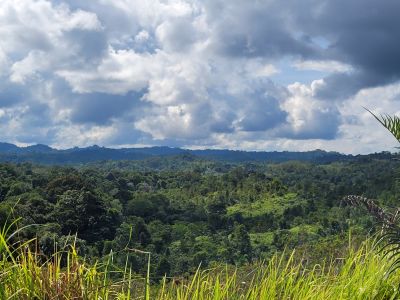
Batang Ai National Park © Isabel Ordaz-Nemeth -
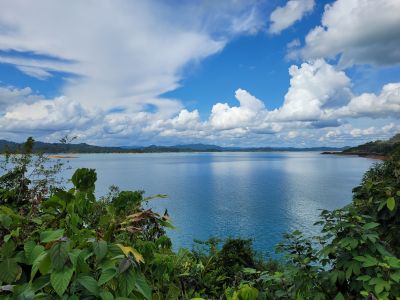
Batang Ai Dam © Isabel Ordaz-Nemeth


Ape status
Between 1999 and 2015 it is estimated that the orangutan population in the region of Sarawak, where the park is located, decreased by 900 individuals (Voigt et al. 2018).
Table 2. Ape population estimates reported for Batang Ai National Park
| Species | Year | Occurrence | Encounter or vistation rate (nests/km; ind/day) | Density estimate [ind./ km²] (95% CI) | Abundance estimate (95% CI) | Survey area | Sampling method | Analytical framework | Source | Comments | A.P.E.S. database ID |
|---|---|---|---|---|---|---|---|---|---|---|---|
| Pongo pygmaeus pygmaeus | 2004 | 119-580 | Batang Ai National Park | Line transects | Wich et al. 2008 |
Sampling methods Analytical frameworks
Threats
Table 3. Threats to apes reported for Batang Ai National Park
| Category | Specific threats | Threat level | Description | Year of threat |
|---|---|---|---|---|
| 2 Agriculture & aquaculture | 2.1 Annual & perennial non-timber crops | Present (unknown severity) | Oil palm plantations continue to expand in the region, threatening to encroach orangutan habitat (Pandong 2019). | Ongoing (2019) |
| 2 Agriculture & aquaculture | 2.2 Wood & pulp plantations | Present (unknown severity) | Industrial forest plantations growing in the region, which threaten to encroach orangutan habitat (Pandong 2019). | Ongoing (2019) |
| 4 Transportation & service corridors | 4.1 Roads & railroads | Present (unknown severity) | High density of logging roads in the region facilitates access for hunters (Pandong 2019). | Ongoing (2019) |
| 5 Biological resource use | 5.1 Hunting & collecting terrestrial animals | Present (unknown severity) | In 2016, the carcass of a flanged male orangutan with gunshot wounds was discovered at the proposed northern extension of Batang Ai National Park (Pandong 2019). A longhouse community living near the park reported that hunters from nearby villages and towns come into the area to hunt orangutans and other wildlife (Ordaz-Nemeth pers. comm. 2023). | 2016-Ongoing (2023) |
Conservation activities
In 2003, the Sarawak Government legalized the Sarawak Forestry Corporation (SFC) to be the Forest Department’s operating arm in managing protected areas and biodiversity conservation in the state. Management changes included greater emphasis on reducing losses and numbers of park staff, as well as reduction in community conservation and communications in totally protected areas, including at Batang Ai National Park. The changes led to general unhappiness among the privileged communities and reduced commitment to protect conservation targets by park authorities, resulting in minimal control over illegal hunting and encroachment into the protected areas at the time.By the 2010s, there were multi-agency efforts to conserve orangutans, address the livelihoods of affected local communities and clarify agency roles and jurisdictions (Pandong 2019).
Table 4. Conservation activities reported for Batang Ai National Park
| Category | Specific activity | Description | Implementing organization(s) | Year of activity |
|---|---|---|---|---|
| 2 Counter-wildlife crime | 2.11 Implement monitoring surveillance strategies (e.g., SMART) or use monitoring data to improve effectiveness of patrols | SMART patrols implemented by WCS Malaysia and the Sarawak Forestry Corporation (Pandong 2019). | Ongoing (2019) | |
| 4 Education & awareness | 4.4 Regularly play TV and radio announcements to raise ape conservation awareness | The orangutan radio program entitled “Jerita Bujang Sigat” or “The Saga of Bujang Sigat” was developed and aired to disseminate information about the importance of the park and its ecosystem services as well as to engage local communities to conserve orangutans and other wildlife (WCS). | 2011-2012, 2018 | |
| 4 Education & awareness | 4.5 Implement multimedia campaigns using theatre, film, print media, discussions | An orangutan conservation education and awareness program was conducted by WCS with Sarawak Forestry Corporation (SFC) and also with the assistance of some of the local communities (WCS). | Unknown | |
| 4 Education & awareness | 4.5 Implement multimedia campaigns using theatre, film, print media, discussions | The Participatory Photography event with the theme, “Appreciating nature through pictures”, was held at SK. Nanga Delok, a primary school near Batang Ai National Park. This is a boarding school with students from different longhouse communities in the area (WCS). | Unknown | |
| 5 Protection & restoration | 5.2 Legally protect ape habitat | The site was established as a National Park in 1991. | 1991-Ongoing (2026) |
Challenges
Table 5. Challenges reported for Batang Ai National Park
| Challenges | Specific challenges | Source | Year(s) |
|---|---|---|---|
| 3 Engaged community | 3.1 General lack of community engagement or support | Pandong 2019 |
Enablers
Table 6. Enablers reported for Batang Ai National Park
| Enablers | Specific enablers | Source | Year(s) |
|---|---|---|---|
| 1 Site management | |||
| 2 Resources and capacity | |||
| 3 Engaged community | |||
| 4 Institutional support | |||
| 5 Ecological context | |||
| 6 Safety and stability |
Research activities
Documented behaviours
Table 7. Behaviours documented for Batang Ai National Park
| Category | Behavior | Observation type | Prevalence | Observation dates | Source | Habituation | Species | Comment |
|---|---|---|---|---|---|---|---|---|
| Not reported |
Exposure to climate change impacts
External links
References
Horowitz, L. S. (1998). Integrating Indigenous Resource Management with Wildlife Conservation: A Case Study of Batang Ai National Park, Sarawak, Malaysia. Human Ecology, 26(3), 371-403. doi:10.1023/a:1018752115074
Pandong, J. (2019). Conservation ecology of Bornean orangutans in the Greater Batang Ai-Lanjak-Entimau Landscape, Sarawak, Malaysia [Master’s thesis, The University of Adelaide].
Voigt, M., Wich, S. A., Ancrenaz, M., Meijaard, E., Abram, N., Banes, G. L., …, & Kühl, H. S. (2018). Global Demand for Natural Resources Eliminated More Than 100,000 Bornean Orangutans. Current Biology, 28(5), 761-769.e5. doi:10.1016/j.cub.2018.01.053
WCS. (n.d.). Orang-utan. https://malaysia.wcs.org/Wildlife/Orang-utan-conservation-in-Sarawak.aspx
WCS. (n.d.). Working towards conserving orang-utans and their habitats. https://malaysia.wcs.org/Wild-Places/Working-towards-conserving-orang-utans-and-their-habitats.aspx
Wich, S. A., Meijaard, E., Marshall, A. J., Husson, S., Ancrenaz, M., Lacy, R. C., …, & Singleton, I. (2008). Distribution and conservation status of the orang-utan (Pongo spp.) on Borneo and Sumatra: how many remain?. Oryx, 42(3), 329-339. doi:10.1017/s003060530800197x
Page created by: APES Atlas Team Date: 2021-10-24