
Minkébé National Park: Difference between revisions
No edit summary |
No edit summary |
||
| Line 260: | Line 260: | ||
= Exposure to climate change impacts = | = Exposure to climate change impacts = | ||
As part of a study on the exposure of African great ape sites to climate change impacts, Kiribou et al. | As part of a study on the exposure of African great ape sites to climate change impacts, Kiribou et al. (2024) extracted climate data and data on projected extreme climate impact events for the site. Climatological characteristics were derived from observation-based climate data provided by the Inter-Sectoral Impact Model Intercomparison Project (ISIMIP, www.isimip.org). Parameters were calculated as the average across each 30-year period. For 1981-2010, the EWEMBI dataset from ISIMIP2a was used. For the two future periods (2021-2050 and 2071-2099) ISIMIP2b climate data based on four CMIP5 global climate models were used. For future projections, two Representative Concentration Pathways (RCP) were used. RCP 2.6 is a scenario with strong mitigation measures in which global temperatures would likely rise below 2C. RCP 6.0 is a scenario with medium emissions in which global temperatures would likely rise up to 3C by 2100. For the number of days with heavy precipitation events, the 98th percentile of all precipitation days (>1mm/d) was calculated for the 1979-2013 reference period as a threshold for a heavy precipitation event. Then, for each year, the number of days above that threshold was derived. The figures on temperature and precipitation anomaly show the deviation from the mean temperature and mean precipitation for the 1979-2013 reference period. | ||
The estimated exposure to future extreme climate impact events (crop failure, drought, river flood, wildfire, tropical cyclone, and heatwave) is based on a published dataset by Lange et al. 2020 derived from ISIMIP2b data. The same global climate models and RCPs as described above were used. Within each 30-year period, the number of years with an extreme event and the average proportion of the site affected were calculated ( | The estimated exposure to future extreme climate impact events (crop failure, drought, river flood, wildfire, tropical cyclone, and heatwave) is based on a published dataset by Lange et al. 2020 derived from ISIMIP2b data. The same global climate models and RCPs as described above were used. Within each 30-year period, the number of years with an extreme event and the average proportion of the site affected were calculated (Kiribou et al. 2024). | ||
'''Table 8. Estimated past and projected climatological characteristics in Minkébé National Park''' | '''Table 8. Estimated past and projected climatological characteristics in Minkébé National Park''' | ||
Revision as of 08:17, 3 September 2026
Central Africa > Gabon > Minkébé National Park
Français | Português | Español | Bahasa Indonesia | Melayu
Summary
- Central chimpanzees (Pan troglodytes troglodytes) & western lowland gorillas (Gorilla gorilla gorilla) are present in Minkébé National Park.
- The population sizes are unknown.
- The population trends are unknown.
- The site has a total size of 7,535 km².
- Key threats to great apes are hunting, mining, logging, and diseases, specifically Ebola Virus Disease.
- The main conservation interventions include regular anti-poaching patrols, ape species monitoring programs, community awareness and outreach, and continuous health monitoring.
Site characteristics
Minkébé National Park is situated in northeast Gabon, bordering Cameroon to the north and Republic of Congo to the east. The forest in Minkébé is extremely rich in bird biodiversity, and has been designated an Important Bird Area (BirdLife International 2020). Minkébé is the name of an ancient village and colonial post that was built on a ridge and abandoned in the 1930s (BirdLife International 2020). The site forms part of the Tri-National Dja-Odzala-Minkébé (TRIDOM) transboundary conservation landscape, spread across Gabon, Cameroon, and the Republic of Congo (WWF).
Table 1. Basic site information for Minkébé National Park
| Species | Pan troglodytes troglodytes, Gorilla gorilla gorilla |
| Area | 7,535 km² |
| Coordinates | Lat: 1.813136 , Lon: 12.569964 |
| Type of site | Protected area (National Park) |
| Habitat types | Subtropical/tropical swamp forest, Subtropical/tropical moist lowland forest, Subtropical/tropical dry forest, Wetlands (lakes, rivers, streams, bogs, marshes) |
| Type of governance | Governance by government |
Types of sites Governance types Habitat types
Ape status
Table 2. Ape population estimates reported for Minkébé National Park
| Species | Year | Occurrence | Encounter or vistation rate (nests/km; ind/day) | Density estimate [ind./ km²] (95% CI) | Abundance estimate (95% CI) | Survey area | Sampling method | Analytical framework | Source | Comments | A.P.E.S. database ID |
|---|---|---|---|---|---|---|---|---|---|---|---|
| Pan troglodytes troglodytes & Gorilla gorilla gorilla | 2012 | 0.3 (1.2-12) | Minkébé National Park | Line transects | ANPN 2013 |
Sampling methods Analytical frameworks
Threats
Poaching is a major threat, not just to great apes- between 2004 and 2014, more than 25,000 forest elephants were killed for their ivory in Minkébé, representing a 78-81% population decline (Poulsen et al. 2017). Gold mining has also been a major threat. In 2011, the Gabonese National Parks Agency (Agence Nationale des Parcs Nationaux / ANPN) and the Gabonese military expelled over 6,000 gold miners; illegal mining camps had grown exponentially as a result of soaring gold prices over the previous 2-3 years. Severe elephant poaching and other illegal activities were linked to these camps (ANPN 2013).
Table 3. Threats to apes reported for Minkébé National Park
| Category | Specific threats | Threat level | Description | Year of threat |
|---|---|---|---|---|
| 3 Energy production & mining | 3.2 Mining & quarrying | High (more than 70% of population affected) | Gold extraction and presence of several illegal gold camps, in the park and in its buffer zone (BirdLife International 2020; ANPN 2013). | 2013-Ongoing (2020) |
| 5 Biological resource use | 5.1 Hunting & collecting terrestrial animals | High (more than 70% of population affected) | Commercial hunting for local bushmeat trade (BirdLife International 2020). Hunting camps and huntings signs (gun shots, trails, elephant carcasses) present at the park during a 2012 survey (ANPN 2013). | 2012-Ongoing (2020) |
| 5 Biological resource use | 5.3 Logging & wood harvesting | Present (unknown severity) | Logging (BirdLife International 2020, Huijbregts et al. 2003). | 2003-Ongoing (2020) |
| 8 Invasive & other problematic species, genes & diseases | 8.4 Pathogens | High (more than 70% of population affected) | Extremely low densities of gorillas and chimpanzees were found between 1998-2000, compared to data collected before 1994. The decline resulted from Ebola outbreaks in 1994 and 1996 in the area (Huijbregts et al. 2003; Walsh et al. 2003). | 1994-1996 |
Conservation activities
Table 4. Conservation activities reported for Minkébé National Park
| Category | Specific activity | Description | Implementing organization(s) | Year of activity |
|---|---|---|---|---|
| 2 Counter-wildlife crime | 2.11 Implement monitoring surveillance strategies (e.g., SMART) or use monitoring data to improve effectiveness of patrols | Long-term monitoring programs assess population trends and ecological status of gorillas and chimpanzees in Minkébé (Maisels et al. 2013, WCS 2018). | WCS, ANPN | 2000-Ongoing (2018) |
| 2 Counter-wildlife crime | 2.3 Conduct regular anti-poaching patrols | Regular patrols and surveillance operations are conducted to reduce poaching pressure, supported by collaboration between Gabon’s National Parks Agency and NGOs (Huijbregts et al. 2003, IUCN SSC Primate Specialist Group 2014, WWF 2017). | ANPN (Agence Nationale des Parcs Nationaux), WWF, WCS | 1998-Ongoing (2017) |
| 3 Species health | 3.11 Implement continuous health monitoring/permanent vet on site | Programs for early detection and response to zoonotic disease outbreaks, especially Ebola, help mitigate catastrophic ape mortality (Walsh et al. 2003, IUCN SSC Primate Specialist Group 2014, Huijbregts et al. 2003). | ANPN, WCS, CIRMF (Centre International de Recherches Médicales de Franceville) | 2003-Ongoing (2014) |
| 4 Education & awareness | 4.1 Educate local communities about apes and sustainable use | Local community outreach and education initiatives aim to reduce hunting of great apes and promote sustainable resource use (IUCN SSC Primate Specialist Group 2014, WWF 2017). | WWF, ANPN | 2010-Ongoing (2017) |
| 5 Protection & restoration | 5.2 Legally protect ape habitat | Officially classified as a national park on 30 August 2002 by Décret n° 615/PR/MEFEPEPN (after a provisional reserve created in 2000). | 2002-Ongoing (2026) |
Challenges
Table 5. Challenges reported for Minkébé National Park
| Challenges | Specific challenges | Source | Year(s) |
|---|---|---|---|
| Not reported |
Enablers
Table 6. Enablers reported for Minkébé National Park
| Enablers | Specific enablers | Source | Year(s) |
|---|---|---|---|
| 1 Site management | |||
| 2 Resources and capacity | |||
| 3 Engaged community | |||
| 4 Institutional support | |||
| 5 Ecological context | |||
| 6 Safety and stability |
Research activities
Documented behaviours
Table 7. Behaviours documented for Minkébé National Park
| Category | Behavior | Observation type | Prevalence | Observation dates | Source | Habituation | Species | Comment |
|---|---|---|---|---|---|---|---|---|
| Not reported |
Exposure to climate change impacts
As part of a study on the exposure of African great ape sites to climate change impacts, Kiribou et al. (2024) extracted climate data and data on projected extreme climate impact events for the site. Climatological characteristics were derived from observation-based climate data provided by the Inter-Sectoral Impact Model Intercomparison Project (ISIMIP, www.isimip.org). Parameters were calculated as the average across each 30-year period. For 1981-2010, the EWEMBI dataset from ISIMIP2a was used. For the two future periods (2021-2050 and 2071-2099) ISIMIP2b climate data based on four CMIP5 global climate models were used. For future projections, two Representative Concentration Pathways (RCP) were used. RCP 2.6 is a scenario with strong mitigation measures in which global temperatures would likely rise below 2C. RCP 6.0 is a scenario with medium emissions in which global temperatures would likely rise up to 3C by 2100. For the number of days with heavy precipitation events, the 98th percentile of all precipitation days (>1mm/d) was calculated for the 1979-2013 reference period as a threshold for a heavy precipitation event. Then, for each year, the number of days above that threshold was derived. The figures on temperature and precipitation anomaly show the deviation from the mean temperature and mean precipitation for the 1979-2013 reference period.
The estimated exposure to future extreme climate impact events (crop failure, drought, river flood, wildfire, tropical cyclone, and heatwave) is based on a published dataset by Lange et al. 2020 derived from ISIMIP2b data. The same global climate models and RCPs as described above were used. Within each 30-year period, the number of years with an extreme event and the average proportion of the site affected were calculated (Kiribou et al. 2024).
Table 8. Estimated past and projected climatological characteristics in Minkébé National Park
| Value | 1981-2010 | 2021-2050, RCP 2.6 | 2021-2050, RCP 6.0 | 2071-2099, RCP 2.6 | 2071-2099, RCP 6.0 |
|---|---|---|---|---|---|
| Mean temperature [C] | 24.4 | 25.5 | 25.5 | 25.7 | 26.8 |
| Annual precipitation [mm] | 2879 | 2952 | 2944 | 2979 | 3005 |
| Max no. consecutive dry days (per year) | 15.9 | 11 | 11.2 | 9.6 | 11.5 |
| No. days with heavy precipitation (per year) | 6.7 | 9 | 8 | 9.1 | 9.7 |
Table 9. Projected exposure of apes to extreme climate impact events in Minkébé National Park
| Type | No. of years with event (2021-2050, RCP 2.6) | % of site exposed (2021-2050, RCP 2.6) | No. of years with event (2021-2050, RCP 6.0) | % of site exposed (2021-2050, RCP 6.0) | No. of years with event (2070-2099, RCP 2.6) | % of site exposed (2070-2099, RCP 2.6) | No. of years with event (2070-2099, RCP 6.0) | % of site exposed (2070-2099, RCP 6.0) |
|---|---|---|---|---|---|---|---|---|
| Crop failure | 12 | 0 | 11 | 0 | 13 | 0 | 24.5 | 0 |
| Drought | 0 | 0 | 0 | 0 | 0 | 0 | 0 | 0 |
| Heatwave | 7.5 | 52.27 | 8 | 57.35 | 8 | 58.33 | 17.5 | 69.65 |
| River flood | 1.5 | 0.65 | 3 | 0.95 | 3.5 | 1.52 | 5.5 | 1.7 |
| Tropical cyclone | 0 | 0 | 0 | 0 | 0 | 0 | 0 | 0 |
| Wildfire | 30 | 0.24 | 30 | 0.24 | 29 | 0.21 | 29 | 0.26 |
-
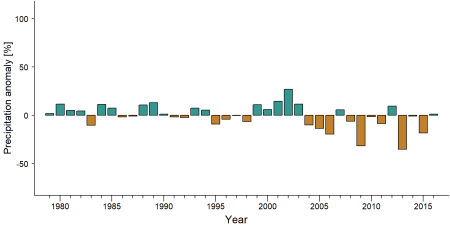
Precipitation anomaly in Minkébé National Park -
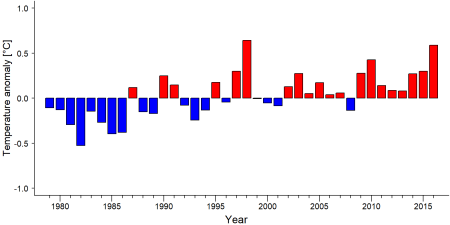
Temperature anomaly in Minkébé National Park


External links
References
ANPN. (2013). Wildlife surveying in Minkebe National Park, 2012: WCS-WWF collaboration. https://www.wwf.de/fileadmin/fm-wwf/Publikationen-PDF/Preliminary_Results_of_Minkebe_Pilot_Study_070213.pdf
BirdLife International. (2020). Important Bird Areas factsheet: Minkébé Forest Reserve. Retrieved November 4, 2020, from http://www.birdlife.org
Global Forest Watch. (2018). Mining in Minkébé National Park, Gabon. Retrieved from https://www.globalforestwatch.org/
Huijbregts, B., De Wachter, P., Obiang, L., & Akou, M. (2003). Ebola and the decline of gorilla Gorilla gorilla and chimpanzee Pan troglodytes populations in Minkebe Forest, north-eastern Gabon. Oryx, 37(4), 437–443. https://doi.org/10.1017/S0030605303000802
IUCN SSC Primate Specialist Group. (2014). Regional action plan for the conservation of western lowland gorillas and central chimpanzees 2015–2025. IUCN.
Maisels, F., Strindberg, S., Blake, S., et al. (2013). Devastating decline of forest elephants in Central Africa. PLOS ONE, 8(3), e59469.
Poulsen, J. R., Koerner, S. E., Moore, S., Medjibe, V. P., Blake, S., Clark, C. J., Akou, M. E., Fay, M., Meier, A., Okouyi, J., Rosin, C., & White, L. J. T. (2017). Poaching empties critical Central African wilderness of forest elephants. Current Biology, 27(4), R134–R135. https://doi.org/10.1016/j.cub.2017.01.023
Walsh, P., Abernethy, K., Bermejo, M., et al. (2003). Catastrophic ape decline in western equatorial Africa. Nature, 422, 611–614. https://doi.org/10.1038/nature01566
WCS. (2018). Monitoring great apes in Gabon’s protected areas. Wildlife Conservation Society. Retrieved from https://www.wcs.org/
WWF. (2017). Protecting Minkébé National Park. World Wide Fund for Nature. Retrieved from https://www.wwf.org/
Page created by: APES Atlas Team Date: 2020-12-29
Page updated by: Aime Mizero Date: 2025-08-15