
Nialama Classified Forest: Difference between revisions
No edit summary |
No edit summary |
||
| Line 337: | Line 337: | ||
= Exposure to climate change impacts = | = Exposure to climate change impacts = | ||
As part of a study on the exposure of African great ape sites to climate change impacts, Kiribou et al. | As part of a study on the exposure of African great ape sites to climate change impacts, Kiribou et al. (2024) extracted climate data and data on projected extreme climate impact events for the site. Climatological characteristics were derived from observation-based climate data provided by the Inter-Sectoral Impact Model Intercomparison Project (ISIMIP, www.isimip.org). Parameters were calculated as the average across each 30-year period. For 1981-2010, the EWEMBI dataset from ISIMIP2a was used. For the two future periods (2021-2050 and 2071-2099) ISIMIP2b climate data based on four CMIP5 global climate models were used. For future projections, two Representative Concentration Pathways (RCP) were used. RCP 2.6 is a scenario with strong mitigation measures in which global temperatures would likely rise below 2C. RCP 6.0 is a scenario with medium emissions in which global temperatures would likely rise up to 3C by 2100. For the number of days with heavy precipitation events, the 98th percentile of all precipitation days (>1mm/d) was calculated for the 1979-2013 reference period as a threshold for a heavy precipitation event. Then, for each year, the number of days above that threshold was derived. The figures on temperature and precipitation anomaly show the deviation from the mean temperature and mean precipitation for the 1979-2013 reference period. | ||
The estimated exposure to future extreme climate impact events (crop failure, drought, river flood, wildfire, tropical cyclone, and heatwave) is based on a published dataset by Lange et al. 2020 derived from ISIMIP2b data. The same global climate models and RCPs as described above were used. Within each 30-year period, the number of years with an extreme event and the average proportion of the site affected were calculated ( | The estimated exposure to future extreme climate impact events (crop failure, drought, river flood, wildfire, tropical cyclone, and heatwave) is based on a published dataset by Lange et al. 2020 derived from ISIMIP2b data. The same global climate models and RCPs as described above were used. Within each 30-year period, the number of years with an extreme event and the average proportion of the site affected were calculated (Kiribou et al. 2024). | ||
'''Table 8. Estimated past and projected climatological characteristics in Nialama Classified Forest''' | '''Table 8. Estimated past and projected climatological characteristics in Nialama Classified Forest''' | ||
Revision as of 08:18, 3 September 2026
West Africa > Republic of Guinea > Nialama Classified Forest
Français | Português | Español | Bahasa Indonesia | Melayu
Summary
- Western chimpanzees (Pan troglodytes verus) are present in Nialama Classified Forest.
- It has been estimated that more than 80 chimpanzees occur in and around Nialama Classified Forest.
- The chimpanzee population trend is unknown.
- This site has a total size of 100 km².
- Key threats to chimpanzees is habitat degradation due to agriculture.
- A community-based chimpanzee monitoring initiative has been established in 1998.
- Nialama Classified Forest is co-managed by local communities and government authorities since 1999.
Site characteristics
Nialama (or Nyalama) is located in the Fouta Djallon highland region in northern Guinea and was designated a Classified Forest (IUCN category not reported) in 1943 (UNEP-WCMC & IUCN 2019). It is 120 km northwest of Labé in the sub-prefecture of Linsan-Saran. It has a size of 100 km2 (UNEP-WCMC & IUCN 2019). Nialama is on and below a steep plateau, an area characterized by a mosaic of open savanna woodland with gallery forests, grassland, patches of bamboo and seasonal swamps (Sunderland-Groves et al. 2011, BirdLife International 2019). The annual rainfall is 1,145 mm (BirdLife International 2019).
Due to its bird diversity Nialama is designated an Important Bird Area with a total size of 120 km2 consisting of Nialama CF and adjacent areas (BirdLife International 2019). Several primate species occur in the forest: western chimpanzees (Pan troglodytes verus), king colobus (Colobus polykomos), Guinea baboon (Papio papio), Campbell’s monkey (Cercopithecus campbelli), patas monkey (Erythrocebus patas), and Northern lesser galago (Galago senegalensis, Sunderland-Groves et al. 2011). In addition, 17 species of amphibians have been recorded in Nialama CF (Hillers et al. 2008).
Table 1. Basic site information for Nialama Classified Forest
| Species | Pan troglodytes verus |
| Area | 100 km² |
| Coordinates | Lat: 11.73 , Lon: -12.74 |
| Type of site | Protected area (Classified Forest) |
| Habitat types | Savanna, Shrubland, Subtropical/tropical dry forest, Subtropical/tropical swamp forest, Agricultural land |
| Type of governance |
Types of sites Governance types Habitat types
Ape status
In a nationwide survey Rebecca Kormos confirmed the presence of western chimpanzees in Nialama CF (Ham 1998). Kormos identified Nialama CF as the third most important priority area for western chimpanzee conservation in Guinea due to high abundance of chimpanzees and remaining suitable habitat (Ham 1998). A follow-up survey in 1998 concluded that at least three chimpanzee communities occur in Nialama CF and additional four groups use the site periodically (Fourrier 1999, Carter 2000 as cited in Kormos et al. 2003, Sunderland-Groves et al. 2011). Marc Fourrier (hired by Janis Carter to lead the conservation activities under the EU-funded project “Projet de Conservation de Chimpanzés en Guinée”) trained community members to monitor chimpanzees and set up a community-based monitoring system in which community members collected data monthly within and outside of Nialama CF (Sunderland-Groves et al. 2011). Funding for this project ceased in 2009 and the current status of the monitoring project was not reported (Sunderland-Groves et al. 2011).
Table 2. Ape population estimates reported for Nialama Classified Forest
| Species | Year | Occurrence | Encounter or vistation rate (nests/km; ind/day) | Density estimate [ind./ km²] (95% CI) | Abundance estimate (95% CI) | Survey area | Sampling method | Analytical framework | Source | Comments | A.P.E.S. database ID |
|---|---|---|---|---|---|---|---|---|---|---|---|
| Pan troglodytes verus | 2006-2008 | 0.08-0.240 | Within and outside Nialama forest | Line transects | Carter 2008 as cited in Sunderland-Groves et al. 2011 | Total survey effort: 3483.84 km | |||||
| Pan troglodytes verus | 1998-1999 | 83.0 | Nialama Classified Forest (125 km²) | Reconnaissance walk | Fourrier 1999, Carter 2000 as cited in Kormos et al. 2003 and Sunderland-Groves et al. 2011 | Community members repeatedly and systematically visited 1 km² grid cells to determine area used by chimpanzees | |||||
| Pan troglodytes verus | 1997 | Present | Nialama forest | Reconnaissance walk | Ham 1998 | Reconnaissance survey |
Sampling methods Analytical frameworks
Threats
The main threat to chimpanzees is habitat destruction and fragmentation as a result of the expansion of agricultural areas (BirdLife International 2019, Kormos et al. 2003, Sunderland-Groves et al. 2011). An additional threat to habitat include uncontrolled fires that are used to prepare agricultural zones for crop planting or grazing (Fourrier 1999, PEGG 2012). Two villages are located within Nialama CF with a total population of several hundred inhabitants, and additional villages are located at the border of Nialama CF (Sunderland-Groves et al. 2011). The expansion of agricultural areas also resulted in an increase in frequency of negative chimpanzee-human interactions, for example crop raiding killing of young livestock by chimpanzees, conflict over water sources and wild fruits and honey. Especially the first one can lead to the reduction in villager’s income. This is turn can lead to retaliatory hunting of chimpanzees by villagers (Fourrier 1999, Carter 2004, 2008 as cited in Sunderland-Groves et al. 2011). Swamps are partly used for rice cultivation (BirdLife International 2019). At the end of 1980s large-scale logging took place (BirdLife International 2019).
Table 3. Threats to apes reported for Nialama Classified Forest
| Category | Specific threats | Threat level | Description | Year of threat |
|---|---|---|---|---|
| 1 Residential & commercial development | 1.1 Residential areas | Medium (30-70% of population affected) | Two villages within the forest, additional villages in the vicinity (Sunderland-Groves et al. 2011). | Ongoing (2011) |
| 2 Agriculture & aquaculture | 2.1 Annual & perennial non-timber crops | High (more than 70% of population affected) | Agricultural very prevalent across the site, especially in the western part of the site (BirdLife International 2019, Kormos et al. 2003, Sunderland-Groves et al. 2011). | 2003-Ongoing (2019) |
| 2 Agriculture & aquaculture | 2.3 Livestock farming & ranching | Medium (30-70% of population affected) | Area used for cattle grazing (PEGG 2012). | Ongoing (2012) |
| 4 Transportation & service corridors | 4.1 Roads & railroads | Present (unknown severity) | Trail system used by villagers (Sunderland-Groves et al. 2011). | Ongoing (2011) |
| 5 Biological resource use | 5.1.5 Persecution/human wildlife conflict | Low (up to 30% of population affected) | Retaliatory killings of chimpanzees after crop raiding, but generally social norms forbid the hunting and eating of chimpanzees (Sunderland-Groves et al. 2011). Conflicts between humans and chimpanzees over dry season water sources is intense and may lead to retaliation (Fourrier 1999). | 1999-Ongoing (2011) |
| 5 Biological resource use | 5.2 Gathering terrestrial plants | Present (unknown severity) | Gathering of non-forest timber products permitted and regulated under the management plan (Sunderland-Groves et al. 2011). | Ongoing (2011) |
| 5 Biological resource use | 5.3 Logging & wood harvesting | Medium (30-70% of population affected) | Large-sale logging in the 1980s which markedly changed the habitat composition (BirdLife International 2019). | 1980-1989 |
| 7 Natural system modifications | 7.1 Fire & fire suppression | Medium (30-70% of population affected) | Fire are set for clearing areas for agricultural use and grass regrowth (Fourrier 1999. BirdLife International 2019, PEGG 2012, Sunderland-Groves et al. 2011). | 1999-Ongoing (2019) |
Conservation activities
In 1998 as part of the project “Projet de Conservation de Chimpanzés en Guinée” local hunters were trained to collect monitoring data on the number and movement of chimpanzees in Nialama forest (Fourrier 1999, Kormos et al. 2003). The aim was to develop a low-cost long-term monitoring system of chimpanzees (Sunderland-Groves et al. 2011). Additionally, an environmental education / sensibilization program using film and community meetings was implemented within the Nialama CF buffer zone to increase awareness of the area’s biodiversity and chimpanzees (Fourrier 1999). Since 1998, a monthly, community-based monitoring system was implemented in the areas. In addition, in 1999 Nialama CF became the first forest in Guinea to be co-managed by local communities and the National Directorate of Water and Forests (DNEF) based on a legally binding agreement between the involved parties (Sunderland-Groves et al. 2011). Co-management implied that local communities and government authorities jointly make land and resource-use decisions as a part of a management plan. Specifically, this included ensuring that community members and forestry agents implement management activities, such as clearing and maintaining fire buffers, wildlife monitoring, enforcing rules for the sustainable use of wildlife and plants, tree replanting and demarcating the classified forest. At the same time communities can use timber and non-timber forest products from the forest, receive financial and technical support for farming and agroforestry in selected areas, all in accordance with rules set forth in the management plan (Sunderland-Groves et al. 2011). The project was funded by USAID until 2009. A study showed that habitat degradation was less prevalent in habitat that had been demarcated as critical for chimpanzees by the community-based project compared to other areas around Nialama CF (Sunderland-Groves et al. 2011).
Noteworthy is also people’s traditional believes forbid the hunting and eating of chimpanzees, resulting in some level of protection to chimpanzees, but is not followed by all community members (Kormos et al. 2003, Sunderland-Groves et al. 2011).
Table 4. Conservation activities reported for Nialama Classified Forest
| Category | Specific activity | Description | Implementing organization(s) | Year of activity |
|---|---|---|---|---|
| 1 Development impact mitigation | 1.4 Farm more intensively and effectively in selected areas and spare more natural land | As part of co-management approach critical chimpanzee habitat was delineated, management plan exists, farmers received technical and financial support (Sunderland-Groves et al. 2011). | 1999-2000 | |
| 2 Counter-wildlife crime | 2.12 Implement community control of patrolling, banning hunting and removing snares | Hunting regulated as part of management plan (Sunderland-Groves et al. 2011). | 1999-2000 | |
| 4 Education & awareness | 4.1 Educate local communities about apes and sustainable use | Environmental awareness raising activities (Sunderland-Groves et al. 2011). | 1999-Ongoing (2019) | |
| 4 Education & awareness | 4.2 Involve local community in ape research and conservation management | Community-based monitoring system of chimpanzees implemented (Sunderland-Groves et al. 2011). | 1998-Ongoing (2019) | |
| 4 Education & awareness | 4.5 Implement multimedia campaigns using theatre, film, print media, discussions | Use of film and community discussions (Fourrier 1999). | 1998-2000 | |
| 5 Protection & restoration | 5.2 Legally protect ape habitat | Designated as Classified Forest (UNEP-WCMC and IUCN 2019). | 1943-Ongoing (2019) | |
| 5 Protection & restoration | 5.6 Habitat restoration | Tree-replanting (PEGG 2012). | 1999-Ongoing (2019) | |
| 7 Economic & other incentives | 7.1 Provide monetary benefits to local communities for sustainably managing their forest and its wildlife (e.g., REDD, alternative income, employment) | Villagers benefited from technical and financial support for farming and other livelihoods which led to increased income (Sunderland-Groves et al. 2011). From 1999 to early 2000s. | 1999-2005 |
Challenges
Lack of transportation for members of the village committee and the National Directorate of Water and Forests was mentioned as an impediment to implementing the management plan (PEGG 2012). Members that were newly elected to the village committee after the conservation project stopped did not receive training and lacked capacity to fulfill their tasks (PEGG 2012).
Table 5. Challenges reported for Nialama Classified Forest
| Challenges | Specific challenges | Source | Year(s) |
|---|---|---|---|
| 2 Resources and capacity | 2.1 Lack of capacity/training | PEGG 2012 | |
| 2 Resources and capacity | 2.5 Lack of equipment/transportation | PEGG 2012 |
Enablers
Table 6. Enablers reported for Nialama Classified Forest
| Enablers | Specific enablers | Source | Year(s) |
|---|---|---|---|
| 1 Site management | |||
| 2 Resources and capacity | |||
| 3 Engaged community | |||
| 4 Institutional support | |||
| 5 Ecological context | |||
| 6 Safety and stability |
Research activities
As detailed above surveys and long-term monitoring of chimpanzees has been implemented (Ham 1998, Fourrier 1999, Sunderland-Groves et al. 2011). A study on amphibian diversity has also been done (Hillers at al. 2008).
Documented behaviours
Table 7. Behaviours documented for Nialama Classified Forest
| Category | Behavior | Observation type | Prevalence | Observation dates | Source | Habituation | Species | Comment |
|---|---|---|---|---|---|---|---|---|
| Not reported |
Exposure to climate change impacts
As part of a study on the exposure of African great ape sites to climate change impacts, Kiribou et al. (2024) extracted climate data and data on projected extreme climate impact events for the site. Climatological characteristics were derived from observation-based climate data provided by the Inter-Sectoral Impact Model Intercomparison Project (ISIMIP, www.isimip.org). Parameters were calculated as the average across each 30-year period. For 1981-2010, the EWEMBI dataset from ISIMIP2a was used. For the two future periods (2021-2050 and 2071-2099) ISIMIP2b climate data based on four CMIP5 global climate models were used. For future projections, two Representative Concentration Pathways (RCP) were used. RCP 2.6 is a scenario with strong mitigation measures in which global temperatures would likely rise below 2C. RCP 6.0 is a scenario with medium emissions in which global temperatures would likely rise up to 3C by 2100. For the number of days with heavy precipitation events, the 98th percentile of all precipitation days (>1mm/d) was calculated for the 1979-2013 reference period as a threshold for a heavy precipitation event. Then, for each year, the number of days above that threshold was derived. The figures on temperature and precipitation anomaly show the deviation from the mean temperature and mean precipitation for the 1979-2013 reference period.
The estimated exposure to future extreme climate impact events (crop failure, drought, river flood, wildfire, tropical cyclone, and heatwave) is based on a published dataset by Lange et al. 2020 derived from ISIMIP2b data. The same global climate models and RCPs as described above were used. Within each 30-year period, the number of years with an extreme event and the average proportion of the site affected were calculated (Kiribou et al. 2024).
Table 8. Estimated past and projected climatological characteristics in Nialama Classified Forest
| Value | 1981-2010 | 2021-2050, RCP 2.6 | 2021-2050, RCP 6.0 | 2071-2099, RCP 2.6 | 2071-2099, RCP 6.0 |
|---|---|---|---|---|---|
| Mean temperature [C] | 26.4 | 27.7 | 27.5 | 27.8 | 29.3 |
| Annual precipitation [mm] | 1444 | 1363 | 1321 | 1397 | 1221 |
| Max no. consecutive dry days (per year) | 90.1 | 88.4 | 91.9 | 94.5 | 91.2 |
| No. days with heavy precipitation (per year) | 3.6 | 4.3 | 3.9 | 4.7 | 3.1 |
Table 9. Projected exposure of apes to extreme climate impact events in Nialama Classified Forest
| Type | No. of years with event (2021-2050, RCP 2.6) | % of site exposed (2021-2050, RCP 2.6) | No. of years with event (2021-2050, RCP 6.0) | % of site exposed (2021-2050, RCP 6.0) | No. of years with event (2070-2099, RCP 2.6) | % of site exposed (2070-2099, RCP 2.6) | No. of years with event (2070-2099, RCP 6.0) | % of site exposed (2070-2099, RCP 6.0) |
|---|---|---|---|---|---|---|---|---|
| Crop failure | 7.5 | 0.9 | 7 | 0.9 | 9 | 0.9 | 13 | 0.9 |
| Drought | 0.25 | 25 | 0.25 | 25 | 0.5 | 25 | 1.25 | 75 |
| Heatwave | 1.5 | 50 | 1 | 50 | 0 | 0 | 0 | 0 |
| River flood | 1 | 3.84 | 1 | 0.65 | 1 | 1.54 | 0.75 | 1.31 |
| Tropical cyclone | 0 | 0 | 0 | 0 | 0.5 | 3.73 | 0 | 0 |
| Wildfire | 30 | 1.46 | 30 | 1.48 | 29 | 1.54 | 29 | 1.88 |
-
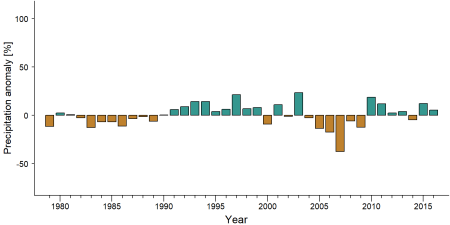
Precipitation anomaly in Nialama Classified Forest -
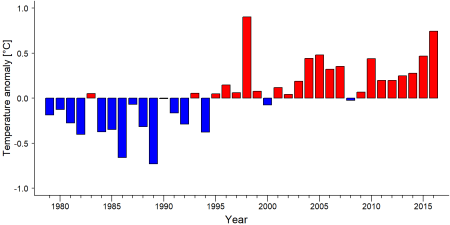
Temperature anomaly in Nialama Classified Forest


External links
References
BirdLife International. 2019. Important Bird Areas factsheet: Nialama. Online: www.birdlife.org
Carter J. 2000. Les Chimpanzés de Guinée. Une etude pour une survie: Nyalama et Pita. Unpublished report for the US Agency for International Development, Conakry, Republic of Guinea, the Direction Nationale des Eaux et Forets, Conakry, Guinea and Friends of Animals, USA.
Fourrier M.S. 1999. Implementation of an Ecological Study of the Chimpanzees of the Nialama Classified Forest and Evaluation of the Education Program and Suggestions for the conservation of Chimpanzees in the Fouta Djallon Highlands of the Republic of Guinea. Unpublished report for “Projet de Conservation de Chimpanzés Guinée”.
Kormos R et al. 2003. The Republic of Guinea, in Kormos, R. Boesch, C., Bakarr, M.I. & Butynski, T.M. [eds.] Status Survey and Conservation Action Plan, IUCN/SSC Primate Specialist Group. IUCN, Gland, Switzerland and Cambridge, UK
Ham R. 1998. Nationwide chimpanzee census and large mammal survey Republic of Guinea. Projet de conservation des chimpanzés en Guineée. Report to the European Union.
Hillers A et al. 2008. A preliminary assessment of the amphibians of the Fouta Djallon, Guinea, West Africa. Salamandra, 44:2, 113-122.
PEGG. 2012 Current state of the classified and co-managed forests of Balayan Souroumba, Nialama, Sincery Oursa and Souti Yanfou. Program in Environmental Governance in Guinea for Capacity Building and Biodiversity Conservation. A rapid assessment conducted by PEGG, in collaboration with DNEF, BGEEE, and COSIE
Sunderland-Groves et al. 2011. Impacts of co-management on western chimpanzee (Pan troglodytes verus) habitat and conservation in Nialama Classified Forest, Republic of Guinea: a satellite perspective. Biodiversity and Conservation 20:2745-2757
UNEP-WCMC, IUCN. 2019. Protected Planet: The World Database on Protected Areas (WDPA), Cambridge, UK: UNEP-WCMC and IUCN Online: www.protectedplanet.net
Page created by: APES Atlas Team & Marc Fourrier Date: 2019-11-26