
Mount Nimba Strict Nature Reserve (Côte d'Ivoire): Difference between revisions
No edit summary |
No edit summary Tag: Reverted |
||
| Line 364: | Line 364: | ||
<span id="R01279"></span>UICN & UNESCO. (2019). Joint monitoring mission report: Mount Nimba Strict Nature Reserve (Côte d’Ivoire/Guinea). IUCN and UNESCO World Heritage Centre. https://whc.unesco.org/en/list/155/documents/ | <span id="R01279"></span>UICN & UNESCO. (2019). Joint monitoring mission report: Mount Nimba Strict Nature Reserve (Côte d’Ivoire/Guinea). IUCN and UNESCO World Heritage Centre. https://whc.unesco.org/en/list/155/documents/ | ||
<span id="R02274"></span>Kiribou, R., Tehoda, P., Chukwu, O., Bempah, G., Kühl, H. S., Ferreira, J., …, & Heinicke, S. (2024). Exposure of African ape sites to climate change impacts. ''PLOS Climate'', 3(2), | <span id="R02274"></span>Kiribou, R., Tehoda, P., Chukwu, O., Bempah, G., Kühl, H. S., Ferreira, J., …, & Heinicke, S. (2024). Exposure of African ape sites to climate change impacts. ''PLOS Climate'', 3(2), 1-19. [https://doi.org/10.1371/journal.pclm.0000345 doi:10.1371/journal.pclm.0000345] | ||
'''Page created by: '''Zausa Diorne''' Date:''' 2024-11-24 08:16:00 | '''Page created by: '''Zausa Diorne''' Date:''' 2024-11-24 08:16:00 | ||
Revision as of 10:35, 15 October 2026
West Africa > Côte d'Ivoire > Mount Nimba Strict Nature Reserve (Côte d'Ivoire)
Français | Português | Español | Bahasa Indonesia | Melayu
Summary
- Western chimpanzees (Pan troglodytes verus) are present in Mount Nimba Strict Nature Reserve.
- In 2022, it was estimated that 25 individuals are present in the Reserve.
- The chimpanzee population trend is unknown.
- This site has a total size of 50 km².
- Key threats to chimpanzees include poaching and habitat loss due to fires.
- Conservation activities include ecological monitoring.
- As a UNESCO World Heritage natural site, the Mount Nimba Nature Reserve (Ivory Coast – Guinea) has been listed as a World Heritage site in danger since 1992
Site characteristics
The Mount Nimba Massif is a transboundary site shared by three countries (Ivory Coast, Guinea, and Liberia). The status of this forest massif varies across these countries. Specifically, the part of Mount Nimba in Ivory Coast is designated as an integral nature reserve and a UNESCO World Heritage site. In Guinea, the Guinean portion is classified as a biosphere reserve and a World Heritage site, while the part in Liberia has no special status.
As a UNESCO World Heritage natural site, the Mount Nimba Nature Reserve (Ivory Coast – Guinea) has been listed as a World Heritage site in danger since 1992 by the UNESCO World Heritage Committee, mainly due to the presence of mining sites within the property. In recent years, the State Parties of Ivory Coast and Guinea have expressed their intention to remove this site from the endangered list. To achieve this, both countries have committed to implementing the recommendations made by the UNESCO World Heritage Committee (OIPR, 2016).
One of the key recommendations from the Committee is the establishment of an ecological monitoring protocol. Despite numerous studies, knowledge regarding the abundance of wildlife species, particularly mammalian fauna and endemic species of the Mount Nimba Nature Reserve, remains insufficient. Data on the populations of endemic, rare, and endangered species is lacking, making it difficult to assess this criterion (IUCN, 2008). However, inventories and research conducted, along with monitoring activities, show that these species are still present, indicating that the reference to this criterion remains relevant (IUCN and UNESCO, 2019).
Table 1. Basic site information for Mount Nimba Strict Nature Reserve (Côte d'Ivoire)
| Species | Pan troglodytes verus |
| Area | 50.92 km² |
| Coordinates | Lat: 7.58287 , Lon: -8.41795 |
| Type of site | Protected area (Nature Reserve) |
| Habitat types | Subtropical/tropical moist montane forest, Savanna |
| Type of governance | Governance by government |
Types of sites Governance types Habitat types
Ape status
Table 2. Ape population estimates reported for Mount Nimba Strict Nature Reserve (Côte d'Ivoire)
| Species | Year | Occurrence | Encounter or vistation rate (nests/km; ind/day) | Density estimate [ind./ km²] (95% CI) | Abundance estimate (95% CI) | Survey area | Sampling method | Analytical framework | Source | Comments | A.P.E.S. database ID |
|---|---|---|---|---|---|---|---|---|---|---|---|
| Pan troglodytes verus | 2022 | 4.2 | 0.50 (0.23-1.06) | 25 (12-54) | Mount Nimba Strict Nature Reserve (50.92 km²) | Line transects & recces | Distance sampling | OIPR 2023 | |||
| Pan troglodytes verus | 2021 | 2.5 | 0.07 (0.34-0.145) | 36 (17-74) | Mount Nimba Strict Nature Reserve (50.92 km²) | Line transects & recces | Distance sampling | OIPR 2021 |
Sampling methods Analytical frameworks
Threats
Table 3. Threats to apes reported for Mount Nimba Strict Nature Reserve (Côte d'Ivoire)
| Category | Specific threats | Threat level | Description | Year of threat |
|---|---|---|---|---|
| 5 Biological resource use | 5.1 Hunting & collecting terrestrial animals | Present (unknown severity) | As for the types of anthropogenic activities recorded in the reserve, they are primarily related to poaching. These include, among others, bushfires, human tracks, cartridge casings, and gunshots. Among these poaching indicators, human tracks have been the most frequently recorded. This high number of tracks in the reserve suggests that the surrounding populations regularly engage in activities that impact the presence of wildlife (OIPR 2021, OIPR 2023). | 2021-Ongoing (2023) |
| 7 Natural system modifications | 7.1 Fire & fire suppression | Present (unknown severity) | Bushfires by humans (OIPR 2021, OIPR 2023). | Ongoing (2023) |
Conservation activities
Table 4. Conservation activities reported for Mount Nimba Strict Nature Reserve (Côte d'Ivoire)
| Category | Specific activity | Description | Implementing organization(s) | Year of activity |
|---|---|---|---|---|
| 2 Counter-wildlife crime | 2.11 Implement monitoring surveillance strategies (e.g., SMART) or use monitoring data to improve effectiveness of patrols | In order to ensure effective and sustainable management of the wildlife in the Mont Nimba Strict Nature Reserve, ecological monitoring activities are carried out periodically. This provides up-to-date, periodic data on the reserve's wildlife, enabling decision-making related to the conservation of key values to be based on sound, rational information (OIPR 2023). | Office ivoirien des Parcs et Réserves (OIPR) | 2021-Ongoing (2022) |
Challenges
Table 5. Challenges reported for Mount Nimba Strict Nature Reserve (Côte d'Ivoire)
| Challenges | Specific challenges | Source | Year(s) |
|---|---|---|---|
| 2 Resources and capacity | 2.1 Lack of capacity/training | OIPR 2021; OIPR 2023 | 2021-Ongoing (2022) |
| 2 Resources and capacity | 2.5 Lack of equipment/transportation | OIPR 2021; OIPR 2023 | 2021-Ongoing (2022) |
| 4 Institutional support | 4.4 Lack of transboundary cooperation | OIPR 2021; OIPR 2023 | 2021-Ongoing (2022) |
Enablers
Table 6. Enablers reported for Mount Nimba Strict Nature Reserve (Côte d'Ivoire)
| Enablers | Specific enablers | Source | Year(s) |
|---|---|---|---|
| 2 Resources and capacity | 2.5 Sufficient capacity/expertise to advise, design, or implement actions | OIPR 2021, OIPR 2023 | 2021-Ongoing (2022) |
| 2 Resources and capacity | 2.6 External partnerships that add expertise or resources | OIPR 2021, OIPR 2023 | 2021-Ongoing (2022) |
Research activities
Documented behaviours
Table 7. Behaviours documented for Mount Nimba Strict Nature Reserve (Côte d'Ivoire)
| Category | Behavior | Observation type | Prevalence | Observation dates | Source | Habituation | Species | Comment |
|---|---|---|---|---|---|---|---|---|
| Not reported |
Exposure to climate change impacts
As part of a study on the exposure of African great ape sites to climate change impacts, Kiribou et al. (2024) extracted climate data and data on projected extreme climate impact events for the site. Climatological characteristics were derived from observation-based climate data provided by the Inter-Sectoral Impact Model Intercomparison Project (ISIMIP, www.isimip.org). Parameters were calculated as the average across each 30-year period. For 1981-2010, the EWEMBI dataset from ISIMIP2a was used. For the two future periods (2021-2050 and 2071-2099) ISIMIP2b climate data based on four CMIP5 global climate models were used. For future projections, two Representative Concentration Pathways (RCP) were used. RCP 2.6 is a scenario with strong mitigation measures in which global temperatures would likely rise below 2C. RCP 6.0 is a scenario with medium emissions in which global temperatures would likely rise up to 3C by 2100. For the number of days with heavy precipitation events, the 98th percentile of all precipitation days (>1mm/d) was calculated for the 1979-2013 reference period as a threshold for a heavy precipitation event. Then, for each year, the number of days above that threshold was derived. The figures on temperature and precipitation anomaly show the deviation from the mean temperature and mean precipitation for the 1979-2013 reference period.
The estimated exposure to future extreme climate impact events (crop failure, drought, river flood, wildfire, tropical cyclone, and heatwave) is based on a published dataset by Lange et al. 2020 derived from ISIMIP2b data. The same global climate models and RCPs as described above were used. Within each 30-year period, the number of years with an extreme event and the average proportion of the site affected were calculated (Kiribou et al. 2024).
Table 8. Estimated past and projected climatological characteristics in Mount Nimba Strict Nature Reserve (Côte d'Ivoire)
| Value | 1981-2010 | 2021-2050, RCP 2.6 | 2021-2050, RCP 6.0 | 2071-2099, RCP 2.6 | 2071-2099, RCP 6.0 |
|---|---|---|---|---|---|
| Mean temperature [C] | 24.6 | 25.7 | 25.7 | 25.8 | 27 |
| Annual precipitation [mm] | 1801 | 1844 | 1876 | 1869 | 1941 |
| Max no. consecutive dry days (per year) | 34.2 | 32.9 | 32.3 | 33.7 | 35.2 |
| No. days with heavy precipitation (per year) | 5.7 | 8 | 8 | 8.7 | 9.9 |
Table 9. Projected exposure of apes to extreme climate impact events in Mount Nimba Strict Nature Reserve (Côte d'Ivoire)
| Type | No. of years with event (2021-2050, RCP 2.6) | % of site exposed (2021-2050, RCP 2.6) | No. of years with event (2021-2050, RCP 6.0) | % of site exposed (2021-2050, RCP 6.0) | No. of years with event (2070-2099, RCP 2.6) | % of site exposed (2070-2099, RCP 2.6) | No. of years with event (2070-2099, RCP 6.0) | % of site exposed (2070-2099, RCP 6.0) |
|---|---|---|---|---|---|---|---|---|
| Crop failure | 3 | 4.49 | 2 | 4.49 | 2 | 4.49 | 7 | 4.49 |
| Drought | 0 | 0 | 0 | 0 | 0 | 0 | 0 | 0 |
| Heatwave | 6.5 | 100 | 3.5 | 100 | 5.5 | 100 | 6 | 100 |
| River flood | 0.5 | 0.61 | 1.25 | 0.81 | 2 | 1.22 | 3.5 | 0.93 |
| Tropical cyclone | 0 | 0 | 0 | 0 | 0 | 0 | 0 | 0 |
| Wildfire | 30 | 0.52 | 30 | 0.5 | 29 | 0.5 | 29 | 0.53 |
-
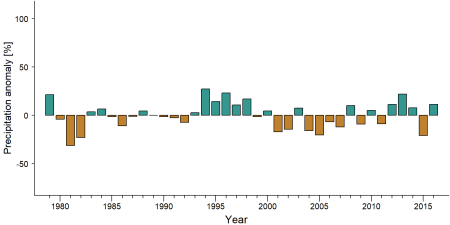
Precipitation anomaly in Mount Nimba Strict Nature Reserve (Côte d'Ivoire) -
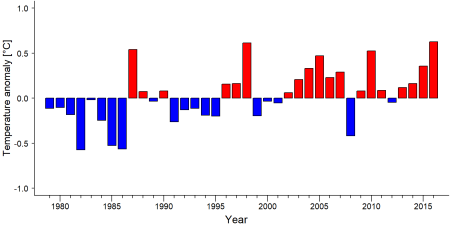
Temperature anomaly in Mount Nimba Strict Nature Reserve (Côte d'Ivoire)


External links
References
OIPR. (2016). Stratégie de mise en œuvre du suivi-écologique dans les Parcs nationaux et Réserves de Côte d’Ivoire. Office Ivoirien des Parcs et Réserves, Abidjan. 13 pp.
OIPR. (2021). État de conservation de la Réserve Naturelle Intégrale du Mont Nimba: Rapport de suivi écologique, phase I.
OIPR. (2023). Rapport de suivi écologique, phase 2, dans la Réserve Naturelle Intégrale du Mont Nimba.
UICN. (2008). Parcs et Réserves de Côte d’Ivoire: Évaluation de l’efficacité de la gestion des aires protégées. Gland, Switzerland. 43 pp.
UICN & UNESCO. (2019). Joint monitoring mission report: Mount Nimba Strict Nature Reserve (Côte d’Ivoire/Guinea). IUCN and UNESCO World Heritage Centre. https://whc.unesco.org/en/list/155/documents/
Kiribou, R., Tehoda, P., Chukwu, O., Bempah, G., Kühl, H. S., Ferreira, J., …, & Heinicke, S. (2024). Exposure of African ape sites to climate change impacts. PLOS Climate, 3(2), 1-19. doi:10.1371/journal.pclm.0000345
Page created by: Zausa Diorne Date: 2024-11-24 08:16:00